THE ROBERT ALTMAN FILES: POPEYE (1980)

As the seventies came to a close and a new day was dawning on Hollywood, filmmakers and studios began to shift their work and business models to better prepare for the type of film they needed to make. Sure, the point of any movie studio at any time in the history of motion pictures had always been to make a profit. But after watching truckloads of cash show up at their doorstep after the release of films such as Jaws and Star Wars, it was no longer enough to just turn a profit. Movies began to come together in board rooms and designed to be less as entertainment vehicles that would make money and more unstoppable machines that would print money. So this is why it made a certain amount of sense for Paramount Pictures and the Walt Disney Company to join forces for a slate of films that would be geared towards the entire family but would be just a smidge more sophisticated than what could be expected from a live-action “Disney movie” which, by the 1980’s, had a certain kind of downmarket reputation and wasn’t exactly raking in the cash.

This partnership produced exactly two movies, Robert Altman’s Popeye in 1980 and Matthew Robbins’s impressive Dragonslayer, released the following year. That it produced anything is a small miracle as Popeye, first on the slate, was an absolutely cursed production from top to bottom and any sane assessment of the film reveals that fact many times over. From on-set fighting to the cocaine bust of producer Robert Evans, the production of Popeye kind of had it all. It wasn’t quite a Heaven’s Gate but it was definitely the last thing director Robert Altman needed at that point in his career. After owning the first half of the 1970’s, Altman’s work was continually met with diminishing returns which culminated in HealtH, his previously completed picture, getting completely buried and unreleased by 20th Century Fox. He needed a hit in the worst way and Popeye was a tee-up for him.

But the fact of the matter was that there was no real certainty Popeye would be a hit. All that was there was a vague notion that the monster Broadway success of Annie meant that there was sure to be a motion picture adaptation and, therefore, something had to be crafted to catch that similar wave of upscale family fare. Paramount owned King Features and, therefore, the universe of the Popeye comic strip so why not hire Harry Nilsson, the genius but inveterate alcoholic pop star on the downslope, to write the tunes and Robert Altman, an independent, bullheaded filmmaker whose last huge hit had been a whole decade earlier, to direct? I mean, it looked good on paper to somebody and I can’t help but think that somebody was Robert Evans whose career, like Altman’s, was also in jeopardy after a string of poor decisions teetered his reputation for rescuing Paramount Pictures in the late sixties from impatient creditors who were ready to engage the studio in a complete fire sale.

Another thing not considered is that by 1980, there was a giant delta that separated audience’s understandings of the Popeye from his origins in the Thimble Theatre comic strip created by Elzie Crisler Segar in 1919. In that iteration, Popeye (introduced in 1929) was but a supporting player in the larger world of Sweethaven, a cockeyed seaport town crawling with strange, yet lovable denizens. After becoming the star of the strip, Max Fleischer’s studios popularized Popeye and the majority of the Thimble Theatre characters in a series of cartoon shorts which usually put Popeye and company in contemporary and urban settings. By the time Paramount’s Famous Studios began producing the cartoons, Popeye and Olive Oyl were fully suburbanized and Popeye would frequently appear in shorts in which he would be battling his nemesis Bluto over trivial things like front lawn maintenance and seats at a baseball game. When Altman and screenwriter Jules Feiffer took the story back to its roots, it looked a lot like a world unfamiliar to many of the people who had become accustomed to Popeye as the confident, spinach-swilling, language-murdering hero who always had Olive Oyl by his side and Bluto at his feet.

But, oh, Lordy Moses, did people bitch when Popeye hit the theaters. Save the Wolf Kroeger production design and the incredible sets constructed in a Maltese cove (that are still standing and function as a tourist attraction, by the way), there was virtually nothing in the film that didn’t prove distasteful to at least one person in some shape or form. It did decent business but, unfortunately, was made at a time when it wasn’t enough to do good business if the business wasn’t good enough. Because of this attitude, Popeye has since been remembered as a magnificent disaster and a flop of a film, neither of which are remotely true. It’s a wild film in Altman’s canon and looking at it from the highest peak of Mt. Objectivity reveals an absolute mess of a final product but it’s also not out of line to rule Popeye a film where the sum of the parts are definitely better than the whole. As if it were built as if it were a number of cartoon shorts strung into one whole movie, Popeye is a movie without much drive but with a whopping ton of energy which can be joyous and fun but, at 114 minutes, feels like a juggernaut that could even wear down the last, most energetic person on the Studio 54 dance floor.

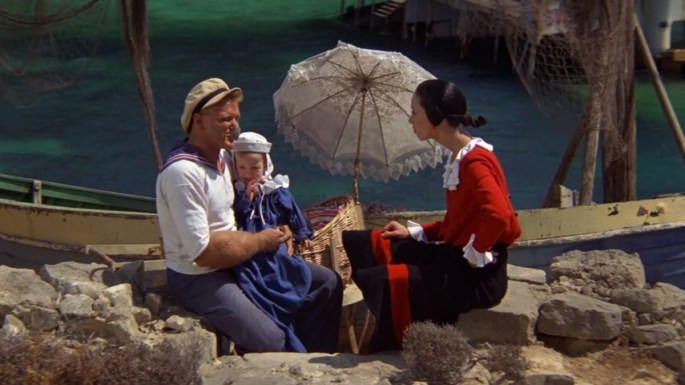
To the uninitiated, Popeye is about the titular character (Robin Williams in his film debut) arriving in the seaside town of Sweethaven in the search for his father, Poopdeck Pappy (Ray Walston). During his hunt, he becomes entangled with and falls for the dizzy Olive Oyl (Shelley Duvall in her final bow for Altman), takes charge of abandoned infant, Swee’ Pea (Wesley Ivan Hurt, Altman’s impossibly cute ham of a grandson), and runs afoul of Bluto (Paul Smith), the burly and hirsute heavy who begins the film as Olive’s betrothed.

Thematically, this is McCabe & Mrs. Miller territory (replete with a direct blink-and-you’ll-miss-it visual nod in the floating casino sequence as a zonked-out prostitute examines a ceramic pot as she reclines in her bunk); ultimately a story about how an iconoclast can enter a town and rearrange the structure. The problem with Popeye is that the story never allows the viewer to understand how anything in the town works in the first place. Some of it feels like a parody of shallow American nationalism but the town of Sweethaven is such a sketch, the details the audience has a right to know are either not there or buried. Taxes are being constantly collected but for what purpose and they’re routed where, exactly? The town has a Mayor but the Commodore holds more stroke why? The Commodore is a recluse that nobody has seen for what reason? Is this an isolated island burg in a post-Quintet future that’s surrounded by the melted ice and where the people are only just learning how to be a functioning society again? Because they sure act like it.

But, putting narrative and story aside (which we shouldn’t do but will anyway) is there another movie outside of Warren Beatty’s Dick Tracy that looks like it was Silly Putty’d right off a newspaper than Popeye? As a retrospective criticism, the film’s bloated budget would be a legitimate concern if every single dollar wasn’t up on the screen and everything didn’t look absolutely gorgeous. The beautiful widescreen compositions by cinematographer Giuseppe Rotunno capture the sideways-pitched structures against an immensely beautiful green sea where foregrounded primary colors absolutely pop off the screen. The costumes by Scott Bushnell, longtime Altman producer, are magnificently elaborate and detailed and everyone in the cast looks 100% perfect.

Altman’s on-screen choreography with his performers, always a staple in making his movies breathe, might just be at its highest level here as the frame is constantly swishing back and forth, always revealing some new information in the background. In fact, so busy is its canvass that, after forty years of watching the film, I have just recently spotted the caveman that randomly pops up in the far back of the background throughout the movie. Where most Altman films demand a second viewing due to the multi-tracked, overlapping dialogue, Popeye joins ranks with works such as Brewster McCloud and HealtH as needing multiple views due to everything that’s going on everywhere but the center of the screen. Just one instance of this is Robert Fortier’s Bill Barnacle. Sloshing around as the town drunk (ya know, the same character he played in McCabe & Mrs. Miller for those of you keeping score), it’s worth missing everything else that’s happening on the screen each time he appears as his physical performance is likely funnier and more interesting than what’s happening front and center.

And despite his giving up on the project to return to Flash Harry, his penultimate album before his untimely death in 1997, the Harry Nilsson tunes (and their wonderful Van Dyke Parks orchestrations) still soar. “Sweethaven,” “I Yam What I Yam,” “I’m Mean,” “Kids,” and, especially, “He Needs Me” all have a loopy charm and sly humor while “He’s Large,” a song dedicated to Bluto’s… ahem… girth, sung by Shelley Duvall and backed up by the Steinettes, the Greenwich Village doo-wop outfit who served as the Greek chorus in HealtH, is absolutely inappropriate for a family film but, on second thought, perhaps this film deserved such a shot of raunch if to only diffuse the treacle in “Sailin’” and “Swee’ Pea’s Lullabye,” two slabs of straight sentimentality that feel a bit out of place in a bizarre place such as this.

1980 wasn’t terribly kind to Popeye and time has done little to repair its image. Folks that loved it then, love it now. Folks that hated it then are always quick to point out they’ve never revisited it. Contemporary audiences don’t know quite what to make of it. Robert Altman didn’t end up in director’s jail but he would be cast out onto the stormy seas of the 1980’s with almost zero studio support, fully requested by the powers that be that he learn to fend for himself. In the end, Popeye turned out to become a fondly-remembered cocaine film for children and, regardless of the film’s box office returns, we probably needed more of them as the dawn of Reagan loomed large.

(C) Copyright 2021, Patrick Crain
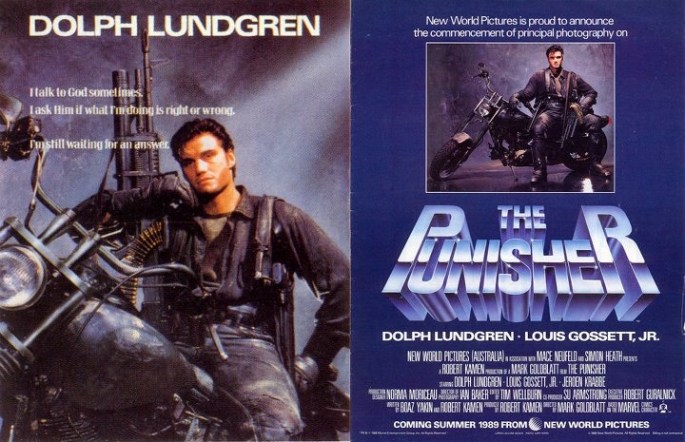
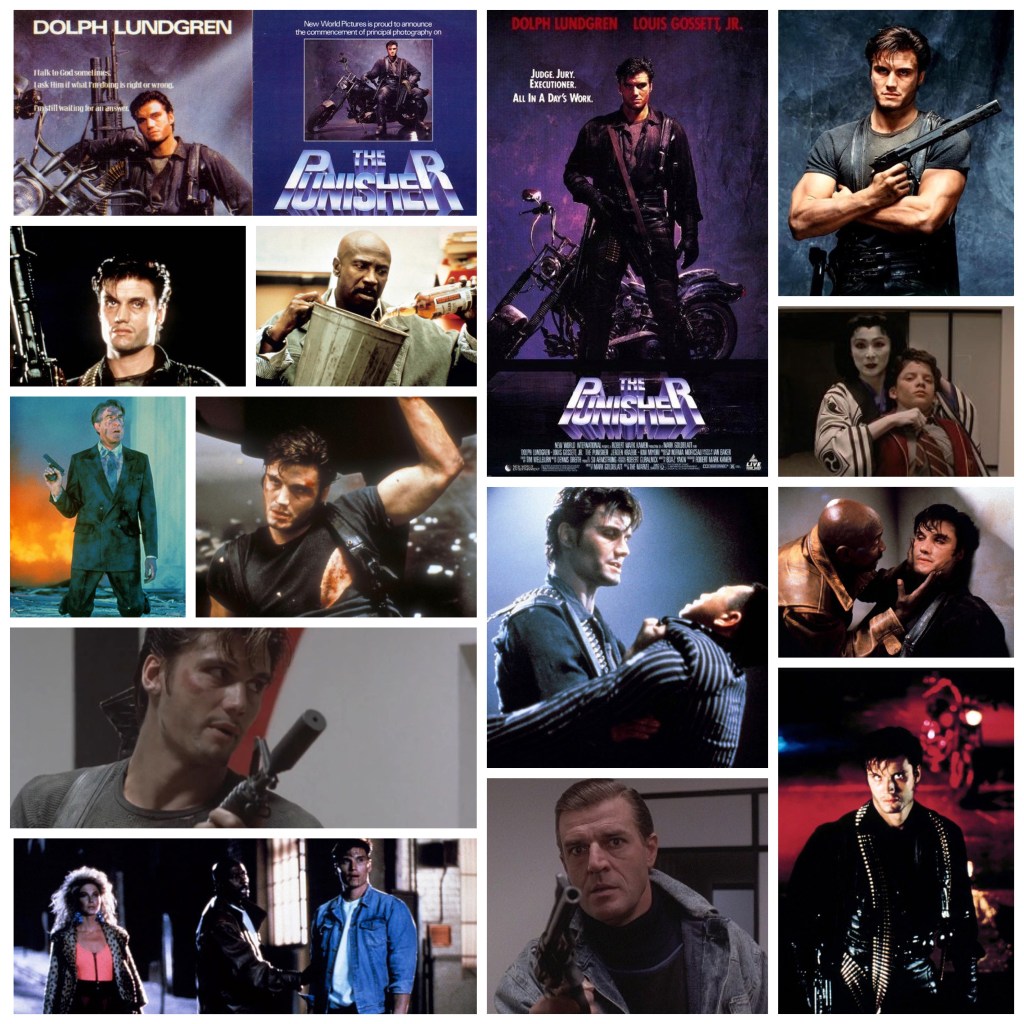
The Punisher (1989)

There was a long period of time where I didn’t even know there was a Punisher flick from the late 80’s starring Dolph Lundgren, and I blissfully lived under the assumption that the character never entered cinema until 2004 when Thomas Jane tried it on for size, and although that’s still my favourite take on Frank Castle to date, in terms of both performance and film overall, the Dolph one is a pretty badass slice of retro action pulp that I greatly enjoyed. It’s not an origin story and doesn’t have much use for exposition, time spent on tragic backstory (beyond a few haunting flashbacks) or dark rumination, it’s strictly a blast of violence, chases and genre thrills built around the visual aesthetic of the Punisher. He’s already been doing this for quite a while here, and Lundgren, strikingly brunette here, imbues Frank Castle with a sort of tired and unimpressed yet still viciously violent edge as he teams up with an equally sardonic cop (Louis Gossett Jr) to take on pretty much every criminal faction in the city including a tribe of psychotic matriarchal Yakuzas and one pissed off drug Baron (Jeroen Krabbe) who initially hired Frank to find his kidnapped son and then inevitably can’t be trusted not to be a backstabbing lunatic. There’s an absolute ton of exciting, well staged action set pieces here including an extended bus chase all over the city, endless thundering shootouts and Frank roaring around on a huge black motorbike that he uses to descend into the subterranean tunnels below the city in a decidedly Batman-esque flair. This version is stripped of much of the mythology behind The Punisher and is more just a straightforward, bloody, pulpy action extravaganza, and had the film not been called Punisher and Dolph not been credited as Frank Castle it would just be another day at the Lundgren races. However, they chose to make it a Punisher film and it’s better for that, Dolph fits the role like a glove, and although my only complaint is that he didn’t get to wear that classic skull logo on his chest that we know so well, he inhabits the gritty, browbeaten, heavy artillery sporting viciousness of Frank very well, whether he’s beating hordes of goons mercilessly or literally mowing down more of them with a fucking Gatling gun he found somewhere. It’s brutal, urban, feels just ‘comic book’ enough to fit the aesthetic and has a ballsy, very dark final stroke to the script in the last act that is a borderline taboo shocker but let’s you know this Punisher isn’t fucking around. Good stuff.

-Nate Hill

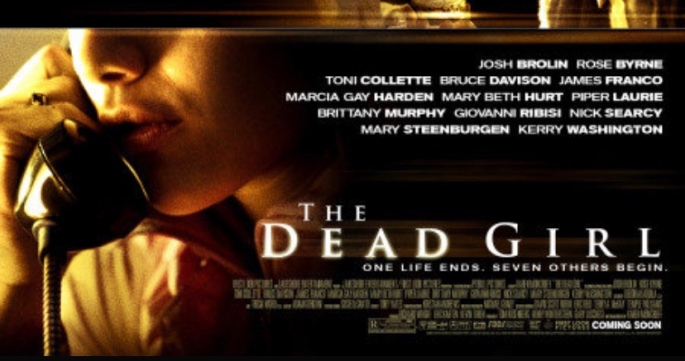
Karen Moncrieff’s The Dead Girl

Karen Moncrieff’s The Dead Girl is one of the bleakest, most depressing and soul dampening films I’ve seen recently, so much so that it seems to take a bit of you with it after the experience. It’s also quite an important film though, serving to illuminate and highlight the downward trajectories that human lives take after being abused and mistreated as children, and the ripple effect these lives have on others as the years pass on. It’s an ensemble film full of amazing talent that falls into the groove of vignette, and while each episodic chapter isn’t quite as immediate or powerful as others, the ones the work are something profound. In the opening segment a socially stunted woman (Toni Collette) finds the decomposing corpse of a teenage girl in the desert, and struggles to deal with her horribly abusive, bedridden gasbag of a mother (Piper Laurie in curdled Carrie mode), while going on a hopelessly awkward date with a weird grocery store clerk (Giovanni Ribisi). This chapter didn’t really resonate with me whatsoever beyond her finding the dead girl (the connective tissue between all of the episodes) so that’s all I’ll say about it. The second sees college med student Rose Byrne and her parents (Mary Steenburgen and Bruce Davison) dealing with the aftereffects of her sister going missing years before and the new knowledge that the dead girl in the desert could possibly be her. The next segment, starring Nick Searcy and an infuriating Mary Beth Hurt, is one best left not talked about because it’s spoiler territory, it’s well done but maddening. The last two are where the film really shines and finds its broken beating heart, as the mother (Marcia Gay Harden, brilliant) of the dead girl visits the ramshackle motel she was living in with another prostitute (Kerry Washington) who knew her well. Both actresses give a master class in pain, anguish and the brittle regret of lives gone wrong and paths taken from which there is no return, they’re two characters from very different walks of life who find solace as they mourn the daughter, sister and companion they once had. Kerry Washington in particular is so heartbreaking, so absolutely present in her flawlessly pitched performance of outwardly guarded toughness barely hiding the wounded, abandoned soul frying out for help beneath and her work here knocked me just flat. Finally in the last sequence we meet the dead girl in question, played hauntingly and painfully by the late Brittany Murphy in one of her blessedly candid, frenzied performances that shirks mannerisms for uncanny realism and emotion that comes across not as orchestrated by an actress onscreen but organically bubbles and wells up from a living, breathing human being, she was that good. Others make fleeting appearances to round out the ensemble including James Franco, Chris Allen Nelson and a degenerate, crack piping Josh Brolin. The film doesn’t let anyone off the hook, doesn’t hand out happy endings to the ensemble like goody bags and hasn’t a care in the world for conventional catharsis, neatly resolved narratives or crowd pleasing, it’s a film whose outcomes and arcs will leave you cold, hurt, confused, angry and completely disillusioned in humanity overall. So why watch it? Well, aside from being a beautifully acted, directed, scored and edited film it’s important as a mosaic narrative, especially in the final two chapters, because we see how the actions, abuse and effects of one life can scintillate out into others, and how this dead girl, an abuse and trauma victim from a broken home, despite being in a life situation some may regard as utterly hopeless she is still desperately clinging onto one glimmer of light in her life, a plot thread I won’t spoil but one that she so fervently keeps in her mind and thoughts that even after a life of tragedy ends in unconscionable untimely death, her intentions, pure heart and undimmed desire to be there for someone ripple out after she has passed away and affect those she left behind, in the film’s only life affirming aspect. I think that’s incredibly important to observe, and while the film’s first three chapters are important parts of this tapestry, it’s the final two that radiate forth as the most integral, and the showcase acting work from Murphy and Washington that is so good and so essential I felt like life was unfolding for real. Brilliant film.

-Nate Hill

Damian McCarthy’s Caveat

Trust Ireland to give us what for me now stands as the scariest film I’ve seen since Ari Aster’s Hereditary. I realize that is the boldest of claims and before anyone chimes in with the obligatory “welL HEridiTARy didntT scAre me And wasNT evEn thAT GOoD”, just keep in mind there are many of us who were scared piss-less by it and keep your edginess to yourself. Damian McCarthy’s Caveat is a brand new addition from Shudder, an Irish mood piece with some unique ideas, atmosphere so thick you could choke on it and some of the most skin crawling, sleep with the lights on moments of sheer terror I’ve seen in many a moon. I didn’t say it was a perfect film and the plot, such as it is, is kind of a murky one in areas but best I could surmise it is: a shady English dude (Ben Caplan) hires an also somewhat shady Irish dude (Jonathan French) with amnesia to babysit his adult niece on an isolated island cabin. The girl has some form of schizophrenia of schizo-affective disorder and is out of it most of the time, but one of the conditions of this well paid for agreement is that Irish dude must wear a leather harness attached to a chain that prevents him from entering certain areas of the house, to make the disturbed girl feel safer… I guess? It’s a premise with so many loaded questions attached that you just kind of have to surrender to the atmosphere and experience, and it’s here that the film not only shines but unearths something almost profoundly spooky. There are ghosts in the film, and they are so scary you’ll wish I’d never recommended this to you. You know that special feeling after you’ve watched a film that genuinely, tangibly provoked real fear in you and you have immediate, dread soaked regret that you ever watched it? Yeah I got that from this one, which is rare for me these days and it may not hit for everyone like that but for me it was effective in that elemental, hair raising way. There is an actual plot to the film and although I wasn’t entirely clear on all the ins, outs and beats it did feel like it was trying to impart a discernible narrative while still being a decidedly arthouse mood-board experience. There’s also a creepy little toy rabbit, as you can see by the poster, and he serves as both a mascot of sorts and also a proverbial ‘canary in the coal mine’ device, as he seems to beat his little drums with relative sentience whenever it feels like malevolent forces are near. The eerie score, suffocating abandoned house atmosphere and deliberately spatial camera movements all place you right in the front seat of terror and apprehension as you wander the mildewed halls and decrepit rooms of this broken down house and encounter things you really could have done without seeing at 2am when you’re alone in your own house and the cat is making noise somewhere. It’s a staggeringly well made film for a first time director and I can’t wait to see what he does next. Terrifying, immersive, hypnotically unsettling, a fully realized horror experience that will fuel the darkest of nightmares. Streaming now on Shudder.

-Nate Hill

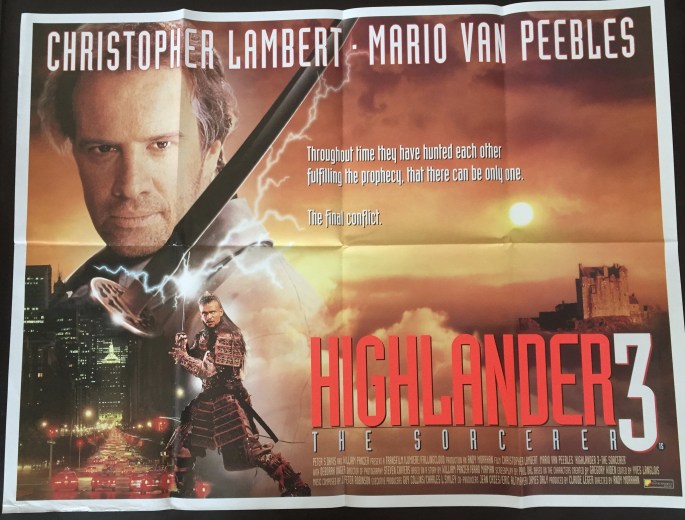
Highlander III: The Sorcerer

After the absolute trip to WTF-ville that was Highlander 2 I kind of felt the franchise had scraped rock bottom and I didn’t think anything could ever be as bad as that. I’m happy to report that Highlander 3: The Sorcerer is not only an improvement (obviously) but an incredible sequel that captures the magic of what made the first such a special film for me and, in my eyes, is on par with it. I know the second film has this big huge production history and that’s why it’s so weird, bad and off topic from the mythology, but for this one they have stripped away all that bullshit and distilled the story back down into what made the first Highlander so great. Christopher Lambert’s immortal Connor McLeod tells us of a new chapter in his ongoing life, wherein a Japanese mystic (Mako) trains him further in the ways of battle so that he can fight another remaining member of his race of beings, the evil Hun-like Kane (Mario Van Peebles). Their battle begins in 500ad or so and rages across time until Connor finds himself in 1990’s New Jersey where Kane follows him. Connor falls for a beautiful archeologist (the lovely Deborah Kara Unger) who is the reincarnation of a girl he knew during the French Revolution and circles a final battle with Kane which, naturally, is staged inside one of those classic ‘smoke and flame’ sheet metal factories that are utilized for showdowns in everything from T2 to Batman 89 and Roger Ebert loved to make fun of so much but try and tell me that in New Jersey there isn’t a large chance that a final fight would realistically end up in one of those buildings, I mean the place is only made of them. Mario Van Peebles is great as Kane, ditching his usual persona for a growling, leering, barbarian type of performance that pays dues to Clancy Brown’s Kurgan without outright aping him. He’s got magic illusion powers, snazzy tattoos, great taste in metal music and is so culturally hopeless in the 90’s that when a hooker gives him a condom he puts it in his mouth in puzzlement, immediately spits it out in distaste and just proceeds to raw-dog her. I’ve talked this film up and you gotta realize that it’s a ramshackle threequel to a cheesy 80’s cult classic that does its best to clean up after a totally irresponsible, ridiculously off the wall sequel and while I was sometimes utterly confused about the timelines or how this chronologically connects to the first, I though it did a pretty damn good job of salvaging tone, style and aesthetics and steering this canon in a serviceable direction. Lambert and Unger are adorable together and have not only a smouldering sex scene that might be among the hottest the 90’s has to offer but actual romantic chemistry to back it up. There is the obligatory helicopter shot of Lambert running and training amidst the gorgeous Scottish scenery that somehow manages to be silly as hell and deeply rousing in the same stroke, here set to a gorgeous Celtic song called Bonny Portmore by Loreena McKennitt. The finale battle between Connor and Kane is like a thunderous fireworks show of lovingly creaky 90’s FX and music that reaches a biblical crescendo and serves to reinforce that even when a franchise has seemingly reached its doldrums, a crowd pleaser like this can come along and shake out the cobwebs. If you go into it cynical over the fact that it’s a Highlander sequel and keep your nose upturned on principle, well you’re only robbing yourself of a fun time, because to me this had everything I wanted from one of these flicks and was a hell of a lot of fun, capped off by a genuinely sweet ending that gives you the option to stop here and have this as the final note of Connor’s story, or continue on in the series for more adventures.

-Nate Hill

THE MICHAEL MANN FILES: MANHUNTER (1986)

Once waist-deep in the world of Miami Vice, executive producer Michael Mann became obsessed with the dichotomy between both the law and lawlessness and good and evil. In that series, these themes were explored through the lens of the undercover cop who has to blend both the personal and professional into one, often creating moral quandaries and existential crises of the soul. In Thomas Harris’s novel Red Dragon, Mann found perhaps the starkest example of these themes as it blended the law enforcement official with a serial killer. Moving beyond dope peddlers and cat burglars, this was a story that would really put the protagonist through the paces.

Due to the financial drubbing felt by producer Dino De Laurentiis’s Year of the Dragon, released in 1985, Red Dragon was retitled Manhunter to avoid the same fate. It didn’t much work as Manhunter, a title that almost nobody on the planet liked, barely made a blip at the box office, grossing less than nine million dollars and having to settle on slowly finding a cult audience on HBO and home video. By the time Jonathan Demme’s adaptation of Harris’s The Silence of the Lambs was released to almost universal acclaim in 1991, Manhunter and its pioneering cinematic representation of serial killer Hannibal Lecter (spelled Lecktor in Mann’s film) had been mostly forgotten, leaving cinephiles who dared to articulate a preference for Mann’s highly stylized thriller over Demme’s film castigated and hectored as snobbish contrarians. But legion was and is the gang of folks who find Manhunter’s moody, yet cool and uncluttered visual palate and detail-oriented procedural a more sensory intoxicating cocktail than Demme’s admittedly brilliant hair-raiser.

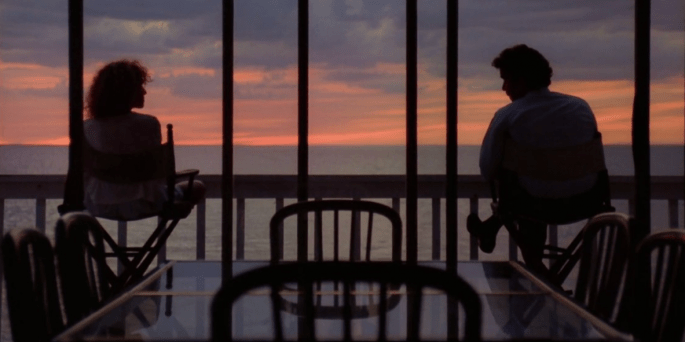
In terms of a broad plot outline, the differences between Manhunter and Lambs are negligible; FBI Agent Jack Crawford recruits a brilliant investigator to track down a serial killer which causes the investigator to enlist the help of incarcerated serial killer Hannibal Lecter to assist in stopping him before he kills again! The major difference between Manhunter and The Silence of the Lambs is in its protagonist. I can’t imagine greenhorn cadet Clarice Starling being as compelling a figure in the world of Michael Mann as haunted FBI profiler Will Graham (William Petersen), the man who earned a Pyrrhic victory by capturing brilliant serial killer Dr. Hannibal Lecktor (Brian Cox) but only after absorbing a punishing amount of psychological damage in the process. With this character, Mann gets to have it both ways as Graham continually walks a fine line not just between cop and criminal but literally between saint and monster. As is the case with Clarice Starling’s monologue about the doomed livestock in Lambs, Manhunter underlines Graham’s humanity with a turtle hatchery he’s constructing at the beginning of the film with his son, Kevin (David Seaman). Will Graham is doing his best to save what he can from the awful, predatory forces of nature. Meanwhile, Jack Crawford (a terrific Dennis Farina) and Molly Graham (an even more terrific Kim Greist) sit on the balcony of the Graham’s beachfront home where she grouses to him about the dangers of bringing the retired and broken Graham into the investigation, all the while being framed against one of Mann’s painterly vistas that drive home the perpetual theme of emotional distance that affects almost all of his characters like a virus. Unlike Lambs, however, the investigative prowess of the protagonist is, in fact, part of his actual deviancy as telegraphed early in the film as Graham’s investigation of a crime scene utilizes the same point of view footage from the pre-credit sequence which chronicles the home invasion by the horrifying Francis Dollarhyde (dubbed “The Tooth Fairy”; Tom Noonan, giving the performance of his career) as he prepares to slaughter the family inside.

As the embodiment of the mythic Mann hero who is conflicted the second he breathes air outside the womb, William Petersen gives a performance that has the unfortunate distinction of being one of the first of its kind. Coming off of a highly energetic turn in William Friedkin’s To Live and Die in L.A. the previous year, Petersen commits to a performance where he makes a series of choices that have been criticized over the years as being flat or unconvincing. It’s a performance that is not exactly either one of those things but it is unconventional and has to be viewed from a very specific angle to be fully admired. Sometimes his emotive bursts are a few degrees too hot for the scenes in which they occur but there are a number of very tricky and difficult things Petersen successfully pulls off that are more important to the character as a whole than a couple of awkward line readings. There is a severe fragility eating at the center of Petersen’s Graham that occurs in scenes with his family where he chillingly employs a mid-distance stare and a lukewarm delivery that never seems like it’s coming from a real person. But, holy god, watch him in an early scene in the hotel room where he dutifully checks in with his sleeping wife on the phone only to have his eyes light up like a Christmas tree when he hangs up and moves over to the portable TV and VCR unit where he can indulge himself in watching the victims’ home movies in order to recapture the mindset of a murderer. Looking like a seventeen year old who is now watching his parents’ porn after assessing that the coast is clear, Will Graham fits in with the many Mann protagonists who treat their lovers and significant others as mothers from whom they need permission to go outside and play and only come alive when totally plugged into their work.

Unlike any other of Mann’s works, sex is treated less as a pleasurable action between two adults but as a brief respite from ongoing pain in the lives of its principal characters. Graham’s character spends his last night with wife at their home making love with her but he’s already on another track that will lead to rack and ruin; something she knows, recognizes, but is also cognizant to the fact that she is powerless to stop it. Dollarhyde, by comparison, eventually makes a genuine physical connection with a blind co-worker (a fabulous Joan Allen) but instead of bringing him any peace, their night together only brings more pathology. And in further tying the two together, the film’s structure is very purposeful as, right around the film’s halfway mark, Manhunter becomes less about Graham and more about Dollarhyde. This specific kind of duality is further driven home by visually framing Lecktor and Graham in such a way that both characters are functionally looking at themselves in a mirror, predating Detective Vincent Hannah’s coffee date with Neil McCauley in Heat by a number of years.

Manhunter was also Mann’s one theatrical film that looks MOST like a traditional Mann production of the time. Thief might be the masterpiece that subtly influenced short-subject filmmaking but Manhunter was the most modernist Mann film. Dante Spinotti’s cinematography is bold and the compositions strong with the exact same kind of anti-earth tone mission that was employed in the first couple seasons of Miami Vice. Additionally, thanks to the production design by Mel Bourne and art direction by Jack Blackman, almost nobody lives in a house that looks like it was built by a sane architect nor decorated by a legitimately bonded interior designer. Mixing the post-modern structures of Miami Vice and the geometrical furnishings and tchotchke from Crime Story, Mann creates a world that is both of its time and retrograde; where glass block is as prevalent as brick and almost every FBI office is spotless and looks like its been cleaned by someone on a coke binge.

Though current home video releases of Thief have been graced with an additional scene not seen in its theatrical release, Manhunter was Mann’s first film to go back to the editing room on multiple occasions and there are no less than three different cuts of it floating around out there and one might say that Mann has used home video as an excuse to tinker with 90% of his work. While Mann gets it right the first time on the majority of his films, a case could be made for the director’s cut of Manhunter (available on Scream Factory’s Blu ray which also includes the theatrical cut). While we lose the elevator shot in Graham’s hotel which feels like taking a knife to my mother’s throat, and the running of the opening credits over the initial Crawford/Graham conversation makes it feel like you’re about to watch a television movie, the director’s cut leans more heavily on the concern for Graham’s mental well-being and also makes the focus on the family much starker. If one thinks of the film’s happy ending as a detriment (as I do), it’s a crying shame that Mann didn’t shoot something a little more dour and closer to his heart as an alternate, even if the odds of getting it past the producers was likely going to be a no-go. For the penultimate scene in the director’s cut would work even more beautifully if, instead of an awkward reunification of the Graham family as is the case no matter what cut you go with, Will was left with nothing but his memories and an empty beach. Graham’s unnecessary and creepy presence at the home of what would have been Dollarhyde’s next victims would hint at a happy ending but, really, Graham could have only really gotten to know their identities if he were as disturbed and calculating as Francis Dollarhyde, casting the film’s finale as something that more closely resembled William Friedkin’s Cruising.

But even if it wasn’t a capitulation to the studio, Mann’s disallowance of Graham to be alone on the beach at the end, especially with the terrible Red 7 “Heartbeat” song draped over it, feels like a false note. In the true universe of Michael Mann, Graham would wander in the white sands amid a bunch of turtles he’d saved but only at the expense of losing everything and everyone else in his life, including himself. And, like Graham, Mann had found a way to get the darkest examination of his obsessions onto the big screen but with no small amount of budgetary difficulty and with little to show for it in return.

With Manhunter behind him, Mann would slink back into the world of television where he would hone and woodshop new visual and thematic ideas in episodes of Crime Story and, portentously, 1989’s made-for-TV L.A. Takedown. Despite his enormous contribution to popular culture, the first phase of Mann’s career was ending on an inauspicious note; a big filmmaker retreating back into a small medium where he was likely to get trapped for the remainder of his career. But the 1990’s were on the horizon and a sea change was forming. Michael Mann was about to get his day.

(C) Copyright 2021, Patrick Crain

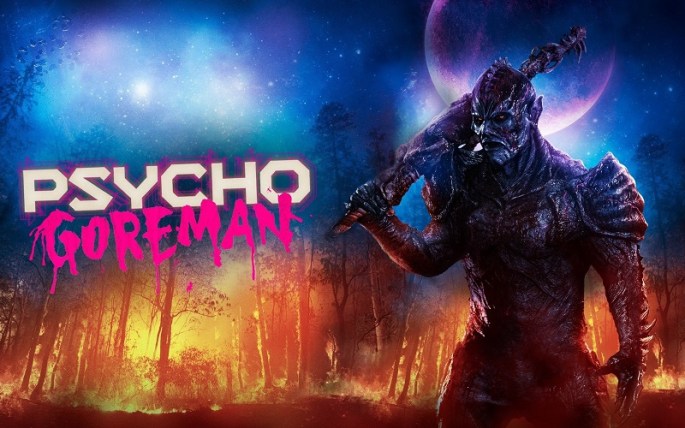
Steven Kostanski’s Psycho Goreman

Psycho Goreman is a hell of a title for a film and anyone one that dares use must ensure their art lives up to it, and this one sure as hell does. It’s one of those deft, near miraculous efforts that dances an impossible yet flawless ballet between genres of horror, SciFi and comedy and almost fuses them all together for something entirely new. The titular Psycho Goreman is a hulking alien warlord with a penchant for violence, torture and all sorts of melodramatic menace, who arrives on earth only to be outwitted by a incredibly feisty ten year old girl (Nita Josee-Hanna) who snags the magic gemstone that controls him and now calls the shots. There is an entire galactic Narmada of silly funny weird creatures who are trying to track and destroy him though and they eventually follow him to earth for all out warfare. The terrific thing about this film is how deftly it balanced extremely graphic, hard-R gore with a genuine childlike sensibility and the kind of dark, deadpan humour that is so funny and so pointed that I just can’t even describe it in a review, you have to see the thing to get it. It’s sweet yet still has a jaggedly nihilistic tonal edge, hilarious yet feels truly gnarly and almost… ‘Troma’ in its levels of schlock and splatter and just the perfect mix of everything fun. Director Steven Kostanski also made the brilliant 2017 cosmic horror The Void, which is in my top ever made in the genre and I always wondered what he’d follow it up with. A true winner that blazes new trails and shows his devotion, invocation and passion for practical effects based horror. The costumes, makeup and gore effects are pure bliss here, with every extraterrestrial creature owning their own distinct, hilarious and lovingly campy anatomical design, the gore is unapologetically ruthless, bathed in buckets of blood n’ body parts and the the script laced with indescribably hysterical wit, comedic inspiration and overall horror nirvana. Wonderful film.

-Nate Hill

THE RUSS MEYER FILES: EVE AND THE HANDYMAN (1960)

Russ Meyer had to take incremental steps to get to become the storied and respected filmmaker that he eventually did. His first step was being a gifted photographer who was as adept at his skill as mortars and debris rained down around him in the heat of battle as he was while studying the contours of his models’ bodies as they were lying at the base of an oak tree while bathed in dappled sunlight. His second step was punching through the wall of morality and releasing The Immoral Mr. Teas, his groundbreaking film that introduced actual nudity in a motion picture to those who would pay for the privilege to see it.

I would bet that Meyer’s most important step in the evolution of his success was hooking up with and marrying the former Eve Turner in 1952. No doubt that Meyer had talent to burn and that his personality caused him to be a little shrewd but Eve took his game to a whole other level. At once both his business partner and muse, Eve Meyer pumped life into his output in which she was the subject by being both impossibly built and having a uniquely strong relationship with the camera. In terms of what they did for each other and each other’s work, you’d probably have to look to Jess Franco and Lina Romay for something comparable.

So it’s something of a shame that, as far as his motion pictures went, Eve Meyer was only ever in front of the camera in Eve and the Handyman, Russ’s follow-up to the previous year’s Teas. But her presence in it is both sly and smart; Eve Meyer is the primary woman on display in this film and it ends up being ten times as effective as Teas without having to resort to any nudity on her behalf.

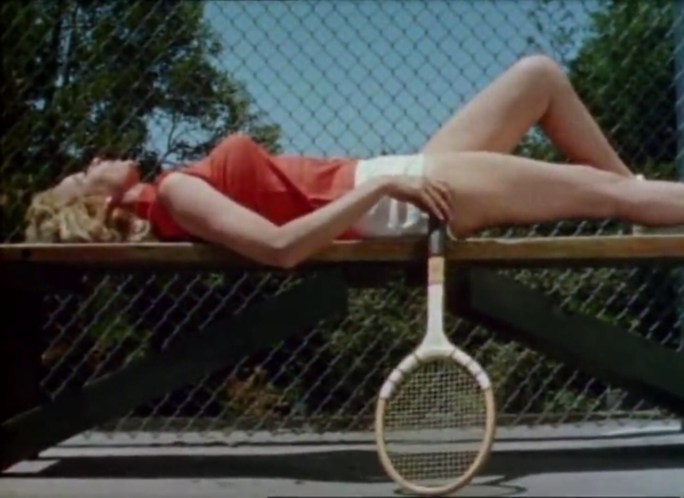
Like Teas before it, Eve and the Handyman is little more than a sketch-pad for Meyer’s visual ideas and micro-budgeted creativity. A jack-of-all-trades handyman (Anthony-James Ryan) is stalked by a mysterious, trench-coated blonde whose constant, double entendre-stacked voice-over narration positions the film as a bawdy, Dragnet-style procedural in which every move of the handyman is noted and remarked upon by his voyeuristic pursuer. Gone is the gimmick in which naked girls pop up to awkwardly pose in the daydreams and hallucinations of our protagonist only to be replaced by our bumbling hero staying 100% focused on his day-to-day tasks, never to be distracted by the many buxom women he encounters along the way (mostly all played by Eve Meyer in various get-ups).

Where Teas reflected women contented to be placed like statues and given little to do, Eve wants women to be the driver of the engine. Teas wants to be a moving centerfold and Eve wants to be the whole damn magazine. The jokes are livelier, the mood is more jovial, and, more importantly, Eve Meyer flips the script by giving the audience an instance in which the woman is on top and the man is the dope. Sexually oblivious, Bill Ryan’s Handyman gets saddled with Eve Meyer almost exclusively because her mission is to, ostensibly, wise him up. So she becomes every woman in his path while remaining the detective that wants to sell him toilet supplies in the end.

Eve Meyer’s presence in this film couldn’t help but inform Meyer as to what exactly he wanted in the future. For Eve Meyer is the first “Russ Meyer Woman.” Eve Meyer showed Russ Meyer how to present a woman who looked like she wanted to be wanted. More importantly, she wanted the audience to know she knew they knew that she wanted to be wanted. Untangle all that and you’re are the heart of what makes Russ Meyer’s films stand so far apart from other films of their ilk that the massive delta between them renders it unfair to mention them in the same breath. Show me a Russ Meyer film that’s blessed with a narrative structure and I’lll show you a heroine that sprung forth from Eve Meyer’s roots which are so firmly planted in this film.

Once past the nudie cuties, the cinema of Russ Meyer is as equally hilarious and exhilarating as it is titillating. And even if the nudie cuties are tame pieces of antiquity, they aren’t bereft of a good laugh or two. The jokes in Eve take a while to unfold and your mileage with them may vary; they might or might not be worth it, depending on your perspective. But this film is the first to have this specific blend of broad, sight-gag humor and sex which was mostly missing from Teas, a film that feels like it can barely breathe lest it get caught doing what it wants to be doing. Additionally, in employing a panoply of visual ideas representative of intercourse and orgasm (the constant churning of oil wells, the coupling of trains, etc.), Meyer gives the thrust of the train into the tunnel at the end of Hitchcock’s North By Northwest, itself released a scant one year earlier, nowhere to hide.

As stated before (and likely will be stated at least one more time in this series), there’s just not a lot of there there in the subgenre of the nudie cuties. They are what they are and the trick is to try and enjoy them with a sense of historical context because there just aren’t many of them that are going to stop the conversation at a dinner party and become the thing everyone will have to have seen before the next get-together. Depending on the director and the talent involved, they mostly all run the gamut between unwatchable and pleasant enough. With Eve and the Handyman, Russ and Eve Meyer joined forces to give the audience something a little more more memorable; electric burlesque compliments of Eve’s stong, palpable sexuality reminiscent of one of Howard Hawks’s joyously randy heroines and Myer’s clean compositions, edited together like a breathless Gatling gun shooting off eye candy.

“The biggest catch in life, my friends, is a happy ending,” so says our heroine in the final line of the film. As much as that phrase meant something even in the creaky days of 1960, the film earns its right to use it as Eve and the Handyman, while not the best or bawdiest of Russ Meyer’s output, is truly his first effective mix of the sex and the sublime.

(C) Copyright 2021, Patrick Crain

THE ROBERT ALTMAN FILES: HealtH (1980)

When you begin to consider the high-level talent that went into the formula that produced Robert Altman’s HealtH, it’s difficult to recall another movie in film history that was, and continues to be, treated as poorly. Coming directly after Altman’s twin failures of 1979, Quintet and A Perfect Couple, its production was relatively quick and on-the-fly; an attempt to get one in the can while things at 20th Century Fox were still being run by Alan Ladd, Jr., a staunch Altman proponent who once gave the maverick filmmaker a million and a half dollars to make 3 Women, a movie that came to Altman in a dream and had no real cohesive story.

Sure enough, things did change and Ladd left for form the well-intentioned but doomed Ladd Company. HealtH, which had an initial scheduled release date in late 1979, began to get slowly pushed back on the schedule. Early 1980 came and went and a series of test runs arranged by the new management proved to be less than promising. The master plan of having it released before the 1980 presidential election never materialized. It’s safe to assume that when Altman began shooting the lavishly budgeted, dual-studio event picture Popeye in 1980, he couldn’t dream that he would get it shot, edited, and in theaters before HealtH.

But Popeye was released in time for Christmas in 1980 and HealtH was eventually pushed off of the Fox release schedule entirely (its final replacement on the Fox release schedule being Oh, Heavenly Dog!, a movie starring Chevy Chase and Benji). It did manage to play a limited engagement at Film Forum in 1982 but, aside from its occasional, stealthy appearance on various television movie channels, HealtH has never seen a release on home video. Every once in a while, a widescreen rip from one of those movie channel broadcasts makes its way onto YouTube, but it’s difficult to know if it’s been edited for time or whether the somewhat squeezed visual presentation is a representation of the film’s true aspect ratio.

Given its obscurity, the perceived notion is that HealtH must be some kind of otherworldly dog of a film; a real hubristic bonanza crafted amidst a barrage of likeminded projects by Altman. But the truth of the matter is that HealtH is a surprisingly strong and wicked look at the ridiculousness of the American political system as filtered through the world of the then-bourgeoning consumer health industry. A fine addition to the busier, wide-canvas ensemble pieces Altman could engineer with remarkable skill and dexterity, HealtH performs double duty as a sly comedy and a prescient warning of the toxic injection of empty personality and media-driven messaging into our electoral process. And having rewatched it in 2021 to rejigger this piece (originally written in early 2016), HealtH comes off as an even stronger film today given the twisted road down which we’ve travelled as a country.

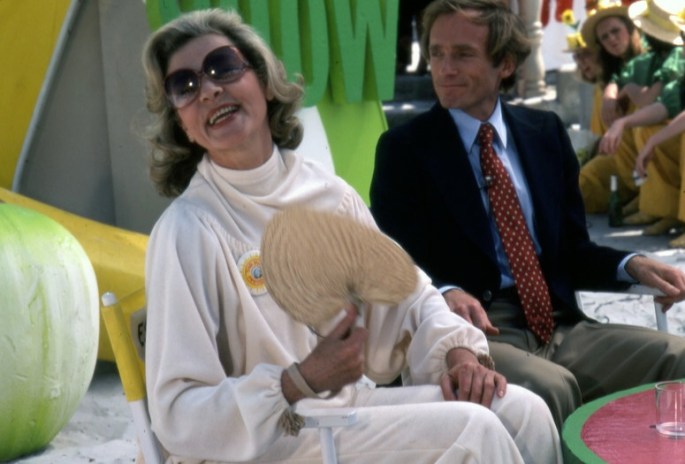
HealtH is, on the surface, about two days at a health convention in which two candidates are running for the title of “President of HealtH.” Present at this convention are product pitchmen, authors, political functionaries & fixers, glad-handing bureaucrats, dirty tricksters, aides, liaisons, and PR staff all centering around the two presidential hopefuls. In one corner, Esther Brill (Lauren Bacall), 83 year-old virgin whose ubiquitous campaign slogan “Feel Yourself,” is delivered with an astounding cluelessness as Brill believes that each orgasm shaves 28 days off of your life. Her staff is made up of PR guru Harry Wolff (James Garner), oversexed campaign manager, Dr. Ruth Ann Jackie (Ann Ryerson) Brill’s undersexed personal physician who secretly lusts after Wolff, and a gaggle of nurses who are constantly drinking behind Brill’s back. In the other corner is Isabella Garnell (Glenda Jackson) a pragmatic-yet-cold idealist whose speeches all seem swiped from Adlai Stevenson. Her entourage consists solely of Willow Wertz (Diane Stilwell), a sweet-natured aide whose ongoing sexual frustration is rooted in her inability to feel anything sexual for anything whatsoever. And between the two candidates are Gloria Burbank (Carol Burnett), a representative from the White House and Wolff’s ex-wife; Dr. Gil Gainey (Paul Dooley), an independent candidate for president and shill for something called “Vita-Sea;” Colonel Cody (Donald Moffat), a bellowing political string-puller; Bobby Hammer (Henry Gibson), a slimy, Roger Stone-adjacent political operative sent to disrupt the Garnell campaign; Sally Benbow (Alfre Woodard), the convention hotel’s PR director; and, finally, Dick Cavett, as himself, who is there to cover the event for his talk show. Oh, yeah, and the Steinettes, an a capella outfit that acts as a ridiculous (but appropriate) greek chorus to HealtH’s very odd portrait of 1979 America.

In the film, we’re told that HealtH (which stands for “Happiness, Energy and Longevity through Health”) is an organization more than three times the size of the NRA and whose members can be similarly motivated to vote one way or the other. So the film certainly exists in an America that could also produce the cockeyed presidential campaign of Nashville’s Hal Phillip Walker. But Walker didn’t much have a real-life counterpart in 1975. The populist politics of Nashville reflected a hopelessness that washed through the post-Watergate, pre-Carter country like a rotten fever. The politics of HealtH were much more immediate. While sending up the then-current political climate, the film seems to anticipate the cultural shift that occurred in the presidential election in 1980. Even if the other candidates in the film could be composites of many other political figures, Esther Brill is a certain representation of the perceived image of Ronald Reagan, a man who counted on a network of advisors and aides to keep him informed and aware and who was about to enter the presidential race with a boatload of sunny optimism and slogans aplenty.

While HealtH isn’t perfect due to its unfocused and rushed production and its occasional tendency to get lost in the sauce of its own mix of satire and reality (you never really feel like you should be investing in it as you really should), it’s Altman’s strongest film since 3 Women. The script, by Altman regular Frank Barhydt, actor Dooley, and Altman does an amazing job keeping the film equally steeped in reality (through the characters of Woodard and Garner), television (Cavett and, eventually, Dinah Shore), and fantasy (basically everything else). The performances, too, are all top-notch. Burnett, Bacall, and Jackson are all terrific but the film is absolutely stolen at every turn by Woodard whose polite facade hilariously begins to give way to disdain as the convention rolls along. Among the men, Garner turns in a reliably easy-going performance, Paul Dooley is as energetic as I’ve ever seen him, and Dick Cavett, remarkably comfortable in a sizable role, has a great deal of fun.

As history marches on, HealtH’s chances of being anything other than a completely forgotten and mostly unseen film become slimmer and slimmer. Fox’s catalog is now owned by Disney, Altman passed away in 2006, and, aside from his centennial that will occur in 2025, there simply seems to be few occasions that could plausibly act as a catalyst for its release. This is a genuine shame because while sometimes chuckling and sometimes wincing while watching it in the midst of our own current absurd political climate that certainly seems like it could play out in an Altman film, it’s almost guaranteed that HealtH could still find an audience today. Sadly, it will probably never have the chance.

(C) Copyright 2021, Patrick Crain

Lorcan Finnegan’s Vivarium

Lorcan Finnegan’s Vivarium is one of those films that takes one simple premise and attempts to wring just about as much mileage out of it as one feature length story possibly could and it’s… *mostly* a successful endeavour. As it opens a young lower middle class couple (Imogen Poots and Jesse Eisenberg) are house hunting for something in their price range. She’s an elementary school teacher and he’s a landscaper, relatable choices I admired from the writer, as you don’t normally see this down to earth demographic in the protagonist arena. They browse into a development office for a project called ‘Yonder’, that seems to have units affordable to them, the estate agent (Jonathan Aris) bizarrely informs them, he’s one of those eerily, painfully cheerful characters that you just want to boot in the jaw and trusting him is definitely their first, and gravest mistake. They go with him to Yonder which is basically the kind of horrifying, cookie cutter, piss green pastel suburbia that even Dr. Seuss would shudder at, and before they know it they’re stuck there, for good. It seems to be a kind of labyrinthine ‘living algorithm’ that traps them, and even when they try to drive away they consistently just end up at the house this guy was showing them, and he’s never seen again. What is this place? Can they ever get out? Who is the absolutely nightmare fuelling Little Rascal reject (Senan Jennings, dubbed over with someone else’s impossibly scary voice who isn’t listed anywhere and I’d like to keep it that way) who one day shows up and demands to be fed, cared for and raised as if he were their own kid? I’ll let you come to those answers on your own because it’s quite a fuckin ride. Imogen and Jesse give fantastic performances, stripped of their usual comedic flourishes and trademark mannerisms for two portrayals that are dark, desperate, down to earth, strikingly emotional and show none of their usual personas. The visual landscape of this artificially tranquil doldrum they are stuck in is both beautiful and threatening, orchestrated by something that knows what a human neighbourhood with cloudy skies above it *should* look like but can’t properly make it look that way because… well, you’ll see. The score by Kristian Eidnes Anderson (Von Trier’s Antichrist) is an unsettling aural piece that seems to hang languidly in the very air of this place and emanate from around every spooky deserted suburban street corner, a very effective lowkey composition. Everything works… so why didn’t I like this film as much as I should have? Well.. I can’t say because it’ll spoil the experience but I will say that this is one disquieting, unpleasant, hopelessly bleak tale in terms of thematics. There’s a scene right at the beginning of the film where Imogen teaches one of her students about a particularly nasty reality in the animal kingdom and the kid bluntly observes “I don’t like nature, it’s horrible.” To which Imogen replies, “It’s not horrible all the time.” This is very true, but this film is pretty much horrible all the time and it is essentially the forces of nature simply playing out on a much grander scale, and we have to watch two inherently decent and kind people preyed upon, broken down and used most heinously. To quote that kid: “I don’t like it, it’s horrible.” That’s not to say I disliked the entire film, I just felt like shit after. There is one moment late in the third act where all seems to be lost and Imogen cradles Jesse in her arms as they share a moment of reminiscence back to the day they met. It’s a beautiful, sweet, tender moment that is handled with maturity, gravity and staggering emotional intelligence from both actors but still served to further accent their despairing situation. It’s a good film and everyone involved should be very proud of their work, and I would never lay blame on artists for how *their* narrative and tone made *me* feel, but I’ll sure as hell be honest about it and this one felt like the world just might end.

-Nate Hill