

Alex Proyas’s Dark City is a radiant jewel of sci-fi beauty, madness and mystery, one of the best films of the 90’s, a testament to just what kind of world building is possible using special effects and a textbook example of deep, ponderous ideas one might explore in this area of the medium. It kind of got overshadowed by the release of The Matrix the same year (which is also masterful) and slipped through the cracks a bit, but it managed to hold on and re-emerge with a kind of cult aura around it, a reverie that prompts discussions in hushed tones and friends holding screenings for new generations who haven’t had their minds and eyes blown out of their skulls by the experience just yet. It kind of goes the Blade Runner route by fusing inky black retro noir with startling futurism, albeit less monolithic tech design and something more organic and otherworldly. In a nameless, perpetually nocturnal city, a man named Murdoch (Rufus Sewell) wakes up in a dingy apartment next to a dead hooker, with no memory of who he is or what happened. Chased all through the night by mysterious, pale gentlemen in hats and trench coats, he doesn’t so much try to clear his name as much as find out what his name actually is, and why things have gotten so strange in this city. He’s supposedly got a wife in Emma (Jennifer Connelly has never been sexier), a lounge singer who knows more than she lets on, and wily detective Frank (William Hurt, fantastic) is on his trail too. Then there’s the creepy, wheezing asthmatic Dr. Schreber (Kiefer Sutherland playing against type) who has a connection to the trench coat brigade. To give too much away would be criminal, but let’s say that the story goes to some truly mesmerizing and disturbing places that explore far beyond the topical murder mystery of the first act and shake the foundations of the world we see built, rearranged and then completely disassembled right before our eyes. At the heart of the narrative lies perhaps the biggest question ever asked by humans: what are we, where are we and what’s the reason for all this? The film blazes it’s own trail of answers to fit the story, but is no less provocative than those age old quandaries, and there’s a point in the third act (you’ll know when it happens) where the lid is blown off of what these characters think their world is, and it’s like a collective gasp from all the universe, one of the most simultaneously harrowing and tantalizing moments in cinema. Sewell plays it opaque as always, I’ve never really been able to connect with him as an actor, but because his character here has sort of a vacant, blank slate thing going on anyways, it works. Hurt has always had a questioning in his eyes while at work, a tender, inquisitive nature that’s put to the test and then some over the course of his brilliant arc. Connelly has all the stars of the galaxy in her gorgeous eyes and it’s so cool to watch her go from sidelined wife/songstress role into take no prisoners, dark angel mode as she joins the search for truth. As the impending legion of trench coats there’s a handful of varied faces including Ian Richardson, Bruce ‘Gyro Captain’ Spence and the absolutely terrifying Richard O’Brien, who goes down in history as one of the scariest villains on hand here. Director Proyas did the classic The Crow in which another atmospheric metropolis takes centre stage, the man knows how to set us right in the environment and keep eyes rooted to the screen with each and every shot. The disconcerting score by Trevor Jones is a restless jangle that puts forth auditory fragments like half remembered clues from a dream before, adding further to the atmosphere. It’s simply one of the best tales ever told on celluloid, a timeless piece of storytelling that speaks on all levels of consciousness. Oh, and remember Shell Beach.
-Nate Hill





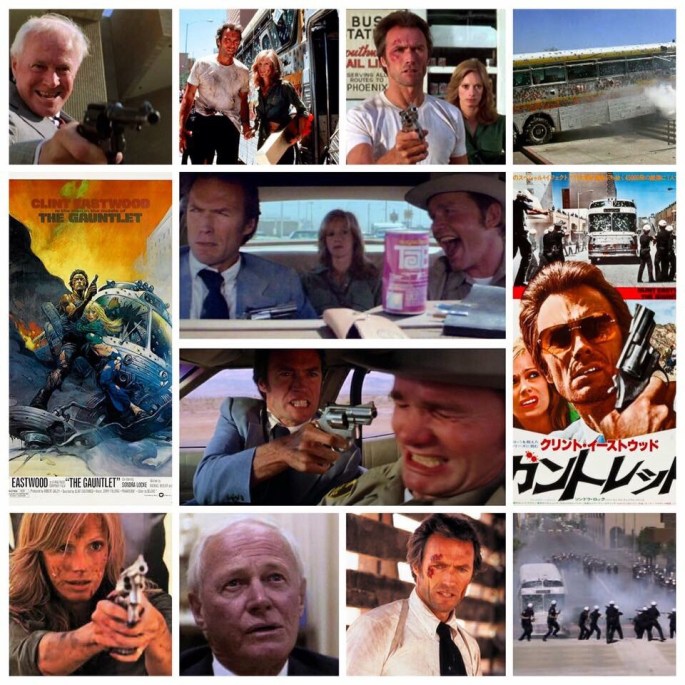 I love scrappy little cop flicks like Clint Eastwood’s The Gauntlet, a short, trashy exercise in exploitation that’s not only a departure from the heady, cerebral detective flicks he does but also miles off of the focused, gritty machismo of the Dirty Harry films. This is a low rent B movie and is proud of it, which is a rare commodity in Eastwood land. Boasting a terminally silly plot, lovably incapable protagonist and more bullets fired than all three Matrix movies stacked together, it’s a great way to spend a Saturday night when you have a hankering for old school action. Eastwood is Ben Shockley here, a disheveled mess of a Phoenix cop, heavily on the sauce and in no mood for the mission his uptight commissioner (William Prince, needing a moustache to twirl in his portrait of unapologetic evil) dispatches him on. He’s to escort a troublesome hooker (Sondra Locke) from Vegas back to Arizona where she will testify at a high profile mob trial. Of course every bent cop and his mother is on their trail, they can’t trust anyone in law enforcement and they’re on their own, forced to run a gauntlet of gunfire and corruption to bring her in. There’s three very odd, very hilarious set pieces that involve gunmen just fucking unloading clip after clip after clip in a way that the you might see on the Looney Toons, until the house they’re firing at *literally* falls apart. That’s the sort of slapdash style the film has, but it works in its dense specificity. Eastwood and Locke have chemistry, and it’s always cool to see the chicks in his action films have their own personality and impact on plot, not just part of the scenery or eye candy. Prince is so nefarious as the Commissioner that one wonders how a man like that ascended the ranks to that position, but in a film where’s he’s allowed to shut down a city block and order the *entire* Phoenix police force to empty boxes of bullets into an oncoming bus that Eastwood rolls up in, it isn’t that much of a stretch to believe. It’s just that kind of film, and I dug it a lot. Oh and look at that epic one sheet of a poster, whoever designed that should get a few medals. Great flick.
 Podcasting Them Softly