The Grudge (2020)

American movie studios are wild, man. They’ll remake Asian horror films, pump out a few sequels, and then once they get bored of that they (pauses, takes off glasses and rubs bridge of nose) remake their *own American remake* of the Asian horror like they forgot they even did the initial one in the first place. That’s not to say this bizarre behaviour can’t produce decent horror flicks as a rule but in the case of The Grudge (2020) I’d say they’ve done a pretty terrible job. The 2004 American Grudge film with Sarah Michelle Gellar scared the piss right down my leg at age 14 and despite being desensitized now that I’m older I’d still consider it a well made, effective chiller. But this new version is so all over the place and contains so little of what made the 2004 one so special it doesn’t even make sense to call it a Grudge film. So basically there’s two moody, hard boiled detectives played by the arbitrarily unlikely combo of Andrea Riseborough and Demien Bichir, who are investigating the classic case of a Grudge spirit hovering around a house and the unfortunate folks who are unlucky, stupid or morbidly curious enough to hang around it. There’s Lin Shaye in the Grace Zabriskie proxy role as the dementia ridden old woman who doesn’t know what planet she’s on, Frankie Faison as her desperate husband who enlists a lady (Jacki Weaver) who facilitates assisted suicides, John Cho and Betty Gilpin as a young couple trying for a baby that fall victim (in the film’s single, solitary effective scare, I might add), William Sadler as a disfigured, mentally disturbed former cop who ran afoul of the ghost and others. It has a huge big cast of talented, recognizable and engaging actors who run around in unnecessary subplots doing not much of anything. There’s barely any ‘classic Grudge moments’ and even when there are they feel somehow ‘off’ and not deserving of the franchise name. The single effective scare involving John Cho is a nicely shocking moment with a great choice of where to place the camera, but if your remake of your own remake only has one scary scene and not much else, I think it’s time to pitch the drawing board out the window and completely rethink your approach. It’s beyond me why they felt the need to do this, and make it so overloaded, needlessly elaborate and bereft of what made the initial Grudge film so good.

-Nate Hill
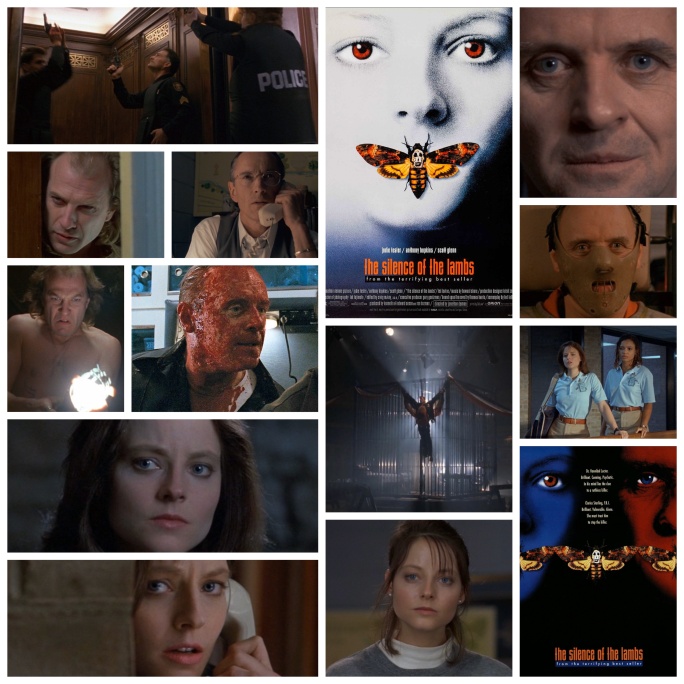
Revisiting Jonathan Demme’s The Silence Of The Lambs on the big screen

I got the chance to see The Silence Of The Lambs on the big screen last night and was very curious to see if it held up as I had only seen it once before, when I was like fifteen and on VHS no less. Well. This has to be one of the most airtight, hair raising, gorgeously produced psychological horror shows ever made and it really, *really* pops in a darkened theatre. I remembered bits and pieces, some of the iconic interplay between Anthony Hopkins’s Dr. Hannibal Lecter and Jodie Foster’s Clarice Starling as well as all the freaky pervo stuff with Ted Levine’s Buffalo Bill and had retained the general atmosphere. I *knew* I loved this film already but getting to see it in that environment of the theatre with focused, uninterrupted absorption really reminded me not only of what a masterpiece this is but also why it’s important to see films theatrically to begin with.

From the moment we see Clarice running through those misty Quantico woods to that final extended shot of Lecter strolling down that street in the Bahamas this is fluid, brilliantly edited, first rate storytelling and the one aspect that stands out most to me is the way the characters relate to each other psychologically. Scott Glenn’s Jack Crawford handpicks Clarice in this assignment for a reason. Hannibal takes an immediate and intimate interest in her for a reason. Clarice toughs out the terrifying aspects of this case and taps into her own vulnerability for a *reason.* We the audience are never told exactly what these reasons are but they’re clearly spelled out in each mannerism, each glance, each performance, there for us to find and digest each in our own way. There’s a reason this film crushed the Oscars, the acting awards in particular. Hopkins lingers over every scene like a cobra, his voice that of an icy river and the horribly calibrated intellect behind it scarier still. Foster shows the wounded orphan in Clarice, toughened up by years of hardship and her training at the academy, all her innermost qualities brought out by Lecter’s presence in a relationship that’s hard to classify. “The worlds more interesting with you in it” he assures her later in the film and we silently beg to know what’s going on in his head. Levine is every bit as scary as we remember, finding the human notes in this egregious monster and making him one of the most iconic serial killers in cinema. Glenn is buttoned down and unassuming as Crawford but we slowly see from his acting that it’s a ruse and he’s as sharp as any of them under that well kept veneer. The rest of the cast are carefully picked and include the likes of Kasi Lemmons, Charles Napier, Tracey Walter, Daniel Von Bargen, Anthony Heald, Frankie Faison, Brooke Smith, Diane Baker, Roger Corman, George A. Romero and Chris Isaak all doing great work.

One sequence in particular demonstrates how well this film holds up and why it should be seen on a big screen, and it’s where Lecter escapes from federal holding, dodging dozens of agents, SWAT operatives and sheriffs along the way. It’s an extended scene full of law enforcement lingo shouted breathlessly, a sneaky elevator roper dope, bloody special effects, desperate mustering of FBI forces to stop him all set to Howard Shore’s exceptionally creepy and exciting score. All that plus Jonathan Demme’s tight, succinct direction make a sequence that just hums along and showcases the film’s firm grip on horror, suspense, police procedural, editing, music and overall storytelling. They don’t get much better than this.

-Nate Hill