Top Ten Harvey Keitel

Harvey Keitel is one of cinema’s most valued actors.  His brand: tough alpha male, career criminal, and the all-around bad motherfucker.  His filmography is unique; he has been a mainstay in the works of Martin Scorsese, Quentin Tarantino, James Toback, Abel Ferrara, and most recently Wes Anderson.  While his hallmark is the tough guy, he’s been able to transform that archetype into colorful dimensional characters that only he could have portrayed on film.  Whether he’s in a crime film, a big budget opus, or an incredibly small independent film, Keitel is always on the mark and he is always fascinating to watch.

ALICE DOESN’T LIVE HERE ANYMORE 1974 Dir. Martin Scorsese

HK ADLHA

In his third collaboration with his friend Martin Scorsese, Keitel gives a dual layer performance.  He starts out being the affable and charming suitor of Ellen Burstyn’s Alice – until he isn’t.  He’s the all too real sociopath that is able to cover his anger and inner frustration with his charm.  Keitel is frightening in this film, the way he’s able to camouflage the character’s actual motivations and drive is unique to the range he has as an actor.

BAD LIEUTENANT 1992 Dir. Abel Ferrara

HK BAD LT

There has never been a performance like Keitel’s turn in BAD LIEUTENANT.  It is as pulverizing as it is soul bearing.  He removes the audience from their comfort zone, and takes them into the heart of darkness, watching a man spiral out of control.  He’s a killer, a gambler, a junkie, a cop – yet he accidentally finds a reason to live through redemption.  While the Bad Lieutenant is incredibly vile, the subtle vulnerability that Keitel graces makes this performance all that more tragic.  Aside from being one of Keitel’s finest performances, this remains one of the best performances in cinema history.

DANGEROUS GAME 1993 Dir. Abel Ferrara

HK DG


Off the heels of BAD LIEUTENANT, the seminal trio of Abel Ferrara, Harvey Keitel, and cinematographer Ken Kelsch embarked on one of the most daring and transgressive pseudo autobiographical films, DANGEROUS GAME.  Like Fosse’s ALL THAT JAZZ or Felini’s 8 ½ Abel Ferrara uses his actor as a vessel to tell his own story on film.  Keitel completely shakes his gangster vibe but leaves his darkness and intensity completely intact to play filmmaker Eddie Israel in a movie within a movie.

FINDING GRACELAND 1998 Dir. David Winkler

HK FG

In the vastly underseen FINDING GRACELAND, Keitel plays a quietly broken drifter who claims to be Elvis Presley.  While on the road to Graceland, he gives his most quietly heartfelt performance with an incredible amount of soul and reach.  We’ve seen characters like this before in cinema, but seeing Keitel playing a man claiming to be Elvis, along with singing SUSPICIOUS MINDS, is a one of a kind performance.  Yes.  Harvey Keitel sings Elvis.  That’s worth watching it on its own.

FINGERS 1978 Dir. James Toback

HK FINGERS

Somewhere there needs to be a theatre showing a double bill of FIVE EASY PIECES and FINGERS.  This is a key performance from Keitel, where he plays the gangster and the intellectual.  He’s a brutal enforcer for his father, yet doubles as a piano prodigy.  Both sides of himself have one thing in common: sexual addiction.  FINGERS is Toback’s finest hour as a filmmaker, and is yet another performance of Keitel’s that is chalked up in the underseen category.

THE LAST TEMPTATION OF CHRIST 1988 Dir. Martin Scorsese

HK TLTOC

Martin Scorsese’s most seminal film, THE LAST TEMPTATION OF CHRIST is controversial and monumental for a variety of reasons.  One of the most enamoring aspects is Keitel’s reinvention of Judas.  He’s an insurgent warrior, he’s the loyal follower, and then he becomes the voice of reason while Jesus is being guided through his final temptation.  Keitel’s turn earned him a Razzie nomination, and that is completely off base.  Keitel is brutish and forceful; purposely directed to speak with an overt Brooklyn accent with a new take on the Biblical character.

MEAN STREETS 1973 Dir. Martin Scorsese

HK MEAN STREETS

MEAN STREETS is often mentioned as the film that birthed the brilliant collaboration of Scorsese and De Niro, but the film is much more than that.  Keitel takes the lead, as the morally conflicted Charlie who is set to take over for his gangster Uncle, yet having to constantly juggle his wild card best friend Johnny Boy (brilliantly played by De Niro).  De Niro has the flashy role, but Keitel is the foundation of the film.  He’s Scorsese’s alter ego; he is struggling with his faith, his family, and his identity.  Keitel gives an incredibly soft and vulnerable performance as a man who is stuck in his own quagmire, having no way out.

RESERVOIR DOGS 1992 Dir. Quentin Tarantino

HK RD

This is the performance where everything Keitel has done before comes to a perfect culmination.  There isn’t an actor who has delivered Tarantino’s dialogue with as much weight as Keitel.  Keitel walks Tarantino’s walk, and in particular talks his talk.  There is a Shakespearean quality to Keitel’s performance in this film.  From the start of the film, we know he’s heading for impending doom, and he does it all with gravitas and honor.

TAXI DRIVER 1976 Dir. Martin Scorsese

HK Taxi Driver

Originally, Scorsese wanted Keitel to play the campaign staffer Tom (the role Albert Brooks knocks out of the park), but instead Keitel wanted to play the pimp who had only a few lines of dialogue in the original screenplay.  Keitel transforms into a smooth and funny character, yet in his private encounter with Iris (Jodie Foster) we see what a master of manipulation and control he is in a creepy and quiet way.

SMOKE 1995 Dir. Wayne Wang

HK SMOKE

SMOKE is another one of those quietly underseen gems of independent cinema.  In a very low key way, we see Keitel in a new light. He’s himself, in a certain regard, a brash New Yorker who smokes, runs a tobacco shop, yet he has an undying pension for art.  In this film’s case, he’s a photographer, who has taken the same photograph in the same intersection every day for the past twenty years.  This is a very touching film, and Keitel gives one of his sweetest performances.

YOUTH 2015 Dir. Paolo Sorrentino

HK YOUTH

In a character that is fusion of Charles Bukowski and John Cassavetes, Keitel plays writer/director Mick Boyle who is on his annual holiday in the Swiss Alps with his best friend, Michael Caine.  This was a role that Keitel was born to play.  He’s the artist that is overflowing with creativity and inner torment.  He’s being torn apart by his own emotions and ego, and he gives is a bittersweet showboat of a performance of what it is truly like to be an artist.

Honorable mentions: BAD TIMING, BLUE COLLAR, BUGSY, CITY OF INDUSTRY, COP LAND, FROM DUSK TILL DAWN, THE PIANO 
CITY OF INDUSTRY – A Review by Frank Mengarelli

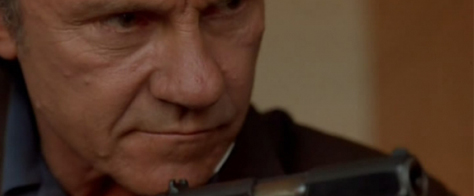
CITY OF INDUSTRY is that seedy noir where men treat their own gunshot wounds with whisky and cigarettes in a rundown bathroom of a motel, talk in short and blunt alpha male code, and live by a code of honor and revenge. The film has a fantastic cast led by Harvey Keitel giving his archetypal tough guy performance. Supporting Keitel is Timothy Hutton, Famke Janssen, Lucy Liu, Michael Jai White, Stephen Dorff, and Elliot Gould.

City of Industry Keitel.jpg

The film’s premise is the Richard Stark esque caper/revenge story of four men robbing a jewelry store, and then one of them (Dorff) kills off two (including Keitel’s younger brother played by Hutton) and then Harvey Keitel spends the rest of the film tracking him down and killing anyone in his way.

City of Industry Hutton.jpg

The film thrives on its minimalist approach. It knows exactly what it is, and it does not try to be anything more. Keitel commands the screen with his scowls and his pistol whipping anyone who stands between him and Dorff. Along the way, Keitel befriends the widow (the always great Janssen) of one of his slain crew members, and of course finds solace and redemption in helping her while tracking Dorff.

City of Industry Dorff.jpg

The film is what it is. For those who enjoy the heavy B movie revenge genre, this film was made for you. Keitel’s stoic performance is solid as ever, Dorff and his blonde highlights is sleazy as ever, and Elliot Gould makes a brief yet groovy turn as a sweaty and smooth crime boss. CITY OF INDUSTRY is one of those gems that stand out among the best of the 1990’s straight to VHS crime films.

MEAN STREETS – A REVIEW BY J.D. LAFRANCE

Mean Streetts 4

Martin Scorsese’s truly great films have all had a personal touch to them. One only has to look at films like Mean Streets (1973), Taxi Driver (1976) and Raging Bull (1980) to see a real vitality and energy to the action on-screen. It is these early films that convey a real sense of someone intensely in love with film — which may be due in part to the fact that Scorsese and his cast and crew were just starting out. Mean Streets, in particular, is a visceral, intimate experience that is just potent today as it was when it first came out.

Mean Streets
takes the notion of the American success story and reduces it to almost nothing. The characters that inhabit this film are small-time hustlers and punks with no real direction in life and no future. Set in the “Little Italy” neighborhood of New York City, we are introduced to most of the main characters in the opening moments of the film. Each one is given his own little scene in order to showcase his distinct character-defining obsession. We first meet Tony (David Proval), the order-obsessed owner of a local bar, as he throws out a junkie and then chastises his bouncer for his lack of initiative. Next, is Michael (Richard Romanus), a serious looking loan shark who ineptly tries to sell a man a shipment of German lenses only to be told by the customer that they are actually Japanese adapters. This is followed by the explosive Johnny Boy (Robert De Niro), a happy-go-lucky punk who gleefully blows up a mailbox and then runs off. Finally, we meet the film’s protagonist, Charlie (Harvey Keitel), an ambitious young man who is embroiled in conflict — both personal and external.

Charlie is torn between two worlds: the static isolation of his uncle’s environment and the constricting chaos of Johnny Boy’s lifestyle. He must make a choice between the two, while trying to exist in both. Conflict occurs when these two worlds inevitably collide and Charlie is left to pick up the pieces. This revisionist approach is in stark contrast to the traditional gangster film which almost always follows a curve that traces the criminal’s rise and eventual fall. However, Scorsese disrupts this notion by having no rise and leaving the fall unresolved. The only thing that is truly alive and vital in the film is Scorsese’s camera which dollies and tracks all over the place with incredible energy and enthusiasm which is truly infectious.

The source of this intensity stems from Scorsese’s personal identification with the material. At the time, the young filmmaker was writing the screenplay for Mean Streets (then known as Season of the Witch) and he had just finished wrapping up Boxcar Bertha (1972) for B-Movie guru, Roger Corman. Scorsese showed the rough cut of the latter to famous actor/director John Cassavetes who told him, “you just spent a year of your life making a piece of shit. You’re better than that stuff, you don’t do that again.” Cassavetes asked Scorsese if he was working on something that he really wanted to do. He showed him the Season of the Witch script and Cassavetes urged Scorsese to work on his own material and not on others.

So, the aspiring auteur began to seek financial backing for his script which initially began as a continuation of the characters in his first film, Who’s That Knocking At My Door? (1968). Scorsese changed the title to Mean Streets, a reference to famous pulp writer Raymond Chandler, and sent the script to Corman who agreed to back the film if all the characters were black. Scorsese was so anxious to make the film that he actually considered this option, but fortunately actress Verna Bloom arranged a meeting with potential financial backer, Jonathan Taplin, who was the road manager for the musical group, The Band. Taplin liked the script and was willing to raise the $300,000 budget that Scorsese wanted if Corman promised, in writing, to distribute the film.

According to Scorsese, the first draft of Mean Streets focused on the religious conflict within Charlie and how it affected his worldview. “See, the whole idea was to make a story of a modern saint, a saint in his own society, but his society happens to be gangsters.” Along with fellow writer Mardik Martin, Scorsese wrote the whole script while driving around “Little Italy” in Martin’s car. They would find a spot in the neighborhood to park and begin writing, all the while immersed in the sights, sounds, and smells of what would eventually appear on-screen. Mean Streets, for them, was a response to the epic grandeur of The Godfather novel. “To us, it was bullshit,” Martin remembers, “It didn’t seem to be about the gangsters we knew, the petty ones you see around. We wanted to tell the story about real gangsters.” It is this rejection of the often pretentious and operatic approach of The Godfather films that really makes Mean Streets distinctive. It was one of the few gangster films, at the time, to use a personal, almost home-movie view of its subjects. The settings and situations are so intimate and personal that you almost feel embarrassed, as if you are intruding on someone’s actual life.

Once the financing was in place, Scorsese began to recruit his cast. Robert De Niro had met the director in 1972 and liked what he had seen in Who’s That Knocking. De Niro was impressed with how the film had so accurately captured life in “Little Italy” where he had also grown up. Scorsese offered the actor four different roles, but he could not decide which one he wanted to portray — they all had interesting aspects to them. After another actor dropped out of the project, Scorsese cast Harvey Keitel in the pivotal role of Charlie. Keitel’s first film was also Scorsese’s debut with Who’s That Knocking and as a result, the two already had a rapport. This may explain why the director ignored the fact that the actor had little experience, and instead opted for a certain amount of rawness and a familiarity with the subject matter that Keitel possessed. Scorsese’s gamble paid off and Keitel’s strong performance is one of the many highlights of Mean Streets. He manages to convey the inner turmoil that threatens to consume Charlie’s character as he struggles to save everyone around him and ends up saving no one.

Keitel was also responsible for convincing De Niro to play Johnny Boy. “I didn’t see myself as Johnny Boy as written, but we improvised in rehearsal and the part evolved.” This improvisation also resulted in some of the most memorable scenes in the film, including the back room conversation between their two characters where Johnny Boy explains to Charlie, in a rather humorous fashion, why he has no money to pay off his debt to Michael. It is also incredible to see how much energy De Niro instills in Johnny Boy — the embodiment of the film’s frenetic force. He is the unpredictable element in Charlie’s otherwise, structured world. Whenever Johnny Boy is on-screen the camera mimics his furious pace that absolutely bristles with intensity. Scorsese reinforces this energy in an early scene where Johnny Boy enters Tony’s bar to the strains of “Jumpin’ Jack Flash” by the Rolling Stones. Even though the entrance is captured in a slow motion tracking shot, De Niro’s character is so energetic that not even this technique can slow him down.

The whole cast was prone to improvising dialogue and Scorsese only encouraged them more by creating a very collaborative atmosphere to the whole shoot. This provided actors like Keitel room to grow and learn their craft. “Mine was a gut, root, raw experience of trying to express myself, and express the character of Charlie in Mean Streets, and trying to discover what it meant to express yourself in a character. I was learning my technique, learning how to apply it. Marty and I always discussed a scene, and usually he trusted me to do what I had in my mind to do.” This trust resulted in a great performance from not only Keitel but the whole cast who transformed into their characters effortlessly.

Keitel was not the only actor who felt like he could make his character his own, the whole cast was encouraged to personalize their roles. Richard Romanus, who played Michael in the film, remembers that Scorsese “allowed you to flesh out the character. Even if you were in the middle of a scene and something came up that was organic, he wouldn’t dismiss it. He would respond to it, and he would probably include it. To me, that is his great gift. He’s an actor’s director.” This approach created a fun environment for the cast and crew to work in and allowed them more opportunity to be creative. As a result, Scorsese, as he put it, “kept pushing the limits of the budget and drove everybody crazy. But that was the only thing we could do because the more we got down there, the more fun we had and the more we realized the atmosphere we wanted to get.” To his credit, Scorsese and his crew achieve this effect with smoky, dimly-lit bars for his characters to inhabit and an amazing classic rock soundtrack to compliment the proceedings. There are several moments in the film where the actors are laughing at something and it seems like they are genuinely enjoying the moment and the experience of making this film which only enhances the enjoyment of watching it.

One of the real joys of Mean Streets is the way Scorsese’s camera captures the action. The camera is restless and frantic as it moves in tight, narrow spaces that lead to dead ends. This is done to convey the destiny of the characters. They are full of energy, but are going nowhere in life. In Mean Streets, Scorsese also used a hand-held camera to create a jerky, off-balance effect that conveys the sensation of disorientation. There is no center of power. No other scene demonstrates this effect more than the famous pool hall brawl where Johnny Boy, Charlie, and Tony go to collect some money from the owner. A fight breaks out when Johnny Boy’s bravado insults the owner. Scorsese uses a hand-held camera to convey the constant confusion of the fight. The camera darts and weaves all over the place, following one fight for a while before shifting to another brawl in an indiscriminate fashion. This effect raises the fight to a frightening level as the audience is drawn right into the middle of the pool hall melee.

We are in as much danger as the characters and this adds an element of realism not seen in traditional gangster films. The combatants in Mean Streets are not easily identified and separated, but instead everything is mixed up and obscured to duplicate the spontaneity of the ensuing chaos that constitutes a real brawl. The violence has no meaning or nobility and no one becomes a hero or succeeds as a result of using excessive force. After the pool hall fight is broken up, the conversation continues as if it never happened. The fight served no purpose and achieved no real end, except to enliven the characters’ mundane existence for a few minutes. Mean Streets excels in its realistic portrayal of violence that goes so far as to implicate the viewer in the spectacle, as the pool hall fight scene illustrates. The camera, and by extension, the viewer enters the fracas, which creates a sense of danger not only for the characters but for the audience as well.

Mean Streets
opened at the New York Film Festival to good reviews and good business. It did so well that Scorsese wanted to show it in Los Angeles where, despite favorable reviews, it promptly flopped. However, it began to gradually find an audience and has since become an influential and much imitated film amongst up-and-coming independent filmmakers who identify with the low-budget exuberance of Scorsese’s film. Even Scorsese himself returned to the same neighborhood, only with greater command of his craft and on a bigger scale with Goodfellas (1990). One only has to look at indie films like Laws of Gravity (1992), A Bronx Tale (1993), and Federal Hill (1995) to see that Mean Streets still continues to inspire filmmakers more than twenty years after its release.

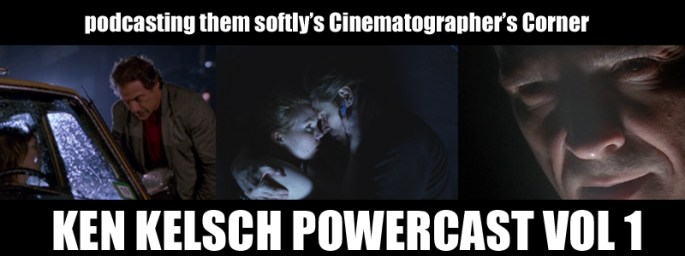
PTS Presents Cinematographer’s Corner with KEN KELSCH Vol. 1

KELSCH POWERCAST

kelsch ferraraPodcasting Them Softly is honored to add Ken Kelsch, as the latest cinematographer to our series, Cinematographer’s Corner. Ken’s work helped shape my love for film with his frequent partnership with one of my absolute favorite filmmakers, Abel Ferrara. They have worked together on twelve films, starting with their first feature THE DRILLER KILLER, BAD LIEUTENANT, DANGEROUS GAME, THE ADDICTION, THE FUNERAL (which he was nominated for best cinematographer at the Independent Spirit Awards), Abel Ferrara’s segment in SUBWAY STORIES, THE BLACKOUT, R-XMAS, THE NEW ROSE HOTEL, CHELSEA ON THE ROCKS, 4:44 LAST DAY OF EARTH, and finally one of the very best films from last year, WELCOME TO NEW YORK. Ken has also collaborated with Stanley Tucci’s directorial efforts, THE BIG NIGHT and THE IMPOSTORS. Ken has shot the first two seasons of the television show, MEDIUM and friend of Podcasting Them Softly’s latest feature film, Eric Red’s 100 FEET.

YOUTH – A Review by Frank Mengarelli

youth-810x434

YOUTH achieves and exceeds what most pieces of art attempt to do.  This film is brought to us by the genius mind of Paolo Sorrentino, as well as career high performances from Michael Caine, Harvey Keitel, Rachel Weisz, Paul Dano and Jane Fonda.  This film is a testament that is timeless, introspective, existential, and a beautifully painful kaleidoscope of emotions that is life.

Michael Caine is Fred Ballinger, a retied and apathetic conductor who is on holiday at a tranquil and off beat hotel in the Swiss Alps, where he’s been vacationing for the past sixty years with his best friend Mickey a writer/director, perfectly played with gravitas and emotion by the magnificent Harvey Keitel.  Rachel Weisz is brilliant in her duel role as Fred’s assistant and daughter.  Paul Dano yet again holds his own, and is not overshadowed by the acting giants he is put up against, as Jimmy, the resentful and bitter method actor doing research for his next role.

JaneFondaYouthSS

The pairing up of Caine and Keitel is awe inspiring.  They are two of the very best actors not only from their respective generations, but in cinema itself.  Keitel has always been a personal favorite actor of mine who has been under appreciated and for a majority of his career stuck in the “tough guy” role.  At the age of 76 Keitel is fantastic as the tortured optimist that is a hybrid between Charles Bukowski and John Cassavetes .  As odd of a couple Caine and Keitel are, there are not two actors alive that would be as suited as them for these two roles.

This film is difficult to navigate.  The music, visual style and design soften the coarse and heavy subject matter.  Its structure is purposely off beat, yet Sorrentino masterfully guides us through this journey where conventional plot points do not matter.  We feel what’s happening, and that’s the purpose of this film, channeling raw and perhaps at times, unrecognizable emotion into ourselves.

download (1)

Not since THE TREE OF LIFE, has a film taken us on a journey inside the human psyche that is set somewhere between reality and a fever dream.  Paolo Sorrentino masterfully delivers the beautiful showboat that is YOUTH, that rare and elusive film that is as charming, poignant, inspiring, and at times devastating as life itself.