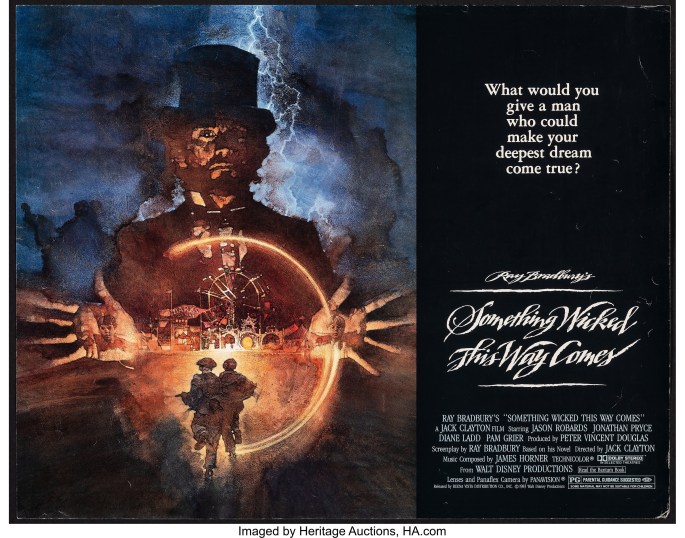
Ray Bradbury’s Something Wicked This Way Comes

Jack Clayton’s Something Wicked This Way Comes is Disney at its darkest and is a ton of spooky fun. Based on a novel by the great Ray Bradbury, here adapting his own work for the screen, it tells of a sleepy, picturesque Vermont town sometime in the 40’s, a place where not much of anything really happens until a mysterious travelling carnival shows up one night via train with little notice, as if borne on the very October wind that howls over the region itself. Their arrival peaks the interest of many townsfolk, especially two young boys who grow quickly suspicious of this outfit, especially its outwardly affable yet intangibly sinister ringmaster, a fellow called Mr. Dark (Jonathan Pryce). Pryce is an actor who has mastered the art of coming across as nervous, stressed and vaguely sympathetic but guards an untapped darkness beneath his terse half smile and he’s positively terrifying here, another sterling villain in his rogue’s gallery of a career. I won’t spoil what this carnival is really up to, but suffice to say it isn’t just to hand out cotton candy and wow the locals with their sideshows and Ferris wheels. There’s an innate, elemental supernatural force at work in each of these carnies, they’re like a pack of ravenous wolves that feed on the human element of both wish and wonder, collecting souls in the process. Most malicious of their group is a mute, animalistic sorceress called the ‘Dust Witch’, played by the always awesome Pam Grier in the kind of dark, fairytale oriented role that she doesn’t get casted in too often, she’s scary, sexy and severely compelling. Also terrific is Jason Robards as one of the boy’s father, his deep, clear speaking voice goes a long way with Bradbury’s wonderfully ornate poetic, prose. It’s a dark, sumptuous jewel of a spooky season watch, with heavy, hazy small town nostalgia captured in elegiac, wistful words by this legendary author and a genuine sense of both eerie wonder and horrifyingly immediate danger. Great stuff.

-Nate Hill
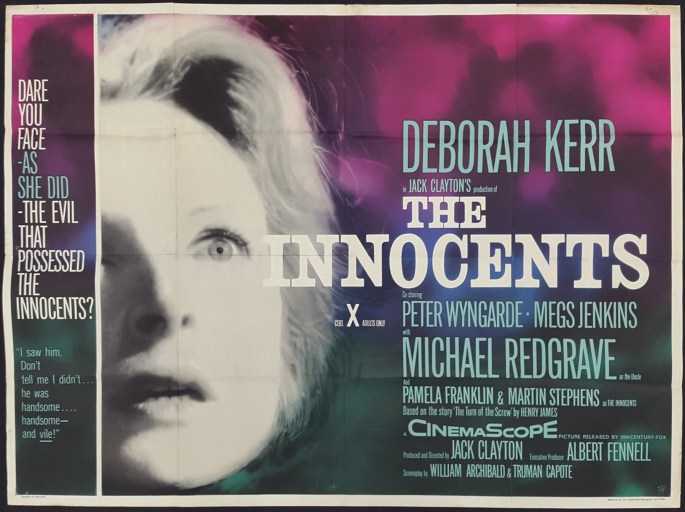
Jack Clayton’s The Innocents

What is it about black and white films that is somehow just inherently creepier than the rest? Daylight seems eerie, anything could be a shadow and spectral presences are easier to hide in any given frame. Jack Clayton’s The Innocents is a frightening, beautiful piece of Victorian Gothic horror that’s subtle in all the right places, baroque when it needs to be and very unsettling, especially from an auditory standpoint. Deborah Kerr plays a young governess who travels from London to the countryside to look after two children in a large Manor, which of course is haunted and causing the youngsters to behave very.. strangely. Now this is of course the source material for Netflix’s brilliant Haunting Of Bly Manor and I don’t want to go too deep into comparison except to say that I greatly enjoyed both, Bly is a nine hour television series and naturally has way more depth in supporting characters and subplots, but it’s more of a love story while Innocents is the scarier of the two and works splendidly as a horror. It’s indeed very scary but not in terms of jump scares, leering ghouls or your usual brand of madness. Practiced in the art of subtlety, this film uses stark black and white photography to unsettle as the acrid marshlands and ornate, breezy corridors of the house yawn open for whatever spectral denizens lurk unseen. Sound design is key here too and should be applauded: in my favourite sequence, Kerr wanders the halls at night and hears some incredibly spooky whispers, moans, clanks and wheezes all around her. There’s something so evocative and iconic about a beautiful blonde Victorian girl, hair down, nightgown flowing, holding a candelabra and wandering the darkened halls of a vast haunted estate, its its own aesthetic. There’s another scene I loved in which she stands at the edge of a boggy pond and gazes over to the other side where the ghost of a former governess stands hauntingly still among the reeds, gazing back. It’s done in broad daylight and adorned in a hectic symphony of jagged sounds and is just so damn unnerving I had to rewind it and watch again just for double spook factor. I wasn’t quite sure what was implied by the ending of this but I enjoyed the note of ambiguity present in its conclusion, like the air being sucked out of the room abruptly or the night wind robbing a candle of its glow with one hoarse gust. This is a gorgeous, macabre, aesthetically pleasing horror gem.

-Nate Hill