A quick note on Steven Spielberg’s Jaws. It changed everything. Literally. Star Wars may have really moved the furniture around two years later but Jaws did something to American culture that was so unique and so strong, our annual pining for summer releases is a residual effect that has bored into our filmgoing DNA. And, as it turned out, there really was no big trick to turning summer films into machines that printed money. You just had to pump a decent budget into what was once seen as drive-in fare and, poof, you’d spun literal gold.
And this is not to take anything away from Spielberg’s masterpiece as Jaws is truly a brilliantly made film adapted from Peter Benchley’s piece of pure upmarket junk. But this kind of mass embrace of what was once kind of niche spelled trouble for folks like producer/director Roger Corman who had created a whole personality out of cheap action pictures and low-budget horror flicks. If this kind of stuff somehow rose out of the drive-ins and grindhouses and was embraced by the masses, it would crowd Corman out of the market.
Fortuitously for Corman, the success of Jaws created something that was right in his wheelhouse; namely: the Jaws-rip off. Jaws was basically manna from heaven for cheap exploitation directors both in America and every other country that had a film industry. Even Universal waded into the waters of the numbered sequel, then a still-novel notion that was only four years old, to rip itself off in 1978 with the enjoyable Jaws 2.
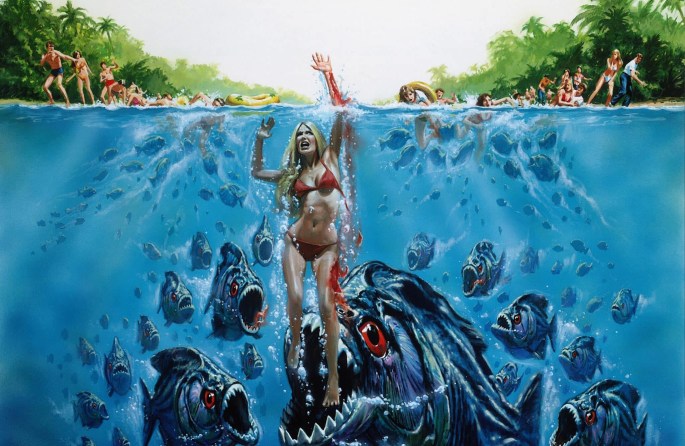
So, of course, Roger Corman had to mine the material to stake a claim in a territory he had homesteaded and, in fact, he mined the material a few times. But the first and most successful of his Jaws-inspired productions was 1978’s Piranha. Directed by one-time Corman editor Joe Dante who, along with Allan Arkush, had previously co-directed Hollywood Boulevard for Corman, Piranha was not only a major financial success for Corman’s New World Pictures, it’s easily the best of the pictures inspired by Spielberg’s original.
What makes Dante’s film feel fresh instead of point-by-point retread (looking at you, William Girdler’s Grizzly) is that it announces its willingness to let the audience in its self-awareness from the beginning. After pulling off a clever Citizen Kane reference, Dante and screenwriter John Sayles invite the audience to throw rotten fruit at the stupidity of the characters in the film’s pre-credit sequence. Decent questions like “Who will ever know we were here?” and “What if this is some kind of sewage treatment facility?” don’t get satisfactory answers before both characters are in waters that we’re sure are filled with piranha (pronounced piraña by more than one character in the film) because, well, it’s the title of the movie. Dumb on the characters’ part? You bet. Are Dante and Sayles cognizant of how ridiculous it is? For certain.
The other remarkable thing about Piranha is just how much movie is packed into 93 minutes. Weird creatures, gore, nudity, boat explosions, water skiing, mean-spirited yet satisfying devouring of children and lake enthusiasts, car chases, Pino Donnagio’s lush score that sounds like a bunch of unused cues from Carrie, and a jailbreak are just a few of the delicious attractions packed into the casing that threatens to burst at the seams. And all of this is before we even get to the cast. While Bradford Dillman and Heather Menzies are very good and play well off of each other in the lead roles, it’s Corman regulars Dick Miller and Paul Bartel who bring the house down as, respectively, a sleazy developer and a dictatorial camp counselor, while Belinda Balaski, who still continues to pop up in Dante’s projects, absolutely shines in a sympathetic role. Veterans Keenan Wynn, Kevin McCarthy, Barbara Steele, and Richard Deacon round out the majority of the supporting cast and are all incredibly game, treating the material with a delicate balance of the straight faced and the tongue-in-cheek.
While Joe Dante would never become a household name like Steven Spielberg, he would go on to create an impressive body of work throughout the 80’s and 90’s that is mostly ripe for reassessment. Beyond his cinematic achievements, he has proven to be an indispensable curator and tireless champion for a kind of cinema that is in a sundowning decline. With his Trailers From Hell website to his Movies That Made Me podcast, Dante emerges as a figure whose film knowledge and enthusiasm for same is pitched somewhere between the enthralling academia of Martin Scorsese and the beautiful junkyard of Quentin Tarantino. As the old gives way to the new and genre cinema goes through inevitable changes and the type of film that guys like Dante truly adored, it’s nice to know that there are things out there like Piranha that serve as landmarks to a glorious time in modern film history, even if those times are becoming longer in the rear view mirror with each passing day.
(C) Copyright 2021, Patrick Crain

 Podcasting Them Softly