Leigh Whannell’s The Invisible Man

It takes a lot to make a truly effective horror film these days. Between fan desensitization, cynicism, employment of rampant jump scares and gore the genre often has a tendency to go off track. And then there are efforts like Leigh Whannell’s The Invisible Man, which is not only an unbearably suspenseful, well drawn shocker with a stunning lead performance from Elizabeth Moss but a beautifully crafted, simplistic yet hard hitting piece of filmmaking. Moss is Cecilia, who makes a daring, hair raising escape from her evil, abusive husband Adrian (Oliver Jackson Cohen) in an atmospheric opening sequence that sets the tone nicely. Adrian later kills himself… or does he? Considering just how nuts this guy is and how far he was willing to go to control his wife, it isn’t a stretch to believe that he’d fake his death and start stalking her like the repulsive creep he is. It doesn’t help that he’s also a millionaire optics innovator with the skills and money to build a suit that renders him invisible. It’s a lean, mean concept that has endless potential for tense, highly uneasy scenes and that’s exactly what we get. Cecilia is in a tricky spot because everyone thinks he’s dead and only she knows him well enough to believe he’d go to those lengths to keep making life miserable for her. We feel her hopelessness as each scenario plays out and when she’s finally had enough and decides to fight back… boy do we ever feel that too. Moss is utterly fantastic, never playing up drama or going into scream queen territory but rather making Cecilia a resilient, believable tough cookie that we feel for and root for. The first half of the film is the most effective, when Adrian is subtly haunting her and playing cruel tricks from beyond her field of vision, despite being right there in the room with her. The original score from Benjamin Wallfisch is a terrifying, dread filled piece that mimics the sound of blood rushing in one’s ears when confronted with danger, anxiety or trauma bubbling up. Like I said it takes a lot in a horror film to truly get to me these days, but this one pulled it off. As I left the theatre and headed home I felt like someone or something unseen was watching me, and no film has had that effect of following me out of the cinema since… well since It Follows. One of the best horror films of the past decade or so.

-Nate Hill

James Wan’s Saw

As much as the Saw franchise has become a screaming mad runaway train from which there is no escape or slowing down (I think they just rolled out the eighth one? Fucking Christ), sometimes I need to remind myself that the first is in fact an excellent horror film and worthy of the mythic status it has earned these days. Written by and starring Leigh Whannell who has recently branched out to direct this year’s awesome genre bender Upgrade, it’s directed by James Who has gone on to become a superstar in the genre, but it’s a bit ironic because with this he basically pioneered a whole new tributary of gore-centric horror, yet went on to do fright flicks that notoriously toned down the carnage in favour of real scares. In a dark, damp room, a doctor (Cary Elwes) and a smart ass (Whannell) are held prisoner, chained to radiators. They are informed by unseen serial killer Jigsaw that they must either chop off a limb with the rusty hacksaw laying about, or die in captivity. A corpse lies near them as well as several other tools and riddles, both of the men have secrets that will come to light and play a part in the unfolding horrors to come. Elsewhere, a weary police detective (Danny Glover) follows the trail of clues and tries to hunt down the elusive Jigsaw killer. It’s all a wickedly paced mechanization that moves along like one of Jigsaw’s jagged, gruesome traps until it reaches that final staggering revelation that has since become legend. Others along for the ride include Lost’s Michael Emerson, Tobin Bell, Monica Potter and Shawnee Smith as the now infamous Amanda. The key to all this, and something that they forgot when churning out those ridiculous sequels, is that less is more. This was a low budget shocker that largely relied on one location, and the looming threat of grisly violence rather than wanton gore every other minute. I suppose every successful idea gets saturated by money and excess once the ball gets rolling but holy fuck did they ever let these Saw films get out of control. The first two are like being at a bar with a few of your friends having casual drinks, then three and four roll in as those crazy friends of friends who order way too many shots and start breaking stuff, by the time five and six show up everyone is dancing and throwing up all over the bar and you forgot how you even got there, and the seventh (in 3D no less, because that’s what we needed) is the anguished hangover the next morning and by then you just want it to stoooopppp. At least that’s how I felt watching the them. I’d just as soon stick to this one, it’s a dark, surprisingly thoughtful chiller with a strong story and one of the best yuck moments in the genre. People forget how measured and restrained it is compared to the un-contained wildfire that those sequels smothered it with.

-Nate Hill

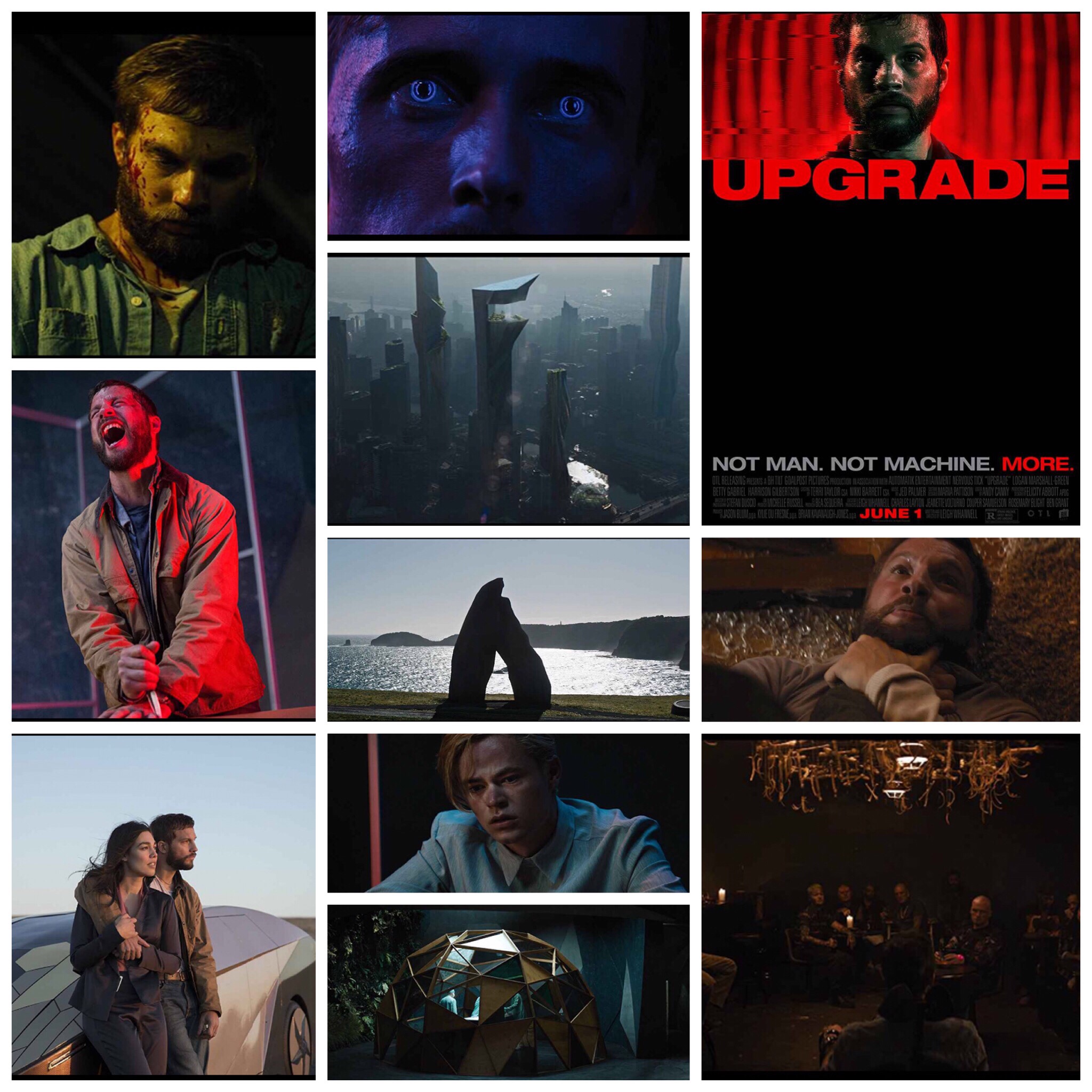
Leigh Whannell’s Upgrade

Leigh Whannell’s Upgrade is slick, bloody, wired Sci Fi action pulp and I loved every second of it, mounted on a high concept premise that’s just this side of outrageous and filled with both enough body shredding extreme violence and atmospheric mood to fuel an entire TV show. A quirky, intelligent mix of horror and futurism, Whannell puts the same brains responsible for the first Saw film into the story of Grey (Logan Marshall Green) a mechanic who is given a nifty new implant following the murder of his wife (Melanie Vallejo) that also leaves him a quadriplegic. Dubbed the Stem and cooked up by a weirdo tech mogul (Harrison Gilbertson), it latches onto his nervous system and makes him a super fast, highly capable killing machine and he sets out to find his attackers and… well.. kill them all in just about as violent ways as anyone could think up. There is actual thought, care and innovation put into this world and it’s construction though, until the very exploitive genre material feels lifted up by pure creation and we get something that thinks, feels and ponders just as much as it stabs and bleeds. An organic mix of Blade Runner style setting is welcome, as both the city they live in and the esoteric score by Jed Palmer are very LA 2049 with a hint of steampunk. Green is a great actor who has slowly been building steam in fits and starts, he had a smaller role in Prometheus and headlined the very underrated Cinemax original Quarry recently, but her he shows he can do leading man work in bigger projects, he’s tough, engaging and sympathetic. This is an extreme vision of a futuristic world that although seems alien to us, is not so different in many ways, and that makes it both scary and compelling. One of the best this year so far.

-Nate Hill