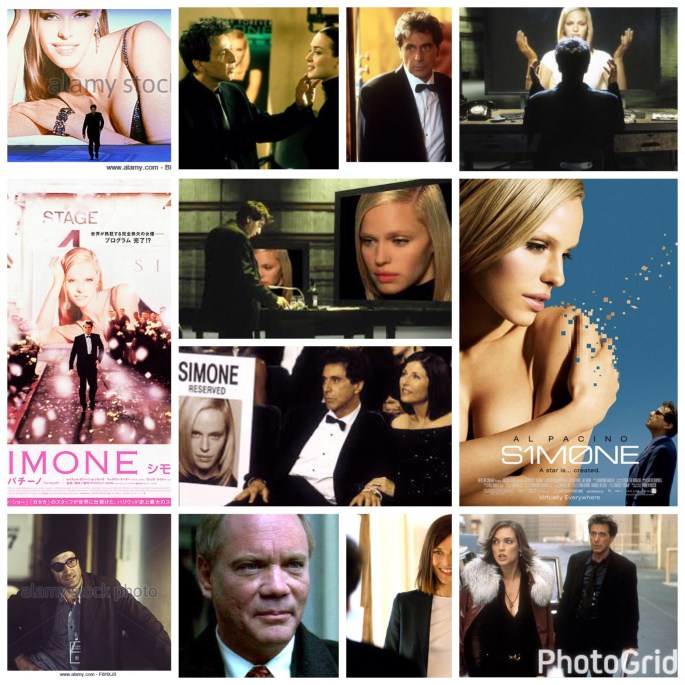
Andrew Niccol’s S1mone 


Andrew Niccol’s S1mone is social satire at its cheeriest, a pleasant, endearing dissection of Hollywood mania and celebrity obsession that only hints at the level of menace one might achieve with the concept. It’s less of a cautionary tale and more of a comedic fable, and better for it too. In a glamorous yet used up Hollywood, mega producer Viktor Taransky (Al Pacino with some serious pep in his step) needs to give his enterprise a makeover. His go-to star (Winona Ryder) is a preening diva who drives him up the wall, and there seems to be a glaring absence of creative juice in his side of the court. Something cutting edge, something brand new and organic, something no one else has. But what? Simone, that’s what. After finding clandestine software left behind by a deceased Geppeto-esque computer genius (Elias Koteas, excellent), he downloads what lies within, and all manner of mayhem breaks loose. The program was designed to create the perfect virtual reality woman, flawless and capable in every way, including that of the cinematic thespian. Viktor sees this as gold and treats it as such, carefully introducing Simone (played by silky voiced model Rachel Roberts) to an unsuspecting film industry who are taken by storm and smitten. Simone can tirelessly churn out five oscar worthy performances in a month, never creates on set drama, whips up scandals or demands pay raises. She’s the answer to everyone’s problem, except for the one issue surrounding her very presence on the screen: she isn’t actually real. This creates a wildly hysterical dilemma for Pacino, a fiery Catherine Keener as a fellow executive, and everyone out there who’s had the wool pulled over their starry eyes. It’s the kind of tale we’d expect from Barry Levinson or the like, a raucously funny, warmhearted, pithily clever send up of the madness that thrives in the movie industry every day. There’s all manner of cameos and supporting turns including Evan Rachel Wood, Jay Mohr, Pruitt Taylor Vince, Jason Schwartzman, Rebecca Romjin and the late Daniel Von Bargen as a detective who cheekily grills Pacino when things get real and the masses want answers. This is fairy tale land in terms of plausibility, but it’s so darn pleasant and entertaining that it just comes off in a relatable, believable manner. Pacino is having fun too, a frenzied goofball who tries his damnedest to safeguard his secret while harried on all sides by colleagues and fans alike. Roberts is sensual and symmetrical as the computer vixen, carefully walking a tightrope between robotic vocation and emoting, essentially playing an actress pretending to be an actress who isn’t even human, no easy task. It’s a breezy package that’s never too dark or sobering, yet still manages to show the twisted side of a famously strange industry. Great stuff. 

 -Nate Hill

Peter Weir’s Picnic At Hanging Rock: An appreciation by Nate Hill

  Yesterday I went into HMV, looking for a standard Blu Ray edition of a film I’ve recently seen that has stuck with me since in a way that I can’t quite describe, Peter Weir’s Picnic At Hanging Rock. The only version they had was a pricy Criterion Blu Ray/Dvd combo which also included the original novel which Weir based his film on. Now normally I’m reluctant with Criterion, as I almost always disagree with the films they pick for their releases. Also..it was expensive as shit. But then I remembered how much it affected me when I first watched it on my humble iPad, and realized that I wanted to have the snazziest output that money could buy, as this is one I’ll be revisiting probably until my years on this rock have run out.   At it’s heart it’s a mystery of the deepest primordial resonance, laced with the burgeoning sexuality of its female lead characters, and ultimately leaving an aftertaste of such yearning, mournful sadness that I had no idea movies were even capable of. Weir sets his story in 1900 Australia, with amusing attempts by the British to tame the near prehistoric nature of the land. Their prim, drawn up customs seem ludicrous and surreal in the face of a wild, abstractly formed landscape that meets their need for order and custom with unimpressed chaos. 

  A group of girls from a nearby boarding school embark on an annual picnic to Hanging Rock, an ominous geological gnarl set in a scorched, unearthly swath of land that evokes the feeling one might get from a partially recalled dream of some far off dimensional plane. For the conservative visitors and the audience alike, the surface of the moon might feel more at home. In a gust of unsettling foreshadowing, several members of their party note that their watches have mysteriously stopped at dead noon. A group of four girls venture forth to explore the upper plateau of the rock, promising their teacher Mademoiselle (radiant, elemental Helen Morse) they’ll be back before tea. Four enter the jagged, awaiting maze; two disappear and are never heard from again. It’s an enigma that shakes the foundations of the boarding school to its core. From stoic headmistress (Rachel Roberts) to a tragically abandoned orphan girl (Margaret Nelson, staggering for a girl who’d had no previous acting experience) no one is quite the same after the incident, almost as if whatever intangible forces responsible for the girl’s disappearance have reached out and deeply disturbed every form of life in its vicinity, the very madness of the continent itself driving these civilized newcomers to the brink of soul shaking distress. In spite of the film’s beauty, there are also moments of sheer horror that rival anything in your garden variety fright flick. The key scene where the girl’s are last scene is fogged over with such a feeling unshakable dread, crafted through sound and editing alone, no actual discernible violence or threat. It’s utter genius and you begin to question why you’ve got hordes of goosebumps from so ambiguous a scene, but you’re left snatching for the same answers to a feeling akin to the sensation of a quickly dissipating nightmare I mentioned above. That’s how powerful the filmmaking is… You are shaken without ever really knowing why or what’s the matter, which is really the concept of a mystery distilled to its purest form.

  What claws at your mind and lingers in the fringes of your awareness long after watching the film is its atmosphere of mounting dread, like knowing for certain the the worst possible type of end is coming for you, yet being utterly unable to articulate exactly what it is. The soundscape is thick with melancholic unease as well, evident in a knockout pan flute solo from Georghe Zamfir, providing a hazy chorus that will stand up the hairs on your arm in its beauty and terror. The scenes at Hanging Rock are lifted straight out of a subconscious place and laid down on the canvas of film with the same exquisite care of pressing flowers, which we see the girls doing early on. Film essentially does this: the painstaking preservation of beauty for countless generations to be pleased, terrified and puzzled by. There’s no better version of this film I’d rather have that with than this one.