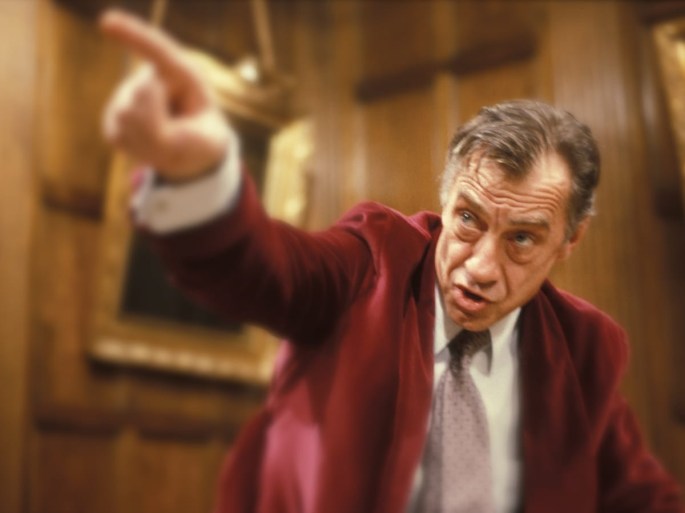
Locked behind security gates with cameras that pepper his estate like so many rose bushes, an exhausted Richard Nixon slowly retreats to his private study with a package in his hand. He first moves toward the fireplace where he pours a brandy and sits as the portrait of George Washington looms above him. Nah… no time for this. Nixon is on a mission and only Chivas Regal is going to do the trick. After pouring a fresh one, he changes into his smoking jacket and moves slowly to the box as if we’re watching a weird pantomime of Mr. Rogers Neighborhood. However, that illusion is broken when the box opens and we see a fully loaded revolver. The stage is now set. For if a gun is introduced in the first act, as the old adage goes, it has to go off on the third. Richard Nixon is going down and for the next 90 minutes (actually 80 as it takes him a bit to conquer simple technology), he’s going to plead his case into a tape recorder for anyone who would want to listen.
Shot on the stage at the University of Michigan where director Robert Altman was employed as a theater professor, Secret Honor is the filmmaker stripped down to the studs and it stand as one of his most triumphant cinematic achievements of the 1980’s. Where his previous two adaptations of the stage plays Come Back to the 5 & Dime Jimmy Dean, Jimmy Dean and Streamers, each reduced the size of both location and cast, Secret Honor is nothing more than 90 minutes of Richard Nixon (Philip Baker Hall in a roaring, commanding, and mesmerizing performance that put him on the map) bouncing off the the wood paneled walls of the study in the cocoon that is Nixon’s post-presidency compound.
Secret Honor isn’t a true tale, mind you and the opening crawl ensures that this is clearly understood. But this isn’t a dark political parable soaked in Greek tragedy and writ large across a 2.35:1 Panavision frame as Oliver Stone’s Nixon would prove to be ten years later. Instead, Richard Nixon is a sole, solitary, and pitiful creature whose tastefully decorated study acts as the prison of his own mind, squeezed into a 1.33:1 frame meant for television broadcasts of the time. Richard Nixon has a story to tell but to let it out would ironically destroy American’s faith in democracy.
So it’s a little surprising that Richard Nixon, dark prince at the center of the malignant rot that began to eat away at America in the late sixties, is presented as sympathetically as he is here. Like Oliver Stone’s film, Secret Honor reflects Richard Nixon as a stone cold zero who used politics and power to make himself a winner. This is underlined in Sharpie by the fact that Nixon didn’t run for office because he wanted to make a difference; he ran for office because a cabal of California businessmen ran him for office. Nixon was never a person with any true core principles, just an insatiable thirst to show those Ivy League punks and east coast intellectuals that he was no loser.
The Richard Nixon of Secret Honor is bathed in paranoid grievances built out of a horrific inferiority complex and the film tries to unspool his pathology in a way to mirror the Reagan Era, then in a bid for a second term. Oliver Stone would suggest that had Nixon not been impeached, Ronald Reagan would have never happened and I can’t help but wonder if Altman felt the same. Watching it in 2021, it’s hard not see Nixon, the dark historical figure who so rattled cognizant Americans, as little more than quaint in the rear view mirror of time but also as someone whose greasy heart of darkness led to the misdirected populism of the Reagan Revolution, itself a one-way slide leading directly to the Trump era. And while the conspiracy theories put forth in Secret Honor have nothing on the kind of stuff Oliver Stone would cook up later, they still point to an America run by a shadow government that’s in bed with numerous Asian governments to help facilitate the heroin trade. Wild stuff, for sure. But how different is it than the United States’s cozy involvement with dictatorial, South American regimes amid the cocaine wars of the 80’s?
Richard Nixon, more than any other President before Donald Trump, infused American politics with a dark sense of personal grievance. Unlike Trump, though, there was little in Nixon’s life that was handed to him without some kind of stark price tag. Like Carter, Reagan, Clinton, Obama, and Biden, Nixon truly came from nothing. The illness of his older brother, Harold, kept him out of Harvard and forced him to go to Whittier College. While pursuing his studies, he was firmly rejected by the schools’ various sports teams and upper crust societies. His future wife, Pat, balked at marrying him but he wore her down by driving her around on her dates with other men. Nixon was a pitiful and loathsome creature who would not take “no” for an answer and for whom every victory had to come at the utter destruction of his enemies all the while using self-pity and cheap political maneuvers to manipulate politicians of his same political party who otherwise loathed him.
Secret Honor shows a Nixon who ultimately found America rotten to the core. “Second rate mobsters and their PR guys,” he bemoans. And, soaked in booze and with his own self-loathing ego in full rage by the end of the film, he chillingly predicts a perpetual Nixon. You’ll never get someone like that down. It’s the American way, after all. And ultimately, he redeems himself by not killing himself and declaring a comeback. Fuck ‘em. As the credits roll over a mindless drone of “FOUR MORE YEARS!” there is little doubt that the dark scream is less about Richard Nixon and about the inevitable further downslide into Reagan’s mourning in America.
(C) Copyright 2021, Patrick Crain


 Podcasting Them Softly