The Paramount logo appears in black and white and in a state of mismanaged distress. This is quickly followed by a calm pre-title credit countdown; Three, the studio… two, the producers… one, the director. Then, the blast off occurs with a voice that booms “NOW AFTER YEARS IN THE MAKING…” revealing a commercial for the film’s soundtrack album that will also operate as the film’s opening credit sequence. Welcome to Nashville, Tennessee in 1975, a reflection of an America that could be marketed just like a K-Tel record. Years in the making but here for your enjoyment “in stereophonic sound and without commercial interruption.”
Robert Altman’s Nashville is ground zero for reflecting America’s unhealthy appetite for mixing celebrity and politics and it savagely and meticulously lays bare the ugly mechanisms that fuel both enterprises and also our collective and insatiable obsessions with them. It’s about a post-war, post-Eisenhower America being left behind as a perverted geek show of wrong-headed populism, shameless grifters, and shallow entertainment tightens its grip on a nation that has been so beaten down and disillusioned that a earnest yet moronic song like “200 Years,” an anthem that marvels at America’s ability to withstand trials and tribulations long enough to last two whole centuries, can be mistakenly presented as a chest-bursting piece of patriotism instead of the hilariously stupid self-own that it is.
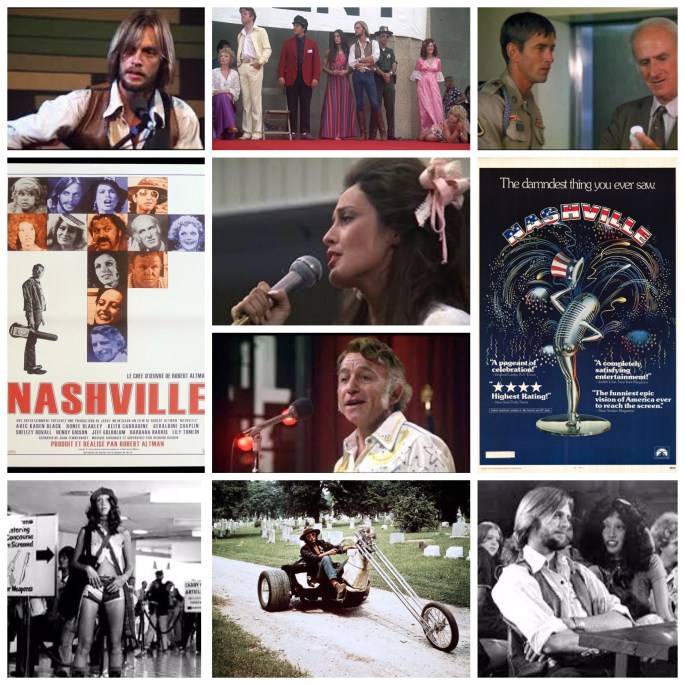
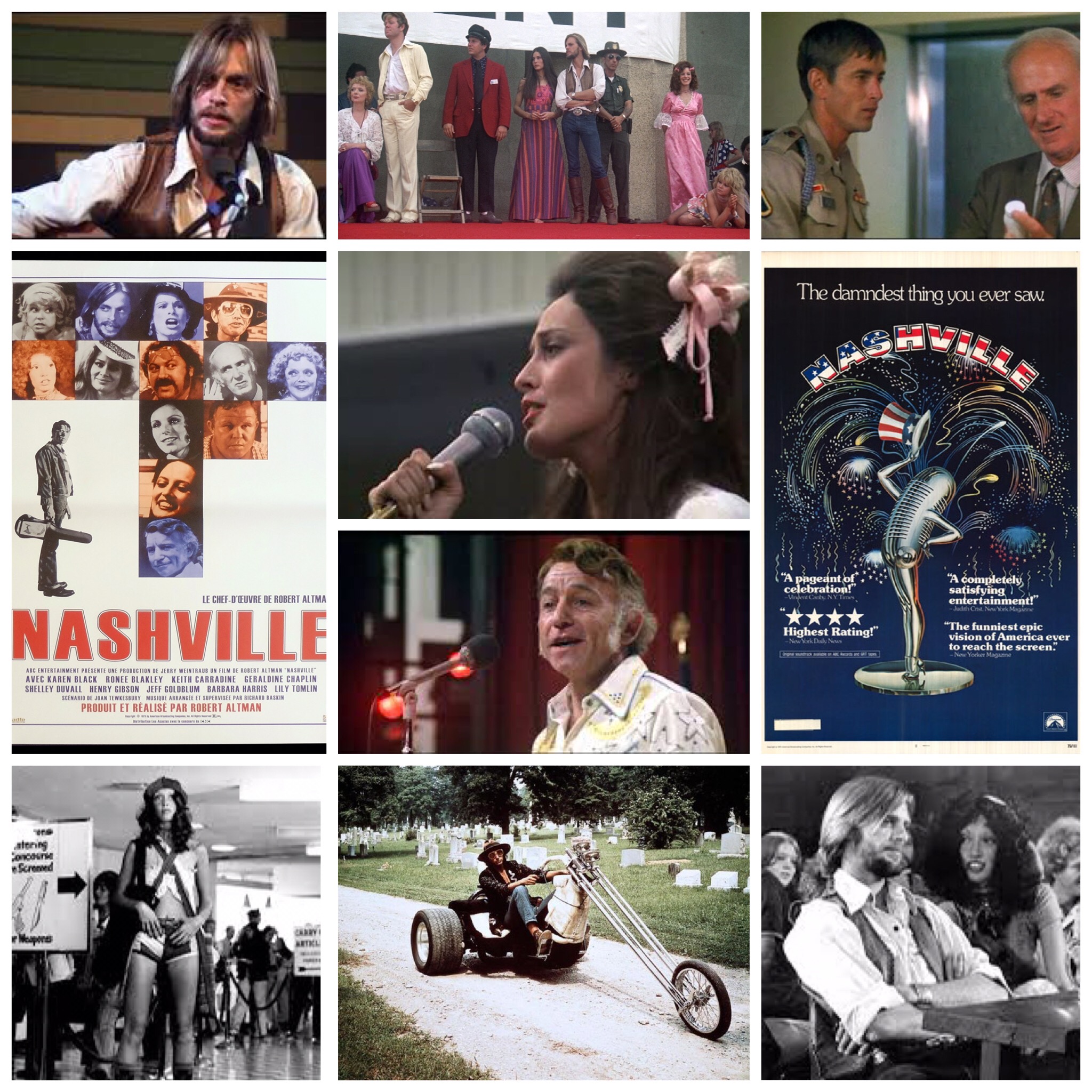
Nashville is the story of a few days in the life of twenty-four people in the titular city in which there are two defining events afoot. One of them is the re-emergence of country artist Barbara Jean (Ronee Blakely), the undisputed but fragile queen of Nashville who’s been convalescing after a recent “flaming baton” incident. The other is the organization of a political rally for Hal Phillip Walker, presidential candidate for the populist, third-party “Replacement Party,” and winner of enough recent primaries to make the political establishment sweat. Through these two events, which will eventually thread together, we follow a whole host of country stars, political advance men, groupies, journalists, bored husbands, their even more bored wives, rock stars, hangers-on, has-beens, never-weres, kooks, and earnest fans. There’s a lot of information that floats at the viewer like an unstoppable current but Altman, with the help of a framework screenplay by Joan Tewkesbury, links all of these characters together with an uncanny skill and a uniquely American eye.
Up until 1975, there had not been a film quite like Nashville. Sure, star-studded films in the vein of Grand Hotel had been produced and were crowd-pleasing successes, but even those felt more like omnibus tales and less like a grand tapestry in which there truly is no lead character. Nashville was the first film to spread its giant cast comfortably across the widescreen canvas while also making them feel as they were part of something that was bubbling with vitality and was recognizably and organically alive. And in fact, Nashville exists in a space where real stars such as Elliott Gould and Julie Christie appear alongside characters portrayed by actors with whom they’ve worked before. Additional life is given to the film in the way it integrates likewise authentic locations like the Grand Old Opry (replete with a real GOO audience) being utilized for the actors to authentically perform songs that they wrote and brought to the project themselves. While the greatest example of this form of Altman commitment likely goes to the mock presidential campaign that crossed paths with very real ones in Altman’s Tanner ‘88 (which, not coincidentally, featured Michael Murphy as the central visible political figure), Nashville was the first to truly make an Altman production the kind of all-in communal effort he’d been tinkering with since McCabe & Mrs. Miller.
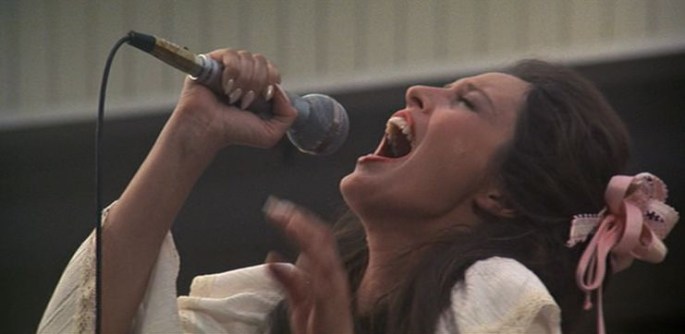
In the spirit of how our lives actually unfold, Nashville is a big movie built of little things. Broad gags such as the freeway pileup at the beginning and the climactic ending aren’t subtle nor are they hard to forget but the heart of the film is found in its small, fleeting passages such as the moment where Barbara Jean’s manipulative, boorish husband/manager, Barnett (Allen Garfield) blows her a kiss as she hits an emotionally terse high note while struggling to get through a musical set without a meltdown. It’s a film that recognizes the hurt on Mary’s (Cristina Rains) face when the vacuous Opal From the BBC (Geraldine Chaplin) announces that she, too, has slept with Tom (Keith Carradine), Mary’s musical partner to whom she’s truly in love despite being married to Bill (Allan Nicholls), the third in their musical trio. It’s a film that makes no judgements in understanding the delta between the feelings of frustration felt by Delbert Reece (Ned Beatty) and the joy felt by his wife, Linnea (Lilly Tomlin), while listening to their deaf son’s story about swimming class. It’s a film that picks up on the absolute contempt, punctuated by camera-ready smiles, that floods the face of Connie White (Karen Black) as she waits in the wings at the Grand Old Opry to fill in for Barbara Jean, a woman she positively hates. Finally, it’s a film that documents the sometimes ugly birth of stardom as it allows Barbara Harris’s unlikely and wonderfully ragged Albuquerque, a total hot mess of bleached hair, torn stockings, mismatched outfits, and wild dreams of becoming a “country western singer and or a star,” to triumphantly rise above tragedy, fully embodying American’s broken soul.
Nashville is also very good at both covering all of its bases and existing on a wavelength of recognizable ebbs and flows. It’s not satisfied with Gene Triplett’s (Michael Murphy) smug disdain for the people of Nashville as he tries to schmooze each and every star or half star into the Walker rally; it’s satisfied when it gets to show his utter shamelessness, following him into the hotel room of Tom and Mary where he attempts to rook them into the same show by dismissing the appeal of the country music artists he’s worked to put on the bill as being limited to dumb shitkickers. It’s not satisfied by showing us Barbara Jean virtually being draped in an American flag while performing “One, I Love You”; it’s satisfied when, earlier in the film, the tragically untalented Sueleen Gay (Gwen Welles) gets booed off the stage at a smoker for performing the same song. It’s not satisfied to show self-absorbed Tom treating every single woman that moves through his hotel room like absolute garbage and with reckless abandon; it’s satisfied when Linnea returns the favor by coldly and wordlessly reminding him that she’s past a point in her life where her feelings can be manipulated by a casual fling, even by him.
Nashville was the last time Altman keenly anticipated the culture and, in fact, the film’s ending became a reference point when Mark David Chapman assassinated John Lennon five years after the film’s release. But created in the haze between Richard Nixon’s resignation and the ascension of Jimmy Carter, Altman found the most fertile possible ground for the ascendancy of the campaign of a sleazy idiot like Hal Phillip Walker. For all the ink spilled on the prophetic nature of Sidney Lumet’s brilliant Network, released the following year, the bone-headed populism at the root of Hal Phillip Walker’s campaign has had longer legs with American culture. After all, not by coincidence, Altman would find the depths of the Reagan years to be the perfect time to recast Hal Phillip Walker as a (still unseen by the audience) right-wing television talking head in his unnecessarily maligned O.C. and Stiggs. The chord of Hal Phillip Walker and how it would likely eat America from the inside out was something that must have troubled and disgusted Altman to such a degree that, after Nashville, Altman ceased reporting on the culture and, in a manner of fashion, tried to do more to influence it (to diminishing returns) with specific elements found in A Perfect Couple, Quintet, and HealtH.
Nashville caused quite stir when it was released and it was uniformly detested by the Nashville community. Of course, this should be expected as, outside the coasts, most every place in America which feels like it’s keeping her memory pure has an almost insatiable desire to appear as unblemished as one of Tom Wolfe’s freshly-pressed suits. But what did Nashville reveal that was so objectionable? That, despite their cornpone humility, folks in the south can be just as petty, uninformed, and judgmental as those in New York or Los Angeles? That reductive, simple-minded country weepies like “For the Sake of the Children” could actually be hits? That there exists a ruthless power structure within the bowels of show business, regardless of what region of the country one finds themselves? That black country entertainers like Tommy Brown (Timothy Brown) have to often grit their teeth and accept the transactional relationship they have with their majority-white milieu? That boredom and infidelity occur in spades, even in places where seemingly everyone goes to church on Sunday morning, even if that house of worship is a hospital chapel? If Nashville, the city, was so bent out of shape at the content explored in Nashville, the film, then they simply revealed that the flame put to their hypocrisy was justified. Just as, in an effort to move forward, Shelley Duvall’s Keechie resigned herself to repeating the untruth that the father of her child died of consumption in Thieves Like Us, perhaps Nashville (and America as a whole) keeps its engine humming along on the fuel of an untenable false narrative about itself that is two parts hubris and one part tomfoolery, lacking any ability or desire to take account of itself.
In 2017, I was asked to list my top ten films of all time and I chose Nashville as number two (for the record, Peter Yates’s Breaking Away will never not be number one). At that time, I talked about how the election of Donald Trump evoked the memories of the end of the film and how America was basically conditioned to just sing and move on after catastrophic events without proper acknowledgment or collective reflection. Since that time, we’ve lived through a pandemic in which the former president couldn’t have cared less that half a million Americans died on his watch. We also saw a deadly insurrection in Washington D.C. at the behest of that same president. With the help of performative politicians who traffic in shallow patriotism with low-rent celebrities, the disreputable, right-wing media has created a cultural situation in which logic is untoward and facts are verboten, preparing us for a future that is as terrifying as it is unpredictable. But in our relative, localized comfort, we still continue to do the same thing as Haven Hamilton does at the end of Nashville; bloodied and bruised, we will call everything to order and give the microphone to someone… anyone… who will hopefully distract us from the pain and the damage. Up until now, this formula has always worked though, as sure as I’m sitting here writing this, one day it won’t. But, until that day, “It Don’t Worry Me” won’t be just a song in this film, it’ll stand as our glib, alternative-national anthem.
America the doomed, the damndest thing you ever saw.


 Podcasting Them Softly