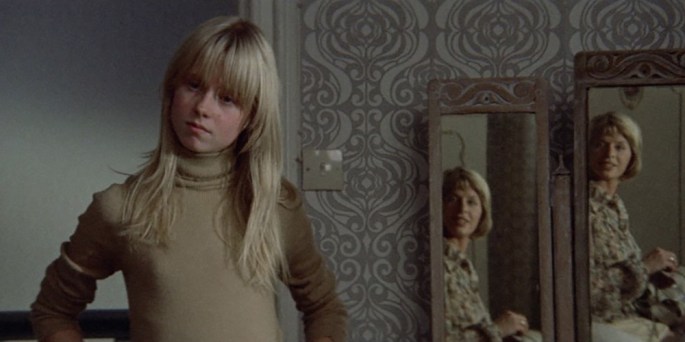
Robert Altman was once quoted as saying that, to him, his entire filmography was one whole movie with each individual film a chapter. If this is true, Images, the lone horror film in his career, is a very pivotal chapter in that string as it reflects backwards on characters already introduced while also projecting forward and allowing the audience to more clearly see how, in Altman’s cinematic world, trace elements of one project can seep into another.
In some ways Images is a re-examination of Frances Austen from That Cold Day in the Park but through the prism of Cathryn, a much more sexual and less socially awkward creature than Frances but one who likewise nurses a mysterious void in her life. In direct opposition to Frances’s hanging out with barely-sentient wax mummies to fill the time, Cathryn spends her days writing children’s novels and waiting around for her boorish jagoff of a husband, Hugh, who has business dinners that last until four in the morning and, like a complete asshole, wears driving gloves as if they’re a perfectly acceptable and fashionable addition to his fall ensemble.
Despite the obvious differences between herself and Frances, Cathryn is similarly and undeniably unwell, which is made quite obvious in the first five minutes of the movie. Mysterious and disturbing phone calls which may or may not be occurring give way to brief, shocking hallucinations which cause Cathryn and Hugh to beat retreat to Green Cove, a semi-isolated, two-story cottage where Cathryn lived with her grandfather during her childhood (shot in picturesque County Wicklow, Ireland). Once there, the hallucinatory nature of the visitations of former lover Rene blend with the shifting, confusing interactions with not only Hugh but also old friend and neighbor, Marcel, and his twelve-year old daughter, Susannah.
On top of employing a lot of methods of twinning, namely the utilization of mirrors and clever match cuts, Altman plays a deft and creative card by swapping all of the cast and characters’ names. Susannah York plays Cathryn, Cathryn Harrison plays Susannah (who, in a moment of perfect, unnerving realization later in the film, says “I think I’m going to be just like you” to York). In terms of the men in Cathryn’s life, Altman stalwart Rene Auberjonois portrays Hugh, Hugh Millais portrays Marcel, and Marcel Bozzuffi portrays Rene. Identity is all but annihilated which keeps the viewer off-balance and the tension ever-shifting.
Up to this point, Images would be Altman’s most intimate film which has perhaps lent to its relative obstructiveness in Altman’s oeuvre. Coming hot on the heels of the megacast and decidedly anti-authoritarian M*A*S*H and Brewster McCloud but before the giant wave of films that would cement Altman’s style (namely The Long Goodbye and California Split), Images is a curious, lonely beast that, despite Susannah York’s Best Actress win at the Cannes Film Festival that year, is only beginning to gets its due almost fifty years after its release. This just a little more than unfortunate as Images uses the manifestation of madness through architecture and space in such a a way that puts it in the exact same company as Robert Wise’s The Haunting, Roman Polanski’s Repulsion, Stanley Kubrick’s The Shining, and Ari Aster’s Hereditary.
And Images is yet another exhibit in what was becoming Altman’s hobby, namely genre bending. In fact, this may be his very most successful. While every other movie seems to function within its respective genre while also obliterating the conventions, nobody doubts that, say, The Long Goodbye is a mystery or that Thieves Like Us is a crime picture. Yet despite the legitimate chills and shocks that come from Images (and there are plenty), it’s only been since until recently that it’s been accepted as a horror film even though it is almost explicitly so. However, this might also be more due to the arbitrary boundaries put on horror films in general which causes discussions surrounding them to devolve into qualifying nonsense where something gets described as “elevated horror.”
Images is also the first film since The Delinquents in which Altman takes full screenplay credit. That being said, all of Susannah York’s narration is hers as it incorporates In Search of Unicorns, an actual children’s book she authored and released in 1973 (and for which she is given full credit at the end). This detail in which Altman utilizes and injects elements of reality onto his cinematic canvas had already felt during the shooting of McCabe & Mrs. Miller where the cast had to choose and mend their own costumes throughout the entire production. But by incorporating York’s actual book as a double for Cathryn’s, Images takes on a multi-dimensioned life of its own which predated the kind of extraordinary hands-on approach to the country music that would be deployed by his cast in Nashville or the in-the-mix of media and politics that would give life to Tanner ‘88.
On a technical level, Images is a stunner. Masterfully dressed by production designer Leon Ericksen, the film has an almost tactile quality and is enormously clever. From Hugh’s complicated folding glasses to the numerous cameras, lenses, stereopticons, and the ocular designs in her headboard, Cathryn lives a life overloaded with optical tchotchke and bric-a-brac where she always feels seen. The subtle details that seem to appear in both Cathryn and Hugh’s home in town and in Green Cove gives off the impression that the film may not take place anywhere outside of Cathryn’s mind. Every detail seems to have a match and every thread seems to be tied.
Pulling off some fluid camerawork alongside more static moments that reveal exquisite, painterly compositions which come alive with York’s beautifully tempered narration of passages from her book, Vilmos Zsigmond’s cinematography is just achingly gorgeous and it gives Images the sheen of a dark fairy tale set in a haunted, mystical land. John Williams garnered an Oscar nomination for his stately and creepy score which is often and effectively punctuated by sharp and discordant sounds by Japanese composer Stomu Yamashta.
In the beginning of Altman’s next film, The Long Gooodbye, driving gloves are introduced in a key moment, offering a visual clue to the film’s mystery to the audience without also revealing it to Philip Marlowe. Five years later, the shared DNA of Cathryn and Frances would most certainly find its way into Shelley Duvall and Sissy Spacek’s characters in 3 Women. And while these seem like trivial details that might even be described as wild reaches, if we were to take Altman at his word in that all of his movies served as one continuous film, it’s hard to argue that these things that floated downstream and lodged themselves explicitly in Altman’s future projects weren’t the consciously laid soft-tissue connections that joined his entire cinema together like a massive, gorgeous tapestry.
 Podcasting Them Softly