Top Ten Tommy Lee Jones Performances

Tommy Lee Jones has had a uniquely interesting career.  He’s made a career out of playing the authoritative Gary Cooper-esque strong silent types; yet Jones has embraced his stoic calling to cinema, freely admitting that some of his turns are because people pay him a lot of money.  Even when he’s walking through a role that he’s done before, like in CAPTAIN AMERICA, he’s always a joy to watch.  Jones is incredibly sharp; his IQ is astronomic.  He’s best friends with Cormac McCarthy, and spends his free time on his ranch in Texas.  Jones is also a PR nightmare.  He only does interviews because he is contracted to, and he makes it very apparent during them, and you can’t help but feel bad for the person who is interviewing him.   His career is has been split into three different factions: staple Tommy Lee Jones, wildly hammy and outrageous Tommy Lee Jones, and the quiet auteur behind the camera who has become one of cinema’s most quietly treasured filmmakers.

BATMAN FOREVER 1995 Dir. Joel Schumacher
TLJ BATMAN

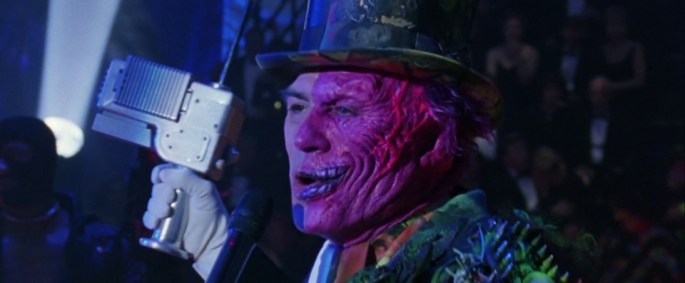
Cashing in on his recent Oscar win for THE FUGITIVE, Jones embarked on a crash course of over-the-top shtick.  In an interview, Jim Carrey recalled meeting Jones for the first time prior to filming.  Carrey was sitting at a bar excited to meet Jones.  Jones walked in, went up to Jim Carrey and looked at him dead in the eyes and said, “I hate you.  I really don’t like you.  I cannot sanction your buffoonery.”  As cold and outright awful a thing that is to say to someone, I can’t help but picture that situation in my mind and laugh.  Jones spent the entire production in ridiculous costumes and makeup, doing his absolute best to out Jim Carrey, Jim Carrey.  Whilst the film is a far cry from the Burton films, it is still a lot of fun.  The fun is attributed to the ironically great chemistry between Jones and Carrey.

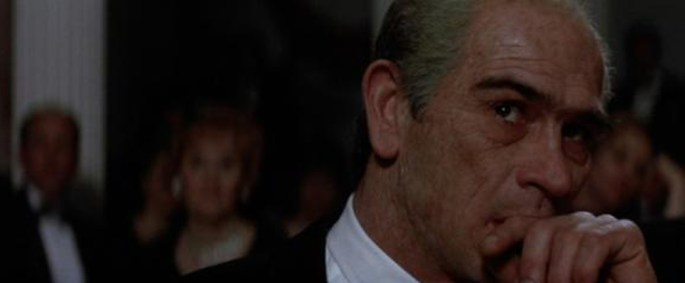
COBB 1994 Dir. Ron Shelton
Cobb.jpg

COBB is a unique film.  It’s a very unorthodox sports biopic by Ron Shelton, yet it almost feels incomplete.  For any flaws this film has, it has nothing to do with Jones’ performance.  He is remarkable in this film.  Shelton did some of the best writing of his career with the overly colorful dialogue that he provides for Jones.   He blends his stoicism with a very hammy performance.  It is easily Jones’ most understated performance.  He plays two Ty Cobbs, the young and ruthless baseball player in flashbacks and then for a majority of the film, a mad old genius that is very reminiscent of Howard Hughes.  He’s brilliant, he’s crazy, he’s outrageous, and yet Jones shades this unlikable character with an amount of vulnerability that you cannot help but identify and sympathize with.

HEAVEN AND EARTH 1993 Dir. Oliver Stone

Heaven and Earth.jpg

In Jones’ second collaboration with Olive Stone, he portrays the most frightening character in his career, the affable Steve Butler who falls in love with a woman while serving in Vietnam.  Throughout the course of the film once he enters, Jones takes a back seat in more of a supporting role, but while watching the film unfold, you feel the pressure of his performance whenever he’s not on screen.  His character is brutal, a psychological villain that has nothing to give the world but overt brutality.

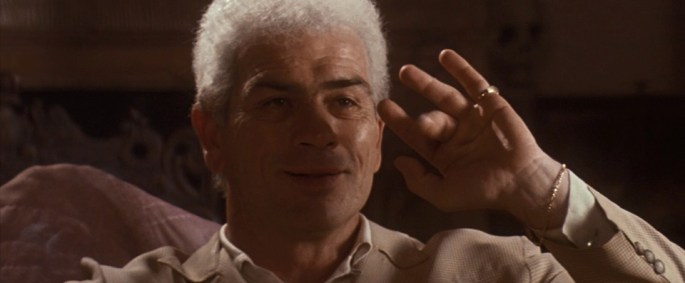
JFK 1991 Dir. Oliver Stone
JFK.jpg

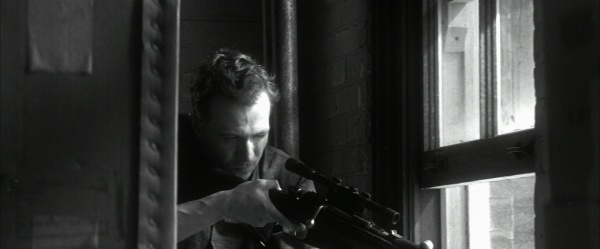
There is not enough that can be said about Oliver Stone’s masterpiece about obsession.  It is one of the most engrossing films ever made; it has the most unique ensemble ever.    The casting of Jones as a flamboyantly gay, ex CIA man who lives in the public of New Orleans as well as the dark shadow world of conspiracy, and underground sex parties is one of the most brilliant casting strokes ever.  Jones plays two characters in this film.  Clay Shaw, the upstanding citizen, business man, and community leader of New Orleans.  He’s the epitome of a straight man; he’s regarded and respected, he’s a class act.  And then.  And then we see him as Clay Bertrand, in all gold body paint, with a cap on making himself look like the Greek God Apollo, snapping poppers and inhaling excessive amounts of cocaine and acting in a way that is so repulsive, you are completely mesmerized by his performance.

LINCOLN 2012 Dir. Steven Spielberg

Lincoln.jpg

Daniel Day-Lewis playing the most admired President in US history wrapped with Tommy Lee Jones’ turn as the civil rights champion Thaddeus Stevens is an absolute Godsend to cinema.  While Day-Lewis’ performance flat-out dwarfs everyone else in this film, Tommy Lee Jones goes toe to toe with him.  His screen time is smaller than it probably should have been, but Jones gives a standout performance not only in the film, but also of his career.  His apathy for anything other than what is right, is brutally honest in this film.  His sunken and worn down physicality only adds mileage to a performance, which if anyone else played could have most certainly been a one note role.

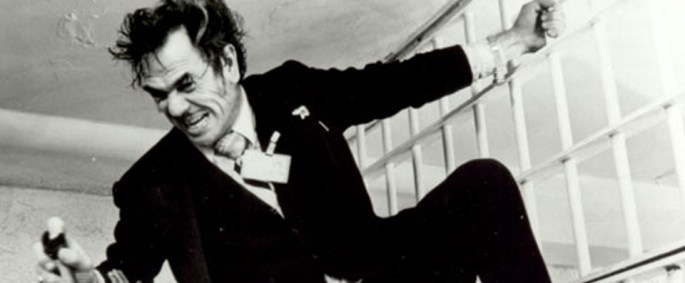
NATURAL BORN KILLERS 1994 Dir. Oliver Stone
Natural Born Killers.jpg

In their third and final collaboration Oliver Stone and Tommy Lee Jones brought to life one of the most excessively outrageous characters in a film that was already chalked full of excess.  In the third act of the film, we are introduced to the vile Warden Dwight McCluskey, and my God is the Warden a vile human being.  His greasy hair is perfectly slicked to the side, his crusty pencil thing moustache is all you can look at, and his zany attire is obnoxious.  Jones plays this part perfectly.  He outdoes anything he has ever done.  His performance is out so out of control it makes Mickey and Mallory look tame.

NO COUNTRY FOR OLD MEN 2007 Dir. Joel and Ethan Coen

No Country.jpg

No one could have played Sheriff Ed Tom Bell like Tommy Lee Jones.  The horror and cruelness of Cormac McCarthy’s world is in every crack and crevasse of this man’s face.  The brutality of it all has worn this man down, more so than almost any other character we have seen on the screen.  He’s a man who as seen it all, until the events of the film unfold, and his apathy is swiftly shaped into caution and disbelief.  His low key performance is criminally overshadowed by the flamboyance of Javier Bardem.  This performance remains on the highest tier of his filmography and is one of his most underrated.

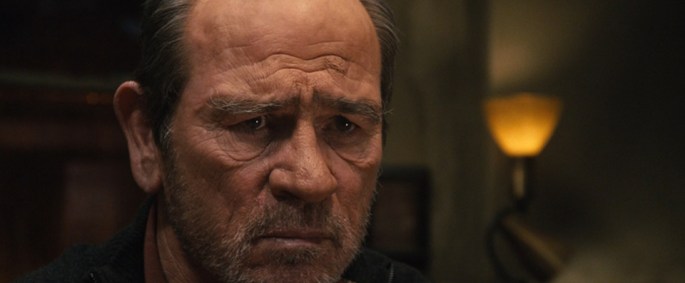
THE SUNSET LIMITED 2011 Dir. Tommy Lee Jones
SL.jpg

HBO deserves all the credit in the world for allowing Tommy Lee Jones to adapt Cormac McCarthy’s brutally heavy two man play for a Saturday night premier.   It is one of the most emotionally draining experiences anyone can endure.  The dark philosophy of life is on full display in a two hour conversation between a suicidal intellectual played by Jones and a killer turned born again savior played brilliantly by Samuel L. Jackson.  McCarthy’s razor sharp dialogue is made even more protruding by Jones’ linguistic abilities as well as his physical acting.

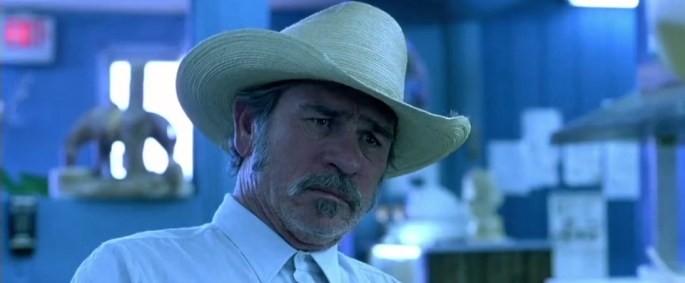
THE THREE BURIALS OF MELQUIADES ESTRADA 2005 Dir. Tommy Lee Jones
THREE BURIALS.jpg

The honestly of Jones’ performance in this film is absolutely haunting.  The hardened vulnerability of his performance is what won him Best Actor at Cannes, and it is a performance that will always stick with you after seeing it.  Out of his entire filmography, his performance in this film is the one that is criminally underseen, underrated, and understated.  I implore anyone and everyone to seek this unique film out and watch it.  This is the film that put Jones on the map as a not only a brilliant filmmaker, but in that unique class of actor/filmmaker that rarely works to the degree that it does with this gut-wrenching film.

UNDER SIEGE 1992 Dir. Andrew Davis

US.jpg

Whoever was behind casting Tommy Lee Jones against Steven Seagal is a genius.  Jones capitalizes on his quick wit and intellect and amazingly holds his own against Seagal in their blistering knife fight during the climax of the film.  Jones is at his absolute finest in this film, delivering darkly humorous dialogue that is strangely understandable.  Not only is Jones on fire in this film, he also gives us one cinema’s best villains.  What makes his performance so great in this film, is how much fun he’s having.

Honorable mentions: THE FUGITIVE/US MARSHALS, IN THE VALLEY OF ELAH, THE HUNTED, BLOWN AWAY, SPACE COWBOYS, LONESOME DOVE, BLUE SKY, THE CLIENT, ROLLING THUNDER.
JFK – A REVIEW BY J.D. LAFRANCE

JFK5

The assassination of American President John F. Kennedy is a watershed event in American history and one that has provoked people to question their own beliefs and those of their government. Yet, for such a highly publicized affair there are still many uncertainties that surround the actual incident. Countless works of fiction and non-fiction have been created concerning the subject, but have done little in aiding our understanding of the assassination and the events surrounding it. Oliver Stone’s film, JFK (1991) depicts the events leading up to and after the assassination like a densely constructed puzzle complete with jump cuts and multiple perspectives. Stone’s film presents the assassination as a powerful event constructed by its conspirators to create confusion with its contradictory evidence, to then bury this evidence in the Warren Commission Report, which in turn manifests multiple interpretations of key figures like Lee Harvey Oswald. JFK offers a more structured examination of the conspiracy from one person’s point of view where everything fits together to reveal a larger, more frightening picture implicating the most powerful people in the United States government.

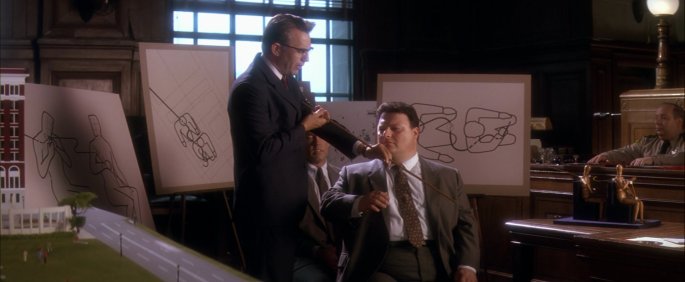
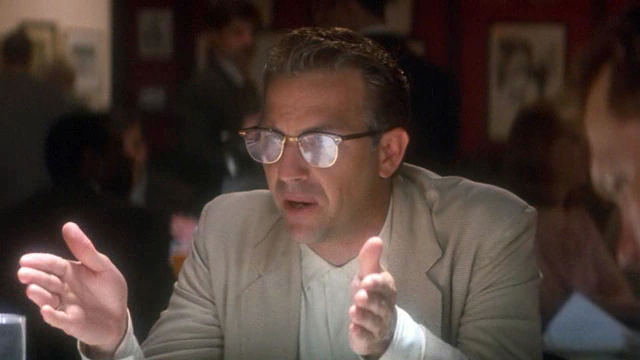
JFK presents the assassination of Kennedy as a powerful event constructed by its conspirators to create confusion with its contradictory evidence and then theorizes that the evidence was buried deep in the Warren Commission Report. Stone’s film filters a structured examination of two conspiracies, one to kill the President and one to cover it up, from one person’s point of view — Jim Garrison (Kevin Costner) — who then assembles all of the evidence at his disposal to reveal a larger, more frightening picture that implicates the most powerful people in the United States government. Stone saw his movie consisting of several separate films: Garrison in New Orleans against Clay Shaw (Tommy Lee Jones), Oswald’s (Gary Oldman) backstory, the recreation of Dealey Plaza, and the deep background in Washington, D.C.

While attending the Latin American Film Festival in Havana, Cuba, Stone met Sheridan Square Press publisher Ellen Ray on an elevator. She had published Jim Garrison’s book On the Trail of the Assassins. Ray had gone to New Orleans and worked with Garrison in 1967. She gave Stone a copy of Garrison’s book and told him to read it. He did and quickly bought the film rights with his own money. The Kennedy assassination had always had a profound effect on his life and eventually met Garrison, grilling him with a variety of questions for three hours. The man stood up to Stone’s questioning and then got up and left. His hubris impressed the director.

Stone was not interested in making a film about Garrison’s life but rather the story behind the conspiracy to kill Kennedy. To this end, he also bought the film rights to Crossfire: The Plot That Killed Kennedy by Jim Marrs. When Stone set out to write the screenplay, he asked Sklar to co-write it with him and distill the Garrison book, the Marrs book and all the research he and others conducted into a script that would resemble what he called “a great detective movie.” Stone told Sklar his vision of the movie: “I see the models as Z (1969) and Rashomon (1950), I see the event in Dealey Plaza taking place in the first reel, and again in the eighth reel, and again later, and each time we’re going to see it differently and with more illumination.”

Sklar worked on the Garrison side of the story while Stone added the Oswald story, the events at Dealey Plaza and the “Mr. X” character. To tell as much of the story as they could, Stone and Sklar used composite characters, a technique that would be criticized in the press, most notably the “Mr. X” character played by Donald Sutherland and who was a mix of several witnesses and retired Air Force colonel L. Fletcher Prouty, an adviser for the film.

600px-JFK_017

Stone ambitiously wanted to recreate the Kennedy assassination in Dealey Plaza and his producers had to pay the Dallas City Council a substantial amount of money to hire police to reroute traffic and close streets for three weeks. He only had ten days to shoot all of the footage. Getting permission to shoot in the Texas School Book Depository was more difficult. They had to pay $50,000 to put someone in the window that Lee Harvey Oswald was supposed to have shot Kennedy from. They were allowed to film in that location only between certain hours with only five people on the floor at one time: the camera crew, an actor, and Stone. Co-producer Clayton Townsend has said that the hardest part was getting the permission to restore the building to the way it looked back in 1963. It took five months of negotiation.

Filming was going smoothly until several attacks on the film and Stone began to surface in the mainstream media including the Chicago Tribune, published while the film was only in its first weeks of shooting. Five days later, the Washington Post ran a scathing article by national security correspondent George Lardner entitled, “On the Set: Dallas in Wonderland” that used the first draft of the JFK screenplay to blast it for “the absurdities and palpable untruths in Garrison’s book and Stone’s rendition of it.” The article pointed out that Garrison lost his case against Clay Shaw and claimed that he inflated his case by trying to use Shaw’s homosexual relationships to prove guilt by association. Other attacks in the media soon followed. However, the Lardner Post piece stung the most because he had stolen a copy of the script. Stone recalls, “He had the first draft, and I went through probably six or seven drafts.”

The film depicts the events leading up to and after the assassination as a densely constructed story complete with jump cuts, multiple perspectives, a variety of film stocks and the blending of actual archival footage with staged scenes dramatized by a stellar cast of actors. This blurring of reality and fiction by mixing real footage with staged footage makes it difficult to discern what really happened and what is merely speculation. Stone does this in order to create what he calls “a countermyth to the myth of the Warren Commission because a lot of the original facts were lost in a very shoddy investigation” and simulate the confusing quagmire of events as they are depicted in The Warren Commission Report. Stone creates different points of views or “layers” through the extensive use of flashbacks within flashbacks. Stone has said that he “wanted to the film on two or three levels — sound and picture would take us back, and we’d go from one flashback to another, and then that flashback would go inside another flashback . . . I wanted multiple layers because reading the Warren Commission Report is like drowning.” This technique conveys the notion of confusion and conflict within evidence.

Kevin Costner acts as the perfect mouthpiece for Stone’s theories. The auteur’s infamously forceful directorial approach to his actors pays off here as he reins in the actor’s usual tics and mannerisms. Stone was no dummy — he knew that by populating his film with many famous faces, he could make the potentially bitter pill that was his film, that much more palatable to the mainstream movie-going public. The rest of the cast is phenomenal. Gary Oldman’s delivers an eerily authentic portrayal of the enigmatic Lee Harvey Oswald. Tommy Lee Jones is note-perfect as the refined, self-confident businessman, Clay Shaw. Even minor roles are filled by such name actors as Vincent D’Onofrio, Kevin Bacon, Jack Lemmon, and Walter Matthau.

The film throws many characters at us and it is easier to keep track of them by identifying them with the famous person that portrays them. Stone was evidently inspired by the casting model of a documentary epic he had admired as a child: “Darryl Zanuck’s The Longest Day (1962) was one of my favorite films as a kid. It was realistic, but it had a lot of stars…the supporting cast provides a map of the American psyche: familiar, comfortable faces that walk you through a winding path in the dark woods.” Future biopics with sprawling casts, like The Insider (1999), and Good Night, and Good Luck (2005), and The Good Shepherd (2006) would use this same approach.

Seeing JFK now, one is reminded that first and foremost, it is a top notch thriller. There are so many fantastic scenes of sheer exposition that would normally come across as dry and boring but are transformed into riveting scenes in the hands of this talented cast. For example, the famous scene between Garrison and X (Sutherland) where the mysterious man lays out all the reasons why Kennedy was killed and how is not only a marvel of writing but also of acting as the veteran actor gets to deliver what is surely one of the best monologues ever committed to film.

capture91

JFK is an important film in the sense that it accurately portrays the assassination of Kennedy as a complex public event surrounded by chaos and confusion. It presents a main protagonist who exposes the conspiracy to be an intricately constructed coup d’état. Stone paints his canvas with broad brushstrokes and powerful images. JFK takes a larger, confrontational stance by boldly implicating the government in the conspiracy and the mainstream media in conspiring to cover it up. Stone is using the persuasive power of film to reach the largest number of people he can in order to wake them up and to reveal how they have been deceived by higher powers. There is no mistaking the importance of the assassination of Kennedy in American culture. Based on the excitement that surrounded Stone’s film, the American public is still greatly interested in the event with more and more people believing in a plot to kill Kennedy.

STEPHEN HOPKINS’ BLOWN AWAY — A REVIEW BY NICK CLEMENT

11754354_10204994461997491_2830460152826839308_o

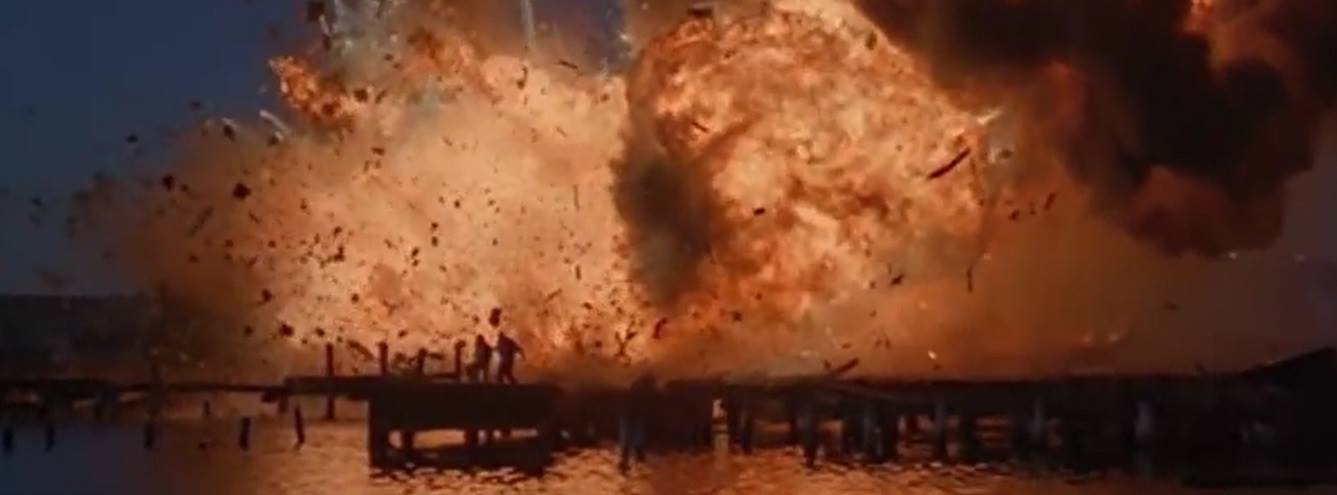
Back in the summer of 1994, there were three big action films to hit the marketplace: Speed, True Lies, and sandwiched in between, was the underrated Blown Away, which suffered the worst box office fate of the bunch but still delivered more than enough thrills and excitement to qualify as an action-packed blast of unpretentious entertainment. This movie is so much fun in an old-school, traditional manner (it just FEELS, in a great way, like an MGM movie), shot with lots of style by director Stephen Hopkins (Predator 2, The Ghost and the Darkness) and acted with intense ferocity by Jeff Bridges and Tommy Lee Jones, as a Boston bomb squad officer and a mad Irish bomber respectively. Jones is running wild on the streets of Boston, blowing up anything and everything he can find, all in an effort to exact revenge on his old friend Bridges, who both went through IRA/terrorist issues which are dealt with in black and white flashback. Bridges is the noble cop who always seems to know which wire to cut – the blue one or the red one. While the plotting is mostly predictable, the film knows exactly what it’s doing with its numerous action scenes, and it must be pointed out, that the film features the SINGLE GREATEST DONE-FOR-REAL EXPLOSION ever captured on film. There’s no debating this. I fucking LOVE movie explosions. I’ve made it a point to STUDY them throughout my life. This one is top-dog. When Jones’ old shipyard boat goes kablooey at the climax, you literally can’t believe what you’re watching and that the two fearless stuntmen weren’t killed or burned to death. The image has REAL camera shake, glass windows in downtown buildings were blown out, and total radio silence in and around Boston Harbor was kept for 10 miles so no interference could occur with the destruction of the balsa wood ship. Peter Levy’s cinematography is terrific all throughout, and the brisk editing keeps the pace moving fast. Kino has just released an excellent special edition Blu-ray of this extremely fun, throw-back type action thriller that was more old-fashioned than audiences may have been expecting. Hopkins provides a great, info-filled commentary, and the picture transfer is very crisp and clean, retaining that awesome, slick-and-gritty 90’s film stock look, with that final explosion looking all sorts of epic and awesome in full 2.35:1 widescreen (previous DVD releases were non-anamorphic). Alan Silvestri’s score is appropriately bombastic and thoroughly exciting. Forest Whitaker, Suzy Amis, Ruben Santiago-Hudson, John Finn, and Lloyd Bridges all offer memorable support. Cuba Gooding Jr. has literally 30 seconds of screen time in one scene. Jay Roach (Meet the Parents) got original story credit!

11709757_10204994462317499_7107405643540402664_o