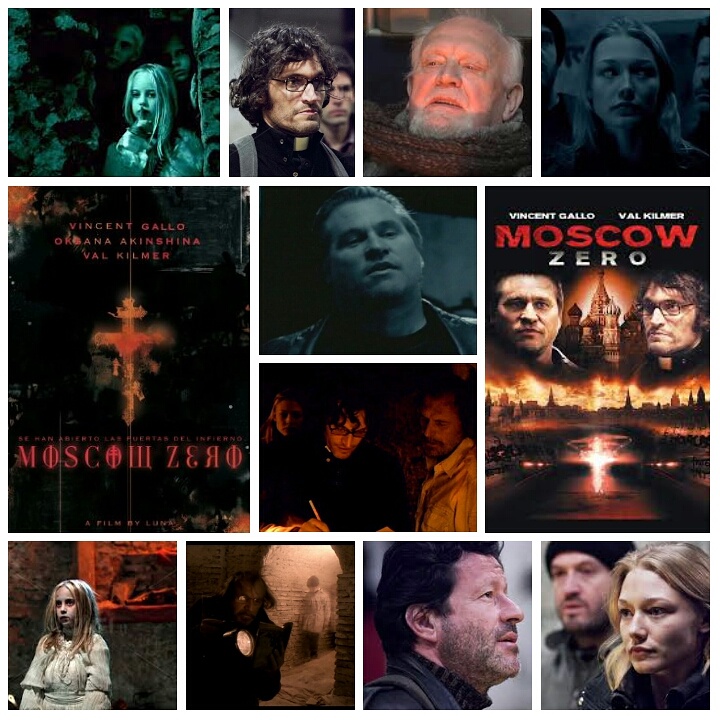
Moscow Zero is a chilly little subterranean ghost story, and a favourite for me. It god critically shredded by the few people who did see it, and quickly forgotten. I think this may be because of odd marketing,and the cultural rifts in different areas of both the world, and cinema. It was marketed in North America as a supernatural shocker starring Val Kilmer, which was a cheap shot to fans and in fact false advertising. Kilmer is in it, for maybe ten minutes, and is very good, but the story isn’t his. It’s also supernatural, but in a far more subtle, ambiguous and inaccessible way that the ADHD-ridden audiences over here just aren’t used to. In short, it’s very European, and they just seem to have a better handle on the intuition it takes to make an atmospheric chiller than anyone else, also seeming to be more connected with ghost lore and the spirit realm. The story concerns a priest named Father Owen (hollywood’s resident alien Vincent Gallo, playing it dead straight here). He has traveled to Moscow I hopes of finding his friend Professor Sergey (Rade Serbedzija), who has descended into ancient catacombs and endless tunnels below the surface of the city in hopes of finding a lost artifact hidden during wartime. He joins up with a group of guides and Moscow natives including the beautiful Lubya (Oksana Akinshina) and a tracker named Yuri (Joaquim De Almeida) to traverse the underside of the city and find his friend. There are long, eerie scenes of Sergey wandering around the dimly lit labyrinth, pursuing his scholarly goal and talking to himself as strange shadows and far away whispers follow him around, gradually letting the viewer know that he’s not alone. Owen and his team rendezvous with Tolstoy (Joss Ackland) the elderly leader of a tribe of tunnel dwellers who won’t go below a certain level of the catacombs, who provides a map. Then they go deeper. Kilmer plays Andrey, a Russian dude who runs a gang that are in control of opening and closing a deep fissure gate that is said to lead to a hell like place. He’s relaxed, in both demeanor and the Russian accent, but he’s clearly having fun in one of his more character type roles. The catacombs have a haunted feel to them, and indeed there are ghosts, but not presented in the way you might think. The way the human characters see them is quite different from how they see themselves, and how the audience sees them, which is a nice touch. The story keeps itself mysterious, right up until it’s puzzling, creepy conclusion, buy I prefer that open ended, almost experimental style over desperate attempts to scare us. It’s atmospheric, strange, unique, thick with ideas and altogether a bit of brilliance. Definitely an aquire taste, though.
Tag: Val Kilmer
Tony Scott’s Deja Vu: A review by Nate Hill
The late Tony Scott and Denzel Washington collaborated on five films, the second last of which is underrated sci fi thriller Deja Vu. It contains Scott’s trademark visual style, all skitchy sketchy frames, deliriously rapid editing and deep, gorgeously saturated colours that pisses a lot of people off in its garish, flippant aesthetic. I for one love his style, and here he is coming down off the high that was his masterpiece, Domino, exercising restraint that was no doubt mandated by the studio bigwigs. Nevertheless, the same unmistakably heightened forces of filmmaking that flow through the veins of this crackling thriller can be found in most of his work, just in smaller doses here. The film tackles a lot in its unassuming narrative, from terrorist bombing, an elliptical story that’s put in an otherworldly trance by a plot point involving a high tech time travel capability, and a surprisingly heartfelt undercurrant that somewhat sneaks up on you. During a captivating opening credit sequence, we see a horrific explosion onboard a navy transport ferry in the New Orleans harbour, killing over five hundred people including women and children. ATF Agent Doug Carlin (Washington) is called in to investigate, and before long his cunning intuition catches the eye of FBI Agent Pryzwara (an unusually calm Val Kilmer) who is spearheading a very hush hush investigative technique that’s being used to track the terrorist in the days leading up to the incident. What Kilmer doesn’t tell him is the mind-bending metaphysical implications of it, but keener Denzel gets wise to their act, and throws himself headlong into a quest to stop the bomber, save the mysterious Claire (Paula Patton, just phenomenal) who was murdered and has ties to the event, and reverse time. Denzel is an implosive wrecking ball of determination, his ingenuity and reserve made me wonder why Carlins career aspirations stopped short of the ATF. I don’t know why Patton isn’t in more films (she recently starred alongside Denzel again in the super fun 2 Guns), she brings a battered resilience to her work, and is a radiant beauty to boot. Peppy gerbil Adam Goldberg is the obligatory one liner spewing techie who’s got more going on than his exterior may read, and Bruce Greenwood is all stern bluster as the FBI honcho in charge. This film doesn’t often come up in discussions of either Denzel’s or Scott’s greatest hits, but it’s ripe for rediscovery and praise. Propulsive action, far fetched sci fi intrigue that’s hard to digest and follow, yet simultaneously wicked fun, and like I said before an emotional core that takes you by surprise. There’s a sentence that I internally intone to myself whenever I see a film, or aspects within a film that fire up my adrenal glands, tear ducts or simply rouse my soul. Be it a banger of an action sequence, a romance that hits all the right notes, a good old fashioned fantastical invention or visual flights of fantasy that stir wonder within me. That sentence is “This is why I watch movies”. I get no greater pleasure in my cinematic escapades than being able to say that to myself as my heart pumps to the tune of whatever grand spectacle I’m witnessing before me onscreen. I can tell you, the sentence was uttered while watching this one, and now that I think of it, pretty much every film in Scott’s portfolio. Highly recommended.
OLIVER STONE’S ALEXANDER — A REVIEW BY NICK CLEMENT
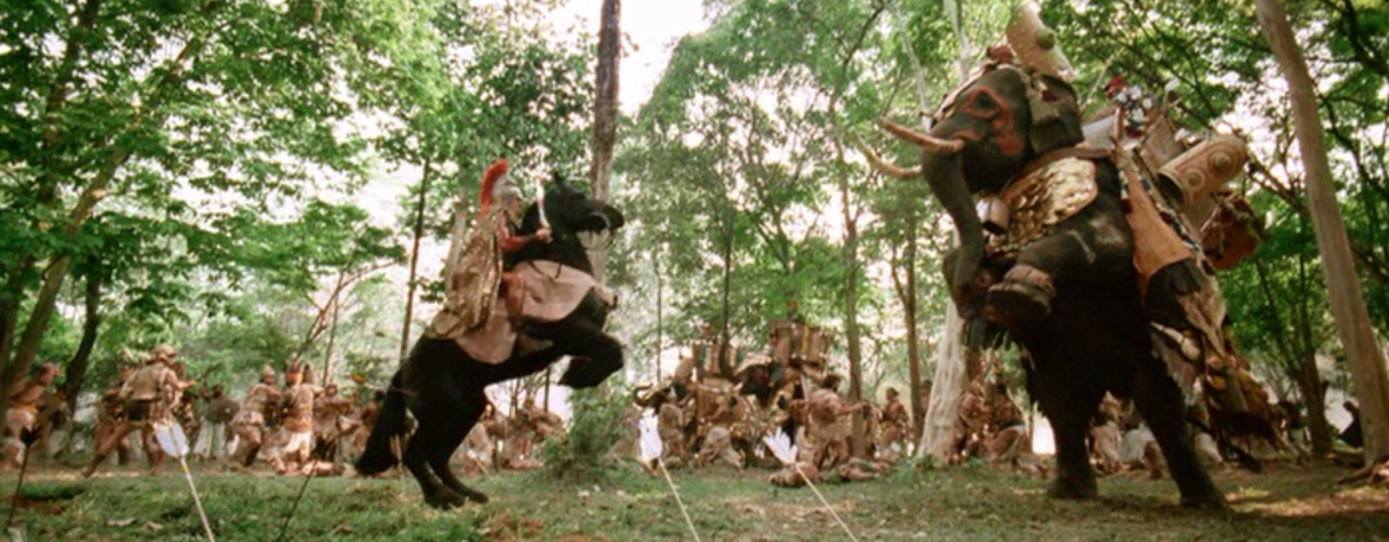
Bursting with over-sized ambition, ferocious amounts of energy, and fever-pitch emotion that’s never afraid to go over the top, Oliver Stone’s gargantuan period epic Alexander is one of the best modern evocations of ancient history that’s ever been crafted, and easily the most underrated film of Stone’s legendary career. I’ll never understand the unnecessary hate that was piled upon this remarkable achievement upon first release; I think it’s because Stone dared to challenge familiar genre ingredients that people were hesitant to the film’s many strengths, from the non-linear narrative to the positively overwhelming battle sequences that put every other depiction of cinematic “Sword and Sandal” combat to shame. In fact, I’ll go so far as to say that the “war-elephant” fight in the jungle, to say nothing of the massive Battle of Gaugamela set-piece, is the single greatest battle scene of its type ever captured on film – relentless, beyond bloody, and truly terrifying — it’s positively hellish to observe, with Stone totally flipping out, even going so far as to show what would happen if an elephant stepped on your face. Rodrigo Prieto’s muscular, hugely expansive, and utterly breathtaking widescreen cinematography is always a sensuous treat, the fired-up screenplay is filled with boisterous speechifying and juicy political intrigue, the immense and soaring musical score by Vangelis reaches for the stars, and the performances range from small to large from a ridiculously stacked cast.
Colin Farrell gave it everything and more and left nothing to spare in a performance that clearly grabbed him from the inside; just look at his eyes in some of the scenes in this film and tell me he’s not insanely aligned with his character. And then you have Angelina Jolie at the absolute pinnacle of her silver-screen hotness – a true serpent/vixen of a role for the ultimate cinematic cobra. Jared Leto, Christopher Plummer, Rosario Dawson, Anthony Hopkins, Val Kilmer and a plethora of “faces” all robustly spiced up the ensemble, while the extravagant and eye-filling production design by Jan Roelfs contributed to the verisimilitude of the entire film. Yes, it’s campy in spots, but likely intentionally so, as the various subtexts and themes are explored in an upfront fashion. But for the most part, this is a deadly serious tapestry of people, places, events, and moments, all patched together in that fabulously unhinged Stone fashion, where the storytelling and filmmaking demonstrates a live-wire spark. The dense script was highly interested in the various characters and their unique motivations, and there’s a sense of gusto to just about every facet of this film that never ceases to impress. This is bravura filmmaking, made by a master director who clearly possessed a true passion for the material, which makes the entire production feel all the more compelling. I saw this film twice theatrically, I own every permutation of the picture that’s been released on DVD/Blu-ray thus far, and I feel that Stone’s recent and most definitive cut is the absolute best that’s been offered. This is a project that Stone seemingly cannot let go of, a film that has driven one of our most challenging and distinctive filmmakers potentially insane.