The VHS Files: Two Small Bodies

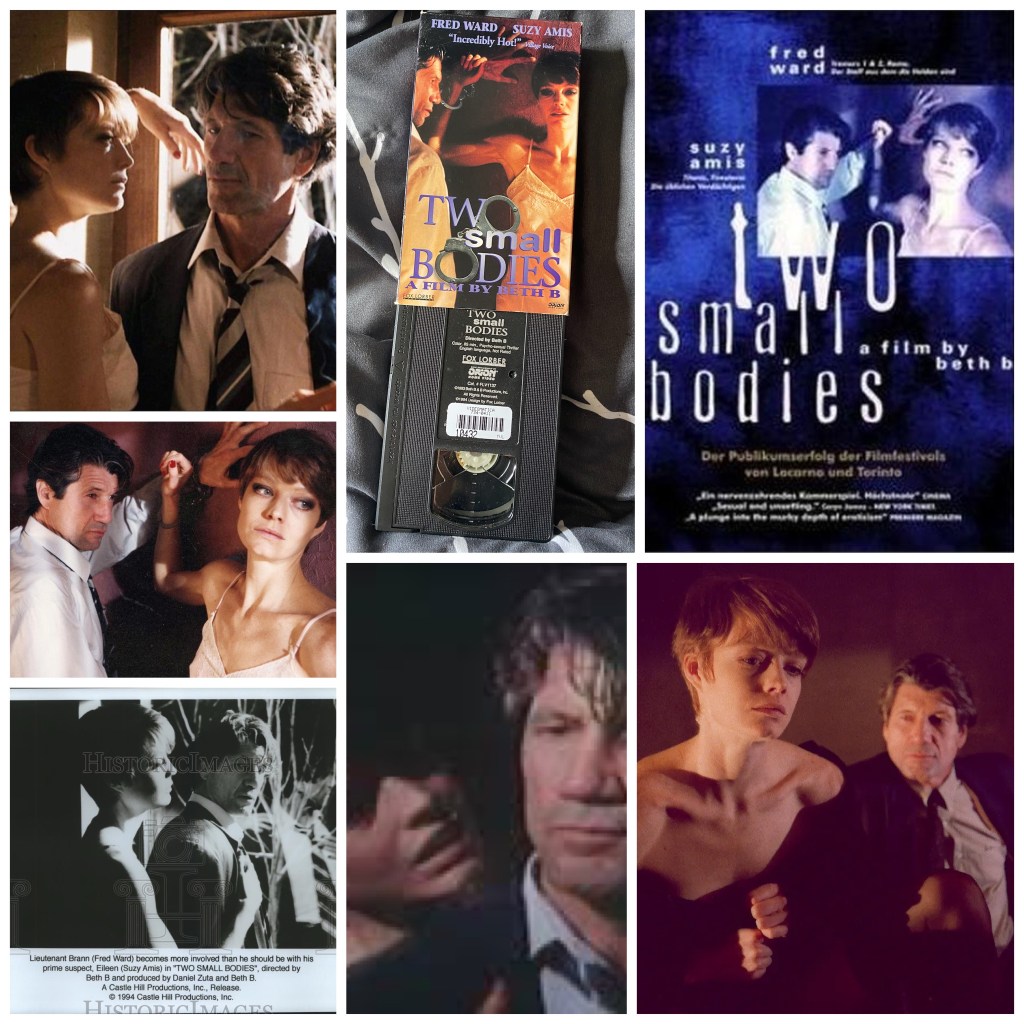
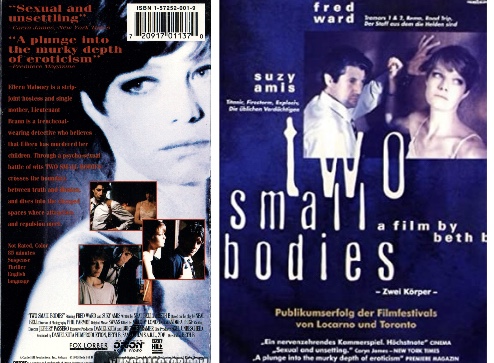
Today’s VHS File is an odd one called Two Small Bodies, essentially a grim two person drama that sees a police lieutenant (Fred Ward) relentlessly interrogate a single mother (Suzy Amis) who has reported her children as missing. They hang about her house as he goads, manipulates, probes and generally just drives a wedge into her life in an attempt to find out what happened to her kids, and he cultivates a growing suspicion that she’s the guilty party herself. This is based on a stage play, so we just have this one location, two actor story without anything else in the way of dynamics. Thankfully our two leads are both excellent, particularly Ward who is at his most… manic, Jim Carrey style acting I’ve ever seen him in a career full of mostly straight shooter authoritarian/cop roles. His cop (I began to wonder if he even was a real cop) here is a piece of work, and takes full advantage of the fact that Amis’s character is a stripper in his tirade of investigative fury towards her. The film is directed by cult filmmaker Beth B so the kinky underground vibe is there, but she struggles somehow in getting this story successfully across. You can only go so far with a constant back and forth barrage between two characters before you need narrative innovation and for your story to, you know… go somewhere! Unfortunately this doesn’t go anyplace concise beyond having the two leads engage in bizarre, borderline surreal roundtable dialogue and questionable behaviour and then just sort of leaves the ending open for us to figure out. I had a vague idea myself of who these two really were, what happened to the kids and what their situation was really about but the film (not sure how the play goes) does little to solidify any concreteness and let’s the final frames billow out in ambiguity like the perpetually windswept curtains in this woman’s nocturnal abode. That’s not to say it’s inherently a bad choice, ambiguity can be an especially *strong* choice if implemented correctly, but you just never know how each viewer will respond to that, and I was left a little lost. A fascinating exercise, if an incomplete one.

-Nate Hill

The VHS Files: John Irvin’s Freefall

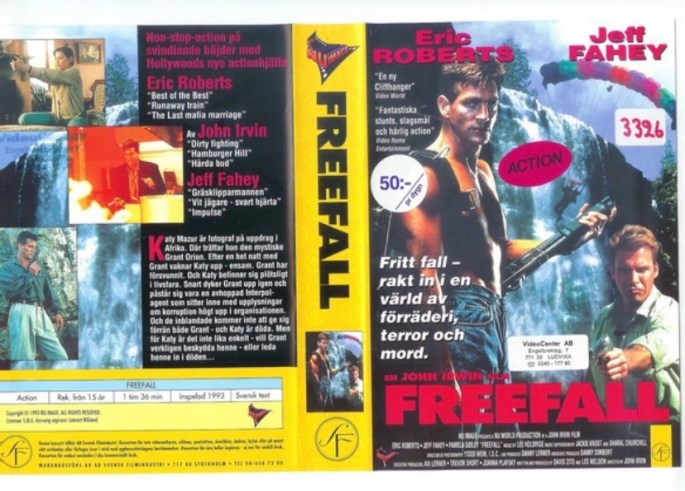
Today on the VHS Files is a super sexy Cliffhanger knockoff called Freefall starring an impossibly sweaty Eric Roberts, a super smarmy Jeff Fahey and a very foxy Pamela Gidley, who actually passed away last year and many of us fondly remember as Teresa Banks from Twin Peaks. This is actually a really solid action flick set in an exotic location and featuring these three B icons at the peak of their physical attractiveness. Pam plays wildlife photographer Katy, sent by her boss and fiancé Dex (Jeff) to get pictures of a rare bird of prey somewhere in deepest Africa. There she meets Eric’s Grant Orion, a daredevil adrenaline junkie who parachutes off waterfalls when he’s not sipping brandy on the hotel veranda, and she falls for him hard, hard enough for us to get to see them bang way up atop a waterfall with a gorgeous view. The plot goes bananas when it’s revealed that Grant is some sort of disgraced former Hollywood stuntman turned double agent for Interpol, all kinds of baddies are introduced including a freaky ass albino assassin and Dex himself who turns out it to not be the perfect fiancé she thought, and a globetrotting cat and mouse game gets underway. Roberts is terrific here, all lithe physicality and southern charm, Fahey himself tries an odd southern accent and comes across as a bit hammy but such is the arena here anyways, while Gidley fills out the action heroine role nicely. The film is directed by a dude named John Irvin who also did stuff like the Patrick Swayze western Next Of Kin, the rough crime pic City Of Industry, the cult Chris Walken curio Dogs Of War, the war film Hamburger Hill and the Schwarzenegger flick Raw Deal so he just knows his way around a good solid action sequence and how to handle tough guy actors. This is good fun with gorgeous locations, three knowingly arch lead performances and a relaxed vibe.

-Nate Hill

The VHS Files: Yesterday’s Target

Today’s VHS File is a dusty old SciFi time travel flick called Yesterday’s Target whose plot I just couldn’t get a handle on, despite it having some cool ideas, ambient atmospherics and neat set pieces. It stars one of the Baldwin brothers, and you pretty much know what you’re in for when they headline something. Daniel Baldwin is an unassuming factory worker who is recruited by a shadow organization because of his untapped psychic talents, targeted by a mysterious rogue military scientist played by Malcolm McDowell in one of his classic mega villain roles but he’s curiously restrained and relaxed here. Baldwin basically goes on a cross country road trip to find other psychics like him including a clairvoyant (Stacey Haiduk), a short order cook who is a firestarter (T.K. Carter from The Thing in this film’s liveliest performance) and others. They’re pursued by McDowell’s top man, a cowboy hat wearing Levar Burton in a bizarrely cartoonish performance that doesn’t work and brings the film somewhat down whenever he’s onscreen. There’s an absolute deluge of expository mumbo jumbo, arbitrary subplots and just garbled SciFi clutter here including some secret society that travels through time to prevent people from having shitty lives, a child prodigy, Vegas card sharking, McDowell’s random personal life with his wife and all sorts of interludes that muck about until I really wasn’t sure what this film was even about beyond a vague idea of ‘time travelling clairvoyants.’ Still, it’s very atmospheric and some of the performances are a lot of fun. It’s also quite muted and laidback and even when there’s gunplay or a pursuit it feels just… hushed and soothing somehow. There’s a deliberately anticlimactic ending as Baldwin and McDowell standoff only to surprise each other with revelations regarding identity, time loops and serendipitous phenomena that again, I wasn’t clear on, but allows Malcolm to inject some real poignancy into an otherwise standard villain role, if even for a brief moment when all is almost said and done. It’s worth a look but nothing special. I have no memory of where I even got the VHS tape but it’s another one of those screeners that nobody is supposed to sell yet somehow find their way to good homes. I see this is also streaming on something called Tubi though, if anyone is at all curious.

-Nate Hill

The VHS Files: Conundrum aka Frame By Frame

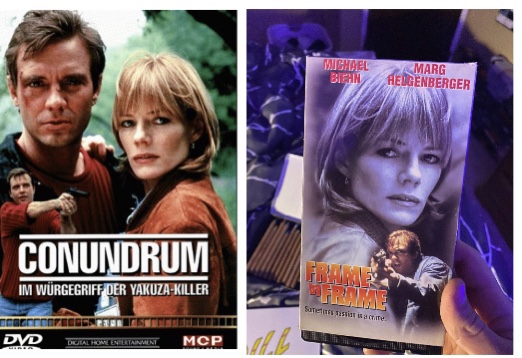
So here’s a fun idea (I hope)… I have hundreds of unwatched, obscure VHS tapes ive collected over the years and I’ve recently organized them, fired up the VCR and begun to explore the darkest corners of Z-Grade 70’s, 80’s and 90’s analog nirvana, so I’ll do a series of intermittent reviews based on these random, unheard of treasures with a snapshot of the tape itself, just for fun. First up is one called Frame By Frame, which I guess is officially called Conundrum on IMDb. It stars Michael Biehn and Marg Helgenberger as two inner city cops who begin to have a fiery affair amidst the aftermath of gangland killings stirred up by a Chinese crime syndicate. His family is murdered to set an example, this event brings them closer as she comforts him but before you know it other nasty secrets are unleashed and the classic obligatory ‘web of deceit, betrayal, twists and kinky obsession’ of the essential 80’s B movie potboiler is set into motion. Biehn and Helgenberger are perfect for each other, and on top of being two of the absolute sexiest cult icons of their day, they actually turn this run of the mill script into something fun thanks to their vivid characterizations. He’s as wild eyed and frantic as he was in Terminator and even gets one sly ‘big emotion’ scene that takes on new meaning once all the twists unfold, and she does this tough girl tomboy thing with her accent and mannerisms that’s fun too. The story kind of goes wildly all over the place and I didn’t quite follow every hairpin turn or believe in this brand of convolution but hey, it’s an ancient DTV flick and half the fun is watching these two stars rip snort their way through the hard boiled narrative anyways. I’m fairly sure I may be the only person to have ever seen this film because the tape I have is one of those promotional screeners that aren’t for resale (but they always are anyways), there are positively zero user reviews on IMDb or even critics reviews out there elsewhere on the interwebs and one can barely find traces of its existence at all beyond the tape I have. Good times though, especially if you love Biehn and Marg as much as this viewer.

-Nate Hill

Hoping for resurrection: Michael Mann’s The Keep

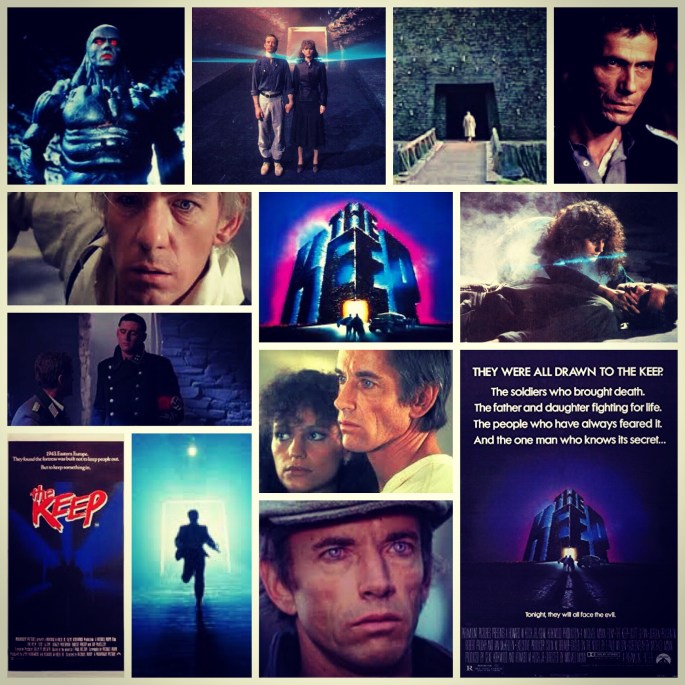
It’s a shame that Michael Mann feels the way he does about The Keep, and although I can’t really blame him after the Leatherface worthy hack job the studio inflicted on his original three plus hour cut, it’s a heartbreak and a half that we may never see a director’s version because what is left is still one of the most haunting, beautifully done Lovecraftian horror fever dreams one can find in VHS-land. Based on a brilliant novel by F. Paul Wilson, Mann employs a legion of smoke machines, a troupe of eclectic character actors all cast against type and giving marvellous work, and a drop dead gorgeous original score from Tangerine Dream that remains in my top OST’s to this day. Somewhere deep in the Romanian mountains, a squadron of German soldiers led by weary Captain Woerman (Jurgen Pröchnow) comes a across a tiny hidden village that harbours a dark secret: just beyond the township is a looming, mysterious structure built to keep something locked inside, and has lain dormant for centuries. Their gravest mistake is setting up camp in this unholy basilica, for soon they’ve awoken whatever resides within, and it really wants out. Cue the arrival of sadistic SS officer Kaempffer (a very young Gabriel Byrne) and his Nazi bastard crew, as well as a professor of ancient languages (Ian Mckellan) with his daughter (the late Alberta Watson). Elsewhere in Europe, otherworldly stranger Glaecken (the great Scott Glenn) is stirred by the happenings at the Keep and treks across the war torn continent towards an unknown end. What follows is an entrancing supernatural fusion mixup of old school prosthetic effects, genocide metaphors, lovingly creaky production design and synth music that will scorch your soul. Glenn plays the shadowy warrior better than ever here, with a paranormal gleam in his eyes and the stone-faced, gravel voiced resolve to see his strange quest through to a brutal conclusion. McKellen emotes fiercely both in and out of some well done old age makeup, sometimes almost unrecognizable but always spirited and present. Pröchnow rarely gets non villain roles with depth but this might be his best ever, early in his career too. He turns the Captain into a sorrowful picture of regret and compassion that one doesn’t often see in Hollywood based German army roles from WWII. Watson is a doe eyed beauty whose loss of innocence and discovery of love is portrayed wonderfully by the actress, who sadly passed away long before her time. Byrne is evil incarnate, with a startling cropped haircut that would be right at home in this day and age it seems. Mann favourite Robert Prosky also shows up as a local priest with knowledge of The Keep. Somewhere out there in someone’s garage there lies a full cut of this film, just waiting for an extended Blu Ray transfer, complete with tweaks on sound design (its fuzzy commotion at times), special features and the redemptive treatment that a sterling genre addition like this deserves. There’s so much quality to be found in it, from the alluring atmosphere that’s so thick it finds its way into your dreams after, to the aforementioned Tangerine Dream soundtrack that haunts the film’s visual landscape like an auditory phantasm to the silver and purple hued neon production design, resplendent in its tactile, tangible glory, it stands as a flawed classic with the potential to be so much more, if Mann mans up and makes the effort to give one of his very best efforts that care and time it deserves to rise from the void and soar again. If only. Oh and one more thing: there’s one more scene before the credits that isn’t in the actual cut, but go find it on YouTube because it’s really worth it and adds a lot to the story.

-Nate Hill

TONY SCOTT’S TOP GUN — A 30TH ANNIVERSARY RETROSPECTIVE REVIEW BY NICK CLEMENT

1

At this point in our culture, it’s nearly impossible to discuss Top Gun with any amount of clear-eyed objectivity. The film is a milestone for all of its key contributors, a pop culture touchstone for multiple generations of people, and an often imitated and parodied relic from a very specific time and place in cinematic history. For director Tony Scott, it was his early-career masterpiece, the film that announced an exciting new voice in commercial cinema while showcasing his slippery-slick yet still gritty visual aesthetic, which would come to dominate the action genre for decades. It’s also the film that got him out of director’s jail after the critical and box office failure of his artsy debut, The Hunger, which is now of course a premiere cult classic. For producers Don Simpson and Jerry Bruckheimer, it was the movie that truly solidified them as the uber-showmen of the 1980’s, with Flashdance and Beverly Hills Cop arriving before and Beverly Hills Cop 2 and Days of Thunder immediately following.
10

As legend has it, Simpson and Bruckheimer were in their office, and an issue of California magazine was sitting on their desk, featuring a clean cut fighter pilot standing next to a jet. And with that evocative and elaborate “Nothing On Earth Comes Close” Saab commercial that Scott had made in the early 80’s continually turning heads (the one that showed a Saab 37 Viggen fighter jet going neck and neck with the Saab 900), it was clear that it would be a match made in heaven between the producers and their ace in the hole. And for star Tom Cruise, it was his first runaway blockbuster sensation, his first taste of global superstardom, and the film that made him a house-hold name. Top Gun is a product of its time in a way that so few films can claim to be, and over the years, has come to mean so many different things to so many different people, which is why it remains imminently watchable 30 years later.
2

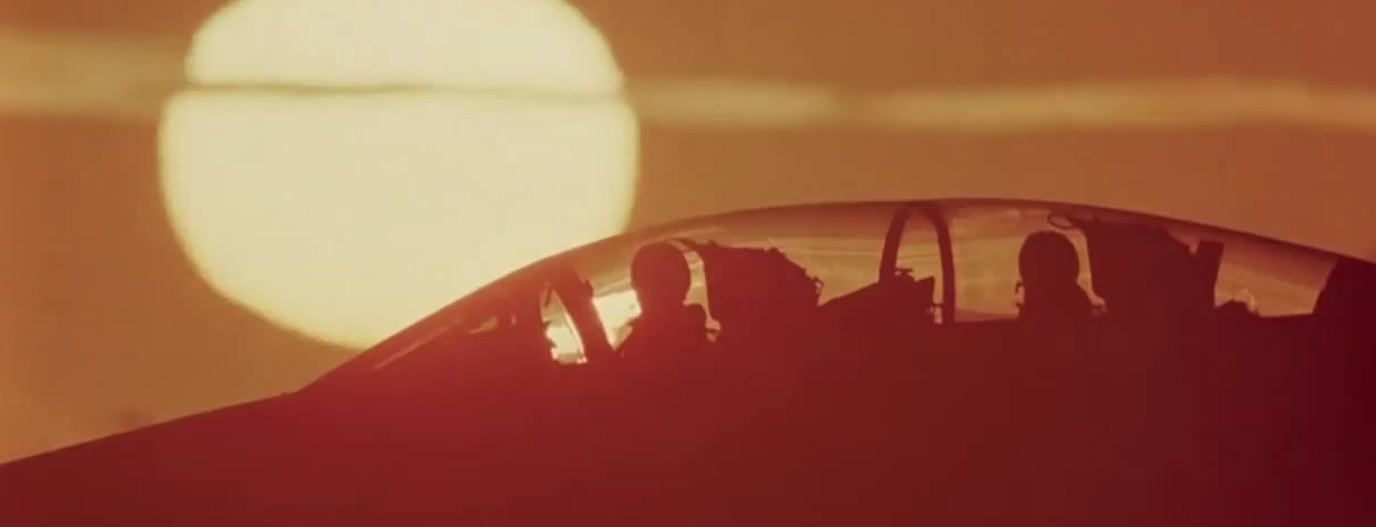
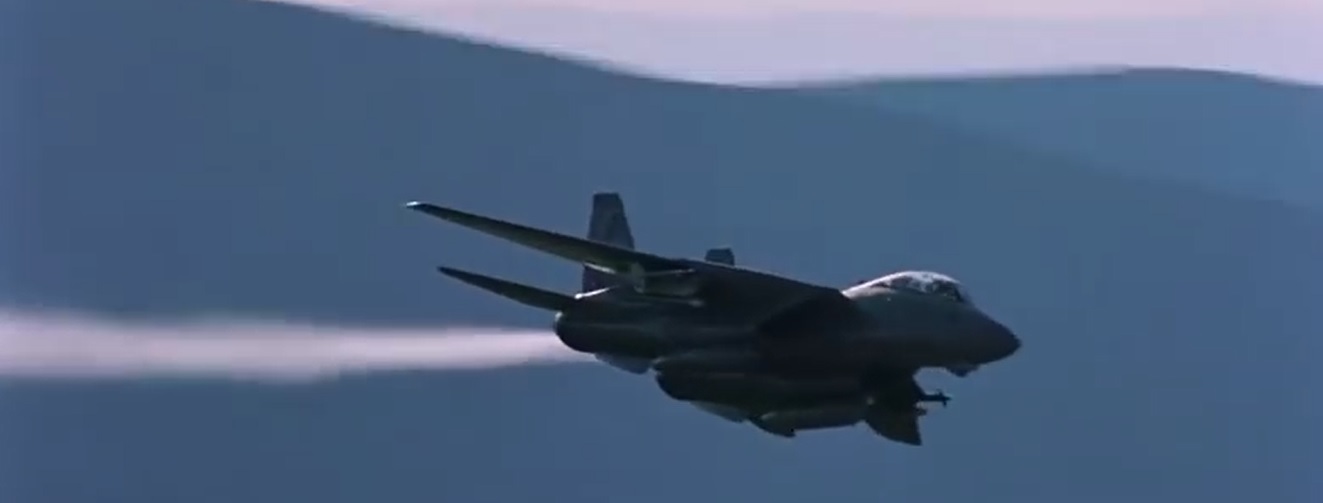
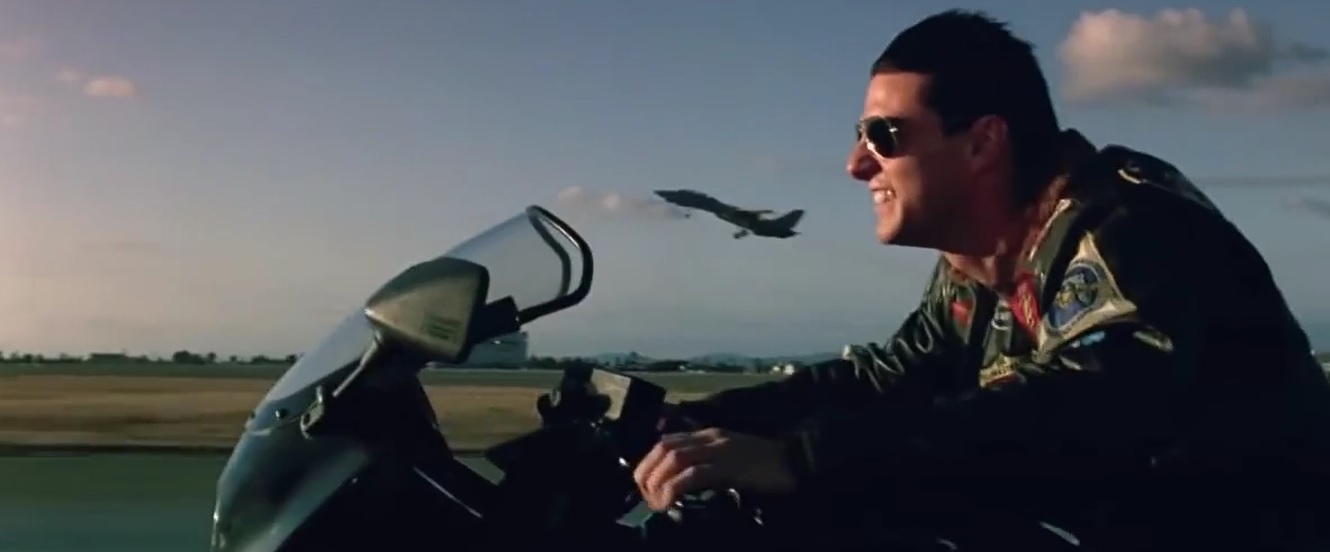
Released in the summer of 1986, Top Gun played on the still lingering fears of war with the Soviets, and carried a rah-rah, jingoistic spirit that seems laughable to some nowadays, but probably felt very honest at the time of release. It feels pointless to rehash the plot of Top Gun – anybody with a pulse has seen it and knows all about Maverick (Cruise, in all his perfect-grinning excellence) and Goose (Anthony Edwards, everyone’s best buddy) and Iceman and Jester and Charlie and the rest of the crew. The scenes on the ground carry an earnestness to them, playing off of melodrama (the mysterious death of Maverick’s father, himself a legendary pilot; workplace romance; the death of a best friend), but the film truly comes alive when it’s up in the sky, as Jeffrey Kimball’s gorgeous, smoky, 2.40:1 anamorphic widescreen cinematography is still a lesson in mid-80’s perfection. Every single shot in this film is spectacular, whether the moment is big or small, with cool blues and sunset reds dominating the horizon. It can’t be understated how influential the look and feel of Top Gun would become for so many films and filmmakers to follow in the years, and whether or not this style is your favorite or not, it’s undeniably exciting on a visceral and stylistic level, with an emphasis on the balance of light, visual minutiae, and overall atmospheric texture. It’s commercial cinema without a shred of pretension, smartly focusing on the drama and action inherent to the story’s scope, and all balanced out by Harold Faltermeyer’s propulsive, oh-so-80’s musical score and the lightning quick editing patterns of Billy Weber and Chris Lebenzon. And when you add in the ridiculously quotable one-liners conjured up by co-screenwriters Jim Cash and Jack Epps, Jr. (who knew that rubber dog shit originates from Hong Kong?) and the high-flying airborne camerawork which is still unmatched to this day, then it’s no wonder that the film plays every Sunday on TNT and has become one of the most influential and iconic movies ever made, with so many other movies attempting, and failing, to ape its success.
3

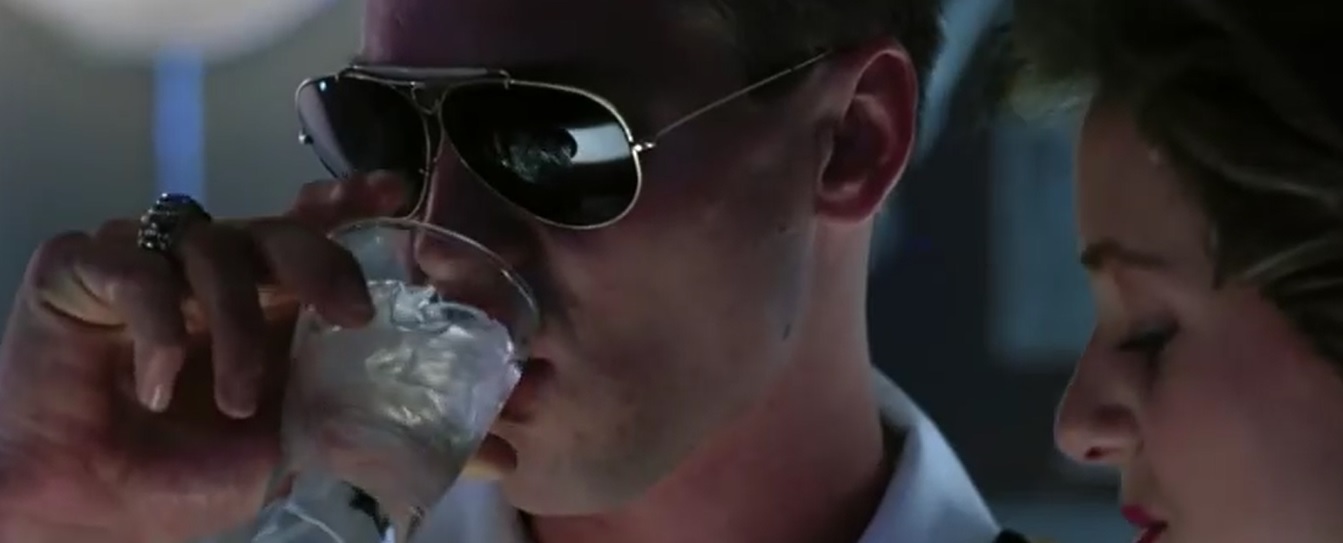
On a thematic level, the film is all about machismo (a major theme in all of Scott’s work), and how men deal with expectations, loss, tragedy, acceptance, and success. Those classic scenes in the shower (or during a particular game of beach volleyball…) seem homoerotic in hindsight (and maybe they did upon first glance…), but what they’re really about is men trying to one up each other, trying to figure out how to best your opponent, and always remembering that there are no points for second place. To say that Top Gun is one of the most macho movies ever made would be understatement; you can practically smell the testosterone on the set. I’ve often wondered if PA’s were kept solely for the purpose of spraying down the actors with water in order to simulate excessive sweat, because everyone is glistening in this film. Top Gun also expertly understands male camaraderie and friendship, and how people are willing to go the extra step for those that they care about, both professionally and personally. Kelly McGillis and Meg Ryan were the objects of affection for Cruise and Edwards respectively, while the absurdly masculine supporting cast included Val Kilmer, Anthony Edwards, Tom Skerritt, Michael Ironside, John Stockwell, Clarence Gilyard, Jr., Whip Hubley, James Tolkan(!), Barry Tubb, Rick Rossovich, Duke Stroud, Tim Robbins, and Adrian Pasdar.
5

Shot for a now hard to believe $15 million, Top Gun opened on roughly 1100 screens nationwide, grossing $8,193,052 on its opening weekend. The film would eventually gross $176 million in the U.S. and another $177 million overseas, truly cementing the Simpson-Bruckheimer brand after the similar worldwide gross two years previous from Beverly Hills Cop. Top Gun would also break every single VHS sales record, as it was one of the first movies made available to the public at the $20 price point. Scott would continue his legendary streak with the two producers in the following years with the equally huge Beverly Hills Cop 2, and then in 1990 with the summer hit Days of Thunder, which while not becoming the blockbuster some might have thought, is still a splendid piece of action moviemaking that was all accomplished with zero CGI and some of the greatest racing footage ever put on film. But Top Gun would be the film that all of the creative parties would become remembered for, what with its sleek visual design, tough guy banter, love story for the ladies, and the dynamic aerial combat footage that still pops off the screen to this day, especially when viewed in the Blu-ray format. In 2015, the United States Library of Congress added the film to their preservation vaults, deeming it “culturally, historically, or aesthetically significant.” And if you’re not a fan of Top Gun, then just remember, the plaque for the alternates is in the ladies’ room.
11