Currently streaming on Netflix and not for the squeamish, Danish filmmaker Kristian Levring’s The Salvation is a ferocious variation on the Death Wish formula, except set in the old, lawless west circa 1864, with old-school nods to John Ford and Sergio Leone peppered throughout the story, while still feeling resolutely modern and tack-sharp. The blood-boiling screenplay by Levring and Anders Thomas Jensen concerns a stoic family man played by Mads Mikkelsen (channeling some of that internal rage from Valhalla Rising) whose wife and son are killed by convicts; Mikkelsen then charts a course of violent revenge against the men who destroyed his family. It’s a simple story, forcefully told, with a minimum of fuss, and bracing shot of vigilante justice.
The ace supporting cast includes the gorgeous and tough Eva Green, Eric Cantona, Alex Arnold, Douglas Henshall, Jonathan Pryce, and an oily, sneering Jeffrey Dean Morgan as the ultimate baddie (he really seems to revel in playing lethal killers). Jens Schlosser’s piercing widescreen cinematography never shies away from any of the on-screen brutality and is frequently gorgeous in a potentially violent yet lyrical manner, while the South African locations convincingly doubled for the American plains. Kasper Winding’s musical score tips its hat to the work of Ennio Morricone and is never overbearing, opting for silence in key sequences. This is a thoroughly bad-ass piece of work that genre fans should be taking note of.
If you ever want to see an entire film production embarrass themselves royally, check out Fist Of The North Star, a misguided, thoroughly awkward live action version of some obscure Japanese manga series. It’s one of those ones that painfully doesn’t translate into the realm of live action though, like that bizarre Super Mario movie they made. Full of notable character actors, packed with steampunk-esque special effects, it could have worked with a different story, but the theatrical intensity and specific vibe of oriental pop culture just doesn’t come to life well on the North American big screen. It’s also at war with itself tonally: there’s a light, PG Power Rangers feel in some places, but many scenes have graphic violence that pushes a hard R rating into the deep end, which makes for a jarring experience. Gary Daniels stars as Kenshiro, a lone warrior out to get Lord Shin (Costas Mandylor under one mess of a mullet), a brutal warlord who murdered his father, briefly played by Malcolm McDowell. McDowell pulls a classic McDowell move, showing up in the flesh for about thirty seconds before disappearing and lazily lending his iconic voice to a talking skeleton version of his character later in the movie. Don’t ask me to remember more of the plot than that because it would involve a rewatch, and ain’t nobody got time for that. Chris Penn is fun as Jackal, an angry vagabond with a giant potato head and the psychotic temper to match. Watch for Dante ‘Rufio’ Basco, Downtown Julie Brown, Clint Howard, Mario Van Peebles and more in equally ridiculous getups. The sole thing I can recommend here is the production design, lifted straight from some striking post apocalyptic video game, it makes somewhat of an impression. The rest lands with a colossal thud and just sits there, doing not much of anything.
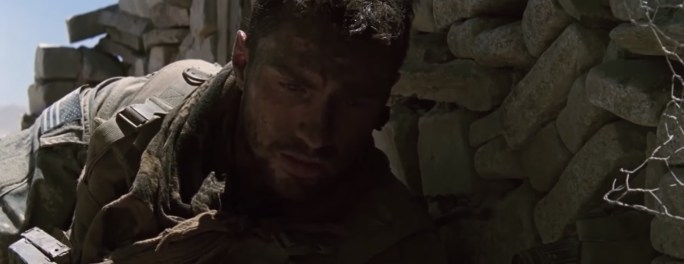
Bitter, subversive, and violently fierce all throughout its super-lean 80 minute running time, Doug Liman’s Iraq war thriller The Wall operates as both a minimalist genre exercise ala Phone Booth and Buried, while angrily commenting on American foreign military involvement. And it serves as a reminder that Liman, who certainly got bit by the blockbuster bug (The Bourne Identity, Mr. and Mrs. Smith, Edge of Tomorrow), can still drop a down and dirty little gem that delivers a smart gut punch. The Wall is short and sweet so I’ll keep my comments the same, as the less you know about this nervy picture the better. I’ve long been a big fan of Liman’s varied technique and it’s exciting to see him switching gears and taking on a gritty quickie like this; he’ll be back on screens later this year with the drug running crime film American Made with Tom Cruise.
Dwain Worrell’s ultra-focused screenplay was the first spec script purchased by distributor Amazon Studios, with the plot centering on two American soldiers, played by Aaron Taylor-Johnson and John Cena, who become trapped by an Iraqi sniper near a small compound and partially destroyed cement wall. When Cena is hit, it’s up to Taylor-Johnson to save himself and his partner, all the while contending with the enemy combatant who has hacked into their radio, remaining unseen for the entire film, and clearly enjoying his close yet hidden proximity. Taylor-Johnson is very effective as the panic-stricken soldier who is also dealing with a potentially life-threatening bullet wound, Cena spends most of the narrative with his face down in the dirt but is still quite strong, and the calm yet chilling voice-over performance of Laith Nakli understandably makes you anxious.
The Wall hugely benefits from Roman Vasyonov’s exceptional and jittery widescreen cinematography (the film was shot on 16mm film stock), while Julia Bloch’s no-fat editing keeps the pace lightning quick without ever sacrificing any of the fired-up dramatics. The solo location keeps things intense and claustrophobic despite being set outside, and the lack of a traditional musical score keeps the film all the more tense and unnerving. The ending is startling and exactly as it should be. The Wall was released last weekend to a questionable Rottentomatoes score of 62% (if the Marvel logo were attached it’d be in the 90’s), and practically non-existent box-office returns. To be fair, I doubt many people are aware of this movie, which is a huge shame, as smart and ruthless thrillers like this are in small supply, especially during the increasingly empty-headed summer movie season.
Mindscape, given the less tantalizing title ‘Anna’ upon release, is a thinking person’s thriller, and perhaps a little bit too much so. In the near future, or perhaps some alternate reality, some humans have evolved into pseudo clairvoyants who can enter the memories of other people and interact with their subjects within them. This talent has been trademarked by law enforcement, who employ ‘memory detectives’ to psychologically resolve conflict or retrieve otherwise out of reach information. Mark Strong is one such man, but his talents have dimmed a bit following the deaths of his family and a crippling stroke. Hauled out of retirement by his former boss (Brian Cox, sly as ever), he finds himself tasked with navigating the labyrinthine mind of Anna (Taissa Farmiga) a girl accused of murder and deemed a potential sociopath pending diagnosis. The film is deliberately dense and elliptical, not standard Hollywood fare at all, which is nice to see, but it also trips just a little bit on its own cognitive aspirations, especially in the third act. It’s one of those pieces that’s less like The Cell, and more like Vanilla Sky or Danny Boyle’s Trance (two absolute favourites of mine) where so much of the story wades through muddy mindgames that at a certain point we think to ourselves ‘well who’s to say if any of this is actually real if it’s gotten so complex’, and indeed it’s very difficult to piece together what has transpired here, especially with a conclusion that would require multiple viewings to even get an inkling. It’s stylish as all hell though, given a clinical, steely grey palette punctuated by flourishes of startling red to show the capacity for violence lurking just out of sight within the opaque and enigmatic human psyche. The acting is top tier as well; Strong is reliably committed and intense, Farmiga is deeply disconcerting as the most fascinating and ambiguous character, showing blossoming talent that I look forward to seeing more of, while Cox steals his scenes as per usual. The film trips over itself a few times and like I said, overly convoluted, but it’s one mesmerizing effort for the most part, albeit after a second or third viewing.
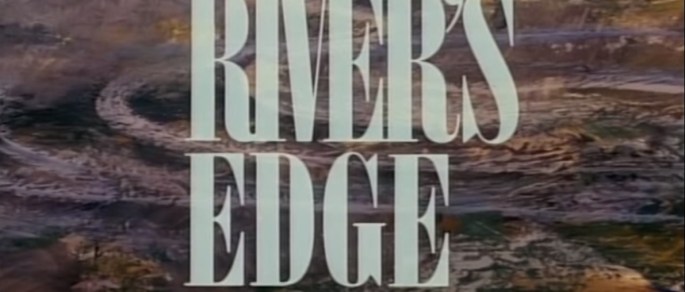
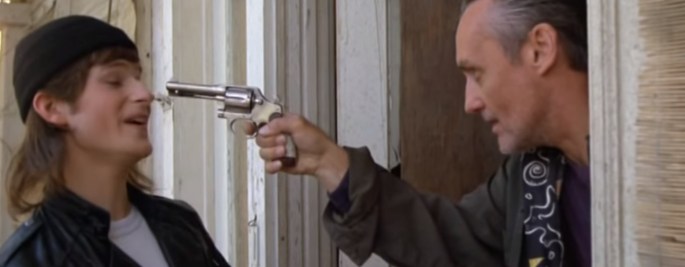
Tim Hunter’s brutal and unforgettable drama River’s Edge is one of the most unflinching looks at dysfunctional teen life ever put on screen, and serves as a grim reminder of how powerful true-crime based cinema can be when properly handled. Inspired by a real murder that took place in 1981 in California, Neal Jimenez’s hard-hitting script never soft pedaled any of the scary, emotionless nihilism that permeated a group of kids who were all tangled up in thoughtless killing, with an amazing cast of then-young actors doing sensational work, including Keanu Reeves, Ione Skye, Roxanne Zal, Josh Richman, and Crispin Glover, with Dennis Hopper providing his usual brand of sinister character acting from the fringes of this chilling film. With evocative cinematography by Frederick Elmes and a haunting score from Jürgen Knieper, this is one of those absolutely harrowing efforts that once you’ve seen you’ll never forget, and despite shining a light on some very unsympathetic characters (Larry Clark must love this film!) who are all caught in a deadly scenario, Hunter’s steely direction keeps the film from ever becoming cloying or sentimental, as he stressed the inherent cruelty and sadness of the story without over doing it.
Ariel Vroman’s Criminal does its best to pay homage to beloved pseudo science fiction genre films of the nineties like Face/Off or Eraser, and for the most part it succeeds. All the elements are in place: padded, eclectic cast, implausibly sketchy high concept brain tampering, slick anti-terrorist war games, a brash arch-villain and adorably clunky emotional interludes. When a deep cover agent (Ryan Reynolds, weirdly uncredited) is killed in London, his FBI handler (Gary Oldman), has a shit fit at the lost secrets he knew and commissions Dr. Tommy Lee Jones to use sketchy cutting edge science and transfer Reynold’s memories into another man’s cerebrum. Of course they choose some violent, irreparably damaged convict, namely Jericho Stuart, played with growling, feral panache by Kevin Costner. “You hurt me, I hurt you back worse”, is this deeply sociopathic dude’s mantra, and it’s expectedly hilarious that the bureau shoots themselves in the foot by picking such a wild card for the program, but there you have it. With new memories, Jericho’s basic primal instinct is diluted with emotional scar tissue from Reynolds, haunted by his former wife (Gal Gadot, terrific), as well as a host of clandestine secrets from Ryan’s noggin that propel him on a globetrotting (well, London trotting, really) excursion to bring down a radical cyber criminal (Jordi Molla, the Spanish Gary Oldman, coincidentally sharing the screen with his counterpart). This is the Kevin Costner show all the way, it’s really the best work I’ve seen from him in years. He would have been way better taking the antagonist route with his career, as showcased here. Jericho is a bitter, psychotic outsider and Kevin plays it up royally, dishing out bone smashing beatdowns on random pedestrians and calling anyone he sees a ‘fucker’. Oldman yells at everything, and I mean everything. It’s like there were cue notes next to his lines that said ‘just scream your lines the whole way through’, but he’s fun too, that early career intensity showing through his weathered gaze. Michael Pitt also shows up with a hysterical Dutch accent, doing the boy with the dragon tattoo hacker shtick, looking pale and sullen. The cloak and dagger stuff is uproariously silly, as it should be, the emotional core appropriately sappy too. Smart move in keeping the hard R action movie alive, unlike some movies we know (I’m casting a disgusted look over at Expendable 3), and indeed Kevin gets some overly bloody kills in that fulfill the carnage quota and then some. He kicks ass, Oldman hollers, Reynolds cameos, Gadot cries, Jones looks weary, and so it goes. Not a total slam dunk, but it will make you feel nostalgic for those good old Sly/Armie/Van Damme blitzkriegs of yore.
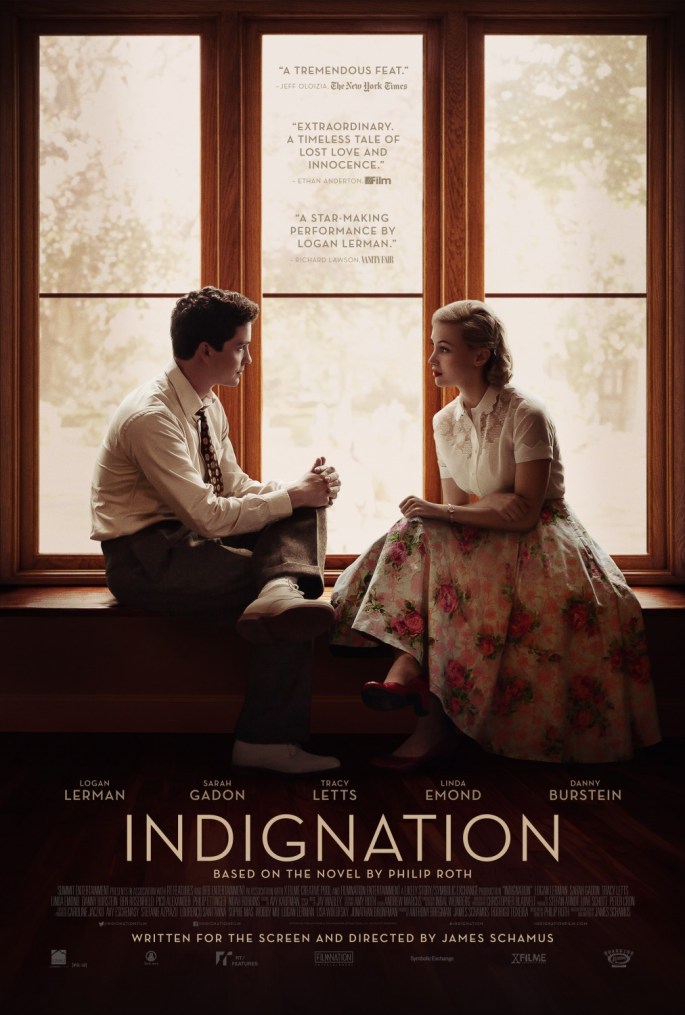
Next up on Did You Have Any Idea This Was Made And Released? is the confident and excellent 50’s-set drama Indignation, from producer/writer/scholar James Schamus, who made his directorial debut with this adaptation of Philip Roth’s novel of the same name. Schamus has, for the last 20 years, been Ang Lee’s main creative collaborator, and also found time to run Focus Features; it’s no surprise that he’d choose an intelligent and classy piece of material such as this for his first foray into full-fledged feature filmmaking. Logan Lerman, again excellent after strong work in Perks of Being a Wallflower and Fury, makes a commanding impression as a young Jewish college student, the son of a Kosher butcher, who leaves New Jersey for Ohio, and immediately has problems settling into campus life. The early scenes project a wonderful sense of time and place, which then fluidly leads into the rest of the story.
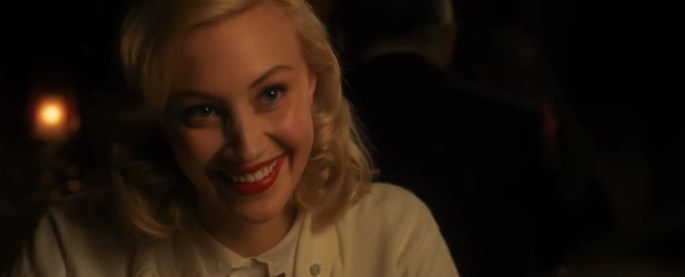
His bumbling roommates aren’t a good fit, he’s got an overbearing Dean of students (played by the tremendous and invaluable Tracy Letts), his parents are a mess, the Korean War is escalating, and he catches the eye of a sexually forward and potentially troubled female student played by Sarah Gadon (very pretty but a little dramatically flat) who changes his life forever after a very saucy (especially for the time) first date. The societal humor that’s on display during the various sexual entanglements is often very, very funny. But just you wait until the film’s dramatic centerpiece arrives in the form of a one on one confrontation between Lerman and Letts; this staggering bit of acting between the two thespians runs for close to 15 minutes and becomes nearly overwhelming by its conclusion. With rat-a-tat dialogue and the two performers heatedly reciting their lines, it’s hilarious, smart, stinging, and hugely entertaining to observe.
So why didn’t Indignation, which was “released” by Roadside Attractions and Summit Entertainment in the head-scratching summer movie season last year after being acquired at Sundance, have any sort of visibility in the marketplace? Beyond the fact that it’s a film that would likely appeal to a narrow audience (especially these days), I can’t figure out why the distributors didn’t even TRY to do something with this strong piece of cinema; it wasn’t even worth a fall release date as opposed to be being buried in late July? Because it should have grossed way more than the $3 million domestic that it did, and it’s much better than its 82% Rottentomatoes score (if the film opened with the Marvel logo it’d be in the 90’s). This should have been aggressively marketed to upscale audiences, with a simultaneous push onto VOD platforms at the time of its theatrical release.
All of the craft contributions were splendid, with period-fantastic art direction and production design by Derek Wang and Inbal Weinberg respectively; painterly cinematography that stressed dark hues from Kelly Reichardt’s favored director of photography Christopher Blauvelt; patient editing by Andrew Marcus which allowed various scenes to unfold at a smart pace for maximum dramatic impact; and a superb musical score by Jay Wadley that tied everything together. But because the film didn’t have massive stars and nobody showed up in superhero spandex, nobody saw it, or has even heard of it. Schamus demonstrated a natural hand as a storyteller with this project, and I hope it’s financial failure doesn’t dissuade him from working again in the helmer’s chair. The title of this film is very fitting for the themes explored within the emotionally tricky narrative, and for how I feel about the direction that cinema in general is currently headed.
Recently re-released with a stunning 4K transfer, Michael Mann’s acclaimed L.A. crime saga Heat is arguably not only one of the greatest films in his formidable filmography, but also the pinnacle of full throttle storytelling. Featuring a duo of searing performances by screen icons Al Pacino and Robert DeNiro, Mann’s trademark urban visuals, and one of the greatest action sequences ever filmed, Mann’s epic treatment of professional thieves and the dedicated lawmen who hunt them transports a Samurai mindset into the modern world in a hail of bullets.
Neil leads a crew who takes down high profile scores. After a job goes wrong, Neil is put into the crosshairs of Vincent Hanna, an obsessive detective whose life is dedicated to the pursuit, that culminates in a daring day time heist and a subsequent shootout in which no one is safe. Expanding upon his script from a failed TV pilot, Mann builds a straightforward world of good and evil before pulling the lines uncomfortably close. Packed with memorable dialogue and unforgettable confrontations, Heat dances around the inevitable showdown of its two leads before annihilating any sense of predictability in the climax. The diner scene between Pacino and DeNiro is remarkable, forgoing the ease of tension by focusing on the basic similarities between two souls who are mirrored, yet set apart only by circumstance.
This is the brilliance of the film. Mann weaves an outstanding ensemble across multiple storylines, some of which are purposefully left hanging to give the viewer a grounded sense of the playing field, complete with sidewalk demons and lost souls looking for meaning from friends, family, and personal ethics. Discipline and the adherence to code, both tangible legalities and metaphysical ideals, are the marrow of Mann’s exposition. Val Kilmer, Tom Sizemore, Danny Trejo, William Fichtner, Henry Rollins, Ashley Judd, Mykelti Williamson, Dennis Haysbert, Tom Noonan, Jon Voight, Diane Verona, Amy Brenneman, Hank Azaria, Jeremy Pivens, and Xander Berkely fill out the supporting cast, but it is Natalie Portman who shines with a handful of scenes. Her performance is the ultimately casualty, the real world consequences for the actions of those who live beyond the law and those who are consumed by it. Relationships are a key component, given an ample amount of time to establish that both sides of the coin are people, despite their choices, adding an undercurrent of humanity that strengthens the narrative by presenting the characters as flawed, but genuine souls with dreams waiting to be shattered under the LA sun.
Eliot Goldenthal’s score, combined with a fantastic soundtrack musically narrate the drama, using Mann’s patented masculine deconstructionism to create an entity unto itself. Moby’s God Moving Over the Face of the Waters in the finale is both beautifully tragic and perfectly applied, an auditory summation of the ultimate neo-tragedy that Mann has created. Deborah Lynn Scott’s costume design has a vintage, minimalist quality, presenting both cop and robber as natural affixtures to the world on display. Heat is a free range compound where killers and flawed saints play cat and mouse games while reality perseveres, unaware of the dangerous stakes being sought out and the way that each character is perfectly accessorized is a welcomed conspirator.
Dante Spinotti’s cinematography has a wonderfully layered quality, capturing the moments between the action with Mann’s trademark blue hues and fevered close ups. Los Angeles is portrayed as a metropolitan Gemini, a twinned persona of complicated domesticity and unrelenting violence. This idea is constantly explored, but the payoff is in the legendary shoot out that begins the final act. There has never been a more technically proficient display of gunplay ever committed to film. The sound design and mixing are a blessed mixture of panic and fury. The actors, particularly Kilmer’s unrestrained focus, show military tactics that are perfectly executed in a manner that affects the viewer on a base level. These are dedicated experts of their trades, challenging one another over a lifetime of personal devastation in the name of said commitments and the result is simply unforgettable.
Ultimately, Heat is a stalwart member of top tier American cinema. The new release is available on Amazon for less than eight dollars and is without a doubt worth every cent. Heavy on exposition, grandiose on the action, this is everything a crime thriller should be.
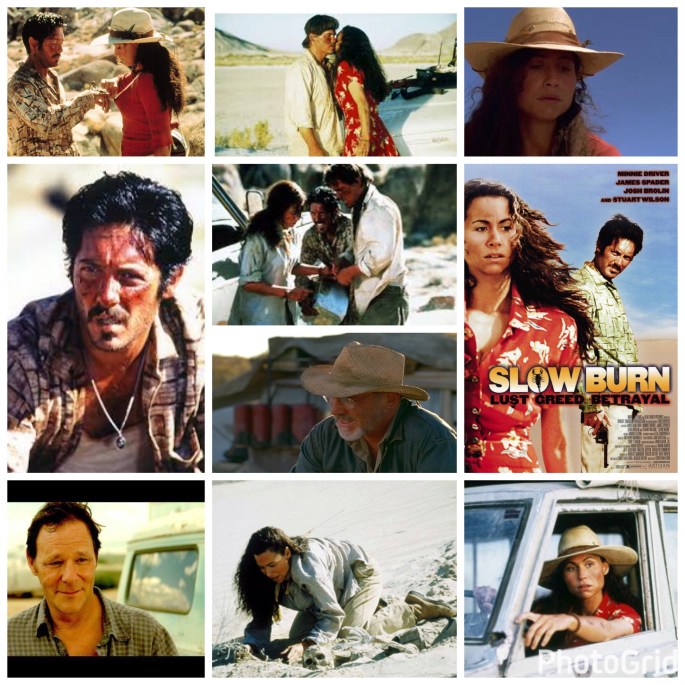
Slow Burn is.. odd, to say the least. Living up to its title, it pretty much goes nowhere, tagging along with James Spader and Josh Brolin as they stumble around in the desert, both hitting on treasure hunter Minnie Driver, who constantly outwits them. This kind of lower budget, steamy stuff just seems to have a licence to languish, in the sense that story is of little concern, it’s more about mood and episodic character interaction than anything else. Spader and Brolin are doing the ‘Of Mice & Men’ shtick here, playing two hapless escaped convicts, one a sharp tongued weasel (Spader) and the other a dimwitted lug (Brolin). They’re kind of lost, in both perpetual arguments and the vast Mojave around them, when they run into Driver, whose presence, and the idea that there’s a whole whack of diamonds buried out there somewhere, inevitably stirs things up. The diamonds belonged to her parents, and there’s hazy scenes relating back to a tragedy involving her gypsy father (Chris Mulkey, briefly) and a mysterious character played by Stuart Wilson who serves as pseudo-narrator as he wanders around out there too. Got that? It’s ok, they barely explain it better than I just did, I’ve seen the thing twice and I’m still not sure how it all adds up either. Sweat, sand, sensual looks snuck between Brolin and Driver, dreamy atmosphere, threats of violence from Spader’s overacted, crazy eyed moron, a treasure hunt and general lack of cohesion is all you’ll find out here in this desert. Good for an absent minded watch or for background noise, not much else though.
First featured on The Movie Revue, contributing critic Brian Wallinger and editor Ben Cahlamer sit down to discuss James Gray’s astounding The Lost City of Z.
BEN CAHLAMER: Brian, thanks for joining me today.
BRIAN WALLINGER: It’s my pleasure, Ben.
BC: Is it safe for me to say that you enjoyed Gray’s effort overall?
BW: Yes. This 2016 release, based on the 2009 novel is a taught and tense adventure set in the jungles of Brazil. All throughout the film lays an undiscovered land where danger lurks around every corner.
BC: I too found the story telling to be riveting and adventuresome, filled with stunning locations and brilliant technical achievements. I especially liked the acting in the film.
BW: Both Charlie Hunnam and Robert Patinson are the true stars of the film, executing clear and sharp performances.
BC: Hunnam as Percey Fawcett, British officer-turned-explorer and Patinson as Henry Costin were stunning, especially Patinson, who just completely immersed himself in his role. Hunnam has a commanding presence about him, but Gray kept him in check. Both performances are extremely strong. They are complimented by several smaller roles featuring Ian McDiarmid of Star Wars fame, Franco Nero, Angus Macfayden, who has been nothing short of brilliant in both John Wick films, Sienna Miller who plays Nina Fawcett, Percey’s faithful wife, and Tom Holland as Jack Fawcett. What did you think of Gray’s directorial efforts?
BW: The direction proves that Gray is not yet a truly masterful film maker, but he surely is on the path to greatness. The film has an uneven balance in its run time and with the overall script.
BC: I confess to not having seeing his previous directorial efforts, but I found his direction here to be top notch, especially for something that is so reflective of glorious epic adventure films and characters of the past, such as The Bridge on the River Kwai or even, Raiders of the Lost Ark. I didn’t have an issue with the run time, and as a matter of fact, I found it to be necessary to tell the full story. John Axelrod’s editing kept the film’s pacing even. I felt as if I was watching a younger version of Indiana Jones thanks to Hunnam’s acting, Gray’s direction and his screenplay, based on David Grann’s novel of the same name….
BW: …The story is based on actual events depicting several attempts at an expedition ultimately leading to an unsolved mystery.
BC: Yes, indeed. It was David Grann’s debut novel, based on his 2005 visit to the Kalapalo Tribe that set the stage for his novel and this film effort. The level of detail in all of the characters is a combination of the entire production’s efforts.
BW: You have hit the nail on the head, Ben. There is a unique style and theme that pays homage to classic adventure films you mentioned: a form that has since gone unnoticed, yet through this film, finds a breath of new life. I found the cinematography to be visually stunning, providing a sincere essence of the peril the characters faced.
BC: YES! Academy Award-winning Darius Khondji’s work here is astounding, and is a hallmark of this film. His use of shadows and light are simply stunning. I recently watched Fincher’s Se7en on a cinema screen and fell in love with Khondji’s work there too. He is just a magician with light in any setting and I’m looking forward to seeing his work on the upcoming Okja.
BC: Any other thoughts, Brian?
BW: The film has several minor technical flaws but is so much fun and sincere to its convictions that I can forgive them. I’m Recommending The Lost City of Z.
BC: This film was stuck in development hell for a very long time at Paramount. I’m really glad that it got picked up by Amazon and Bleecker Street. Although its box office was not very strong, word-of-mouth should propel this film into the minds of many moviegoers. I also am Recommending this film. Thank you for joining me today, Brian.













 Podcasting Them Softly