Benson & Moorhead’s Synchronic

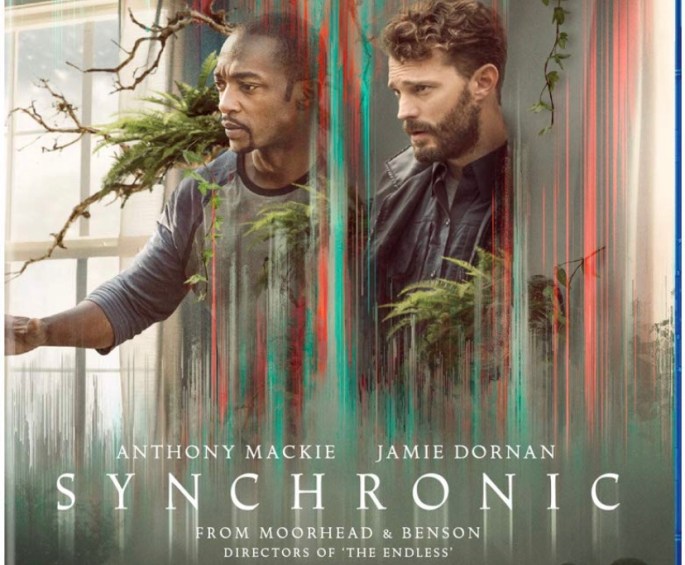
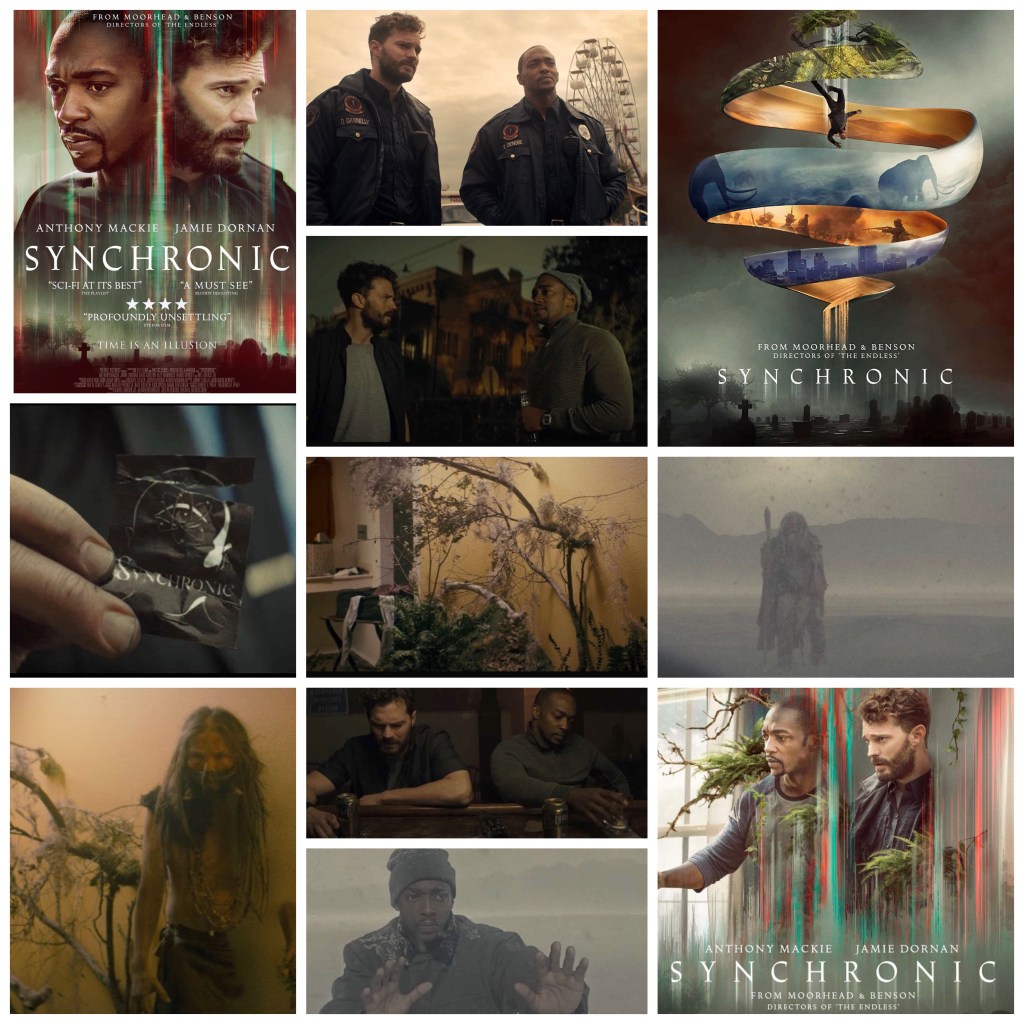
Justin Benson and Aaron Moorehead have consistently been putting out wild, innovative and boundlessly creative ideas into cinema including Lovecraftian romance, esoteric doomsday cults, otherworldly time loops and more. What’s so great about their work is that along with these very grand, high concept SciFi ideas they always have the right application of atmosphere and tone as well as extremely believable, well written characters to back it up and with their newest film Synchronic they just may have outdone themselves. Anthony Mackie and Jamie Dornan play two New Orleans EMT’s who are also steadfast besties, their bromance banter a huge asset to this story. They seem to be getting a lot of disturbing calls lately, of people injured or hurt very badly after taking a mysterious experimental street drug called Synchronic, which is available in Vape form at various stores. It’s basically a synthetic DMT compound that acts on the pineal gland to provide unnervingly vivid hallucinations, but what really happens is that for the duration of the high, you quite literally go backwards in time to a random period of history, could be five years ago, could be five thousand years ago. This powerful but dangerous ability is the lynchpin of a story that involves these two characters as Dornan struggles with family issues, Mackie wrestles with a terminal illness diagnosis and the drug itself comes into play in ways you might not expect. Both actors are terrific especially when onscreen together, with Mackie being the standout and taking full blooded advantage of the deep, ponderous and soulful writing. What really makes the film sing is the synergistic flow of atmosphere, music and special effects for the trips back in time and there are several breathtaking set pieces including a Spanish conquistador in a damp bayou, a hellish picture of the New Orleans harbour on fire sometime around the civil war and an absolutely stunning trip back to the ice age. These sequences feel fully realized, immersive and tactile and where other films would take a high tech gadgetry approach to time travel, this one uses the onset of the drug’s effect in an eerie, elemental biochemistry fashion to transport us into the film’s realm. Moorehead and Benson floored me with their 2015 film Spring (couldn’t recommend it enough) and then their follow up The Endless left me a bit underwhelmed but for me this is them roaring back into cinematic innovation on all levels with a wondrously moody, unbelievably creative SciFi that’s sure to become a classic. Brilliant film.

-Nate Hill

Justin Dix’s Blood Vessel

What’s something you can find on a nazi warship that’s worse than nazis themselves? Well a group of allied castaways find out exactly what when they drift into the path of a deserted one in Blood Vessel (amazing title) a super fun, super old school, kinda low budget but enthusiastic B horror flick that I really enjoyed. As a stranded life raft from a torpedoed sub approaches a giant derelict boat, the survivors are seemingly saved until they board the craft, find it curiously deserted and discover what is lurking deep below deck, waiting to hunt them. It seems the nazis were transporting several caskets from Romania containing immortal creatures known as Strigoi, which are basically vampires with a lot more snazzy magic powers backed up by a lot more specific backstory lore. The minute these things wake up it’s game on as they discover these new people in their vicinity and begin to viciously take them out. The allied group is a surprisingly varied bunch including a cowardly Brit, an enthusiast Aussie, an American battle surgeon and an Eastern European badass who has survived all kinds of gnarly stuff and has the scars to prove it. They are all very well acted, written and have distinct, unique anthropological personas and angles which isn’t something you find in every horror flick about a bunch of folks who are essentially cannon fodder for vampires. The creatures themselves are very cool, designed with practical prosthetic effects, all exaggerated ears, accentuated fangs and acted with snarling vivacity by those under all that awesome makeup. What’s more is they aren’t just an animalistic horde either, they’re an ancient, evil aristocratic family complete with a young daughter Strigoi who is just as deadly as mom and dad, it’s a cool family dynamic. There’s gory showdowns, subtle sociopolitical banter amongst the human characters, well drawn arcs and loads of spooky, smoky, eerie abandoned boat atmosphere full of beautifully saturated Argento-esque lighting and gorgeous frames filled with gothic eye candy. A solid horror, streaming now on Shudder.

-Nate Hill

Nia DeCosta’s Candyman

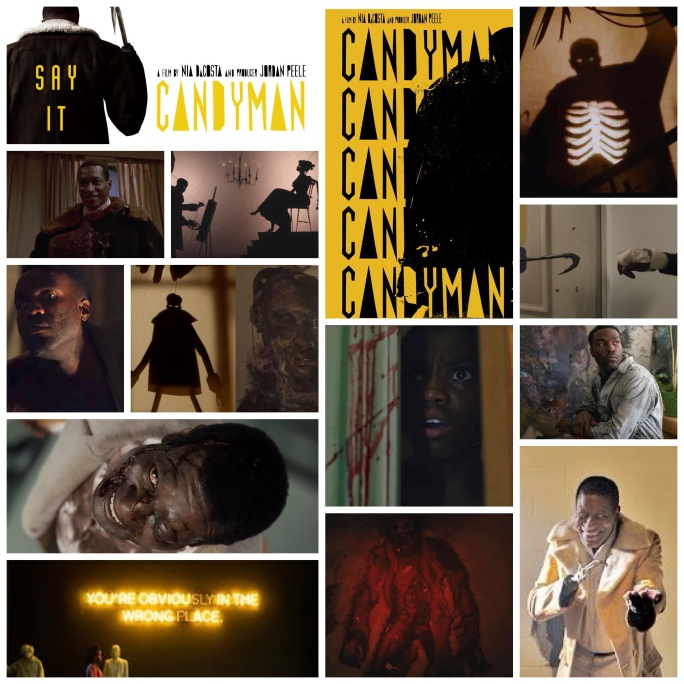
Urban legends have a way of living on decades after the actual events that inspired them, like ghosts of the past doomed to linger as long as the collective human consciousness remembers what happened, and spreads it by word of mouth. The original 1992 Candyman film is a minted horror classic that has only gotten better with age and still holds up in every respect to this day, a terrifying supernatural parable that covers classism, racism, the power of myth and the passing on of stories in a ritualistic fashion. So how does Nia DeCosta’s Candyman, a ‘spiritual’ sequel and decades later follow up compare to its inspiration? Well naturally it’s not quite as good, but it was never going to be, and it was also never going to be the exact same thing because the world has changed and along with it so has the grim Chicago project housing neighbourhood of Cabrini Green, once a derelict death trap and now a hilariously partially gentrified (we see a rundown laundromat sitting snug right next to an artisanal ‘roastery’) overrun with art world types, the horrors that befell it over twenty years ago now almost forgotten. Not quite though, as we see struggling artist Anthony (Yahya Abdul-Mateen II) catch wind of the Candyman events, now little more than a campfire story, and decide to investigate further in order to gain inspiration during an artistic dry spell where his successful girlfriend (Teyonah Parris) is supporting him financially. Naturally the more he learns the more his life unravels and pretty soon people are saying those magic words five times into mirrors and being viciously murdered by Candyman, albeit a different incarnation than Tony Todd’s iconic and darkly tragic Daniel Robitaille. He’s called Sherman Fields this time (played excellently by Michael Hargrove) and I gotta hand it to the guy, he’s pretty damn scary, in less baroque, theatrical fashion than Todd and instead a more animalistic, unstable way. The idea here is that Robitaille pioneered the dark necromancy that keeps the Candyman legend alive but there are also others, each with an appropriately unfortunate backstory, who fill the position. It’s a neat expansion into the mythos even if Todd himself gets sadly little to do here. The callbacks to the first are integrated well enough into this version of today so that it feels psychically linked to it without having outright sequel syndrome, which I suppose is what they mean by ‘spiritual sequel.’ Nia Decosta is a filmmaker to watch out for, she meticulously blocks actors and stages the killing scenes in ingeniously innovative ways using space, movement and reflection for some truly trippy and original sequences invoking settings like mirrored elevators, high rise apartments, high school washrooms and cavernous holes in dilapidated drywall. There’s also some beautiful shadow puppetry that fills in for flashbacks instead of ripping actual footage right from the 1992 version, which adds an elemental flourish and a terrific musical score by Robert Aiki Aubrey Love that echoes Phillip Glass’s achingly gorgeous original composition without aping it. There’s even some startlingly gruesome body horror thrown in that breaks new prosthetic ground and is… quite something to look at, or look away from depending on your tolerance. It ain’t the 1992 version and let’s face it, nothing will be. But it’s hell of a good horror film and a damn fine shoutout to a classic that’s in its own time capsule now, it illustrates how myth, legend and superstition live on no matter who forgets, dark forces like that have a way of finding their way home to the hallowed grounds where they were birthed, and this incarnation of Candyman is every bit as chilling and atmospheric as the first, albeit in different, fresh ways.

-Nate Hill

Brian DePalma’s The Black Dahlia

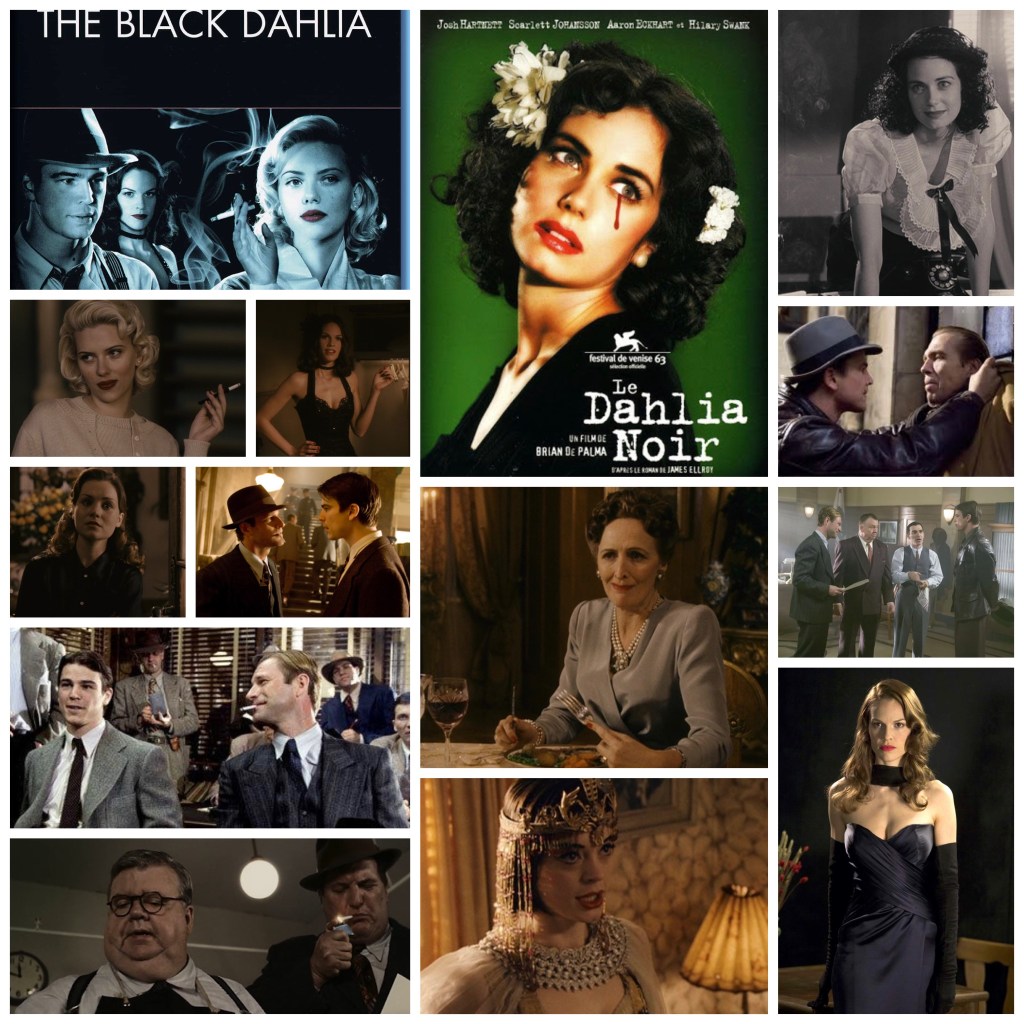
I’m not sure exactly happened with The Black Dahlia but it’s like the recipe was there, it was on time and legible and whoever was in charge of whipping up the ingredients into something coherent, be it editor or producer or Brian DePalma himself, was simply having an off day. In telling the story of two hard-boiled LAPD detectives (Aaron Eckhart and Josh Hartnett, both giving good performances that deserve a much better film) who are assigned to the infamous murder of Elizabeth Short (here played by Mia Kirshner in flashbacks), the filmmakers seem more intent on sidetracking into a useless love triangle between the two cops and a former prostitute (Scarlett Johannsson) as well as numerous political, high society and other cluttered subplot threads that don’t feel like they need to be there. Hartnett gets tangled up with a weird femme fatale (Hilary Swank trying on an accent that fails spectacularly) from a super rich and super shady aristocratic family and it’s here where the film, based on a fiction novel, tries its best to tell the made-up story of what really happened to this girl, kind of like that Johnny Depp Jack The Ripper film only nowhere near as gripping, atmospheric or well told of a story. There’s so much going on I just threw my hands up in frustration at one point and resigned myself to bailing on the story and simply spending most of the two hours playing I-Spy with all the familiar faces in the supporting cast, and it’s here I can say something truly positive about the film. I miss the days when big budget Hollywood flicks had epic, sprawling supporting casts full of awesome people on roll call, even if they’re only around for a swift cameo or couple cool quick scenes. Here we get appearances from many including Kevin Dunn, Mike Starr, Rose McGowan, Troy Evans, Richard Brake, Rachel Miner, Patrick Fischler, Gregg Henry, Ian McNeice, singer K.D. Lang, DePalma himself and more. The great British actress Fiona Shaw (Aunt Petunia in Harry Potter) almost saves the entire film with a deranged extended cameo as Swank’s deeply unstable mother, her performance is so intensely off the wall and bizarrely compelling she seems like she walked in from a David Lynch film, she’s basically the liveliest spark the film has to offer. There is one particular death scene that is also quite memorable and almost more gruesome than the Dahlia murder itself, you’ll know when you see it. I just couldn’t get wrapped up in this thing though, the story is all over the place, feels disingenuous at the core of its script and is just a giant mess, no other way to put it. Great cast though, at least there’s that.

-Nate Hill

Netflix’s Brand New Cherry Flavour

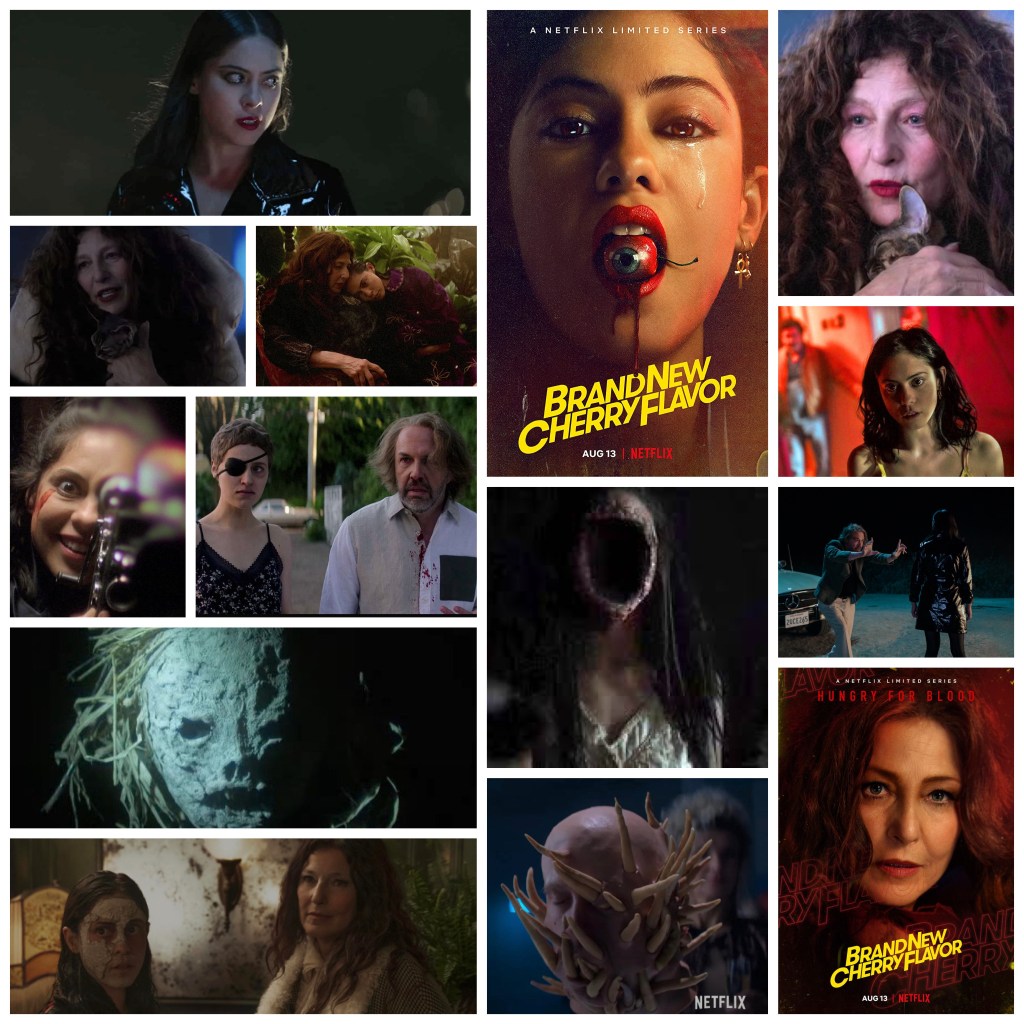
It’s always neat when a major streaming service takes a devilish gamble on something completely deranged and ‘out there’ for their original shows, and Netflix’s Brand New Cherry Flavour is about as WTF as you can accessibly produce without going into full fledged David Lynch surreal arthouse realms. It’s based on a book by a dude called Todd Grimson who I’m not familiar with but the creator/show-runner is Nick Antosca who is responsible for my favourite horror tv show of all time Channel Zero (which can be seen on Shudder) so it’s safe to say his creative output here is also a unique, otherworldly game changer. This tells the story of Lisa Nova (Rosa Salazar, the Battle Angel in Alita), a film student who has brought her horror short to LA in hopes of signing a feature deal, which starts by garnering the interest of fast talking, knowledgeable, well connected producing guru Lou Burke (Eric Lange). Unfortunately, as is often the case with Hollywood bigwigs, Lou is a sociopathic, sleazy piece of shit who not only comes onto her and gets petty when she rejects his advances but then steals her short film for his own purposes and even assaults her. What to do? Well, you could sell your soul to a weird cat worshipping witch deity in exchange for revenge most foul. I wouldn’t recommend it but in this case Lisa is a bit naive and doesn’t heed the obvious warning bells when she’s approached by mysterious Boro (Catherine Keener), who promises her retribution in return for a vaguely Faustian bargain. Well after neglecting to read the fine print Lisa finds her life and that of everyone around her turn into a full on hellish supernatural nightmare complete with flesh eating zombies, inter dimensional hallucinations, angry phantasms, peyote induced mania, pissed off Latino mob hitmen, hiccups, extreme violence at every turn and a strange affliction where every so often she’ll dry heave and vomit up a newborn kitten, and I mean that in the lost literal, explicit way possible, she straight up chundies little tiny demonic white cats covered in barf and it’s nasty af. But that’s what you get when you tangle with a mischievous witch I suppose. Catherine Keener hasn’t had a role this great in years and she’s a diabolical wonder as Boro, the least trustworthy being you’ve ever met, full of quips, quotes and scathing verbal roasts with the bizarre black magic to back her talk up, it’s truly a wondrous villain performance that she has a lot of fun with. This isn’t necessarily the most… succinct or airtight vision and it’s sometimes feels like paint just hurled at a canvas there are so many elements at play, especially in the back half of the season. But oh, what elements they are. This is dark, fucked up, no-chill storytelling with some of the blackest humour imaginable, laughs that catch in your throat on the way up like a barfed kitten and some of the most acidic, punchy, sizzling writing I’ve ever heard, full of impossibly colourful language and brimming with delicious, often very niche Hollywood references. It’s messy but it’s a beautiful goddamn mess and has so much jaw dropping, unbelievable content that I was transported along for the ride that resembles something like Mulholland Dr tossed together with Cronenberg, Raimi’s Evil Dead films with a dash of Entourage and something even intangible thrown in for good bloody measure. Be careful with this one if you’re content sensitive because it’s… punishingly perverse, overbearingly intense and unforgivingly willing got plumb the dark, demented depths of the collective storytelling psyche and puke up whatever it finds onto the screen. Like a kitten, or a self removed eyeball, cannibalistic zombies, metre long tapeworms pulled slowly out of human eye sockets, those are all but a taste. Buckle up.

-Nate Hill

Dave Made A Maze

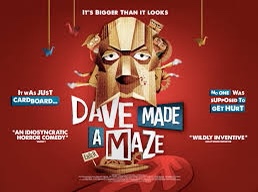
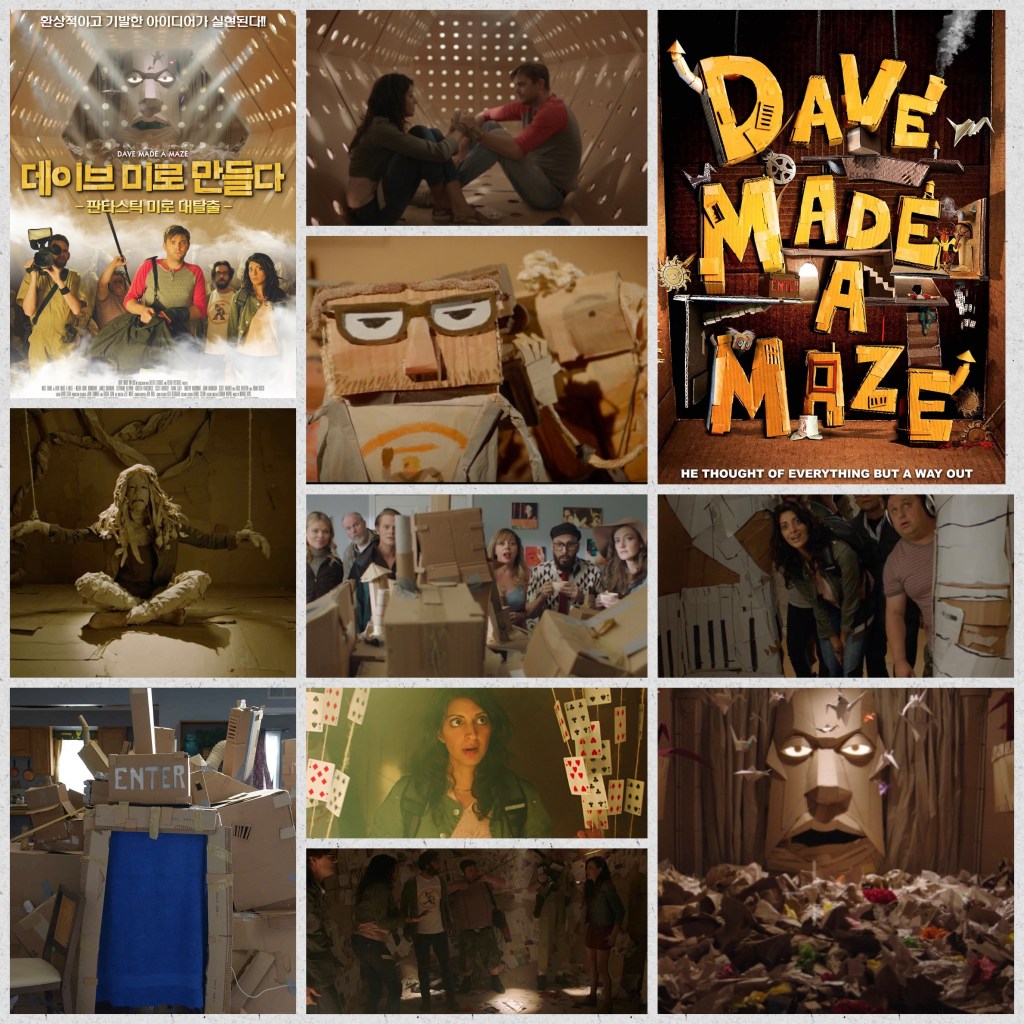
Dave Made A Maze, and then someone made a movie about him making a maze, and now it’s on Shudder. Is it any god? Well… kinda. It’s certainly incredibly creative, artistically impressive and visually something else, I’ll give it that. It’s literally about a girl (Meera Rohit Kumbhani) who gets home one day to find that her boyfriend Dave (Nick Thune) has built a massive cardboard labyrinth in the middle of their living room, and subsequently gotten lost within it. How has he gotten lost, you may ask? Well I wasn’t exaggerating when I said the thing is massive; on the outside it looks like a ten by ten square foot art project that a cat could comfortably cavort about it, but the minute you go inside it becomes an endless maze of hallways, vicious booby traps and confusing tunnels. “It’s bigger than it looks from out there” he yells from inside, and warns her not to come in. Soon she invites a bunch of people over to see this thing including a few of his friends, a pesky documentary crew and a random homeless dude who she thinks is a maze expert (“I said I know *cardboard*” he informs her, clearing up the misunderstanding). Pretty soon all of them follow Dave into this thing and find themselves just as lost as he is, and eventually they start to get killed by the frequent booby traps. So what is this maze, how was Dave able to make it this way and what is the film trying to say? Well, that’s where it lost me a bit, because as visually creative and unbelievably gorgeous looking as this maze is, the tone of the film has this sort of… faux Wes Anderson-y, wannabe Michel Gondry-esque attitude that just started to irk me pretty quick, like a deliberate, forced ‘quaint n’ quirky’ vibe that the actors just aren’t able to sustain for more than a few minutes. What’s more, it attempts this sad millennial set of themes where Dave built this thing because he never was able to finish a project properly, he’s always working jobs he hates and he’s ‘still getting money from his parents at age 30’ when he’s got a perfectly cool little apartment and seems to have found the time to have built a giant magical maze. It’s just a whiny angle and not a good look for the film overall. Those frustrations aside I did really, really enjoy the artistic vision of the maze, it’s blessedly CGI-free and is a wonder of infinite cardboard panels, trippy swivelling walls and origami creatures that come to life and a big mean Minotaur that chases them around. The tone of the acting and attempted subtext may have exasperated me, but they should be very proud of the artistic achievements they’ve crafted onscreen, one could almost watch this with the sound off and be just as transported.

-Nate Hill

Canadian greatness: Phillip Borsos’ The Grey Fox

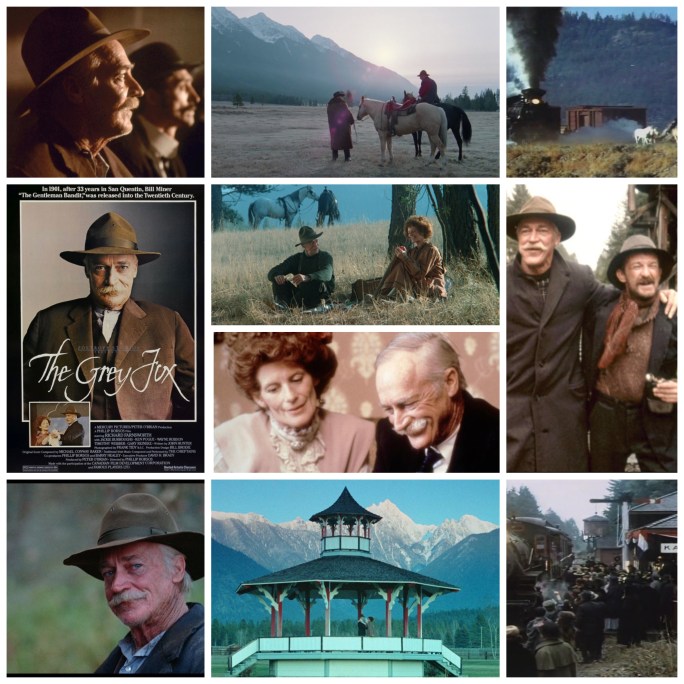
Famed Canadian outlaw Bill Miner might have been the most soft spoken, polite, counterintuitive criminal in the annals of history and the late great Richard Farnsworth plays him as such with his trademark clear eyed, honest voiced, pure hearted charisma in Phillip Borsos’s The Grey Fox, a film of stunning quality, wonder and grandeur both great and small. Miner spent the early part of his life as a career criminal with a penchant for politeness and after a three decade stint in San Quentin, he meandered north to Kamloops, BC to reconnect with his estranged sister and start a new life. His old ways find him once again though and soon he carves out a new legacy as a notorious train robber and once again his life takes a turn for the adventurous. He falls back into this groove simply out of habit I suppose, and because he feels he isn’t meant for much else. He meets and romances early feminist artist Kate Flynn (Jackie Burroughs), mentors his dim witted partner in crime Shorty (Wayne Robson), does the odd shady rustling work for local magistrate and crime kingpin Jack Budd (Ken Pogue) and is pursued by an eerily placid Pinkerton detective (Gary Reineke). Farnsworth makes this character sing, he was a stuntman turned actor who was just born with a natural gift and lit up the screen with impeccable emotional truth and vivid vitality anywhere he appeared, and this (along with his beautiful work in David Lynch’s The Straight Story) may be the finest work of his career. He makes Bill a quiet, sweet, compassionate and honest man, the absolute antithesis of what we’ve been told a lifelong criminal must be like, he’s always the most comforting presence in the room, is a natural leader and trailblazer and his scenes of tenderness and love with Burroughs are blessedly open-hearted and kind. The film was shot in and around some keystone British Columbia locations that don’t often get to play themselves in cinema (American studios can’t just shoot in their own locations, they’ve always got to rip off ours with no due credit) including Kamloops itself, Cheakamus Canyon, Fort Steele, Lillooet, Cranbrook, Pemberton and of course Vancouver. This adds a rugged, authentic realism and elemental grace to Bill’s story as Farnsworth and his cast-mates wander about in the wild Pacific Northwest realm, captured wonderfully in its early days by cinematographer and set designers alike. The score intertwines with traditional Celtic melodies for a unique musical/visual experience as well, especially in a hypnotic opening sequence where a steam train makes its way around the bend of a mountain pass as the credits lope alongside it. From that gorgeous opening crawl until the final melancholic few moments where another train goes by, this time in the other direction and for a different reason, this is a mesmerizing experience, anchored by Farnsworth’s angelic, note-perfect character work and everything else mentioned above. Available for rental on iTunes for 99c.

-Nate Hill

The MacManus Brothers’ The Block Island Sound

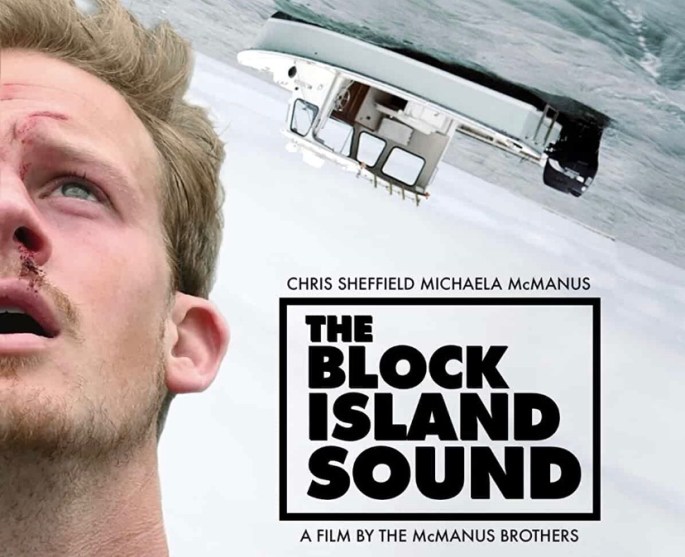
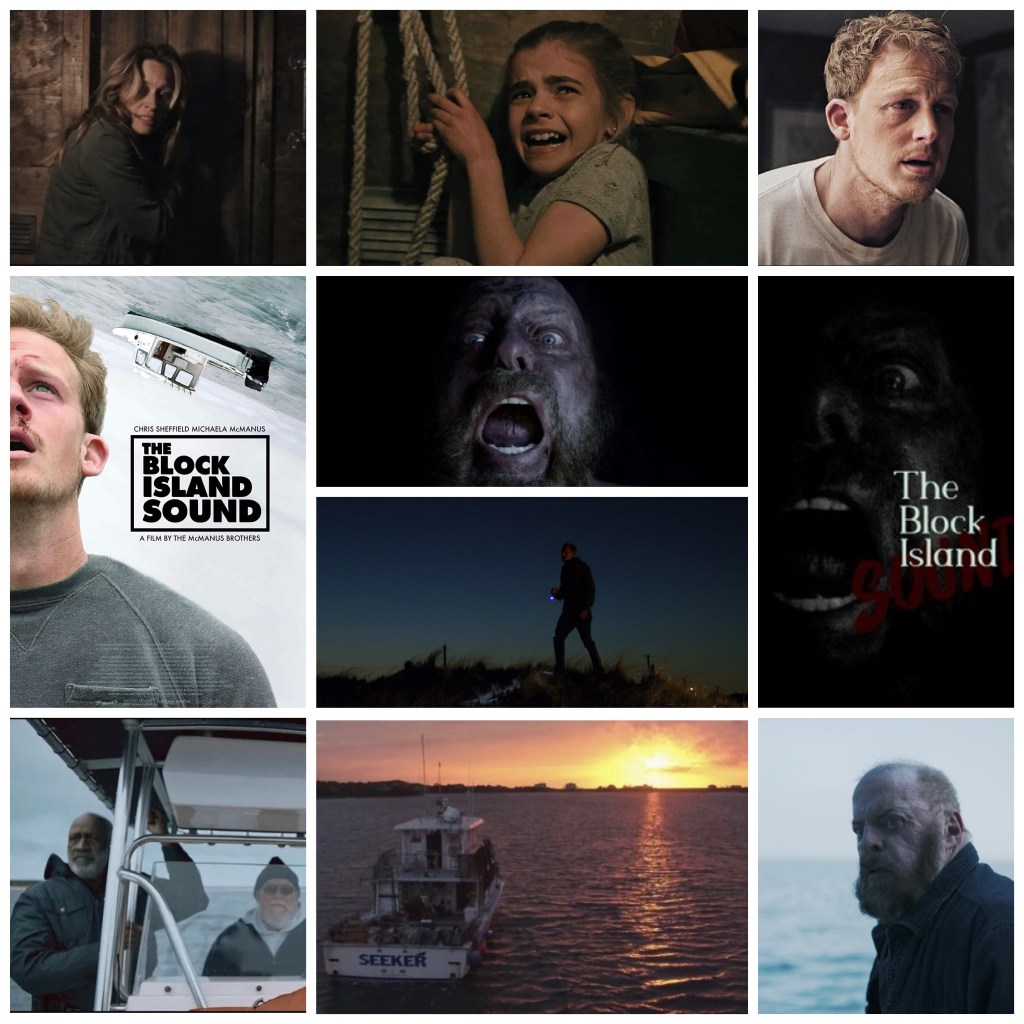
Aliens are up there and they’re messing with us… or are they down below, in the waters of the ocean? The MacManus Brothers’ The Block Island Sound is a fascinating, atmospheric and frequently terrifying glimpse of life in a small fishing town on the Rhode Island coast as inhabitants grapple with a mysterious, threatening, possibly extraterrestrial or cryptozoological force that slowly encroaches on them in increasingly horrifying ways. One fisherman (Chris Sheffield) has already seen his father (Neville Archambault) fall victim to these things and now finds himself coming down with strange symptoms: sleepwalking, blackouts, bizarre hallucinations, dark thoughts and the most severe case of tinnitus I’ve ever seen. He struggles to protect his family from whatever is out there and what it’s doing to him as he can no longer trust his own actions or impulses, especially around his young niece (Matilda Lawler, excellent) whose safety he fears for. This is a slow burn, ambiguous SciFi horror story that takes its time; you never see what’s out there beyond esoteric hints and chilling sounds behind the perpetually overcast coastal skies and the flint grey waters of the sea below. It’s always the threat of what’s out there that is scarier than the thing itself seen in full, and the filmmakers know this, taking full advantage of the ‘less is more’ mantra. Acting is all superior quality, there are a few sequences that drag and could have been tightened up a bit but overall this is a slick, nasty, spine chilling otherworldly horror that hits the spot. It even achieves a moment of pure greatness right at the very end when a character provides thought provoking narration that will make you completely rethink the nature of alien abductions themselves. Good stuff.

-Nate Hill

Don Bluth’s The Secret Of Nimh

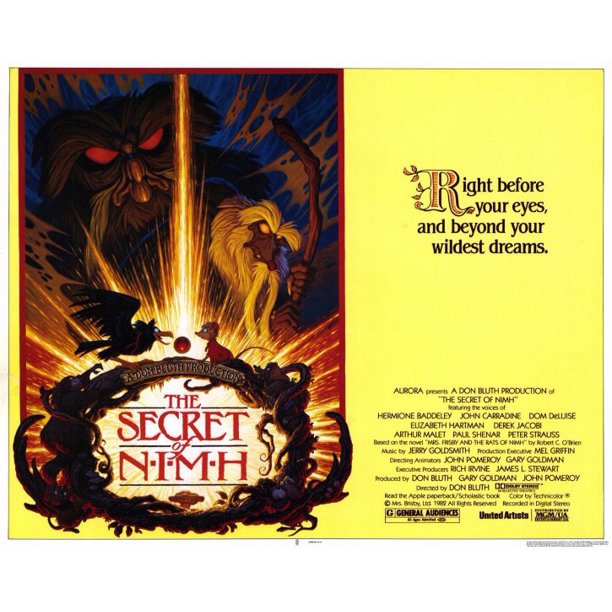
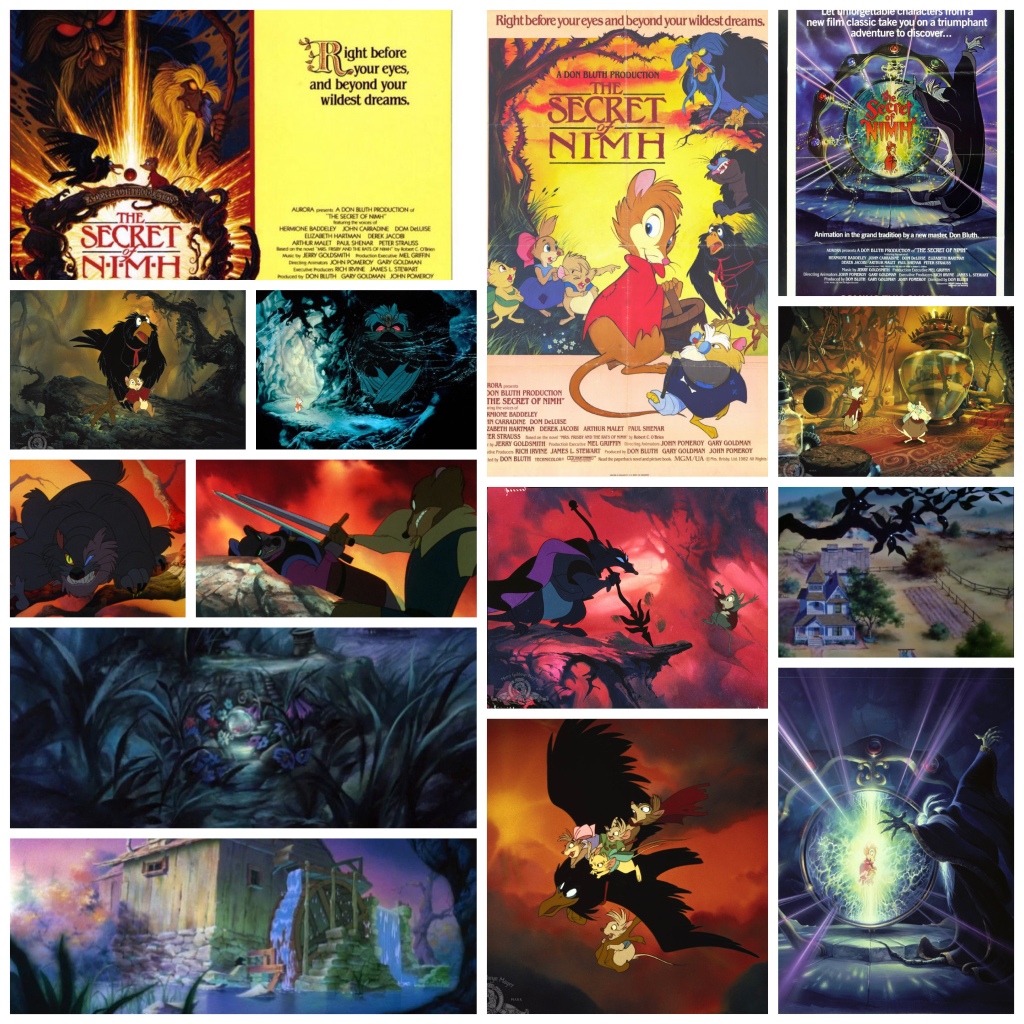
I remember reading the book Mrs. Frisby & The Rats Of Nimh as a child and being utterly transported by Robert C. O’Brien’s prose and storytelling. I think it’s the duty of any filmmaker adapting a literary work to do three things; 1) keep the spirit, themes and intention of the sacred source material on hand and implement it accordingly, 2) present a great deal of their own artistic and personal flourishes wherever they can and 3) utterly transport their audience to the world they are both adapting and further exploring. In the case of Don Bluth’s The Secret Of Nimh he has outdone himself by keeping the dark, often threatening beats of the book intact while offering up a dazzling galaxy of unbelievably gorgeous still-frame animation tableaus for equally stunning animated animals in motion to inhabit and tell this unique story. Mrs. Frisby (Elizabeth Hartman) is a widowed field mouse living in a vast and dangerous farmyard realm with her wee mousie children, one of whom is very ill. Every year when the farmer comes to plow the fields, all the woodland creatures are violently displaced in an apocalyptic ritual they refer to as ‘moving day.’ Because of her youngest child’s illness, moving day would be especially torturous for them this year and so she sets out on a mythical quest to find a better life for her family, a quest that puts her in contact with many other animals in the realm including friendly crow Jeremiah (Dom DeLuise), a spooky old great horned owl (John Carradine), the vicious and predatory farmer’s cat and a troupe of scheming rats, some trustworthy and others treacherous. This is a dark, prophetic, devilishly imaginative story that isn’t just children’s nursery rhymes but gets intense, introspective and downright menacing, I can see how this would scare the ever-loving soul out of young kids. Bluth’s animation is the real star here and every breathtaking backdrop is gorgeously hand painted, detailed and atmospheric tapestry of swirling colour, borderline abstract shapes and boldly audacious expressionism. The animals are vividly drawn with a touch of the surreal and the images and sound on display are dreamlike wonders of artistic creation. The world feels frightening, full of wonder, lived-in and soaked in ambience whether it’s overgrown forest thickets, arcing wheatgrass meadows, cluttered farmyard dwellings and even a brief trip to a nocturnal cityscape in a hellish flashback that holds the key to the story’s central mystery. This film is an unbelievable artistic achievement and benchmark in the medium of animation.

-Nate Hill

Willy’s Wonderland

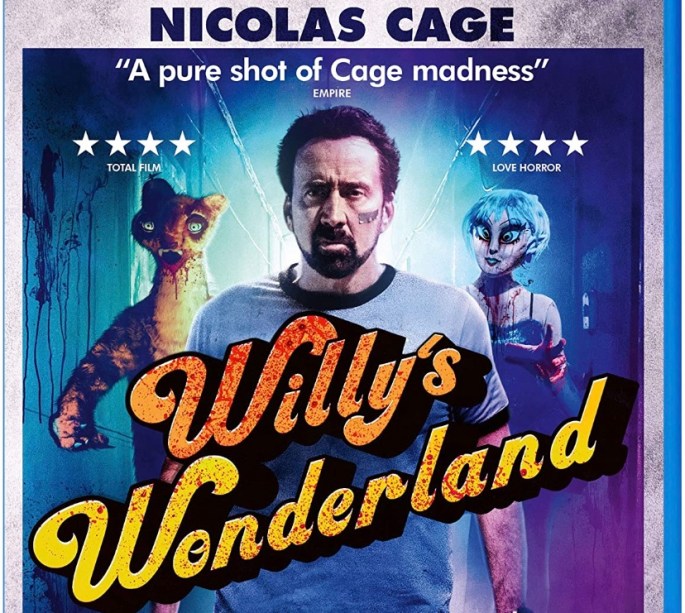
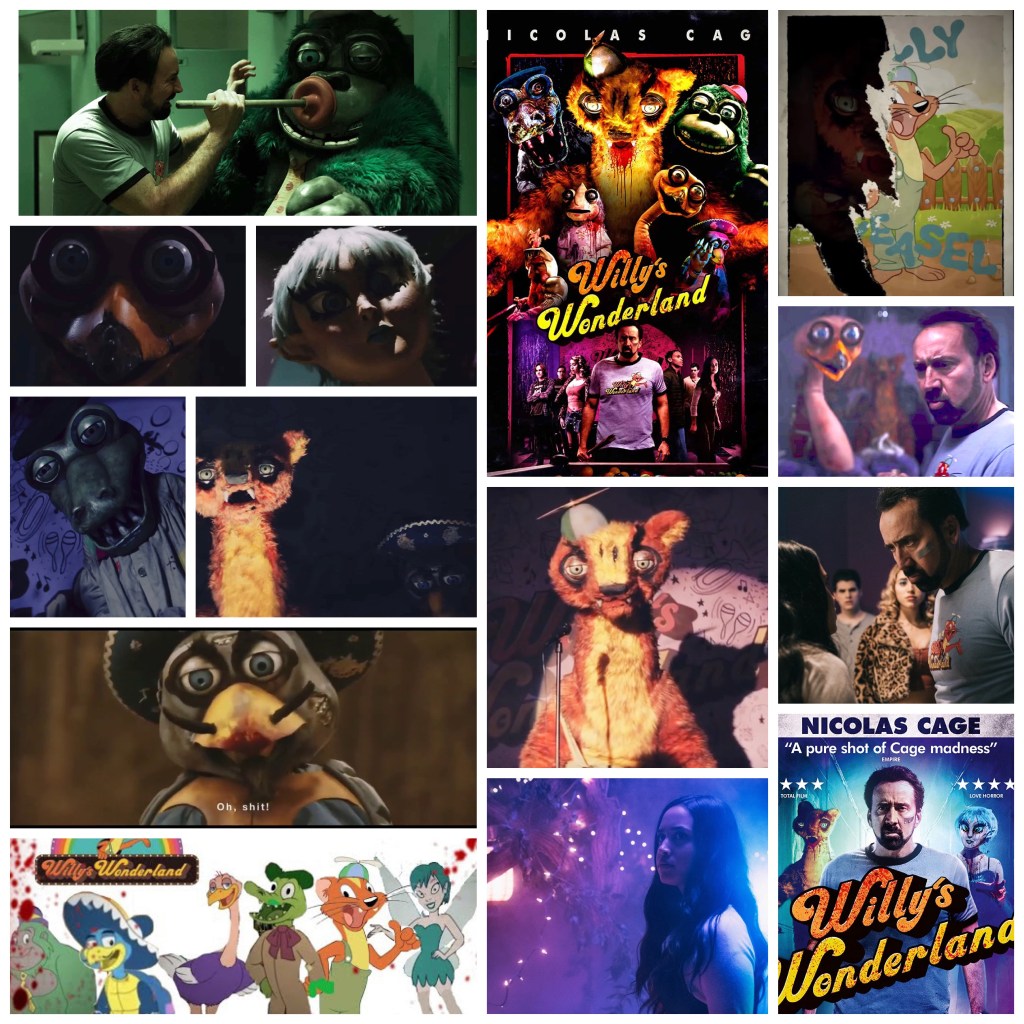
I never thought I’d live to see Nicolas Cage violently tune up a giant plush gorilla with a toilet plunger and curb stomp it’s head onto a urinal, but here we are. Willy’s Wonderland is an absolute bonkers blast, the kind of delirious, fucked up, funny as hell, gory as shit horror comedy I haven’t seen the likes of since the original Evil Dead. Now, I’m not sure what the rights or relationship situation is to the video game Five Nights At Freddy’s because this is clearly very much inspired by it, but that aside this finds it’s own demented groove, devilish mythology and wicked funny dark humour. Cage plays a mysterious, mute drifter who takes a night job cleaning a creepy, rundown Chuck E. Cheese restaurant to pay off a mechanic debt but it’s clear that the inbred yokels of this backwater enclave have a more sinister agenda, starting with the no nonsense sheriff (Beth Grant, Speed, Donnie Darko). Sure enough, the seemingly dormant animatronic toys are possessed by evil spirits and come to life at night with plans on killing Cage. What to do? He springs into silent but deadly action and beats the ever-loving fucking piss out of these loud mouthed Fisher Price rejects in what can only be described as an experience of pure unfiltered pandemonium. Meanwhile outside the restaurant a group of local kids prepares to pour gasoline and burn the place down in attempts to end the evil forever. This is Cage’s show and he’s a tornado of charisma even with no dialogue, guzzling down soda pop and dancing around pinball machines when he isn’t ruthlessly and violently decimating the animatronics, who all have interesting and creative designs from an ostrich to a medieval Knight to a Mexican mariachi turtle (lol) to Willy himself, a giant leering weasel with an elongated neck. The unnerving theme song and all of the musical numbers belted out by this demonic cabal of zoological burnouts are all written by experimental multi-musical artist Emoi and they all pop for a soundtrack that sets the cheeky tone perfectly. The story, although completely ludicrous, somehow feels engrossing and believable in a manic, bizarro world kind of way and every actor knows what kind of script they’ve been handed and does a terrific job with the humour. It is what it is man, if you came to see anything other than Nic Cage tangle with animatronics you’re gonna disappoint yourself but I’ll tell you this much: this could have been cheap lazy trash built around a gimmick they expected to sell itself. It isn’t. The gimmick is just the diving board, and the film itself is a genuinely well written, acted and executed piece that’s impressive and fun beyond being ‘just that crazy Nic Cage flick.’ It’s even legit scary in a few places, which is did NOT expect. So buckle up.

-Nate Hill