24 years old from Vancouver, Canada. Loved movies since I can remember. I do reviews on Instagram and Facebook as well, and after being harped at by my friends to start a blog as well... Here I am. I try to give obscure, overlooked films a day in court, ones I feel are hidden gems, that deserve to get some love.
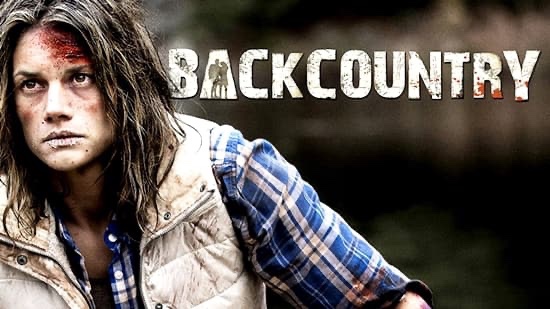
Getting hopelessly lost in the woods is a big fear for many people, and one that comes horrifically true in Adam McDonald’s Backcountry, a realistic, breathless, flawed yet ultimately effective survival thriller very loosely based on a true story. Young couple Jeff Roop and Missy Peregrym are off on a camping trip in the gorgeous Ontario wilderness, but things go dangerously wrong when they don’t bring a map, a phone or any means of navigation and find themselves stranded. I know what you’re thinking, how stupid is it to do that, however, the script provides specific reasons for every mistake they make and it’s up to the viewer to decide just how credible their turn of events is. In addition to being lost, they are suddenly faced with a very angry black bear who doesn’t take well to them wandering onto its land. The film isn’t really structured like your average thriller, instead building steadily and slowly with our two leads until it gets really crazy all of a sudden, and the visceral impact of the bear attacking hits very hard. The film is ruthlessly realistic in these scenes and if you thought Leo DiCaprio got it bad in The Revenant, just wait for this mauling. I really like Missy Peregrym, always been a fan of her work in stuff like Heroes, Rookie Blue and the overlooked Reaper. She’s usually cast in more lighthearted characters but she does a terrific job with the emotional heft, panic and despair needed to pull this role off and I wish she’d get cast in more dramatically demanding parts. There’s an odd, inexplicable subplot involving another hiker they come across played by Eric Balfour, who is vaguely threatening to them for reasons unknown but his character’s involvement and attitude towards them is never properly explained nor feels necessary to the story overall, which jams up the otherwise rock steady narrative a bit. Still, it’s a very effective film, the bear attacks are genuinely blood curdling and our two leads, Missy in particular, make their characters humans with depth that we care about. Good stuff.
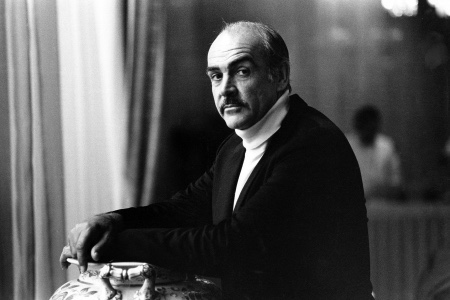
What is there to say about Sean Connery other than he was a legend, an iconic totem who terraformed the landscape of cinema throughout his career and left us with a rogues gallery of tough guys, adventurers, action heroes and memorable starring roles to revisit. Here are my top ten favourite performances from Sean!
10. Draco in Rob Cohen’s Dragonheart
It’s only his voice here, but he voices a great majestic dragon and gets to banter with Dennis Quaid for the whole film, their chemistry is terrific. It’s one of the few times he did voiceover work which is odd because he’s got the pipes for it and would have done very well extensively. His pronunciation of “look to the stars” has always stuck in my mind since seeing this wonderful fantasy film as a kid.
9. Marshall William T. O’Niel in Peter Hyams’ Outland
This is a fairly standard western that just happens to be set in space, where plays the lone lawman standing up to corporate corruption on his own. There’s something so elemental about the sight of uniformed Sean, shotgun in hand dishing out justice on one of Jupiter’s moons, and he rocks the strong, silent, lethal avenger role here nicely.
8. Allan Quatermain in Stephen Norrington’s The League Of Extraordinary Gentlemen
Alright so this film doesn’t have the best reputation but I really enjoy it, so there. Sean is terrific as the gruff literary figure and blusters his way through several delightfully preposterous action set pieces with a world weary swash and buckle that sells the material. Who cares if he himself has stated in interviews he had no idea what he was even filming because the script was all over the place, he looks damned dashing in the costume flinging around six guns, guzzling from a flask and making impossible shots from a highly stylized long rifle.
7. Henry Jones in Steven Spielberg’sIndiana Jones & The Last Crusade
He makes the perfect dysfunctional father to Harrison Ford’s Indy here and their relationship is exactly what you’d expect from such an extreme lifestyle. My personal favourite moment is when he literally crashes an enemy plane from the ground by scaring up a flock of seagulls to obscure its visibility using his umbrella, and looks damned pleased with himself about it after too.
6. Marko Ramius in John McTiernan’s The Hunt For Red October
Some thought it odd to cast a Scot as a Russian submarine captain but he does such brilliant job as a morally shrouded man of fierce conviction and brutal resolve that we don’t even care about accents or ethnicity, just authenticity and nuance in performance.
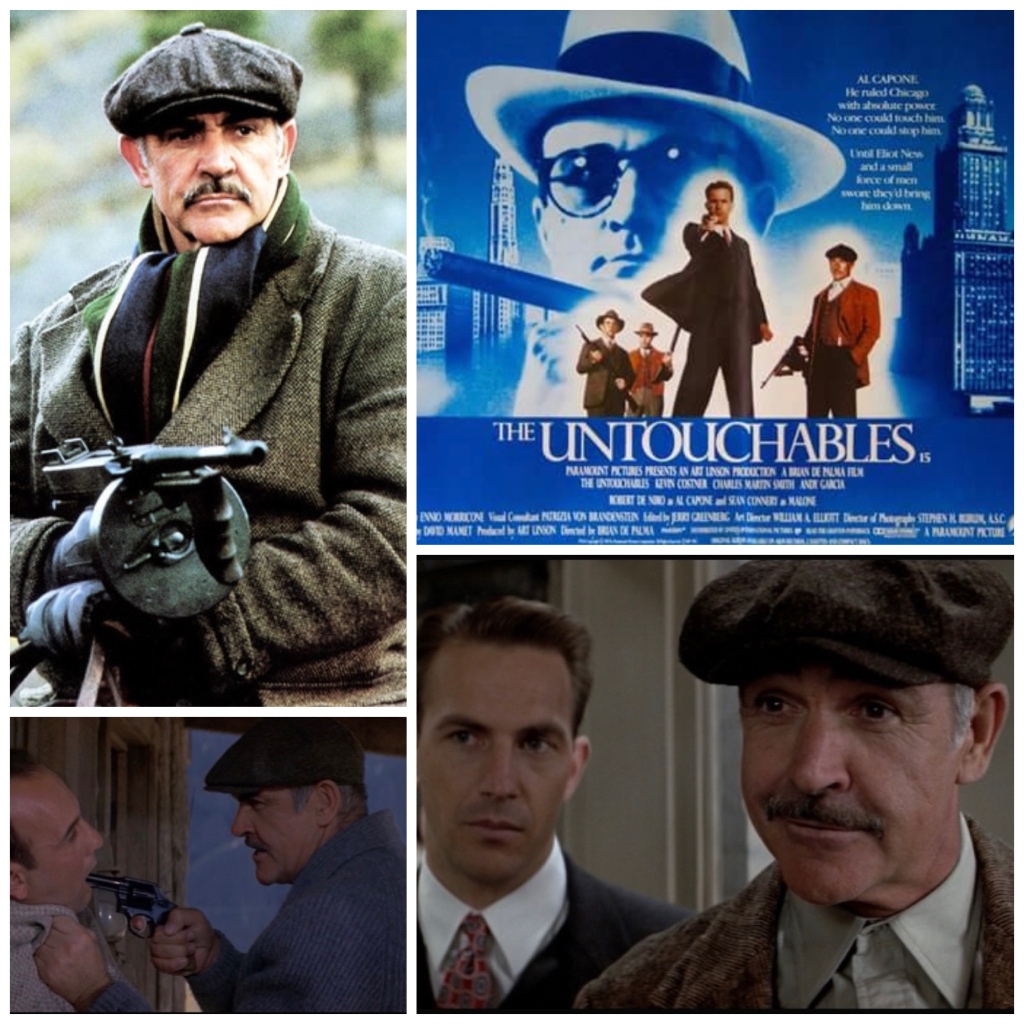
5. Jim Malone in Brian DePalma’s The Untouchables
The toughest Irish cop in prohibition era Chicago, Malone is a true bruiser tasked with training Eliot Ness (Kevin Costner) and his rogue unit, and he doesn’t fuck around either. “They pull a knife, you pull a gun. They send one of yours to the hospital, you send one of theirs to the morgue. That’s the Chicago way.” His delivery of those lines is light, breezy but laced with lethality that has you believing every word.
4. John Connor in Philip Kaufman’s Rising Sun
This is an underrated performance in an even more underrated film and if you’re doing a Connery retrospective right now after he’s passed, it’s a must. There’s a murder among the elite Japanese community of LA, and Connor is a culturally adept guru who knows how to navigate such waters. It’s a terrific piece of acting with meaty dialogue, great character work and chemistry alongside Wesley Snipes.
3. Ramirez in Russell Mulcahy’s Highlander
I can’t imagine the fun he must have had playing this character, but it radiates off of him in every frame anyway. A supernatural Spaniard warrior tasked with training immortal Scottish McLeod (Christopher Lambert), he’s arch, tongue in cheek, lovable, adorned in eye shadow that would make Jack Sparrow blush and just has this wonderful, charming way about him that almost has you wishing he’d get his own spinoff franchise.
2. James Bond/007 in various James Bond films
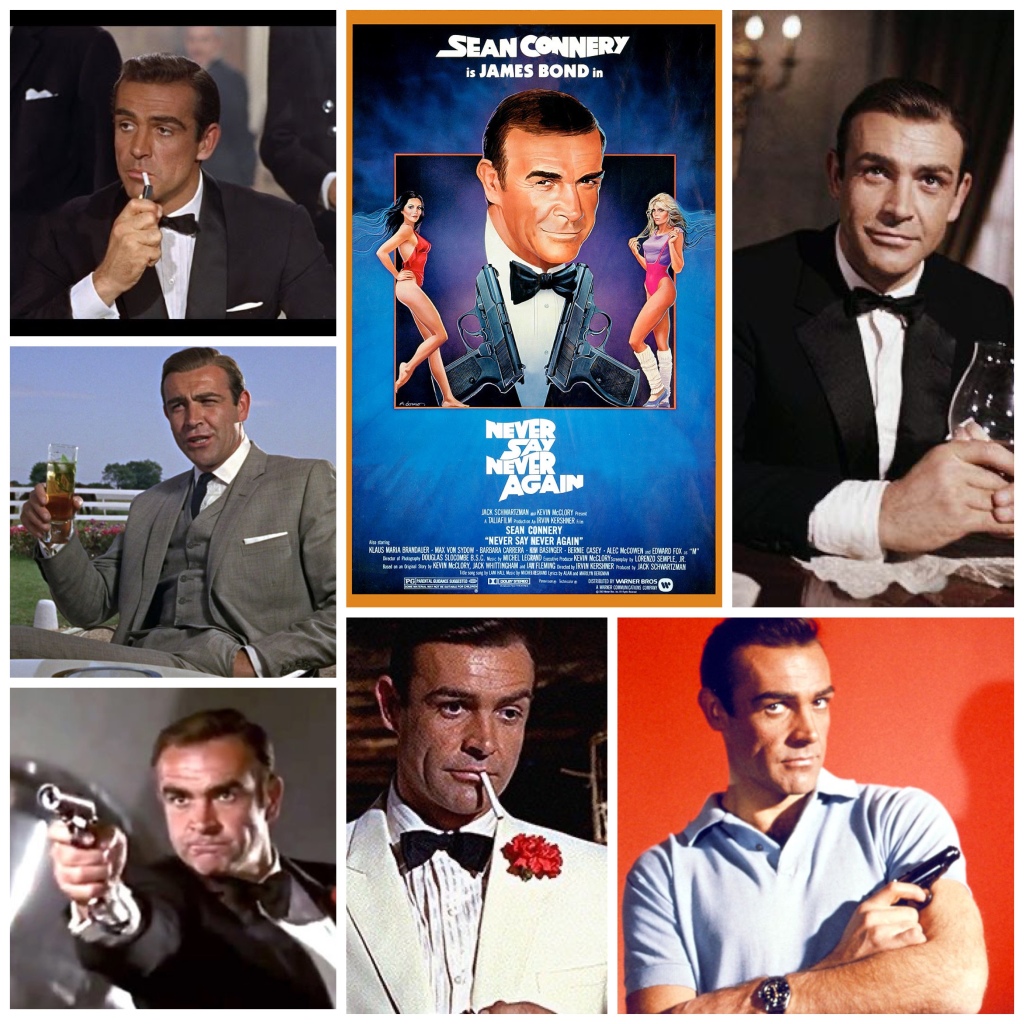
Its Bond, baby. While I can’t call Sean my favourite Bond in cinema, he was technically the first actor to hold that martini, brandish that Walther PPK, fill out that expensive suit and kick ass for MI6, and he does so with style, flourish, sex appeal and magnetism in spades. My favourite outing of him as Bond? 1983’s Never Say Never Again, which might be an weird choice but hear me out: he was already an older dude by this time or old in terms of playing a lithe super spy, but man he was a trooper and did a fantastic job in his final Bond adventure alongside the likes of Rowan Atkinson, a sultry Kim Basinger and a sassy Barbara Carrera.
1. John Mason in Michael Bay’s The Rock
The other British super spy in his career, I love his work as Mason because there’s a lot more depth than 007 and we get this world weary, sardonic and almost very sad energy from a guy who has been locked up unjustly for like three decades. All he wants to do is see his grown up daughter one time but he’s recruited to basically save the entire city of San Francisco, which he does in his own sneaky, brutal and often quite funny way. Mason is a terrific character and much more than just a spy or action hero, Sean gives him a deep pathos and soulful gaze that makes this, at least for me, his best acting work.
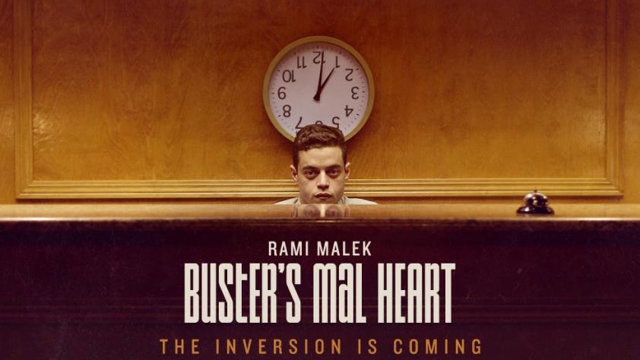
Sarah Adina Smith’s Buster’s Mal Heart is one of the best, most striking and unique films I have seen in some time for exactly the reasons it might be one of the most frustrating, maddening experience for other viewers. This film is like a Rubik’s Cube except it’s not square, all the pieces are the same colour and they’re all in different time zones. It’s a complex, dreamy, intangible, non-traditional narrative full of idiosyncratic asides, shifting plane storytelling, non linear abstraction and all sorts of brilliant filmmaking wizardry and it cast a spell on me I can’t quite describe in writing. Rami Malek and his perpetually glazed faraway gaze play Buster, a deeply troubled family man who works night shift at a desolate highway motel, the perfect breeding ground for psychological unrest to creep in and do some real damage. What *does* creep in is a mysterious stranger who calls himself The Last Free Man, played by eternally boyish, gnome looking curio DJ Qualls. This guy pays in cash to stay off the grid, raves about impending Y2K and foretells an event called the Inversion, which will forever alter time and space as we know it. Fast forward some years and Buster is a maniacal bearded homeless waif who breaks into empty vacation homes in the Montana mountains and tries to piece together his identity, his past and future to no avail as authorities close in. You can’t really describe this film in terms of plot because it’s not about that, it’s about mood, feeling, disorientation and atmosphere, all of which are my cup of tea over logic and plot structure. Director Sarah Adina Smith is a brilliant artist who uses strange, otherworldly editing techniques, coaxes bizarre, darkly humorous performances from her actors and whips up a world from which there is no cognitive escape for the duration of your stay. The positively extraterrestrial original score by Mister Squinter is amazing too. This isn’t a film to be understood though, it is one to be felt and later deciphered. You know when you wake up from a particularly elaborate and thoroughly profound dream, then you sit there trying to collect pieces of it using conscious thought processes and you simply cannot get them in line because they are not of this world? That’s how I felt immediately after this film, as the experience washed over me and although I knew deep down where it’s essential what this film means, I couldn’t explain it in waking terms or paint that meaning in anything outside subconscious awareness. If you enjoy challenging stuff like the work of David Lynch, Guy Maddin or other artists who successfully employ dream logic in cinema (not an easy thing to do) then you’ll love this enigmatic, indistinct yet achingly specific gem.
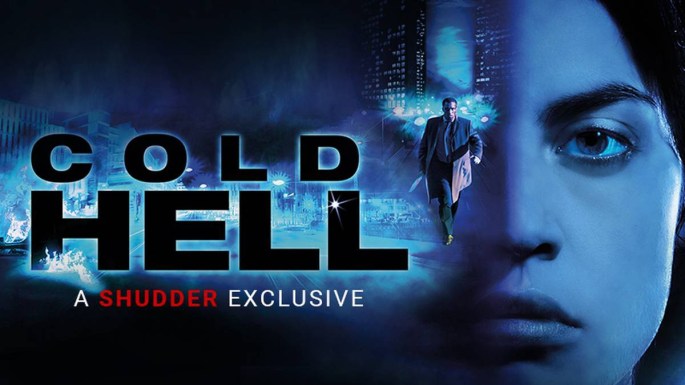
German cinema is off the hook if this one is any indication. Like some bizarre infusion of Giallo, Transporter style action and quirky family dramedy, this is billed as ‘Cold Hell’ on Shudder where I found it but it looks like the original German title translates to simply ‘The Hell.’ That has a specific meaning relating to the modus operandi of a very, very nasty serial killer who is targeting prostitutes in Vienna. Our protagonist is sullen, haunted Ozgë (Violetta Schurawlow), a Turkish cab driver who moonlights as a kick-boxer and frequent babysitter for her wayward cousin who is stuck in a cataclysmic marriage. One night she witnesses a mysterious Muslim assailant (Sammy Sheik) ruthlessly slaughter a girl in the flat across the street, he pegs her as a witness and they embark on a frenzied pursuit all over the city. I’m not sure if this was the filmmaker’s choice of if Europe is just a little crassly behind the times but there’s a harsh attitude towards women, every other person Ozgë runs into is a profane asshole, and the killer himself is a freaky religious fanatic who thinks he’s sending sinful whores to hell on his own watch, but I suppose he’s allowed to be written that way because he is of course the villain. Ozgë develops a relationship with an extremely stressed out police detective (Tobias Moretti) who seems at first to have the same shitty attitude towards her as everyone else but later we get a diamond in the rough reveal and he turns out to be quite different, quite kind beneath his gruffness and I enjoyed their arc together quite well. This is an amalgamation of sorts, blending different elements but like not blending them seamlessly, it’s very clearly a genre patchwork quilt, in a fun sort of way. There are horror vibes early on that feel distinctly like an Argento or something, then it veers hard left into action movie territory garnished with some oddball eccentricities. Ozgë is such a terrific character, a woman of few words but tons of action. She uses her kickboxing skills to get her out of tight situations, lays some bloody beatdowns on the killer and all the while she’s carrying around the toddler daughter of her murdered cousin. The cop and her form a sort of strange bond, he’s looking after his dad who has Alzheimer’s so they’re both caring for someone vulnerable while trying to catch this gnarly killer and I found myself swept up in both their relationship and collective situation. It’s a scrappy flick and certainly not the greatest thing out there but I was entertained, loved the characters and had a good time with this story.
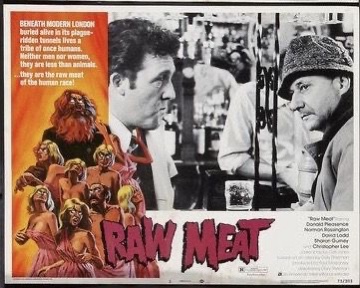
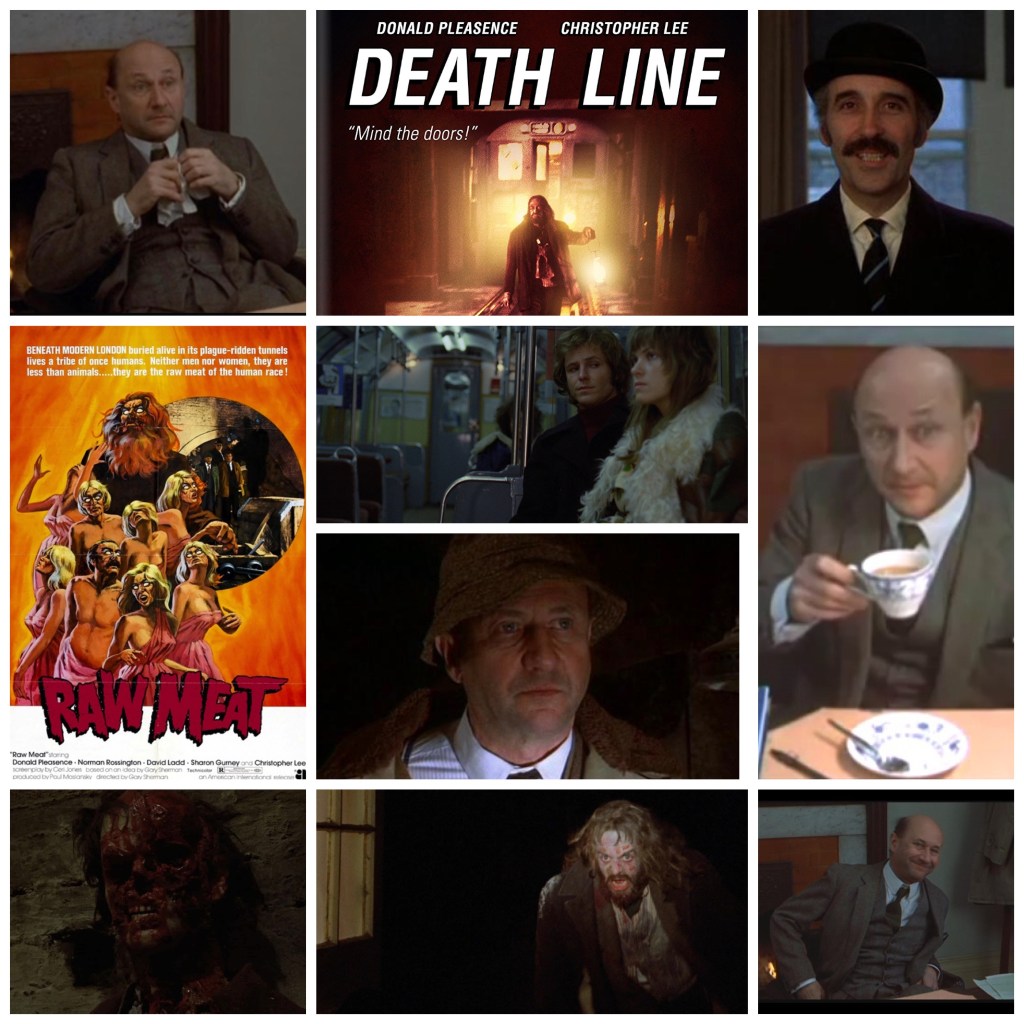
Gary Sherman’s Death Line (aka Raw Meat) is billed as a horror film but they must have meant comedy because I haven’t laughed that hard during a movie for a long time. That’s not to say it isn’t a horror, I’d definitely classify it as one if it twisted my arm over the matter, but holy fuck this is one of the weirdest, most berserk things out there. So get this: sometime in the 70’s, the London authorities discover that far beneath a tube station, there’s a tribe of mentally handicapped, cannibalistic subterranean yahoos living down there, descendants of a group of track workers trapped during a tunnel collapse during the 1800’s. For hundreds of years they have been snatching unsuspecting commuters off the platforms, eating them and also keeping some to reproduce with I guess. Meanwhile Donald Pleasance gives one of the most outright bizarre, unpredictability intense performances of his career as London’s most sarcastic Scotland Yard detective who gets wind of this bonkers situation and, well, investigates is a strong word for the level of effort he puts in, but he’s dimly aware of it anyhow. He plays a guy who is so British that he sleeps with a literal pot of tea next to his bed, has an emotional breakdown if his secretary forgets his cup of Earl Grey and wears a hat that can *only* be described as a tea cozy. This film just kinda meanders until you’re aware of what it’s technically about, yet can’t help but notice it’s slack pace and complete lack of desire tell a story with any sort of cohesion beyond an illusory ‘concept’ of subway dwelling maniacs. Arbitrary diversions abound, such as Christopher Lee randomly showing up as a very rude MI5 spook just so Pleasance can tell him “fuck you” straight to his face in the film’s one cheeky F bomb. At one point the whole thing just stops dead in it’s tracks so Pleasance and his partner (Norman Rossington) can hit up a local bar, get absolutely fucking torqued on beer and scotch, have a drunken pinball tournament and threaten the barkeep by telling him they’ll report him to the police for serving patrons after hours when, ya know, they *are* the police, the only ones still in the establishment and the very ones who made him stay open late to serve them anyways. The scenes underground are super cheesy with enthusiastic yet hilariously messy special effects and one terminally off pitched performance from Armstrong as the last surviving… whatever they are. Seriously this guy is covered in buckets of slime and has this weird way of acting that calls to mind a certain word I won’t use here, but he jumps around, hollers like a loon and makes quite the… campy impression. The pacing is all over the place and could barely be considered thriller structure, aside from a quick third act chase. Add to all of this perhaps the strangest proto-electronic musical score ever ever devised for a ‘horror’ film and you’ve got something that defies description. It’s like one of those movies you see on TV at 3am in a hazy fugue state and later try to explain to your friends, who all think you’re making it up. Weird ass flick.
There’s slashers, serial killers and then there’s villains of an altogether more disturbing nature like that of Sleep Tight, a deeply disquieting Spanish psychological oddity that sets in slowly and builds to a devastating payoff. In a sunny Barcelona apartment building, life seems breezy and pleasant. Friendly concierge César (Luis Tosar) greets the tenants kindly every day and does his job dutifully. Little do any of them know, César is a misanthropic, mentally disfigured lunatic whose very mission in life is to covertly make the lives of everyone around him thoroughly miserably because, as he tells us in forlorn inner monologues, he is physiologically incapable of feeling happiness. What does this involve? Well for starters, sneaking rotten fruit into the back of fridges, feeding an old woman’s dog the wrong kind of food to give it the shits, watering rooftop plants at the hottest time of day to kill them and piss off the building’s owner, small petty stuff like that. However, a beautiful young woman (Marta Etruria) living in one of the suites has a sunny disposition that isn’t so easy to breach and he goes to some skin crawling, abominably sociopathic measures to do so. The film chooses to focus on César as a protagonist rather than have him skulking about in the shadows like the villain usually does, so what we get is something that feels like a twisted character study as opposed to outright horror, but that structural augment doesn’t stop this from being one of the most upsetting experiences you could have. César is a sick, sick man and despite how intimate the script allows us to get with him, he’s never likeable, relatable or in any way justified, no inspires sympathy at all in these horrible actions like some black sheep characters in film. Tosar (who I remember as the intense Cuban drug lord in Michael Mann’s Miami Vice) is a stark looking dude, whose severely receding hairline has apparently migrated downward into eyebrow territory for a very, shall we say, otherworldly appearance. He’s great in the role, opaquely amicable on the surface but we can see the malformed creature inside just through his coal burner eyes. Director Jaume Balagueró also made on of my favourite underrated horror films, 2004’s Darkness with Anna Paquin. He knows how to use light, shadow, oppressive architecture and eccentric character traits to create a believably creepy atmosphere with shades of Hitchcock and classic thrillers of the like. This is an expertly told, beautifully produced original story and well worth watching but word of warning, it’s not roses and sunshine. This is a grim tale of a terminally unpleasant, incurably mentally ill monster who commits sustained acts of shocking menace and perverted exploitation that culminate in a sickening final reveal that will have the bile rising in your throat. But it’s not without its charms either, including terrific character work, picturesque production design and splashes of pithy black humour. Great film.
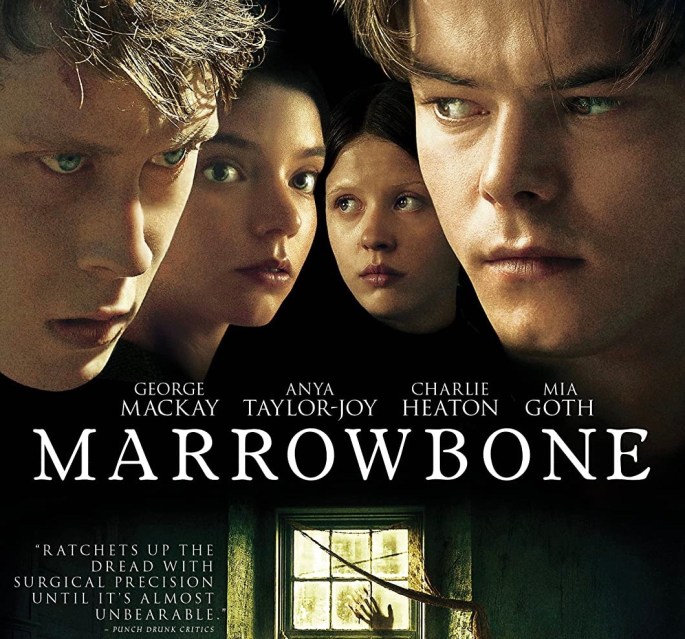
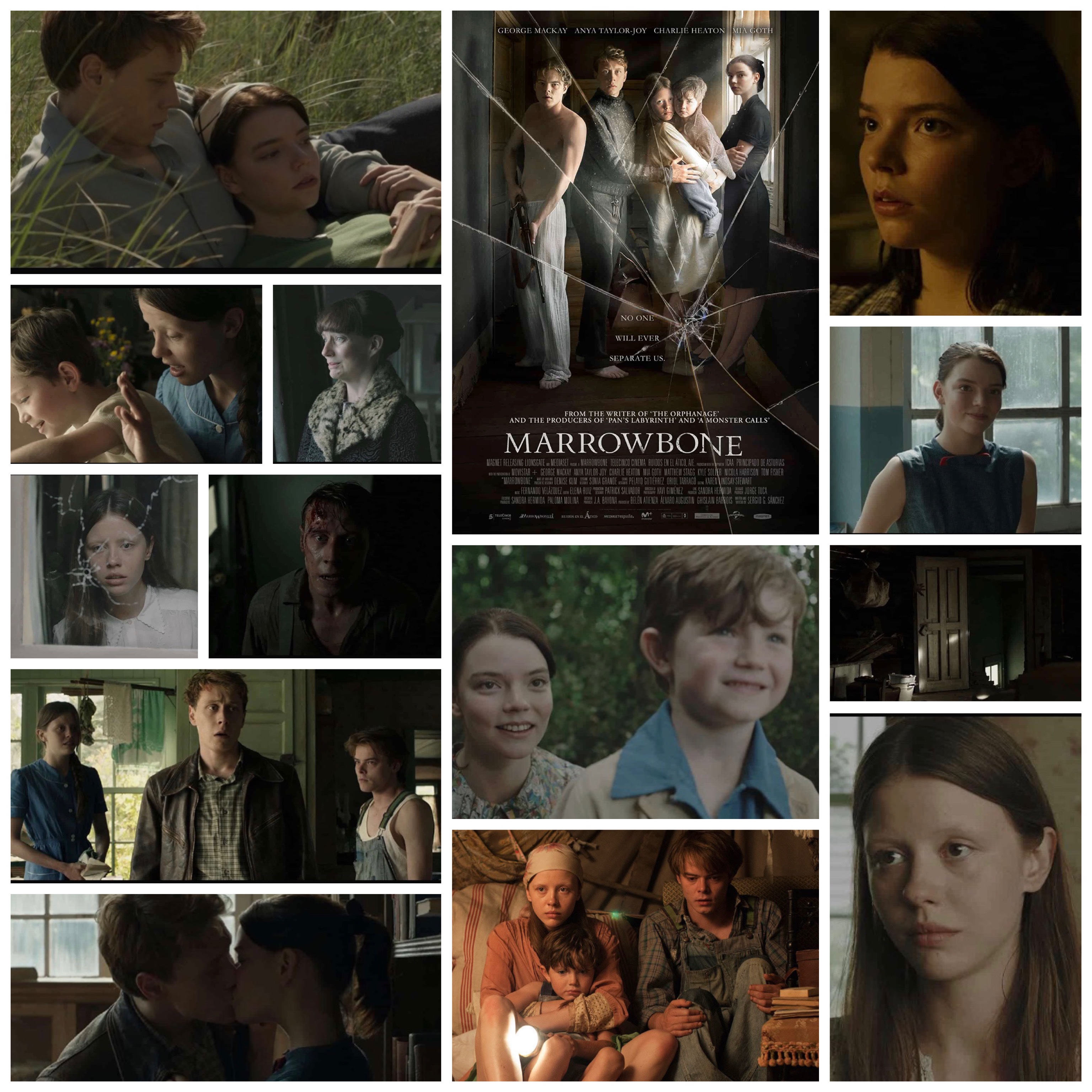
Horror movies always work best for me when the scares are in service of story, when character and emotion come first and the supernatural or horrific elements work their way into the human side organically, which is what we see in Sergio C. Sánchez’s Marrowbone, a wonderful, terrifying, heartbreaking masterwork that I just happened upon while browsing Shudder. You’d think it would have made a bigger splash with how prolific it’s four principle young cast members are, but it’s just as well that it retains hidden gem status. An English family of four children migrate over to America with their mother, running from a dark past and taking up residence in Marrowbone House, a place once owned by vague family. After the mother passes away the four are left on their own to financially keep the house, look after each other and survive demonic trauma that hovers over all of them them. Oldest brother Jack (George MacKay from Captain Fantastic, How I Live Now and 1917) is the natural leader and caretaker, trying his best to look out for younger siblings Billy (Charlie Heaton of Stranger Things), Sam (Matthew Stagg) and Jane (Mia Goth from Suspiria and A Cure For Wellness). They basically have no one in the world now except their friend local librarian Allie (Anya Taylor Joy, The VVitch, Split), who soon falls deeply in love with Jack and has a desire to help him and his family through dark times. Soon they hear eerie noises from the attic and a suspiciously sentient full length mirror draws attention in inexplicable ways as the ghosts of their past rise up to haunt them and memories once long buried begin to surface. I don’t want to say too much because this is such a fun puzzle box of a story to unravel and includes some twists that are tough to see coming (pay attention to the poster, where a big clue hides in plain sight). It’s a sad, forlorn tale about children growing up far quicker than they should have to, familial trauma and violence leaking over into the next generation and the ripple effect that evil and malcontent in a family can have. There’s wonderful romance that is sold effectively by MacKay and Joy, who are both superb, as are Heaton and Goth in roles that are secondary but no less deeply felt and acted. The scares are genuinely, bone chillingly fucking terrifying stuff, and the fact that restraint and subtlety is used make them all the more effective. Seriously, there are a few squirm out of your skin, shudder down your spine moments that push the creep factor past eleven on the dial, which isn’t easy to do. What makes the film work so well for me is that it cares deeply for these kids, their situation and makes each character stand out in their uniqueness, thanks to strong acting work, writing and music. It has a slight gothic feel, and I almost got like a ‘horror version of Narnia’ fantasy feel from these characters and their plight, but that could have just been me. Brilliantly written and directed by Sánchez (his freaking feature debut I might add), vividly and emotionally acted, it’s just a beautiful and frightening story worth immersing yourself in and one of the best horror films I’ve seen in a long time. 10/10.
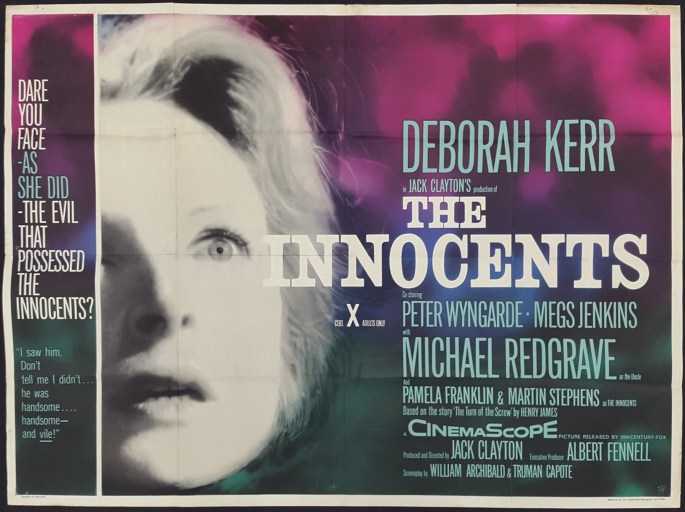
What is it about black and white films that is somehow just inherently creepier than the rest? Daylight seems eerie, anything could be a shadow and spectral presences are easier to hide in any given frame. Jack Clayton’s The Innocents is a frightening, beautiful piece of Victorian Gothic horror that’s subtle in all the right places, baroque when it needs to be and very unsettling, especially from an auditory standpoint. Deborah Kerr plays a young governess who travels from London to the countryside to look after two children in a large Manor, which of course is haunted and causing the youngsters to behave very.. strangely. Now this is of course the source material for Netflix’s brilliant Haunting Of Bly Manor and I don’t want to go too deep into comparison except to say that I greatly enjoyed both, Bly is a nine hour television series and naturally has way more depth in supporting characters and subplots, but it’s more of a love story while Innocents is the scarier of the two and works splendidly as a horror. It’s indeed very scary but not in terms of jump scares, leering ghouls or your usual brand of madness. Practiced in the art of subtlety, this film uses stark black and white photography to unsettle as the acrid marshlands and ornate, breezy corridors of the house yawn open for whatever spectral denizens lurk unseen. Sound design is key here too and should be applauded: in my favourite sequence, Kerr wanders the halls at night and hears some incredibly spooky whispers, moans, clanks and wheezes all around her. There’s something so evocative and iconic about a beautiful blonde Victorian girl, hair down, nightgown flowing, holding a candelabra and wandering the darkened halls of a vast haunted estate, its its own aesthetic. There’s another scene I loved in which she stands at the edge of a boggy pond and gazes over to the other side where the ghost of a former governess stands hauntingly still among the reeds, gazing back. It’s done in broad daylight and adorned in a hectic symphony of jagged sounds and is just so damn unnerving I had to rewind it and watch again just for double spook factor. I wasn’t quite sure what was implied by the ending of this but I enjoyed the note of ambiguity present in its conclusion, like the air being sucked out of the room abruptly or the night wind robbing a candle of its glow with one hoarse gust. This is a gorgeous, macabre, aesthetically pleasing horror gem.
There’s a lot of bad mojo out there for this film and maybe it had to do with the fact that M. Night Shoppingcart was attached during the nadir of his creative enterprise. He’s endured a fair helping of hate but I’ve always loved his storytelling and I really enjoyed Devil, a film that lives up to its title in ways you don’t see coming and weaves a taut, spring loaded morality fable laced with just enough supernatural menace to keep us on edge. One stormy day in a Philadelphia high rise five strangers find themselves trapped together in a busted elevator. A young woman (Bojana Novakavic), an old woman (Jenny O’Hara), a mechanic (Logan Marshall Green), a snotty dweeb in a suit (Geoffrey Arend) and a temp security guard (Bokeem Woodbine). Outside a police detective (Chris Messina) with a tormented past races against time to get them out as they all start dying one by one. One of these five in the elevator is in fact the Devil, in a quite literal sense, and he’s killing the others off one by one when the lights flicker in and out. How do we know this? The obligatory superstitious Latino Catholic character nervously informs us, of course. Alright, this isn’t the greatest film on some fronts, the story could have been a bit more focused, there’s some third act revelations that swoop in out of nowhere and although I myself didn’t guess off the bat who was the Devil, I’ve heard many claim they did, but who knows if that’s true, film critics are notorious flakes and liars. There’s a lot to enjoy here, including those third act revelations, the final twist lands well exceptionally well with timing and pathos, the Devil has some slick dialogue when he finally does show himself and the character work is pretty good. Also, you know your cinematographer is having fun when he opens the film with a classic overhead cityscape shot… presented upside down. The man in question is legendary DOP Tak Fujimoto, whose credits include everything from Silence Of The Lambs to Pretty In Pink to Badlands to The Manchurian Candidate. He has a blast here with ballsy dolly shots, quick zooms and wide pans that make the building feel larger than it is and the elevator smaller than it is, very effective work. I’d love to hear what the abject haters of this have to say for themselves *without* mentioning Shyamalan and focusing on the film itself, because it’s pretty weak, tired and hive-minded to attack his solid, varied and excellent career just because it’s cool to do so. Devil is wicked fun, a high concept supernatural shocker that isn’t perfect but entertained the hell out of me.
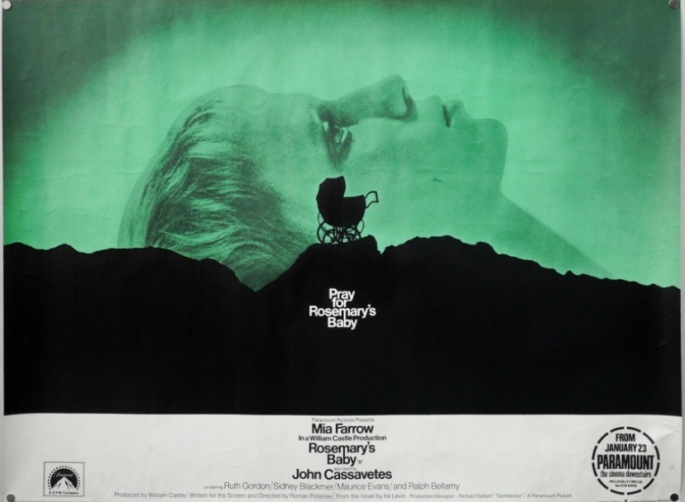
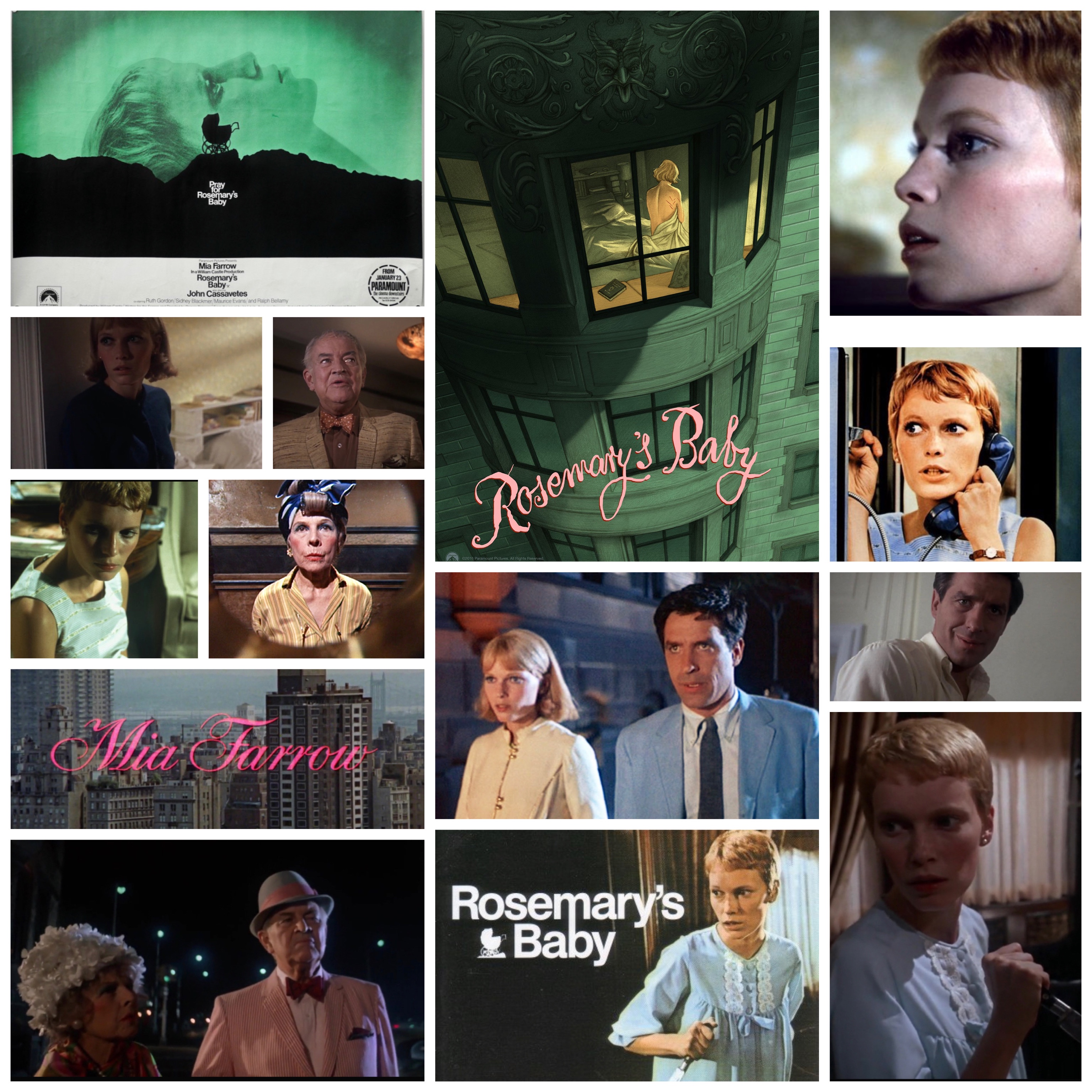
I saw Roman Polanski’s Rosemary’s Baby for the first time this week, and what a sensational, slow burning, delicate piece of unholy dread. I think I was expecting something more heavy handed or outright demonic like The Exorcist, but this is a gauzy, laconic, eerily reflective piece that takes time to hang out with all of its characters until you feel like you too are a tenant in the drafty, beautiful, impossibly spacious New York City brownstone apartment building where this dreamy tale unfolds. Young, naive Rosemary (Mia Farrow) and her gregarious actor husband Guy (John Cassavetes) move into a sprawling suite in this castle overlooking the park and seem poised for an idyllic life there as they try for a baby. Soon they get quite close with their odd duck neighbours, an older couple called the Castevets, played to the fruitcake hilt by Ruth Gordon and Sydney Blackmer. This is where the trouble begins, as these two pseudo parental totems insinuate their way into Rosemary’s life and then, more dangerously, her pregnancy. This is a horror film, a marriage drama, an occult mystery, a screwball comedy and a surreal arthouse enigma rolled into one special experience. I wasn’t expecting the level of experimental unease fuelled into a simultaneously gorgeous and anxiety inducing dream sequence where abstraction, Nightmare logic and off key sound design are used to quite literally transport you to another realm. Farrow is terrific as Rosemary and captures the small town naïveté of this character, inspiring caring and sympathy from the viewer when no one else is fighting in her corner. Cassavetes has some pep in his step, I had no idea he also acted but he’s got a slightly more buoyant Roy Scheider vibe and commands the screen nicely. Gordon and Blackmer definitely steal the show as the Castevets though, what a pair of loons. They dress like Hanna Barbera cartoons, never *ever* stop talking and deftly cover up their sinister intentions with flagrant eccentricity and the fact that no one can get a word in edgewise around them. There’s also fine work from Ralph Bellamy as a weirdo, unorthodox Doctor, Charles Grodin, Tony Curtis and more. Pretty sure I saw Sharon Tate hovering around in the background too, which was cool. The film begins with an overhead chopper shot of NYC as a haunting, melodic lullaby is sung by Farrow herself over the opening credits, luring the viewer into trancelike devotion for two transfixing hours as we see a woman fall victim to dark forces that flutter on the fringes of awareness unnervingly before making themselves known it by bit. A brilliant piece of atmospheric horror anchored by Farrow’s angelic work and eerie, unconventional direction from Polanski.












 Podcasting Them Softly