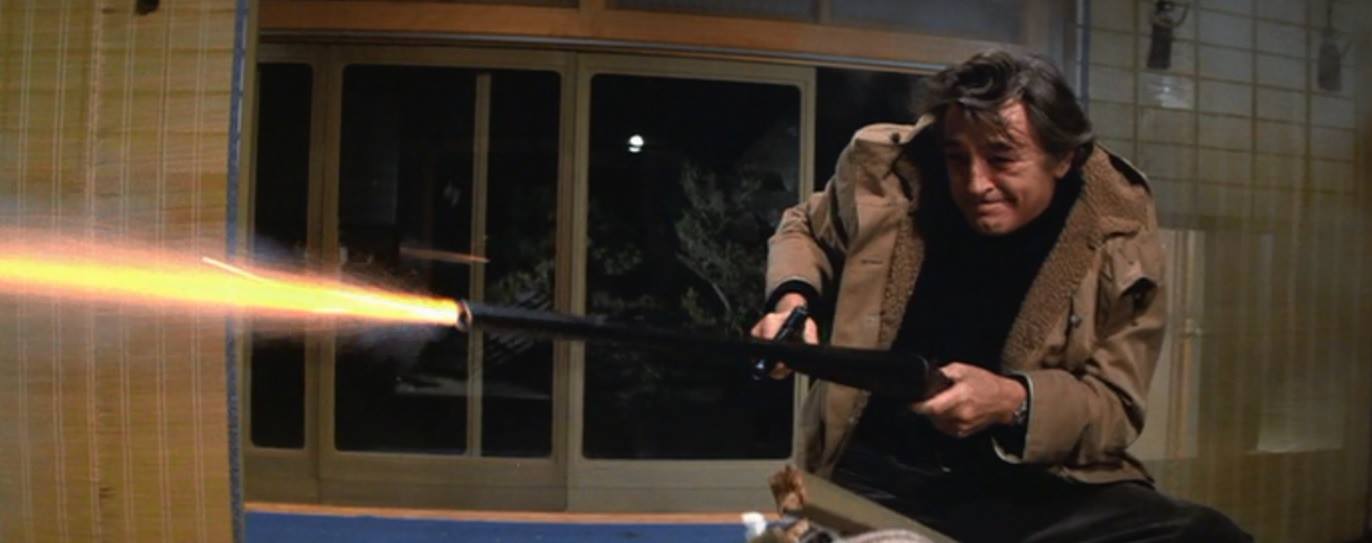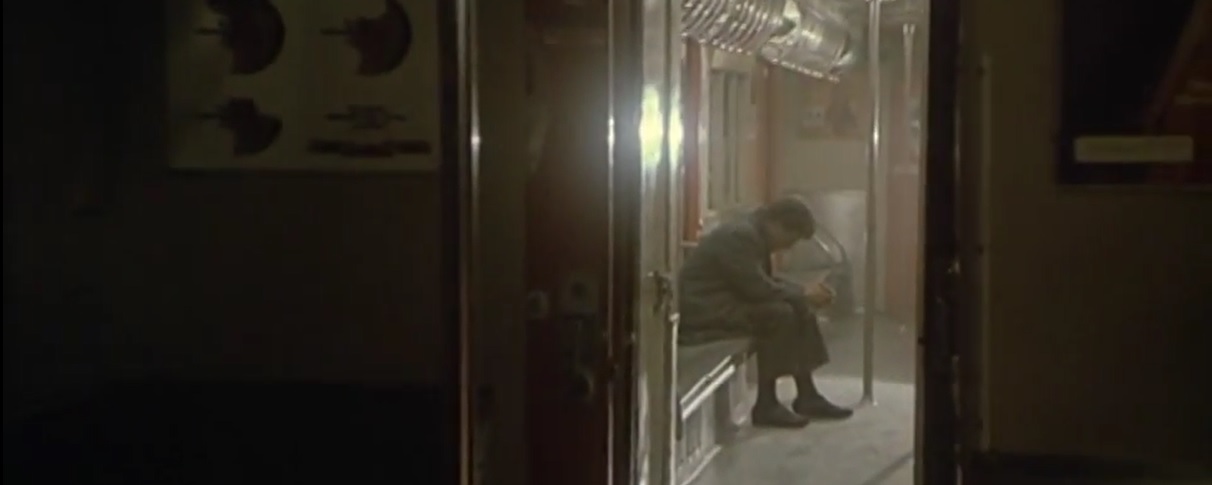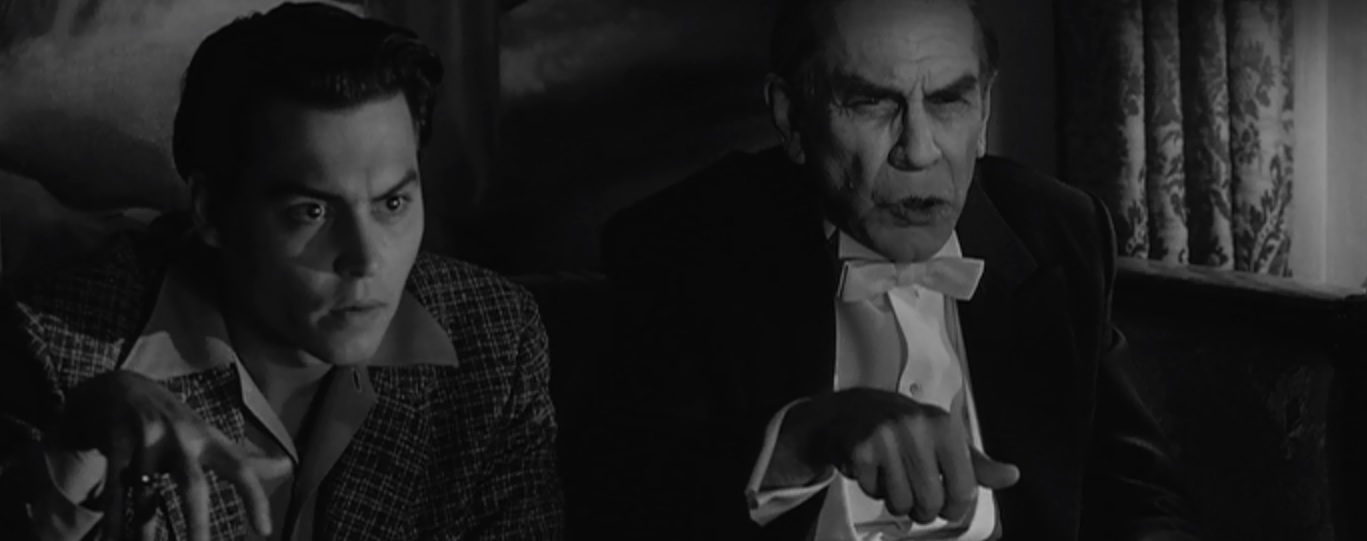
Sidney Pollack’s The Yakuza, released in America in 1975 after a Japanese premiere a year earlier, is a unique neo-noir gangster hybrid boasting an excellent script written by Leonard Schrader, Paul Schrader, and Robert Towne. Despite not being a box office hit at the time, the film has certainly gained a cult following over the years, and it was a movie that had always escaped my grasp. I’m so glad I finally caught up with this exceedingly entertaining drama, one that’s spiked with some truly great action scenes and a narrative that’s engaging on a story and emotional level. Featuring a solid-as-oak Robert Mitchum as an ex-private investigator who returns to Japan in an effort to rescue the kidnapped daughter of his friend, there’s a distinctive quality to this movie that’s hard to describe. There’s a great mix of hard-core shoot-outs and bloody sword play, Dave Grusin’s music supplied tension and grandiosity in equal measure, and the thoughtful and at times ruminative screenplay stressed character and motivation and thematic context rather than being an empty display of action. Ken Takakura provided more than just a steely gaze, injecting the film with a sense of lethality and wisdom, while supporting cast members Brian Keith, Richard Jordan and Herb Edelman made the most out of their distinctive roles. Especially Jordan, whose unique face was able to convey just as much information than the script ever could. But it’s Mitchum who totally owned the picture, bringing his customary gruff line delivery and masculine sense of purpose to this exotic and violent story that traded off of noir tropes and the demands of the action picture in equal measure, with Pollack’s sure and steady directorial hand bringing it all together in a very elegant, crisp fashion. The rich screenplay investigated themes of moral and social expectations on the part of the Japanese culture, and how familial loyalty and personal friendship can be tested through the differing viewpoints of Eastern and Western school of thought. Ridley Scott and his creative team would heavily borrow from this film for the 80’s classic Black Rain, and clearly, this must be a favorite for Quentin Tarantino.
Author: nlclement
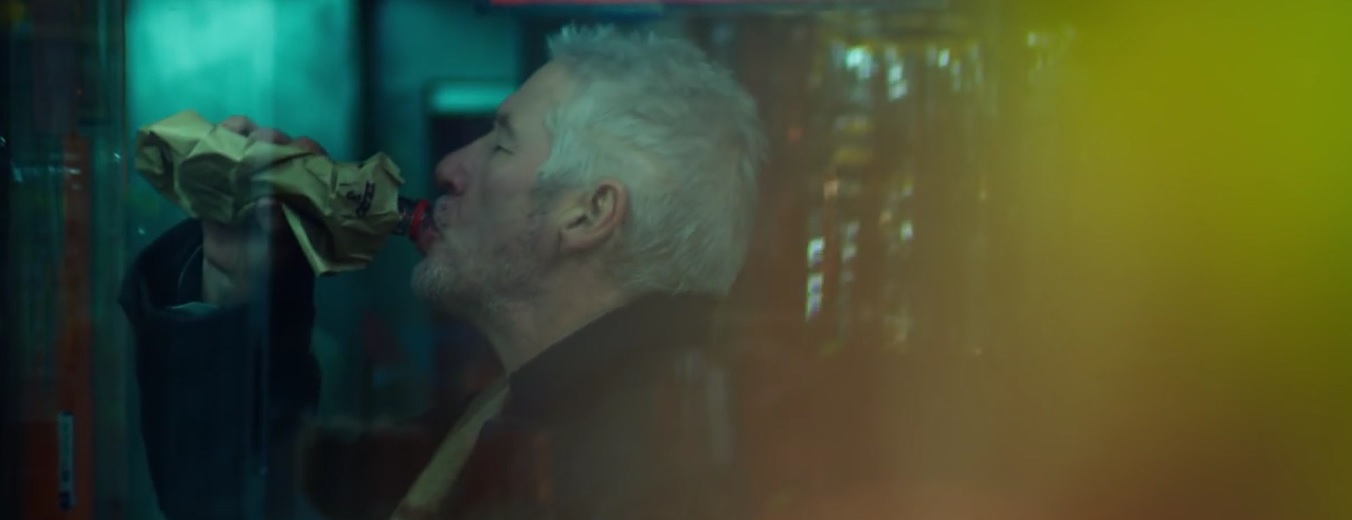
OREN MOVERMAN’S TIME OUT OF MIND — A REVIEW BY NICK CLEMENT
BILL POHLAD’S LOVE & MERCY — A REVIEW BY NICK CLEMENT
Love & Mercy is a very sad film about a very troubled person. I have to assume that this film is factually correct because it feels extremely well-researched, and I just can’t imagine the filmmakers inventing stuff simply to manufacture drama. I’m was not up to speed with Brian Wilson’s turbulent life and the events that surrounded the rise of the Beach Boys, so as such, the entire film was one surprise after another, and it’s a work that’s both illuminating and despairing in equal measure, much as life so often is for many people. This isn’t your routine biopic whatsoever, and one of the aspects I liked the most was that director Bill Pohlad (his second film in 25 years after years of producing, most notably The Tree of Life, 12 Years a Slave, and Into the Wild) and screenwriters Oren Moverman (Rampart, The Messenger) and Michael Lerner really showed you the intense creative process that goes into devising, writing, and performing music, especially for a guy like Wilson, who clearly had some savant stuff going on, and definitely was ahead of his time in terms of how he approached the task of artistic collaboration. There’s a fantastic sense of fidelity to the material that makes the entire piece feel very heartfelt and eye-opening, with some of the real-life recording stages being used for key scenes in this constantly probing film. I haven’t seen a better performance from John Cusack in years, as he paints a portrait of the older Wilson as extremely damaged goods, yet not without his glimmers of hope and ability to want to love. Paul Dano is absolutely fantastic portraying Wilson in his song writing and singing prime, yet still demonstrating the fact that his mental illness took root early on in life, no doubt spurred on by the abusive behavior of his father. Both actors fully commit to their impassioned performances, and as a result, the dual impressions of Wilson the artist and Wilson the man feel incredibly cohesive. Paul Giamatti is pure scum as a disingenuous “doctor” who duped Wilson out of happiness (and other things) for far too long, and the always wonderful Elizabeth Banks plays Wilson’s later-in-life love interest, a woman who fell in love and went to bat for Wilson, in an effort to help him turn his life around. Shot by the extremely talented cinematographer Robert Yeoman (all of Wes Anderson’s films, To Live and Die in LA), the film feels extremely California, with golden sunlight stretching across the colorful images, with smart, casually stylish framing in abundance as per usual for this incredible cameraman. Atticus Ross’s immersive score not only highlights the best of the Beach Boys but creates an unnerving quality that cuts to the heart of Wilson’s numerous psychological issues; the use of rising sounds followed by abrupt silence is used to maximum effect. This is an incredibly focused and expertly crafted film, especially for someone calling the shots for the first time in more than two decades, marking Pohlad as a major talent to watch out for in the future, should he wish to continue sitting in the most important seat on the set.
JOHN IRVIN’S THE DOGS OF WAR — A REVIEW BY NICK CLEMENT
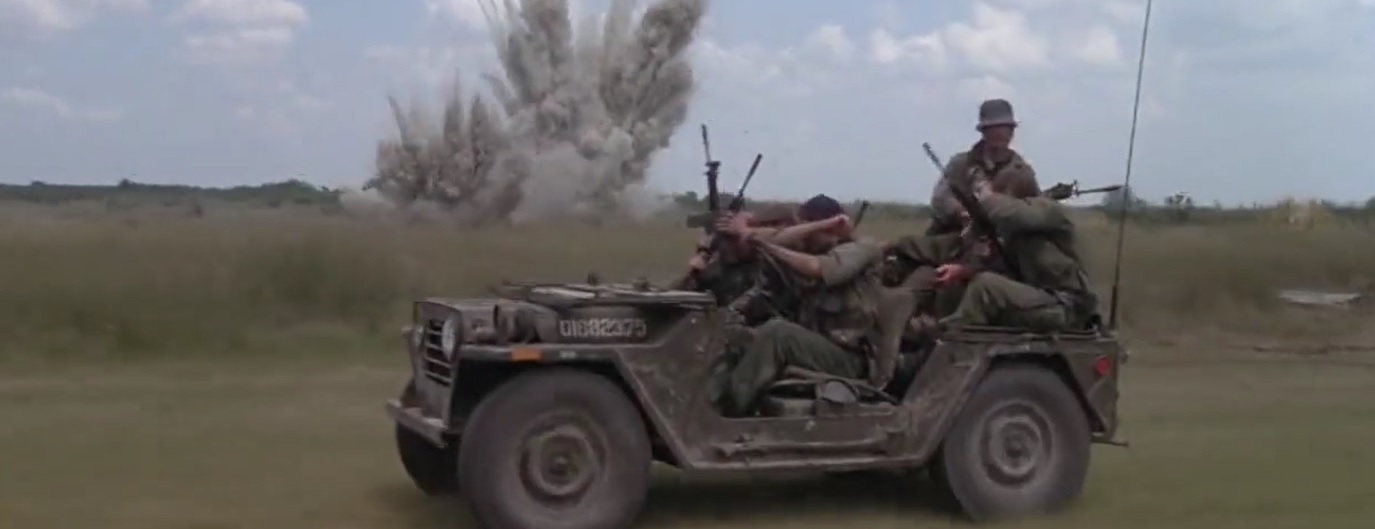
John Irvin’s take-no-shit war drama The Dogs of War is the sort of action picture rarely made these days — unsentimental, lean, and thoroughly engrossing (David Ayer’s underrated Fury feels cut from the same cloth, as do portions of Antoine Fuqua’s compromised Tears of the Sun). Gritty, violent, masculine, and shot with rugged panache by director of photography Jack Cardiff, this 1980 mercenary adventure has received the Blu-ray treatment from the fine folks at Twilight Time DVD Label and if you’re a fan of unpretentious, straight ahead war films, then check this one out. Christopher Walken and Tom Berenger deliver intense and extremely effective performances, with a surly and gruff supporting cast which included Colin Blakely, Hugh Millais, and Ed O’neil. Irvin would later direct the outstanding Vietnam film Hamburger Hill, 80’s classic Raw Deal, and the underrated Michael Caine thriller Shiner. According to the internet, Michael Cimino did a re-write on Gary DeVore and George Malko’s terse and disciplined script. The opening action sequence, which plunges the viewer into the middle a full scale Central American war-zone, is outstanding, especially for the days of zero CGI, with all sorts of for-real pyrotechnics and incredible stunt-work. The final act is essentially a battle, with some ridiculous fire-power on display. Geoffrey Burgon’s pulse-pounding score was more than up to the task. This is one of those excellent films that may have snuck through the cracks that’s totally worth re-discovering.
CINEMATOGRAPHER SPOTLIGHT: STEVEN POSTER, ASC — BY NICK CLEMENT
Veteran cinematographer Steven Poster, ASC has compiled a wide-ranging mix of theatrical and television credits throughout the years that stretch various genres and styles. After getting a start as a camera operator on Robert Altman’s brilliant 1978 comedy A Wedding, he moved into second unit work, getting a chance to cut his teeth on Close Encounters of the Third Kind, Blade Runner, Starman, and Big Trouble in Little China. In recent years, he’s developed a close working relationship with maverick indie director Richard Kelly on the cult classics Donnie Darko and Southland Tales, as well as the underrated sci-fi thriller The Box, which approximated the look and feel of the 1970’s in ways that few modern movies ever attempt. He shot the provocative Los Angeles sexual drama Spread from rising star director David Mackenzie (Perfect Sense and Starred Up), Ridley Scott’s 1987 neo-noir thriller Someone to Watch Over Me, audience favorite Rocky V, the subversive and totally wild sequel Big Top Pee Wee, and 80’s classics Strange Brew and The Boy Who Could Fly. In addition to his duties behind the camera, Steven currently serves as President of the International Cinematographers Guild, and in previous years, served as President of the American Society of Cinematographers. His upcoming projects for 2016 include the horror sequel Amityville: The Awakening, a new Richard Kelly movie, and the indie drama All Good Things. He’s an artist always looking to change it up with varying material and specific aesthetic choices, while always stressing smart control with imagery and a disciplined sense of camera placement.
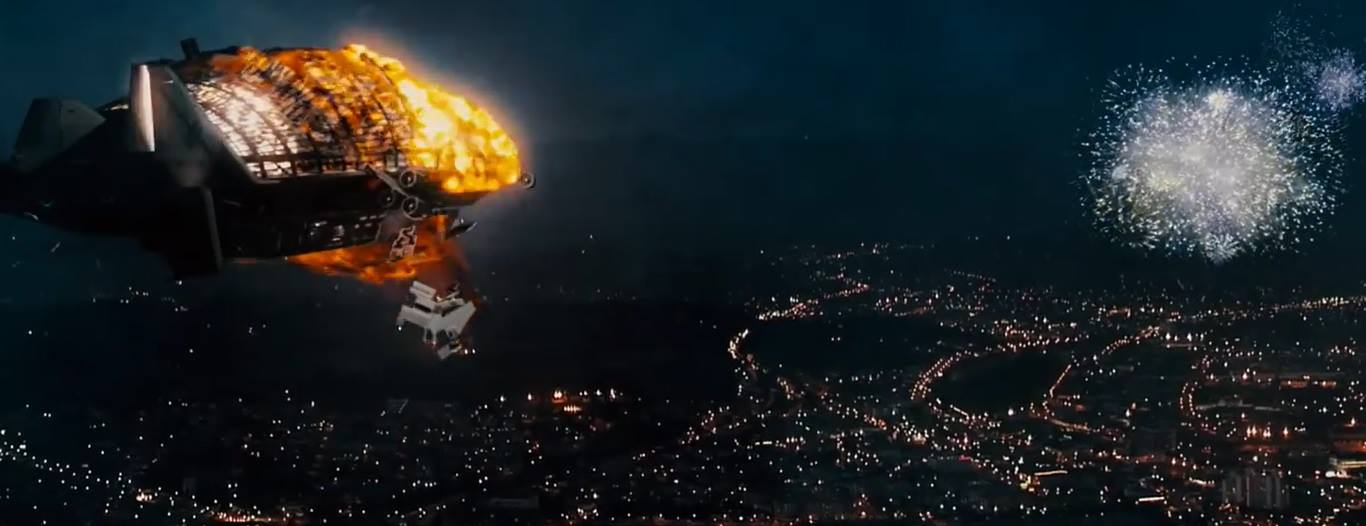
Donnie Darko announced the arrival of the challenging filmmaker Richard Kelly, and the film became a calling card for the director, and for a generation of high school and college kids looking for something offbeat and unique. A big reason for the film’s overall level of success is the dreamy visual style that Poster brought to the project. Shot in 2.35:1 widescreen and frequently emphasizing the middle of the frame, the film has an ominous tone all throughout, with much of the story set at night, while Poster’s camera glides through one surreal cinematic moment after another, using slow-motion in a perfect fashion, heightening the emotional moments with force and purpose. Another Poster/Kelly collaboration is Southland Tales, the divisive, Dr. Strangelove-esque political and social satire that feels like 10 movies stuffed into one, with an aesthetic style that feels like a smart and logical extension from Donnie Darko, again maximizing the use of the widescreen space, filling the screen with hallucinatory images that wash over you like some sort of wild, psychedelic trip. The saturated colors favored by Poster in this film made the volatile world being presented in the narrative all the more seductive, while the final 30 minutes represent something of a stylistic freak-out on the part of everyone involved, with Poster emphasizing the otherworldly through lens flares, bold nocturnal images, with an exploding zeppelin and a floating ice-cream truck providing him with the opportunity to craft images that feel like nothing you’ve ever seen. And Poster’s work on Ridley Scott’s underappreciated thriller Someone to Watch Over Me is a clinic on how to shoot a neo-noir that never feels overly slavish to other genre entries, always taking cues from the past while imbuing it with a (for the time) slick and sexy visual style that feels oh-so-gloriously late 80’s in retrospect. Shadows, smoke, darkness, moonlight, neon, and all sorts of atmospherics played a big part in Poster’s overall mise-en-scene, and under the firm direction of Scott, Poster was able to craft one of the best looking films of his stellar career.
RICHARD KELLY’S SOUTHLAND TALES — A REVIEW BY NICK CLEMENT
How can one accurately “review” Richard Kelly’s mind-bendingly crazy and divisive film Southland Tales? Kelly, whose debut was the incredibly enjoyable cult classic Donnie Darko, totally shot for the moon and back with his second directorial effort, which is filled with an insane amount of ambition and spontaneous sense of creativity. A sprawling, Los Angeles-based head-trip, Southland Tales feels like one of the most expensive experimental films ever made, bowing to zero concessions, devised by a mad scientist who often times feels like he’s making up new rules as he goes along. For some, Southland Tales will inevitably be a maddening viewing experience, especially upon first glance, but over the last few years, I’ve grown to absolutely love the movie, and I constantly feel compelled to revisit it. The film’s extra-packed midsection, at first, seemed purposefully meandering, but I’ve realized that it’s just extra dense, and requires some careful dissection. While some may feel that Kelly possibly bit off more than he could chew overall, it’s impossible to dismiss this film the way a majority of critics did, if for no other reason than it takes serious chances as a piece of storytelling, and because it’s a surreal, distinct vision that could only have come from a filmmaker with immense talent and a high level of chutzpah.
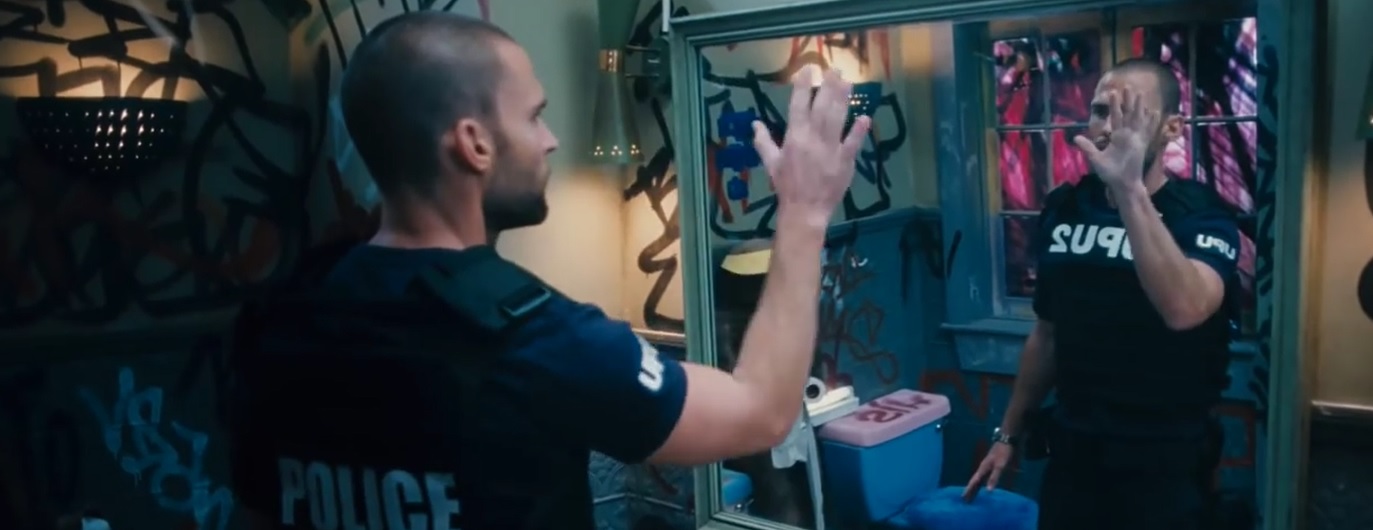
The film starts off in 2005, at a backyard, Fourth of July barbeque in Texas. Home video camera footage shows families playing with sparklers and eating hot dogs. Then, the unthinkable—a mushroom cloud can be seen in the horizon. An atomic bomb has been dropped in Abilene. The world is forever changed. We then jump three years into the future to Los Angeles; again, it’s July 4, but the world we knew is gone. Society stands on the brink of social, economic and environmental disaster. A fascist government is in control with big brother lurking everywhere. Boxer Santaros (Dwayne “The Rock” Johnson) is an action-movie star who’s stricken with amnesia. He crosses paths with a calculating porn star named Krysta Now (a sassy Sara Michelle Geller), who, among other things, is developing her own reality television project. The two of them concoct a movie idea that has Boxer set to play a cop. Meanwhile, good-guy police officer Ronald Taverner (an excellent Sean William Scott), agrees to allow Santaros to shadow him so he can get the feel for police life in an effort to turn in a convincing performance. But, it turns out that Taverner may hold the key to a vast conspiracy that nobody is ready to comprehend. There’s a lot more to Southland Tales than that. Radicals are stirring up a political uprising, using Venice beach and Santa Monica as their staging ground, while much of Los Angeles has been reduced to a DMZ. Armed soldiers monitor the beaches and streets with itchy trigger fingers. Then there’s the finale with two Roland Taverners, time-portals that open up into new dimensions, a floating ice cream truck, rocket launchers, and an exploding, futuristic zeppelin. There’s more…much more…but I’m at a loss to know how to summarize all of it. It’s a massive piece of filmmaking, going off on tangents and filling the frame with tons of visual detail (Kelly’s regular collaborator, the versatile Steven Poster, handled the aggressively stylish cinematography). This is a film that takes elements of political satire, post-apocalyptic nightmare, science-fiction fantasy, romantic drama, and movie-musical and throws them all into a blender and swirls them up into a wild smoothie of a movie.
Making all of these seemingly disparate threads add up to a cohesive whole had to have been a herculean task. This is a staggeringly original piece of work, filled with homages to classic films, while still operating as a unique vision all its own. While narratively stuffed at times, and with performances that veer this way one moment and the other way the next, Kelly’s film is never boring and is fascinating on many levels, mostly because Southland Tales is satirizing a world that doesn’t totally exist. Kelly created a frightening political and social landscape, one that in fact may not be too far away for all of us in reality. But by not basing his vision in any sort of fully realistic setting, the audience isn’t in on the joke as much as Kelly; he’s poking fun at a world that is removed from our own, and as such, the satire sometimes feels a bit esoteric. But that’s because Kelly truly KNOWS this world that he’s created. The performances are broad, and in many respects, over the top, but that was likely the directorial intention. The true acting surprise of the film was easily Sean William Scott, still best known at the time for his immortal role as “Stifler” in the American Pie franchise, and here, give the chance to be someone totally different from the lovable and immature clown that he so memorably portrayed. Granted, his character (much like the audience), spends most of the film in a fog of confusion, but the charm and ease that he brings to this zany movie is very effective and emotionally engaging. I always had the sneaking suspicion that there was more to him as an actor, and throughout much of Southland Tales, he makes good on that promise.
CINEMATOGRAPHER SPOTLIGHT: TIM ORR — BY NICK CLEMENT
Tim Orr is one of the busiest cinematographers currently working in Hollywood, having amassed 40 credits over the last 15 years, putting his distinct touch on both comedies and dramas, always knowing how to approach every visual situation with an organic and naturalistic quality. He’s the director of photography of choice for eclectic, can’t-pin-him-down filmmaker David Gordon Green, having shot all of the versatile director’s films, along with pairing up with a diverse field of directing talent on a terrific mix of studio and indie material. Tim has worked on some of the best comedies over the last few years, including the instant stoner classic Pineapple Express from DGG, Jody Hill’s brilliant satire Observe and Report, the underrated end-of-times comedy Seeking a Friend for the End of the World, and Mike White’s charming black comedy The Year of the Dog. He’s also no stranger to dramas, having collaborated with DGG on the gritty Nicolas Cage film Joe, the dreamy Zooey Deschanel romance All the Real Girls, the Terrence Malick produced southern thriller Undertow, and film festival favorite George Washington. He’s also dabbled in television, with credits that include HBO’s hilarious water-cooler sensation Eastbound and Down, and he recently shot the pilot for the upcoming comedy Red Oaks for Amazon Originals, which was exec produced by Steven Soderbergh. In late October, his newest feature film hits the big screen – the highly anticipated Sandra Bullock political comedy Our Brand is Crisis – which was produced by George Clooney and Grant Heslov, and could be a factor in the year end awards season. He’s also got the Netflix original film Pee Wee’s Big Holiday, which marks the return of Paul Reubens as Pee Wee Herman(!), which is set for release in March of 2016. Orr is one of those tremendously talented cameramen who can switch back and forth, effortlessly, between genres and styles, and it will be exciting to see where his career goes from here after establishing such an interesting and varied body of work.
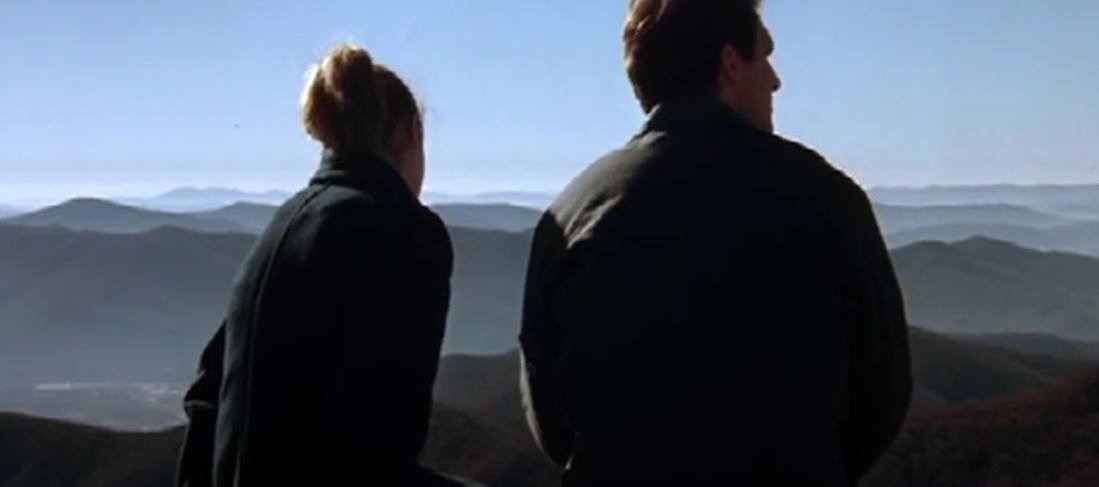
Snow Angels is certainly a bleak, sad film, with an uncompromising ending that’s both upsetting yet somehow cathartic. This isn’t a film I would recommend if you’re easily upset by realistic tragedy and tough stories about familial dysfunction. Orr shot with hand held cameras, draining the image of eye-popping color, and in tandem with the snowy and extra-cold atmosphere which worked perfectly with the story’s themes of anxiety and desperation, the film feels lived-in and entirely convincing. In the unique item Seeking a Friend for the End of the World, Orr brought his usual brand of on-the-fly camerawork to the story but had the chance to shoot in vibrant widescreen, stressing bold color saturation in an effort to heighten the emotional fragility of the panicked characters. Nobody gave this movie any credit for having so much odd charm and looking at the end of the world with a unique and funny spin, and Orr was able to craft a film that felt big even though it always remained intimate. Filmmakers have been obsessed with capturing the mood and spirit of young love for years, and with the poetic, sad, and beautiful film All the Real Girls, director David Gordon Green tapped into the heartstrings of a young, inexperienced woman who is learning to love for the first time (Zooey Deschanel in her wonderful breakout performance) and an older lothario who just so happens to fall in love with the sister of his best friend (co-writer Paul Schneider). This is a small-town movie with perfect, small-town flavor, and Orr brought a lyrical, Malick-esque sense of visual poetry to this boldly romantic film via exquisitely framed compositions, naturalistic lighting, and an emphasis on long takes that heighten the dramatic mood at almost every turn. Anyone who has ever fallen in love, had their heart broken, been excited by the possibilities of a new romantic partner, or been confused as to what they want in life, will find this movie to be a potent summation of all of our fears, desires, and longings when it comes to finding that special someone. And a huge reason for its success is the dynamic way in which Orr captured every singe scene, stressing an inherently homespun quality that makes the film feel all the more believable and honest.
ALEX ROSS PERRY’S QUEEN OF EARTH — A REVIEW BY NICK CLEMENT
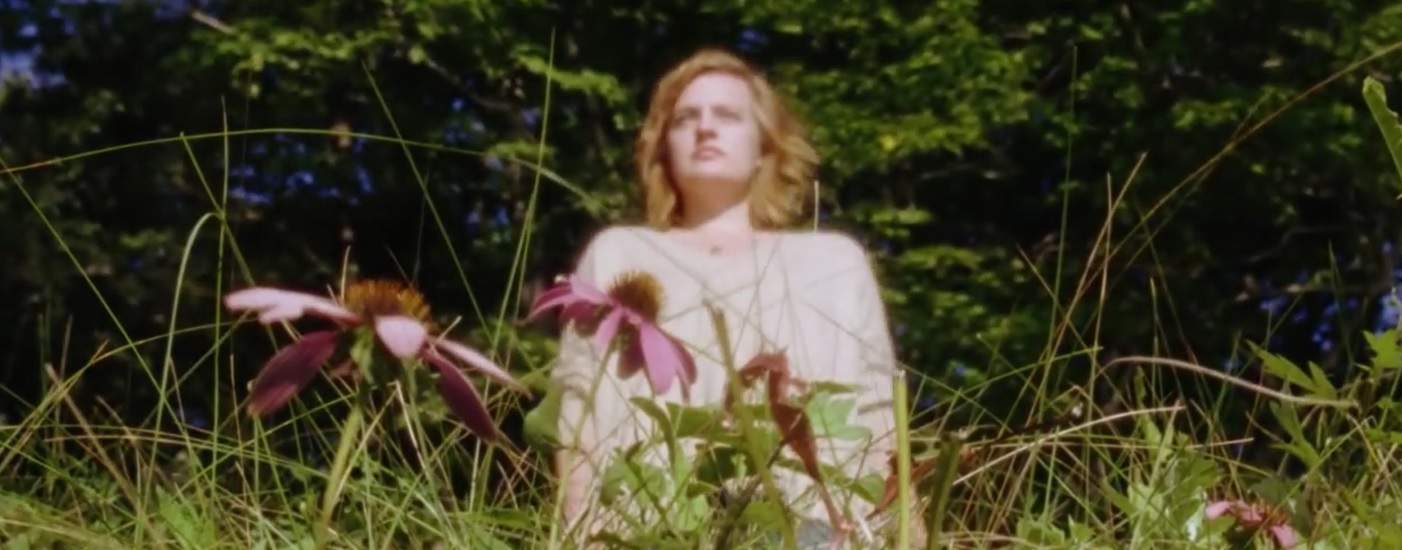
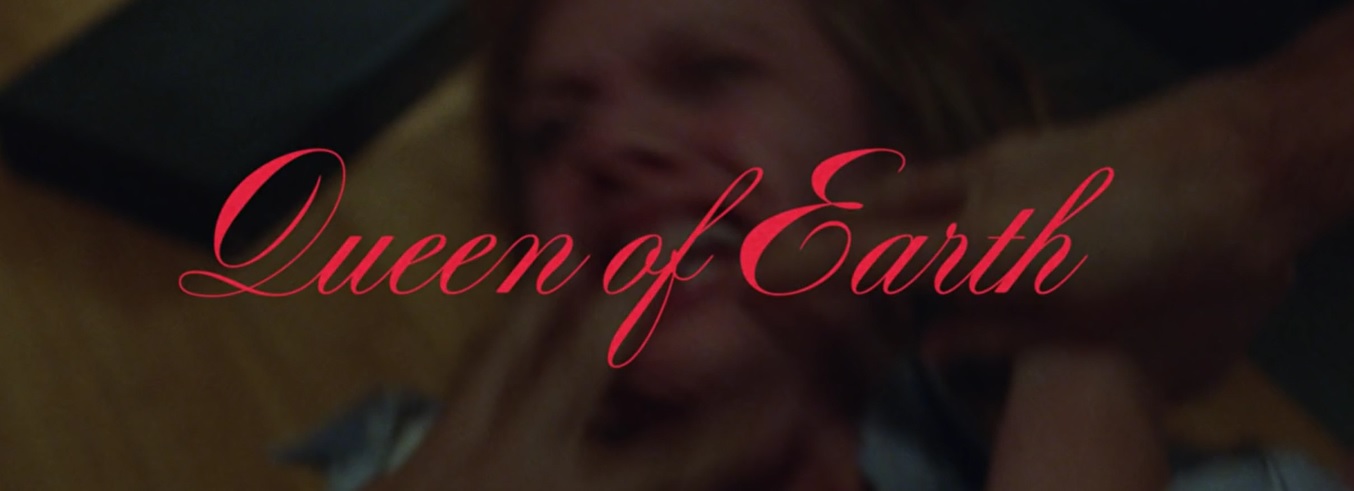
I recently had two viewings of Queen of Earth on successive nights and the film has stuck with me ever since. This one won’t be for everyone. It’s challenging, it’s uncompromising, and it features a riveting lead performance from the stunningly talented actress Elizabeth Moss (Mad Men, Top of the Lake) that will leave you emotionally drained by the end of the 90 minute run time. Up and coming filmmaker Alex Ross Perry (last year’s bitterly funny Listen Up Philip, which also s…tarred Moss) could do a lot worse than be wholly inspired by Robert Altman’s one of a kind masterpiece 3 Women, and even if Queen of Earth isn’t on that level (NOTHING could ever be…) I’d rather see a young talent emulating Altman as opposed to half-dozen other filmmakers I won’t mention. This is the sort of film that isn’t really “about” anything tangible, but rather, it’s an intensely internalized piece of storytelling that holds at its center the chance for an actress to go to some genuinely pained places as an artist. And it’s unquestionably one of the most unique films I’ve seen all year, a bold piece of work that feels crafted by a smart group of collaborators who knew exactly the story they wanted to tell.
There’s an unnerving quality to much of the film, due largely in part to the ominous score by Keegan DeWitt and the measured, highly stylized cinematography by Sean Price Williams. The elliptical editing by Robert Greene only intensifies the unpredictability and vulnerability being demonstrated by Moss, and the sense of uncertainty being felt by Waterston. Perry’s film centers on Catherine (Moss), a psychologically fragile woman who is still suffering the traumatic effects of her father’s recent suicide, who reconnects with an old friend (Katherine Waterston, making good on her promise from Inherent Vice) at a cabin in the woods, trying to calm her life down. But that’s not going to happen. It’s pretty clear from the get-go that this isn’t going to happen. So you just watch as Moss presents the ultimate portrait of a person coming apart at the seams, unable to gather her thoughts coherently, and the way that Perry doles out implied backstory and various narrative clues demands that viewers actively engage with the film rather than passively experiencing it. I have a lot of respect and admiration for the filmmaking, for Moss, and for the overall ambition on display, but it’s a film that will likely leave many people feeling uncomfortable, if for no other reason than it literally feels like you’re a secret guest to a mental breakdown, which is something that many individuals just won’t want to deal with when deciding what movie to watch on a Friday night.
TIM BURTON’S ED WOOD — A REVIEW BY NICK CLEMENT
DAVID GORDON GREEN’S PINEAPPLE EXPRESS — A REVIEW BY NICK CLEMENT
David Gordon Green, the indie specialist of such films such as George Washington, All the Real Girls, Undertow, and Snow Angels, was just about the last person I’d ever expect to get the directing job on a Cheech & Chong inspired stoner-action-comedy like Pineapple Express. Up until right before Pineapple Express, his style would have been considered much more in the vein of Terrence Malick than Judd Apatow (who produced Pineapple Express). But almost to prove a point that he could change it up and play in the big leagues of studio financed product, Green stepped out of his comfort zone and crafted, along with screenwriters Seth Rogen (who also stars) and Evan Goldberg, the ultimate bromance marijuana movie, a film that playfully mixes genres, blending simple yet extremely effective pot humor with the sensibilities of John Woo’s ultra-violent action movie period of The Killer and Hard Boiled and Face/Off. The results are a bizarrely awesome, hard to define piece of work, a movie that has big laughs, a surprising and almost giddy amount of blood, a never ending stream of creative profanity being uttered from the stacked cast, and a huge supply of generous heart and friendship born from the two perfectly matched leads (Rogen and a scene-stealing James Franco, playing everyone’s friendly neighborhood weed dealer). I’ve been a fan of this film from day one, and I’ve watched it repeatedly over the last seven years, and it’s proven to be a comedy that just won’t die for me. The summer of 2008 will always be remembered for Pineapple Express and Tropic Thunder, two blockbuster comedies that grabbed their R-ratings by the balls and embraced the hell out of their crazy ideas.
The set-up is simple in Pineapple Express. Rogen, playing a ganja-loving process server named Dale Denton, stops over at his dealer’s apartment to grab some little green trees. His dealer, Saul Silver (an utterly priceless Franco, looking beyond glazed-over), has the best stuff in town: Pineapple Express. Oh yeah – notice their initials? SS and DD? Same Shit Different Day. Ha! After getting his fresh new stash, Dale heads over to serve someone with their papers, only this someone happens to be the city’s main importer of the fabulous Mary-Jane. What Dale also doesn’t expect to see is Ted Jones (a disheveled and drugged-out Gary Cole, reliably funny as always) murder his rival, shooting him in the back of the head in the living room of his glass-walled house. Fleeing the scene, but not before throwing his roach of Pineapple Express out the window, Dale high-tails it back to Saul’s to tell him what he’s witnessed. Ted observes Dale making his escape, heads out to the street, sniffs the roach, and because Saul is the only one that he’s given the Pineapple too, he knows immediately where to start looking. The film speeds along with Dale and Saul on the run from Ted and his goons, getting stoned every chance they get, and finally culminating in a wonderfully graphic shoot-out that would make Woo and Michael Bay blush.
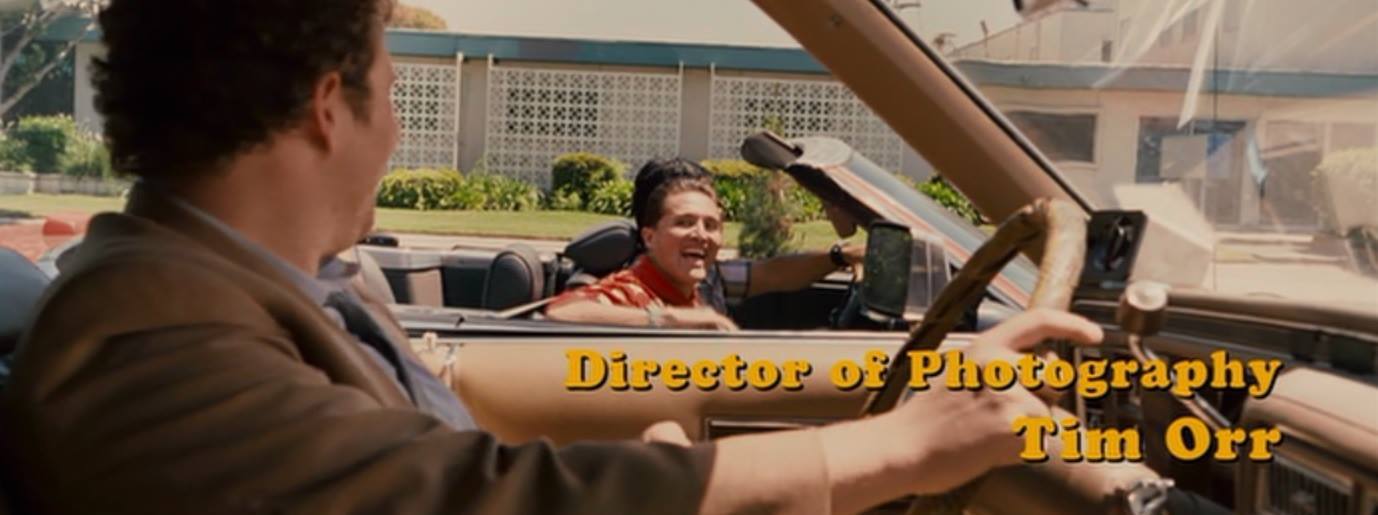
What’s so fun and unique about this wild and sometimes out of control movie is the irreverent tone and blissful disregard for logic. The first portion of the film is an easy-going, herb-scented comedy, with Franco’s Saul tossing out one incredible zinger after another. Franco seemed utterly baked in this film, and I wouldn’t be surprised if he was, though he’s repeatedly claimed that he wasn’t. Either way, he looks incredibly at ease in the role, laughing and snorting and having a blast with his absurdly lovable character. Rogen, who can do no wrong at this point for me, plays the guy we’ve come to love from films such as Knocked Up and The 40 Year Old Virgin, but here, he’s in action-hero mode towards the second half, and it was a blast to see Rogen clearly going wild during the raucous action scenes. One of the film’s highlights is a ridiculous, apartment-destroying brawl between Rogen, Franco, and the hilarious Danny McBride playing the world’s worst best-friend/middle man, who gets tons of laughs with his dead-pan line delivery and vulgar idiocies. Cinematographer Tim Orr, who has shot all of Green’s features, opted for 2.40:1 widescreen, and he was able to mix an anything-goes-atmosphere with creatively chosen angles that maximize the jokes and punchlines while heightening the action. Orr’s work is always visually interesting, and here, he was able to riff on the stylings of a studio action picture while still retaining his inherently organic qualities as a craftsman.
Pineapple Express is, at its heart, a male weepie. Dale and Saul love each other, and like any lovers, they have some fun, they fight, they separate, and then they get back together. Whether it’s the two of them blowing clouds of smoke onto unsuspecting caterpillars or wielding double shotguns and blowing people away, they are a duo that can’t be separated. A great supporting cast is also along for the ride, including Bill Hader in the film’s hilarious 1930’s set prologue showcasing the sad prohibition of the magical plant, Craig Robinson and Kevin Corrigan as bickering, hysterically inept hitmen, Rosie Perez as a corrupt cop and Cole’s henchwoman, the sexy Amber Heard as Rogen’s high-school(!) girlfriend, and Nora Dunn and Ed Begley Jr. as Heard’s disapproving parents. And when the action-fireworks take place during the film’s final and extremely bloody act, you’re all the more invested in the characters because of the time spent with them watching their characters evolve. It’s a film that’s fairly layered and sort of dark when you cut down to the bone, and it’s easily the most subversive item in Apatow’s catalogue of cinematic craziness. Pineapple Express is the sort of stony movie gift that keeps getting you buzzed, even if you don’t partake in Item 9.