JOHN BADHAM’S NICK OF TIME — A REVIEW BY NICK CLEMENT

3

This is such a nifty flick – it’s basically an inflated B-movie with some low-key A-production values, with journeyman action filmmaker John Badham directing with a plucky sense of verve, and Johnny Depp doing a great “every-man” performance as a regular Joe forced into an extraordinary circumstance. Depp starred as mild-mannered businessman/father who is nabbed at the train station, along with his daughter, by corrupt cops, and is told that he has roughly an hour to kill the Governor of California. If he doesn’t, his daughter gets whacked. It’s that simple, a premise to make Hitchcock smile, and carried out in a slick and theatrically heightened manner to always remind you that you’re watching a movie. Nick of Time is so mid-90’s, and I mean that as a compliment. I can remember seeing this on the big screen, and then watching it 250 times on HBO. Badham and screenwriter Patrick Sheane Duncan did the “real-time” conceit very well here, with the action starting immediately and rarely letting up for 90 minutes. Sinister and cheesy in almost equal measure, this is the sort of disposable entertainment that’s become a rarity on studio slates in recent years.

2Christopher Walken was terrifically menacing to the extreme, all bug-eyed crazy and sweaty-desperate; Marsha Mason was fun in a key supporting role; Charles S. Dutton did a great job as the one guy you can trust; and Courtney Chase was fantastic as Depp’s perpetually scared and kidnapped little girl. This movie absolutely revels in child endangerment, and really reminds you how things have changed in Hollywood over the years. Arthur Rubinstein’s sketchy score kept the tension palpable, and the hot-white-light cinematography by Roy Wagner cleverly used numerous POV shots and skewed angles to ratchet up the anxiety; this is a very visual movie in many regards, and he must’ve had a really fun time figuring out how to cover all the action. Frank Morriss and Kevin Stitt’s nimble editing was a lesson in pure economy, never allowing the pace to sag for a moment. Most of the film was shot on location at the Westin Bonaventure Hotel in downtown Los Angeles. I seem to remember a number of films shooting there in the 90’s. Currently streaming on Netflix; it’s lots of silly fun.

1

MARK WEBBER’S THE END OF LOVE — A REVIEW BY NICK CLEMENT

3

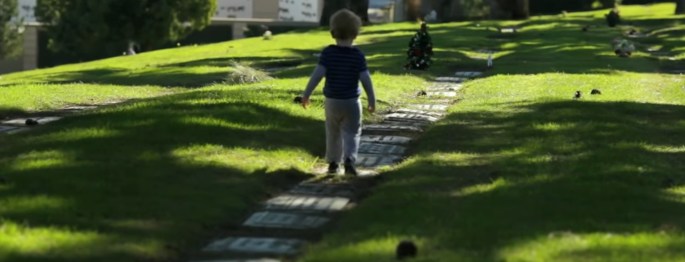
Mark Webber’s The End of Love is a small masterpiece, a film filled with such aching sadness and yet such hopeful possibilities that it consistently reminds me of how fragile life is, and how we often take it for granted. This film will be too much for some people, too raw and nakedly emotional, and I totally understand that; you have to want to take this particular journey as it goes to some very real places that might be uncomfortable for some viewers to process. And I know that my perception and respect for The End of Love has changed throughout the last few years, as I now have a child of my own, and could never begin to think of raising him without his mother. The power of family and what it does to people can’t really be put into words, and when this bond is cut short, it produces feelings of fear, uncertainty, and anger. Webber’s delicate screenplay never leaned too hard in any one direction, and because he cast himself in the lead role and acted with his own two-year old son, Isaac, the entire film has an authentic quality that is rarely seen on screen. The moments between the two of them are incredible to observe, as a real paternal instinct can be viewed all over Webber’s expressions, while Isaac steals the show at every point, delivering an impossibly adorable performance that never felt cloying because of the skillful way that Webber structured the entire piece.

2

Webber plays a struggling actor living in Los Angeles, shuffling from one audition to the next, without any sense that his career is gaining any forward momentum. Then, suddenly, his life is changed in an instant and forever, when his wife, and the mother of their child, unexpectedly dies, leaving him as a confused and stressed single parent, who is still trying to figure himself out as a person, let alone being fully prepared to tend to the needs of a small child. The observational aspects to Webber’s filmmaking aesthetic produce a low-key vibe that very much feels inspired by European art cinema, in that the film is more concerned with catching small moments in an effort to create a larger picture. The supporting cast includes some familiar faces such as Michael Cera, Amanda Seyfried, Michael Angarano, Aubrey Plaza, Alia Shawkat, and Jason Ritter, while the underutilized and alluring actress Shannyn Sossamon cut a convincing portrait of a single mother trying to navigate some of the same precarious waters. There’s a level of sensitivity in Webber’s direction that casts a spell over the viewer, and despite a low budget, the film was expertly shot by the smart cinematographer Patrice Cochet, who knew exactly when to opt for close-ups and when to settle his camera in the background, so that it could simply observe the behavior and relationships of the various characters, especially those moments between father and son. What an amazing document to have as a parent, as this is a piece of art that truly defines the term forever lasting. And while the movie is called The End of Love, it could easily have been called The Beginning of Love, as it presents a world that demands change and acceptance, while demonstrating that people are capable of just about anything, no matter the situation, if they use their heart and their mind to accomplish their goals.

1

Rob Zombie’s 31: A Review by Nate Hill 

I couldn’t help but feel fairly underwhelmed and a bit let down by Rob Zombie’s 31, which is a reaction I never thought I’d have to a film from one of the most dedicated and talented artists working in the horror genre these days. 

Now I’m not saying saying I hated it or even really disliked the film, there’s actually a lot of incredibly creative visual material and good old fashioned practical effects to feast your fangoria loving eyes on, but the fact remains that Zombie has regressed to the primal state he opened up his first few films with. 

  There’s two phases of his work so far: a rip snortin’ hoo rah gross out redneck scumbucket pile of profanity and bottom feeding trailer trash human garbage, which is what we saw in The Devil’s Rejects, House Of 1000 Corpses and somewhat in Halloween. Then there’s quieter, more thoughtful and meditative Zombie, using an art house, Argento psychedelic slow burn template that he brought hints of to the table in the excellent Halloween II and then full force with The Lords Of Salem, which to me is his best film so far. Now I love the trailer trash aesthetic to bits. It’s mile zero, the genesis of his fascinating career so far, and his writing is detailed, character driven, lifelike and oh so hilarious. But there’s a natural progression to any filmmaker’s career, moods and states which ebb and flow into new regions of stylistic exploration, and 31 just feels like a detour down the wrong road. I expected the atmosphere we got with Salem to churn forward and be a leg on the table of whichever phase came next. But alas, he has done a willful throwback to his earlier work, and although solid (I believe he’s incapable of making a truly bad film, there’s just too much creative juice with him), it’s sadly the least memorable among even phase 1 of his work. 

 31 is essentially a variation on The Most Dangerous Game, with a dirty dustbowl setting thrown in. A group of potty mouthed carnies, including Meg Foster, Jeff Daniel Philips and the ever present Sheri Moon Zombie, trundle through the desert, reveling in promiscuity and lewd behaviour, another trope that is getting old and icky, even on Rob’s barometer. Attacked and kidnapped one night by a band of scarecrows, they find themselves unwitting contestants in a vicious game called 31 (why is it called that? I still don’t know), on Halloween eve. The masterminds are a group of creepy aristocrats led by a plummy Judy Geeson and Malcolm McDowell, sporting a powdered wig, attire of french royalty and going by the name Father Murder. They release Moon and her peeps into a dismal maze and set a group of demented cackling psychopaths called the “heads” after them, dressed like clowns and seriously adjusted I’ll adjusted, these folks. Now you’d think that premise would be just a bucket of horror fun, and it’s nominally entertaining but just never really takes off into the desperate, visceral fight for survival I wanted to see. The clowns are varying degrees of scary and amusing. EG Daily fares well as whiny creepshow Sex Head, and there’s Sick Head, a chatty midget dressed up like Hitler who yowls at his prey in garbled Hispanic incantations. The film’s real energy shows up in the form of Richard Brake as Doom Head, a repellant maniac who is the only actual scary one of the bunch. Brake is a criminally underrated actor who I had the honour of interviewing some months ago, and when asked what the favorite role of his career is so far, he promptly said this. One can see why, it’s the most he’s ever been given to do in a film and he milks it with virile ferocity and animalistic sleaze that will leave you crying in the shower. McDowell and his cronies are here and there, but feel oddly disconnected from the events at hand, and while visually ravishing, ultimately aren’t given much to work with. I will say though that Zombie has a flair for the musical finale, and the end sequence set to ‘Dream On’ here is a blast that does indeed touch the epic heights of his older films. 

 And there you have it, kids. I wanted to rave about this one, I really did. But it use felt loose,

cobbled together and nowhere near as cohesive and brutally mesmerizing as his earlier work, all of which still hold up. There are elements here that work, but unfortunately just not enough, and framed by a whole lot of choices that feel copied and pasted. Now Zombie at his worst is still better than most in this sagging genre these days, but for those of you who know his work well and have expectations for the guy, you may just feel a little let down, like I did.

CURTIS HANSON’S IN HER SHOES — A REVIEW BY NICK CLEMENT

1

I love In Her Shoes. This is a wonderful movie, filled with big laughs and lots of heart, never succumbing to anything cheap, and always demonstrating compassion for its characters. Curtis Hanson’s naturalistic direction was a perfect fit for the emotionally sensitive material, while he demonstrated a deft hand for light comedy, and as always, a generous ability to coax excellent performances out of an ensemble cast. He made SO many solid or great films all throughout his steady directorial career: The River Wild, Wonder Boys, 8 Mile, L.A. Confidential, Bad Influence, The Hand that Rocks the Cradle – he could do any genre seemingly at any point, and it’s a terrible shame that health issues slowed his life and filmic output, and even more sad to learn of his recent passing just yesterday. I need to go back and revisit his poker drama Lucky You, with Erica Bana, on which he collaborated with the great writer Eric Roth (The Insider, Munich, Benjamin Button). The eclecticism of Hanson’s storytelling choices simply cannot be denied, and because he placed a large emphasis on the people within his narratives, all of his films have a humanistic quality to them, even when dabbling in genre-y elements.

2

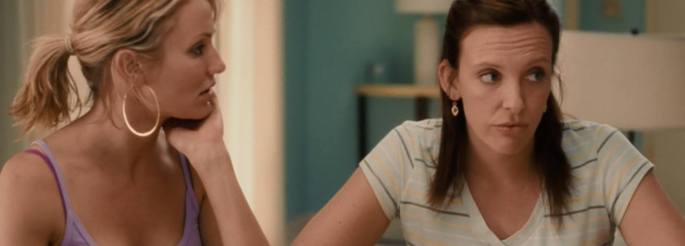
Cameron Diaz was super-sexy as Maggie, a promiscuous, hard-drinking, and perpetually aimless couch potato who can never pull her shit together, and was matched very well with Toni Collette as her all-business sister named Rose, a woman trying to successfully balance her career and love life in equal measure. Shirley MacLaine did fantastic work as their grandmother who sets them both straight in all areas of life, while Norman Lloyd stole the entire show and elicited tons of tears as a blind patient of Diaz’s (she becomes a nurse for the elderly) who asks her to read poetry to him as he lays in his bed; the unique friendship that develops between the two of them always melts my heart and makes me smile. Seriously – this is a great little film, with nary a false moment or wasted scene. The screenplay by Susannah Grant was witty and funny and sharp and Terry Stacey’s warm lensing made the most out of the sunny Florida locations and Diaz’s bikini-ready body. Call it a chick-flick if you want — I’ll just call it an awesome movie that never fails to entertain and enlighten, and a further reminder of how elegant and clean a filmmaker Hanson was all throughout his quietly underrated career.

3

DAVID CRONENBERG’S SPIDER — A REVIEW BY NICK CLEMENT

1

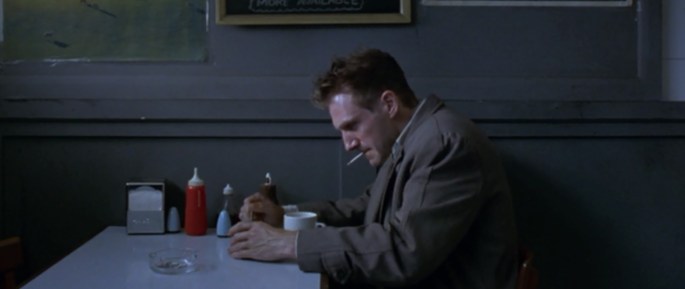
Spider is easily one of my favorite films from master filmmaker David Cronenberg, with other personal highlights on his wild and provocative resume including Videodrome, A History of Violence, Dead Ringers, Scanners, Eastern Promises, and The Fly. He’s made so many great films, almost all of them extremely memorable, but I think this is one of his sharpest and most deceptive works to date, a movie that’s hard to explain without spoiling, so if you don’t know too much about this one, I would suggest staying far away from anything that might give up it’s numerous secrets. The narrative centers on Dennis Cleg, aka “Spider,” played by Ralph Fiennes in a shattering performance that’s very hard to shake upon first viewing, a man who is recovering at a halfway house after being released from a mental institution after decades of treatment. He begins to attempt to make sense of his fractured life, striking up a friendship with another resident of the house, played by the great John Neville. It seems that Spider’s childhood was one filled with terror, as he was abused by his father, played by Gabriel Byrne, and lived through the murder of his mother, hauntingly played by Miranda Richardson. Themes of transference, emotional isolation, and mental duplicity are all at work, while Fiennes went all out in a performance that ranks as one of his absolute best.

2

The layered screenplay by Patrick McGrath, which was based on his novel, perfectly balances the real world with Spider’s remembrances, while adding a trippy “is-this-really-happening” element in certain spots. The appropriately dark, shadowy, and murky cinematography by Cronenberg’s regular director of photography Peter Suschitzky casts a gloomy pall over the entire film, that feels very much in line with psychologically complex story being told. Howard Shore’s creepy score and the tack-sharp editing by Ronald Sanders keeps you on edge at all times. Spider premiered at the Cannes Film Festival and was released in 2002, and while it received extremely strong reviews from critics, it failed to catch on with audiences, as it was only released in a handful of theaters in select cities in America. Cronenberg won Best Director at the Genie Awards. Produced by the legendary Samuel Hadida (Domino, True Romance, Freeway, The Rules of Attraction, Perfume: The Story of a Murderer, and Good Night, and Good Luck).

3

Brett Ratner’s Red Dragon: A Review by Nate Hill


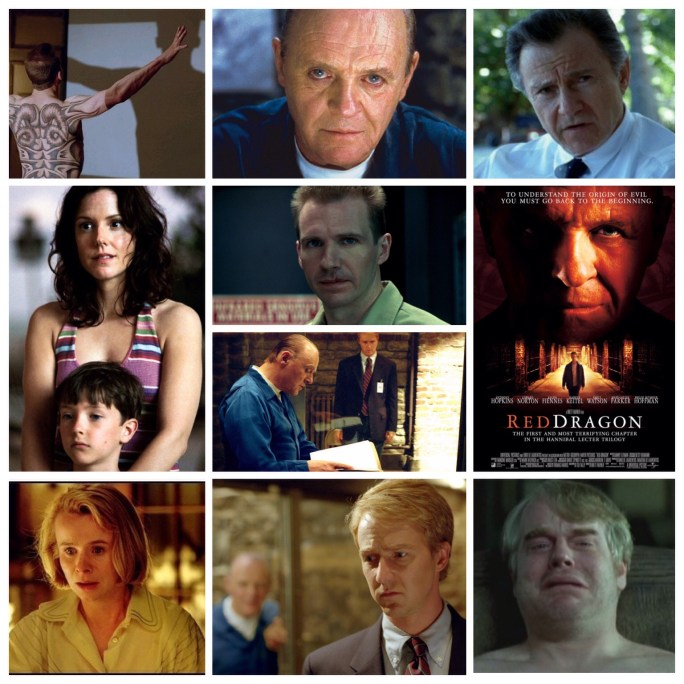
Brett Ratner’s Red Dragon, although pretty darn stylish, is just cursed with being the least engaging and unique Hannibal Lecter film out there. It’s not that it’s a bad flick, but when you have Silence Of The Lambs, Hannibal and the far superior Manhunter to compete with, you’re trucking down a rocky road. The strongest element this film has going for it is Ralph Fiennes, who plays the hell out of the role of Francis Dolarhyde, the disturbed serial killer also known as the Tooth Fairy. Previously played by an introverted and terrifying Tom Noonan, Fiennes gives him a more rabid, haunted vibe and steals the show, but then he always does. Edward Norton is a bit underwhelming as FBI behavioural specialist Will Graham, sandwiched between William L. Peterson and Hugh Dancy’s modern day, definitive take on the character. Graham has the tact and luck to ensnare notorious cannibalistic murderer Dr. Hannibal Lecter (Anthony Hopkins purrs his way through a hat trick in the role), whose help he subsequently needs in pursuing Dolarhyde. Harvey Keitel clocks in as rock jawed Jack Crawford, Graham’s boss and mentor, solidly filling in for far mor memorable turns from Laurence Fishburne, Dennis Farina and Scott Glenn. All the scenes with Dolarhyde fare best, given some truly impressive rural cinematography that sets the mood for the killer’s twisted mindset nicely. The cerebral jousting between Graham and Lecter only half works here, dulled in comparison to the crackling exchanges that Jodie Foster masterfully handled with Hopkins, who was far, far scarier back then. Emily Watson lends her doe eyed presence to the blind girl that brings out the only traces of humanity still left in Dolarhyde, Philip Seymour Hoffman shows up as bottom feeding tabloid reporter Freddy Lounds, and Mary Louise Parker, grounded as always, plays Graham’s wife. You could do worse in terms of films like this, but in the Lecter franchise it falls pretty far short of any of the other entries, save for the few inspired moments involving Fiennes. 

SCANNERS – A REVIEW BY J.D. LAFRANCE

scanners-01

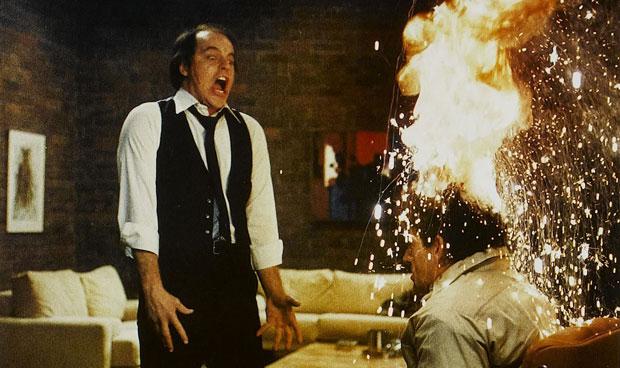
For a good part of his career, David Cronenberg has been fascinated by secret societies, be it the New Age-y psychotherapist and his patients in The Brood (1979) or the people addicted to an immersive video game in eXistenZ (1999). With Scanners (1981), he explored a small, but growing number of people endowed with mental abilities that allowed them to read other people’s thoughts or literally blow their minds. This is evident in the film’s most iconic scene where a character blows up another’s head. This premise eerily mirrors Brian De Palma’s The Fury (1978), but where it was more of a conventional thriller, Scanners incorporated more cerebral ideas as some of Cronenberg’s characters see themselves as the next rung in the evolutionary ladder.

Cameron Vale (Stephen Lack) leads a vagabond lifestyle and is kidnapped and brought to Dr. Paul Ruth (Patrick McGoohan) who works for a mysterious corporation called ConSec. He tells Vale that he is a “scanner”, someone with telepathic abilities and proceeds to teach him how to use his powers. Ruth soon finds himself at odds with Braedon Keller (Lawrence Dane), head of security at ConSec and who is secretly in cahoots with Darryl Revok (Michael Ironside), the leader of an underground group of scanners. Ruth sends Vale to infiltrate Revok’s group and the film builds to an inevitable confrontation between the two powerful scanners.

Stephen Lack, who came from a performance artist background, delivers a wonderfully idiosyncratic performance as Vale, a man who is initially uncomfortable in his own skin, but gradually becomes more confident as he learns how to control his abilities. In one of his career-defining roles, Michael Ironside is excellent as the malevolent Revok who sees himself as a Che Guevara-type figure. Lack and Ironside’s contrasting acting styles compliment their adversarial characters nicely.

Scanners was part of a fantastic run of early films that Cronenberg wrote and directed himself as he explored the dark intersection where the science fiction and horror genres converged. The success of this film spawned two lackluster sequels that Cronenberg wisely had no involvement in. Unlike The Fury, Scanners goes into much more detail about how these mental abilities work and how they can be harnessed as evident in a scene where Ruth teaches Vale how to accelerate a man’s heartbeat, almost killing him. Cronenberg goes further than simply pitting good scanners vs. bad, but also touching upon the notion that they may be the next step in human evolution.

MATTEO GARRONE’S GOMORRAH — A REVIEW BY NICK CLEMENT

1
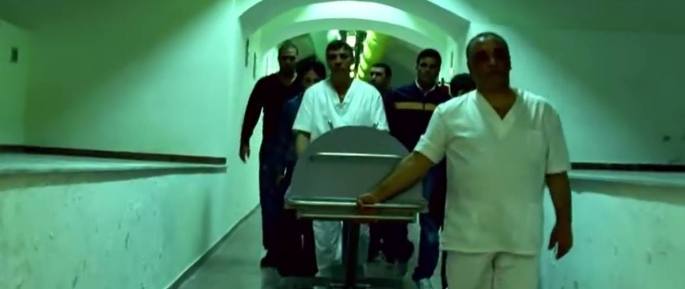
Matteo Garrone’s Gomorrah is tough and totally brilliant. It’s a nasty, unflinching piece of filmmaking, and because it stays so focused and refuses to ever get sentimental there’s a hardened quality to the storytelling that’s unique for the genre. Now, is it an “entertaining” mafia saga along the lines of Goodfellas or Casino or The Godfather? Not remotely. As impeccably made as it is, Gomorrah is a punishing and depressing look at real-deal organized crime in Naples, Italy. Based on a bestselling and highly controversial true-crime novel which ended up requiring the author (and members of the eventual film production) to go into witness protection, Gomorra is essentially the Italian version of City of God, in that it takes you on a hellish journey to a very violent corner of the earth and rubs your face in vicious behaviors and unremorseful killing. And that, really, is the essence of Gomorrah: The act of killing and how it affects so many different people. Death, as it is in all gangster tales, hangs over this film like the Grim Reaper itself, and as the narrative progresses, you slowly realize that there’s no hope for anyone in the story.
2
You half expect any of the characters to get bumped off at any moment while the riveting action unfolds; the phrase “always looking over your shoulder” is a sad reality for everyone in Gomorrah. The film effortlessly weaves five separate storylines together. Two young punks who love reciting dialogue from Brian De Palma’s bloody classic Scarface are anxious to become real-life hoodlums, and are blissfully unaware of the real dangers that they face. An illegal garment maker who has perfected his trade through various crime circles starts trading his knowledge to the Chinese in exchange for cash; you can imagine how pissed the Italians will be with this. Two youngsters are drafted into a life crime after doing petty jobs for the higher-ups, and here, you get a look at the organization’s money-man, who becomes increasingly conflicted with his job as the film progresses. And finally, there is the toxic-waste disposal element to the narrative, which is equally as troubling as any of the other segments.
gomorrah_xlg
The hand-held, down and dirty aesthetic is reminiscent to that of The Battle of Algiers, as director Garrone immerses you in the scummy, crime-filled environment and forces you to see everything at ground level and face value. There is immediacy and sad impact to the violence in Gomorrah, which features a bracing level of coldness on display from the various killers, which is rather startling. It’s all part of the business – killing just comes with the territory. And even though almost all of the characters are unlikable, you watch with a growing sense of dread as it becomes all but certain that everyone will end up meeting their maker before the end credits start to roll. This isn’t an easy or commercial gangster movie like the films I referenced earlier. Instead, it’s a brutal look at a real-world scenario that’s going on right now, one that’s been going on for years, right under our noses. Gomorrah takes you to hell and back, and there is an uncompromising sense of inevitability and visceral impact in the film that forces the viewer to take notice.
3

WARREN BEATTY’S REDS — A REVIEW BY NICK CLEMENT

1

Warren Beatty’s towering historical drama Reds is one of the grandest achievements in cinema, a film that matches its epic scope with poignant intimacy on a character level, resulting in a work that has genuine grandeur and a sense of sweep that immediately engrosses the viewer. The often-imitated faux interview structure is marvelous to look back upon in retrospect, as it’s informed so many other filmmakers on so many diverse projects, and the way that Beatty was able to shape this sprawling yet always coherent narrative into something fully cohesive is a testament to both his innate understanding of filmmaking, and to the astounding work done by the film’s editors, Dede Allen and Craig McKay. The dense and info-packed screenplay by Beatty and co-writer Trevor Griffiths was based on the John Reed novel Ten Days that Shook the World, focusing on Reed’s life as a journalist during the Russian Revolution, and with Beatty assuming the lead role. Co-starring Jack Nicholson and Diane Keaton, both absolutely superb, the film had a deep supporting cast, including Paul Sorvino, Jezy Kosinski, Gene Hackman, Nicolas Coster, M. Emmet Walsh, Maureen Stapleton, Ramon Bieri, Edward Herrmann, and many others.

2

There’s a tremendous sense of romance running all throughout this big and volatile motion picture, with history and Hollywood colliding in the best sense, while the filmmakers stressed intelligence in all departments, resulting in a film made by adults and for adults. Master lenser Vittorio Storaro’s burnished and elegant cinematography worked in perfect tandem with the nearly overwhelming and astonishingly detailed production design by the legendary Richard Sylbert, while the evocative costumes from Shirley Russell reveled in period authenticity. After a year long shoot, in which Beatty and Keaton’s personal relationship apparently greatly suffered, the post-production process reportedly lasted close to two years, as this behemoth of a movie required various teams of editors to sift through nearly two and half million feet of film and the constant supervision of Beatty to bring it all home. Released in December of 1981 and garnering glowing reviews from critics, the film preformed solidly at the box office, grossing $40 million domestic; the over three hour run time definitely limited the number of screenings and likely dissuaded some people from seeing the film on the big screen. Beatty won the Oscar for Best Direction, Storaro for Best Cinematography, and Stapleton for Best Supporting Actress, with nine other nominations.

3

RIPD: A Review by Nate Hill 

I wanted to give RIPD chance, I really did. But it’s such a shameless ripoff of Men In Black that most of it just constituted one big eye roll from me. It’s not an outright knockoff, but it just uses the unmistakable blueprint of MIB and runs with it as if it were it’s own organic idea. The veteran wiseass, the young hotshot, the clandestine otherworldly law enforcement syndicate, googly, goopy special effects, it’s all there and just feels stale these days, but for a few saving graces. Jeff Bridges is an undeniable charmer as Roy, an undead wild west super cop who is tasked with retrieving runaway souls hiding out down on earth, and capturing them for return to the great beyond, here pictured as the penultimate vision of nightmarish beaurocracy that seems oddly derived from Beetlejuice (huh). When Boston cop Ryan Reynolds is betrayed and murdered by his corrupt scumbag of a partner (a skeezy Kevin Bacon) he’s recruited by Proctor (Mary Louise Parker, all business and loving it) to join Roy in bringing “deados” back upstairs. The two don’t get along, as newly paired cops in movies always behave, and the banter only really works from Bridges’s side. He’s a hoot as crotchety old Roy, while Reynolds plays it a bit too serious, especially in scenes with the wife he left behind (Stephanie Szostak). The film earns it’s one inspired subplot when we see the human avatars the pair use to move about the earthly plane: Bridges is a knockout blonde chick (Marissa Miller), and Reynolds an elderly Chinese man played by the seemingly immortal James Hong. If they spent more time on terrifically funny ideas with potential like that and less on special effects that look like something out of the Garbage Pail Kids, they might have been on to something worthwhile. But alas, most of the film is spent on a whirlwind of silly slapstick and big gross weird things that are in no way engaging. There’s a few slap dash deado hunts, including a brief turn from Robert Knepper as one that is lured out of hiding with Chinese food (what in the..), and a big sky vortex yawner of a finale where evil Bacon tries to wreak havoc on earth. Most of the time it’s just a snooze though, save for the few times the clouds part and we get something fresh, usually from either Bridges or those to damned hilarious avatars. Shame.