The Hidden


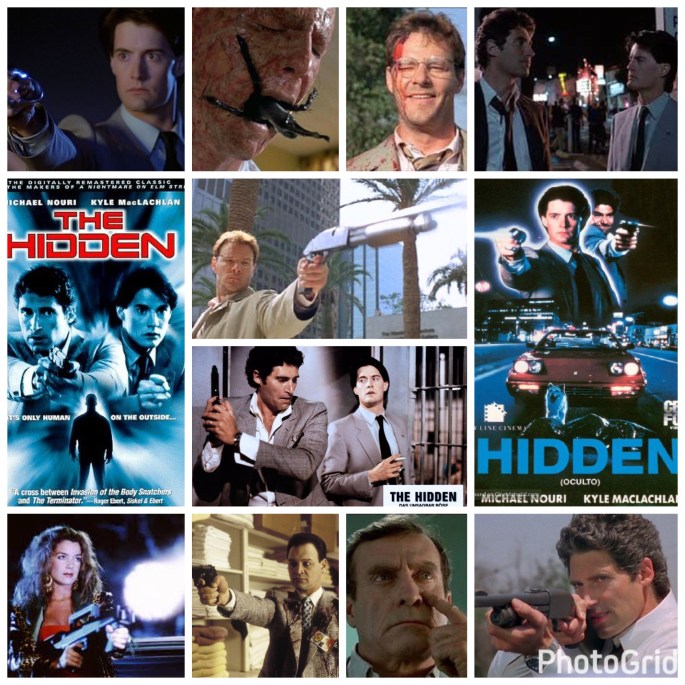
The Hidden is the kind of flick that makes you sit back, sink a little deeper into the couch, take a long swig of lager and nostalgically murmur “they don’t make ’em like they used to.” Maybe I was just born in the wrong era, but the 80’s and 90’s just seemed to hurl forth so many winners, unbridled genre bliss that only got better with age, worth the revisit every time. The effects were practical, the stories were told with love, care and inspiration and the action was real, hard hitting and built to last. This film one opens with what can literally only be described as a cinematic version of Rockstar’s Grand Theft Auto; we see a well dressed, determined man (Twin Peak’s Chris Mulkey in batshit mode) rob a bank, obliterate several police officers with a big honkin’ shotgun, steal a Ferrari, drive said Ferrari through a busy park, smoke a dude in a wheelchair at over a hundred clicks, lead the entire police force on an apocalyptic highway chase and cheerfully get ventilated in a hailstorm of bullets upon careening through their barricade. Case closed, right? Not for a mysterious FBI Agent (Kyle MacLachlan) who arrives out of nowhere and commandeers the case from the leading detectives (Ed O Ross and a wicked sharp Michael Nouri). MacLachlan knows something the force doesn’t, let alone would ever believe: there’s an alien running around inhabiting human bodies a là Body Snatchers, and going on hedonistic tirades of the worst possible behaviour, hence the shotgun tantrum in the opener. How does he know this, you ask? Because he himself is an alien in a Kyle suit, intrepidly pursuing the other one from a distant galaxy to halt it’s destructive shenanigans forever. It’s a premise that could have opened the door to all sorts of ooey gooey creature effects, but the film minimizes on those, choosing a few key moments to show the slime, and focuses mainly on glass shattering, guns blazing action, a neat recipe of three parts action with a tablespoon of yuck, if you will. MacLachlan, still very young at the time, anchors his performance with emotional heft, amusing aloofness and the necessary grit that can be found in his iconic portrayal of Agent Dale Cooper on Twin Peaks, and I was reminded more than a few times of that character while watching him in this. As the extraterrestrial nutjob moves from host to host, blowing everything up and leaving a trail of massacred people in it’s wake, the two of them race at every turn to catch up, and it’s Nouri who finds the seething anger one must get watching an outsider roll up and stamp all over someone else’s territory. The alien isn’t interested in world domination, resources or assimilation, it just wants to fuck shit up and have a good time, man. Blasting rock n’ roll music, gorging itself on steak dinners, stealing every Ferrari it can get it’s hands on and raiding the police evidence room for all kinds of heavy artillery, this thing doesn’t slow down for a second. This is the only film I know that paints off-earth visitors quite like this, just a gleeful, anarchic adrenaline junkie asshole, and I admire the brutal honesty, because I know of quite a few morons who would probably engage in the exact same behaviour, should they ever find themselves incognito and without consequences on an unassuming, far away planet. This one is pure screaming fun the whole way through, and should be every bit as iconic as other sci fi tales that are remembered more prolifically. Watch for the tiniest Danny Trejo cameo, playing (guess what) a prison inmate.  

-Nate Hill
TATE TAYLOR’S THE GIRL ON THE TRAIN — A REVIEW BY NICK CLEMENT

3

I very much enjoyed last year’s much-derided thriller The Girl on the Train. It’s not the best movie I’ve ever seen, and it’s hardly the worst. I like a good, steamy, erotic thriller, the types of movies that used to be original screenplay spec sales back in the 90’s. But nowadays, these genre thrillers are typically made because they’re based on best-selling novels, which is the case with this flick. Emily Blunt is absolutely awesome as a totally out of control alcoholic who can’t remember the fine details concerning her potential involvement in the disappearance of a local hottie who may or may not be schtupping the entire neighborhood. The gorgeous Haley Bennett is the seductress, Justin Theroux is Blunt’s much-irritated ex-husband, side-of-beef Luke Evans is around as a possible suspect, and Allison Janney and Rebecca Ferguson fill in the margins as a cop and goodie-good-wife respectively. The gorgeous cinematography by Charlotte Bruus Christensen (Far From the Madding Crowd) stresses visual sensuality at nearly every chance afforded, while the luxury home furnishing production design is nearly pornographic in the same way as the current HBO show Big Little Lies, which I’m thoroughly enjoying.

2

Director Tate Taylor (The Help, Get On Up) might have been a little too tasteful with some of the seamier elements to the narrative, which was adapted by screenwriter Erin Cressida Wilson (Chloe, Fur) from the Paula Hawkins novel; I kept wishing that Brian De Palma had been offered a chance to direct this pulpy-trash because when formally elevated, these types of movies can be very entertaining, as this one was for me. Paul Verhoeven might’ve been a cool fit with the material, too. It’s got a leering, predatory vibe, and while Taylor is a smooth craftsman, I’m not sure he was fully up for all of the kink that was inherent to the material. Still, for its entire running time, I was engrossed and entertained. It’s nothing serious or overly substantial, but it’s a solid thriller made with lots of production polish, and anchored by the magnetic acting chops of Blunt, who can seemingly do no wrong for me as a viewer. Despite mixed reviews, the film was a sizable worldwide hit, grossing $175 million off of a $45 million budget. Danny Elfman’s score is appropriately sketchy.

1

GUS VAN SANT’S GERRY — A REVIEW BY NICK CLEMENT

1

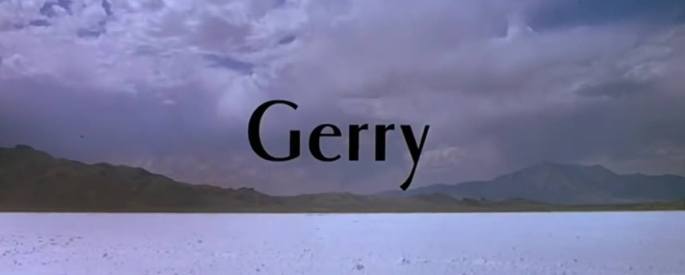
Gus Van Sant’s “death trilogy” started in 2002 with the unique and intimate film, Gerry, kicking off a run of small, super low budget and very internalized pieces of work, which also included 2003’s Elephant and Last Days in 2005 (while similar, 2007’s Paranoid Park isn’t officially part of this unofficial grouping). Certainly not for all tastes due to the unconventional nature of the narratives, these films found Van Sant in total artistic mode, essentially searching for answers to questions where answers might not ever be possibly found. Purposefully slow paced and based on true and very tragic events, Gerry unfolds in an elliptical manner, with two main characters drifting in and out of the narrative like spectral creations who never feel truly tethered to the here and now.

2

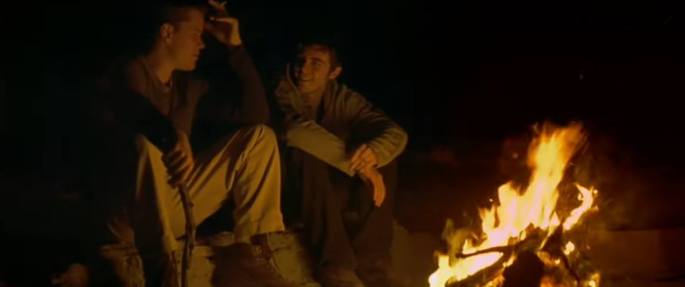
Matt Damon and Casey Affleck play two lost souls (literally and figuratively) who wander the Utah dessert, get lost, have ruminative discussions about the meaning of life, wander some more, and then, well, you’ll have to see the film to learn what happens by the end. What I will say is that this film is intensely private, it lends itself well to watching while under the influence of psychoactive substances, it doesn’t care if you don’t like it, and the cinematography by the late, great Harris Savides is visually sublime; his work on Elephant and Last Days is similarly striking and challenging on an aesthetic level. Van Sant has credited the work of filmmaker Bela Tarr as a heavy inspiration when making Gerry; the film is dedicated to the memory of Ken Kesey.

3

THIRST (1979) – A REVIEW BY RYAN MARSHALL


02-1[1]

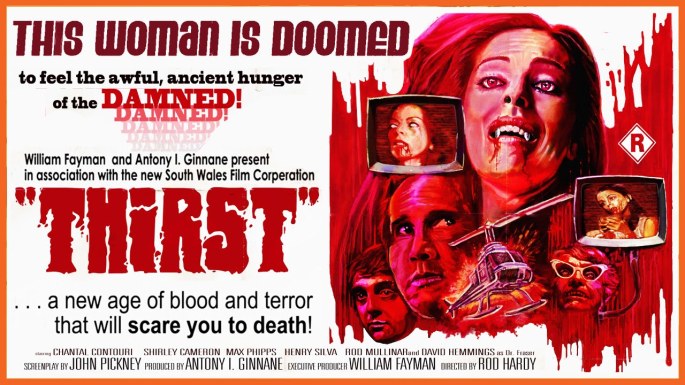
Blood of bright red flows throughout the frames of Rod Hardy’s sublime and seemingly undervalued THIRST. An imperfect but no less enthralling gem excavated from the tail end of the 70s, this is the kind of film that oozes with all sorts of salaciously surreal potential. Midnight madness is no stranger to twisty tales of vampirism, but few come so dangerously close to evoking the quality of the feverish day-dream of a deeply disturbed flower child (one with a penchant for paranoid conspiracy and aesthetic occultism) and that’s barely penetrating the surface.

If the director’s name is at all familiar, it might be because Hardy was behind the Daniel Radcliffe vehicle DECEMBER BOYS (2007); quite an unexpected change of pace from his acid-tinged debut, which is far more interested in entertaining elements of science fiction, psychedelia, and even the legend of Elizabeth Bathory than it is in conventional empathic rumination.

thirst6big[1]


The infamous Blood Countess provides a great deal of essential framing for the story, which concerns the kidnapping of Australian housewife Kate Davis (Chantal Cantouri) by a shady organization which refers to itself as “The Brotherhood” who later inform the distraught heroine that she is in fact a descendent of Bathory and that she is to be kept in the confines of their compound in order to undergo a series of mysterious though revealing medical experiments.

Roughly the first half of the film is soaked in pervasive ambience and ambiguity, and for better or worse, we feel about as lost as Kate. Those behind the operation seem to be harvesting the blood of their “patients” and it would also appear that Kate is unique for her hereditary ties. One of the professionals on site, Dr. Fraser (the ever-reliable David Hemmings), takes a shine to her and even makes a commendable effort to subvert the character’s increasingly grim fate.

08-1[1]

Then, the illusion is shattered and the screaming starts; with the ingestion of psychoactive substance comes a positively remarkable phantasmagoria that segues into a somewhat underwhelming conclusion that almost seems to actively acknowledge that what came before was a uniquely hard act to follow. It is, along with the silly glowing red eye effect applied to the vamps as they make their immediate transitions, one of the only real blind spots here but it’s a biggie. It might be difficult to imagine, with a premise as unabashedly outlandish as this, that the lackluster home stretch would be borderline detrimental to its lasting influence, but here we are.

On a whole, however, this is just exquisite. The widescreen compositions are absolutely divine, just jam-packed with essential information, and some would argue the oddball ideas on display here are not quite worthy of their grandeur; but it all made sense when an IMDB search informed me that Vincent Monton had also lensed the excellent LONG WEEKEND just a year prior. Brian May, best known for his work on the first two installments in George Miller’s MAD MAX Trilogy, also provides an alternatively elegant and haunting musical accompaniment to the madness which unfolds on-screen. It’s a perfectly perverse and meticulously crafted spectacle, and one which knows all too well that not every trip – and this is certainly a memorable one – is thoroughly pleasant.

thirst3big[1]

Sure, this could just as easily be chocked up to drug-addled nonsense as it could be to an effective late night entertainment but one man’s bullshit is another man’s benefit. THIRST dares to descend into the rabbit hole and emerges with an intriguing cinematic brew; and if it’s one that doesn’t entirely work, because admittedly mileage may vary among viewers, it’s at the very least an inspiring effort that does well to provide a substantial amount of audio-visual fodder for those who simply, and constantly, crave the wild side of celluloid. Nothing, and nowhere, is safe from the liquid red; not the chicken drumsticks at the picnic, not the bottle of milk delivered to your doorstep, and absolutely not the suburban shower. The nightmare certainly seems never-ending, but it remains a powerful prospect. Sometimes you gotta go get mad, and it’s films like this which just make it all the easier.

SPIKE LEE’S INSIDE MAN — A REVIEW BY NICK CLEMENT

1

Spike Lee has always been a very politically and socially conscious filmmaker, with much of his work touching on topical elements that link us all together as human beings. This makes his straight-up genre picture, Inside Man, all the more atypical, as it’s one of the few gun-for-hire pictures that he’s put his name on. And it’s also one of his most overtly entertaining and stylish motion pictures. Denzel Washington was fantastic here, not exactly the guy who you think he is, and the same could be said for Clive Owen; this movie has many tricks up its sleeves, and I love how it kept you guessing as to the morality of the characters all the way until the end. Jodie Foster is extra-icy in this one, playing a bureaucratic serpent in an expensive wardrobe with a flexible moral compass. Willem Dafoe, Christopher Plummer, and Chiwetel Ejiofor round out the super supporting cast, with lots of familiar faces making up the various bank hostages who are central to the heist narrative that’s central to the story.

2

Russell Gewirtz’s script has a strong sense of anger running along the edges of the tight plotting that he created, and while there’s certainly a “message” at play, it’s buried neatly under the confines of dense plot threads and colorful dialogue. Snazzy cinematographer Matthew Libatique went for a slick and gritty visual style, with some really choice individual shots peppered all throughout the proceedings. Terence Blanchard’s blustery score hits some righteously jazzy notes; the opening credits with Chaiyya Chaiyya playing on the soundtrack are a total visual and sonic stunner. Terry George and Menno Meyjes both contributed to the script but didn’t receive on-screen credit, while Lee felt that this was his chance to do his version of Dog Day Afternoon. Released in 2006, Inside Man did strong box office and got rock solid reviews, and is always worth a revisit.

3

Mean Dreams 


Mean Dreams is every adolescent’s worst nightmare. Or maybe it’s horrible scenarios like this that prepare youngsters for the real world, and build character. Or perhaps they just turn them into the same bitter, violent adults they’re trying to escape from, only to perpetuate the circle. In any case, it’s an ugly, somber story, scarred by the harsh realities some teens face on the road to adulthood. It’s ironic in a way that this is Bill Paxton’s last role in cinema, and I wish it weren’t, because he plays an absolute monster. For anyone who’s met him or seen interviews, he was the sweetest dude you could ever hope to meet, and wouldn’t hurt a fly, but he always chose tough scripts that made memorable, challenging films and this is just one more. Paxton plays a lawman and single father who moves his daughter (Sophie Nelisse) out to a desolate county, brought to life by stunning, haunted rural Ontario. Once there, she finds her only friend in a local rancher’s son (Josh Wiggins), and it’s not long before romance begins to flourish. Not on Paxton’s watch though, that angry drunk prick. Abusive, dangerous and up to his neck in illegal activities, it’s only a matter of time before he gets one of them, himself, or everyone killed, and Wiggins hatches a plan to get the both of them out of their and on the run to better lives. Trouble is, where do you turn for help in a town whose only police officers are not there to help you? Paxton has a bitter ally in the Police Chief, venomously played by Colm Feore, and the dragnet they lay over the county threatens to ensnare the two teens at every turn. Wiggins and “” are excellent, especially for their age, playing the character development with all the right notes, even when things get tense between the two of them, a facet of their relationship that’s nice to see and brings out shades of maturity in the writing that this type of film begs for. Paxton is scary, tragic, broken and brutal, a soured man who shows occasional flickers of the father he once must have been, and despite the ugliness, it’s some of his best work in a while, particularly during a positively poetic final confrontation. The cinematography from Steve Cosens lingers in the long grass until you can hear the mournful echoes of a region beset by economic despair, a place where danger breeds easily and is always just on the horizon, an uneasy mood also perpetuated by Son Lux’s unconventional score, which finds the spark of first love amidst the strife. Downbeat, but hopeful stuff. 
-Nate Hill

Review of A UNITED KINGDOM

 David Oyelowo, Rosamund Pike, Jack Davenport, Tom Felton, Vusi Kunene. Directed by Amma Asante. Rated PG-13. 111 minutes. 2017.

It is important, first and foremost, to remember that film is a visual medium. It’s an obvious point to make about an art form that forces its consumer to view a series of rapidly moving photographs, but it is also important to remind oneself that, when it comes to relaying a true story through such a medium, the result must not simply coast on the extraordinary nature of its specifics. This is the trap into which Amma Asante’s A United Kingdom falls, unfortunately, for here is a film whose makers seem to have believed that the story they were telling was of more importance than their telling of the story. Even the broad subject matter is fascinating for the previously uninformed, such as myself, who had no idea of the marriage between the heir to an African king and a salesman’s daughter from London.

The heir is Seretse Khama (David Oyelowo, offering a fine performance that would make a good companion piece to the one he gave as Martin Luther King Jr.), and as his parents both died when he and his sister (Terry Pheto) were very young, Seretse is ready to take the throne of rule in the British protectorate of Bachuanaland (now known as Botswana) that was previously their grandfather’s. He is soon to return from London, where he has been completing his schooling, to assume his reign, but within the final months, he meets Ruth Williams (Rosamund Pike), who, unlike Seretse, doesn’t come from great wealth and is white. Their courtship is quick, and when he is faced with a return to his country without the woman with whom he has fallen in love, he asks her to marry him, much to the disapproval of his uncle (Vusi Kunene) and her parents (Nicholas Lyndhurst and Anastasia Hille). She, of course, says yes.

The situation is, to put it lightly, complicated, as it also turns out that neither the African regime nor the British government is approving of this union, especially after it is consummated. For the African tribe of which Seretse is meant to be king, it is a question of tradition: The wife of a king is also their queen, and they understandably see the rule of a white queen as another power move from colonialist England. For the British government, it is a question of decency: Sir Alistair Canning (Jack Davenport), the government’s liaison to South Africa, and Rufus Lancaster (Tom Felton), a commissioner, can barely remain discreet about his smug prejudice, which is shared by many whites among the upper class. For Seretse and Ruth, it is a question of love: Theirs for each other is undying, even in the face of such discrimination and a game of proverbial chess between countries.

The problem is that screenwriter Guy Hibbert, adapting a book by Susan Williams, doesn’t offer much insight here beyond what is on the page. Seretse and Ruth have an appropriate sweetness as a couple (Pike is also solid as Ruth, especially in moments when she realizes she has entered situations beyond her control), but they remain cyphers when treated individually. They are defined entirely by their roles as subjects of a biographical picture whose intent seems to be hitting the beats of the story without much to-do. There are scenes of individual power, such a pair of speeches given by Seretse that prove both his worthiness of a position of leadership and Oyelowo’s skill at delivering them, but the whole of A United Kingdom is too broadly drawn to garner much response beyond the kind that one has to the story it tells.

Review of LAND OF MINE

Roland Moller, Louis Hofmann, Joel Basman, Oskar Bokelmann, Mikkel Boe Folsgaard. Directed by Martin Zandvliet. Rated R. 100 minutes. 2017.

The men must scour the shore for landmines that their fellow soldiers laid down to trap the enemy. It is slow and grueling work, and the catch is that these are not actually men. Many of them are boys, these prisoners of war, and the hard men that lord over them care not a lick if they live or die. The sergeant says so, repeatedly, including after a bout of hunger in his workers and even when one of them catches ill, vomiting into the night and unable to stay awake for very long. The workers must use poles to prod the ground at intervals of roughly six inches, and the process to defuse the mines is simple in theory but unthinkably tense in practice. It’s a potentially hopeless life that is led by these young men in Martin Zandvliet’s Land of Mine, but the writer/director doesn’t wallow in it.

That’s an important achievement, because it means the characters are able to be and grow as characters, rather than needing to supply fodder for a message movie. This is, quite decisively and effectively, an anti-war polemic, but it doesn’t have the anger of the usual polemic. There are no blustering speeches raging against the System for sending these boys into a war they hardly understand. The situation is harrowing on its own terms, and it doesn’t need the burden of such acidic political statements. The realpolitik here is inherent in the story Zandvliet is telling, although the film does supply melodrama of a different kind by way of the story framing the situation. It loses some of its potency in those stretches, but that also matters less than it could have. The urgency is still present.

Some of the young men are essentially interchangeable, although a few of the interchangeable ones are afforded a personality trait (or, if they are lucky, two), such as one boy whose hands are so shaky we are never sure that he will survive. The job, after all, requires a steady hand. The ones who are not so interchangeable act as our entryway into the story. Sebastian (Louis Hofmann) wears a cross that reminds him a father whose fate he does not know, and he’s the one who readily stands up to their commanding officer on behalf of his brothers in arms. Helmut (Joel Basman) is the eldest and the makeshift leader of the young men, but his squirrelly attitude and conniving ways are a constant source of punishment for the whole group. There is a pair of twins, Ernst (Emil Belton) and Werner (Osker Belton), so one must only count the minutes until the pair are separated.

The commanding officer is Rasmussen (Roland Moller), and the focus on him is where the film occasionally stumbles. He begins with contempt for the boys, whom he sees as nothing more than another group of German soldiers worthy of death. “Better them than us,” says his own superior officer Jensen (Mikkel Boe Folsgaard), and Rasmussen’s look of concession to the point says it all. That sense of murderous superiority shifts quite radically, albeit slowly, when deaths occur (The craftsmanship in showing us the aftermath of a mine explosion is effective and somber, even after we start to expect it by way of a cleverly framed shot) and especially when Jensen abuses his power to humiliate the boys. The film essentially becomes another drama about a stern teacher who learns to warm to his students, although Moller’s performance is good enough that it doesn’t hurt the picture too much.

And that’s especially true when everything else is as effective as it is. The emotion might push a bit too hard in such scenes as a silly game of soccer, scored to some flowery compositions, but it’s a stark outlook elsewhere. Every scene in which the prisoners much go forth with their mission to find and defuse landmines is rich with tension and unpredictability. No character is safe here, and the stark presentation of the violence at hand is utterly compelling. Also effective are performances that, every one of them, are convincing and precise. There is not a single actor here that makes a misstep. The sense of focus in Land of Mine is less assured, but the drama is in the pitiable nature of a war that forces boys to fight as men and, if not fight, die without dignity.

Review of KONG: SKULL ISLAND

Tom Hiddleston, Samuel L. Jackson, Brie Larson, John C. Reilly, John Goodman. Directed by Jordan Vogt-Roberts. Rated PG-13. 118 minutes. 2017.

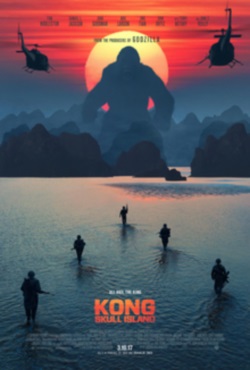
I hesitate to call Kong: Skull Island a “good” movie, for it is also a movie of undeniable idiocy that contains an ensemble of characters who are really just cutout cardboard figures in the path of the ape of the surtitle. To embrace its simple pleasures, though, one must disconnect with one’s own expectations of seeing a movie with Kong in it, for this is not really a traditional King Kong movie. It uses the character popularized by the 1933, 1976, and 2005 pictures (and the various sequels they might or might not have spawned) as a springboard for an ensemble-driven action-comedy that, if the post-credits stinger is to be believed, wishes to insert the eighth wonder of the world into a new cinematic universe. Whether that franchise has legs remains to be seen, but it’s also immaterial to this film, which is just a lot of expository build-up to a string of action sequences.

The human characters matter approximately none, but we are still offered an eccentric cast of them, played by an eccentric troupe of actors. There is the expedition group that leads the charge of the main narrative engine: John Goodman as Bill Randa, who heads an ultra-secret government group that wants to explore the untapped terrain of a recently discovered island, Corey Hawkins as Houston Brooks, the college kid confronted by Randa because of his theory that the earth holds secrets, and Tian Jang as San, who just kind of exists to echo Brooks’s confidence in his theory. They confront a military colonel to green-light their expedition, which of course involves also green-lighting a military escort, a tracker who can guide them through the muck of the island, and a photographer to capture the journey for scientific and journalistic purposes.

The military escort is led by Samuel L. Jackson as Preston Packard, a soldier fighting in Da Nang who believes the U.S. has abandoned the war in Vietnam when President Richard Nixon calls it off. He’s grateful for one last mission, even one as seemingly trivial as an escort for a scientific study, and spends the rest of the movie apparently feeling he is still in combat with the human enemy. His men, who are mostly interchangeable, are still played by the personality-driven likes of Toby Kebbell, Jason Mitchell, Shea Whigham, Thomas Mann, and Eugene Cordero. Tom Hiddleston is James Conrad, the tracker in question, and Brie Larson is Mason Weaver, a photojournalist who passes up the cover of a popular magazine to tag along on something historic.

That seems like a lot of introduction to characters that, this review claims, don’t matter, but that’s also all the introduction we get. They are cutout cardboard stand-ins for the audience, with the exception of John C. Reilly, who is boatloads of fun when he shows up as Hank Marlow, a WWII veteran who was marooned on the island of the subtitle before his deployment ended. The real story of the movie kicks in when they reach the island. They encounter Kong (whose movements are provided by Kebbell via motion-capture) immediately in a superbly mounted scene of controlled chaos in which Kong considers the helicopters in which they arrive to be nothing more than giant gnats. The beast isn’t so much a tragic one here, though, as a territorial one, even more so when the interfering humans awaken the creatures that reside underground: They are fearsome beasties – giant lizards with lots of teeth.

There are yet more monsters on this island, such as an inexplicable cross between a bison and a leviathan or a far less mysterious arachnid with bamboo legs. The spectacle here is enormous and infectious, with screenwriters Dan Gilroy, Max Borenstein, and Derek Connelly keeping the tone light while director Jordan Vogt-Roberts approaches the genuinely berserk action violence with as much aplomb as anyone has recently. The film exists for the sole purpose of witnessing various evolutionary nightmares do battle and seeing foolish humans come between them. It’s all very inconsequential, frequently dumb-as-rocks, and almost exclusively successful in a way that requires one immediately discard one’s brain at the door, but Kong: Skull Island works, and it works because it knows it is all of these things. Sometimes, good-enough is good enough.

STEVEN SPIELBERG’S CATCH ME IF YOU CAN — A REVIEW BY NICK CLEMENT

2

Lighthearted, spirited, and undeniably charming, Catch Me If You Can is easily one of Steven Spielberg’s most purely entertaining films, and it’s a work that I find to be hugely re-watchable and always a pleasure to behold. Leonardo DiCaprio was light on his feet in a way that feels very far removed from his more recent performances, taking on the role of a notorious conman whose exploits seem too impossible to be true. The based on a true story narrative is extremely well calibrated, with screenwriter Jeff Nathanson effortlessly blending family dynamics, chase-film elements, con-artistry, various love interests and side-plots, and two, off-beat, father-son relationships that stretch between DiCaprio and his dad, warmly played by Christopher Walken with twinges of sadness in-between the margins, and Tom Hanks, as the FBI agent who doggedly pursues the young criminal as he hitches free rides on planes and cashes his own perfectly forged checks. There isn’t one aspect to this film I’m not enamored with, between the jaunty John Williams score to the gorgeous cinematography from Janusz Kaminiski, and then there’s that amazing opening title sequence, Michael Kahn’s peppy editing, and that ridiculous supporting cast. This movie is pure fun and yet another reminder of how generous and loving The Beard can be as a storyteller.

4