THE RUSS MEYER FILES: MUDHONEY (1965)

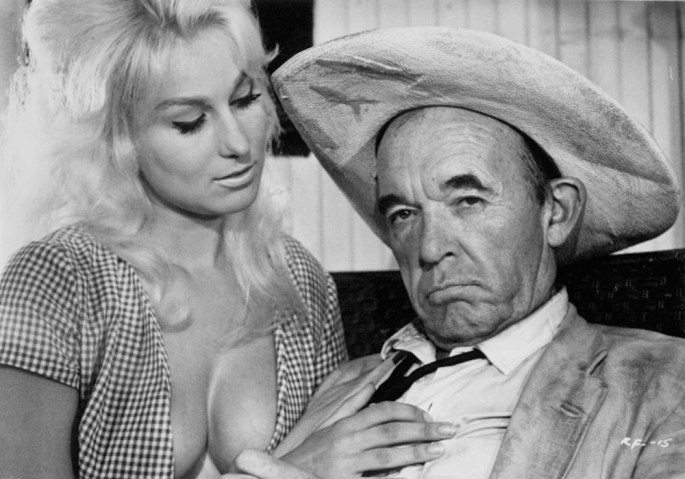
Fresh off the dizzying success of Lorna, Russ Meyer’s first foray into 35mm narrative filmmaking that cost somewhere around $60K and grossed $1 million, the filmmaker packed up two of the film’s stars and stretched the sparsely cast morality play across a wider area, cloaking it in the skin of Streets Paved With Gold, a novel by R. Friday Locke who, along with W.E. Sprague, adapted the novel into screenplay form. These ingredients created Mudhoney, a bountiful main-course of hedonistic pleasure, wobbly morality, and small-town religious corruption that is even more delicious than Lorna even, as the poster screamed, it “leaves a taste of evil!”

From the outset, Mudhoney feels a lot like Lorna. Not five minutes into the film and we watch Hal Hopper drunkenly break into his own house where he then beats and rapes his wife. And there will be a stranger that descends into this hillbilly Peyton Place who will put conventional mores to the test. But where Lorna was designed as a showcase for Lorna Maitland, Mudhoney is louder, hornier, meaner, and an altogether more satisfying experience.

Mudhoney is the tale of two houses ravaged by the Depression in the dusty town of Spooner, Missouri. On one end is the house of ill-repute run by Maggie Marie (Princess Livingston, an absolute treasure). A romping, stomping edifice of carnal desires and contraband moonshine, Maggie Marie holds court with her two daughters, the deaf/mute Eula (Rena Horton) and oversexed Clara Belle (Lorna Maitland), and a coveralls-clad handyman named Injoys (Sam Hannah). It’s a joint where you’re just as likely to get soaked by an exaggerated spit-take full of corn liquor or have your eardrums blown out by all the shrieking and hollering than you are to get laid.

On the other edge sits the the lonely Wade farm. Run by the good-hearted and decent Luke Wade (Stuart Lancaster), he is assisted by his niece Hannah Brinshaw (Antoinette Cristiani) who is married to the cruel and sadistic Sidney Brinshaw (Hopper). In the middle of these two houses comes ex-con Calif McKinley (John Furlong), an upright and square-jawed drifter who takes an emotional wrong turn on his way to California and ends up in the thick of things in Spooner.

If the film has an uncharacteristic curiosity, it’s that Meyer is not yet comfortable with a Lorna-type female lead carrying such a heavy narrative bulk. Instead, the females in Mudhoney rotate in an orbit around Calif and Sidney, taking turns standing up for themselves and, in the case of Maggie Marie, being the big baller shot caller. But, despite Lorna Maitland’s return and the photogenic Rena Horton, Mudhoney attempts to spread the wealth between the two and ends up lacking a central female character to drive the show, ceding a lot of ground to Antoinette Cristiani who serves as a much more traditional and conventional function in the film.

Mudhoney allows Meyer to stretch his legs a little with the length and the pace. While Fanny Hill takes an unjustifiable chunk of time to reach its conclusion, the vast majority of Meyer’s films up to Mudhoney ran not much longer than 70 minutes on the average. At 92 minutes, Mudhoney feels downright epic in scope, rolling out slowly without ever feeling slack and constantly in a state of construction. Pivotal characters drop in late in the drama and contribute additional action and texture, allowing for more cross cutting that builds with intensity as the film moves to its delirious and violent climax. Why, one could be forgiven if they forget that, by the time the credits roll, this was just a baroque roughie at heart that somehow becomes much more Tennessee Williams than Titty Tuesday.

Mudhoney is an absolute gem of a picture but it proved to be a little bigger production than what Meyer was comfortable with at the time. Mudhoney sports an opening credit sequence packed with more names that are not Russ Meyer than in any non-studio Russ Meyer picture (or Fanny Hill, natch). So upscaled is this production that Lorna Maitland is no longer too much for one man as, in Mudhoney, according to the one-sheet poster, she’s too much for a whole ass TOWN.

Despite handing lensing duties to Lorna-camera operator Walter Schenk, Mudhoney 100% looks like a Russ Meyer picture. With its shimmering, high-contrast black and white photography and the judiciously constructed camera set-ups meant to exaggerate the already exaggerated bosoms of Lorna Maitland and Lee Ballard, it’s not hard to see why Meyer brought Schenk back to shoot Faster, Pussycat! Kill! Kill! the following year.

The film’s resolution aims to be a little neater than Lorna’s in terms of its moral through-lines but it refuses to reduce itself to anything simplistic or cheaply unearned. While the wicked are more punished in this than in Lorna, there is still a lot of collateral damage both physical and emotional. For instead of using the Man of God as a Greek chorus, Franklin Bolger’s shady rural reverend is injected right into the middle of the combustible pile of the backwards town, casting dark shadows in every direction and giving unearned, righteous shade and cover to the malignant Sidney. And the relationship between them is what makes Mudhoney a more crucial and longer-lasting blow to small-minded society than even Lorna. Where that film’s dramatic tension came from sniggering gossip and a casual affair all of which occurred in a vacuum, Mudhoney’s poison comes first from a place of poverty and desperation brought on by the times, or, as Luke Wade puts it, the hate in the heart that grows in a man’s belly.

“The whole town has been cheated,” he says. “Cheated by the times. They’s full of hate and they’re liable to listen to anybody who will give them something solid to use that hate on.”

Despite its grindhouse origins and lurid appeal, the work of Russ Meyer also stood as a full-bodied and colorful testament to the old adage that while times may change, people don’t.

(C) Copyright 2021, Patrick Crain
THE DAVID ROBERT MITCHELL FILES: IT FOLLOWS (2014)

David Robert Mitchell returns to the Detroit suburbs that were cruised by the young hopefuls that made up the cast of his charming debut, The Myth of the American Sleepover. But where a hot summer day lazily rolled through twilight and into a magical nightscape in that film, the tree-lined streets are now rusted with the yellow and orange brushes of autumn and they are inhabited by something quite sinister in It Follows, Mitchell’s second feature. Far from succumbing to a case of the sophomore slump, Mitchell elevates his universe of latchkey kids to edge-of-fall mystery hounds where the inevitable and natural slide into adulthood is an equal thing of beautiful mystery and abject terror.

Like The Myth of the American Sleepover before it, It Follows takes place in a world where the adults are just kind of around; they numbly day-drink and gossip across a formica table while the kids watch bad horror films or play Old Maid on the porch, sipping a cocktail mixed from their folks’ stolen booze and generic soda. The lack of parental supervision is exemplified by a week-old sandwich and juice that sits and festers in the room of our traumatized heroine as she hunkers down and tries to figure out how to survive. Claire Sloma, who portrayed incoming freshman Maggie in The Myth of the American Sleepover, pops up in a tiny moment as she shares a cigarette with the hot boy from across the street making It Follows the dark flip of Sleepover as it explores, with no small amount of horror, the dark journey of maturation.

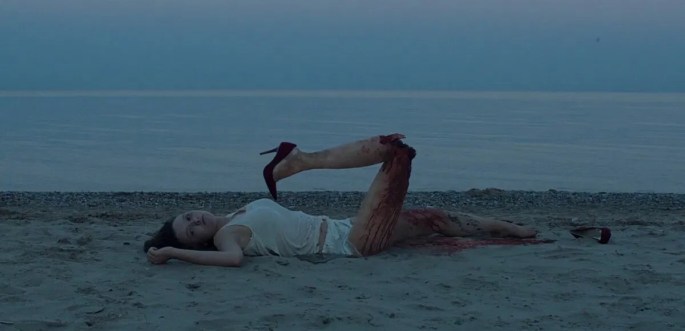
When the film begins, we’re plopped into a homage of nostalgia porn as Detroit, Michigan does an amazing Pasadena-as-Haddonfield and we almost immediately witness a troubled teen named Annie, clad in a ridiculous ensemble of 80’s sleepwear and heels, flee a house right out of A Nightmare on Elm Street as she is fearfully running from… something. While this is unfolding in front of our eyes, it’s almost impossible to hear Disasterpeace’s minimalist, synth-driven, propulsive soundtrack and not recall the musical scores of John Carpenter or Charles Bernstein. Annie drives to the shores of Lake Michigan where she doesn’t last past dawn and ends up a perfectly posed beach corpse having befallen a terrible and malignant force nobody but she and a handful of others can see.

The opening meditation on the last swim of the season for Jay (Maika Monroe) our protagonist is a loaded metaphor as the kids all seem in that nebulous time where one by one, they lose their virginity and move toward adulthood, an inevitable horror they will never outrun. Jay is dating Hugh (Jake Weary) a boy from another school with whom she’s considering going all the way for the first time. And in clocking the rites of passage, fucking in a car among the urban decay of Detroit is what passes for parking in this day and age as Mitchell is deliberately expands his geographical universe as a metaphor for maturation; your neighborhood may be your world but there are a lot of scary things in that neighborhood on the other side of town. The further one travels away from the neighborhood, the more twisted and immoral and confusing things become.

“Imagine how cool that would be to have your whole life ahead of you,” says a 21 year old Hugh, speaking like he’s on the other side of the divide and, in this world, he is. For he will later deflower Jay and will pass the curse on to her; sexual activity being the stark tipping point between victim and innocent. Once the rules of the game are set up, the film mostly becomes an exercise in pure cinema in which more is shown and not told, leaving the audience to puzzle out how the differing embodiments of the lurking figure factor into the terror and the psyche of its victims. Simple, yet effective, stylistic choices right out of the John Carpenter playbook such as its drab suburban setting evoking a new kind of neighborhood folk tale where bold, center-framed compositions rule the day and negative space is utilized to an astonishing level.

And the more I examine It Follows, the more my eye catches the forever friend-zoned Paul (Kier Gilchrist) and can’t be sure if he’s not something of a sub-villain in the piece. Operating from a place where his motivations are kinda suspect and maybe a little less selflessly heroic, his nitwit idea utilized during the Scooby Doo’d climax in a derelict pool backfires so spectacularly and with such a quickness that, in the film’s beautifully clever denouement, Jay is correct in fucking him right into Troublesville.

Aside from the excellent performances from the young cast, much should be said about Mitchell’s attention to the kind of detail that barely even registers as detail. Check out the subtleties within the frame that don’t call attention to the fact that there is also a class struggle that is occurring in this nightmare scenario. Chain-linked fences and above-ground pools where the bottoms have become besotted with leaves and the standard, half-moon window cutouts on the garages clash with the rolling lushness of Hugh’s neighborhood. An uptight rich bro who lies in a neatly trimmed house that backs up to a bucolic soccer field, it becomes more than aware that Hugh has picked Jay to pass along this curse because, to him, she’s south side trash. Later, we’ll see a character travel below his station and to the outer boundaries of town where two prostitutes stand among the landscape that looks like a war zone. No matter how old we are, we seem to want to always drop our troubles onto poorer people.

It Follows is very smart about what it’s doing. Folding the natural angst into a horror framework is as old as movies itself so rare is the one that finds a way to explore its themes as cleanly and carefully as this. It’s a top to bottom examination of the invisible line into adulthood everyone must cross where boundless pleasures certainly await but that also comes equipped with a countdown clock; an emblematic place in everyone’s life where, as one character says, the city begins and the suburbs ends.

(C) Copyright 2021, Patrick Crain
THE ROBERT ALTMAN FILES: BEYOND THERAPY (1987)

Beyond Therapy is bad. And I don’t mean that it’s a weaker Robert Altman effort or that it’s bad of kind. I mean to say that it’s a bad movie that I could scarcely dislike more even if it had been written and directed by Henry Jaglom, a major/minor talent I love and cherish as much as I do getting paper cuts on my balls. Whatever pleasant vibes may radiate off of the film’s innocuous and airy promotional artwork that hints at a comedy of manners among a star-studded cast is a goddamn pack of rotten lies.

The last in Altman’s feature adaptations of stage plays, Beyond Therapy is a story about, I think, sexual fluidity, self-acceptance, and the (disproven) utter worthlessness of therapy. I say “I think” not because I don’t know; it’s just that Altman’s busy style and overlapping dialogue does a grave disservice to the film and it barely registers as anything other than a cacophonous vortex of shouting, goofy accents, performative emoting, and Julie Hagerty.

Disguising itself as a polyamorous and pansexual Woody Allen comedy, Robert Altman’s Beyond Therapy avoids amusing like the plague in favor of buying unfunny by the barrel and spraying the whole movie with it. Adapted from co-writer Christopher Durang’s off-Broadway play, Beyond Therapy concerns itself with Bruce (Jeff Goldblum) a bisexual who meets Prudence (Julie Hagerty) after she answers a magazine ad Bruce has placed much to the chagrin of his live-in boyfriend, Bob (Christopher Guest) and his mother (Geneviève Page). Most of this chaos plays out in a French restaurant in which mirrored deceptions and partner swapping seems to be happening on the margins and also in the offices of Charlotte (Glenda Jackson) and Stuart (Tom Conti), two therapists who treat Bruce and Prudence, respectively, and, coincidentally, sneak off to have sex with each other at twenty after the hour.

Beyond Therapy feels like it’s being helpful as this kind of subject matter (in America, at least) was something that, in 1987, was still mostly assigned to very serious dramas and was considered pretty provocative but, alas, it’s ultimately too confused to work retrospectively. I mean, the idea that Jeff Goldblum’s fluidity somehow throws the world off of its sexual axis is borderline insulting, even for a farce such as this. In fact, this is a film in which the whole idea of bisexuality is a foreign one; as if it resides in a world governed by its extremes. If it’s trying to state the fact that most everyone lies somewhere between the polar extremes on the sexual spectrum (which in 1987 would have been classified more as an “argument”), it’s not doing it in a particularly good or charming way. And where the film ends on a positive and healthy note where everyone more or less celebrates their most honest and open sexual desires replete with straight and gay couplings (and at least one ménage a trois), Altman wheezes his way to the finish line feeling far too out of shape to even attempt to get into the mix, let alone direct it.

One of the problems with Beyond Therapy is the film’s frenetic pace which flattens out any real enjoyment of it. The cramped set of the French restaurant overstuffed with peripheral characters feels so constricted that Altman’s usually graceful choreography is off by two beats as visual gags don’t register and anything that might come off as clever is completely crushed and has the life choked out of it. Altman loved the French and it’s not difficult to understand why given their undying love for him and his work. But his comedies with French twists feel cold in a way that, if you’re not on Altman’s specific wavelength about the French and French culture, it’ll all seem like inside baseball and hard to gauge. What I do know is that much of it is not funny. And, on the whole, Beyond Therapy feels more like a French farce about sexually neurotic New Yorkers than it does an American film dealing with sexual hang-ups. I guess that tracks since this film was shot in Paris masquerading as New York.

This is a situation in which I think 90% of the cast is wonderful, just not when they’re occupying the same screen space with this material. Jeff Goldblum is very good as he delivers his usual dexterous brand of frazzle but Christopher Guest is utterly wonderful, providing the prototype for Zack Galifianakis’s twin brother Seth from Between Two Ferns. Julie Hagerty, on the other hand, is a ball of nervous energy who, despite being incredible in Lost in America and Airplane, is forced to play a character who is mostly shrill, unappealing, and doesn’t get enough water thrown on her during the course of the film. Glenda Jackson is great but she’s lost in the material which does her a great disservice, and Tom Conti is mildly amusing as the malapropism-prone therapist who actually revels in his tendency to ejaculate prematurely and who feels that sex that lasts longer than five minutes is unnatural.

If not for his bit in the opera-omnibus Aria (which, frankly, is just ok), 1987 would have represented Altman’s career nadir. He retreated back into the world of television and would not be seen in the cinemas again for another five years. Of course, he would continue to deliver masterworks on the small screen and his comeback in the multiplexes would prove to be one of the most confounding, against-the-odds stories in Hollywood history. But those triumphs should be shared for another day and should get no closer than five thousand yards of Beyond Therapy, a film only preferable to A Perfect Couple due to the sense that, at the conclusion of the former, everyone is moving in a healthier direction and is doing so with a complete lack of live performances from Keepin’ ‘Em Off the Streets.

(C) Copyright 2021, Patrick Crain

Stephen King’s Lisey’s Story

I didn’t really know what to think of Lisey’s Story for the first two episodes or so because it’s so disarmingly, otherworldly strange and surreal, but as the story unfolds in an almost subconscious vernacular, step by step I found my footing and it has become likely my favourite Stephen King adaptation ever undertaken. I think it’s the closest we’re ever gonna get to an ‘arthouse’ King story, and the sheer audacity and bizarro world sensibility of it might be why it’s not being received too well, but make no mistake, this is gorgeous top shelf stuff. The story, told in bold expressionistic strokes, tells of the core relationship between Lisey (Julianne Moore) and her deceased husband Scott Landon (Clive Owen), a famous writer and deeply troubled man who left a series of clues for her before passing that will lead her on a journey to the heart of his unfinished literary work and protect her from deranged homicidal stalker Jim Dooley (Dane DeHaan) who seeks to find his hidden manuscripts. That all sounds very straightforward but the creators opt to tell this story in deep, dense flashbacks, musical cues that take prescience over dialogue and an arresting, dreamlike visual palette that takes over for exposition. In Scott’s books he tells of another dimension called Boo’Ya Moon, a realm of the dead and half-dead that’s full of alien beauty and home to a terrifying monster called the Long Boy. This sort of exotic astral plane proves to be very real and integral in both putting Scott’s spirit to rest and killing Dooley, who becomes quite the force to reckon with for Lisey and her two sisters (Jennifer Jason Leigh & Joan Allen). Moore is fantastic as Lisey, full of emotional intuition and charisma, while Owen has never been better and his level of commitment and intensity to a role that is cast way, way against his usual type is staggering, I have never seen him so raw and vulnerable. There are frequent flashbacks to his horrifying childhood where he struggles to deal with his half mad Viet Nam vet father who is so mentally far gone he can barely get a sentence out. The dad is played by an unrecognizable Michael Pitt who manages to be despicable, relatable, pathetic, chilling and heartbreaking in the same notes, it’s a mad dog, candid performance you don’t usually see in mainstream stuff and he should win all of the awards. The show is just unlike anything I’ve ever seen, from the strikingly intense, almost David Lynch style work from the actors to the stunning mystical dreamscape of Boo’Ya Moon to the languid, formless narrative that’s free of peripherals or structure to the deep, haunting emotional core to the sweet, innocent and life affirming romance between Lisey and Scott to the wonderfully atmospheric, spine chilling score by ‘Clark’, this is just grand, unique storytelling that sweeps you away into its world. You have to be willing to go though, and I think that’s why so many people recoiled at this. Many were likely expecting an accessible, routine King adaptation firmly planted in the ground like we usually see wrought of his work, but this is simply something from another world altogether, it’s one that you feel your way through in images and impression rather than dialogue and drama. If you’re ready for that, I’d highly recommend it. Don’t listen to the hate out there, it’s truly, truly extraordinary stuff.

-Nate Hill

Netflix’s Blood Red Sky

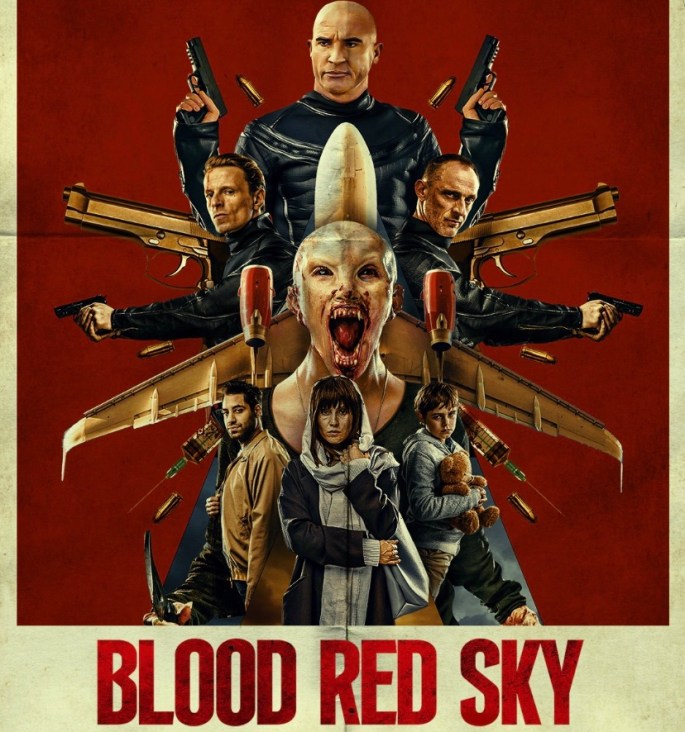
You’ve heard of Snakes On A Plane now get ready for Vampires on a plane! Real talk though the new Netflix horror hybrid Blood Red Sky is a lot better, more vicious and effectively made than most gimmicky, chimera-like efforts of its kind. A sort of German American Scottish coproduction that seamlessly blends actors/accents from all three countries, it tells of a young German mother (Peri Baumeister, a dead ringer for Noomi Rapace) who finds herself and her son on a transatlantic flight that has been hijacked by multinational terrorists hellbent on crashing the plane in London and killing everyone onboard. There’s just one slight variable these assholes didn’t figure on: this girl is in fact a vampire, and not a slow, dramatic Dracula vampire either, she’s one of those sleek, terrifying, hyper-vigilant, high strung 30 Days Of Night Vampires, which when you consider the finite, constrained area of a plane interior, is just a nightmare waiting to happen. The big cheese terrorist is a sociopathic mercenary played excellently by Dominic Purcell but the real villain is a German maniac (Alexander Scheer) from his ranks that goes rogue, starts maliciously murdering hostages and is just downright nasty, if there was a German production of Batman he would land the Joker role for sure. The fights, chases, gore and intensity here are so well staged you barely get a moment to breathe and there’s genuine high-level suspense that had me on edge. What helps achieve that is that even amidst all the snarling, throat ripping, bloodletting and pandemonium and even under all that slick vampire makeup, actress Baumeister manages to give her performance a genuine maternal instinct and palpable pathos in caring for her son and protecting him from danger, she basically gives a multilayered, deeply effective performance as both a human being and a pissed off vampire. The film is built around a totally ridiculous premise and they could have made this just the cheesiest thing, but instead they’ve played the situation dead straight and approached this script with the very serious notion of “what IF a vampire found herself on a plane at the same time as a gang of evil terrorists,” and the result is something immersive, beautifully made, spectacularly violent and, in some scenes, surprisingly poignant. Highly recommended, streaming on Netflix now.

-Nate Hill

PIRANHA (1978) – D. JOE DANTE

A quick note on Steven Spielberg’s Jaws. It changed everything. Literally. Star Wars may have really moved the furniture around two years later but Jaws did something to American culture that was so unique and so strong, our annual pining for summer releases is a residual effect that has bored into our filmgoing DNA. And, as it turned out, there really was no big trick to turning summer films into machines that printed money. You just had to pump a decent budget into what was once seen as drive-in fare and, poof, you’d spun literal gold.

And this is not to take anything away from Spielberg’s masterpiece as Jaws is truly a brilliantly made film adapted from Peter Benchley’s piece of pure upmarket junk. But this kind of mass embrace of what was once kind of niche spelled trouble for folks like producer/director Roger Corman who had created a whole personality out of cheap action pictures and low-budget horror flicks. If this kind of stuff somehow rose out of the drive-ins and grindhouses and was embraced by the masses, it would crowd Corman out of the market.

Fortuitously for Corman, the success of Jaws created something that was right in his wheelhouse; namely: the Jaws-rip off. Jaws was basically manna from heaven for cheap exploitation directors both in America and every other country that had a film industry. Even Universal waded into the waters of the numbered sequel, then a still-novel notion that was only four years old, to rip itself off in 1978 with the enjoyable Jaws 2.

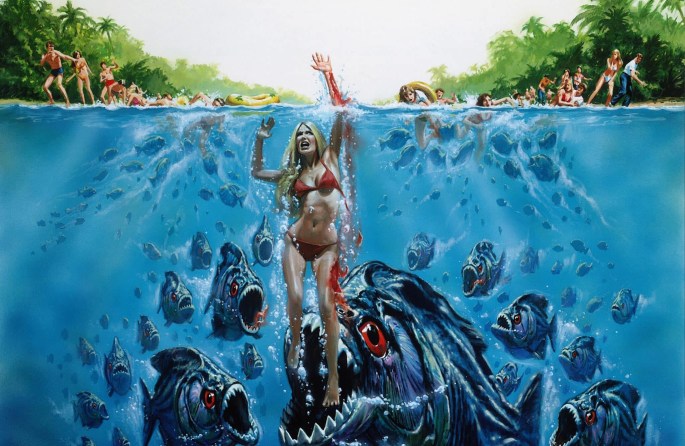
So, of course, Roger Corman had to mine the material to stake a claim in a territory he had homesteaded and, in fact, he mined the material a few times. But the first and most successful of his Jaws-inspired productions was 1978’s Piranha. Directed by one-time Corman editor Joe Dante who, along with Allan Arkush, had previously co-directed Hollywood Boulevard for Corman, Piranha was not only a major financial success for Corman’s New World Pictures, it’s easily the best of the pictures inspired by Spielberg’s original.

What makes Dante’s film feel fresh instead of point-by-point retread (looking at you, William Girdler’s Grizzly) is that it announces its willingness to let the audience in its self-awareness from the beginning. After pulling off a clever Citizen Kane reference, Dante and screenwriter John Sayles invite the audience to throw rotten fruit at the stupidity of the characters in the film’s pre-credit sequence. Decent questions like “Who will ever know we were here?” and “What if this is some kind of sewage treatment facility?” don’t get satisfactory answers before both characters are in waters that we’re sure are filled with piranha (pronounced piraña by more than one character in the film) because, well, it’s the title of the movie. Dumb on the characters’ part? You bet. Are Dante and Sayles cognizant of how ridiculous it is? For certain.

The other remarkable thing about Piranha is just how much movie is packed into 93 minutes. Weird creatures, gore, nudity, boat explosions, water skiing, mean-spirited yet satisfying devouring of children and lake enthusiasts, car chases, Pino Donnagio’s lush score that sounds like a bunch of unused cues from Carrie, and a jailbreak are just a few of the delicious attractions packed into the casing that threatens to burst at the seams. And all of this is before we even get to the cast. While Bradford Dillman and Heather Menzies are very good and play well off of each other in the lead roles, it’s Corman regulars Dick Miller and Paul Bartel who bring the house down as, respectively, a sleazy developer and a dictatorial camp counselor, while Belinda Balaski, who still continues to pop up in Dante’s projects, absolutely shines in a sympathetic role. Veterans Keenan Wynn, Kevin McCarthy, Barbara Steele, and Richard Deacon round out the majority of the supporting cast and are all incredibly game, treating the material with a delicate balance of the straight faced and the tongue-in-cheek.

While Joe Dante would never become a household name like Steven Spielberg, he would go on to create an impressive body of work throughout the 80’s and 90’s that is mostly ripe for reassessment. Beyond his cinematic achievements, he has proven to be an indispensable curator and tireless champion for a kind of cinema that is in a sundowning decline. With his Trailers From Hell website to his Movies That Made Me podcast, Dante emerges as a figure whose film knowledge and enthusiasm for same is pitched somewhere between the enthralling academia of Martin Scorsese and the beautiful junkyard of Quentin Tarantino. As the old gives way to the new and genre cinema goes through inevitable changes and the type of film that guys like Dante truly adored, it’s nice to know that there are things out there like Piranha that serve as landmarks to a glorious time in modern film history, even if those times are becoming longer in the rear view mirror with each passing day.

(C) Copyright 2021, Patrick Crain
THE RUSS MEYER FILES: LORNA (1964)

Where Russ Meyer’s previous features had generally begun with soft, laconic shots of nature that were coupled with a booming bowl full of earnest, corn-filled narration, Lorna’s mobile, ghost train opening shot promises to transport us to a place we’ve never been before. And, for sure, we eventually roll up to a man clad in black (credited as “The Man of God”) who stands in the middle of the road and immediately breaks the fourth wall, warning us of sin and judgement. The nudie cuties, it seems, were just the soft preliminaries. For when we’re eventually waved on by our ominous stranger and begin moving further down the road of iniquity, we’ve fully graduated into the real world of Russ Meyer. Welcome to Lorna, a film in which the titular character was promised as being “TOO MUCH FOR ONE MAN!” on its promotional one-sheet.

Envisioned and quickly written by Meyer and James Griffith (who also plays the ominous Man in Black), Lorna was Meyer’s first attempt at a true narrative where he would be calling all the shots. Fanny Hill, Meyer’s debut outside the confines of the nudie cutie, was such a miserable experience that he traded in that film’s costume-laden period decor for the starkness of Nowheresville, America. And where Fanny Hill had a mid-size cast that mostly had little to do, Meyer strips Lorna down to a world populated by ten people.

Lorna was the first in a long string of tongue-in-cheek morality plays constructed by Meyer in order so soft-peddle his cantilevered beauties. However, Lorna really plays it smart with those moral angles. The film begins as a standard roughie in the row houses of the backwater California town of Locke where Luther (Hal Hopper) and Jonah (Doc Scortt) stalk a drunken women named Ruthie (Althea Currier) to her house. There, their twisted sexuality is put on full display as Ruthie is beaten and raped by Luther while Jonah leers through a window. Down the river apiece, Lorna (Lorna Maitland) is a deadpan saint to her well-meaning but weak sauce husband, Jim (James Rucker) who is studying to becomes a CPA while working down at the salt mines with Luther and Jonah, the former forever chiding Jim about Lorna and her supposed infidelities which barely conceal his lustful coveting of her.

In truth, Lorna and Jim are fundamentally decent folks who, for no greater sin than being normal, flawed humans, get more misery heaped upon them than they probably deserve. Jim might be a wet mop whose cocksmanship isn’t anything to write home about, but he really isn’t a bad guy and he truly loves and cares for Lorna. And Lorna isn’t a bad woman, either. Treated like a thing on a pedestal, which she doesn’t necessarily object to, Lorna argues that perhaps this attitude can be taken a bit too far and that there is a decent-size chasm between being respected and being handled like a porcelain doll. And being stuck in a fishing shack with absolutely nothing to do all day and nobody around for miles, it’s not hard to fault Lorna when, after another disappointing night in bed with Jim, she goes out to onto the dock and more or less wishes upon a star to be whisked away toward a more exciting life, shown in a dazzling montage of neon burlesque over a much happier, undulating Lorna Maitland.

When an escaped convict stumbles his way through the marshes and eventually happens upon Lorna, he sexually assaults her which leads to a kind of physical deliverance for her. This is sort of a narrative blunder where the arcane convention of the “struggling woman who gives in to the passion” is taken to the outer limits of taste and decorum. While a certain contingency of more seasoned generations recognizes this kind of coded filmic language when they see it and mostly give it a pass, it’s hard to fault the reactions to those for whom the origins of this convention have been buried under layers and layers of film history, especially to those who aren’t familiar with the context of the roughie. But in Lorna, however ill-advised it seems in retrospect, I’m not totally convinced that this device isn’t executed for the benefit of Lorna’s character as she both takes control over the situation (thereby drawing a contrast to the earlier character of Ruthie), and achieves a long-needed sense of sexual release with the convict.

Whatever complications are apparent in the tact of sexualizing rape, Lorna mostly gets away with it due to the uncommon skill of Meyer as a filmmaker and his knack for throwing his characters into a blender and upending any preconceived notions about them. For like in a very sly play, everything in Lorna gets turned upside down in its second half, proving the liquidity inherent in quick-shifting morality. While it’s loaded to make it look like the ones who are punished are the ones who upend their marriage vows, Lorna actually dies for everyone’s sins. Would her relationship with the convict been different if Jim would have shown her the kind of care for her and their one year anniversary as he should have? And what does one make of Luther’s tearful breakdown at the end of the film as he finds some sort of redemption (if not complete absolution) when, not 70 minutes earlier, we watched him beat a woman senseless? As articulated in David Lynch’s Blue Velvet, “It’s a strange world.”

But above all, Lorna was a way for Meyer to strut his stuff as director, producer, co-writer, editor, and photographer. Forever innovative, Meyer finds a clever way to reduce the strip teases of Europe in the Raw down to the restless Lorna, hot and bothered while her husband toils away at his studies in the another room, writhing around in their bed while bathed by chiaroscuro lighting. And Lorna, if nothing else, is economical. Lorna’s flashbacks are presented by heat waves over static shots of a running brook and Dutch angles of the church in which they’re married. Meyer also gets a lot of story by employing nothing more than a POV camera as a prison break is pulled off on a Saturday afternoon by grabbing a few pickup shots here and there and throwing an alarm sound effect over them. And if this were mere sexploitation, the beauty in the carefully designed and thought-out match cuts wouldn’t roll over the audience like a pleasant breeze. Nor would the hotted up climax, replete with axes and hooks, work like absolute gangbusters if not for Meyer’s skill as an editor.

In terms of casting, Lorna Maitland creates quite the mold as the first of Meyer’s superstars, defining the Meyer female outside of the nudie cuties as strong, highly libidinous, and yearning for her own identity. Special mention, too, should go to Hal Hopper who is just terrific as Luther and also co-wrote the film’s catchy theme song. If I were to find out that Hopper was a slobbering, high-wire nut job in real life (he wasn’t), I would not hesitate to believe it to be true as he literally embodies the kind of ghastly creep one spends most of their life avoiding.

Lorna was definitely a page-turner and game-changer for Meyer and laid a foundation upon which he could begin to build his very singular cinematic universe populated by decent people doing the best they can while toiling about in a judgmental, hostile, and unforgiving world littered with violence, betrayal, and poisoned passions. It also gave the world a heroine in whom a salacious promise of being too much for one man was entirely conditional on the broke-dick dude in question.

(C) Copyright 2021, Patrick Crain

Tanya Wexler’s Jolt

Kate Beckinsale is, quite literally, electrifying in Jolt, a new bubblegum pop action flick from Amazon prime that is already being written off as empty popcorn fluff when it’s so much more fun than that. Yes it is action popcorn entertainment, but Kate’s performance, the writing, character quirks, purply-neon visual dynamics and wry, dark sense of humour totally won me over. There’s a million and one “tough girl assassin with vague superpowers“ movies out there but this one does the shtick with actual talent, sass and good old fashioned storytelling, kinda like if Joe Carnahan did a Luc Besson. Kate plays Lindy, a girl who has suffered from what’s called “intermittent explosive disorder” (it’s a real thing, I looked it up) since she was a child, a condition that causes her to involuntarily burst out in angry, violent episodes which, when coupled with her off the charts cortisol levels and overactive adrenal glands, make her very powerful and very dangerous. She controls this, with a bit of help from Stanley Tucci’s underworld doctor, by deliberately juicing up her nervous system with a jolt of electricity from a handheld control device wired to implants inside her. Does this work, you may wonder? Kinda, sorta, not really… I mean what fun would the film be if we didn’t get to see her lose her shit and beat the absolute piss out of people? The trouble starts when she finally meets a guy she likes (Jai Courtney) and of course he’s murdered under shady circumstances. This puts her on a one woman crusade across NYC to find the ones responsible with two oddball detectives on her trail, a sympathetic one (Bobby Cannavale) and a hard-nosed, unforgiving one (Laverne Cox, a genuine scene stealer). Lindy’s journey is a vigorous, colourful, violent, profane, unexpected odyssey that takes her to nightclubs, fight-clubs, clandestine skyscrapers, a hospital maternity ward where a game of ‘catch the baby’ ensues (don’t ask) and she comes up against all sorts of weirdos including Filch from Harry Potter as some sort of creepy rare animal collecting mob emperor and an unnerving Susan Sarandon as a shadowy figure from her own past come back to haunt her. While this narrative itself has patches that are a tad overplayed and the eventual ‘twist’ struck me as a bit bothersome, what the film has is energy, wit, enthusiasm and pizazz for days. It’s stylish, propulsive, visually gorgeous and peppered with delicious bits of dark, eccentric humour here and there. What’s more, it proves once again that Kate Beckinsale is an absolute diamond of an actress and a natural born star, whether it’s in Underworld, something dramatic like David Gordon Green’s Snow Angels, Van Helsing or even the shitty Total Recall remake that she was the only good part of, the woman just has charisma and talent like no other. She tears into the role of Lindy here with punishing physicality, sardonically droll deadpan attitude and, most importantly, a genuine sense of humanity and character kept aglow amidst all the action and flair. The film sets itself up for a sequel; I say bring it on.

-Nate Hill

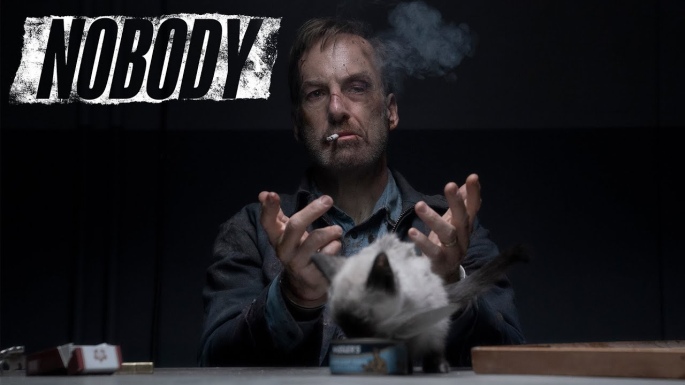
Nobody

Nobody is a nice riff on the one man army revenge shtick and is not only in the tradition of John Wick, it’s also written by one half of the same creative forces behind it so it sorta has that feel, albeit of a more… suburban dad variety. Bob Odenkirk is a left field choice for the ‘invincible ex-spook’ archetype and while I had my doubts that his physicality could pull off some of the stuff I saw here, he no doubt has the grit and charisma in spades to inhabit this intense role. He’s Hutch, an unassuming family man whose wife (nice to see Connie Nielsen) and kids don’t seem to think much of him, especially after he appears to be totally ineffective at defending them from violent home invaders one night. It turns out this random blue collar family man is an ex government assassination guru and pretty soon that one encounter with burglars leads to an ongoing, cataclysmic feud with the Russian mob, spearheaded by a sociopathic (or soviet-pathic?) piece of work named Julian, played by Aleksey Serebryakov in an impressively rambunctious portrait of pure unfiltered evil, like a Slav kingpin version of the joker or something. The action here is wonderfully choreographed, relentlessly brutal and crisply filmed, especially a bone smashing close quarters fight on a public transit bus that kicks off the central conflict. The great Christopher Lloyd has a nice bit as Hutch’s dad, a veteran living in a rest home who proves he isn’t quite out for the count yet and gets some great kills in alongside his son, and we also get RZA as a former colleague who steps in for some action too. Unfortunately the film chose to include the always awesome Michael Ironside but inexplicably decided to cast him in a wholly inconsequential sideline role that has nothing to do with the plot overall and could have been played by any Joe Nobody, an ill advised casting choice that would have caused me to remove a star from the rating if I were doing that star thing. Don’t hire Michael Ironside unless it’s a memorable, badass, worthy role, it’s just common sense. Anywho, it’s a solid flick, great villain, superb action and while I may not be onboard with the hype as much as some I’ve seen, I still had a good time. I will give it extra credit for one of the most gruesome, satisfying, laugh out loud villain deaths I’ve seen in action cinema.

-Nate Hill

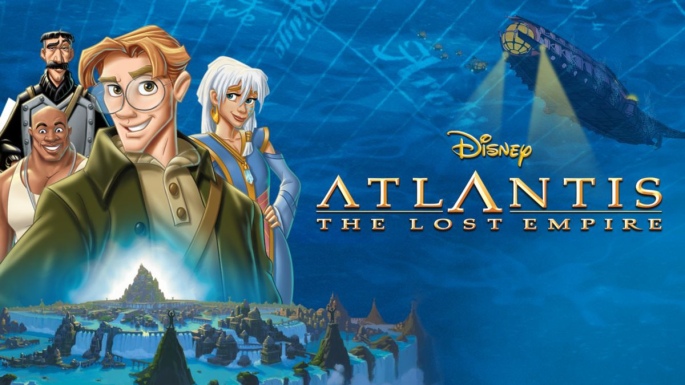
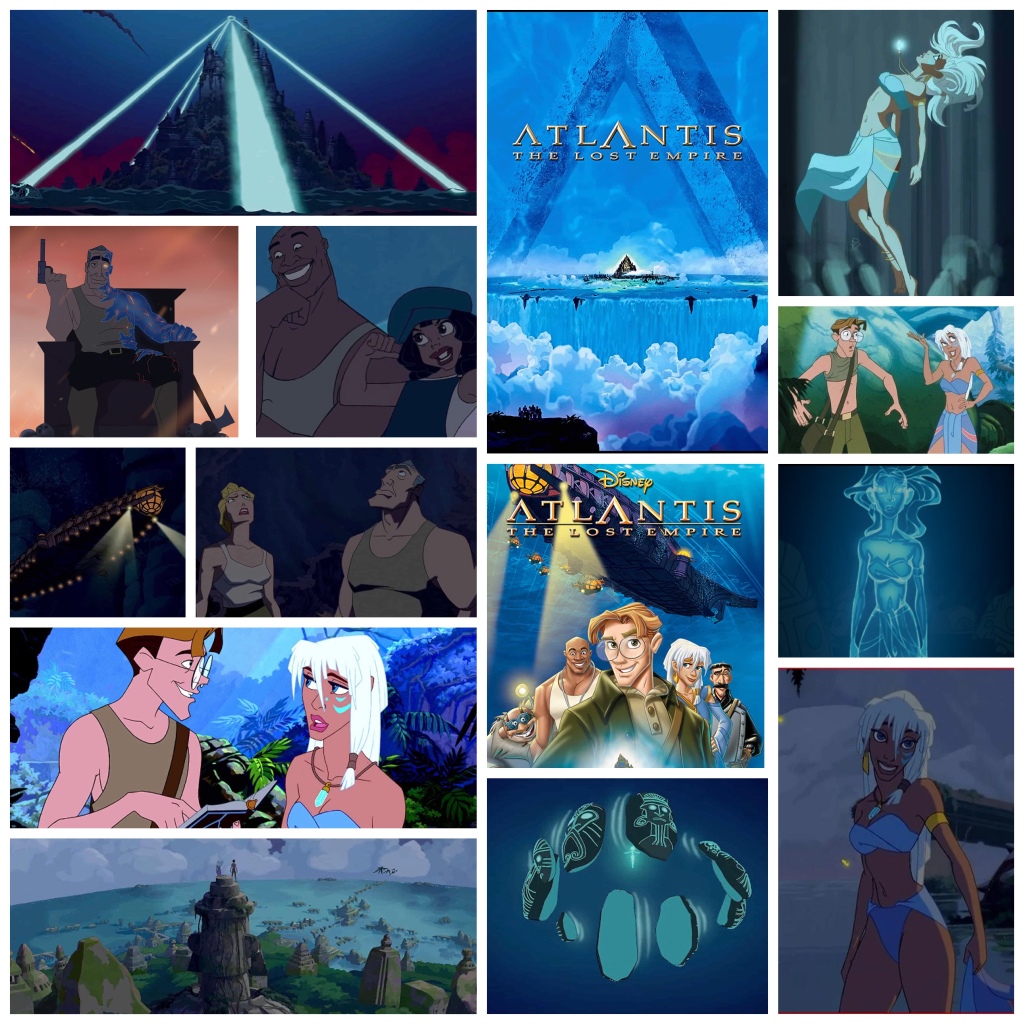
It’s interesting to me how the best Disney films, or at least the ones that I connect with most anyways, don’t get talked about too much. Atlantis: The Lost Empire is always one I was kind of dimly aware of, I had the McDonald’s toys as a kid even though I never saw the film and always thought of it as just another rote Princess storyline from the studio. How wrong I was. This is an absolutely sensational SciFi adventure fantasy on all levels, boundlessly imaginative, strikingly mature as far as Disney goes and the kind of intricately designed experience you can get lost in. In the early 1900’s young scholar Milo Thatch (Michael J. Fox in a lovely, exuberant turn) dreams of finding the lost city of Atlantis as his peers and superiors at the Smithsonian mock his efforts. When an eccentric and very rich tycoon (the late John Mahoney) agrees to fund an elaborate deep sea exploration with Milo spearheading the research aspect, it’s off to the races as a beautifully designed mega-craft descends into the Atlantic Ocean with our hero and a whole team of ragtag experts, grunts and grease monkeys onboard. The film is very realistic and fair with its characters and we get an entire fleet of fascinating individuals including an African American former civil war surgeon (Phil Morris) with indigenous roots, a cantankerous cook (Jim Varney), a Mediterranean explosives guru, a vivacious French geologist and the crew’s mercurial captain Rourke, given the commanding, affable yet vaguely menacing voice of James Garner who does a terrific job of the villainous arc. There is a Princess here but she isn’t doe eyed, sing-songy or cloying for romance every second. Her name is Kida (voiced wonderfully by Cree Summer), she’s the daughter of the Atlantean King (Leonard Nimoy, of all people) and she’s assured, strong willed and cares deeply for the plight of her race, who have fallen on hard times. There are eventual romantic sparks between her and Milo but they feel organic, earned and born out of a genuine, character development based relationship as the two get to know each other and she shows him around her striking world. The visual design and animation here is something else, even before we see Atlantis there’s a steampunk vibe to their equipment and vessel, and when we see the otherworldly biodiversity, detailed architectural splendour and tattoos/costume design it’s an atmosphere like no other. Not to mention the ballistic gong show of a climax, born out of capitalist fuelled betrayal, the very fate of Atlantis and every living thing in it at stake. This isn’t your average Disney flick and while there are the usual beats like comic relief and romance etc, it all feels far more down to earth than I’m used to from this kind of output. I’m reminded of another Disney one that has a similarly grounded, spectacularly imagined world, the wonderful Treasure Planet. I think the studio has never been as good or as inspired as their work with that one and now Atlantis too, it has to be up there as my favourite.

-Nate Hill