Atomic Blonde 


Atomic Blonde is the annual adrenaline shot the action genre gets every year, if we’re lucky. Amidst carbon copy superhero extravaganzas, increasingly ridiculous Fast/Furious hemorrhages and head scratching animation ventures, the multiplex is a frustrating realm these days, but sometimes we are blessed with a good old fashioned hard-R action blitzkrieg that turns out to be a pure banger, lighting up the summer movie roster like neon fireworks. Blonde rides the wake that John Wick left behind, a refreshing, stylistic, no-holds-barred form of action storytelling that cheerfully pisses in the face of all things glossy and PG-13. Set in a frenzied Berlin days before the wall comes down and the Cold War freezes over, Charlize Theron is a breathtakingly sexy super spy with a very particular set of skills and a borderline nihilistic approach to espionage, as well as a massive bone to pick with certain factions of the enemy, who stay fairly hidden until the wicked chess game of a plot rounds it’s final curves. Tasked by a sneaky British intelligence honcho (Toby Jones) and a mysterious CIA Agent (John Goodman, excellent as always) she’s caught between all kinds of warring assets including the KGB, roaming German euro trash punks and a British rogue agent (James Macavoy) playing all sides at once. The plot serves action, to be sure, but it still takes itself seriously amidst all the punches, flying kicks, icepicks to the jugular and careening vehicular destruction. Theron is a primal piston of wanton violence and slinky sexual virility, throwing herself headlong into every action sequence with the kind of reckless abandon that makes you believe those bruises for real (apparently she busted a few ribs for real filming this, the absolute champ). The highlight is a bone shattering one take wonder of a staircase fight, a hapless Eddie Marsan bandaging a bullet wound with swaths of duck tape while Theron furiously dispatches several enemies using any means within arms reach, a spectacle that leads to glorious cringes once the hits get hard and critical and sharp objects start getting close to eyeballs and major organs. The soundtrack must be noted too, the filmmakers employing nostalgic melodies straight out of the 80’s to evoke time and place nicely, with everything from Nina’s 99 Luftballoons to The Clash’s London Calling and Queen’s Under Pressure coming into play. There’s also pretty much the hottest movie sex scene I’ve seen in years, as Theron and a bombshell of a French agent (Sofia Boutella) get slippery under the sheets in a neon soaked Berlin hotel room. This is an action film made by folks who are head over heels in love with the genre, and the passion shows. We never feel cheated, chaperoned or short changed, every ounce of this piece charged up to please the crowd and keep pulses thundering. 

-Nate Hill

TWIN PEAKS: THE RETURN

Image result for twin peaks the return black lodge

Let’s discuss Showtime’s finest “original” programming and David Lynch and Mark Frost’s cataclysmic finale of the TWIN PEAKS saga. First things first, will we get another season or a standalone film that is akin to FIRE WALK WITH ME? Probably not, no. Sure, stranger things have happened, but it’s more than likely we will not get another visual TWIN PEAKS story, and may not even get another film from Lynch himself. This very well could be it for both Peaks and Lynch.

What does the final season mean? What does it answer in the twenty-five-year absence? What happened to Cooper at the end? Honestly, none of that really matters, does it? The more diehard fans of both Lynch and his seminal series with Mark Frost, are not looking for answers, one could say that they are just seeking more unfulfilled questions that will keep them returning to the Peaks canon over a series of years, if not decades.

One thing is apparently clear from THE RETURN. Lynch’s obsession with dreams and a parallel reality which is all rolled into lifelong inspiration, THE WIZARD OF OZ. OZ deals very much in dreams, a parallel reality, and one’s journey back home or at the very least the center of their own reality. There are a plethora of motifs and nods to the film within the series.

THE RETURN isn’t very much like the original series, aside from a string of arcs from beloved characters. What truly perpetuates the main narrative is FIRE WALK WITH ME, which is even more of an important component of the mythology of TWIN PEAKS than ever.

David Bowie’s brief cameo as time traveling Blue Rose Task Force Special Agent Phillip Jeffries became the great and powerful Oz of THE RETURN. He spoke in a method of half riddles, through puffs of steam coming from a percolator.  Sadly, David Bowie was not able to start and complete his scheduled scenes, so instead actor Nathan Frizzell was cast as the voice of Jeffries, and even overdubbed Jeffries’ dialogue from FIRE WALK WITH ME and THE MISSING PIECES. Regardless of the lack of David Bowie, Lynch was able to bring him back into the spotlight, not only in the foreground of the new series but also as the pop culture icon that he had always been.


Without diving into the Lynchian mathematics that is near impossible to solve within THE RETURN, the series ends itself exactly where it began. Cooper is in the Lodge, speaking with Mike and with Laura Palmer whispering in his ear. What does that all mean? It means that Cooper is looped inside of his own dream, within the Black Lodge, and with this reveal, it certainly calls the entire run of this season into question, and makes us ask ourselves what is the reality of the show? Is the reality we saw outside the Black Lodge a tangible reality, a parallel reality, or is it fictitious and all conjured up within Dale Cooper’s head as his sits in the Black Lodge?

David Lynch and Mark Frost brought the season back to where it began and left the audience with a bigger question than what was originally asked. They not only created the finest television event of the year but possibly ever. They have crafted an alluring, taut, and downright haunting story that has no end.


NICK’S NOTES: WARGAMES

3

I used to watch WarGames all the time as a kid. It aired constantly on HBO, my dad was a big fan, and it was edgy in just the right spots but never overly offensive as to be objectionably in my mother’s movie-watching eyes. Released in 1983 and directed by John Badham (who had replaced Martin Brest), this cold-war era piece of vintage entertainment centers on a young computer hacker (Matthew Broderick) who accidentally infiltrates a top-secret government computer program, resulting in a series of escalting “war games” being conduced by a super-computer between the U.S. and Russia. You gotta love this idea! Co-written by Walter Parkes and Lawrence Lasker, the film sports some gorgeous cinematography by William A. Fraker, and is very well-paced by editor Tom Rolf. Shot for $12 million and grossing $80 million, the film was a big hit and was well-received by critics, and has become one of those staple catalog titles that people still adore to this day. Extra-cute Ally Sheedy POWER and big-time Dabney Coleman POWER like a cherry on top.2

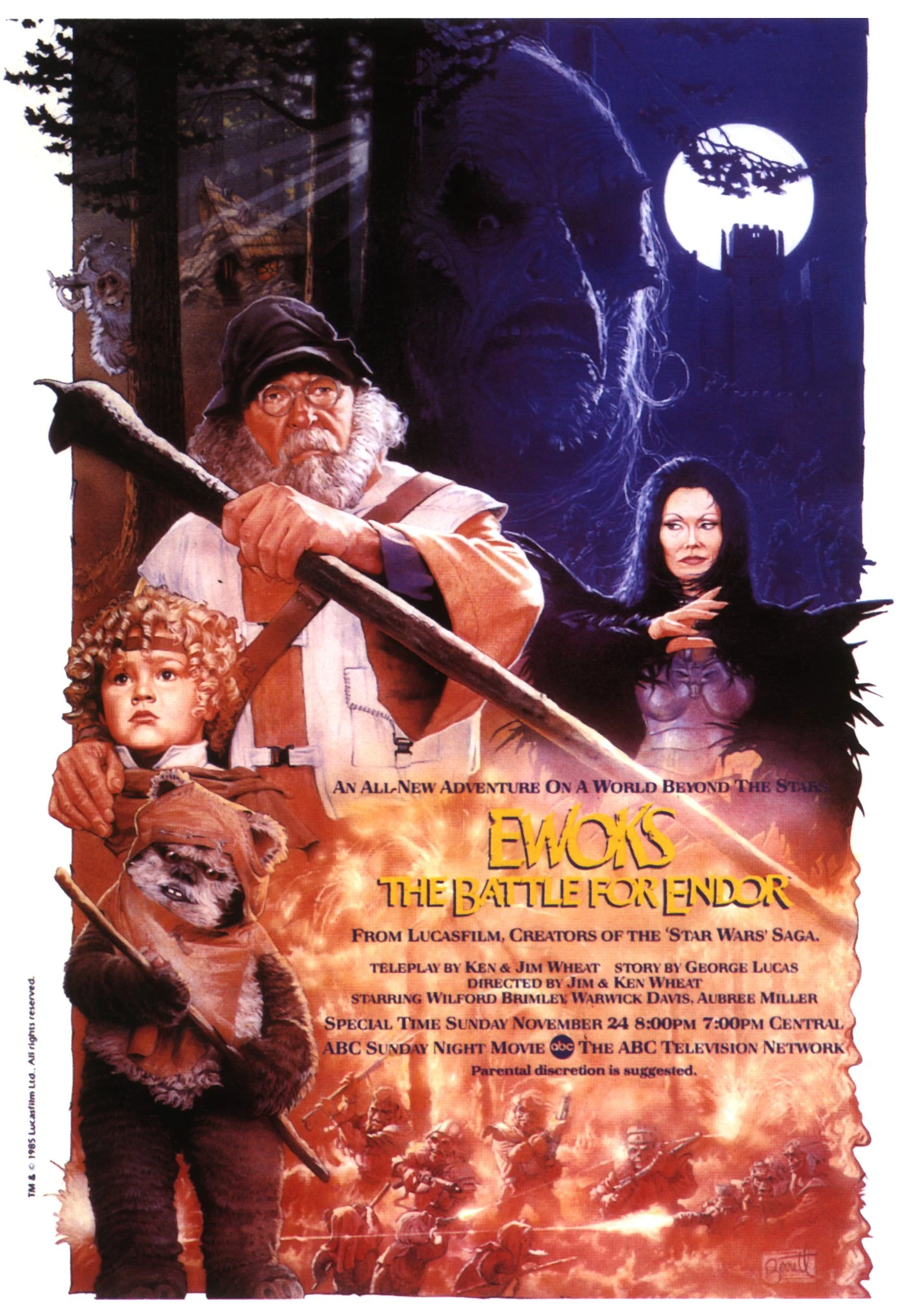
Force Friday Podcast: THE EWOK ADVENTURES

Image result for the ewok adventures

Join Frank and filmmaker Derek Wayne Johnson as they discuss BOTH of the Ewok films that are seminal films from their childhood. Don’t forget to purchase Derek’s film, JOHN G. AVILDSEN KING OF THE UNDERDOGS from retailers everywhere!

Image result for battle for endor


RON HOWARD’S GUNG HO — A REVIEW BY FILMMAKER & GUEST CRITIC DAMIAN K. LAHEY

GungHoPoster

‘Gung Ho’ (1986) dir. Ron Howard

“The truth? You don’t want the truth. You want to hear that Americans are better than anybody else. But they’re kicking our butts. That ain’t luck. There’s your truth. Sure, the great old American do-or-die spirit. Yeah, it’s alive. But THEY’VE got it.”

In ‘Gung Ho’. a U.S. automotive plant has been bought out by a Japanese company and the workers must adapt to the Japanese way of doing business. This is an unintentionally prophetic film about the complacency of the American working class and the tensions that arise in a rapidly evolving multi cultural and global economy. A comedy packed with some earnest socio-political insight, this remarkable film is headlined by an effortless and confident Michael Keaton who fits this movie like a glove.

Watching this film years after I last saw it, some of the culture clash gags did make me wince but overall it holds up. In less capable hands individual sequences could have dissolved into SNL skits. Howard does a commendable job of sidestepping obvious set ups (for the most part) and focusing more on the world these characters inhabit without becoming patronizing. I think this is one of his best films. The script by Lowell Ganz and Babaloo Mandel from a story by Mandel, Ganz and Edwin Blum is clever and quick with a clear understanding of these characters. The film feels very ‘lived in’ and Production designer James L. Schoppe and costume designer Betsy Cox deserve serious kudos for their work on this. Cinematographer Donald Peterman captures the proceedings in an unassuming way, really letting the material breathe.

I really love all the supporting players in this, too. Gedde Watanabe, George Wendt, Mimi Rogers, John Turturro and infamous acid tripping professional baseball player Dock Ellis all do a wonderful job.

Adding to this film’s relevancy is the fact that ‘Gung Ho’ sheds a light on something that has now had a very negative impact on the United States Of America – the delusional entitlement of the working class or more specifically, the white working class that turned out in droves for Donald Trump. Brain dead from propaganda telling them they’re the greatest thing since sliced cheese and that they deserve pay checks just for getting up in the morning, they have supplanted a racist nationalist ideology for a reliable work ethic. They want to be treated and compensated like the hard working Paul Bunyons of American mythology without actually doing any of the work. They believe they’ve been abandoned and in some ways this is true. But they’re abandonment of a reliable work ethic has let them down far more than any foreigner or liberal policy they would like to blame.

GungHoStill

I’LL BE BACK: FIVE FAVORITE SCHWARZENEGGER FILMS

o-ARNOLD-SCHWARZENEGGER-facebook.jpg

In honor of the latest re-release of Terminator 2: Judgment Day and Skynet’s 20th birthday yesterday, Ben and Kyle sat down to reflect on Ahnuld’s film legacy. Those action-adventurers and comedies that marked a highlight in his film career. From an Austrian bodybuilder to the action star of the 80’s and 90’s, to a storied politician, the duo revisit five classics and put our their spin on them.

Conan the Barbarian

MV5BNDgyZmRmZGQtNGVkZC00N2UzLWI1NGYtMGRjZjU4ZmFiNGZiXkEyXkFqcGdeQXVyMjMyNTkxNzY@._V1_.jpg

BEN: Although he had a number of roles in the 1970’s after being discovered as a body builder, none of those roles defined Arnold Schwarzenegger more than 1982’s Conan the Barbarian and its sequel, Conan the Destroyer two years later.  Patterned after The Road Warrior and Mad Max: Beyond Thunderdome, John Millius’s and Oliver Stone’s script for Barbarian is at its heart a revenge story, full of amazing cinematography and classic characters, such as James Earl Jones as Thulsa Doom, Max von Sydow as King Osiric, Mako as the Narrator/Wizard amongst others.  I’ll be honest, I haven’t seen this film in a very long time and I’m overdue for a visit because I remember Duke Callgahan’s cinematography of the desolate, yet rich mountainside landscapes to be stunning along with Basil Poledouris’ drum-heavy instrumental score.

KYLE: Poledouris’ score is legendary.  Aside from the outstanding cinematography, one of the things that makes this film work is that it is unapologetically violent and adult oriented.  The 80’s was a decade in American cinema where you could get away with quite a bit and many films, particularly those geared towards children had a darker undercurrent.  Barbarian went the opposite route and didn’t bury the darkness, it showcased it.  This is also easily Arnold’s best performance.  Conan is flawed and violent, but there’s a savage nobility to him that really comes to fruition after the crucifixion scene.  It’s my favorite part, when they raid the orgy and Doom’s minion says “You” and Conan immediately raises his sword.  It’s scenes like this that make you fall in love with movies.

The Terminator

the-terminator-1.jpg

BEN: In some ways, this role really defined Schwarzenegger’s style as a sarcastic something or another.  It wasn’t so much the character of the Terminator that defined him, but his formidable, yet mechanical presence on the screen. Future roles would lighten him up, where here, Cameron had him approach the role with a more robotic precision, which would permeate some of his more militaristic roles in future movies.  What I liked about his performance was that he was ultra-cool even when he was deadly serious.  The opening scene with Bill Paxton and Brian Thompson where The Terminator asks for their clothes and Paxton’s character says “This guy’s short of a six pack” says a lot about the story and the character because in the next scene Schwarzenegger just sticks his fist into the abdomen of one of the punks, killing him instantly.  It is this precision in Schwarzenegger’s acting that really is defined in this film and is something that we continue to see today.

KYLE: Cameron’s best film by a mile and the one that put Arnold on the map.  It’s the perfect blend of 80’s neon dystopia and cold war paranoia…a place where Arnold’s inhuman assassin is free to kill with impunity in the name of a machine dominated future.  While Arnold is amazing, I’d argue this is really Michael Biehn’s film, but his layered performance only works because it is contrasted by the emotionless antagonist that only Schwarzenegger could portray.

Commando

202-8.jpg

BEN: This film allowed us to explore Schwarzenegger’s . . . tender(?) side by exposing his character to a situation that placed his daughter in danger.  The intriguing element is that he is very much a military muscle jock, even if his character is retired and ‘off the grid’.  I really liked the story and characters in this film.  The settings are very 80’s with the Contras-like group taking his daughter hostage as he tries to figure out what’s going on.  Just as with his Terminator role, here he is a no-holds barred killer and he’ll blow anyone and anything up.  Except his daughter.  Oh, and Rae Dawn Chong.

KYLE: The body count for this one rivals Total Recall (which sadly didn’t make our list!).  Where The Terminator was the gritty underbelly of the 80’s, Commando is ultra-macho American end of the spectrum.  Let’s also not forget the tool shed scene, which is a legend unto itself with respect to comic book violence.  While the subject matter may not hold as much relevance today, the combat and over the top performances will always remain fixtures in American action cinema.

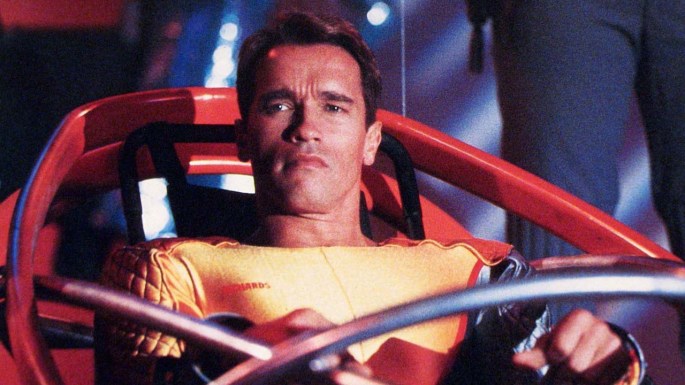
The Running Man
MV5BMDdiYTUxOTMtZDA5Ni00ZTg0LWJiZTktZThjNTgyNzA0YzcwXkEyXkFqcGdeQXVyMjk3NTUyOTc@._V1_.jpg

BEN: Never has there been a more relevant film to not only the time in which it was made, but also today.  It’s ironic then that Stephen King (under the pseudonym Richard Bachman) set the film in 2019.  Steven E. de Souza gave the horrors of government control a graphic representation, while director Paul Michael Glasser (yes, that Paul Michael Glasser!) layered the film with a veritable who’s who of actors to surround Schwarzenegger including Yaphet Kotto, Maria Conchita Alonzo, and former game show host Richard Dawson.  Some who have never seen it might call it cheesy, but it mirrors our reality today quite well.  Pay attention to what this movie is trying to say.

KYLE: I absolutely adore this film.  Coupling the very serious themes with the campy overindulgence of reality television makes for an outstanding experience.  There’s terrific action set pieces, mysterious landmarks of the zone, and Dawson’s scene chewing villain.  This is one of Arnold’s more vulnerable roles and it’s a blast to see him fighting the system.  Some of the commercials and other propaganda that are placed throughout are hilarious.  This is probably Stephen King’s actual worse nightmare, and like you say, it’s interesting that it is slowly becoming a reality.

True Lies
maxresdefault.jpg

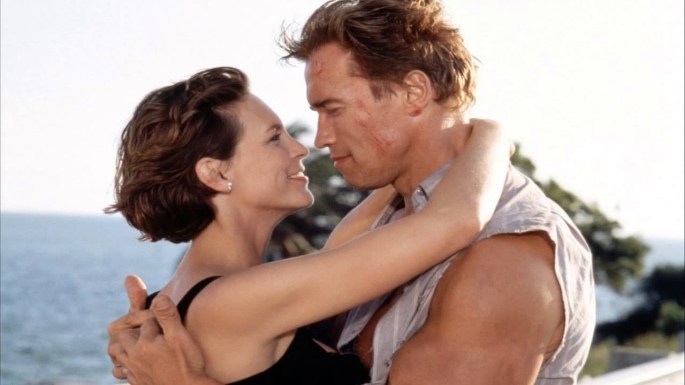
BEN: Our final film is another James Cameron classic, if not an underrepresented film.  Based on the French film La Totale!, Lies focuses its story on Harry Tasker, a global sales manager who doubles as a black operative for a covert terrorism taskforce known as Omega Sector.  The story by James Cameron and Randall Frakes balances Tasker’s real world situations with his life as a family man, where he is married to Jamie Lee Curtis’s Helen Tasker, who knows nothing of his real life.  Tom Arnold and Grant Heslov round out his team while his daughter, Dana, played by Eliza Dushku is full of teenage angst.  Art Malik as the bad guy is very effective. Bill Paxton was hilarious as a faux double agent, Simon. Cameron surrounds himself with notable technical folks to support him.  Russell Carpenter serves as the cinematographer.  Whether we’re being chased down a snow covered, tree-lined hill in the Austrian Alps or we’re taking a helicopter ride over the Overseas Highway spanning the Florida Keys, Carpenter is up to the task. Conrad Buff, Mark Goldblatt and Richard A. Harris are all editors on various Cameron projects and they do a stunning job over the course of the 141 minute run time.  Finally, Brad Fiedel is back to give Harry and company a riveting adventure score.  Watch for the Westin Bonaventure Hotel to make another appearance as a stand-in for a D.C. hotel.

KYLE: While Total Recall and Predator are probably higher on my list, I think True Lies is an interesting film.  There is a lot of debate about whether True Lies is chauvinistic with respect to Arnold’s treatment of Curtis and while I won’t get into the specifics here, I do think the conversation has merit.  One of my favorite things about this film is how everyone appears to be having a wonderful time.  It’s probably the most fun film of Arnold’s adult oriented content because, like its premise, it knows it is an illusion.  It is a caricature of the films that Arnold built his career on while simultaneously being a playful examination on relationships, loyalty, and perspective.  Technically, this is one of Cameron’s most impressive entries, with the editing being the true stand out.

BEN & KYLE: Thank you for continuing to follow our conversations.  Next week, we’re going to take an in depth look at Lawrence of Arabia.

 

BILL WATTERSON’S DAVE MADE A MAZE — A REVIEW BY NICK CLEMENT

1
The charming, off-beat indie Dave Made a Maze is one of those efforts that truly feels hand-made and the product of a filmmaker who had a very specific vision and a very specific way of realizing that vision. Directed by Bill Watterson from a script he co-wrote with Steven Sears, this quirky and unconventional piece of psychological distortion is a startling and extra-cool debut for the helmer, while the film has a genuine novelty as a hook (30,000 square-feet of cardboard were used to create the titular maze) and there’s an exciting sense of originality at work all throughout the lean running time, which results in a movie where genre conventions are explored and upended, statements are made about viewer expectations and the decisions that the various characters face, with the overall surreal nature of the entire piece becoming a constant source of joy to discover. You legitimately don’t know what will happen next, which is one of the best compliments anyone could ever pay any particular film. Jon Boal’s inventive cinematography is a major plus for the entire production.
2
The art direction by Jeff White and production design by Trisha Gum and John Sumner is pause-button worthy, as the film takes on a humorous yet dark done that extends from everything to the performances to the aesthetic. The various actors, especially lead Nick Thune, are never arch with their line delivery or reason for being within the story, and you get the sense that Watterson and his collaborators were having serious fun with the shifting fantasy world that is on display. The narrative centers on an artist suffering from a serious case of creative block, and the complex maze which he creates in his living room as a way of escaping his frustration. But when the maze seemingly takes on its own life with surprising and dangerous ramifications, all bets are off, as the weird and wild story straddles multiple lines while dishing out something happy-creepy and new. After premiering at the Slamdance Film Festival and winning the Audience Award for Best Narrative Feature, Dave Made a Maze received a limited theatrical run this summer, and is available as a streaming option via various providers. This is a cool, funky-fresh little item that defies description and feels destined to pick up a sizable cult following.
3

Xavier Gen’s Hitman 


How to put this: if none of the classic video games featuring Agent 47 were ever made, and Xavier Gen’s Hitman was a standalone film, it wouldn’t be a half bad little B-movie type actioner, with a few gnarly set pieces and a level of acceptable energy kept up throughout. As a film version of these beloved games, however, it just just crashes and burns. Here’s why: the games were very specific, stealthy and designed to be atmospheric, slow burning tactical missions carefully built upon each other like a precarious house of cards, each mission more complex, difficult and risky than the last. The film? A standard Hollywood-ized action narrative that blatantly ignores every structural piece and character quality of the games. When will they learn? What’s more is, the film would have been unique, something memorable, had they followed the blueprint which the games pioneered, but they always just insist on cheapening the formula with boring old movie tropes instead of revering an already charted course which made the source material popular enough to get a film version green-lit in the first place. Ironic. Anywho, this ones your standard globetrotting cheeseball outing, with a bald Timothy Olyphant doing his best yet coming nowhere close to being a solid 47, stuck in a mucky plot involving corrupt Eastern Europeans, double crossing fellow agents and pursued by a hyped up Dougray Scott as some Interpol bigwig and Robert Knepper as a shady Russian (dat accent tho) secret police dude. 47 is betrayed by his own organization and tossed to the dogs, forced to go rogue and, in the film’s most grave plotting misstep, saddled with babysitting duty to a Slavic damsel in distress (Olga Kurylenko). They seriously just gotta hurl a Bond babe into every flick that remotely resembles a 007 venture, don’t they, which is a major offence when you look at what a ruthlessly mythic, near inhuman creature 47 is in the games, and what a manipulatable chump he becomes when pinned under the yoke of this painfully silly script. The 46 I know would just as soon as bury a bullet in this chick’s head as let her tag along and become a liability, let alone start to develop (cringe) human emotions. Such are the dollar signs in the eyes of studio execs though, and any hope of a faithful adaptation suffers as a result. The few sequences that work, including a hotel escape and a subway car Mano á mano between 47 and his genetically altered fellow killers, just don’t feel remotely inspired by, or in the spirit of the video games. The film has a few muted notes of originality, but any action piece that feels the need to pilfer John Powell’s Bourne Identity score instead of hiring a composer to whip up something fresh just can’t be taken seriously. Big ol’ meh from me, think I’ll rent out a PS2 from the pawn shop and settle in with Hitman: Blood Money again, because this shit doesn’t cut it. 

-Nate Hill

Taylor Sheridan’s Wind River


“I knew this girl, and she was a fighter. However far you think she ran, I can promise you she ran farther…”
I couldn’t find an exact verbatim quote, but that’s the kind of affecting, succinctly written dialogue to be found in Taylor Sheridan’s Wind River, a deeply moving knockout of a film. The third in a so far brilliant stateside saga dubbed the ‘frontier trilogy’ (following Sicario and Hell Or Highwater), River is the beast of the bunch, a surprisingly emotional, fully engaging murder mystery set in yet another harsh, weather beaten vista where life struggles to survive, namely a desolate Indian reservation in the heart of Wyoming. We open with life in jeopardy right out of the gate: as Nick Cave’s haunting original score howls across the snowy plain, a terrified young girl flees through the landscape, alone and injured. She doesn’t make it through the night. This sparks an investigation from the scant law enforcement the area has to offer (Graham Greene is wonderfully world weary as the tribal Sheriff), a rookie FBI Agent (Elizabeth Olsen) and a veteran game tracker (Jeremy Renner in hands down the best work he’s ever done) who’s rocked by his own personal tragedy. Their task is anything but easy, stalled on all sides by criminal activity, uncooperative suspects and that ever present, ruthless winter climate. The mystery, although not quite as elaborate as one might imagine going in, is an unfortunate and infuriating situation that fires up the blood, as well as Renner’s dogged hunting instinct and need for retribution, an act he solemnly promises to the girl’s broken father, played by Gil Birmingham in the kind of show stopping, heartbreaking performance that pretty much demands a best supporting nod. Renner is just… so good, and it’s jarring to see him out of that glossy Hawkeye getup and in a role with some real heft, but he carries himself with grave charisma, especially in a monologue that will have eyes, ears and hearts rooted to the screen. This is Sheridan’s first time in the director’s chair and the guy proves he’s just as uncannily gifted as he is with writing, especially when it comes to action, his rendition of the classic Mexican standoff/shootout is queasily suspenseful and the best sequence of it’s kind that I’ve seen in years. He’s also got a knack for finding just the right musical talent for his pictures as well. Sicario saw Jóhann Jóhannsson whip up an audible nightmare of a score, and Hell Or Highwater also had the benefit of Cave and Warren Ellis, whose compositions here echo out through the desolation like laments for those lost, dead and buried under the snow. Tightly paced, emotionally rich, suffocating in it’s scenes of tension, cathartically invigorating when it needs to be, all of the best things a story should be are on display here. If Sheridan’s output continues to ascend the way we’ve seen so far, he’ll singlehandedly save ol’ Hollywood. 

-Nate Hill

B Movie Glory- Mirror Wars: Reflection One 


Mirror Wars: Reflection One is a miserably bad, slipshod Russian produced Top Gun/Bourne Identity clone that seems to exist only so three genre heavyweights can collect a nice little paycheque. The fellows in question are Malcom McDowell, Armand Assante and Rutger Hauer, and the trio grimace their way through grade school dialogue plus a nonexistent, comatose plot line, surrounded by Russian no name ‘actors’ who do anything but perform decently. Everyone here is some sort of clandestine spy or cloak n’ dagger federal heavy, all out to get a cutting edge self flying aviation AI program implemented in fighter jets, or at least that’s what I got out of it. McDowell is a sinister nutjob who plans to steal it or something, with surprising stunt agility for a dude his age. Assante is some bumbling, overzealous law enforcement pazzi who traipses all over Eastern Europe doing not much of anything, while Hauer is a mystery man literally credited as ‘Mysterious Man’, some all powerful spook who pulls the strings on everyone. The main flub here is dubbing, as in whoever they brought in to lay English voices over those of the Russian actors, because they sound like deaf people with mouths full of maple syrup, and that’s no exaggeration. At least hire a few competent VO artists to lay in some English bars so the pitiful few people who actually give this thing the time of day (myself included, sadly) can understand the badly written dialogue. But no. Aside from the three legged table of wasted talent that Hauer, Assante and an especially gamy McDowell provide, this ones for the dogs.