Review: Jack Sholder’s action-horror “The Hidden” is a diamond in the rough.

While the modern world enjoys Kyle MacLachlan in his current turn as Dale Cooper in “Twin Peaks,” I decided to celebrate his cult status with the classic The Hidden.

Recommended to me by several film friends earlier this year, Jack Sholder’s taut action-horror film features MacLachlan as young FBI agent Lloyd Gallagher on the hunt for an alien parasite that can and needs to move between hosts to survive.  Gallagher is partnered with Michael Nouri’s Tom Beck, a seasoned LAPD homicide detective.

This was MacLachlan’s third turn following his roles in Dune and the wild cult-classic Blue Velvet.  Here, he relies more on his ability to emote rather than speak, carrying a certain amount of stoicism throughout the majority of film.  Nouri’s Beck, a family man, is very much the voice of the duo, echoing the audience’s sentiments of mistrust, concern and intrigue.  Nouri’s performance was nominated for a Best Actor Saturn Award and he won in the same category at Sitges.

Jack Sholder, who had just directed A Nightmare on Elm Street 2 was an appropriate choice here.  His style is open and head-on, going for mostly wider shots.  Under the pen name of Bob Hunt, Jim Kouf’s (Money Monster) script does an excellent job of building a rich history of each character, layering in the mystery and intrigue.  Kouf disassociated himself from the project when New Line refused to allow him to direct the film.  Sholder stepped in to re-work some of the script moving it from a purely action film to an action-horror hybrid.

Many of the characters are on screen for a short while only to have their personalities altered when the parasite consumes their bodies.  Kouf’s script and Sholder’s direction make for an effective transition in each supporting character.  Of the supporting characters, William Boyett’s Jonathan Miller, who’s imposing presence was the most fun to watch.  The always scintillating Claudia Christian is a tease here.  She may be on screen for only a few minutes, but they were a blast.  A young Richard Brooks, who would go on to play the assistant D.A. in early seasons of “Law and Order” gives a very convincing performance.  I had to rewind a certain sequence twice to catch Danny Trejo’s cameo.

The most surprising turn in the entire movie is Ed O’Ross’s Detective Cliff Willis.  Mr. O’Ross is normally known for playing “rough n’ tumble” characters and here his imposing nature works for both approaches.  His character’s fate is revealed if you’ve seen the one-sheet poster, but that’s the charm of the story:  you never know who will be consumed next.

Taking advantage of the Halloween weekend, New Line opened The Hidden in 1,045 screens on October 30, 1987, taking in $2.5 million its first weekend.  It would remain in the Top 10 the following weekend, before falling off eventually taking in $9.7 million domestically.   Though it did not run very long in theaters, it’s resurgence on home video and television has certainly elevated the film to cult-classic status.

Running a tight 96 minutes, Jack Sholder’s The Hidden holds up after all these years.  The themes it explores are still as relevant as ever and Michael Nouri and Kyle MacLachlan leave a lasting impression.

Essential Viewing: James Burnett’s neo-realistic “Killer of Sheep” is timely and timeless.

In today’s flash-in-the-pan film environment where a perfectly-timed explosion, laugh, or shout punctuates a non-existent narrative, it’s very rare that I am floored by a film. Yes, I find every film to have a redeeming quality, but that doesn’t necessarily mean that something is good.

When I do find something good, that is worthy of sharing, I make it a point to do so.

That’s why when a friend mentioned a screening of Charles Burnett’s 1978 film, Killer of Sheep and ‘film school’ in the same fell swoop I knew I had to see this.

With a budget of $10,000 and a skeleton crew, Burnett wrote, directed, produced, shot, and edited what would become his master’s thesis film for the UCLA film program.

The interesting thing about Sheep is that the narrative is a series of vignettes focused on the characters and their environments.  The film nearly felt non-narrative, and yet, the vignettes work together forming a neo-realistic theme of a father trying to make a better life for his kids.

Set in the Watts area of Los Angeles, Stan, his wife and two kids are barely making ends meet.  Stan works long hours in a slaughterhouse.  Rather than turning to a life of petty crime, it’s the best work that he can find.  Stan has trouble sleeping and tries to evade his wife, while raising a son who would rather be out with his friends, getting in to trouble and a daughter who is also vying for his attention. With the help of his friend Bracy, Stan tries to buy an engine so that they can get a more reliable car.  They eventually end up worse off than they started.

Other than Stan and Bracy, Burnett did not name the main characters, but one doesn’t mind this.  He gave each of his characters a visceral richness that transcended the need for names.

Burnett shot the entire film on 16mm Black & White film in the Academy aspect ratio.  His use of close-ups was jarring at times, and at others, certain images fell partially out of frame.  Despite this, he created an intimacy out of the despair that Stan must’ve felt as he was struggling for a better life.  This dichotomy was never more prescient than during a dance scene between Stan and his wife.   In that scene, his wife was trying to be intimate while you could clearly see that Stan was focusing his attention elsewhere.

The completed film garnered a number of awards and many accolades when it was screened in 1978 at the Berlin and Toronto film festivals.  It did not receive a wide release due to complications in securing the rights to the 22 songs Burnett included in the film.

It sat for 30 years as a result.

In 2007, the UCLA Film and Television Archives and Milestone Films restored the 16mm prints and transferred them over to 35mm.  The restoration was completed due in part to a donation from Steven Soderbergh, who also paid the $150,000 to license the soundtrack.

Officially released on March 30, 2007 in select US and Canadian cinemas, Charles Burnett’s Killer of Sheep is an austere portrait of someone who wants to do better for himself and his family, and yet he is so utterly unable to alter his life.

While I can’t say that Stan’s life worked out for the better, I can say that this neo-realist portrait is something that will stick with me forever.  The film appeared on several critics’ top ten lists of 2007; it has been inducted into the United States Film Registry by the Library of Congress in 1990, and was chosen by the National Society of Film Critics as one of the 100 Essential Films.

RANDAL KLEISER’S THE FLIGHT OF THE NAVIGATOR — A REVIEW BY NICK CLEMENT

1

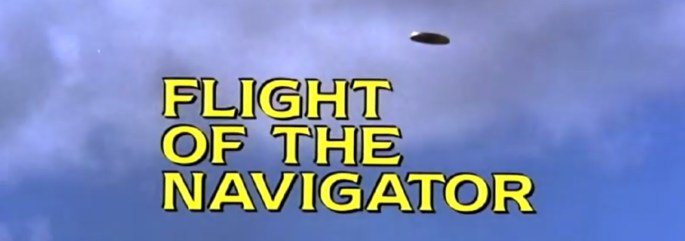
Not many films instilled as much wide-eyed wonder in me as a youthful movie-lover as The Flight of the Navigator, which was released in the summer of 1986, and while not attaining the runaway big-screen blockbuster status that it truly deserved, has lived on throughout the years as an all-time cult favorite for many children of the 80’s. Directed with a terrific sense of old-school movie-magic by Randal Kleiser (Grease, The Blue Lagoon, Big Top Pee-wee) and written with gee-whiz excitement by Michael Burton and Matt MacManus from a story by Mark Baker, child star (and future bank robber…) Joey Kramer got the role of a lifetime as a kid who gets abducted by a friendly alien (voiced by Paul Reubens but credited as Paul Mall!) who then takes him forward in time from 1978 to 1986, all the while battling the charms of a then extremely young Sarah Jessica Parker. The supporting cast included Cliff De Young, Veronica Cartwright, Matt Adler, and Howard Hesseman, but the film’s narrative was squarely placed on Kramer’s young shoulders, and he did a great job interacting with the various creatures and showing genuine responses to his otherworldly craft.

2

The Flight of the Navigator included some of the earliest full-on CGI effects, and features strong cinematography from James Glennon (About Schmidt, Election, Deadwood, Carnivale) and a lively musical score from Alan Silvestri (Back to the Future, Predator, The Delta Force). The film had a weird gestation, as it was first attempted to be set up as a Disney production, with the Mouse House ultimately declining to produce, but agreeing to distribute. The film was lensed on location in Florida with the scenes set aboard the ship shot in Norway on a budget of $9 million, with box office receipts reaching nearly $20 million in America; critical response was favorable. And over the years, it’s become one of those treasured items for many people that feels too refreshingly quaint to be remade in today’s overly slick and cynical CGI movie landscape, though an update has recently been threatened. I hope they leave this property alone, as it works just fine as is, and no amount of money will be able to replicate the original’s sense of overall wonderment. The Flight of the Navigator is available on Blu-ray and DVD, and as an Amazon and YouTube streaming option.

3

ROBERT REDFORD’S ORDINARY PEOPLE — A REVIEW BY NICK CLEMENT

3

Robert Redford’s brilliant family drama Ordinary People is a great movie. How could it not be? It’s real. It’s genuine. Nothing is overdone. And everything works. Redford’s invisible direction, for which he won an Oscar in no less than his directorial debut, is sublime, never showboating in any aesthetic fashion, instead allowing Alvin Sargent’s sensitive and deeply layered screenplay (which was based on Judith Guest’s novel) to do all the heavy lifting. And because Sargent was a master when it came to dialogue and crafting scenes that felt inherently real and honest, there’s nothing about Ordinary People that rings false or feels ill-conceived. The exemplary performances are beyond description. Donald Sutherland as the nice-guy father trying to keep his family together, Mary Tyler Moore with her bottled up rage and intense emotional repression, Timothy Hutton dropping a tour de force performance as an anguished, suicidal teen, Judd Hirsch as the kind shrink who takes a liking to Hutton, fresh-faced Elizabeth McGovern as Hutton’s object of desire – everyone was absolutely remarkable in this delicate piece of work. John Bailey’s plain and focused cinematography is a clear-cut lesson in less is more; sometimes you just need to frame the actors and hold the shots for a bit longer than normal (Jeff Kanew’s patient editing is superb) and pure movie magic will become the result. Marvin Hamlisch’s piano-centric score is the icing on the cake. The winner of four Academy Awards including Best Picture, Best Screenplay, and Best Supporting Actor (Hutton), Ordinary People was a critical favorite and box-office smash, and despite 37 years elapsing since its release, its power remains undiluted. No major studio would be interested in making this film today and that’s a really sad fact of life.

1

Little Nicky


I’ve never been one to actively nab the Adam Sandler flicks off the rental shelf, but even he has made the occasional winner, one of the best being Little Nicky. For some reason it’s panned over other far worse ones he’s churned out of the gumball machine (ever re-watch Billy Madison? What the fuck were we/they thinking back then?), but when you part the curtains of Sandler Stigma™ and really just look at what the movie is in itself, it’s a hoot. What other film can boast Rodney Dangerfield playing Harvey Keitel’s dad in hell? That’s right, Keitel is the red beast himself, coming down off a ten thousand year unholy monarchy, with no plans to retire. This infuriates his two wicked sons, played by Tiny Lister (must have been a different devil-mom) and a slick Rhys Ifans. They depart the inferno and set up their own devilish franchise up in New York City, raising all kinds of hell, the most amusing of which is lowering the drinking age to ten (where were these guys when I was that age?) and forcing Regis Philbin to say naughty things on live primetime. Their younger, slightly retarded brother Nicky (Sandler) must pursue them on their haunts and trap them in a magic flask before it’s too late. Dumb concept, right? Sure it is, but try and tell me it’s not hilarious m, especially with the amount of inane visual gags and trippy production design these folks have dreamed up. Between Hitler dressed as a slutty maid getting a pineapple repeatedly rammed up his rectum to a giant gorilla massaging mammaries that have sprouted on a dude’s head like fleshy succulent pigtails, there’s no shortage of wtf moments. Sander picks an odd character mask as usual, sporting a metal-head swoosh of a haircut and lisping his way through his lines sounding like he had a stroke from watching Billy Madison dailies one too many times. Patricia Arquette is in it, as a sweet, shy girl he meets topside and the closest thing to a sane person you’ll find in this madhouse. Cameos abound, from usual Sandler cronies like Jon Lovitz, Rob Schneider, Kevin Nealon, Dana Carvey, Peter Dante and Allen Covert, to randoms like Michael McKean, Clint Howard, Laura Harring, Henry Winkler, Ozzy Osborne, Reese Witherspoon as Nicky’s angelic mom and Quentin Tarantino as a blind preacher. I don’t really know what else to say about the thing, because its it’s own thing and you either rock out with it, or you don’t. Visually it’s never boring, the script was conceived in the toilet and jumped straight to the gutter, the performances are all garishly obnoxious and the overall tone is that of an sixth grade birthday party gone rogue. 

-Nate Hill

ROBERT MULLIGAN’S THE NICKEL RIDE — A REVIEW BY NICK CLEMENT

3

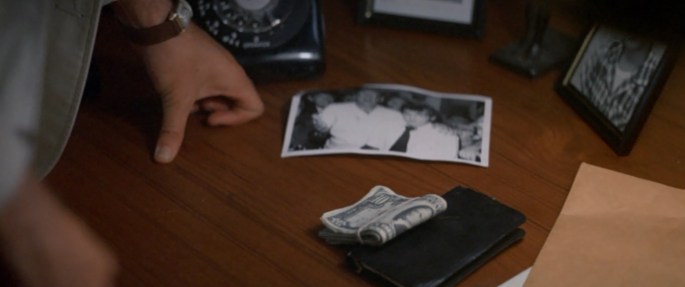
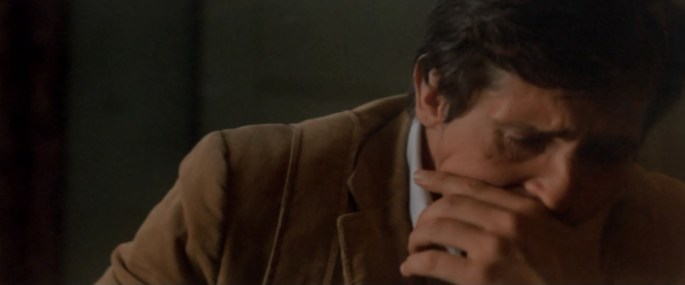
The Nickel Ride is a cool as a cucumber crime film from 1974, patiently directed by Robert Mulligan (Summer of ’42, The Stalking Moon, To Kill A Mockingbird) from a sly, morally ambiguous screenplay by then-newbie Eric Roth (Munich, Forrest Gump, The Curious Case of Benjamin Button, The Insider). The plot centers on a “key-man” named Cooper (Jason Miller), who works for a local crime syndicate, and always carries his ubiquitous key chain at all times. His job is to run a group of Los Angeles-based warehouses that house stolen goods, but things get complicated when a real estate deal turns south and local gangsters led by an evil John Hillerman who feel threatened by Cooper’s knowledge of the ins and outs of the various illegal activities. Before he knows it, someone has been sent to kill him. But who? And why? Roth’s script is clever and shifty, never giving up its full hand until the final moments, and it must be said that Miller’s ability to convey pensive, sullen, broken-down alpha males was truly signature.

2

The film is more about its tense atmosphere and the anxiety that Miller projects as an actor than it is about anything else; his underplayed performance rests in his eyes and body language and the way his sullen face is captured within the frame. The Nickel Ride was shot in 2.35:1 widescreen with a love for shadows and darkness by legendary cinematography Jordan Cronenweth (Blade Runner, Cutter’s Way, Altered States, Rolling Thunder) and features a low-key musical score from Dave Grusin (The Friends of Eddie Coyle, Three Days of the Condor, Oscar-winner for The Milagro Beanfield War). The Nickel Ride screened at the 1974 Cannes Film Festival and was nominated for the Palme d’Or before getting lost in the theatrical market with less than a $2 million domestic gross. The film is available on DVD as a double feature with the outlandishly entertaining John Frankenheimer oddity 99 and 44/100% Dead from Shout! Factory, and would easily fit the bill for a great night of 70’s crime cinema where you never can truly guess how things will end up.

1

Indie Gems: American Perfekt


American Perfekt is a disjointed yet darkly compelling little nightmare of a road movie, a dusty ode to bowers of the American southwest left unchecked and decayed, populated by wayward souls with perpetual heat delirium, vixens, psychopaths and hustlers alike, who saunter through lurid storylines that often end in bloodshed and madness. In the vein of stuff like Oliver Stone’s U-Turn and Kalifornia, we once again pair up with some extremely off colour characters as they navigate both the tangled web of highways that lace the States as well as the human capacity for greed, lust and heinous physical violence. The characters, and actors for that matter, who populate this stretch of highway are an especially bizarre bunch, starting with Robert Forster’s vacationing criminal psychologist Jake Nyman. Forster is quite the unpredictable guy, usually found in calmly benign protagonist roles, yet just as capable of stirring the pot with evil antics. Here’s he’s opaqueness incarnate, driving from one place to another until he runs into two sisters played by another couple of acting hellcats, Amanda Plummer and Fairuza Balk. Jake is basing each decision of his trip upon the flip of a coin a-lá Harvey Dent, a tactic which simultaneously causes trouble and indicates how unhinged he might really be.

Plummer is weird and Balk is weirder, but neither as weird as David ‘Professor Lupin’ Thewlis as an awkwardly placed character who seems to exist just to jump into a scene and throw the mood off kilter. There’s others running amok too, including Geoffrey Lewis, as well as Paul Sorvino and Chris Sarandon as a pair of state troopers who serve as comic relief. Forster is scary here, playing a guy who is psychologically hard to pin down or get a read on, and he’s got some dynamite scenes with Balk in the third act, the two talents lighting up the frame. It’s pretty far south of coherent though, mostly just these freaks terrorizing each other and engaging in puzzling romantic flings that only make sense to them, I suppose. If feverish, borderline abstract, sun-stroked neo noir is your thing, go for it. You can certainly do worse than spend a certifiably bonkers ninety minutes with this terrific bunch of actors. 

-Nate Hill

THE FOX & THE HOUND — A REVIEW BY FILMMAKER AND GUEST CRITIC DAMIAN K. LAHEY

FoxAndTheHoundPoster

“The Fox and the Hound” (1981) dir. Ted Berman, Richard Rich, Art Stevens

One of Disney’s more adult efforts, ‘The Fox and the Hound’ is an endearing morality tale depicting the negative long term effects of tribalism. Todd, a fox and Cooper, a hound become childhood best friends only to realize as they grow older that they must adhere to the roles of their respective cultures and cannot be the friends they once were.

The filmmakers do a remarkable job at the outset of developing the friendship between the young hound and the young fox. It is extremely genuine. A tad hammy but not false. This foundation holds the film together. Cooper is derided by his peers for befriending a fox but is given the benefit of the doubt because of his youth. The older hunting dog Chief and the master, Mr. Slade, are metaphorically unabashed racists as the film brazenly makes its case that bigotry is not inherent in the young but is instead learned by one’s elders and their culture. This film is also astute enough to point out that even the seemingly enlightened woodland creatures who befriend Todd are just as responsible for the general state of things. While they may acknowledge that societal prejudice is wrong, their refusal to do anything about it makes them benign accomplices all the same.

It should be noted that ‘The Fox and the Hound’ features to-die-for voice work by Mickey Rooney, Kurt Russell, Corey Feldman, Sandy Duncan, Pat Buttram and Pearl Bailey. Hard to imagine what this film would have been like without them.

Much has been made about whether or not Chief should have been killed. The new blood at Disney working on the project argued vehemently the Chief should be killed but the old guard voted them down. I certainly agree that the film would have had more narrative bite (ha!) if Chief had been killed. As it stands the retribution seems a little wonky even for Disney logic but it doesn’t raise much of an eyebrow. In my opinion it was a small price to pay in order to get the film’s message across.

Life is unfair, people. And as this film shows us, most of life is spent within the grey areas as opposed to the blacks and whites. Even the most dramatic moments in our lives end in neither clear victory nor defeat. When Cooper stands up to Mr. Slade at the end of the film, refusing to betray Todd – it is merely a truce of sorts. It is no victory for multiculturalism nor defeat for isolationism. There is merely a mournful acceptance that the fox and the hound cannot coexist for many frustrating reasons. But for a brief period of time, Todd and Cooper proved that they could. Society, my friends, can be a very oppressive force. One that influences people far too often to betray their more noble instincts for the ‘good’ of the pack. We could all be more mindful of this.

TheFoxandTheHoundStill

STANLEY KRAMER’S INHERIT THE WIND — A MINI-REVIEW BY NICK CLEMENT

2

Stanley Kramer’s timeless drama Inherit the Wind still has the capacity to rouse and startle, and remains scarily relevant in today’s increasingly Idiocracy-leaning society. Co-written by blacklisted screenwriter Nedrick Young and Harold Jacob Smith, the film was based on the play by Jerome Lawrence and Robert Edwin Lee and inspired by the famous “Scopes Monkey Trial” in 1925, where creationism vs. evolution was up for debate. Starring Spencer Tracy, Fredric Marsh, Gene Kelly, Dick York, Donna Anderson, Claude Akins, Harry Morgan, and Elliot Reed, there’s not a bad performance in the entire bunch, and the film’s black and white photography by Ernest Laszlo is consistently dynamic, which was no small feat considering that much of the action takes place in a courtroom. I was introduced to this film by my father early in my formative movie-buff years, and I’ve revisited it numerous times as it always provides an intellectual punch, and serves as a potent reminder of how mixing religion with law is a terrible idea.

3