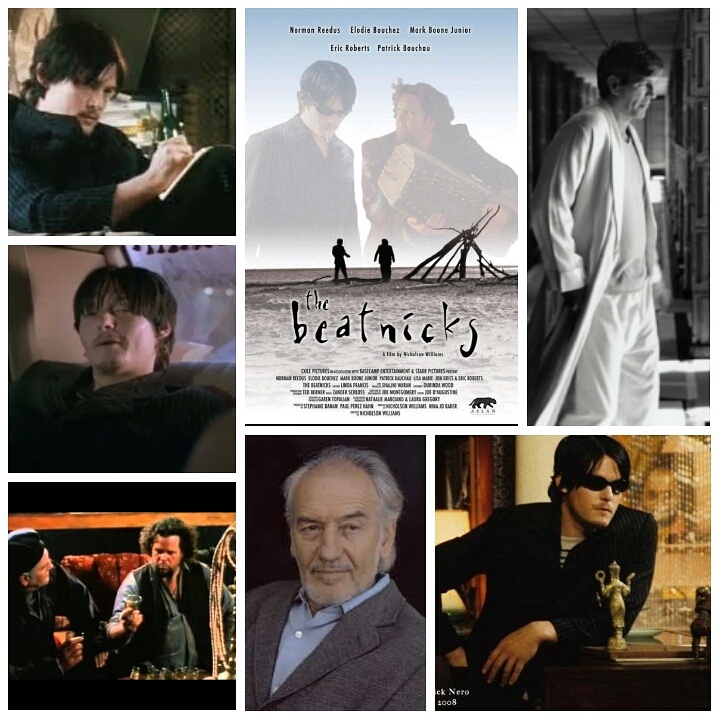
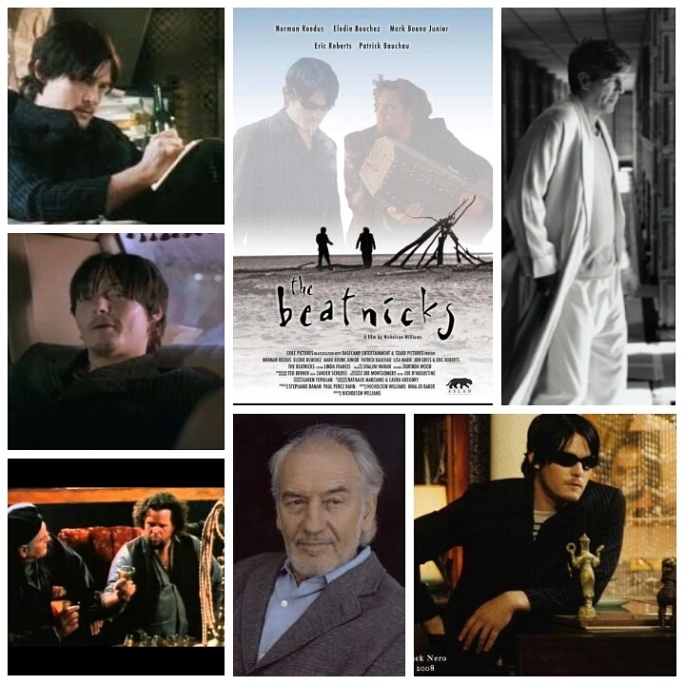
The Beatnicks is an kooky, shambling little indie that I can’t really say whether or not I liked, because not much of anything happens the whole time. The filmmakers have obviously tried hard to capture the quaint feeling of the beat generation, whether or not they succeeded though isn’t for me to say, I kind of avoid stuff in that style, never appealed to me. It’s a strange little story concerning Nick Nero (Norman Reedus) and Nick Beat (Mark Boone Jr), two aimless wandering performers who are down on their luck and desperate for a gig. Most of the film is just them wandering around, pontificating on life and art and not much else. Reedus clashes with mysterious night club owner Mack Drake (a slick Eric Roberts) over the affections of his moll-esque girlfriend (Elodie Bouchez), whilst Boone gets handed a series of arbitrary, cryptic tasks by enigmatic stranger Hank (the underrated Patrick Bachau). And that’s it. There are pockets of the film filled with nothing but air, places where they’ve tried to stretch ‘not much’ into ‘a whole lot’ and have caused their creative well to run dry. In a film about beat poets who I imagine spend most of their time filling up time and space with constant stream of consciousness output, dead air isn’t a good thing to have lingering around in your story. An odd duck of a film that didn’t really chime with me, but some may find it worth a gander.
Category: Film Review
Todd Phillips and Lawrence Sher on WAR DOGS

Podcasting Them Softly is beyond thrilled to present an extremely entertaining chat with filmmaker Todd Phillips and cinematographer Lawrence Sher, as they discuss their new political action-comedy-drama WAR DOGS! This was a true honor to speak with Todd and Larry as they’ve become a major collaborative force over the last decade, working on some of the funniest movies that have been released (THE HANGOVER TRILOGY, DUE DATE), and with WAR DOGS, the creative duo appear to be taking on an even meatier story, this time one that’s based on real-life escapades of gun running in the Middle East. Listen in for tidbits on the casting process, the challenge of getting a movie like this made in today’s filmic landscape, and their approach to a project that was shot in multiple countries with a large scope and exciting action! Big thanks to Todd and Larry for their time, and we hope you enjoy this terrific discussion with two supremely talented artists!
B Movie Glory With Nate: The Immortals
The Immortals is one of those brilliant little action crime flicks that seemed to slip through the cracks and disappear soon after it aired on TV. That wouldn’t be a problem if it was one of the many intolerable embarrassments that speckle Eric Robert’s career like goose shit on a manicured lawn. But it’s actually a really great time, with a bunch of actors who are super into what the script has them do, and geniunly fascinating story to tell us, which it does so at a breakneck pace. Roberts plays Jack, a silver tongued nightclub owner with ties to some dangerous underworld players. One night he calls a meeting with eight different petty thieves from all walks of life, announcing that he’s planning to orchestrate a heist against criminal kingpin Dominic (screen legend Tony Curtis in one of his final roles), and proceeds to send them off to perform risky jobs all over town, rapidly gaining Dominics attention and hostility. During an extended face off between his forces and Jack’s merry band of miscreants, they discover that Jack has a very specific and secretive reason for selecting them all for this venture, and nothing is what it seems. William Forsythe is a kicker as Tim, the loose cannon of the bunch, a rowdy psycho who smartens up during the finale, which gives him terrific dialogue to chow on. Chris Rock is the fast talking dude among them, Tia Carrere is sexy and stunt savvy as always, Clarence Williams III does his bug eyed weirdo shtick to the hilt, and Joe Pantoliano never misses a beat either. Roberts is the ringmaster of this chaotic little circus though, failing up that southern prince charm and flashing the mile wide million dollar grin whenever he gets the chance. There’s a lived in, easy breezy feel to this, like these characters are really getting to know each other, bonds are formed and tested amidst a haughty atmosphere and a lethal situation. Twists, turns and somersaults punctuate the narrative, and they’re super fun to try and sniff out as you watch the fireworks blow up the screen. A B movie, yes, but an extremely well made one that gives it it’s all and comes out a grinning winner.
Sam Raimi’s The Gift: A Review by Nate Hill
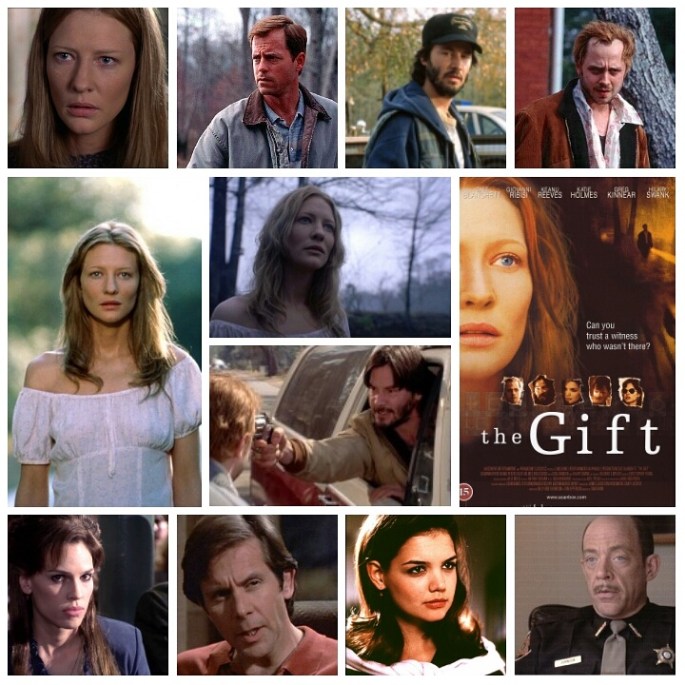
Anyone who loves a good slice of southern gothic murder mystery should check out Sam Raimi’s The Gift, one of several films in the eclectic scoundrel’s ouvre which made a departure from his usual brand of chaotic horror. Cate Blanchett stars as Annabelle, a single mother with a very perceptive telepathic ability, which in rural USA is greeted without any skepticism by the locals. She is renowned for her gift, and often approached by people in need. The story sees her trying to locate young Jessica (Katie Holmes), who has gone missing, and discovering some nasty secrets about the people around her in the process, people she thought she knew better. Jessica’s fiance (Greg Kinnear) is desperate but clearly knows something he’s not saying. Also involved is battered housewife Valerie (Hilary Swank), her terrifying abusive boyfriend Donnie (Keanu Reeves), a local mechanic (Giovanni Ribisi) who befriends Annabelle, and others. It’s an ugly tale contrasted by Blanchett’s striking beauty, which the cameras capture in all the right instances. She could be rearranging a bookshelf and still be compelling and elegant, and always is in whichever role she takes on. Reeves is a scary tornado of pent up rage and sickness, cast way against type and loving every rage fuelled second. As if the main cast wasn’t packed enough with talent, we also get stellar work from Gary Cole, Michael Jeter, Kim Dickens, Rosemary Harris, a random cameo from Danny Elfman and a sly turn from J.K. Simmons as the county sheriff. What a cast, eh? Raimi puts them to good use, and each one gets their moment to shine. I’ve never seen a film by the director I haven’t loved; the guy just makes super fun, accessible genre treats that are irresistibly likable. Pair that with the evocative southern tone and Blanchett’s winning presence and you’ve got one hell of a little package. Very overlooked stuff.
UNDER THE TUSCAN SUN – A REVIEW BY J.D. LAFRANCE

From her screenplay for The Truth About Cats and Dogs (1996) to her directorial debut with Guinevere (1999), Audrey Wells has created films with strong female protagonists. She continues this thematic preoccupation with Under the Tuscan Sun (2003) featuring a main character that goes on a journey of self-discovery in Italy. Based on the bestselling 1996 memoir of the same name by Frances Mayes, the film is a warm and inviting romantic comedy that attempts to deviate from some of the conventions of the genre.
Frances Mayes (Diane Lane) is a professor of literature living in San Francisco with her husband. Her bad reviews of other people’s books comes back to haunt her when a writer harboring a grudge hints that her husband has been having an affair. During the messy divorce, and understandably upset over his betrayal, she sells her half of their house rather than pay up via alimony. Frances moves into a noisy apartment building and tries to figure out what to do with her life. She suffers from writer’s block — not just with her book, but with her life. Patty (Sandra Oh), her best friend and support group, is unable to go on a ten-day trip to Tuscany because of her upcoming pregnancy. So, she gets Frances to go in the hopes that a change of pace and scenery will provide her with a fresh start.
Before she knows it, Frances is on a bus full of gay people in Italy with the tour guide telling everyone her life story. She spots a charming little villa on the tour and decides to get off the bus. She becomes enchanted with the place, meets the owner and decides to buy it. To say that the house is fix-it-upper opportunity is a mild understatement but Frances plugs away, renovating the house and, in the process, her life.
Under the Tuscan Sun was a nice change of pace for Diane Lane, fresh from her role in the dark, erotic thriller, Unfaithful (2002). She is quite good as a newly independent woman trying to start her life over. The gorgeous Lane looks absolutely radiant and brings a lot of charm to the role. She shows a real knack for light comedy as well and is not afraid to look silly or vulnerable.
It also doesn’t hurt that director Audrey Wells surrounds the stunning Lane with a picturesque, postcard perfect Italian countryside. Every frame is filled with resplendent scenery and everyone eats delicious looking food. It is a shameless love letter to Italy. A more cynical person might say that this film is just one long ad for the tourism board of the country. It works. Under the Tuscan Sun really makes you want to go there, discover your very own villa and escape from it all.
Under the Tuscan Sun is reminiscent of Enchanted April (1992) in that it also features women getting away from dreary past lives and moving to Italy to gain their independence and start their lives anew. In terms of plotting and dialogue, Tuscan Sun is pretty standard fare but it is quite entertaining, features a winning performance by Diane Lane and is handsomely photographed.
ELAINE MAY’S MIKEY AND NICKY — A REVIEW BY NICK CLEMENT

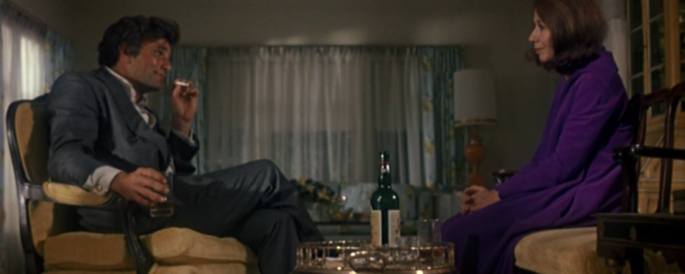
Funny, dark, uncompromising, and totally a product of the auteur-driven studio system of the 1970’s, Mikey and Nicky was written and directed by Elaine May, and it wouldn’t be the last time she had to deal with a turbulent production. To hear it from Victor Kemper’s candid interviews on the DVD, the shoot for this film was anything but easy (Kemper would quit the production twice!), but as so often with influential pieces of cinema, the terrific end result almost had to be born out of some form of madness. The action centers on Nicky (John Cassavetes, desperate and sad), who yet again needs help from his best friend Mikey (Peter Falk, intense and filled with quick-tempered rage), as he’s in over his head with debts to gangsters, and at the start of the film, is holed up inside a sketchy hotel, losing his collective mental shit in the process. Mikey tries to help is buddy, but at almost every turn, Nicky screws it all up, leading to a potentially tragic finale that tests the boundaries of friendship and sacrifice. This is one of those tricky films that was able to find the perfect balance between dangerous plotting, character based comedy, and genuine heart. May had such a distinct cinematic voice that it seems a shame that her career would often be plagued with issues having nothing to do with the overall quality of her work.

Because May was happy to leave cameras rolling (according to the internet she shot 1.4 million feet of film!), there’s a spontaneous feeling to the loose and gritty aesthetic favored by Kemper and the various other collaborators who worked on this scrappy little picture. And the natural rapport between Cassavetes and Falk really was something special; these two actors knew precisely how to play off of each other, always bringing out the best that they had to offer. The film clearly had to have influenced filmmaker Jon Favreau when he was working on his comedy classic Made, as the casting of Falk as the guy who sets the plot in motion in that 2001 film seems especially astute in retrospect. Ned Beatty, M. Emmett Walsh, Carol Grace, William Hickey, and Rose Arrick round out the solid supporting cast, while Sheldon Kahn’s jagged editing patterns contributed to the frenetic quality to the storytelling and filmmaking aesthetic. Also, it must be noted, and this is according to Wikipedia: “Budgeted at $1.8 million and scheduled for a summer 1975 release, the film ended up costing $4.3 million and not coming out until December 1976. May was eventually fired by Paramount Pictures (the studio which financed the film), but succeeded in getting herself rehired by hiding two reels of the negative until the studio gave in.” Those were the days – filmmakers holding films for ransom from the studios! If only this sort of anarchic spirit still lurked in Tinseltown.

THE LOOKOUT – A REVIEW BY J.D. LAFRANCE

With his adaptation of Elmore Leonard’s novel, Out of Sight, Scott Frank demonstrated a knack for crime thrillers with plenty of plot twists and double crosses. He finally got the chance to direct his own film and the result was The Lookout (2007), a neo-noir that evokes other crime movies like Charley Varrick (1973) and Fargo (1996).
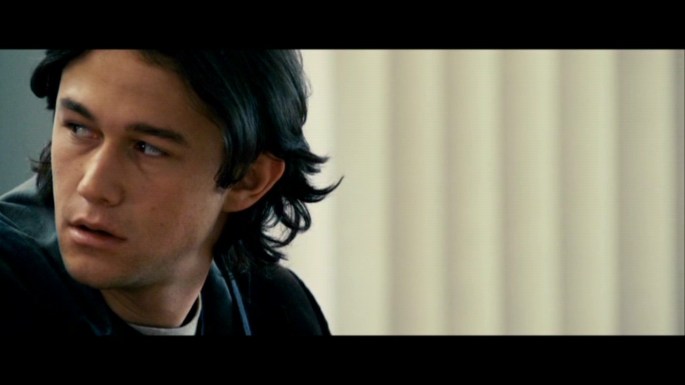
Chris Pratt (Joseph Gordon-Levitt) is a young hockey player with a promising career that is snuffed out in an instant thanks to a car accident that he caused. Four years later, he’s working as a night janitor at a local Midwestern bank located out in the middle of nowhere and dealing with a head injury from the accident. He has to write down everything that he does to get ready every day. His old life is gone and his new one is one mundane day after another. Chris now lives with Lewis (Jeff Daniels), his blind roommate who helps the young man out with things around their apartment.
Chris meets Gary (Matthew Goode) at a bar one night. He’s a genial guy who befriends the young man over beers. Chris also meets a beautiful young woman named Luvlee (Isla Fisher) who is friends with Gary. They quickly go to work on Chris, Gary appealing to his brain and Luvlee to his heart. They make him feel like he belongs, which is important to him because his family doesn’t know how to relate to him anymore. Pretty soon Gary tells Chris about a bank heist he plans to pull with his buddies. The bank that they are targeting just happens to be the one that Chris works at. Gary dangles the proverbial carrot in front of Chris with the promise of money and the power that comes with it. He is very persuasive and knows exactly which buttons to push. Like most heist films, things do not go according to plan and the rest of the film deals with the aftershocks.
Joseph Gordon-Levitt continues his knack for offbeat roles. He does a great job portraying someone with neurological damage and the frustration that comes from not being able to do simple things like opening a can of food or remembering someone’s name. He also conveys the guilt his character feels over the car accident that cost two of his friends their lives and robbed him of a promising future. We see how he tries to hide his disorder and the frustration of not being able to do basic things. It’s a performance grounded in realism that is in contrast to this stylized noir world. It doesn’t hurt that he is surrounded by cold, detached characters, and this makes him very sympathetic as well.
Jeff Daniels steals pretty much every scene he’s in as Chris’ genial roommate. The actor displays a dry sense of humor that is very funny to see in action. He and Gordon-Levitt’s character make for very unlikely roommates to say the least but the two actors make it work thanks to the excellent chemistry they have together. Along with The Squid in the Whale (2005) and Good Night, and Good Luck (2005), Daniels is turning out to be quite an excellent character actor appearing in several well-made independent films.
Frank has a keen visual sense, adopting a predominantly dark color scheme in keeping with the neo-noir tradition. He has crafted a clever little thriller with a fascinating protagonist at its center. What could have easily been a forgettable film is anchored by yet another riveting performance by Gordon-Levitt.
ROGER DONALDSON’S THE BANK JOB — A REVIEW BY NICK CLEMENT

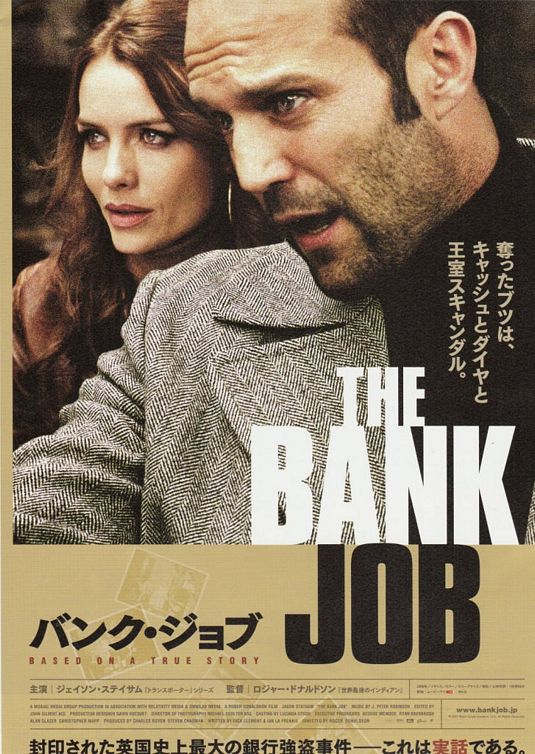
The less you know about Roger Donaldson’s enormously entertaining heist flick The Bank Job the better off you will be when you see it. This is a total crowd-pleaser from start to finish, a smart, adult-oriented thriller that really thrills, and it’s a shame that it slipped in and out of theaters back in 2008. Donaldson, who has had a solid directorial career filled with some great popcorn flicks and more personal underrated efforts, crafted a very polished piece of genre filmmaking with The Bank Job; it may be his best overall effort. The caper movie can be a tricky beast at times as the audience expects surprises from stories such as this, and in that respect, The Bank Job doesn’t disappoint. The smart yet complicated script courtesy of veteran screenwriters Dick Clement and Ian Le Frenais (The Commitments) is sassy, tough, and fast paced. It’s also very funny, and when necessary, down and dirty and mean. Anchored by a sturdy, Steve McQueen-esque performance from big-screen tough-guy Jason Statham (his best work to date as an actor) The Bank Job breezes along, never slowing down for a moment during the extremely tight two hour run time.
One of the reasons why I had such a blast with this flick was that I didn’t know all of the particulars. The film starts off in sexy, 70’s fashion, with a couple of topless women frolicking in crystal clear ocean water, at some unnamed resort area. The ladies, and their male friend, move to a nearby bungalow, for a more private encounter. What the three of them don’t realize is that there is someone snapping some incriminating photographs from outside their window. What the audience doesn’t initially realize is that one of the women enjoying the tryst happens to be British royalty. And it doesn’t help matters that the individual taking those photographs happens to be connected to the ruthless gangster Michael X (a sneering and vicious Peter De Jersey). The photos will serve as leverage if he ever gets into trouble with the British government. Right off the bat, some excellent pieces are set into motion.

Cut to London. Terry Leather (Statham) runs an auto-body shop with a couple of ex-goons. Leather is no stranger to trouble and local harassment from an assortment of petty gangsters and crooked cops. It’s clear that he might have had some run-ins with the law earlier in life, but that he’s at least attempting to go straight. But before long, in classic tradition, his stunningly gorgeous old-flame Martine (Saffron Burrows, exuding sexiness), a part-time model, shows up at his shop with a potentially dangerous but extremely lucrative proposition. She’s met some people who want to rob a bank in downtown London. There are some specifics to the case that I will allow you to discover on your own, but I will concede that Martine may or may not be 100% truthful with all of the facts. And the way a porn kingpin, the British secret intelligence, local cops, a high-class brothel, dirty politicians, and a variety of naked women figure into the plot are also developments that should be left for your discovery. Normally a heist film doesn’t juggle this many plot lines, but credit the writers with doing so coherently and excitingly, while never losing sight of the tight story at its core. Also, in reference to the on-screen nudity, I must say how refreshing it was to actually see an adult-minded picture that wasn’t shy about sexuality and had some fun in this realm. It was also rather nice to see a heist film where I actually believed the heist that was going on! How many times have we seen over-the-top scenarios with an impossible heist in the middle of a ridiculous plot? The fact that The Bank Job is based on real events makes it even juicier.
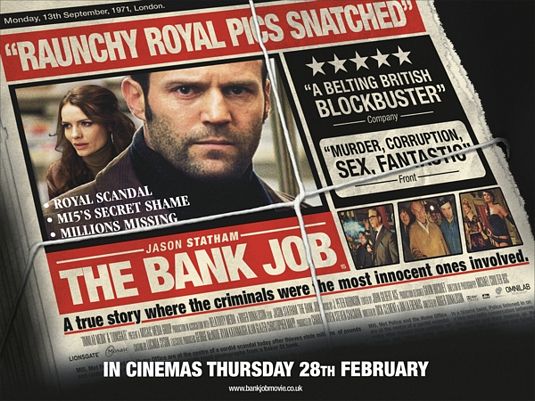
Statham got a chance to actually prove that he could act in The Bank Job, grounding the movie at all times with his inherent gravitas, while also allowing for more nuance than one probably expects from him as a performer. While I have loved seeing him kick continuous bad-guy ass in movies like Crank and Crank 2 and The Transporter/Expendables series, it was great to see him play a real character for once, one with a credible backstory, honest vulnerabilities, and some level of genuine stress. But never fear – Statham gets to flex his muscles at the end of The Bank Job, and because the ass-whooping that he throws is completely warranted by the plot, it felt all the more cathartic and exciting. The deep ensemble cast, made up of lots of British character actors, seals the deal as there isn’t one wasted performance or actor in the entire bunch. Burrows, who has more to do in the film than you might think considering her “hot-chick” character archetype, is mysterious, gorgeous, and dangerous, exactly what a femme fatale should be.

But to be honest, I can’t help but feel that the real star of The Bank Job is its director. Donaldson, an Australian journeyman/gun-for-hire, had a couple of big hits in the 80’s with the excellent No Way Out and the slick ‘n shitty Cocktail. And then came the 90’s, which weren’t as kind: Cadillac Man, White Sands, and the wholly unnecessary yet still entertaining remake of Sam Peckinpah’s masterwork The Getaway, all of which were critical and commercial disappointments. Then there was the schlocky and totally awesome sci-fi hit Species, which while derivative beyond belief, was a fun, effective B-movie that did solid business, spawned a franchise, and introduced the world to Natasha Henstridge. Next came Dante’s Peak, the first (and better) of the two big-budget volcano movies of the late 90’s. Then, in 2000, Donaldson busted out with the excellent Cuban missile crisis political thriller 13 Days, which did piss-poor business, and probably competes with The Bank Job for “best film of career” honors. Needing a hit, he followed that up with the more conventional spy film The Recruit, which was solid if uninspired entertainment, and then in 2005, he made the delightful Anthony Hopkins starrer The World’s Fastest Indian, clearly a more personal project.

Donaldson, always a solid technician who brings an unfussy sense of style to all of his films, seemed to have been reinvigorated by the material in The Bank Job. He directed with an icy firm grip, never letting the busy plot spin out of control, shooting the action in a crisp and clean fashion, and allowing for moments of character based humor. And in tandem with his talented cinematographer Michael Coulter, he brought a gritty, desaturated color palette to match the 70’s-style realism with the on location London surroundings. But while critics heaped praise on The Bank Job, it died a quick death with theatrical audiences, and after the unfair box office failure, Donaldson has gone back to more routine offerings, like 2011’s clichéd lawyer thriller Seeking Justice (which barely got a release) and the vanilla-looking The November Man (haven’t seen that one yet). If you’re looking for smart entertainment, a film that is sexy, unpredictable, humorous, and satisfying, you could do a lot worse than check out The Bank Job. It doesn’t re-invent the wheel, but for what it is, it’s just about damn near perfect. And sometimes, all we need is a classy, unpretentious piece of entertainment like The Bank Job to remind us that there is life left in one of our more well-stocked genres.

VIVA (2007): A Review by Ryan Marshall

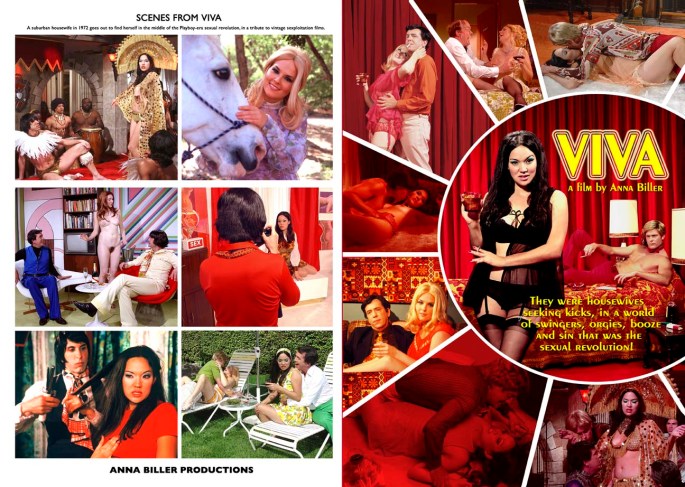
An homage, when executed with the most shallow of intentions (that is, to pay tribute without any sort of recognizable personal stamp), can potentially be a deeply disastrous affair. Truth be told, just about anyone can spread their fanaticism far and wide, but it takes a particularly gifted individual to balance immeasurable admiration with a more comprehensive understanding of his/her obsessions. Anna Biller’s VIVA belongs to a long line of exploitation throwbacks that have turned up in recent years – a candy colored excursion back to a time when the idea of corrupted innocence was genuinely invigorating – and immediately it looks to be the kind of extra-cutesy affair that you either love or hate depending on your own tolerance for the kind of material it seeks to evoke. In spite of whatever complicated feelings one might have, there’s an undeniable hook from the first frame onwards, which is that Biller’s at the very least got the “look” and “feel” down to a tee; unmistakably the result of countless years spent thrifting, crate digging, and existing almost entirely in her own world.
I’m the kind of guy who appreciates a true sense of craftsmanship when it comes to production design in film (and even more-so with an intended period piece), so Biller’s commitment to recreating the sleaze and cheese of 1960’s/70’s sexploitation is an immediately imposing quality. Every last aspect of sound and sight, from the pictures hanging on the walls to the occasional (and only slightly jarring) continuity error, exists for the sole purpose of total immersion. Taking a closer look at her filmography thus far, the writer/director (plus costume designer, editor, actress, producer, animator, musical contributor, etc.) seems to have a very unique (and so far successful) brand which seeks to revisit the kind of lucid technicolor dreamscapes that once graced the silver screen with their distinctive phantasmagoria, but with an added intellectual twist which allows the material to be studied under the microscopic lens of today’s comparatively tame social-political landscape.
“This is a story about a housewife during the sexual revolution. The time is 1972, the place is Los Angeles, and the people are ORDINARY.” The situation at large: Barbi (Biller) enjoys, or rather submits to a stay-at-home life with her husband in and out on various business trips and the neighbors, Mark and Sheila, serving as a constant reminder of the mundanity of her sexuality as of late. But one day, Barbi ventures far outside of her comfort zone, pursuing a career in modeling, which leads to an unlikely encounter with a vivacious hair stylist that prompts her man to walk out on her. Instead of confronting the crippling emptiness she experiences in light of his absence, Barbi goes out on the town with Sheila (whose husband has also left her) where they take up new lives as call girls. Nudist hippie camps, flamboyant art snobs, the allure of showbiz, and crazy drug-fueled orgies – there’s truly something for everyone out there.

But of course, this exhilarating new world is not quite all it’s cracked up to be; the girls are of the belief that they are escaping the constricted roles of the household through all the glitter and glam, when in fact the men of this so-called “high life” are no less intolerant and negligent than their respective spouses. Where their husbands merely laughed until their faces were red or extended their skiing vacations an extra full month, these savage beasts are content to buy and sell them out or worse yet, take their abusive tendencies to more regrettably hands-on territory. Yet, Barbi proves time and time again that she is much stronger than she appears; the toxic cycle seems never-ending and the web of overbearing masculinity is a powerful obstacle, but what this tale ultimately suggests is that progress is not an all-together impossible dream.
Speaking strictly of surface-level pleasures, this covers just about anything that could be found on the unofficial sexploitation checklist, which is a modest achievement in its own right – but brewing beneath is something far more interesting and – ultimately – important. This is indubitably a feminist film, and one which is refreshingly fearless in how it pronounces itself as such; a simple but poignant story of a woman breaking free of both internal and external boundaries and learning to exist as her own separate entity. Aesthetically, Biller crafts a language that is entirely her own, in spite of her many prominent influences; if this can be compared to anything, it’s the early works of John Waters (FEMALE TROUBLE and DESPERATE LIVING, especially). Much of it is gleefully over-the-top, often hysterical, but whilst wallowing in the filth, Biller gracefully unearths honest, ugly truths when it comes to female representation both on and off the screen, though it’s her auteurist touch – her fetishistic attention to detail and supernatural gifts as a visual artist – that really allows the bigger, more progressive ideas to shine.
But most importantly, it’s just great entertainment. At two hours, there are brief moments when one feels the narrative meandering ever so slightly, although it’s safe to assume this is simply by design – either way, the film is never anything less than effortlessly engaging. Spectacular musical numbers, a vibrant color palette, the casual celebration of excess (a surplus of sex, drugs, and mood music can be found here for those inquiring) and even a mind-bending animated sequence (designed by Biller herself, to the surprise of, well, absolutely no one) ensure that it keeps finding new ways to surprise the viewer at every turn, and the cast deserves a special mention as well for keeping the material consistently amusing without overstepping into grotesque self-parody. The scene with the hair stylist, in particular, is of a (hilarious) nature that would make the aforementioned Waters green with envy; it’s positively absurd, and gleefully filthy, without abandoning the heart of the picture. Impressively, it’s one of many things that remains perfectly in-tact throughout.
VIVA is about as cool, collected and smart as feature debuts get – signifying all at once a compelling introduction to a singular obsessive cinematic conscience and a passionate call to action for those interested in the sexual politics of yesteryear and yesterday, and how from them we can derive lessons to be applied to contemporary values. It’s fresh, endearing and poetic in its artful trashiness – it’s very much the movie I needed at this particular time in my life. If ever there was further proof of the values inherent in actively searching for hidden gems within the grimiest and most effectively transgressive crevices of cinema, it can be found here, deep within the pulsating portal of pop-art progressiveness that is Anna Biller’s beautifully bat-shit psyche.
Eternal Sunshine Of The Spotless Mind: A Review by Nate Hill
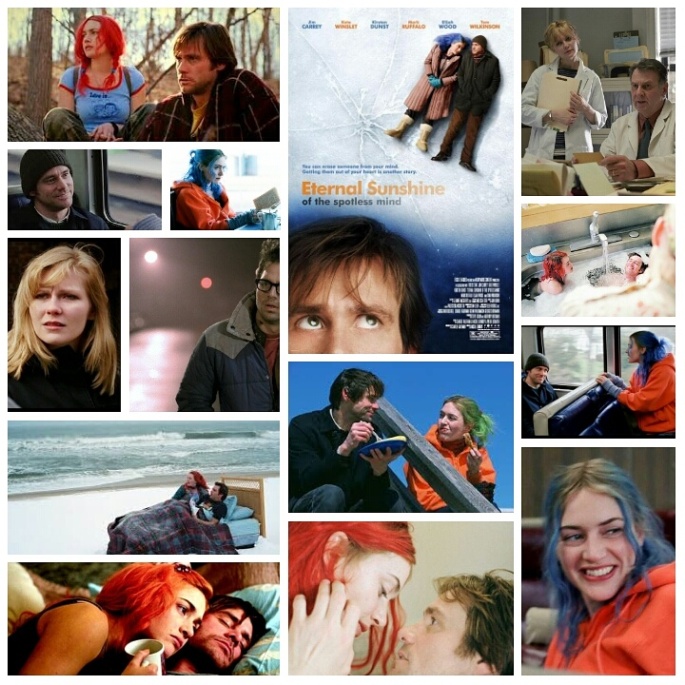
Films like Eternal Sunshine Of The Spotless Mind come around once in a lifetime, if we’re lucky. I watched it when I was too young to fully grasp much, and it flew over my head. In the last few years I had a revisit and was knocked flat. Few stories out there have the power to mine deep within the human psyche and search for the complexities, contradictions and puzzling flaws that lie in the beautiful disasters we call human beings. A contemplative yet fast paced meditation on relationships, love, heartbreak and reconciliation doesn’t even begin to paint a picture of what you’re in for with this uniquely told and one in a million film. Sagely ragamuffin Michel Gondry, not one for the easy way out, has truly outdone himself, as has screenwriter Charlie Kaufman, who is never short on wild ideas with emotional heft that sneaks up and blindsides you. Joel Barrish (Jim Carrey) ditches work on a whim one morning, and hops a train out to snowy Montauk. Through fate’s mysterious grasp, he meets free spirited Clementine (Kate Winslet), and the two hit it off immediately. He’s reserved, cautious and calculated, and she’s an impulsive wild card. They couldn’t be more different, but somehow they work. Until they don’t. Joel is devastated to learn one day of a radical brain alteration technique that effectively removes the memory of an ex from your mind, and Clementine has taken the plunge. Joel is confused and lost, and while the iron is still hot in his beating heart, he decides to undergo the procedure as well. Then the film really turns your world upside down. Whilst the staff of the Institute (Mark Ruffalo, Elijah Wood and Kirsten Dunst) go to work on his mind in his sleep, he has a change of heart. With the memories of Clementine radidly disintegrating, he races through the internal landscape of his mind in order to find and save her, hiding her in obscure corners of his data log where she won’t be found. It’s a genius way to tell the story, taking a delightful turn for the surreal as both of them find themselves catapulted headlong into various moments of his life. On the outside, a tragic subplot unfolds involving Dunst and the the head doctor at the program (Tom Wilkinson). Kirsten and Tom have never been better, treating an often used trope with dignity and gentleness. For all its tricks and psychological whathaveya, the film is first and foremost about love. It isn’t interested in showing us any generic or clichéd depiction of it either, like most of the pandering fluff that gets passed off as romance these days. It strives to show love in all its brutal and painful glory, the fights, the hurt, the time spent alone, the resentment and the willingness to batter your way through all that, against better judgment and logic, if it’s worth it. Is love a force of its own, a measurable influence that can transcend a procedure like that? Is it it’s own element, or simply always a part of us? Carrey and Winslet (and, to a lesser extent, Wilkinson and Dunst) tenderly search for the answers to these difficult questions in what are the roles of a lifetime for both. Carrey has never been so vulnerable, so open, and despite his brilliant comedic work elsewhere, his performance here is a direct window into the soul, and his best work to date. Although the film is quite labyrinthine and jumps around quite a lot, it never, ever jumps the track or misses a beat. It’s always concise, deliberate and crystal clear, if you have the patience and dedication to watch it a few times in order to let all the beautiful images, words and ideas sink in. Movies are first and foremost for entertainment. You give the man your nickel, he fires up the projector and you watch the lone ranger chase down down a speeding locomotive. Every once in a while you get one like this, one that challenges and inspires deep thought, intangible feelings and teaches you something, maybe even about yourself. Every once in a while, you get one that alters your life, and that is what is so important about that little spinning machine that opens up worlds upon a simple flat white canvas where before there was nothing. A masterpiece.