To boldly go where no man has gone before – A Star Trek Beyond review by Josh Hains

Always imitated but never duplicated, Star Trek has stood the test of time for 50 years, and has influenced not just the vast majority of science fiction generated in the decades after its fruition (film, television, comics, and books alike), but also pop culture itself. The fingerprints of Star Trek are everywhere, similar to Star Wars (original trilogy) for example, and it seems that hardly any sci-fi movies, specifically space operas like Guardians Of The Galaxy (drop the Marvel logo and the Thanos and Howard The Duck cameos and you have a pure space opera) go by without taking influence of some magnitude from these iconic franchises, whether purposefully in homage, or unintentionally. Because of the heavy influence of these two titanic properties (especially Star Trek), familiarity between properties has become an ever increasing issue in the science fiction community. What was groundbreaking then is cliche and familiar today, so Paramount Pictures has wisely chosen to embed fresh takes on old stories in their latest cinematic franchise rather than conjuring up completely new stories that might stray too far from source material for Trekkies. To the untrained eye of some of today’s more picky audiences, the familiarity of the stories is a let-down and hindrance to their movie going experiences, yet precisely what others want out of the ongoing series (a fourth installment is on the way).

Beyond opens with Captain Kirk via Captain’s log, explaining how the crew of the Enterprise has been handling the third year of their five year voyage mentioned in the last installment. Kirk, now a year older than his father George, was when he died heroically in the riveting opening sequence of Star Trek, is contemplating his position as Captain, and his place in an unlimited universe. Spock too, is grappling with his place in the universe after *possible spoiler alert* he learns that Spock Prime has passed away (a respectful way to tie up that recurring subplot). During the Enterprise crew’s all too brief shore leave at the Yorktown Starbase, they’re called into action to rescue a ship stranded on a planet in the nebula. The Enterprise comes under attack by the brutal Krall and his formidable army, leaving crew members scattered on the planet, with some taken captive by Krall. You can probably guess what happens next.

For some (and quite absurdly) the familiarity and predictability lodged within the plot of Star Trek Beyond, is a detriment to the movie. For this life long Trekkie (and Star Wars lover), to quote Bones McCoy in Beyond, “That’s just typical.” Familiarity isn’t a bad thing in the slightest in Beyond, because rather than feeling like a clone of something it’s striving to be (Into Darkness aiming for Wrath Of Khan status), Beyond feels more akin to the 2009 Star Trek reboot. Refreshing, ridiculously fun and enjoyable, yet touching and deeply heartfelt. It feels like a return to what made the original series great, performing a delicate balancing act between humour, drama, and spectacular action set pieces, none of which take a back seat in Beyond. The cerebral nature of the series, a thinking person’s movie or show with a finely tuned focus on dialogue and relationships rather than spectacle and action, has slightly diminished with the recent movie series in favour of lens flares and big explosive blockbuster action sequences, but still remains present and potent as ever. Take note of a scene late in the movie involving a picture. I won’t say anymore, you’ll know the scene when you see it, but it works because we too have been there, we can understand the emotions of the character, and our hearts bleed for them.

Star Trek has always worked best when the characters, the relationships between them, and the fun bantering, are at the forefront. They don’t talk too much in Beyond, I saw that complaint and it makes me laugh even as I type this. I’ve seen a Star Trek episodes with too much talking, and Beyond is far from those. A random and awkward complaint that the characters dictate their feelings to the audience, is just asinine by all accounts. Communication in Star Trek is key, and with a foundation built around dimensional characters, one comes to expect that they share their feelings, thoughts, and emotions between each other…out loud. Sharing in loss, expressing confusions, and bringing to light insecurities isn’t having the characters dictate their internal struggles to the audience, it’s a heartfelt way of building further connective tissue between full blooded characters, and making us care more deeply for them. That’s far from an issue in this movie. 

The action comes fast and furious (try not to groan at the pun), but is as delightful, inspired, and slick as ever, popping in the 3D screening I saw, wonderfully highlighting the eye popping visual effects director Justin Lin handles with energy and style to spare. Never for a second did the action lack spacial awareness or coherence, it’s rather easy to follow. The special effects, a fine blend of CGI and practical effects, are as convincing as anything in The Force Awakens, and the 3D adds an extra layer of excitement to it all, continually involving the audience in everything from the crashes and explosions to brawls and shootouts. It’s wickedly fun stuff!

The cast is once again in fine working order, feeling at home in their roles, comfortable compared to when the 2009 reboot was launched. Sofia Boutella as the skillful, and rather hilarious fighter Jayla, is a welcome addition to the cast and bounces off the other characters effortlessly. Idris Elba fearsome and ferocious as ever, is obviously fantastic as usual as Krall, though he’s vastly underused in Beyond. A good ten more minutes of Krall could have made him all the more intimidating, but as it sits he’s a fine villain along the lines of Nero from the 2009 reboot or the typical Marvel villain. Ronan The Accuser comes to mind. In his last major film role after his tragic passing a little over a month ago, Anton Yelchin is a delight as Pavel Chekov, and will be a sorely missed presence in future Star Trek movies. I always had fun with his quick one liners and innocent nature.

Does Star Trek Beyond boldly go where no man has gone before? Not really, it lacks the harsh darkness and risk taking of Into Darkness (thankfully), the storytelling never breaks new ground, but it’s not a bad thing because it doesn’t have to. It just has to be a traditional Star Trek movie, and it damn well is. Live long and prosper Star Trek!

TODD HAYNES’ SAFE — A REVIEW BY NICK CLEMENT

1

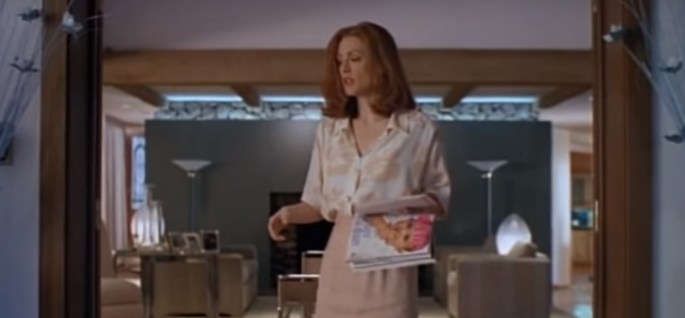
There aren’t many films like the extra creepy “environmental allergy” movie Safe from unpredictable and eclectic filmmaker Todd Haynes (I’m Not There, Far From Heaven, Carol). Released in 1995 and featuring a then rising star Julianne Moore in what amounts to a powerhouse performance of internal anguish, the film was unjustly overlooked by many in favor of splashier projects, but still cuts very, very deep and close to the bone. A psychological horror film of the first order, Moore plays a wealthy Los Angeles homemaker who develops multiple and unexplained allergies to everything around her – smells, sounds, sights, and the overall environment start to make her physically sick and mentally unstable. Apparently, it’s called Multiple Chemical Sensitivity, and her husband, played by an at first concerned and then by the end totally exasperated Xander Berkeley, is at a complete loss for words and understanding, her friends can’t comprehend any of it, and worst of all, she can’t figure any of it out for herself.

2Providing no easy answers for any of his characters (or the audience), Haynes and the adroit cinematographer Alex Nepomniaschy (Narc) used compositional space to suggest isolation and loneliness and mental despair, while the complicated sound mix, which utilized multiple layers of sound in order to distort and augment reality for Moore’s emotionally fragile character, never allowed the viewer to know anything more than any of the characters at any point in the narrative. Movies rarely get as underrated or as unsung as something like Safe; it’s a small film with big ideas and it’ll mess with your head long after the final shot fades to black. And as always, Moore was mesmerizing to watch, dropping a tour de force piece of acting that registers as one of her best and most unhinged portrayals of a damaged soul on screen. Available on Criterion Blu-Ray.

3

Riddick: A Review by Nate Hill 

Being a huge fan of the two previous Riddick films, I was overjoyed to hear that Vin Diesel would be raiding his own couch for change to save up in order to make this R rated follow up, still helmed by David Twohy. It’s reassuring that in a franchise with more than a few haters, Diesel has the passion and ambition for his character to go out of his way in bringing this to fans. Not to mention what a kick ass, gnarly little space yarn it turned out to be. Pitch Black was a claustrophobic horror fest set on a single harsh world, and The Chronicles Of Riddick opened up into a vast galactic space opera. This one reigns it in closer again (partly because of budget, I would imagine) and gets back to the roots established in Pitch Black. After defeating the Necromongers and becoming their King, Riddick is betrayed and sent into exile by the treacherous Lord Vaako (Karl Urban in a brief but memorable reprisal). Cast out into the stars with a ship running low on fuel, he finds himself marooned on a small, deadly planet that’s more challenging than any other he has found himself on (and if you remember, he has been to some hellish little nooks in the past). This world is a dry, acrid rock where every form of wildlife seems to be incredibly lethal, and out to get him. The first half of the film is pure genius, and consists of Riddick playing Survivorman with his environment, battling aliens and elements and befriending a small hell-pup type doggo that grows up into a teeth and claw ridden killing machine that is at one point referred to as a ‘dingo dango thing’. This is where it’s at for the film, and as soon as the more generic second half arrives, the air gets a bit stale, but it’s still heaps of fun. After mastering the terrain and ingeniously dispatching a snakelike alien that seems to have wandered right in from Wolfgang Petersen’s Enemy Mine (practical effects POWER), he encounters trouble of the human variety, in the form of bounty hunters. Two teams of outlaws have arrived to claim him: the stern Boss Johns (Matt Nable) who has an old bone to pick with Riddick, and the psychotic A-hole Santana (Jordi Molla, who I think of as the Latin Gary Oldman). They bicker a whole bunch on who gets the prize, unknowingly being infiltrated and messed up by the guy before they’ve barely landed. Katee Sackhoff is nutso awesome as Dahl, a lesbo tough chick who legit has the line “I don’t fuck guys, but occasionally I fuck them up.” Soon there’s more charming wildlife, this time in droves of shrieking reptilian predators who intend to see each of them, Riddick included, dead. This forces an amusingly unstable team-up from all forces to battle the uglies and escape this godforsaken place. It’s giddy sci-fi pulp good times, and benefits from its hard R rating, something which the other two films never had on their side. Diesel was born to play Riddick, the growling teddy bear, and I hope he gets to continue wearing the goggles for more of these movies, indefinitely if possible. A hell of a great time. 

PTS PRESENTS EDITOR’S SUITE with JIM HELTON

HELTON POWERCAST

HeltonPodcasting Them Softly is honored and extremely excited to present a discussion with feature film editor Jim Helton. Jim‘s big screen credits include Blue Valentine, The Place Beyond the Pines, and this September’s The Light Between Oceans — all of which were directed by Derek Cianfrance. It’s very clear that Jim has forged a unique and intense artistic relationship with Cianfrance, who ranks as one of our favorite filmmakers currently working, and throughout this extremely informative chat, we discuss how their unique partnership came to be born. Jim has also worked on a variety of short films and documentaries, and also edited the indie dramedy Lovely By Surprise and the street-racing action thriller Quattro Nozza. He also contributed to the dynamic soundtrack for The Place Beyond the Pines, as music is a big passion for him, which is something we also had a chance to discuss. He even crafted the extremely memorable title sequences for Blue Valentine. Jim‘s work is smart, stylish, and extremely disciplined and we’re thrilled to add him to our Editor’s Suite series. We hope you enjoy!

JOHN MCTIERNAN’S DIE HARD — AN EXPRESSION OF LOVE BY NICK CLEMENT

2

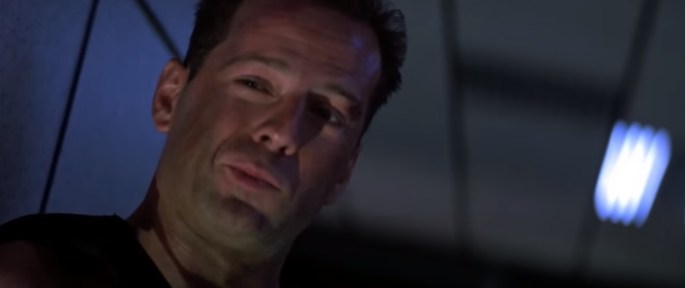
Remains a stone cold classic of American cinema. Masterpiece goes without saying. The very definition of timeless. I find so few flaws – if any – in John McTiernan’s Die Hard. Many, many imitators and copycats have tried to replicate the brilliance of this film and almost all have failed. From the air-tight plotting to the muscular direction this was an action movie that literally shattered the genre; Joel Silver would never be the same as a producer and it forever changed the landscape of the Hollywood action picture. Jan De Bont’s silky yet robust 2.35:1 cinematography stretched the frame to the max; his work as a cinematographer was always fantastic. Bruce Willis was both a credible “every-man” hero and the projection of something more – it’s an underrated performance that he nailed in every single respect. The historic screenplay by Jeb Stuart and Steven E. de Souza stressed narrative economy, logical plotting, and ironic humor that never, ever delivered its jokes with a tongue in cheek vibe. The first blast of bloody violence doesn’t happen for nearly 40 minutes, and it’s close to 20 minutes before the “plot” kicks in. Instead of immediately clobbering the audience over the head with a sensory blast, McTiernan, ever the craftsman, ummm, you know, told a story with actual characters and dialogue that was witty and smart and THEN he let the bullets fly and the explosions rip. He knew that none of the violent mayhem would matter if the audience didn’t care. Die Hard also marked the birth of Bruce Saving the Day in a stained undershirt POWER and Look at Bruce Make that Grimaced Face POWER and look at all of the sleazy Hart Bochner POWER. This is an unassailable tour de force of thrilling pop corn entertainment that never, ever gets old. It’s a firm example of what I call Grade A Entertainment.

8

Broken Lizard’s The Slammin Salmon: A Review by Nate Hill 

The hype surrounding comedy troupe Broken Lizard quieted down somewhat after the hullabaloo of both Super Troopers and Beerfest, but that didn’t mean they halted their output. In 2009 they released the insanely funny screwball romp The Slammin Salmon, which nobody seems to have seen and garnered nowhere near as much buzz as their previous films. It’s just as much of a riot, this time landing the gang into a Miami seafood restaurant, after their jaunts in rural law enforcement and extreme competitive alcohol consumption. The restaurant they all ‘work’ at is owned by a hulking bull in a china shop named Cleon ‘Slammin’ Salmon, a gigantic ex pro boxer played by the late great Michael Clarke Duncan in one of his last, and best, appearances. Cleon runs the restaurant with an obnoxious iron fist, a giant petulant brat with a penchant for beating up his staff and the social skills of a grizzly bear. On a busy night he announces to his staff that they must sell enough deceased marine life on plates to come up with a ten grand debt he owes to the Asian mob. This sets off a chain of reliably hilarious shenanigans involving the whole Broken Lizard crew, and a few cameos from salty hollywood veterans, a welcome trend that is commonplace among their films. The pushover manager Rich (Kevin Hefferman) attempts to keep the order. The lunatic head chef (Paul Soter) and his dimbulb busboy brother (also Soter) create trouble for everyone. Douchey waiter Guy (Eric Stolhanske) plays dirty to boost his sales. Ditzy server Mia (April Bowlby) dolls up her smile and smart one Tara (Cobie Smulders) plays it crafty to get ahead. Funniest by far is Jay Chandrasekhar as Nuts, a weirdo whose alter ego Zongo makes insane appearances whenever he forgets to take his meds. Clarke Duncan is the bellowing life of the party though, in an untethered romp through the comedic corn that clearly has been improvised a lot and shows the actor having some of the most fun I’ve ever seen onscreen. It’s a chaotic flick that captures the mania of restaurant life perfectly, with nods to everything from Monty Python to Blake Edward’s The Party, while still retaining a contemporary personality of it’s own. Broken Lizard has a knack for making every joke land in their films, and it’s laugh city all the way through this one. From engagement rings in fecal matter, third degree burns from scalding soup, endless situational fisacos and satirical characters, it’s just wild. Watch for Lance Henriksen, Carla Gallo, Olivia Munn, Jim Gaffigan, Sendhil Ramamurthy, Morgan Fairchild, Vivica A. Fox as a pop star named Nutella (lol) and a priceless Will Forte. On par with Troopers and Beerfest, funny in spades and so damn re-watchable. An essential for comedy fans. 

Dredd: A Review By Nate Hill


After the floundering absurdity that was 1995’s Judge Dredd left a nasty taste in the collective mouths of fans, all wen quiet on the cinematic front of Dredd for nearly two decades (I call it the Batman & Robin effect). The clouds parted though, and we finally got one streamlined masterpiece of a flick with 2013’s Dredd. Not only is it achingly faithful to the comics right down to Dredd never removing his helmet, but it stands as one of the ballsiest and well made action pictures in recent years. It’s never overstuffed or busy, takes the violence seriously, has genuine suspense, a bone deep and super tough performance from a grizzled Karl Urban, a sexy, no nonsense villain and the best original score of 2013 by a country mile. Not too mention it’s atmospherics, which are helped by said score of course, to create a sonic mood board of post apocalyptic ruin and urban rot. Dredd is part of an elite department called the Judges, who roam the smoky desolation of Mega City One and act as judge, jury and executioner wherever they see fit. Dredd is a trigger happy juggernaut with no use for scum or criminals and has not a qualm with taking them out like the trash they are, often in brutal, bloody and uncompromising ways. On day he’s partnered up with judge in training Cassandra (Olivia Thirlby, perfect), a rookie with blossoming telepathic abilities. A routine call leads them to a gargantuan Mega Block tower called Peach Trees, a sting irony once we see the rampant squalor inside. This tower happens to be controlled by the fiercest criminal overlord in town, Ma Ma, played by a purring, lethal and altogether terrifying Lena Headey. Her tactics go beyond barbaric and she’s sitting on the manufacturing of a drug called Slo Mo, which makes the users feel like time is passing at one percent it’s normal rate (a gold mine for setting up a scene visually). Ma Ma locks down the tower as the two judges arrive, and decrees that she wants them dead. Now it’s a visceral fight for survival against her armies of thugs and miscreants, and a slow ascent towards her penthouse lair, for Dredd to finish her off. The whole film takes place in Peach Trees, so it’s a self contained, one location affair, and a goddamn knockout of a movie. There are R rated films that dabble in violence a bit and barely earn their stripes, and then there are R rated films that leap at the chance to show people dying six ways to Sunday. Dredd absolutely decimates Ma Ma’s armies in high style and often in super slow motion as they face him while they’re high. The slo mo never feels tacky, but has a tactile richness and fluidity that makes the inflicted carnage so satisfying as it unfolds. The score by Paul Leonard Morgan is an uproarious rallying call that drives forward constantly, charging out of the gate in the opening minute as Dredd pursues a van down the highway on his thundering motorbike, and pummelling each scene with heart stopping force until it mellows out for an eerie passage called ‘Ma Ma’s Requiem’ which is my favourite piece in the film and can be listened to on repeat. Pure genius. Thirlby is the voice of reason and the eyes of the audience, experiencing for the first time how ugly this crime fighting business is, and holding her own wickedly. There’s a dark sense of danger to the whole thing, a frank and outright lawlessness to the villains, as it’s just another day on the job for them. No overacting, no histrionics. Just mellowed out murder and meanness all round. This is the Dredd film that we’ve been waiting for, and have long deserved after that other mess. Low box office returns means we may never see a sequel (wtf is wrong with people, like, who didn’t go see this??), but we’ll always have this little blitzkrieg of a flick to re watch time and again. I know I will.

THE COLOR OF MONEY – A REVIEW BY J.D. LAFRANCE

color-of-money

The 1970s saw the rise of the Movie Brats, a collection of filmmakers that had grown up watching and studying films. They made challenging films that reflected the times in which they were made and were revered by cineastes as much as some of the actors appearing in them. Directors like William Friedkin, Francis Ford Coppola, Hal Ashby and Martin Scorsese made intensely personal films that blended a European sensibility with American genre films. However, the one-two punch of Jaws (1975) and Star Wars (1977) and the failure of expensive passion projects like New York, New York (1977) and Heaven’s Gate (1980) ended these directors’ influence and saw the rise of producers like Joel Silver, Don Simpson and Jerry Bruckheimer, and movie star-driven blockbusters in the 1980s and beyond. It got harder and harder for the Movie Brats to get their personal projects made. Most of them went the independent route, making films for smaller companies like Orion and doing the occasional paycheck gig with a Hollywood studio.

For years, Scorsese had been trying to fund a personal project of his own – an adaptation of The Last Temptation of Christ. It was a tough sell and he ended up making After Hours (1985) and The Color of Money (1986) as a way of keeping busy while he tried to get Last Temptation made. At the time of The Color of Money much was made of it being Scorsese’s first movie star-driven film and some critics and fans of the director felt that he was selling out. It would not only be promoted as a film starring Paul Newman and Tom Cruise (and not as a Scorsese film), but was a sequel (something that the director was never fond of doing) of sorts. Newman had been interested in reprising his famous role of “Fast” Eddie Felson from The Hustler (1961) for some time but he had never met the right person for the job – that is, until he met Scorsese.

The Color of Money begins twenty-five years after the events depicted in The Hustler and we find that Eddie (Newman) is enjoying a comfortable existence as a savvy liquor salesman with his bar owner girlfriend Janelle (Helen Shaver) and occasionally fronting a pool hustler. His current investment, a cocaine addict named Julian (played with just the right amount of sleazy arrogance by John Turturro), is getting roundly beaten by a young turk named Vincent (Tom Cruise) who catches Eddie’s attention with his “sledgehammer break.” He becomes fascinated watching Vincent play and his cocky behavior between shots, like how he works the table. Eddie also watches the dynamic between Vincent and his girlfriend Carmen (Mary Elizabeth Mastrantonio). What really catches his attention is not just Vincent’s raw talent but also his passion for the game. He’s even willing to play Julian after he’s won all of the guy’s money because he just wants his “best game.”

There’s a nice bit where Eddie tests Carmen’s skill as Vincent’s manager, exposing her lack of experience and schooling her on the basics of pool hustling in a beautifully written monologue by Richard Price that Newman nails with the ease of a seasoned pro. We get another healthy dose of Price’s authentic streetwise dialogue in the next scene where Eddie takes Vincent and Carmen out for dinner and continues to school his potential protégés: “If you got an area of excellence, you’re good at something, you’re the best at something, anything, then rich can be arranged. I mean rich can come fairly easy.” The scene is also nicely acted as Tom Cruise plays the cocky upstart with just the right amount of arrogant naiveté without being a typical goofball. As Eddie puts it, “You are a natural character. You’re an incredible flake,” but tells him that he can use that to hustle other players. The ex-pool player lays it all out for the young man: “Pool excellence is not about excellent pool. It’s about becoming something … You gotta be a student of human moves.” And in a nice bit he proves it by making a bet with them that he’ll leave with a woman at the bar. Of course, he knows her but it certainly proves his point. This is a wonderful scene that begins to flesh out Vincent and establish how much he and Carmen have to learn and how much Eddie has since The Hustler.

The young man is a real piece of work – brash, directionless but with raw talent. It is clear that Eddie sees much of his younger self in Vincent and decides to take the young man under his wing and teach him “pool excellence” by taking him and Carmen on the road. It’s an opportunity to make some money while also getting back Eddie’s passion for playing pool. The Color of Money proceeds to show the three of them on the road for six weeks, getting ready for an upcoming nine-ball tournament in Atlantic City. Of course, there are the predictable bumps in the road as Vincent’s impulsive knack for showing off costs them money and Eddie feels like the young man’s not listening to him. It’s a formula we’ve seen used in countless films but Scorsese does everything he can visually to keep things interesting, especially in the dynamic way he depicts the numerous games of pool, the use of music (for example, one game is scored to “Werewolves of London” by Warren Zevon) and the actors that play some of the opponents along the way, like a young Forest Whitaker as a skilled player that manages to hustle and beat Eddie at pool.

However, it is the camerawork by veteran cinematographer Michael Ballhaus that impresses the most. He and Scorsese depict each game differently, employing a variety of techniques, like quick snap zooms in and out, and floating the camera gracefully over the pool table or gliding around it. He even has the camera right on the pool table following the balls around. The camera movement and editing rhythm of each game is dictated by the mood and intensity of each match, like the grandiose techniques employed when Vincent shows off during a game of pool. As he revels in his own showboating moves, the camera spins around him as if intoxicated by his bravado. However, much like the chaotic pool hall brawl in Mean Streets (1973), the camera movement goes nowhere symbolizing the futility of Vincent’s actions. Sure, he beat the top guy at that pool hall but in doing so scared off an older player that had much more money.

While The Color of Money was made fairly early on in Tom Cruise’s career, his relative inexperience actually suits his character. His youthful energy mirrors Vincent’s. It is his job to come across as an arrogant flake of a human being, which he does quite well (too well for some who were unimpressed with his performance). Cruise has always been an actor that performs better surrounded by more talented and experienced people and with the likes of Paul Newman acting opposite him and Scorsese directing, it forces the young actor to raise his game. One imagines he learned a lot on the job much like Vincent does in the film. Scorsese knew exactly what he was doing when he cast Cruise and got a solid performance out of him. In the late ‘80s, Mary Elizabeth Mastrantonio acted in a series of high profile roles like The Abyss (1989), The January Man (1989) and this film. She’s given the thankless job of the girlfriend role but manages to make the most of it. One gets the feeling that Carmen is a fast learner and smarter than Vincent. She is much like Eddie in understanding the business side of pool hustling.

Color-of-Money-Tom-Cruise

Naturally, Newman owns the film, slipping effortlessly back into Eddie’s skin after more than 20 years and it’s like he never left. The scenes between him and Cruise are excellent as the headstrong Vincent bounces off of the world-weary Eddie. Over the course of the film something happens to the elder pool player. As he tells Vincent at one point, “I’m hungry again and you bled that back into me.” We see that youthful spark fire up in Eddie again after so many years dormant and Newman does a fantastic job conveying that. While many felt that his Academy Award for the performance he gives in The Color of Money was really a consolation prize for a career of brilliant performances, this does a disservice to just how good he is in this film and how enjoyable it is to watch him get to work with someone like Cruise and Scorsese, watching how their contrasting philosophies towards acting and filmmaking co-exist in this film. There is an energy and vitality that Cruise brings and Newman feeds off of it and Scorsese captures it like lightning in a bottle.

When Paul Newman read Walter Tevis’ sequel to The Hustler it made him wonder what “Fast” Eddie Felson would be doing now and wanted to revisit the character. He had seen Raging Bull (1980) and was so impressed by it that he wrote a letter to Scorsese complimenting him on such a fine piece of work. The director was just coming off of After Hours and was attached to several projects, including Dick Tracy, with Warren Beatty, a fantasy film entitled Winter’s Tale, Gershwin, with a screenplay written by Paul Schrader, and Wise Guy, a book about the New York mafia written by Nicholas Pileggi. However, they all took a backseat when Newman invited him to direct a sequel to The Hustler. The actor had been working on it for a year with a writer. Scorsese was interested but didn’t like the script Newman showed him because it was “a literal sequel. It was based on at least some familiarity with the original.” Scorsese felt like he couldn’t be involved with the project if he didn’t have some input on the original idea of the script.

Scorsese wanted to go in a different direction and brought in a new screenwriter, novelist Richard Price who had written The Wanderers and also a script for the director based on the film Night and the City (1950). Scorsese liked the script because it had “very good street sense and wonderful dialogue.” For The Color of Money, Price and Scorsese’s concept was basically what became the film, exploring the director’s preoccupation with redemption but with what Newman saw as “recapturing excellence, having been absent from it, and then witnessing it in somebody else.” Newman liked it and Price and Scorsese came up with an outline and began rewriting the script. Price studied pool players and wrote 80 pages of a script. They took it to Newman and got his input. By the end of nine months, Price and Scorsese decided to make the film with Newman.

For Scorsese this was the first time he had ever worked with a star of Newman’s magnitude. “I would go in and I’d see a thousand different movies in his face, images I had seen on that big screen when I was twelve years old. It makes an impression.” As a result, Scorsese and Price made the mistake of writing for themselves when they should have tailored the script to suit Newman and his image, or as Scorsese later said, “we were making a star vehicle movie.” The actor wanted to explore aging and the fear of losing his “pool excellence.” He also wanted the character of Minnesota Fats, played so memorably by Jackie Gleason in The Hustler, to return but Price couldn’t get the character to fit into the script. He and Scorsese even presented a version of the script with Fats in it to Gleason but he “felt it was an afterthought,” said Scorsese.

It was Newman that suggested Cruise for the role of Vincent to Scorsese. The young actor had met Newman before when auditioning to play his son in Harry & Son (1984). Scorsese cast Cruise before Top Gun (1986) had come out but he was a rising movie star thanks to Risky Business (1983). He had seen the young actor in All the Right Moves (1983) and liked him. The project was initially at 20th Century Fox but they didn’t like Price’s script and didn’t want to make it even with Cruise and Newman attached. Eventually, it went to Touchstone Pictures.

Newman was not fond of improvising on the set and suggested two weeks of rehearsals before filming. Scorsese wasn’t crazy about this and found them “aggravating. You are afraid that you are going to say ridiculous things, and the actors feel that way too.” However, he agreed to it and brought in Price so that he could make changes to the script. Fortunately, everyone felt secure in character and with each other. Price and Scorsese didn’t have the film’s ending resolved and felt that they had written themselves into a corner. The studio wanted them to shoot the film in Toronto but Scorsese felt that it was too clean and chose Chicago instead. Both Cruise and Newman did all their own pool playing with the former being taught how to do specific shots that he played in the film with the exception of one, which would have taken two additional days to learn and Scorsese didn’t want to spend the time. Cruise had dedicated himself to learning how to play pool: “All I had in my apartment was a bed and a pool table.” He worked with his trainer and the film’s pool consultant Mike Sigel for months before shooting started.

Some Scorsese fans marginalize The Color of Money as one of his paycheck films – the first he did for the money – and while it may not have the personal feel of a film like Taxi Driver (1976), it still has its merits, a strong picture that fits well into the man’s body of work. I would argue that it is one of his strongest films stylistically with some truly beautiful, often breathtaking camerawork capturing all the nuances of playing pool: the energy and vitality of the game is there without sacrificing any of the story or the characters. This film also shows how a director like Scorsese can take a hired gun project and make it his own. It looks, sounds and, most importantly, feels like one of his films and not a commercial studio picture. Others must have agreed as the film not only became Scorsese’s most financially successful film at the time but a critical hit as well.

ColorOfMoney_Rolex2

The director proved to the studios that he could deliver the goods at the box office while to himself he was still able to invest the film with some of his own personal touches. Ultimately, The Color of Money is about Eddie’s redemption and rekindling the spark he had in The Hustler before the screws were put to him. As with many sports movies, the story builds towards the climactic big game or, in the case of this film, the big tournament but Price’s script offers a slight twist in that Eddie’s victory is a hollow one and the real one is at the very end when his love for playing pool has finally come back completely. He is reinvigorated and excited about where his life and game will go from here and this is summed up beautiful in the film’s last line – “I’m back.”

ROBERT ALTMAN’S THE LONG GOODBYE — A REVIEW BY NICK CLEMENT

1

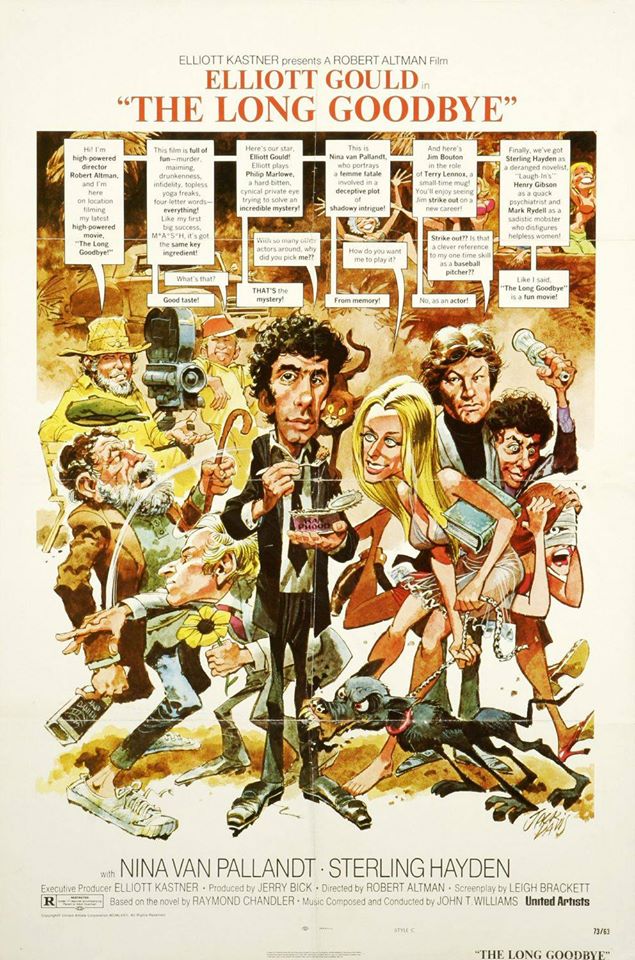
There are very few Robert Altman movies that I’ve seen and not enjoyed. The man was beyond prolific, and I’m still not 100% caught up with his genre-hopping filmography, but he made so many great, unique, and all-together interesting motion pictures that it’s no wonder he’s been the inspiration for so many of our best current filmmakers. The Long Goodbye is one of my absolute favorites from Altman, an overstuffed shaggy-dog detective story that is more interested in people and their eccentricities rather than concrete plot points. Written by legendary screenwriter Leigh Brackett, this film served as an updated companion piece to Brackett’s decades earlier The Big Sleep, with both taking life as original novels by Raymond Chandler; talk about loving the art of being convoluted! The tone that Altman achieved in The Long Goodbye is exactly why I respond so favorably to its many distinct charms; the film is a cool customer, and feels like it could only have come from that glorious decade of 70’s cinema.

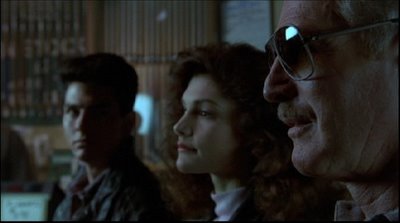
Elliot Gould did some of his best and funniest work as laconic detective Philip Marlowe, with the entire supporting cast delivering very tasty and memorable performances; Nina van Pallandt, Sterling Hayden, ex-MLB pitcher Jim Bouton, Henry Gibson, David Arkin, and filmmaker Mark Rydell were all fantastic. Altman’s trademark use of overlapping dialogue was in full swing in The Long Goodbye, and in tandem with the super-wide 2.35:1 cinematography by the legendary cameraman Vilmos Zsigmond, the film has an effortlessly cool, hazy-stoned, and oh-so-raggedly-beautiful aesthetic which is very well complimented by the Kino Blu-ray release. The final scene is all sorts of amazing, wrapping everything up but still retaining that loosey-goosey vibe, while the film sports a jazzy John Williams musical score. Apparently, Brian G. Hutton, Howard Hawks and Peter Bogdanovich were potential directors before Bogdanovich passed on the project, and recommended Altman. “I even lost my cat” POWER.

CRAIG JOHNSON’S THE SKELETON TWINS — A REVIEW BY NICK CLEMENT

1

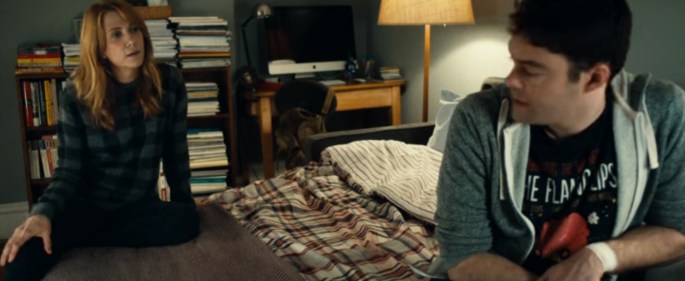
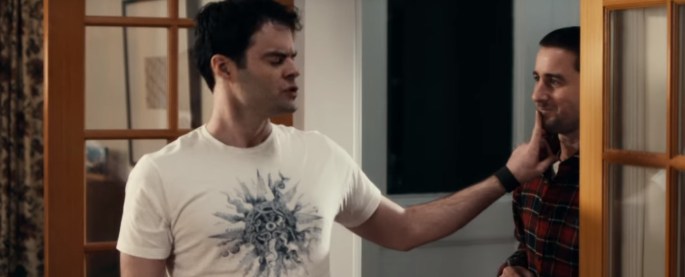
Bill Hader and Kristen Wiig are both absolutely fantastic in the poignant and hilarious black comedy The Skeleton Twins. Any movie that’s able to wring laughs out of the topic of suicide knows a thing or two about sly, subtle, dangerous humor; this is a film that goes to some tough places and asks for serious commitments from its two leads, who are more than up to the dramatic challenge. This is a wonderful brother-sister movie, filled with terrific scene after terrific scene, and even if there’s one narrative misstep that keeps it from being extra-tidy, there’s so much to enjoy and recommend about the storytelling. Hader and Wiig are estranged siblings, who crash back into each other’s orbits after both experience some scary life lessons. They are both broken souls, drifting through their respective problems, and the hope is that they might be able to bond once more in effort for some type of healing. Craig Johnson’s tonally perfect direction and character focused script (co-written with Mark Heyman) nails the sadness and the humor that’s necessary for a story like this.

2

Luke Wilson is a supporting actor MVP, stealing every single scene he appears in. But the movie belongs to Hader and Wiig, who both hit new heights as performers, with Hader in particular surprising in a big way. Never going over the top yet always bristling with emotion and outward feeling, his performance is perfectly in tune with the exceptionally dead-pan comedy style that Wiig excels at. Everyone knows that Hader can be a clown; here he’s able to get serious at a moment’s notice and I loved everything about him in this movie. Wiig continues her stellar big-screen run and adds another comical sad-sack to her repertoire, but this time, mixed in some serious grace notes as a dramatic actress. And in their numerous scenes together, Hader and Wiig radiate true sibling chemistry that’s a joy to watch. Painful one moment and then laugh out loud funny the next, The Skeleton Twins is one of those great little films that will surprise anyone who gives it a chance.

3