JOHN IRVIN’S CITY OF INDUSTRY — A REVIEW BY NICK CLEMENT

city_of_industry

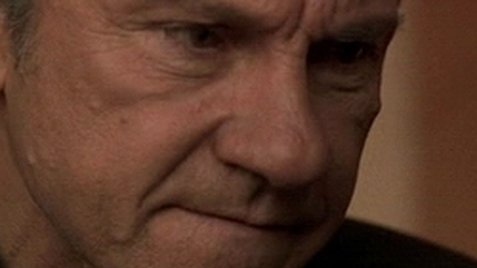
The crime genre is one of the most studied milieus in all of cinema, and in our rapidly changing Hollywood landscape, genuine genre fire-crackers like City of Industry are increasingly harder to find. Receiving an extremely small theatrical release before making its way to DVD and cable in 1997, John Irvin’s gritty, finely textured, and extremely seedy motion picture contains an oversized lead performance from Harvey Keitel as a career criminal who refuses to be taken advantage of by one his young underlings. After a viciously staged heist sequence where things actually go according to plan for Keitel and his crew (a nice spin on the classic idea of the robbery gone awry premise), the film switches gears into revenge territory, with Keitel looking to take down the menacing Stephen Dorff, a dangerous hot-head who tries to double cross Keitel and make off with the score for himself.

city-of-industry-movie-poster-1997-1010542729

Written by Michael Mann protégé Ken Solarz, the film does feel very much inspired by some of the plotting from Mann’s 1995 masterpiece Heat, taking the shape of a stylized, contemporary western where everyone is a shade of grey rather than simple black or white. A whiff of Reservoir Dogs can also be felt, but this distinctive film is definitely its own beast overall, and it serves as a reminder of how few down and dirty crime movies like these actually get made in today’s Hollywood landscape. Irvin, whose credits include The Dogs of War and Hamburger Hill, directed with an iron fist, but in the best sense of the phrase; there’s a no-nonsense quality to City of Industry that allows the bristling narrative to move with driving forward momentum, never pausing for extraneous or unnecessary beats. The rough and tumble outskirts of Los Angeles feel ominous and scary in this film, with Irvin and his astute cinematographer Thomas Burstyn never making any one image too pretty or overly manufactured, instead opting for a dank and murky vibe with flashes of red and blue.
1

City of Industry feels like a left over from the 1970’s, a crime film interested in character motivation as much as it is in showing off bloody shoot-outs or the expected explosive violence from a tale such as this. In fact, one of the best aspects to the film is how the script does a few things out of the norm, and it can’t be understated just how magnetic and powerful Keitel was in this role, which seemed tailor made to his sensibilities as an actor. The deteriorating industrial side of Los Angeles is also a major character in the film, with an atmosphere that suggests crumbling infrastructure and shady morals, which feels perfectly in tandem with the duplicitous characters. And because everything here was played straight and without a wink of self-conscious posturing or riffing, all of the developments in the story feel all the more tough and earned. Timothy Hutton was shrewdly cast against type, while Famke Janssen and Lucy Liu got some solid scenes as well. Elliot Gould made a colorful cameo appearance. An Orion Pictures release.

city_of_industry_ver2

TROPIC THUNDER – A REVIEW BY J.D. LAFRANCE

large20tropic20thunder20blu-ray6

For the years leading up to Tropic Thunder (2008), Ben Stiller had been coasting on his patented, one-note neurotic doormat shtick in films like Night at the Museum (2006), The Heartbreak Kid (2007), and others. What happened to the guy who could play a self-destructive junkie screenwriter in Permanent Midnight (1998) and a dorky romantic in There’s Something About Mary (1998)? Stiller, at times, is more interesting behind the camera as director of the Generation X comedy Reality Bites (1994), the black comedy about stalking and television, The Cable Guy (1996), and the hilarious fashion world satire Zoolander (2001).

With Tropic Thunder, Stiller returned to being behind the camera (and also in front of it) and decided to take on the Vietnam War sub-genre. In an odd way, we have Oliver Stone to thank for this film. Not just because he made Platoon (1986), which really popularized the sub-genre, but he also rejected Stiller when he auditioned for a role in the film. Stiller never forgot it and now he’s parlayed those feelings of rejection into a film that not only lampoons war films but Hollywood in general.

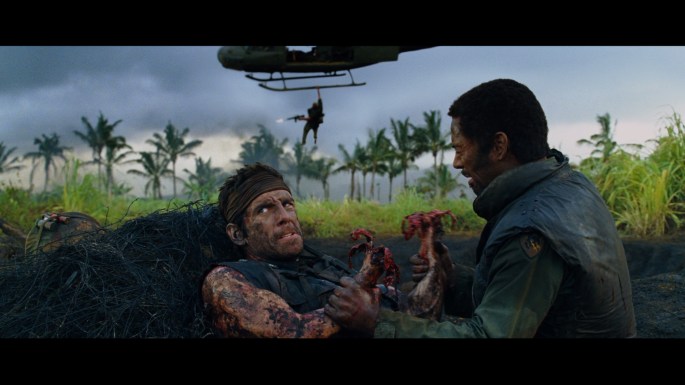
Tugg Speedman (Stiller) is an action film star on the decline, still flogging his Scorcher franchise – films that resemble a cross between something Tom Cruise might do and Roland Emmerich’s brain-dead special effects epics. Jeff Portnoy (Jack Black) stars in low-brow comedies filled with fart jokes that allow him to play multiple characters a la Eddie Murphy (Norbit, anyone?). Australian actor Kirk Lazarus (Robert Downey Jr.) is a five-time Academy Award winner who appears in “serious” films that win all of the important awards just like Russell Crowe.

They are all starring in a Vietnam War movie called Tropic Thunder that is currently being made on location in South Vietnam. The production is on the verge of being in the kind of trouble that almost consumed Apocalypse Now (1979) as Lazarus is upstaging Speedman. First-time director Damien Cockburn (Steve Coogan) can’t control his actors, which is causing the movie to go behind schedule, much to the chagrin of Les Grossman (Tom Cruise), the blustery, Harvey Weinstein-esque head of the studio.

In an effort to save the movie, Cockburn takes the five main actors to a remote jungle area to shoot a bunch of scenes guerrilla-style only to stumble across a rag-tag group of Vietnamese drug runners who assume that the clueless movie stars are actually DEA agents. At first, Speedman and his co-stars think that this is all part of the production but they (except for Speedman) quickly realize that this is for real.

Robert Downey Jr. was rightly praised for his hilarious performance as an actor who goes so deep into character that he undergoes “pigmentation alteration” surgery to darken his skin in order play an African American soldier. Downey’s commitment to the role is almost as dedicated as Lazarus’ and he gets some of the film’s best lines, including such gems as “Man, I don’t drop character ’till I done the DVD commentary,” and “I know who I am. I’m the dude playin’ the dude, disguised as another dude!”

It’s not too hard to figure out the real-life Hollywood power players that Stiller’s film satirizes with Cruise’s Grossman channeling the abusive reputation of the aforementioned Weinstein and Downey poking fun at the way-too serious on-and-off-screen antics of Crowe. Unlike all of those Scary Movie spoofs, Stiller understands that a good satire plays it straight on the surface. Admittedly, he’s got a much bigger budget to play with ($100 million+) than any two of those dime-a-dozen spoof movies so he’s able to hire the likes of A-list cinematographer John (The Thin Red Line) Toll and cast marquee name actors like Robert Downey Jr. and Jack Black instead of C-listers like Carmen Electra to make Tropic Thunder look like the slick war films he is sending up. Of course, the danger in doing this is to become the very thing you’re trying to parody, but fortunately Stiller doesn’t fall into this trap.

Every generation needs a Mel Brooks and Stiller takes up where the legendary comedian left off – before he became irrelevant and painfully unfunny. Stiller goes after the usual suspects of the genre: Platoon, Apocalypse Now, The Deer Hunter (1978), and even a sly reference to a scene from Predator (1987), but Tropic Thunder is more than a game of spot-the-reference that spoof movies tend to devolve into. It actually has something to say other than Hollywood is excessive. This is one of Stiller’s most ambitious film to date and demonstrated that he can play in the same big leagues that fellow comedian-turned-filmmaker Jon Favreau has also graduated to with Iron Man (2008). They both started off with very modest films and have shown a very definite learning curve with each subsequent film they’ve helmed. Tropic Thunder has everything you’d want from a big budget, R-rated comedy.

FRANCIS FORD COPPOLA’S THE COTTON CLUB — A REVIEW BY NICK CLEMENT

1

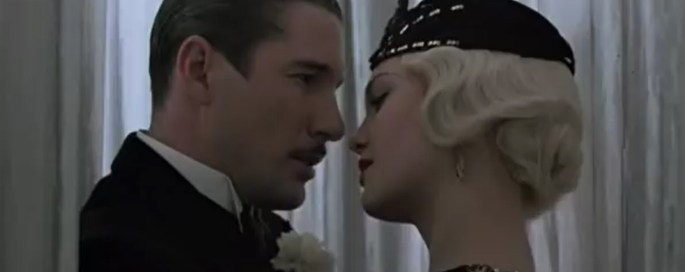
Despite being met with mixed critical response upon initial release and becoming a major financial wipeout, The Cotton Club is a massively ambitious epic, sprawling in its scope, and hugely entertaining, fusing the period gangster film with the movie musical in very unique ways. An absurdly plagued production on any number of levels (just head on over to Wikipedia…), this Francis Ford Coppola directed film has some of the greatest production design I’ve ever seen (courtesy of the legendary Richard Sylbert), and ludicrously photogenic cinematography from Stephen Goldblatt. Featuring an utterly insane cast including super suave Richard Gere, extra hot Diane Lane, Bob Hoskins, Laurence Fishburne, Lonette McKee, Nicolas Cage, Jennifer Grey, Gregory Hines, James Remar, Tom Waits, Diane Venora, James Russo, and tons of character actors from that era, The Cotton Club centers around Dixie Dwyer (Gere), a young musician who uses mob influence to advance his show-biz career, but ends up in a dicey situation when he falls in love with the sultry girlfriend of mob boss Dutch Schultz (Remar). Lane is the sexy object of desire, and she and Gere were both terrific. In fact, everyone gets a chance to shine in this expansive tale of friendship, love, rivalry, jealousy, murder, and betrayal.

2

The plot thickens when Dixie’s brother Vincent (Cage) decides to join in on the criminal antics, while various real life gangsters are intermingled into the busy plot which ratchets up the spectacle and suspense. The musical set-pieces are spirited and terrifically choreographed, with the smashingly authentic costumes by Milena Canonero lending the entire production a sense of gaudy splendor. And it goes without saying that the vibrant and jazzy musical score from John Barry is absolutely sensational, mixing show tunes and peppy musical numbers with somber melodies from the traditional score. When a film goes through as many difficulties as The Cotton Club did, by the time it’s ready for release, critics have already sharpened their knives, which is of course wildly unfair but pretty much standard operating procedure for those writing about film. Every movie is a struggle to get made, some more than others, so it always seems wrongheaded to bring any upfront negativity into a viewing when you’ve heard that things haven’t gone smooth on set. Judge the final product, not the process of getting the film made. Siskel and Ebert most notably included the film on their top 10 lists in 1984 and for good reason, as The Cotton Club is a celebration of all things cinematic, both large and small, and as always, the level of detail and craftsmanship that Coppola brought to the table was eye-opening to behold.

3


In Bruges: A Review By Nate Hill

  
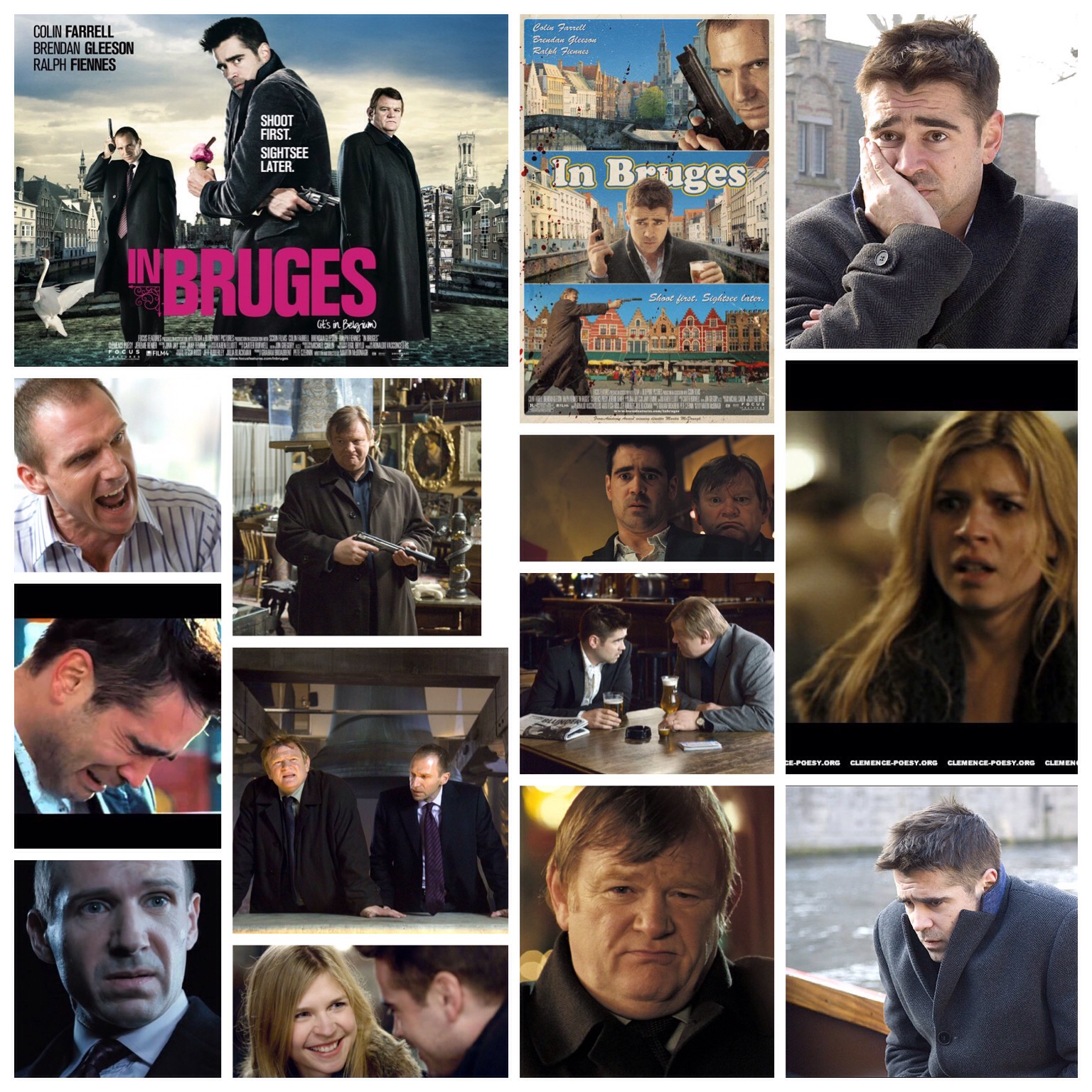
I can’t really say in enough words how much I love In Bruges. In fact there aren’t words in my language which can express how deeply in tune to it I feel every time I put the DVD in for a watch, which is at least every four months or so. The dual forces of comedy and tragedy have combined here using Martin McDonough’s genius scriptwriting as an avatar to create something raucously funny and profoundly moving. The comedy is of the spiciest and very darkest nature (my favourite), and the tragedy tugs at both the heart strings and the tear ducts, scarecly giving you time to wipe away the tears of laughter from the scene that came before. The best in UK crime fare, some of the most balanced, peculiar writing and fully rounded characters who are as flawed as human beings get. Colin Farrell delves deep and gives the performance of his career as Ray, a would be hitman who has fucked up bad, and now heads for Bruges (it’s in Belgium) with his mentor Ken (Brendan Gleeson, pure brilliance and humble class). Ken loves eccentric little Bruges, with its historical architecture and quaint townsfolk. Ray is bored to tears and pouts like a toddler. They meander around the town getting into all sorts of mischief including a dwarf (who has fascinating ideas about the ultimate race war), museums, cocaine, the Belgium film industry and more. Ray sets his sights on the gorgeous Chloe (), and Ken does his paternal best to keep him out of trouble while wrestling with his own gnawing guilt. The film gets a shot of pissy adrenaline when their boss Harry comes looking for them, in the form of a knock it out of the park funny Ralph Fiennes. Fiennes rarely cuts loose and bounces off the walls like he does here, and his Harry is a delightful creature to watch in action. Angry, petty, volatile, clever and out for blood, just a joy to behold. As playful as the script is, there’s a purgatorial sadness to Ray’s situation, a fateful sense that he’s been dumped in Bruges not just to fool around, get drunk and utter witty barbs in that brogue (which he does do a lot) but to deeply ruminate on his choices and ponder where his actions will lead him moving forward from his terrible deed. Maturity permeates each exchange between him and Ken, a fledgling and an old timer shooting the breeze about heavy topics which neither of them pretend to understand, but both are neck deep in. I always cry at certain scenes, always laugh my ass off at others, and never cease to be affected right to my emotional center and the marrow of my funny bone each time I watch this. Look for a brief cameo from Ciaran Hinds in the opening few minutes. Every second of this piece is filled with lush, thought provoking dialogue, awesomely un-politically correct dialogue that doesn’t censor a single impulse from its characters, and a yearning to explore the decisions which cause people to be labeled ‘good’ or ‘bad’, something that’s inherently complex yet feels lightly treaded on here. Masterpiece. 

Indie Gems with Nate: Dreamland


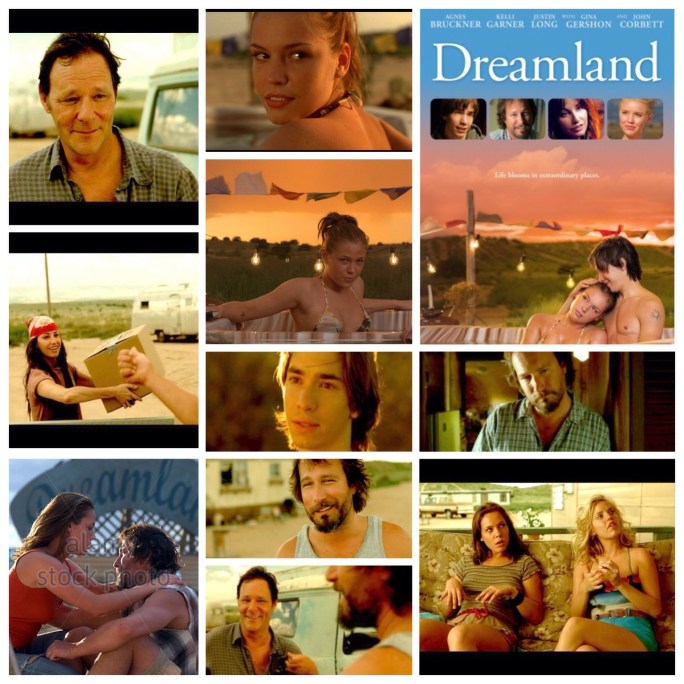
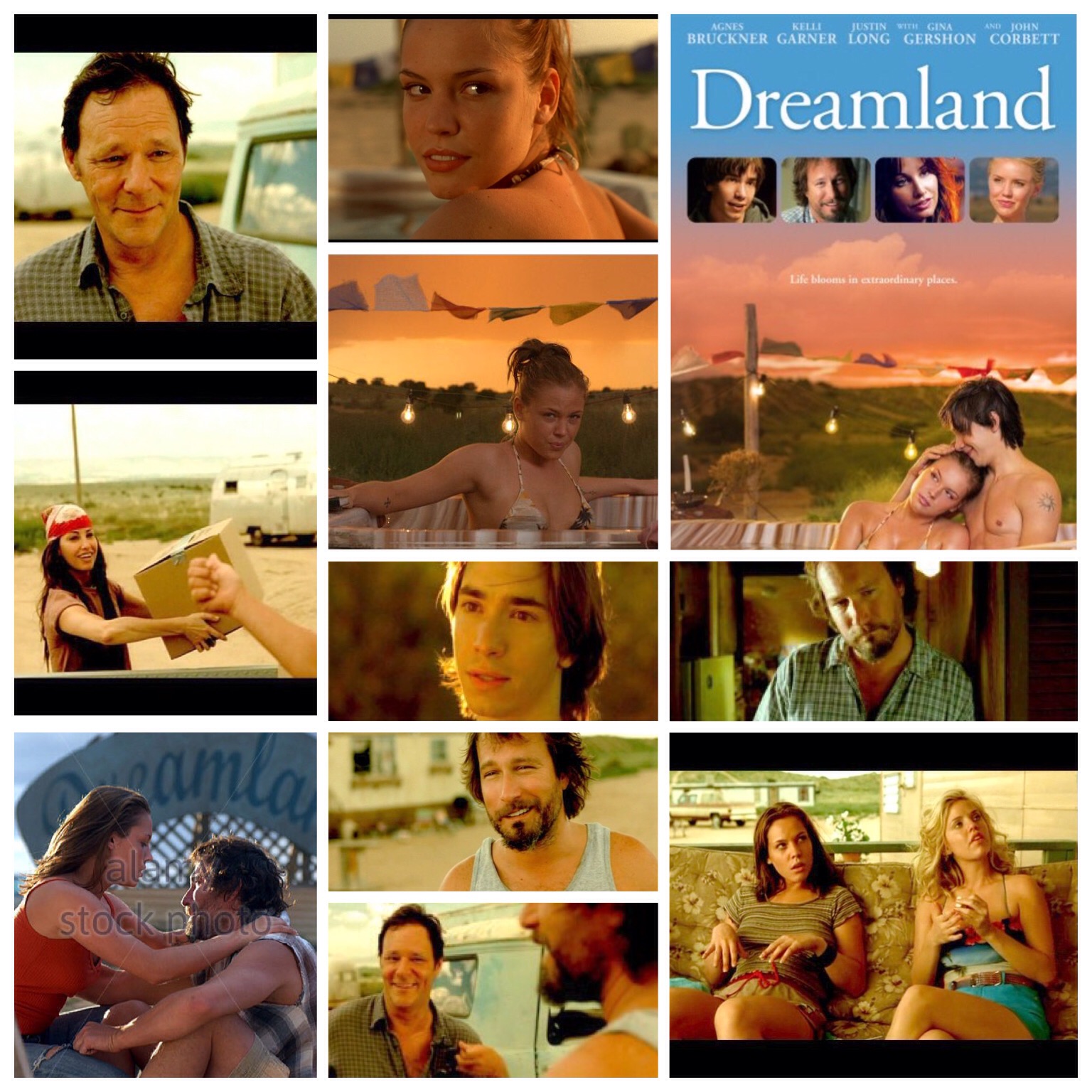
Dreamland is an introspective little indie drama concerning the life of Audrey (Agnes Brucker). She lives in a sleepy trailer park way out in the desert somewhere, far and away from anyone else. She longs for a life somewhere else, but is torn between that and caring for her agoraphobic father (John Corbett), who is severely broken following the death of his wife and her mother. Fresh life is breathed into their environment with the arrival of kindly Herb (Chris Mulkey), and his musician wife Mary (Gina Gershon). Along with them is Herb’s son Mookie (Justin Long is a tad miscast), who immediately has eyes for Audrey. The two strike up an easygoing romance that is tested by her rebellious nature, and the commitment she feels for her ailing father. Corbett is sensational, giving the best performance of the film as a damaged soul that needs caring for, and to find the strength to move on. Mulkey and Gershon are real life guitars strummers, giving their characters an authentic, earthy feel. The title matches the tone nicely; everything is non rushed, relaxed, laid back and dreamy, as one would imagine life out there might be. I was lulled into the hazy routines and moving relationships that bloom for these individuals out on the far side of nowhere. Great stuff. 

VOLKER SCHLONDORFF’S PALMETTO — A REVIEW BY NICK CLEMENT

1

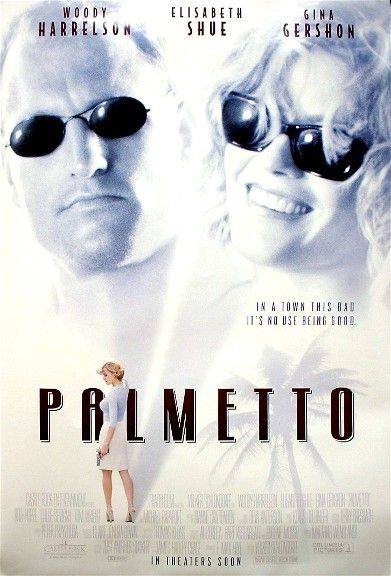
Palmetto is a twisty, lethal little neo-noir from 1998 that took familiar ingredients and threw them into a blender of Florida sunshine and juicy star-turns from a game cast who clearly had fun with the hot-blooded, morally treacherous material. Directed by the great filmmaker Volker Schlöndorff (The Tin Drum), the film failed to ignite a fire at the box office and received mixed to negative reviews, while serving as the director’s last American feature film. And while it’s hardly a brilliant film ,there’s so much fun stuff on display to remind you that Hollywood rarely makes them like this anymore. Taking a page from genre staples like The Big Sleep and Key Largo, the screenplay concocted by E. Max Frye, which was based on the novel by James Hadley Chase, concerns a falsely imprisoned journalist named Harry Barber (Woody Harrelson in one of his most atypical performances) who, upon release from the joint, crosses paths with the sexy but probably dangerous Rhea Malroux (the absolutely fantastic Elisabeth Shue in drop-dead sexy mode), a classic femme fatale who you just know is going to take poor Harry for a ride he’ll never forget. Rhea convinces Harry to help her in an extortion plot against her rich husband, but nothing goes according to plan, with multiple plot strands converging and everyone double and triple crossing each other without a moment’s notice. I still haven’t looked at a 55 gallon drum the same way since this film. Cinematographer Thomas Kloss took advantage of his lush surroundings, bathing the film in warm colors and sun-dappled imagery so that the audience felt the sticky humidity all throughout the constantly shifting narrative. A game supporting cast including sultry Gina Gershon, Michael Rapaport, Chloe Sevigny, Rolf Hoppe, Tom Wright, and the always awesome Marc Macaulay all contributed to the sweaty thrills. This overlooked item would make a nice double feature with the underrated Bob Rafelson crime-noir Blood & Wine with Jack Nicholson.

COWBOYS AND ALIENS – A REVIEW BY J.D. LAFRANCE

Cowboys and Aliens-15

Jon Favreau has certainly come a long way since his independent film roots with Swingers (1996), the film he wrote and starred in. Over the years, he’s increasing spent more time behind the camera than in front, directing Made in 2001. The modest success of that film saw him transition to studio films with larger budgets like Elf (2003) and Zathura (2005). Then came Iron Man (2008), his most ambitious effort up to that point, and he rolled the dice with the casting of Robert Downey Jr. as his leading man. The gamble paid off and the film was a massive success, paving the way for the inevitable sequel. Rushed into production, the end result was a commercial triumph but a critical failure, which upped the stakes for his next film, Cowboys & Aliens (2011), an adaptation of the graphic novel of the same name by Scott Mitchell Rosenberg.

The premise is an intriguing hybrid of the science fiction and western genres with an alien invasion set in 1873 New Mexico. To hedge his bets, Favreau corralled Daniel Craig and Harrison Ford to headline his film, which caused epic seismic ripples through the fanboy community at the prospects of seeing the actors who played James Bond and Indiana Jones in the same film together. As a result, expectations were understandably high. Could Favreau and company deliver the goods or would this be another Wild Wild West (1999)?

A man wakes up in the middle of nowhere wounded and with a strange, futuristic device strapped to his wrist. He has no idea who he is or how he got there. Three men on horseback show up assuming he’s an escape convict and try to take him in. He quickly and brutally dispatches them, taking their gear and heading towards the nearest town – the former mining colony of Absolution. He eventually learns that his name is Jake Lonergan (Craig), a notorious outlaw wanted by the law for a variety of offences. One of which was robbing local cattle baron Colonel Woodrow Dolarhyde (Ford) of his gold. When he learns that Lonergan is in Absolution, Dolarhyde and him men intend to lynch the outlaw in retribution.

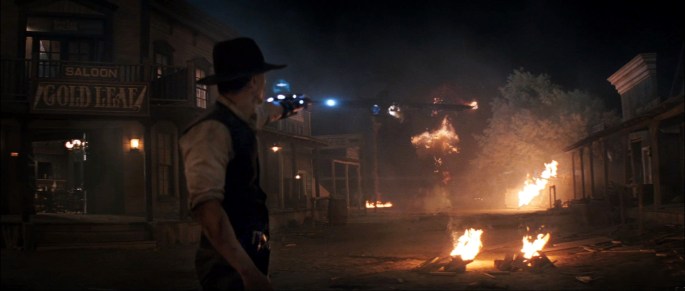
However, a strange light appears in the sky just as Dolarhyde arrives into town. The device on Lonergan’s wrist activates and the light turns out to be several alien spacecraft that proceed to blast the town to smithereens and kidnap several of its townsfolk. Lonergan discovers that his wrist device is a weapon, which he uses to take down one of the alien craft. The film sets up Dolarhyde as a mean son of a bitch while Lonergan is a no-nonsense criminal. They represent two unstoppable forces of nature and one of the pleasures of this film is when they have to put aside their differences, repel the alien invaders and rescue the kidnapped townsfolk.

For years, Harrison Ford has made bad choices in the films he’s decided to be in and phoned in one-note performances, playing the same gruff character, but with Cowboys & Aliens acting against someone like Daniel Craig has inspired him to bring his A-game this time around. Ford actually looks interested and engaged in the material and the role. It’s great to see him go up against Craig and their scenes together crackle with intensity and tension. Best of all, Ford has two scenes that expose his character’s gruff exterior and reveal a more vulnerable side. They are poignant and heartfelt because we’ve become invested in these characters by this point. This is the best Ford has been in years and reminds one of when he used to play characters we cared about.

Craig adds another man of action to his roster. He excels at playing edgy tough guys and is well cast as the enigmatic outlaw. The only drawback is that Lonergan is underwritten and there isn’t much for Craig to work with except for some standard motivation for his character revenging a lost one. As a result, the character comes across as a one-note Man with No Name, at times.

Favreau does a good job of surrounding Craig and Ford with a solid ensemble cast of character actors. You’ve got Clancy Brown as the upstanding town preacher Meachum, Sam Rockwell as Doc, the mild-mannered saloon owner, Keith Carradine as Sheriff John Taggart, the always watchable Adam Beach as Nat Colorado, Dolarhyde’s right-hand man, and Olivia Wilde as a mysterious woman named Ella whose exotic beauty gives her an almost otherworldly aura. Hell, Favreau even throws Walt Goggins in for good measure as a member of Lonergan’s gang.

Favreau has all the traditional western iconography down cold and the fun of Cowboys & Aliens is seeing these motifs clash with the science fiction elements. So, we see cowboys on horseback being chased by fast-moving alien spacecraft. This film doesn’t stray from the conventions of either genre or try to reinvent them but instead merges and fulfills them in a crowd-pleasing way. Cowboys & Aliens has impressive special effects, nasty-looking aliens, several exciting action sequences, and two cool heroes to root for. This may not be the classic that people were hoping for but it is a very entertaining film in its own right and sometimes that’s enough.

Mystery Men: A Review by Nate Hill

  
I’ve always been both fascinated and puzzled by Mystery Men. It’s essentially a titanic budget spent on a bunch of inane tomfoolery that makes sense neither as satire, straight up comedy, serious superhero fare or anything in between. And yet, it’s so much fun, coming out a complete winner despite any odds it dodges on the way. I bring it up because Suicide Squad is coming soon, and for whatever reason every trailer and bit of marketing for it so far reminds me of this one. Couldn’t even really say why, just something about the vibe and aesthetic of both films that seems distantly related. Could just be me being strange, which is the word in question for this one. It’s bizarre beyond belief, stylized to a point where Dr. Seuss would get dizzy and full of abstract, off the wall humour that requires you to coast along in the same delirium as the characters before you really get it. It takes place in Champion City, a cluttered metropolis that makes Gotham look like dullest suburbia. It’s a place populated by heinous, eccentric super villains, one legitimate superhero and a bunch of misfits who fancy themselves costumed crimefighters. When theatrical arch menace Casanova Frankenstein (Geoffrey Wright proved to me that he could top Barbosa, no easy feat in my books) is booted from prison, he launches into his old ways, ransacking the city and bringing hero Captain Fantastic (Greg Kinnear), to his knees. It’s now up to a hilarious group of lovable buffoons to bring him and his minions down. You better sit down before I describe these guys, cuz they’re too good to be true. Ben Stiller is Mr. Furious, a dude who believes he can get so angry he has super strength… except..not. William H. Macy plays The Shoveler, who pretty much shovels. Janeane Garofalo is The Bowler, who carries a ball with the essence of her superhero dad trapped inside. Kel Mitchell is the Invisible Boy, who is only invisible when nobody is looking. My favourite by far is The Blue Raja (a scene stealing Hank Azaria), a turban wearing, plummy British accent spouting dude whose weapons of choice are forks, which he flings about the place like ninja stars. I could go on and on about every little quirk and stroke of genius, but I’d rather let you discover it all yourself, and immerse yourself in the giddy treasure chest that is this film. I must make mention of Tom Waits as a scientist who designs elaborate and “non lethal” weapons. Man, this movie rocks. Additional flair is provided by Lena Olin, Ned Bellamy, Claire Forlani, Paul Reubens, Wes Studi (whose character cuts guns in half with his mind and blurts out endless paradoxical platitudes) and Eddie Izzard. There’s a few hidden moments of emotion that take you off guard like easter eggs amongst the lunacy, for all you folks who want a side of seriousness with your buffoon burger. This isn’t everyone’s thing, but check ‘er out anyways, just to make sure. It’s one of my favourites.

TOM TYKWER’S PERFUME: THE STORY OF A MURDERER — A REVIEW BY NICK CLEMENT

2

If you aren’t familiar with the eclectic and amazingly distinctive body of work from filmmaker Tom Tykwer, you should get to know it fast. His films, which include Run Lola Run, Winter Sleepers, Heaven, The International, The Princess and the Warrior, Three, Soul Boy, and segments of Cloud Atlas, are almost impossible to easily classify or describe, often mixing various genres and stylistic ingredients which add up to extremely original pieces of work. One of his best and certainly most underrated efforts is Perfume: The Story of a Murderer, a project previously attempted by no less than Stanley Kubrick, Ridley Scott, and Martin Scorsese, a story so wild and crazy and totally off the reservation that it required overseas financing to ever see the light of day (this film was produced with $60 million in German coin). Perfume, much like the rest of Tykwer’s body of work, is a heady mixture of existentialism, surrealism, fantasy, violence, and sexuality. This is a film that made over $150 million outside of the United States, yet only around $4 million here. Just watch it and you’ll likely see why. It’s something of a bizarre masterwork, and while maybe not perfect, it’s so bold and audacious that I guarantee you’ll be fascinated, if not repelled. In a good way. I think. Yeah, you’ll probably be repulsed at times, but always engrossed. Because you’re never too sure where all of this is going, there’s something very exciting about watching this creepy yet undeniably stylish movie unfold.

5

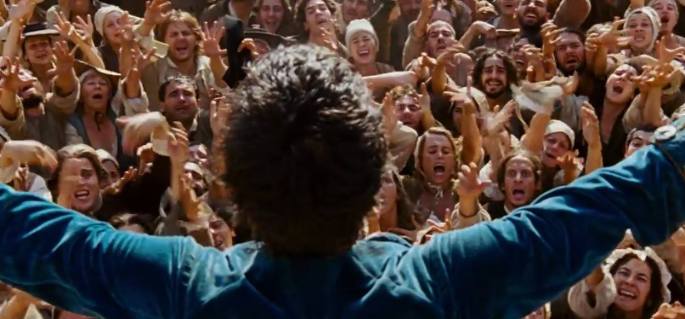
The film is based on the 1985 novel by Patrick Suskind, and the action is set in 18th century France, during the time of the plague and general misfortune, not to mention amazing hygiene! The pensive yet seductive Ben Whishaw is Jean-Baptiste Grenouille, something of an olfactory specialist, a man driven to homicide and obsessive behavior in an effort to find the perfect scent. So what does he do? He starts killing the country’s virgins, becoming more and more possessed by the idea that a pure sexual being emits the greatest bodily odors, which can then be processed into intoxicating perfumes and fragrances. If what I’m describing sounds insane, well, it all sort of is just that – insane with ideas, textures, smells, tastes, costumes, grungy locations, and the endless possibilities that come with a truly unpredictable narrative. And then just wait for the amazingly funny and erotic finale, where an about to be hung for his crimes Grenouille may be able to escape certain doom by creating a mad orgiastic frenzy amongst a crowd of spectators – it’s something you just have to see to truly believe. I viewed this film in the theater on opening weekend in Los Angeles, and since its initial release have watched it numerous times on Blu-ray and DVD (a region free Blu from Germany provides a gorgeous transfer). It’s a film that mostly escaped the movie going landscape but it’s a work that deserves to find a passionate audience.

3

B Movie Glory with Nate: Borderline

image

Borderline plays around with the grey areas of the human mind that control impulse, empathy and rational thinking, showing (albeit in slightly stunted and blunt B movie form) us a recently released psychiatric patient with Borderline Personality Disorder who becomes obsessed with bis former doctor. Gina Gershon is Lila Coletti, a prison psychiatrist who is very good at her job. Maybe too good. When she sanctions the release of Ed Baikman (Sean Patrick Flanery), she has no idea the heap of trouble she’s headed for. Ed is anything but rehabilitated, just a charmer who’s great at disguising his instability. Pretty soon people in Lila’s life start to get mysteriously injured, and even killed. She is protected by her boyfriend, Detective Macy Kobacek (a slick Michael Biehn), but it may not be enough to put a stop to Ed’s crafty, dangerous game. Gershon has always been a strong force, despite being saddled with a lot of… I don’t want to use the M word, but let’s say, promiscuous roles. She holds her own as a lead female protagonist in a real world context even better, and I wish she’d get more roles like this. Flanery is creepy without resorting to gimmicky grimacing or run of the mill psycho stuff. Biehn is Biehn, he’s just a legend in any role. Most of the acting besides those three is pretty patchy, but one can only hope for so much with this kind of low budget fare. Worth it for fans of these actors (they’re all favesies of mine), and a not too shabby little thriller.