THOR: THE DARK WORLD: A Retrospective by Joel Copling

Rating in Stars: ** (out of ****)
Cast: Chris Hemsworth, Natalie Portman, Tom Hiddleston, Anthony Hopkins, Christopher Eccleston
Director: Alan Taylor
MPAA Rating: (for sequences of intense sci-fi action and violence, and some suggestive content)
Running Time: 1:52
Release Date: 11/08/13

At the start of almost every sequence, Thor: The Dark World seems like it’s heading in the heading in the direction of being a surprisingly, solidly interesting first sequel to Thor. By the time we reach the end of each sequence, though, the screenplay by Christopher Markus and Stephen McFeely has regressed backward to the flippant and familiar. This process is tiresome in its repetition, because here is a narrative that has some real potential to make major steps toward building upon the direction in which the Marvel Cinematic Universe seems to be going. Instead, by giving us all the generic beats of a sequel that feels a lot more like wheel-spinning, the screenwriters offer only the familiar to underwhelming results.

Thor (Chris Hemsworth) is now the protector of the Nine Realms, on one of which he easily defeats a fearsome rock beast to the adulation of the crowd watching (“Maybe next time you should start with that,” exclaims one of his fellows, and we nod in agreement). He’s juggling this responsibility with that of rebuilding the peace left to die by his adoptive brother Loki (Tom Hiddleston) after the disastrous events he facilitated and then committed on Earth (for which he will remain in prison) and the prospect of ascension to a throne currently filled by their father Odin (Anthony Hopkins, once again displaying credence in an underwritten role).

The major conflict here shows up on Earth, though, because Jane Foster (Natalie Portman, looking disinterested), the woman Thor met and fell in love with on Earth during his last visit, has stumbled across an anomaly with the help of Darcy (Kat Dennings, a delight) and Dr. Erik Selvig (Stellan Skarsgård), who kind of went insane after New York’s invasion by aliens. The anomaly’s source is a mysterious rift in the time-space continuum (I think) that leads her to the location of the Aether, a substance that predates existence (I think) and possesses some sort of power to do something. Honestly, by the time Jane is pointing out to the others that it will cause “spatial extrusions” (what?), the audience will have clocked out both intellectually and emotionally.

The film even offers the requisite villain whose main henchman is far more threatening and interesting. The former is Malekith (Christopher Eccleston, embarrassingly hammy), whose major defining feature is looking like a steely-eyed, poodle-wearing cousin of Nosferatu, and the latter is the Kursed, played by Adewale Akinnuoye Agbaje in a convincing physical performance that gains mileage from his silence. They are the last of the Dark Elves, an ancient race whose members (excepting a horde of expendable soldiers, of course) all died as a result of Malekith’s bid for power. It’s dull stuff and, once again, overshadowed by the continued, conflicted relationship between Thor and Loki (Hemsworth and a very good Hiddleston shine in these sequences).

After much to-do (a treasonous escape from his home realm of Asgard, a death, some more expository nonsense about a “Convergence” that I think created the universe), Thor and Malekith do battle that once again introduces a bit of creativity into the mix (The hero, his foe, and a bunch of other things around them dash in and out of different realms) before yet again devolving into murkiness (The final confrontation way overcompensates the lack of distinctive coloring in director Alan Taylor and cinematographer Kramer Morgenthau’s imagery by dousing everything in red). It’s indicative of the constantly shifting process of regression inherent in Thor: The Dark World, which is at least an interesting mishap.
IRON MAN THREE: A Retrospective by Joel Copling

Rating in Stars: ***½ (out of ****)
Cast: Robert Downey Jr., Gwyneth Paltrow, Guy Pearce, Rebecca Hall, Ben Kingsley
Director: Shane Black
MPAA Rating: PG-13 (for sequences of intense sci-fi action and violence throughout, and brief suggestive content)
Running Time: 2:10
Release Date: 05/03/13

If the first film had the opportunity to examine the reasons that its titular superhero had to don the gold titanium alloy suit shot with hot-rod red that has an arsenal of weapons up its sleeves and in its shoulder pads only to thrust him into a generic conflict and its first sequel did nothing to expand upon that potential (It certainly didn’t and, in fact, regressed from it), then Iron Man Three is the first time in this series–or, indeed, in the Marvel Cinematic Universe, considering his appearance in The Avengers was in direct proportion to how he interacts with another superhero–that the man within the suit has been properly examined. What writer/director Shane Black finds is a damaged prodigy from privilege and a source of unflappable sarcasm. It seems that trauma, which is the real conflict in store for the man, activates the defense mechanism of outwardly taking nothing seriously.

That is a quality that Black’s carefully honed screenplay shares, too, as is clear in a sequence wherein Tony Stark (Robert Downey Jr.) visits an anomalous location in Tennessee where an explosion may or may not have occurred that is similar to a series of them that have left many people dead and no trace of a source. He meets Harley (Ty Simpkins), a young, plucky kid whose personality mirrors Tony’s own and who aids in Tony’s investigation of the scene of a crime that left five people dead. The scene is oddly but affectionately balanced between the investigation and their repertoire. Downey’s performance is similarly balanced between the moroseness of Tony’s internal conflict and his sarcastic deflection of it; it’s the actor’s best work to date in the role.

That internal conflict has reared its head in the form of sleeplessness and posttraumatic anxiety following the events that led to New York City being overrun by aliens. Even the mention of the city or the beings from someone as innocuous as a child who wants an autograph on his drawing of the battle sets the stress level to 11 for Tony, whose Iron Man alter ego has gone through an upheaval as of late. The lack of sleep has nonetheless spawned a terrific creative spike in the form of remote-controlled suits and a nifty device that summons them and has been placed subcutaneously in his wrist. When one of those attacks is upon Air Force One, he uses one of them to great effect–until, of course, it meets the front end of a semi truck (The interrupted hero shot is a constant, go-to gag that never fails to illicit a healthy chuckle).

External conflict is two-fold this time around. First, there is the re-introduction of Aldrich Killian (Guy Pearce), whom Tony met in 1999 (a meeting that we see in a prologue amusingly scored to a late-decade one-hit wonder) while working on a project with confidant and sort-of-girlfriend Maya Hansen (Rebecca Hall). He wants to collaborate on his newest bit of technology, which is the rejuvenation of genetic defects through cellular manipulation, with Stark Industries, but Pepper Potts (Gwyneth Paltrow), its C.E.O., thinks it highly weaponizable. The other, seemingly more generic conflict comes from a terrorist calling himself the Mandarin (Ben Kingsley); he is the one responsible for bombings positioned as social experiments for the President of the United States (William Sadler), who has now publicly championed James Rhodes (Don Cheadle), aka Iron Patriot, as an official superhero on the government’s behalf.

Things, though, are not as they seem, and the result is the film within the Marvel Cinematic Universe that feels as if it’s taking the biggest number of chances. Part of that is in the revelation of the Mandarin’s identity (refreshingly played as a joke that might be a barb aimed at the MCU itself for giving us such generic villains); the other part is in the action sequences, which are either creatively conceived (the aforementioned Air Force One rescue or the destruction of Tony’s residence, in which a piano is used as a weapon) or thrillingly staged (the climax, which might predictably be set among crates on a rig in the ocean but is a highlight all the same due to the welcome levity of humor and more of those interrupted hero shots). Iron Man Three is unique and risky, yes, but it’s also a lot of cheeky fun.

JEFF NICHOLS’ MIDNIGHT SPECIAL — A REVIEW BY NICK CLEMENT

midnight

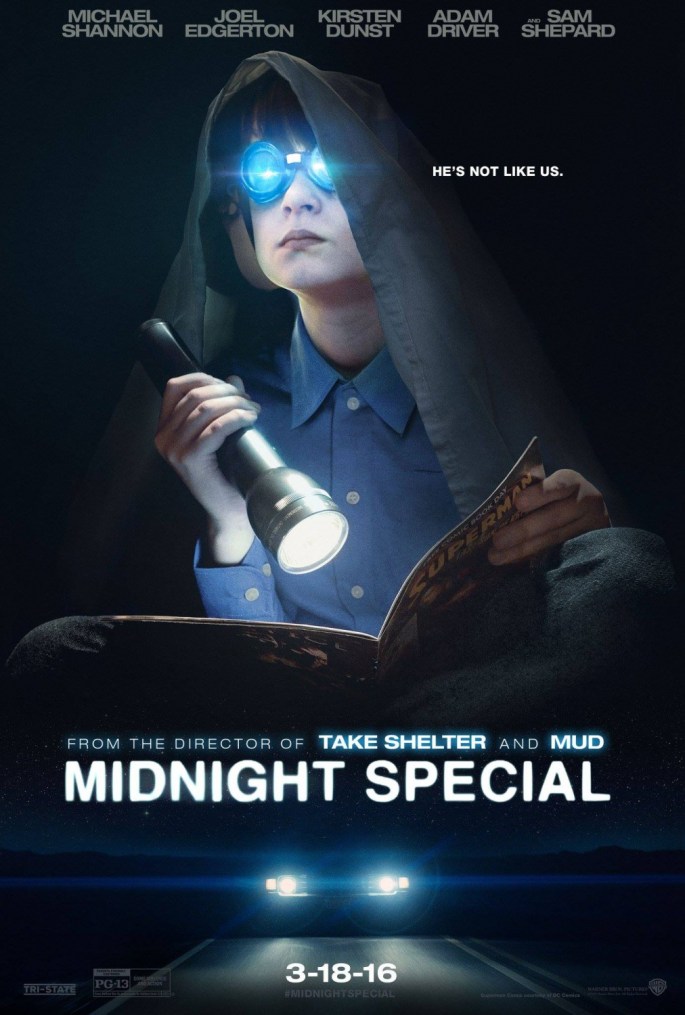
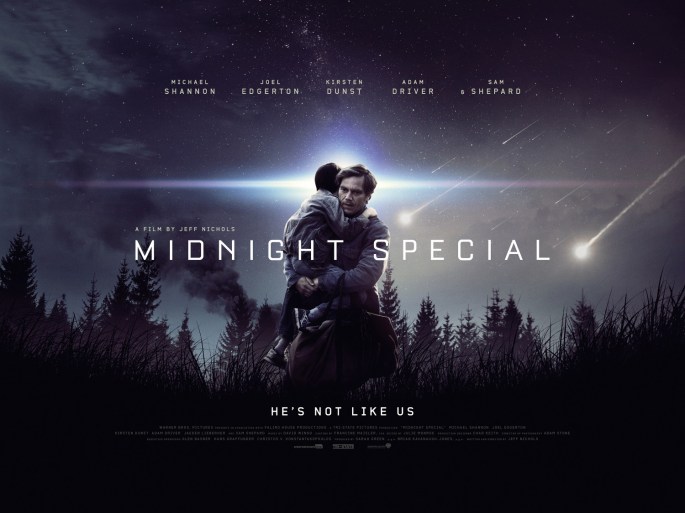
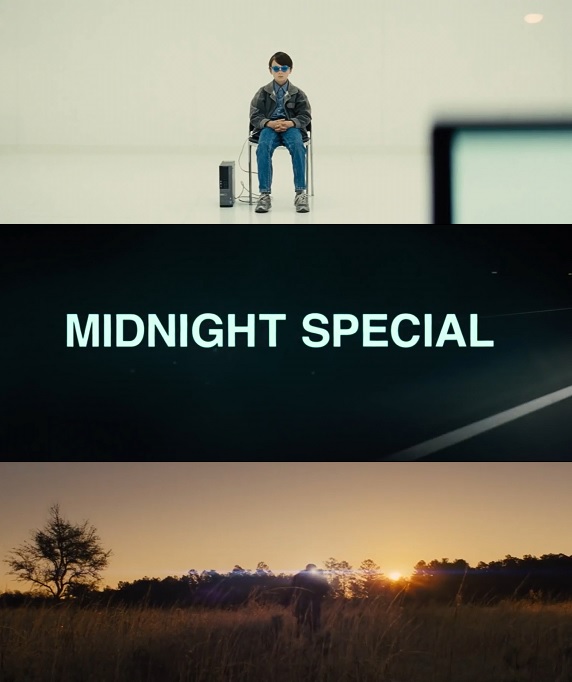
The experience of watching Midnight Special was akin to eating 50 Oreos with a humongous glass of ice cold milk. In short, I loved every single second of this fantastic film, but I’m not too surprised, considering how Jeff Nichols has only made quality films, with his sophomore effort, Take Shelter, registering as a masterpiece of introspective, existential cinema. He’s back in semi-ambiguous mode here after the solid southern drama Mud, and to be honest, I want Nichols to stick to this arena, the thought provoking genre bender that you can’t quite pin down. It’s a miracle that a major studio funded this film – bravo, Warner Brothers. There’s no chance of a sequel or lunchboxes or action figures with this one, and it seems to have been crafted with BRAINS as the motivating factor, not endless action scenes or noisy visual effects. Instead, the audience is treated to tantalizing ideas, smart dialogue and riveting plotting, excellent performances, realistic family dynamics that propel the narrative, and CGI that’s used to enhance the story, and not act as the central focus. I loved the Amblin-ness of Midnight Special, and how it reminded me of John Carpenter’s Star Man and other nostalgic offerings from the 80’s, yet still made with modern panache and overall exquisite style, rarely ever calling overt attention to itself. Adam Stone’s shimmery and bold widescreen cinematography meshed perfectly with Chad Keith’s inspired and subtly stylish production design, which went a long way in evoking these feelings. And the last 20 minutes of the film are spellbinding in their ability to transport you out of the theater and into a movie world where you just have to know what’s going to happen next.

1

If you’ve see the trailer, that’s all you need to know from a plot stand point. There’s a strange and unique child being moved across state lines by two men with a variety of groups giving chase, and for some reason, the kid is able to emit light rays from his eyes. I’m giving nothing away that’s not shown in the trailer. And I’ll reveal no more. This movie has a ton of heart and honest emotion that worked me over like a baby, and a central performance from Michael Shannon that is compelling and totally consuming to observe. Jaeden Lieberher is equal parts spooky and sympathetic as the potentially dangerous cargo, while Joel Edgerton and Kirsten Dunst are both very effective in supporting roles. Adam Driver nails his scenes as an NSA agent looking into the situation, while Sam Shepard has a cameo as a cult leader who feels that, for some reason, the boy is very special. David Wingo’s music is haunting and pulsating and delivers a serious punch, and again, it must be mentioned that the entire film has been shot with casual elegance by Stone, who clearly was favoring a lot of natural light, and knew exactly where to place the camera in some key situations. But the star of the show is Nichols, and his erudite sense of storytelling, never holding the audience’s hand too firmly, and always allowing for tantalizing bits and pieces from his heady narrative to remain unanswered, so that when you leave the theater, you’ll be thinking about the fine details for hours after the film has finished. I can’t wait to see this film again and again and again and I have no doubt that it will be included in my top 10 favorite films of the year.

midnight_special_ver2_xlg

DAVID O. RUSSELL’S THE FIGHTER — A REVIEW BY NICK CLEMENT

the fighter

The Fighter is an inherently compelling piece of entertainment. Christian Bale, as a crack-addicted boxing coach, stole the entire show, but Mark Wahlberg, starring as real life boxer Micky Ward, was low-key terrific and was somewhat overshadowed by the hype that accompanied Bale’s transformative performance. Wahlberg clearly excels while working with director David O. Russell (they previously teamed on the masterwork Three Kings and the criminally underrated I Heart Huckabees) and it’s clear from frame one that this was Wahlberg’s passion project. It’s probably the least idiosyncratic movie that Russell has ever directed, but switching it up a bit thematically and stylistically was probably a good move for him at the time, as he definitely showed that he’s got solid commercial instincts and that he can stay focused with a concise story. The film also has some huge and unexpected doses of humor (mostly at the expense of the broadly drawn characterizations that comprise Ward’s white-trashy sisters) that really bring the laughs.

You might not like the brutality of boxing, you might not want to have your face rubbed in the low-class Lowell-grit-‘n-slime for two hours, and sure, most of the beats in the script are predictable, but it’s got such a rousing finish and the story is so quintessentially American (who doesn’t love a second, sometimes third chance in life?), that it’s hard not to find the film inspiring to a certain degree. The acting across the board was so strong and enjoyable that in tandem with the sharp and believable dialogue, the obviousness of some of the story recedes into the back of my mind. The Fighter has a somewhat traditional boxing movie narrative, but everything is spiced up by the gritty, lived-in atmosphere and by the rough and tumble dynamics of the Ward family. Amy Adams and Melissa Leo were both terrific, and again, it needs to be said, without Wahlberg’s sensitive and quietly observed performance, the film would be without its steady anchor. It’s his best overall performance since Boogie Nights and it’s something that he should be very proud of.

Faster: A Review by Nate Hill

image

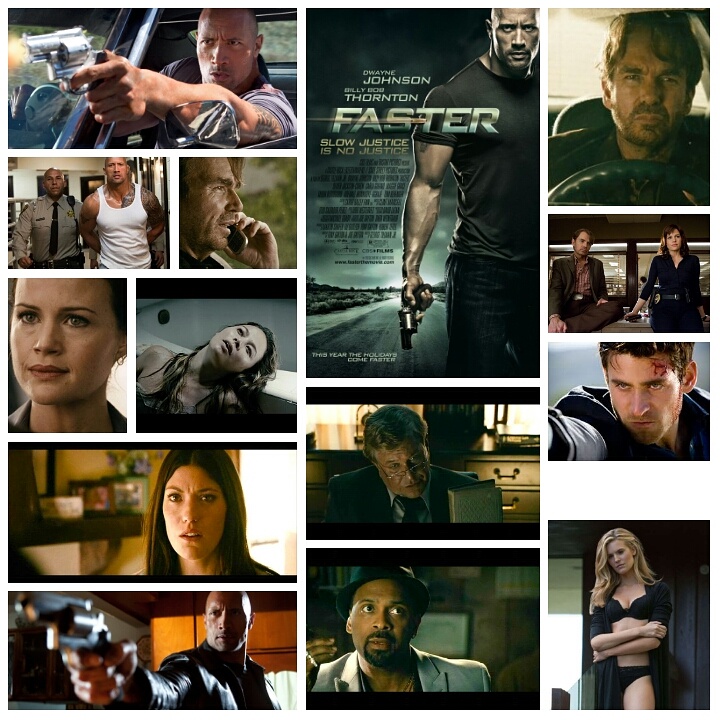
Faster is an action film with an eerie aura and a darkly unnerving bite to it. Don’t get me wrong, it’s action through and through, a genre effort right to its marrow. And yet, there’s something oddly esoteric about it, an obvious extra effort put in by the filmmakers, namely first time action director George Tillman, to give every character an off kilter, bizarre cadence to ensure we won’t forget them. There’s clichés, no doubt, but they’re eclipsed by the strange, full moon weirdness of the rogues running about the film’s story. Dwayne Johnson fires up a furious protagonist in his first action role after a long and ridiculous stint in insufferable family comedies. He plays a quiet, hulking dude known only as Driver, reluctantly released from prison by a watchful Warden (Tom Berenger). Upon exiting the gate, he runs. And runs. And runs. He arrives at a small town junkyard where he tears a tarp of a vintage Chevelle which seems to be left there for him like a care package. From there he launches a bloody crusade of revenge that knows neither mercy nor discretion, and whose reasons we are only slowly allowed to know. He’s a one man wrecking ball, the murders piling up before we really have any idea what this guy is about. He’s been greatly wronged in the past, the culprits of which should all be running scared, as he comes looking for them one by one and with the juggernaut pace of a boulder tumbling down a mountain. Pretty soon there’s two cops on his trail, intrepid Cicero (Carla Gugino) and mopey sleazeball ‘Cop’ (Billy Bob Thornton), a dilapidated piece of work who mainlines heroin and clearly has a murky past. Soon there’s one hell of a hitman (Oliver Jackson Cohen) skulking around looking for Driver, an extreme sports enthusiast who has ‘beaten yoga’ and is avidly looking for the next big thrill. Johnson jumps from one ultra violent encounter to the next with all the corrosive ferocity of the grim reaper, tallying up the corpses until we’re all but sure he’s an inhuman elimination machine. Then.. the film curveballs us and throws a glint of humanity into the mix with some late third act emotion that only goes to show the filmmakers set out with more than a one track mind. Driver has been unspeakably betrayed, and his rampage is undeniably justified, but there’s a complexity to his quest that he didn’t see coming, and neither did those of us who expected pure action without a moral conundrum in sight. I say good on it for grasping something besides the thrills. A terrific cast populates the almost Oliver Stone – esque proceedings, including Maggie Grace, Moon Bloodgood, Mike Epps, Jennifer Carpenter  (always superb), Matt Gerald, Xander Berkeley, Buzz Belmondo, Courtney Gains and more. It’s got the depth of a well written graphic novel and a level of thought out characterization that heaps of stale action entries wish they possessed.

B Movie Glory with Nate: Ticker

image

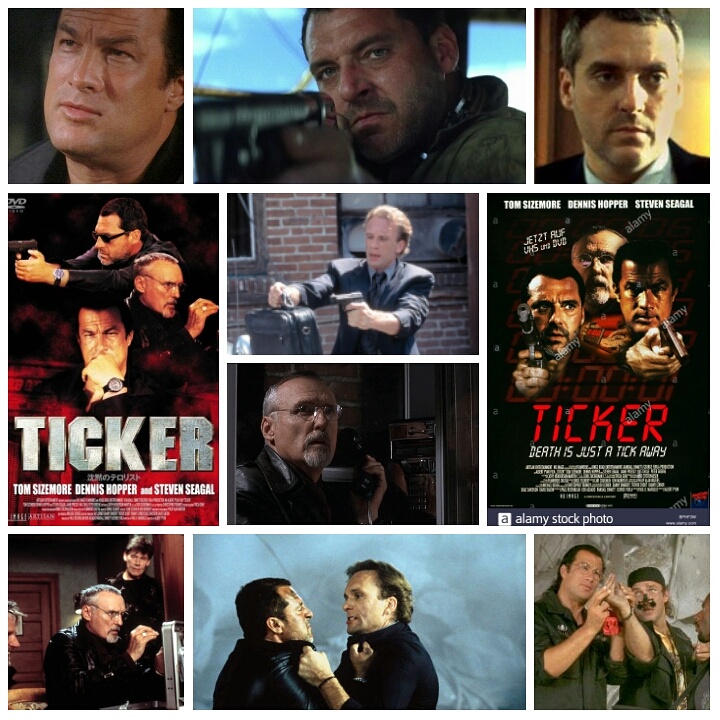
If an eighth grade class raided their parents liquor cabinet, passed around a bottle, got good and loaded and took it upon themselves to make their own version of every 90’s action cliche, it would look something like Ticker, a wonderfully inept mad bomber tale that starts at rock bottom and cheerfully drills farther down, as well as into critics collective patience, it seems. It’s silly clunky and all over the place, but there’s a scrappy likeability to its amalgamated stew of genre tropes, masculine posturing and endless explosions. The bomber in question is Alex Swan (Dennis Hopper), a homicidal Irish extremist intent on making life hard for the San Francisco bomb squad, led by explosives expert Frank Glass (a laughably zen Steven Seagal). Hero cop Ray Nettles (Tom Sizemore) previously lost a partner to bombers and has a big score to settle with Swan. And so it goes. Bombs go off. Cops argue. They chase Hopper, who eludes them until the next set of fireworks destroy a wall glass panels or a bridge. Sizemore is surprisingly sedated, not seizing the opportunity to use his lead role as an excuse to tear through scenery like a bulldozer, as is usually his speciality. Seagal is so silly, his intended gravitas landing with all the profundity of an SNL skit. Hopper is demented, even more so than in Speed, and the rental fee is worth it just to hear his perplexing, absolutely wretched Irish accent. Not since Tommy Lee Jones in Blown Away have I laughed that hard at an actor butchering the dialect to high heaven. There’s appearances from Nas, Jaime Pressley, Kevin Gage and the always awesome Peter Greene as ana a-hole fellow cop that hounds Sizemore any chance he gets. Quite the cast, and in a perfect world the film they wander through would match their talent. I watched this with the same morbid curiosity that the bystanders gawking at the resulting destruction of one of Hopper’s bombs no doubt had: incredulity and the inability to look away for missing a moment of a disaster unfolding in front of you.  

Mr. Brooks: A Review by Nate Hill

image

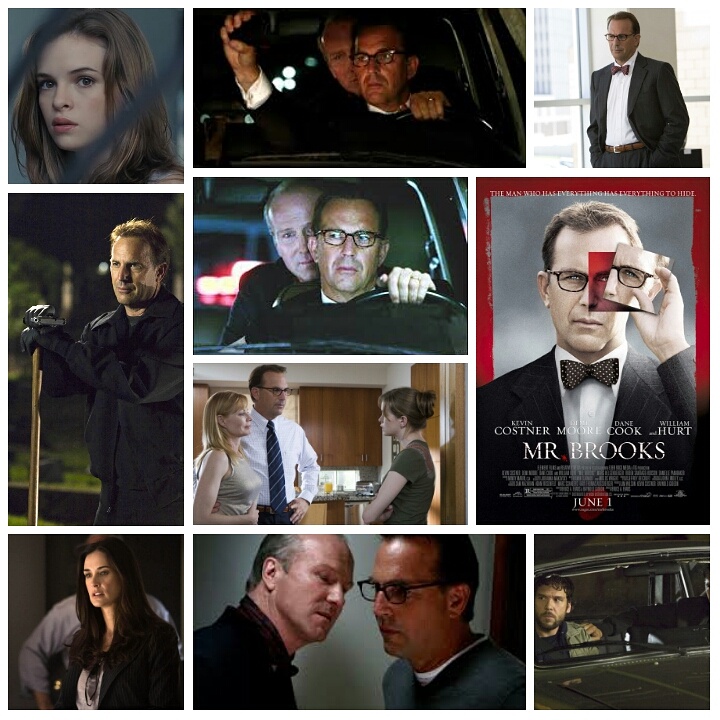
There are a few films Kevin Costner has done in which he has really been allowed and been willing to test the boundaries of what is usually expected from him in a role. 3,000 Miles To Graceland and Eastwood’s A Perfect World are fine examples. Perhaps the finest though is Mr. Brooks, a dark tale that showcases the actor in a terrifying turn and the last type of role you would picture for him on paper. Opposites are paramount in acting and cinema as a whole, and it’s that type of contrarian casting choice that can lead to a performer’s finest hours. In this case it’s certainly one of Kevin’s best outings, and casts him in a frightening new light, or should I say dark. Here he is Earl Brooks, husband, father, businessman and all round stand up guy. Except fpr the fact that he moonlights as a methodical and psychopathic serial killer. He sees it as an affliction, and is almost ashamed of it, whether by a tiny flicker of a soul he may have, or simply by the standards impressed onto society. He’s efficient, cold and hopelessly addicted to the act of murder. His alter ego, or ‘dark passenger’ as the scholars say, is a cynical persona called Marshall, brought to life by a scary William Hurt. “Why do you fight it, Earl?” he drawls in that committed, laconic snarl that only Hurt can do. There’s shades of his character from Cronenberg’s A History Of Violence here, affirming my belief that Hurt is a pure acting prodigy and masterful of both the light and the dark within his craft. Earl has a daughter too (Danielle Panabaker) who he has worrisome thoughts about, and a picture perfect wife (Marg Helgenberger). One can’t keep the turbulent nightlife of the serial killer a secret for one’s entire life though, and pretty soon people start to catch on. A nosy Nelly (Dane Cook) catches a whiff of Earl’s crimes and lives to wish he hadn’t, and a keen Detective (Demi Moore) begins to piece the puzzle together as well. Earl is as clever as he is murderous though, covering his work and tying off loose ends with gut churning gusto. Costner carries the film terrifically, a man who is at once both uncomfortable in his own skin yet fits it like a glove when the camera dutifully bears witness to his killings. He’s like a tiger who really can’t change his stripes but wants to shield them from the judgment of others, and of course his own persecution. The scenes of murder are skin crawling in their frank, fly-on-the-wall nature, no slasher cinematics or gimmicky set ups here, just the icy horror of a predator extinguishing human life to sate the beast, and the nightmarish inevitability of death. Those scenes paint Earl in a horrific light, but the film doesn’t try to convince us he’s a monster using any usual methods, it just presents to us this man, his acts and his life surrounding them, without discernable condoning or condemning. It’s cold, it’s clinical and it’s one of the best serial killer flicks out there.

PTS Presents Director’s Chair with RENNY HARLIN

RENNY HARLIN POWERCAST

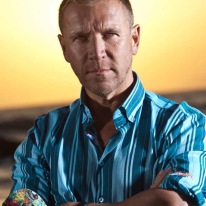
RH Official PhotoPodcasting Them Softly is overwhelmingly excited to present a chat with veteran action director Renny Harlin, a man who needs very little introduction! Die Hard 2. Cliffhanger. The Long Kiss Goodnight. The Adventures of Ford Fairlane. Deep Blue Sea. Cutthroat Island. Exorcist: The Beginning. And so many others. His latest action extravaganza, Skiptrace, stars Jackie Chan and Johnny Knoxville, and is set to explode into cinemas this summer. Listen as Nick and Frank try and contain their excitement, and Renny dishes on his incredible career and his newest cinematic offering — we hope you enjoy!
INHERENT VICE – A REVIEW BY J.D. LAFRANCE

inherentvice1

There are unfilmable novels and then there is Thomas Pynchon, the premiere post-modern novelist responsible for legendary tomes like Gravity’s Rainbow and Mason & Dixon. He is known for producing dense, complex novels that explore themes such as racism, philosophy, science and technology while fusing theological and literary ideas with popular culture references to comic books, films, urban myths and conspiracy theories. Satire and paranoia are common currencies that he uses in his novels. And that’s only scratching the surface.

The 1960s were an important decade for Pynchon. It was at this time that his novels V. and The Crying of Lot 49 were published and the bulk of Gravity’s Rainbow was written. He would revisit the ‘60s again from the perspective of the 1980s with Vineland and, most recently, with Inherent Vice, which was published in 2009. The latter novel has been considered his most accessible work since Lot 49 and has been adapted into a film by Paul Thomas Anderson, the American auteur responsible for such memorable efforts as Boogie Nights (1997), There Will Be Blood (2007) and The Master (2012) among others.

Possibly informed by Pynchon’s stint in Manhattan Beach, California during the mid-‘60s, Inherent Vice is part stoner comedy/mystery and part lament for an era that was all but gone by 1970 when the story takes place. If the ‘60s was about having your head in the clouds then the ‘70s was about having your feet on the ground. Like its source material, the film plays fast and loose with notions of plot and story, riffing on elements of a Raymond Chandler-esque mystery through a counterculture filter.

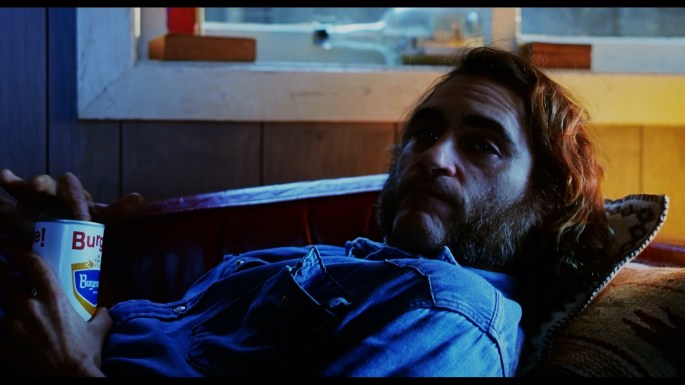
Larry “Doc” Sportello (Joaquin Phoenix) is a private investigator of the rumpled variety. One night, he’s visited by an ex-girlfriend by the name of Shasta Fay Hepworth (Katherine Waterston) whose latest boyfriend, Mickey Wolfmann (Eric Roberts), a big-time real estate developer, and his wife are involved in some kind of shady scheme. Doc soon finds himself framed for murder, Shasta disappears (as does Mickey) and he runs afoul of hardass Los Angeles police detective Christian “Bigfoot” Bjornsen (Josh Brolin). During the course of his investigation, Doc finds himself immersed in the bizarro social strata of California culture, including a drug-addicted surf musician (Owen Wilson), a member of the Black Panthers (Michael K. Williams), a cokehead dentist (Martin Short), and a secret cartel known as the Golden Fang.

Inherent Vice is the second collaboration between Anderson and actor Joaquin Phoenix and the former may have found his cinematic alter ego. Working together brings out the best in both of them with the actor delivering another excellent performance. He portrays Doc as a peaceful hippie P.I. content to coast through life surrounded by a cloud of pot smoke, but is thrust into a strange world when an ex-lover comes back into his life. He acts as our guide on this journey and the key to navigating the sometimes murky narrative waters is to never lose focus of the primary mystery: the disappearance of Shasta. Doc represents the peace-loving idealism of the ‘60s and who is confronted by all kinds of outlandish people that represent the aggressive excessiveness of the ‘70s.

Anderson populates Inherent Vice with a stellar cast of supporting actors that includes Owen Wilson, Reese Witherspoon, Benicio del Toro, and Martin Short, all of whom bring this collection of oddball characters vividly to life. Some may find the cavalcade of recognizable movie stars distracting but, on the contrary, they act as important signposts along the way to help us keep track of the numerous characters Doc encounters during his investigation.

Josh Brolin gets the most screen-time of the supporting cast as Bigfoot Bjornsen, a throwback to cops of the early ‘60s, complete with crew cut and deep loathing of hippies like Doc. Initially, Bigfoot starts off as Doc’s primary nemesis, but over the course of the film he reveals a frustration with his lot in life, displaying a grudging mutual respect. Brolin certainly has the imposing frame to play Bigfoot and wisely plays the role straight, which makes several of his scenes that much funnier because the uptight character is a product of a bygone era that clashes with the more easygoing Doc as much as the excessive culture of the ‘70s.

The trailers for Inherent Vice are misleading in the sense that they sell the film as some kind of madcap comedy and while there are some out-and-out funny scenes, like Martin Short’s cocaine-addicted dentist, there is a melancholic tone that permeates most of the film expanding on “The High Water Mark” speech Raoul Duke gives late in Fear and Loathing in Las Vegas (1998) as he laments the death of ‘60s idealism. Inherent Vice even ends on a surprisingly emotional moment that is quite affecting. Instead of going for quick, comedic beats, Anderson applies the aesthetic he used in There Will Be Blood and The Master by breaking the film down into lengthy, dialogue-heavy scenes between Doc and one of the many people involved either directly or tangentially to Shasta’s disappearance, which may test the patience of some expecting the stylish zaniness of something like Fear and Loathing in Las Vegas. While Terry Gilliam’s film reflected Hunter S. Thompson’s gonzo sensibilities, so too does Inherent Vice reflect Pynchon’s peculiar sensibilities. Like the book, Anderson takes his time and lets you sink into Pynchon’s world, which is certainly not an experience for everyone.

Several reviews have compared Inherent Vice to Robert Altman’s The Long Goodbye (1973) and the Coen brothers’ The Big Lebowski (1998), but they are only similar on a very superficial level. Anderson’s film is its own thing – a shaggy dog journey through a corner of Pynchon’s universe that the filmmaker has brought faithfully and lovingly to life. Much like Walter Salles’ adaptation of Jack Kerouac’s On the Road (2012), Inherent Vice is made by and for fans of Pynchon’s novel, which will leave the uninitiated out in the cold, struggling to follow a film that may seem like an incoherent mess, but is actually quite faithful to its source material with huge chunks of the author’s prose coming out of the characters’ mouths. You shouldn’t have to see a film more than once to “get it,” but there are some that reveal themselves in more detail and whose nuances are appreciated upon repeated viewings. This is such a film. As Pynchon himself once famously said in response to the complexity of his novel V., “Why should things be easy to understand?” The fact that one of Pynchon’s novels has been adapted into a film is quite a significant accomplishment. That it successfully translates his worldview is even more noteworthy.

PETER BERG’S LONE SURVIVOR — A REVIEW BY NICK CLEMENT

lone s

Writer/director Peter Berg pulled out all the stops and went for the emotional and visceral jugular with his ferocious combat film Lone Survivor, a harrowing, gut-wrenching modern war movie that deserves to sit alongside other battle-ready, anti-war classics such as Hamburger Hill, Black Hawk Down and We Were Soldiers, truly throwing the audience into the middle of a nightmarish warzone where anything can happen. Crafted with stunning technical proficiency, Lone Survivor aims to put you in the middle of a bloody, unrelenting gun battle, rarely letting up for a breath of air. And what a battle sequence it is. The fluid yet ragged cinematography from Tobias Schliessler is remarkable to behold and the crispness of the editing by Colby Parker Jr. smartly establishes concise geography and clear spatial coherence during the protracted firefight. Berg was as single-minded and determined in his directorial approach to the story as the soldiers-on-a-mission were in his narrative, centering on their attempt at doing their job and coming out of a terrible situation alive. And it’s because Berg stuck to the nitty gritty, never losing focus or succumbing to cheap politicizing, the film operates in a bluntly forceful fashion, and almost immediately kicks into high gear.

No matter what or how many creative liberties the filmmakers took with the true-story aspects of the incident (a botched mission where four Navy SEALS went up against numerous Taliban soldiers in the unforgiving mountains of Afghanistan after allowing civilians to go free), the emotional core of the film is honest and at times overwhelmingly powerful, just like great cinema should always be. It’s no spoiler to reveal that only one SEAL makes it out of the fight alive, and it’s mind-blowing to think that these guys were able to endure what they probably endured during those hellish hours. Berg smartly opens the film with real-world SEAL training footage, and by watching just two minutes of these clips, it’s easy to see how these men could become total warriors, able to drop their enemies with precise head-shots, never succumbing to fatigue or lack of food, always ready to fight and kill. Berg wisely celebrates the warrior spirit in all of the men, while never glamourizing the horrific toll that war brings to multiple societies. And most importantly, he never turned the film into a cheesy political message or soap-box statement – this is truly “War is Hell Cinema,” with a focus on the blood and guts of the situation. Persuasively acted by the grizzled quartet of Mark Wahlberg, Taylor Kitsch, Ben Foster, and Emile Hirsch, this is an unforgettable reminder of what’s been going on for over a decade during the “War on Terror.”