ED HARRIS’ APPALOOSA — A REVIEW BY NICK CLEMENT

a

I love westerns. I really do. From the classics (The Searchers, Red River, Winchester ’73, My Darling Clementine, hundreds more) to modern efforts (Unforgiven, The Assassination of Jesse James by the Coward Robert Ford, Open Range, 3:10 to Yuma), it’s a genre that never fails to intrigue and satisfy. I was obsessed with HBO’s brilliant show Deadwood and I still lament the early cancellation that it received. David Milch’s creation was as bold and unique as anything that has ever been aired on television, and I can only hope that the recent TV movie rumors are true. Appaloosa, which was co-written and directed by Ed Harris and released in the fall of 2008, is an extremely solid genre entry for anyone who’s a fan of this milieu. Harris stars as Virgil Cole, a gun/sherrif for hire who rides into the dusty town of Appaloosa with his shotgun-toting sidekick Everett Hitch (Viggo Mortensen, one of my favorite actors), looking to find work. They are hired by the town organizers to take out the human trash that has been infecting the area, chiefly, Randall Bragg (a sneering Jeremy Irons) and his gang of thieves and murderers. The set-up is perfect: Two men who are quick with guns are assigned to take care of business. But a wrench is thrown into their plan with the arrival of the saucy Allison French (Renee Zellweger, in one of her best roles), a seemingly dignified woman who comes to town looking to start her life over after her husband’s recent death. Cole falls in love with French almost immediately. He’s a man who has spent his life frequenting brothels rather than looking for a wife, and the notion that this Angel out of nowhere has appeared in an otherwise dangerous town, well, that’s enough for him to want to become lover and protector.

Appaloosa explores classic themes of honor and betrayal and machismo, which are filtered through the lens of a classical western, turning this old-fashioned story into something that never feels out of date. Cole and Hitch are best friends, and Appaloosa, at its heart, is a modern buddy movie, much like most westerns tend to be. There are some well staged and appropriately gritty shoot-outs, but this isn’t a modern day action movie spiced up by western locales like James Mangold’s exciting 3:10 To Yuma remake. Appaloosa is more of a character piece, taking its time to explore the friendship between Cole and Hitch, with everything hinging on character and motivation as much as it does bloody showdown. All of the bullets fired in this film count (and hurt), much like they did in Kevin Costner’s underrated Open Range, with the script smartly saving its violence for the perfect moments. The dialogue between Cole and Hitch has a witty, crackling quality and all of the performances are top-notch, most notably from Zellweger, who was utilized to great effect in this film. Harris, as always, was intense and focused, and Mortensen downplayed his role as Hitch, bring a level of mystery to his character. The film looks nice but isn’t overly “pretty,” with the cinematography by Dean Selmer (We Were Soldiers, Dances With Wolves, Apocalypto), possessing a traditional sense of genre classicism. Appaloosa is solid in every respect, and enjoyable on all levels.
EMBRACE OF THE SERPENT: A Review by Joel Copling

Rating in Stars: *** (out of ****)
Cast: Nilbio Torres, Antonio Bolivar, Jan Bijvoet, Brionne Davis, Yauenkü Migue
Director: Ciro Guerra
MPAA Rating: NR
Running Time: 2:05
Release Date: 02/17/16 (New York)

The religious fervor of the tribal West collides with the scientific discovery of the colonial East in Embrace of the Serpent, co-writer/director Ciro Guerra’s take on the Old World’s resistance toward the influence of the New by way of a kind of parable structure. At one end of a time frame, we have an explorer disappearing into the jungles along the border between Colombia and Brazil. At the other end, we have another scientist retracing his steps. It’s a way for the region to comment upon its own history, as these stories are based in truth. Guerra and co-screenwriter Jacques Toulemonde Vidal (taking inspiration from a diary written by its protagonists’ real-life counterparts Theodor Koch-Grunberg and Richard Evan Schultes) weave an intriguing tale rife with symbolism and haunting imagery.

In what we will call the “present day” (Although the screenwriters don’t put a specific date on the proceedings, these events took place roughly in the late 1940s), an explorer named Evan (Brionne Davis) searches the banks of the Amazon for traces of Theo (Jan Bivoet), a scientist who came upon this area in forty years previously and never returned from what was to be an exploratory trip. An elderly villager named Karamakate (Antonio Bolivar) meets Evan rather coincidentally, having  done the same with Theo perhaps upon that very shore. As Karamakate reluctantly helps Evan on the search, he recalls the time the “other white” arrived, very ill and in the care of a guide named Manduca (Yauenkü Migue), and asked Karamakate’s younger self (Nilbio Torres) to aid his own search for the yakruna plant (something which will cure his illness).

Interpersonal conflict of some sort exists within these characters from the moment many of them interact with each other. Skin color separates both Theo and, later, Evan from Karamakate by virtue of preconceptions on each person’s part. Both white explorers are wholly unprepared for the primitive lifestyle of the natives whom they encounter and with whom they travel. In the past, Theo, Manduca, and Karamakate come upon a settlement wherein the Christian faith is taught to children with such rigor that the priest whips the boy who welcomes outsiders into their midst. In the present, Evan and Karamakate encounter a tribe whose leader has convinced them that he is Jesus Christ incarnate, come to be married to a young, dying girl he insists be healed by Theo the scientist and to be given the cure to their own, likely nonexistent illness.

This latter encounter exhibits a problem shared by the film’s second half, which conflates symbolism with a kind of thematic opacity that makes much of it hard to pin down in any significant way. The business with the plant for which Theo is searching inspires an acid trip of sorts (the only instance of color in a film that is quite effectively shot by cinematographer David Gallego in stark, black-and-white hues), but it isn’t quite established what purpose the climax of the journey (which then cuts to credits rather insignificantly) holds.

It is also, ultimately, less relevant to the film’s impact as a cinematic effort. Flashbacks are an iffy tool to utilize and even more so to execute in a way that doesn’t make them feel like a gimmick. Here, they are used to inform Karamakate’s past; the shared performances by Bolivar and Torres are both very good at conveying a weariness with the world and with the West. Bivoet is also a highlight in this ensemble as Theo, whose fate is as uncertain as his real-life counterpart’s, the actor compelling in his portrayal of a sick man trying to make his mark. Embrace of the Serpent, in spite of its drawbacks, proves in this regard an unexpectedly tender treatise on the inadvertent marriage of two sides of civilization.

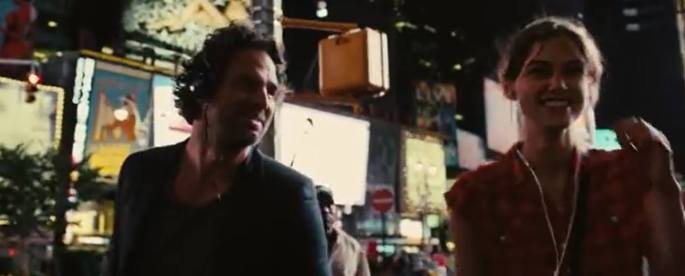
JOHN CARNEY’S BEGIN AGAIN — A REVIEW BY NICK CLEMENT

1.jpg

Begin Again is a pure delight from start to finish, filled with laughs, catchy music, and a bright spirit. A tad melancholy to be sure, but like John Carney’s previous heartfelt musical-romance Once, his newest effort is long on charm and inherently likable. Mark Ruffalo, in one of his very best performances, is a sloppy, beaten-down, old school music executive who, after a night of heavy, depressing drinking, stumbles into a NYC bar and just so happens to hear the voice of a talented, equally-down-on-her-luck singer (the effervescent Keira Knightley, who should have been Oscar nominated for her work in this film). Ruffalo hears Knightley singing, and in one of the best sequences of the year in any film, he imagines the musical accompaniments that would pair with Knightley as she’s singing and playing solo guitar, with Carney playfully visualizing Ruffalo’s imagination. It’s mutual respect at first sight for the artist and the producer, but will it blossom into something more? The two music lovers decide to record an original album, preforming all of the songs all throughout NYC, out in public areas, in an effort to create something special and organic and long lasting. Carney is a heartbreaker with a smile, a guy who loves the tropes of the romantic dramedy but enjoys tweaking the formula just enough so your expectations are subverted at almost every turn. He’s also a massive fan of keeping his potential love birds apart from one another for as long as humanly possible, which will annoy some, but delight those of us who know that life isn’t as simple as “I do” and “I don’t.” If Begin Again isn’t quite the movie-miracle that Once was, well, that would have been impossible to replicate for a variety of reasons, but it’s still a hugely entertaining movie that will likely prove impossible to resist for anyone who gives it a chance.

The Big Easy: A review by Nate Hill

For a film about violence, crime and police corruption, The Big Easy sure is easy going and colorful. The characters are the liveliest bunch of rascals and it’s a pleasure to spend every minute with them. Dennis Quaid plays cocky New Orleans detective Remy McSwain, a swaggering smooth talker who’s gotten wealthy taking payoffs, a dude whose silky charm matches his swanky suits. He’s gotten used to the easy life in the police department, with a captain who looks the other way (Ned Beatty brings a jovial, rotund presence), and colleagues (John Goodman is perfectly cast as the witty loudmouth of the bunch) who are just as happily willing to bend the rules as him. Trouble arrives in the sultry form of D.A. corruption task force specialist Anne Osborne (a swelteringly hot Ellen Barkin) who leans on Quaid as heavily as he hits on her. There’s immediate and electric chemistry between them, which she adamantly fights, and he chases like a horn dog pursuing the bumper of a speeding Buick. Quaid and Barkin have the same spitfire sheen to their work, their careers dotted with performances that are flashy yet brave, pulpy yet laced with depth. Here they’re having oodles of fun and carry the entire film on their crackling star power and romantic spark alone. There’s also a subplot involving a rash of gang killings, as well as family matters involving Quaid’s vivacious Cajun clan, including his Momma (monumentally talented Grace Zabriskie). It’s a lively hodge-podge of plot elements we’ve seen a zillion times, but given such flippant style and good natured southern hospitality that we can’t help but be won over. There’s some lovely live performed Cajun music as well to add extra spice.

image

JOHN MCTIERNAN’S DIE HARD WITH A VENGEANCE — A REVIEW BY NICK CLEMENT

2.jpg

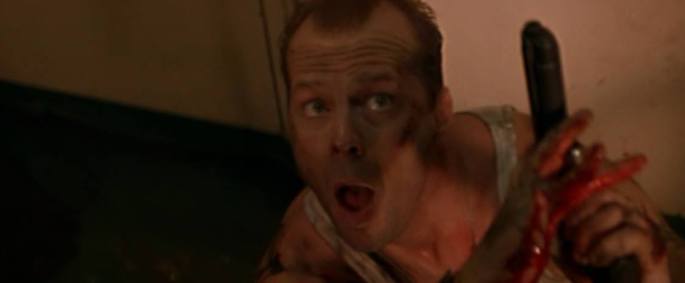
Make no mistake about it: John McTiernan’s original Die Hard is easily the BEST film of the franchise, and unquestionably one of the 10 best action movies of all time. However, my personal FAVORITE from the franchise will always be Die Hard: With a Vengeance. Taking the smart and credible plotting from the first entry and combining it with some of the over-the-top action of Renny Harlin’s icicle-in-the-eyeball sequel Die Hard 2: Die Harder, McTiernan returned to the series that made him famous with this brawny, beefy, explosive threequel, a film that over the last 20 years has stood the test of time as one of the most visceral, down and dirty, big-city action flicks ever produced. Shot on location in NYC, the verisimilitude of this movie is staggering, with a noticeable lack of blue-screen work, honest-to-goodness stunt-men doing their glorious, ballsiest best to defy the laws of gravity and physics for our personal amusement, with bravura hand-held camera work capturing all of the insane action, which brought an immediacy and danger to the proceedings. Shot by master action lenser Peter Menzies Jr., Die Hard: With a Vengeance is one of the roughest looking action movies ever shot. The camera is rarely not moving around (never chaotically though), always glimpsing here and there for some sort of visual information, with the anamorphic 2.35:1 widescreen space constantly filled with bodies and vehicles and bullets in motion. Willis is paired up with a reluctant buddy in the form of Samuel L. Jackson’s hostile and angry Zeus, a hardscrabble man living and working in Harlem who is sucked into McClane’s whirlwind of city saving escapades. The two of them have immediate chemistry and a natural rapport, with their abrasive lines of racially charged dialogue bouncing off of one another with the same intense fashion that the bullets leave McClane’s various firearms of choice. It seems that someone has a grudge against McClane and is setting off bombs all over NYC. Played with vile charisma to the extreme by Jeremy Irons, his villain is an East German terrorist with as much smarts as ruthless killing ability, and the narrative twist that the filmmakers serve up with Irons’ character brings the film full circle with the first effort.

5

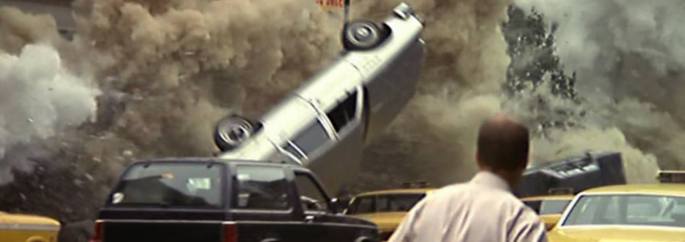
In Die Hard: With a Vengeance, the audience is treated to one sensational action set-piece after another. After the spectacular morning rush-hour bombing of the old Bonwitt-Teller department store in downtown Manhattan, we’re treated to a live-wire chase through Central Park, we get a hair-raising car chase along a rain-soaked Saw Mill River Parkway, a variety of close-quarters (and extremely graphic) shoot-outs, any number of vicious hand-to-hand fight scenes, with one featuring Willis facing off against a hulking, heavily accented henchmen which has to go down as one of the best fights of all time. There are exploding shipping vessels, crashing helicopters, and cars that ram their way thru highway guard-rails in an effort to land on the road beneath. All of this is done with zero CGI, tons of fake-blood-filled-squibs, and a constant stream of vulgarity pouring out of the mouths of the two battered and bloodied lead heroes. This is pack-it-all-in action filmmaking at its finest, and a further reminder of the cinematic muscularity that McTiernan was tossing around in his glory days. I can remember my father picking me up from high school early on the Friday that this movie opened (I ditched the last two classes so we could see the first showing) and I can still remember sitting in the theater and watching this masterwork of pyrotechnics and entertainment, my mouth completely left in slack-jawed amazement. This is one I’ll continue to re-visit for years to come.

3

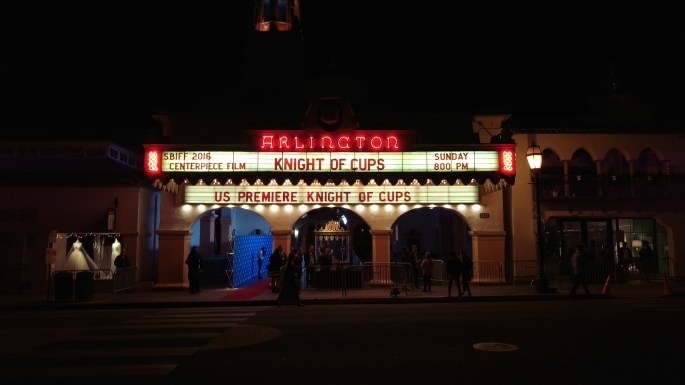
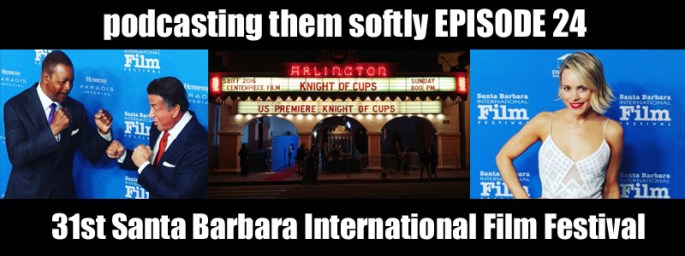
Episode 24: Coverage of the 31st Santa Barbara International Film Festival and Terrence Malick’s KNIGHT OF CUPS

SBIFF episode

Our coverage of the 31st Santa Barbara International Film Festival is up!  This has been our first red carpet coverage, and included are interviews with actors James Morrison, Michael Keaton, Rachel McAdams, Carl Weathers,  film historian Leonard Maltin, filmmakers Benjamin Cox of STEREOTYPICALLY YOU and Tom McCarthy of SPOTLIGHT, producers Marcia Nasatir (THE BIG CHILL, COMING HOME, IRONWEED) and Sarah Green (THE NEW WORLD, THE TREE OF LIFE, TO THE WONDER, KNIGHT OF CUPS) and executive director of the Santa Barbara International Film Festival Roger Durling.  We then dive in, head first, into Terrence Malick’s new film KNIGHT OF CUPS which had it’s US Premiere, and was the Centerpiece film at this years fest.  We would like to thank Roger Durling and the staff of the SBIFF for accommodating Podcasting Them Softly at the festival this year.  To find out more about the SBIFF please click here.

FERNANDO MEIRELLES’ THE CONSTANT GARDENER — A REVIEW BY NICK CLEMENT

h

After making a tremendous splash with his masterful debut City of God, it was a decidedly tricky and unexpected task to take on an adaptation of a John Le Carre novel, what with its dense sense of narrative and expectations stemming from the source materuial, but that’s exactly what the aggressively talented filmmaker Fernando Meirelles did, with results that are positively spellbinding. This is a lush yet gritty film, one that has a sensuous visual texture at times, with Meirelles and his incredible cinematographer César Charlone using light and color and hand held cameras to convey tons of visual information as well as a constant sense of unnerving tension all throughout. Claire Simpson’s expert editing went a long way in keeping all of the information coherent, while providing a sense of tragic grace to the flow of the narrative. Adapted by screenwriter Jeffrey Caine, the film centers on Justin Qualye (the always excellent Ralph Fiennes), a British diplomat living in Kenya, and trying to put together the pieces to the mysterious death his wife Tessa (a sensational Rachel Weisz), who was working as an Amnesty International activist. The film utilized a nonlinear structure to tell its story, showing flashbacks to Justin and Tessa’s intense romance, intercut with the present day, political thriller narrative. The strong supporting cast included Bill Nighy, Pete Postlethwaite, Donald Sumpter, a nasty Danny Huston, and Hubert Kounde, with portions of the film being shot on location in the seemingly dangerous slums of Kenya. The plot line to the film was loosely based on a real-life incident in Nigeria, thus amping up the film’s sense of moral outrage, as elements of the story include the illegal testing of unproven drugs on the poorest members of African society. The Constant Gardener would receive extremely strong critical support and would perform solidly at the box office, before receiving four Academy Award nominations for Best Adapted Screenplay, Best Original Score, Best Film Editing, and Best Supporting Actress for Rachel Weisz, who would go on to win the little gold man.

2


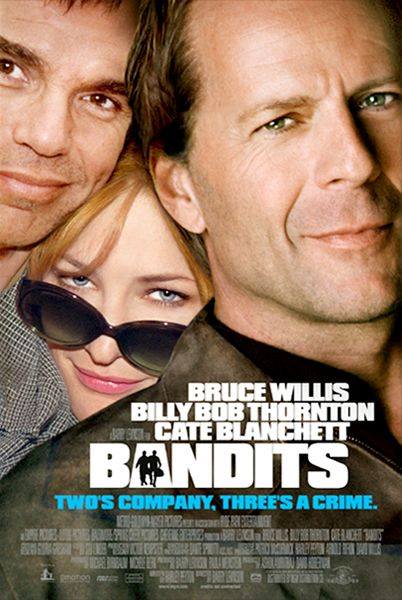
BARRY LEVINSON’S BANDITS – A REVIEW BY NICK CLEMENT

1

Barry Levinson’s Bandits is a film that I really enjoyed when I first saw it in theaters back in 2001 and it seems to be playing a lot of late on the HD movie channels. And every time I come across it, I can’t help but check it out, because it’s always insantly entertaining. It’s fun. It’s witty. It’s VERY clever. It’s got a great sense of casual style which was captured by the great cinematographer Dante Spinotti. Bruce Willis and Billy Bob Thornton were a terrific team with lots of chemistry, and Cate Blanchett has rarely been more sexy and fun and loose in a role. The ending is magnificent, to be honest – it’s a great twist that makes sense and that you never see coming, even if it’s been hinted at previously in the twisty narrative. Bank robber movies have been done to death, but there’s something unique about this mostly unsung effort that’s sort of hard to exactly pinpoint. I can remember laughing out loud in the theater over the ingenuity and the unexpected nature of the final moments. Harley Peyton’s perfectly calibrated screenplay knew when to be funny, knew when to be serious, knew when to be romantic, and knew how to pile on the incident and action, showing a total mastery of tone and really treasuring the element of surprise. Levinson’s career has been all over the place, with lots of great films, a few total duds, and dependably solid work in between; this is easily one of his most underrated efforts.

RON HOWARD’S FROST/NIXON — A REVIEW BY NICK CLEMENT

frost nixon

Frost/Nixon is one of those historical dramas with a predetermined ending that somehow never fails to be anything less than mightily entertaining. Reprising their stage roles, Michael Sheen is David Frost, the wild British talk show host who bought himself an interview with Richard Nixon, played by Frank Langella, after he had left office. Crisply directed by Ron Howard from a witty and detail-oriented script by Peter Morgan (who also wrote the stage version), Frost/Nixon is an intimate time-capsule, going back to a time when an ex-President could be gullible (and conceited) enough to agree to a series of interviews without really doing his due diligence. Nixon figured that Frost would be a push-over, as nothing that Frost had done professionally up to that point had suggested any real depth or societal importance. Nixon was blinded by cash. But boy did he get what he deserved. Essentially, and I’m not really spoiling anything that anyone with a nominal US history background wouldn’t know already, Frost got Nixon to admit guilt in his role as President during the taped interviews, which would then be broadcast on world-wide television (and have been released on DVD). The film has a terrific supporting cast of some of the best character actors in the business: Sam Rockwell, Kevin Bacon, Oliver Platt, Toby Jones, Matthey MacFadyen, Rebecca Hall, and Clint Howard all turn in vivid performances. Howard directs in an unfussy fashion with a simple elegance coming from his director of photography, Salvatore Totino, who has been working with Howard for over a decade. Shooting the film with a burnished, gold-brown glow gave off a feeling of yesteryear which was integral to the production. Again, you know where the story is going and how it’s going to end; it’s just a question of how good the film is in getting you there. This is easily one of Howard’s best films to date, and one that stands up on repeated viewings.