ARI FOLMAN’S WALTZ WITH BASHIR — A REVIEW BY NICK CLEMENT

2

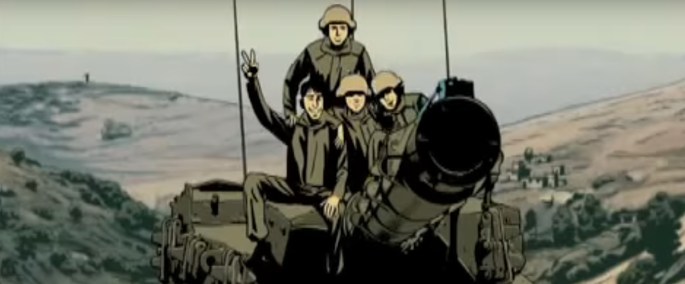
Ari Folman’s tour de force Waltz With Bashir is a mesmerizing visual experience that also packs an intense emotional wallop. Taking the form of an animated documentary, Folman narrates this searing portrait of war-time life with fellow veterans of the 1982 invasion of Lebanon in order to reconstruct his own memories of his military involvement during the conflict. The hallucinatory nightmarescape that Folman and his technical crew have created is nothing short of astonishing, and it’s truly unlike any film that you’ve ever seen. This isn’t rotoscope animation like Richard Linklater’s stunning neo-noir/sci-fi mash-up A Scanner Darkly, nor does it have the rounded-edge, glistening sophistication of a Pixar film. Waltz With Bashir is visceral, rough, demanding, and shocking; it’s a vision of “war as hell” in a manner that’s never been captured before, and that could likely never be repeated.

1

Taika Watiti’s What We Do In The Shadows: A Review by Nate Hill 

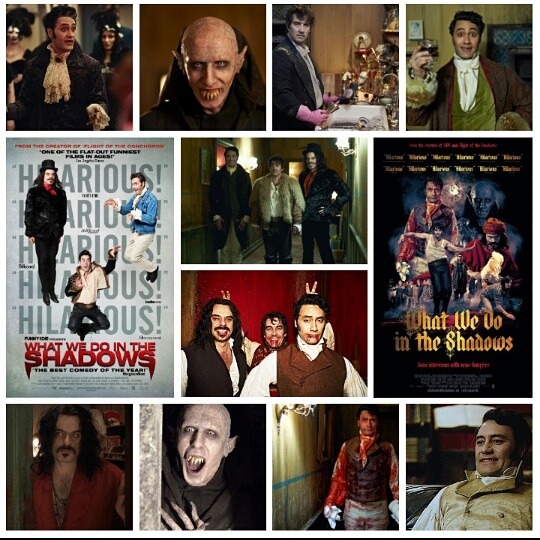
I don’t remember laughing as hard at a film in years as I did at What We Do In The Shadows the other night. It’s pure comedic bliss from front to back, and makes the often tedious chore of making an audience laugh seem effortless. It’s part horror comedy, part mockumentary with a dash of buddy camaraderie and and depth of wit and character all it’s own, thanks to New Zealand filmmaker Taika Watiti, who is fast becoming one of my favorite new voices in the independent field. A master at finding the humour in little moments and dry subtlety, his cameras spend a couple hours documenting pratfalls, squabbles and zany encounters wirh quartet of vampires living in Wellington, New Zealand, each one simultaneously a different caricature of bloodsuckers from previous lore, as well as a completely unique, hilarious individual. Jermaine Clement is the closest thing you’ll find to a household name amongst the cast as Vladislav, a Dracula esque, baroque vamp. Jonny Brugh is Viago, the musically inclined, Ann Rice incarnation, and Ben Fransham, plays Peter, a spooky eight thousand year old Nosferatu clone. It’s Watiti himself who steals the show though, as Deacon, a dandy of a Germanic royal who gets all the best lines and relishes them with adorable deadpan delivery every chance he gets. The film comes nowhere near the classification of horror, and in fact these four resemble a bumbling, lovable frat house, their vampiric nature treated lightly as they cavort about their everyday life like rambunctious nocturnal teddy bears. They navigate household chores, nightlife, inter species relations (there’s a few priceless encounters with a rival pack of werewolves), pesky humans, and have a ball the whole time through. What makes the film so special is the goldmine of comic skill and talent that both director and cast have tapped into. The relationships are unforced, full of idiosyncratic nonsense and always feel utterly organic. For a group of undead fellows, they truly are the life of the party. The documentary style never feels intrusive or irritating, seamlessly taking refuge behind the forceful and side splitting antics which take center stage for the entire film. Comedy is the hardest genre to produce fruitful results in, with horror a close second. What it takes to make you laugh can often be a rare gift, wielded by few and far between, those writers, directors and actors who have that elusive midas touch on our funnybones, combining just the right elements of script, improv and intuition to  get us laughing ourselves silly. This one achieves that and then some.

Taika Watiti’s What We Do In The Shadows: A Review by Nate Hill 

I don’t remember laughing as hard at a film in years as I did at What We Do In The Shadows the other night. It’s pure comedic bliss from front to back, and makes the often tedious chore of making an audience laugh seem effortless. It’s part horror comedy, part mockumentary with a dash of buddy camaraderie and and depth of wit and character all it’s own, thanks to New Zealand filmmaker Taika Watiti, who is fast becoming one of my favorite new voices in the independent field. A master at finding the humour in little moments and dry subtlety, his cameras spend a couple hours documenting pratfalls, squabbles and zany encounters wirh quartet of vampires living in Wellington, New Zealand, each one simultaneously a different caricature of bloodsuckers from previous lore, as well as a completely unique, hilarious individual. Jermaine Clement is the closest thing you’ll find to a household name amongst the cast as Vladislav, a Dracula esque, baroque vamp. Jonny Brugh is Viago, the musically inclined, Ann Rice incarnation, and Ben Fransham, plays Peter, a spooky eight thousand year old Nosferatu clone. It’s Watiti himself who steals the show though, as Deacon, a dandy of a Germanic royal who gets all the best lines and relishes them with adorable deadpan delivery every chance he gets. The film comes nowhere near the classification of horror, and in fact these four resemble a bumbling, lovable frat house, their vampiric nature treated lightly as they cavort about their everyday life like rambunctious nocturnal teddy bears. They navigate household chores, nightlife, inter species relations (there’s a few priceless encounters with a rival pack of werewolves), pesky humans, and have a ball the whole time through. What makes the film so special is the goldmine of comic skill and talent that both director and cast have tapped into. The relationships are unforced, full of idiosyncratic nonsense and always feel utterly organic. For a group of undead fellows, they truly are the life of the party. The documentary style never feels intrusive or irritating, seamlessly taking refuge behind the forceful and side splitting antics which take center stage for the entire film. Comedy is the hardest genre to produce fruitful results in, with horror a close second. What it takes to make you laugh can often be a rare gift, wielded by few and far between, those writers, directors and actors who have that elusive midas touch on our funnybones, combining just the right elements of script, improv and intuition to  get us laughing ourselves silly. This one achieves that and then some. 

The Screenwriter of SEAL Team 6: An Interview with Chuck Pfarrer by Kent Hill

This slideshow requires JavaScript.


When I think of the film Navy SEALs nowadays, that line of Randal’s from Kevin Smith’s Clerks is usually the first thing that pops into my head(I hope Chuck will forgive me):

Randal Graves: They never rent quality flicks. They always pick the most intellectually devoid movies on the racks.

Low I.Q. Video Customer: OOOOH! NAVY SEALS!

If this is Mr. Smith’s point of view on the movie then so be it. After this thought fades away though, I find myself placing Navy SEALs up there with all those glorious military/action movies from the 90’s like Fire Birds, Flight of the Intruder, Under Siege, Hunt for the Red October, the Iron Eagle films, just to scratch the surface.

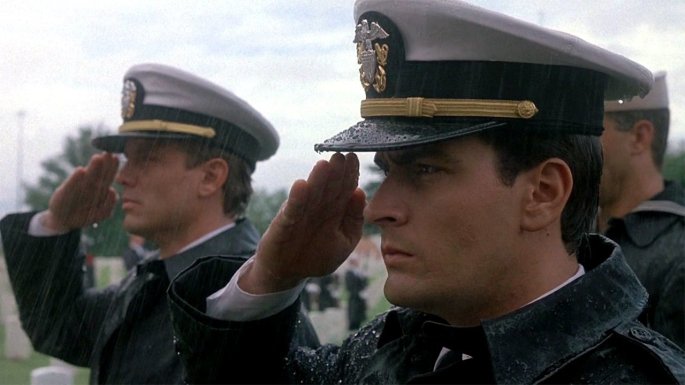
The film’s writer, Chuck Pfarrer was the perfect choice to pen such a movie – Chuck, you see, used to be a Navy SEAL. After graduating from military school plus two other colleges he went through Basic Underwater Demolition/SEAL training (BUD/S). Over the next eight years he racked up an impressive military career serving as a military advisor, training NATO forces, an executive officer of the SEAL Team assigned to the Multi-National Peacekeeping Force, before ending as Assault Element Commander at the United States Naval Special Warfare Development Group (DEVGRU), formerly known as SEAL Team 6.

Then Chuck went and did a crazy thing – he became a screenwriter.

With movies like Darkman, Barb Wire, Hard Target, The Jackal, Virus and Red Planet, plus uncredited writing on Arlington Road, Second Nature, Sudden Impact and The Green Hornet, as well as being author and creator of graphic novels for Dark Horse Comics, and writer/ producer on interactive full motion videos – all this on top of being a bestselling author – Chuck Pfarrer has traded one distinguished career for another.

Still the man remains humble and I was delighted to hear during one of our chats, that he refers to himself (as I do) as merely a scribbler. He has been busy promoting his new book Philip Nolan: The Man without a Country, but he has taken time out to have a chat about adventures in the movie business.


KH: Sir, it is a privilege for you to take time out of your busy schedule to chat with me?

CP: Thanks, Kent, for asking me.

KH: I am a big fan of both your fiction (Killing Che) as well as your non-fiction (Warrior Soul), but round these parts we talk about movies, so we shall focus on your screenwriting days if that’s okay?

CP: It’s absolutely true that screenwriting gets all the sizzle.

KH: So how did you get started in Hollywood?

CP: Oddly enough, I sold a couple of screenplays while I was in the navy. They didn’t go anywhere but they did get optioned and that encouraged me to try my hand after I got out of the Navy. When I left the SEAL Teams I was going to go to medical school to be a psychiatrist.  While I was waiting for acceptance into medical school, I sold a screenplay about Ernest Hemingway and I thought, probably naïvely that I should go to Hollywood and give screenwriting a try.  I got lucky and sold another screenplay based on my experience in the SEAL Teams. It became the movie Navy SEALs and based on that screenplay Sam Raimi hired me to write the film Darkman.

KH: Did the impact of Warrior Soul help when it came to shopping Navy Seals around town?

CP: Actually, I didn’t write Warrior Soul until I was pretty deep into my Hollywood career.   When I first sold the screenplay for Navy SEALs an editor at Knopf wanted me to write a book about the SEAL teams.  I refused because no SEAL had done that yet.   Richard Marcinko was the first SEAL to write about our community. Before that, no one in the Teams had written about being a SEAL. Navy SEALs are so famous now it’s hard to imagine that just about 10 or 15 years ago the community itself (and the government that hires us) considered the entire program too secret to write about.  With Warrior Soul I was only the third SEAL to write about SEAL Team Six, and I did so only after my commanding officer Bob Gormley wrote his book Combat Swimmer.  I didn’t want to be the first SEAL to write about SEAL Team Six.

KH: What was selling that first script like?

CP: The first screenplay I sold was actually about Ernest Hemingway’s life in Cuba. I sold that while I was still on active duty as a Navy SEAL. I co-wrote it with a great friend of mine, Richard T. Murphy, who was then in the MFA screenwriting program at NYU.  To our shock, our screenplay was nominated for Focus award and William Morris signed us both.  We suddenly found ourselves as working screenwriters.  It was especially strange for me because with that signing, I became the only Navy SEAL with a William Morris agent.

KH: You have created graphic novels, but your first clash with the comic book style world was working on Darkman?

CP: It was great working with Sam Raimi on Darkman. He’d recently finished The Evil Dead and had a really good idea about what he wanted to see in Darkman. Sam’s style is big and brash, and his films move by leaps and bounds. Sometimes it was a bit of a fight with Universal to make sure Sam got what he wanted.  In the end the battles were worth it.  We were all very happy with how the film came out and it was really a great honor to work with Sam, and a lot of fun.

KH: Let’s talk Hard Target, and your debut as an actor, you are Douglas Bender; killed in the film’s opening scenes?

CP: I was in New Orleans working with John Woo to make the movie, which was pretty unusual for a screenwriter but there were some small tweaks in the script that needed to be made as we went along. We were about three weeks from the wrap of the movie when John came to me and said, “I want you to play Douglas Binder”.  At that point in the draft we were shooting there really wasn’t much about the character Binder. As a victim, Binder had been basically a chalk mark on the sidewalk.   John and I went out to dinner and John told me about the 10-minute opening scene he had decided to do about the murder of Douglas Binder. It involved almost 10 days of shooting.  Binder winds up getting hunted all over the city of New Orleans, shot at, stabbed with arrows, run over by motorcycles, blown up and finally shot through with a cross-bow.   All very exciting — that is, until I wound up doing all of my own stunts. At the end of it I was black and blue. John Woo was also a director with a really clear vision and worked in a very collaborative way with the writer to get exactly what he wanted on the screen.   Working with John was a privilege.   He’s really an amazing and extremely creative guy.

KH: You now cross paths with another comic-book style piece in Barb Wire. Tell us of that experience?

CP: That was a nightmare. I had written a series of graphic novels for Dark Horse and they came to me and wanted me to do a rewrite on the script. I read it; it was bad, and I passed.   They came back and asked again.  I kept declining and the “negotiations” finally reached the point where the money they were offering was absolutely ridiculous and I said yes.   I had just finished the shooting script for The Jackal and I thought what the hell.  I thought I would be just another anonymous pencil trying to make the script into something.  The script was so bad I thought I could make it better, but I was wrong. It turned out that by the time I started working on the screenplay for Barb Wire, the previous writer had already submitted paperwork to take her name off the movie.  The fine print of my contract prohibited me from taking my name off the final product.  No matter what I came up with for the script, the notes from the studio never allowed me to make any real changes to improve it.   I thought the whole thing would go away, but the movie got made, it came out, and it was a train wreck.   And my name was on it.  It’s funny now.   The movie they made was so bad it even got a Razzie award.  It just goes to show that you should never do things you don’t believe in, and you should always read the fine print of your contracts.

KH: Bruce Willis is The Jackal. How did this gig come across your desk and did you have the opportunity to meet Bruce?

CP: I was at Universal and finishing up a three-year deal. The studio came to me and told me they had just bought the rights to The Day of the Jackal and asked me if I wanted to write a remake. I said no. However, the studio gets what it wants.  Eventually, they twisted my arm and I said yes.   During the time I was writing it they were vacillating a bit about calling it a remake.  I submitted the script and they were actually very happy with it.  We went right into preproduction.   I thought that they were no longer going to call it a remake, but simply just set it up as a brand-new movie.  Wonderful, I thought.  There won’t be any blowback from fans of the original film.  When they cast Bruce Willis and Richard Gere I was even happier because I realized they were going to make a serious movie out of it.  On most of my movies, I wind up training the actors how to use firearms, how to shoot and move, etc.  Diane Venora, who played the Russian investigator, worked for about a week with me on the LA SWAT Team range in LA.  I didn’t work very much with Bruce—his schedule was full right up until shooting.  I saw him on the set, of course, and talked to him as we worked.  But to me the biggest thrill on The Jackal was getting to work with Sidney Poitier– probably the only time in my career that I was ever star struck.   He was a joy to work with, a craftsman, a professional and a gentleman of the old school. Just to add it too—he did his own stunts!

KH: Virus I thought was a great movie and Donald Sutherland was delicious in his role. The film is based on the graphic novel of your creation?

CP: I pitched Virus to Universal at the beginning of my three-picture deal and they passed on it.   So I went ahead and wrote the series of graphic novels using the idea for Dark Horse.   They wound up selling 400,000 copies.   I went back to the studio armed with the four graphic novels, and the studio saw the potential, and told me to write it. Virus was made on the cusp of the age of digital filmmaking.   It was a story about bringing to life machines infected with a digital “Virus”, machines that could replicate themselves and use human tissues. It called for some really complicated effects.   The studio spent millions building the machines used in the movie.  The digital image technology just wasn’t there yet.  And there were some huge hurdles for the filmmakers to get over.  To be honest, I didn’t care very much for the movie.  I was rewritten and I didn’t think that the real human drama of the “events” came through.  

KH: Writing comics and also video games; was it a case of something you always wanted to do, or is it an opportunity seized upon?

CP: I was approached by Tusmani Media just after we made Virus to make interactive movies. They had a new technology that allowed them to vary story paths in video and they asked if I’d be willing to write them a script.   We did Flash Traffic and then Silent Steel.  Again, this was on the cusp of the digital age—we did some heavy-lifting.  It was really interesting for me to write scripts with multiple outcomes.   They weren’t shooter games—they were interactive thrillers.   We were doing things then that no one had ever done.   Now with GTA and products like it, “interactive” stories happen every day.  It was really great to help take that from theory to reality. There are still things yet to be done with the technology. 

KH: You got Val Kilmer to the surface of the Red Planet which was shot in my neck of the woods, Australia?

CP: It sure was. We were originally going to shoot it in Namibia.  I was going to direct it, but the studio went in another direction, and I was thrown a bone as Executive Producer.    The original script was called “Alone”, and like “The Martian”, it was about one guy, alone on the surface of Mars.  It was the studio that added three other guys.  I guess the original screenplay was the way to go. Fifteen years later someone shot something very like the original script and it was extremely successful.   One of the big frustrations about being a screenwriter is that your work passes through other “creators”.  When they improve the work, it’s great; when they drive it off a cliff, the easiest thing to do is blame the original writer!

KH: Like Bill Goldman, do you have any interesting tales that have not surfaced from the Screen Trade?

CP: Bill Goldman said it all. Almost everything he said in the book happens everyday to screenwriters in Hollywood.   Sometimes working in the process is great; sometimes it is a complete stick in the eye.   Part of it is the way the Guilds are set up.  If a director is hired for a film, that’s it—he is the director.  When a writer comes up with an original screenplay and the studio buys it, the studio is free to hire a dozen other writers to “improve” the screenplay. It is interesting what is happening now in TV. Writer/creators have the power to maintain their original idea—and that has been an epic move to correct the abuses that happen in feature film. When the studios hire a writer-creator to run a show, the vision gets to the screen.     That has changed series TV but feature films are going to stay as frustrating as ever.

KH: I found you have done uncredited script work or punch-ups as it is sometimes referred on scripts like Arlington Road, Sudden Impact, Green Hornet. How does this work come to you and is it tiresome to do such work and yet remain uncredited?

CP: It’s just part of the job. Sometimes it’s a lot like being a session player on an album.  You are hired as a technician a lot of times to come in and “punch up” the dialogue or get the plot sorted out.   The problem with changing anything in a screenplay is that it soon becomes very, very complex.  A small change in act one reverberates though the entire movie.   The crediting process through the writer’s guild is also complex.    For the most part, I think it is pretty fair.  I know the process is as honest as it can be.   In most cases, when I do a rewrite, I don’t ask for credit.   Arlington Road and Green Hornet are examples of work I did without credit. With Second Nature I didn’t even know they were shooting the script–and a lot of what I did went into it. 

KH: You’ve not had a film out since Red Planet; are you still developing scripts and what is the status of your latest film Crash Site?

CP: I have a few things in development– the effort goes on. As far as Crash Site is concerned, it is no longer being developed by ALCON. It is in turn around, in the hands of another producer. But I am working mostly now as a novelist.   I have a historical novel, Philip Nolan: The Man without a Country, that just came out from the Naval Institute Press, and I am working right now on a thriller.   It has been amazing to me how differently writers are treated in publishing and in screenwriting.  In publishing, the writer is the creator, and in screenwriting the writer is an expendable commodity.    The important thing—always—is to create believable characters and put them into interesting plots.   That’s the joy of the process for me.  That, and entertaining the people who see my movies or read my books. 


Again I offer my thanks to Chuck, for not only his generosity, but for taking the time out of busy schedule for this interview. He is a gentleman and a scholar, as well as being a truly unique and interesting character whose life and career are to be marvelled at.

All the films he has written are widely available on DVD and Blu-Ray. Below I have placed links to his books so that you may see for yourselves that he not simply a screenwriter or a novelist – but a great writer in general…

https://www.amazon.com/Philip-Nolan-Man-Without-Country-ebook/dp/B01CN2L7VI/ref=sr_1_1_twi_kin_2?s=books&ie=UTF8&qid=1480462242&sr=1-1&keywords=chuck+pfarrer

https://www.amazon.com/Warrior-Soul-Memoir-Navy-SEAL-ebook/dp/B000FC0XZK/ref=sr_1_3_twi_kin_2?s=books&ie=UTF8&qid=1480462242&sr=1-3&keywords=chuck+pfarrer

https://www.amazon.com/SEAL-Target-Geronimo-Inside-Mission-ebook/dp/B006BDDU4S/ref=sr_1_4_twi_kin_2?s=books&ie=UTF8&qid=1480462242&sr=1-4&keywords=chuck+pfarrer

https://www.amazon.com/Virus-Graphic-Novel-Chuck-Pfarrer/dp/1569713170/ref=sr_1_6?s=books&ie=UTF8&qid=1480462242&sr=1-6&keywords=chuck+pfarrer
MICHAELANGELO ANTONIONI’S THE PASSENGER — A REVIEW BY NICK CLEMENT

1.jpg

The Passenger is in my top 50 films of all time and is an absolute masterpiece of cinema. Jack Nicholson has never been more enigmatic or casually paranoid. Released in 1975, the quietly sinister narrative cooked up by screenwriters Mark Peploe, Peter Wollen, and director Michaelangelo Antonioni keeps you guessing all throughout, as nothing is as it seems in this picture. The impossible to understand tracking shot towards the end of the film still makes no sense even after you’ve seen how it was done – TRUE MOVIE MAGIC. Cinematographer Luciano Tovoli’s work on this film is nothing short of awe-inspiring. Nicholson plays a journalist who assumes the identity of a dead businessman while he’s on assignment in Africa, without realizing that he’s inadvertently posing as an international arms dealer.

2.jpg

Things get even more complicated when the beyond-sexy Maria Schneider appears. There’s a sense of the unknown to this film that keeps inviting me back for multiple visits per year. Seeing this on the big screen in Los Angeles, with a very stoned audience, was a major highlight; I can remember people blazing-up in the NuArt on more than one occasion. Antonioni made some truly breathtaking films (Blowup, Red Desert, La Notte, L’Eclisse, L’Avventura, Zabriskie Point) but this one is likely my favorite. All of his films require the proper state of mind before delving in, but once you’ve “gotten there,” there are few places more heady and exciting. Immediately engrossing and hugely ambitious, this is an existential drama like no other, a piece of introspective cinema that gets richer and richer with each experience.

3

Captain Fantastic – A Review by Kyle Jonathan

Captain Fantastic

2016.  Directed by Matt Ross.

captain-fantastic-movie-slice-600x200

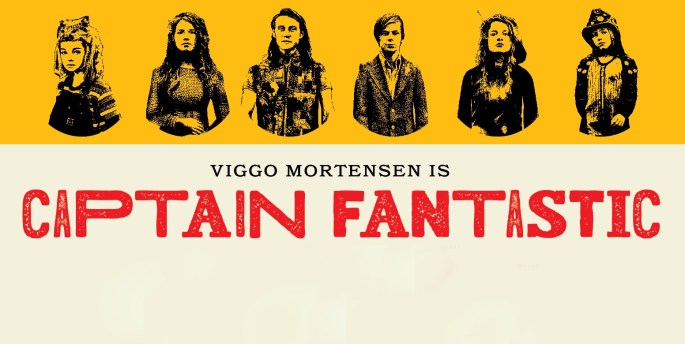
There are countless stories about families who chose to live off the grid, with each version either being a cautionary tale about isolation or a sly commentary on the advantages of living outside the comforts of modern society.  Matt Ross’s exceptional feature film, Captain Fantastic manages to walk the divide between these extremities, delivering a dissenting lead performance, vibrant watercolor visuals, and a touching script that both glorifies personal freedom and stresses the importance of societal connections.

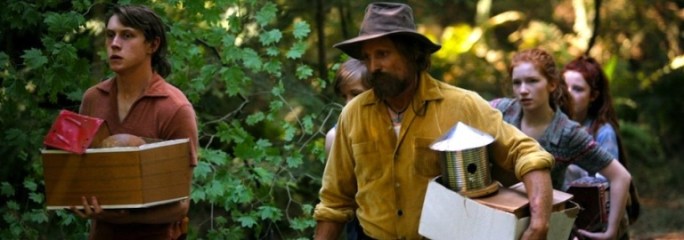
Ben and Leslie are raising their six children in the wilderness of the Pacific Northwest.  Ben is a charismatic intellectual who believes capitalist society is fraudulent and uses philosophy, classical literature, and social discourse as a means to instill his world view in his children.  A tragedy leads to the family returning to the confines of the big city, challenging Ben’s authority as his patchwork clan mingles with accepted civilization, bringing to the surface rebellious intentions, fatherly guilt, and familial discord.  As a result, Ben is forced to confront his perceived nobility and the cost of raising children in his own, elitist vision rather than the flawed, but worthwhile reality in which we’re all a apart of.

captain-fantastic-film-22_article-detail

Viggo Mortensen gives one of the strongest performances of his career as Ben.  Ross’s script is full of memorable and hilarious exchanges, the bulk of which involve Mortensen explaining the workings of the world to his children with an anthropological presentation, devoid of emotion or connection.  Initially, the various rhetoric used by the children to verbally spar with their father is unappealing, appearing to be a counterculture refutation delivered with cult like fervor.  However, as the narrative unfolds, the various philosophical and religious dissertations become symbols of Ben’s sorrowful existence and the educational prison that he has built around his children, in which learned anarchist knowledge is the key to their deliverance.

Stephane Fontain’s cinematography blooms with natural colors, capturing the rugged landscape and Ben’s commune with wide shots that highlight the splendor of the hidden sanctuary.  Courtney Hoffman’s costume design, particularly with the family’s ceremonial attire in the first act has a lived in quality that becomes more and more removed as the the film continues.  The highlight comes in the family’s hippie drenched livery that they don to attend a service that is the centerpiece of the story.  While the costumes have an out of time theme, it’s the idea that this family, for better or worse, is a singular unit that resonates.

1892

Captain Fantastic is a story about familial identity, and while it is somewhat predictable, it’s the journey that matters.  Everything is in transition.  The emerald forests give way to looming towers of concrete while the children begin as supplicants and grow into independent and often comically self aware renegades.  The film’s greatest concession, that every rebellion ends on the home front, doesn’t diminish Ben’s philosophy, but rather welcomes it’s turbulent mantra into the merry go round of parenthood, ending with a tear inducing rendition of an 80’s classic that heals the wounds of regret with compassion and acceptance.

Available now for digital rental, Captain Fantastic is a predictable, but profoundly moving example of picaresque parenthood.  While the viewer only gets a glimpse into the family’s rigid customs and anti-capitalist anthems, these concepts are interchangeable with the various rites and traditions of any family.  Parenting, and the importance of family is what this film is ultimately about.  Featuring an unforgettable performance and a genuinely heartwarming story about the importance of moderation and acceptance of what we cannot change, if you’re looking for an uplifting viewing experience, Captain Fantastic will not disappoint.

Highly recommend.

captain-fantastic-movie-pos

JUSTICE LEAGUE: FLASHPOINT PARADOX

​JUSTICE LEAGUE: FLASHPOINT PARADOX is my first foray into the DC animated feature film series.  It’s based upon a graphic novel, FLASHPOINT where The Flash goes back in time, preventing his mother’s death but by doing so he changes the trajectory of events that yields a dead Bruce Wayne, a rage filled Batman in Thomas Wayne who maliciously uses guns as his primary weapons, turning Martha Wayne into the Joker – basically most of all the heroes as we know are villains, and a few villains are heroes.

The animation draws the heroes in an obnoxiously muscular way, and some of the dialogue is almost intentionally lame, but with a voice cast of Kevin Conroy, Michael B. Jordan, Danny Huston, C. Thomas Howel, Kevin McKidd, Nathan Fillion, Dana Delany, Cary Elwes, and Ron Perlman – it’s pretty good.
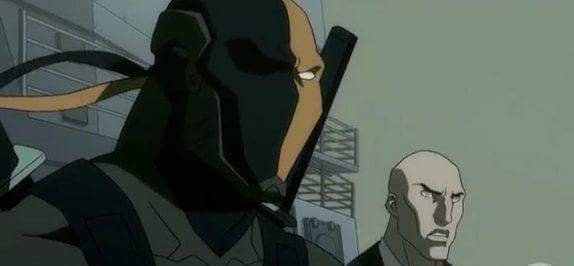
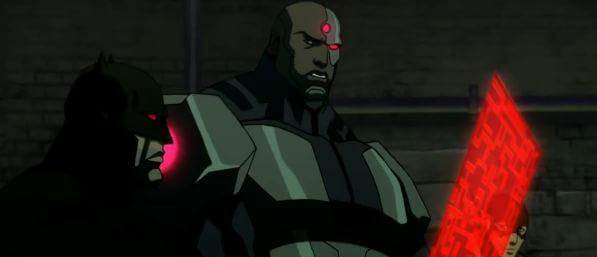
Seeing the heroic DC Universe flipped, where Batman is killing everyone, Wonder Woman is beheading Atlantians, and Deathstroke and Lex Luther are fighting with Cyborg and the military against the meta-human war between Wonder Woman and Aquaman, all in all it’s a pretty fun watch.  PARADOX proposes itself as a rich “what if” in an already interesting universe.

If you are rabidly awaiting the onslaught of the DC Cinematic Universe, this film is a fun introducrion into who the heroes and villains you’ll eventually see on screen are.  Or, if you’re like me and don’t know a lot about some of the deeper characters in the DC Universe, this is a quick film that is certainly worth checking out.

JUSTICE LEAGUE: FLASHPOINT PARADOX is now available to stream on Netflix.

ROBERT ZEMECKIS’ ALLIED — A REVIEW BY NICK CLEMENT

3

Allied is an old-school entertainment made with new-school aesthetics, a film that feels refreshingly out of step from the constant demands of the studios: a star-driven, non-franchise, and thoroughly polished piece of filmmaking for adults that carries the express purpose of providing a good night out at the movies. Directed by Robert Zemeckis (one of our last true movie-magic showmen) and written by Steven Knight (Locke, Dirty Pretty Things, Peaky Blinders), this extremely well-crafted film benefits from an excellent third act, luxurious production values, and nearly blinding star wattage from the extra-glamorous duo of Brad Pitt and Marion Cotillard. The two of them play spies who meet up on a job in Casablanca in 1942, looking to assassinate a high-ranking Nazi commander while posing as husband and wife. The opening passages of the film certainly evoke all of the movies from yesteryear that the filmmakers so obviously are in love with, while Knight’s script stays intimate with the two main characters for the entire piece, allowing for playful banter and unexpected surprises. But the hook of the film rests on the juicy notion that the wife might really be a German spy, making things all the more complicated as the two lethal love-birds have gotten married and moved back to London during the height of the war. If she’s in fact a spy, Pitt has been given orders to execute her on the spot. Is she or isn’t she, and will he or won’t he?

2

When I first saw the trailer, I figured that the overall effectiveness of the film would rest in the finale, and how the ultimate reveal would be treated and dealt with. And while I’d never risk spoiling anything that goes down in this confident and glossy confection, I’ll allow that the third act is genuinely riveting, with Zemeckis ratcheting up the suspense thanks to supremely tight editing by the team of Jeremiah O’Driscoll and Mick Audsley. The gorgeous widescreen cinematography by Don Burgess is aided immensely by the seamless integration of some sensational CGI/special-effects and the evocative production design from Gary Freeman, while Pitt and Cotillard both look too sexy for words, costumed to an inch of their lives by designer Joanna Johnston, with Pitt digitally scrubbed into Golden Boy Adonis mode, and Cotillard radiating sensuality and potential duplicity at nearly every turn. Knight’s sharp and smart script features strong dialogue, sensible plotting, and nothing that felt over the top or unnecessary. Alan Silvestri’s score hits all the proper notes no matter the scene. And for Zemeckis, his work on Allied marks yet another surprise effort after so many intensely CGI-driven spectacles, pairing extremely well with his Denzel Washington collaboration, Flight, in that they’re both decidedly R-rated endeavors that will appeal to an older audience and likely to nobody else. I loved how this film felt like one of those vintage studio programmers from back in the day, except gussied up with sex/nudity, bloody violence, and salty language.  This is a robust piece of work from everyone involved.

1

Certain Women – A Review by Kyle Jonathan

Certain Women

2016.  Directed by Kelly Reichardt.

685425p19685ednmain3474certainwomen-lowres-1

Cautious.  Intimate.  Entrancing.

Kelly Reichardt’s loose triptych of Montana women is one of 2016’s most resonant films.   Using three vignettes to distill the American female identity, Certain Women is an immaculately constructed poetic vision.  Featuring lush visual compositions and potently restrained performances, this is an unflinching dissection of everyday life from the feminine perspective.

Laura is an attorney who is in a sexual relationship with a married man.  Her current case involves a disgruntled worker who refuses to heed her advice, and seemingly submits to the same encouragement from a male colleague.  Gina is a married woman who, along with her husband, attempts to purchase a pile of sandstone from an elderly man who pretends that she does not exist.  Jamie is a lonely ranch hand who enrolls in an educational law class.  She befriends Beth, the attorney teaching the class and goes to great lengths to find a connection, despite Beth expressing her disdain for the trip she has to make to teach the class.  All three stories are lightly interwoven to deliver a devastatingly quiet premise on the human condition.

kristeninner

Reichardt adapted her script from stories by Maile Meloy.  The dialogue is simplistic and pointed, but never pretentious.  There is no mystery to unravel or hidden meaning to uncover.  This is life on display, and Reichardt’s steady hand delivers a thoughtful slice of Americana that evokes Ozu’s glacial sentimentality throughout.  Christopher Blauvelt’s rustic cinematography harmonizes perfectly with the  somber atmosphere, capturing the Montana landscapes with a laconic sense of observation.  The world of Certain Women is remarkably beautiful, but also shackled by a sense of longing that is purveyed in virtually every scene.

Lily Gladstone as Jaime is the standout.  Her ability to communicate unrelenting loneliness with virtually no dialogue is a triumph that cannot be overstated.  Her scenes with Kristen Stewart, who does an excellent job with a minimal role, are the heart of the film.  Despite the events being uncertain, Gladstone denies the viewer any chance to pity her character, persevering through heartbreak by mechanically returning to her daily routine, signifying the film’s core inspection of everyday life.  The lack of overt drama may be off putting, even boring to many, but the payoff is in between the exchanges, with needy stares and knowing smiles filling the small universe of these women with an uncommon sense of realism that is too often lacking in the box office experience.

408668

Laura Dern, Jarred Harris, and long time Reichardt collaborator Michelle Williams round out the cast.  Dern and Harris’s chemistry, in what is arguably the film’s greatest exchange, is a masterful display of two lost souls warily treading through an emotional minefield.  The two actors put everything into this scene and despite its ferocity, the fact that it remains in tune with the film’s hushed ambiance is a credit to their talent.  Michelle Williams has the least amount of screen time, but she does wonders with what time she has.  Her portrayal of a married women in a man’s world is thoughtfully accepting, broadcasting an aura of submissive ignorance under which lies a furnace of discontent that will never be ignited, for to do so would undo the social harmony that has become the expectation of a nuclear American family.

In select theaters now, and hopefully coming to digital soon, Certain Women has garnered a plethora of Independent Spirit Award nominations and is slowly emerging as an Oscar hopeful.  Featuring a profound breakout supporting performance, pristine visuals, and an unusually grounded story, this is one of 2016’s must see films.  If an artistic approach to deliberately straightforward material interests you, give this one a chance.

Highly Recommend.

certain-women-poster-1024x538-623x350

STANLEY KUBRICK’S THE KILLING — A REVIEW BY NICK CLEMENT

1

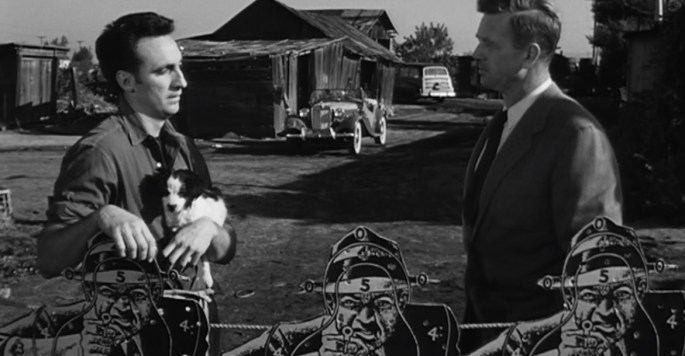
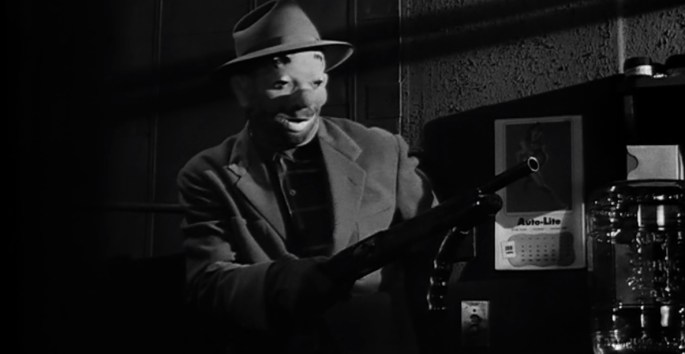
The Killing is quite possibly Stanley Kubrick’s most outright entertaining film, and it’s definitely at the top of my list in terms of favorite noir crime thrillers. Released in 1956, this was Kubrick’s third feature film, and was based on the Lionel White’s novel clean break; Kubrick and Jim Thompson co-wrote the adaptation. The plot centers on a complicated robbery during a horse race and the various double and triple crossings that occur due to everyone in the narrative being extra-duplicitous. Sterling Hayden was super manly, fronting a terrific ensemble which included Coleen Gray, Vince Edwards, Elisha Cook Jr., Marie Windsor, Jay C. Flippen, Ted de Corsia and Timothy Carey.

2

The stark black and white cinematography by Lucien Ballard was a perfect match for the pulpy material, while the dialogue zings, zigs, and zags with punchy grit due to the stern line readings. The ending is appropriately tragic, never letting anyone off the hook. Despite excellent critical notices at the time of its release, the film failed to secure a traditional release from a major studio, and quickly died with audiences. But many people consider it to be the first film to truly show off some of his more trademark aesthetic touches, and would pave the way for Paths of Glory, which would follow the following year.

4