CARLOS – A REVIEW BY J.D. LAFRANCE

Carlos

Notorious international terrorist Ilich Ramirez Sanchez a.k.a. Carlos the Jackal came to prominence in the 1970s and 1980s with several politically-motivated bombings, kidnappings and hijackings in Europe and the Middle East. He eventually became a popular culture icon with thinly-disguised depictions in films like Nighthawks (1981) and gracing the cover of Black Grape’s debut album. His image was used as a cultural touchstone rather than an accurate depiction. Incredibly, it wasn’t until Olivier Assayas’ ambitious, five-and-a-half hour miniseries Carlos (2010) that the man and his times were finally done justice. Assayas wisely doesn’t pass judgment on Carlos but rather depicts how he influenced the political climate and how it, in turn, influenced him. Far from a stuffy history lesson, Carlos is an epic political thriller with a charismatic performance by Edgar Ramirez as the infamous terrorist.

Carlos is presented in three, feature-length episodes that track his rise to power and notoriety; the man at the peak of his powers and his greatest triumph; and his inevitable decline and capture. Early on, Assayas establishes his take on Carlos (Ramirez), presenting him as a vain man who, at one point, is seen admiring his own naked body in a mirror to the strains of “Dreams Never End” by New Order. We also see him espouse his personal philosophy, that true glory is “doing one’s duty in silence. Behind every bullet we fire, there will be an idea because we act in harmony in our conscience.” And initially, he seems to adhere to this but once he becomes a superstar among international terrorists, he embraces and cultivates his inflated reputation.

In the first episode, Assayas shows Carlos’ clumsy attempts to impress Wadie Haddad (Ahmad Kaabour), co-founder of the Popular Front for the Liberation of Palestine (PFLP), with a bungled assassination and a failed bombing. This segment builds towards an intense showdown between French domestic intelligence agents and Carlos at one of his girlfriends’ apartment in Paris where we see just how dangerous he is when cornered. The second episode starts off literally with a bang as Carlos and his group arrives at the OPEC headquarters in Vienna and take oil ministers from all over the world hostage in 1975. This was his highest profile operation done at the height of his powers.

By the end of the second episode, Carlos has been kicked out of the PFLP and he starts up his own terrorist organization, effectively becoming a mercenary. The third episode tracks his inevitable decline as he wages a war of terror on France in the early to mid-‘80s after they arrest his wife and a close associate. It’s costly battle for both sides but more so for Carlos who can no longer rely on his reputation to get jobs or find safe haven in countries that used to be sympathetic towards him. He becomes more vulnerable to attacks because he has more to lose, chief among them a family.

Edgar Ramirez’s magnetic presence really comes across early on as he exudes the cocky confidence of the man and conveys his complete commitment to the cause he espouses so brazenly. The actor has Carlos’ terrorist swagger down cold, showing us the smooth ladies’ man with his perfectly coifed looks and stylish attire. Known prior to Carlos mostly for his strong supporting turn in Tony Scott’s Domino (2005), he finally gets to be front and center, playing the role of a lifetime: a larger than life historical figure in a sprawling epic. Assayas and Ramirez’s fascinating take on Carlos is that he viewed himself as a kind of rock star, a charismatic personality who clearly saw himself as someone of importance, destined to do great things. This is evident in the way Carlos idolized and emulated Che Guevara during the OPEC raid, sporting the iconic revolutionary’s trademark beret and scruffy facial hair look as if making a statement. Also, the rock star analogy is further explored in the use of post-punk music along with the third episode, which could be seen as Carlos’ “fat Elvis” period of decline. Ramirez commands every scene he’s in, especially the OPEC raid where he prowls around rooms and hallways, expertly orchestrating this attack in order to get what he wants.

In an intriguing break from tradition, Assayas eschews a traditional orchestral score for source music, predominately post-punk rock. The opening track is “Loveless Love” by the Feelies, which sets the tone of the film. As the song builds so does the tension of the scene it plays over – that of Carlos attempting to assassinate a pro-Israeli businessman in England. Assayas also uses a few tracks by Wire, one by A Certain Ratio and a memorable action sequence scored to “Sonic Reducer” by the Dead Boys. The attention to period detail and architecture is also excellent as Assayas takes us on a perverse travelogue through Europe and the Middle East with Carlos as our guide.

With its color-coded sequences and its objective direction that is slick and confident, Carlos resembles Traffic (2000) and Syriana (2005). These films are all ambitious and expansive in scope as they expertly blend personal politics with bigger political movements. Carlos is a towering achievement, a fascinating study of a man who was a reflection of the times in which he lived in and is embodied by Ramirez’s powerful performance spanning several decades. Assayas’ film is very relevant to our times as it examines the complex machinations of international terrorism with the agendas of terrorist groups clashing with that of the governments of countries all over the world. Carlos sees the struggle of the oppressed against imperialist regimes as a war that he helps fight. With the end of the Cold War, he is marginalized and considered a relic from a bygone era. Assayas has crafted an incredible film that is smartly written, well-acted and masterfully directed.

NEVELDINE/TAYLOR’S CRANK 2: HIGH VOLTAGE — A REVIEW BY NICK CLEMENT

1

Crank 2: High Voltage is absolutely insane. On purpose and by design. You likely already know if this bit of madcap lunacy is in your cinematic wheelhouse; those unfamiliar with the first installment are not likely to take this challenge. The plot here is the same as the original: Indestructible hitman Chev Chelios (Jason Statham) has to keep his heart pumping fast enough to overcome a ridiculous affliction, with the conceit here being that his own heart has been removed and replaced with an artificial one that requires electricity to operate. The gonzo-splatter filmmakers, Mark Neveldine and Brian Taylor (the first Crank, Gamer), are sadists of the first order. Here’s a random checklist of some of the cartoon-like atrocities that are displayed in this breakneck action movie: Anal-violation via shotgun; elbow-caps hacked off with machete; close-quarter machine gun shoot-outs; 10,765 old-school squibs being detonated; graphic and near pornographic sex scenes; gratuitous female nudity; Godzilla-style beat-downs (in the film’s most inspired sequence); casual racism; casual homophobia; casual misogyny; pitch-black humor – this equal opportunity offender has something hysterical and repugnant for every member of the extended family! I am able to easily award this amazing piece of trash four outta four stars. Four Big Ones. The film itself knows that it’s bonkers, and everyone involved in the making of it knew that it was bonkers. It doesn’t give a fuck what you think of it, and most enjoyably, it makes sense on its own terms. Extreme cinema like this lives in its own bubble, and I love these types of modern grindhouse efforts, as they typically all feature explosive stylistic ingredients that push various formal boundaries.

2

Sure, it’s nothing more than an R-rated Wile E. Coyote cartoon where nothing makes any logical sense. But the sheer energy and low-tech skill that Neveldine/Taylor brought to the table is simply staggering. Working with the daring and resourceful cinematographer Brandon Trost, the filmmakers shot this off-the-wall movie with 20, $1000 consumer-grade camcorders (or so I’ve read), resulting in a Tony Scott-on-a-sheet-of-acid aesthetic that will send anyone with any sort of spastic disorder into bouts of epileptic shock. The rogues gallery supporting cast is incredible, with the likes of Dwight Yoakam, David Carradine, a totally tripped-out Bai Ling, Corey Haim, Art Hsu, Reno Wilson, the amazing Efren Ramirez, and a snarling, extra-bad-ass Clifton Collins, Jr. as one of the chief baddies. Oh, and MAJOR shout-out to super-hottie Amy Smart, who again proved herself to be a champ on all fronts. She’s basically topless THE ENTIRE FILM, and her racetrack love scene with Statham is probably one of the longest, funniest, and wildest bits of simulated movie sex ever put on film. And what can you say about Statham that hasn’t been already said? He’s become his own brand, and even if I’m not in love with all of his actioners, when he wants to rip it up with full-force, he’s more than capable, and in the Crank films, he was able to cut totally loose and go for broke. Again – you’ll likely know before reading this review if you want to see this film. Is this the greatest movie ever made? No. But it’s an unqualified success based on its ambition, and no matter how depraved their vision may be, Neveldine/Taylor were clearly operating with a singular vision with this one.

3

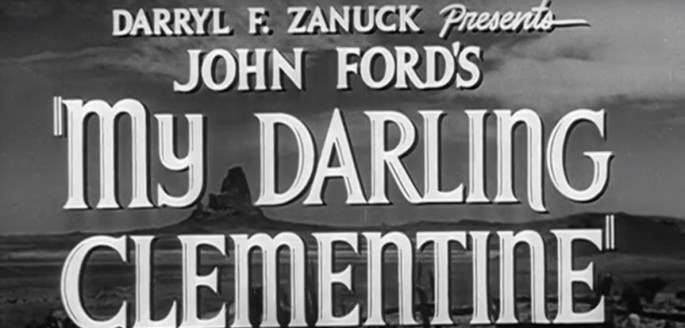
JOHN FORD’S MY DARLING CLEMENTINE — A REVIEW BY NICK CLEMENT

1

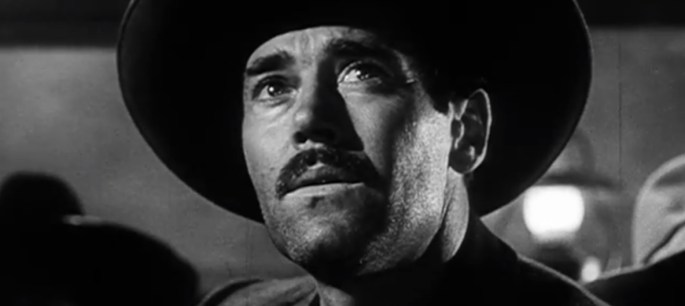
My Darling Clementine will always be my favorite motion picture from legendary director John Ford. There’s something so simple and elegant about the film, and the somewhat recently released Criterion Collection Blu-Ray features a stunning digital transfer, no blemishes to speak of, the shimmery and wonderfully detailed black and white cinematography filling the 1.33:1 frame in all its Academy-ratio glory. Despite the compromised post-production process, the film still stands as one of Ford’s most assured and distinctive works, the funereal tone creating a dreamy and melancholic atmosphere to the old west proceedings. Henry Fonda’s performance was laid-back brilliance, always allowing the story to come to him, instead of trying to dominate each scene with blustery acting techniques.

3

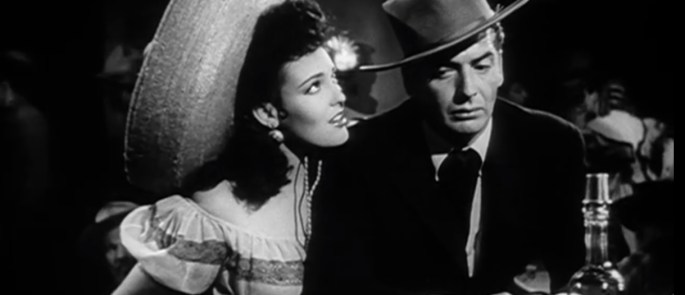
Victor Mature’s work as the alcoholic Doc Holliday is the stuff of cinematic dreams-come-true; it’s one of my favorite performances of all time and every time you observe his work in this film you are able to find new, sad grace notes. Light on gun-slinging but rich in subtleties and character, the movie sort of feels at times like an anti-Western, which is interesting given that it was made during the genre’s full swing and not during the revisionist period. Kevin Costner tipped his hat to My Darling Clementine repeatedly in his underrated 2003 film Open Range, which also features a gripping and deadly shoot-out at the finish. I love contemplative westerns where the dialogue is rich and the relationships are complex – My Darling Clementine fits that bill while also providing unforgettable imagery and projecting a quietly lethal sense of finality.

2

B Movie Glory with Nate: Double Team 

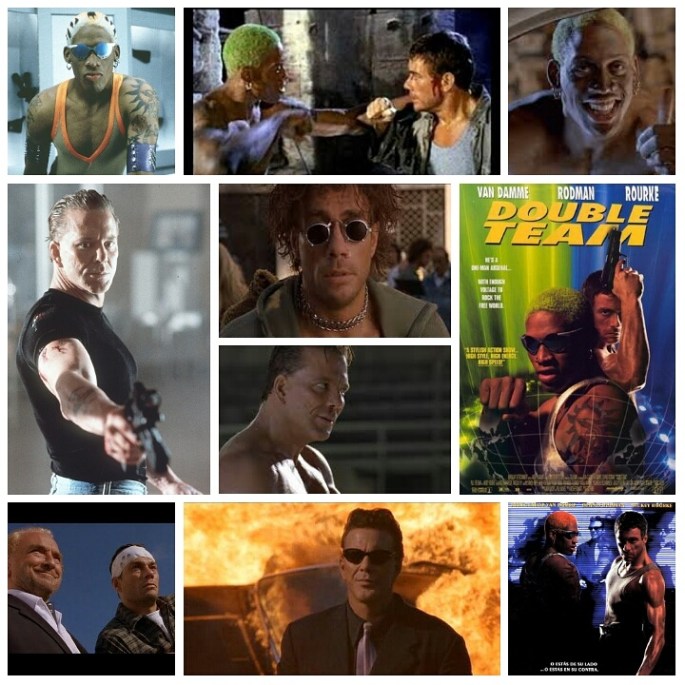
Double Team has to be seen to be believed. Hell, even the poster does. It exists in that delirious wasteland of the late 90’s action genre, a place where anything can, and does go. As the genre evolved, the scientists deep within Hollywood’s labs were trying out endless mind boggling action star team ups, even using a few celebrities that had never had a film to their name. In this particular twilight zone we get Jean Claude Van Damme and Dennis Rodman sharing a spotlight. There’s a pairing for ya. Van Damme plays a counter terrorist expert who miserably fails in preventing an attack from dangerous villain Stavros (Mickey Rourke), and is sent to The Colony, where disgraced agents are branded with all the snazzy technology the 90’s had to offer, after which being sent back into duty. He needs inside helps to track down Stavros, and finds it in beyond eccentric arms dealer Yaz (Rodman), a whacko who mirrors the man’s overblown real life persona. Together they make a run at Rourke, fireworks ensue, blah blah. It’s a crappy flick made noticeable by the strange presence of Rodman, and marginally watchable by Rourke, who actually gives Stavros the tiniest glint of surprising gravity, despite how downright silly the whole enterprise is. Loaded with cheese, dated special effects and clichés, it ain’t no picnic, but worth a glance during an inebriated late night channel switching blitz. 

THE MEN WHO STARE AT GOATS – A REVIEW BY J.D. LAFRANCE

bt7ul3laqprvmupqkhqw

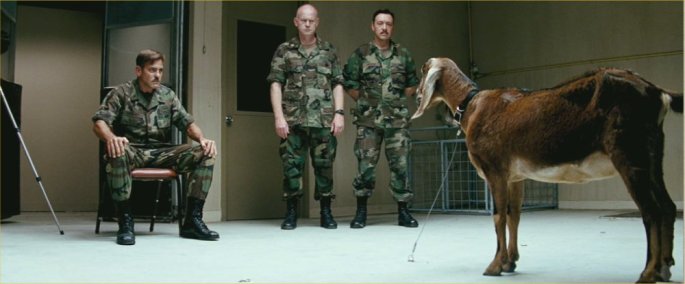
George Clooney is one of those versatile actors that can easily go back and forth between big budget studio films like Ocean’s Eleven (2001) and smaller, more personal independent films like Good Night, and Good Luck (2005). One gets the feeling that given his preference, he’d much rather make the latter than the former but he’s smart enough to know that doing the occasional studio film gives him the opportunity to make smaller films. One glance at the cast list for The Men Who Stare at Goats (2009) and you would assume that it was a studio film with the likes of Clooney, Jeff Bridges, Ewan McGregor, and Kevin Spacey involved. It’s the offbeat premise, however, that could only come from an indie film.

Inspired by Jon Ronson’s non-fiction bestseller of the same name, The Men Who Stare at Goats follows the misadventures of Bob Wilton (McGregor), an investigative journalist in search of a major story to cover. He stumbles across a secretive wing of the United States military called The New Earth Army, created to develop psychic powers in soldiers. These include reading the enemy’s thoughts, passing through walls, and yes, killing a goat by staring at it. While doing a story about a man (Stephen Root) who stopped the heart of his pet hamster with his mind for a local newspaper in Ann Arbor, Wilton finds out that this man used to be part of a top secret military unit of psychic spies in the 1980s. At least, that’s what he claims.

Understandably skeptic about the man’s abilities, Wilton learns about the former leader of the unit, Lyn Cassady (Clooney), “the most gifted psi-guy” who now runs a dance studio. After a co-worker dies suddenly and his wife leaves him for his editor, Wilton interprets these incidents to be a wake-up call and travels to the Middle East to cover the war. By chance (or is it?), while staying at a hotel in Kuwait, he runs into Cassady. This self-proclaimed Jedi Warrior (?!) tells Wilton about Project Jedi, a hush-hush assignment that cultivated Super Soldiers with super powers. Cassady’s technique for tapping into these powers involves drinking alcohol and listening to the music of classic rock band Boston.

Wilton learns all about this elite unit that combines “the courage and nobility of the Warrior” with “the spirituality of the Monk,” and follows in the footsteps of “the great Imagineers of the past”: Jesus Christ, Lao Tse Tung and Walt Disney. Wilton convinces Cassady to allow him to tag along during his mission in Iraq and the rest of the film plays out as a quirky road movie cum satire of war films.

George Clooney is quite good as the clearly bat-shit crazy Cassady. The actor plays the role seriously but you can see that insane glint in his eyes. It’s impressive how he is able to say some of his character’s ridiculous dialogue with a straight face. Clooney gets maximum laughs by playing it straight and is also not afraid to act silly when the situation calls for it. And it does in one of the film’s funniest set pieces during a flashback where Cassady’s New Age commanding officer (Bridges) loosens up the unit by having them spontaneously dance to “Dancing with Myself” by Billy Idol. It’s pretty funny seeing a bunch of uniformed soldiers, Clooney included, dancing their asses off.

Clooney is surrounded by a very impressive supporting cast. Jeff Bridges plays a peace-loving high ranking soldier, sort of the Dude if he had been drafted instead of dropping out of society. Kevin Spacey is the black sheep of the unit and jealous of Clooney’s powers. Meanwhile, Ewan McGregor is the naive reporter and audience surrogate. They all get their moments to show their stuff but the film really belongs to Clooney and his seriously wacky character.

After making serious political films like Syriana (2005) and Good Night, and Good Luck, it’s nice to see Clooney starring in a political satire that is funny but still has something to say as it shows the absurdity of the war in Iraq. This is evident in a scene where Cassady and Wilton narrowly escape a firefight between two competing security firms. The Men Who Stare at Goats falls under the truth is stranger than fiction category as it presents a story populated by eccentric characters and tall tales, some of which might be true. Regardless, it is an entertaining film with a wonderfully oddball sense of humor in the same vein as other memorable war satires like M*A*S*H (1970), Catch 22 (1970) and Three Kings (1999). Don’t be put off by the setting. Although it takes place in Iraq, The Men Who Stare at Goats is not weighed down by the baggage of this war.

Suicide Squad: A Review by Nate Hill 

Suicide Squad has left me so torn. On the one hand I just want to belligerantly profess my love for certain key aspects which I have salivated for for a long time now, to blindly just say ‘nope. Fuck it, it’s great’, like that one stupid kid in class who just won’t back down from an argument he is clearly losing. On the other hand I do have to come to terms with the very real, very problematic aspects to the whole thing, weigh it out rationally (not something I’m great at) and make heavy mention of what didn’t work (not something I enjoy doing). I also have a massive bias towards DC as well, particularly all things Batman and foes, so that needed to be taken into account too. 
  Let’s get what didn’t work out of the way: everyone is hearing that the film is a mess, and I can indeed say that yes, it’s one huge jumbled mess, like twenty unmade beds tossed into a washing machine together. It’s heavily edited in places that could have used fluidity, and flatlines in other spots where a bit of frenzy would have worked better. It’s scant on character, frankly because there are too many, packed with a soundtrack that has it bursting at the hastily sewn seams, drastically and obviously cut in specific places that are noticeable holes in which you could drive the Batmobile through, and burdened with a lazily assembled antagonist who doesn’t deserve the heroes they rumble with. That’s just off the top of my head. 
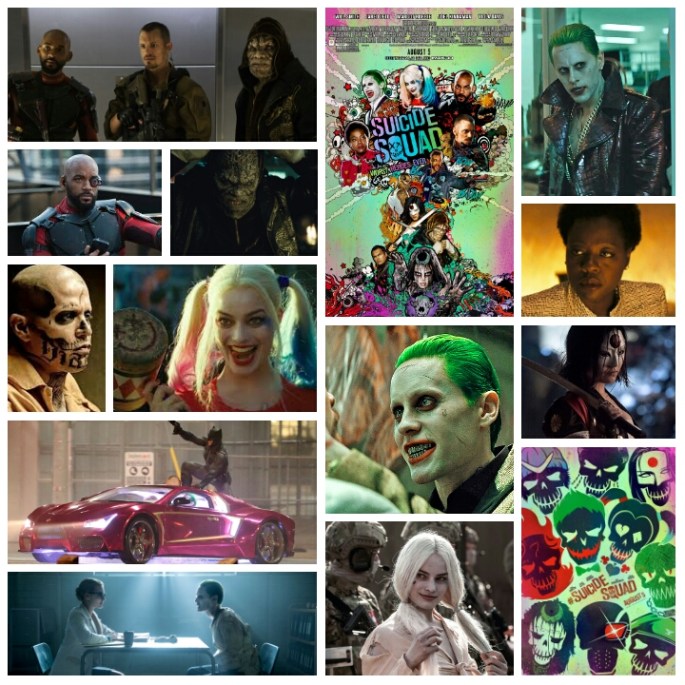
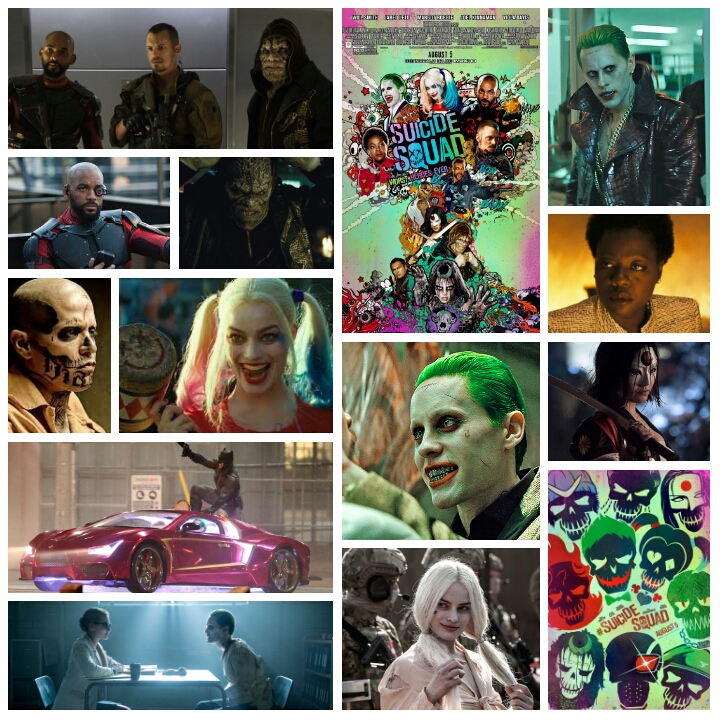
  Now, what worked: There’s a silver lining to the inane madness of the film, because in it’s confusing symphony of random candy coated antics it almost finds a trace of a beat, a rhythm that’s almost decimated by the chorus. I’m not excusing the hackjob of editing or cuts, merely saying that with all taken into account, it kind of takes on a life of it’s own that while completely tone deaf, is never boring. Let’s talk about Harley Quinn and The Joker. When the Blu Ray comes out with all them deleted scenes, I’m going to make a personal fan edit that sheds the spotlight on all the nastier stuff we missed in the theatrical version. The stuff we do get to see with Harley is pure magic, and Robbie owns the film. Maddeningly sexy, sketchy, dangerous, cute, and gloriously insane, she nails it to the wall in terms of what makes the character so special. Jared Leto as The Joker is…. different. While I didn’t like the laugh (he sounded like a geriatric hyena), I really took a shine to the direction they went with the clown this time around. A pasty ghoul who is sick with weirdo ‘love’ for Harley, this is a Joker who is way more in tune with the comics version than Ledger was. There were a few off key mannerisms and questionable little things, but for the most part I’d say he rocked it, and I’m stoked to see him square off with Batman in a standalone flick. 
  So, the rest of the squad. They’re a random bunch of nut bars who are hastily and over enthusiastically hurrah-ed onto stage by stone cold suit Amanda Waller (a terrifying Viola Davis), who is far more villainous than any of them. Davis is the consummate amoral politician, fuelled by gnawing xenophobia and given the power to push her unholy agenda to scary heights. Will Smith is a hoot as Deadshot, he just needed a little less mirth and a tad more menace in the mix. A joke or three sits well with me, but I don’t like wading through quip stew with thoughts of serious threat on the other side, only to find a backbone replaced by pining for his young daughter. Nothing wrong with pathos, but remember guys, Deadshot is a villain, and too much mush takes away from the street cred. Killer Croc is great when he’s around, which isn’t much until the climax where he gets a nice action bit, but still overall underused. I’ve been an avid non fan of Jai Courtney thus far, he’s just reeked of blandness. Well crikey, the guy does a nice job here of being the rambunctious bad boy of the pack, even if the reason for his inclusion in the squad doesn’t extend much farther than ‘he robbed every bank in australia’. Like… what? Joel Kinnaman holds his own as special ops asset Rick Flagg, and Cara Delevingne much less so as the gyrating, Grudge inspired Enchantress. She’s just not a powerful villain in any way, but damn if she didn’t turn heads in that little outfit. Cara actually fared way better as Dr. June Moon in what little time we spent with her, of which I would have loved to see more. Jay Hernandez is on fire (sorry) as Diablo, a flammable ex gang banger who grew a conscience to go with his pyrotechnic prowess. As far as Slipknot  (Adam Beach) goes, there was literally no reason, no reason at all for him to be in the film. Introduced as ‘the man who can climb anything’, he climbs like… one wall that anyone with his tools could scale….and then dies. Poor Adam. Karen Fukuhara is cool as Katana, but we’ve seen the hot Asian samurai shtick done to death, so it’s nothing altogether new. 
  No, the film rests on Joker, Harley and to a lesser extant, Batman. Old Bats is in it for two crucial scenes, one of which had me give out a roaring cheer, as it’s the type of thing I signed up for when I shelled out 22 goddamn dollars to see this in VIP mode. I kept wishing the whole time that I could make my own edit with all of David Ayer’s footage, because there’s so much gold found onscreen, and I know there’s more to be mined on the floors of his editing room, left there by the prudish anxieties of studio heads that just don’t. Ever. Learn. I want to see Batman and his villains thunder out in this blooming DC franchise, and while the rest of the more obscure faces in the squad are fun, I was in it for the core villains. All the stuff with Joker and Harley is inspired, and the car chase where the Batmobile tears after Joker’s purple Hotwheels Lamborghini is pretty much the best part of the whole film. I want more Batman and Co., for shit sake. In any case, there’s a lot of fun to be had, an endless grab bag of stylistic tricks, fonts, gimmicks, colors, sounds and chaotic hullabaloo running around. Some of it works. Some of it doesn’t. Tough shit. It’s certainly not a terrible movie, and I feel many critics resorted to the oft employed ‘knee jerk’ reaction instead of internalizing it all before brandishing pen and keyboard. Critics are a spastic lot of baboons who have have a tendancy, especially these days, to jump the gun and hurl verbal feces at stuff before it’s had a chance to sink in. I’ll concede that there are huge issues, but huge amounts of fun can be found too. Or not. It’s up to you. I certainly had some fraction of a blast watching it, and the only way I can describe the thing as an whole is the Looney Toons having a food fight with a bunch of fluorescent Lucky Charms. If that abstract picture chimes with you, chances are you’ll at least get some kind of kick from the this baby, and probably be just as perplexed by certain areas as I was. Good luck.

ABEL FERRARA’S FEAR CITY — A REVIEW BY NICK CLEMENT

1

Gritty integrity. That’s the promise you get with every single film by maverick auteur Abel Ferrara, the director of The Bad Lieutenant, King of New York, The Black Out, The Funeral, and so many other brilliant, transgressive pieces of searing indie cinema. His customarily seedy and sadly neglected 1985 masterpiece Fear City might just be one of his greatest and least celebrated pieces of work, a film that is so much a product of its time that it feels inconceivable that it could ever be made today. It also feels so much like the product of its creators that I could think of no other director’s name to appear in the credits. The ludicrous yet wildly entertaining plot concocted by frequent Ferrara collaborator Nicholas St. John couldn’t contain any more exploitive elements if it tried: There’s a karate-master serial killer on the loose in Manhattan, targeting the strippers who work at the various joints along Time Square, and it’s up to a down and out former boxer, the perfectly cast Tom Berenger, to figure out who is responsible while trying to protect his main squeeze, who may or may not be the killer’s next intended victim.

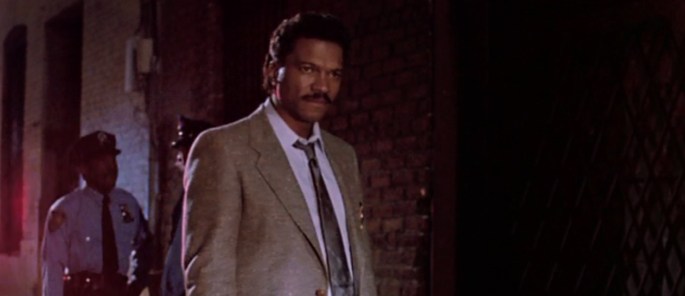
3This is a disreputable film, and right from the extra-sleazy start with the blood-red title credits splashed over a sexed-up montage of women of the night strutting their considerable stuff, you just know you’re stepping into Ferrara’s signature playground of eroticism and violence. The dark and purposefully smeary cinematography by James Lemmo captured NYC in all of it’s old-school, scuzzy splendor, highlighting shadowy alley ways and ominous street life, with streaks of bold color and flashing neon emanating from downtown. The eclectic supporting cast is impossibly cool, with Billy Dee Williams turning in one of his best performances as a determined detective, Melanie Griffith as Berenger’s ultra-sexy love interest, 80’s icon Rae Dawn Chong, Rossano Brazzi as Berenger’s buddy, Jack Scalia, John Foster, Neil Clifford, and Maria Conchita Alonso. The film was originally bankrolled and produced by 20th Century Fox, who then sold it after becoming concerned by the level of sordid elements. Dirty, raw, and with a constant sense of danger running all throughout, Fear City is a walk on the wild side for fans of this type of extreme, outlaw cinema. Available on Blu-ray from Shout! Factory.

2

The Last Outlaw: A review by Nate Hill


The Last Outlaw is a revenge themed western written by Eric Red, and if you’re at all familiar with his other works (he also penned The Hitcher and Near Dark), you’ll have some idea of how bloody and intense it is. It’s a smile story populated by hard bitten, gruff sons of bitches, and the violence comes fast and hard from all directions as soon as a few backs are stabbed, and several ravenous tempers ignited. Often in westerns the violence is clipped and minimal, the damage which a six gun does to flesh oddly shirked in favour of theatricality. This one has no use for that, and messily displays exactly what such a weapon does to people, repeatedly and with no discretion. It’s rough, gritty, Walter Hill style stuff, with not a trace of levity, smash or buckle, and every character kicking up dirt and anger the whole time. The film opens with a daring bank robbery, executed by former civil war Colonel Graff (Mickey Rourke), and his brutal gang. Their victory turns sour when mutiny looms among them in the form of Graff’s second in command, Eustos (Dermot Mulroney). He can’t abide by Graff’s sadistic methods, and bitterly betrays him. The rest is a bullet ridden cat and mouse game in the dusty deserts and shanty towns of the southwest, as the bodies pile up and the blood spatters in the dirt time and time again. Rourke is an implosive, grade A dickhead as Graff, a man less concerned with the fruits of his labor and more driven by the desire to exact violent retribution. One wonders if that’s what he’s in the game for anyway, to bide his time until something goes amiss, and the revel in the carnage. The supporting cast is just epic, with work from Steve Buscemi, Ted Levine, Paul Ben Victor, Richard Fancy, John C. McGinley and Keith David. It’s essentially one big stylish bloodbath, a pulpy ride through the gutter of arrogant machismo. Terrific fun, if that’s your thing. 

WON SHIN-YUN’S THE SUSPECT — A REVIEW BY NICK CLEMENT

1

Won Shin-yun’s breathless action thriller The Suspect is pure pedal to the metal adrenaline, but yet heavy on character and plot, so that by the finale, you’re totally invested in all of the various storytelling elements. I hadn’t heard of this movie until a friend suggested I see it, and thanks to Netflix streaming, this Korean ass-kicker should become a serious option for anyone looking for a high-octane antidote to the increasingly lackluster Hollywood action movie offerings. Centering on a top secret and ultra-lethal North Korean spy (the fabulous Gong Yoo) who is betrayed by his government and ends up on the run from multiple agencies, Shin-yun’s fast-moving actioner takes some sharp aesthetic cues from the hyped-up intensity of the Bourne movies and tells a thematically complex and astonishingly well-crafted tale of international espionage, using the man-on-the-run narrative conceit in a smart fashion, and allowing for some absolutely stunning action set-pieces to take center stage. We’ve seen the various plot ingredients before, but never done quite like this, and while the film could’ve benefited from some more judicious editing, I really responded to the character dynamics and the sociopolitical undertones to the screenplay.

2

There’s a mind-boggling car chase done half in reverse, shoot-outs galore, foot chases that seemingly break all the rules, and a tremendous sense of visual integrity in each and every shot. While watching a movie like this 2013 import, one becomes immediately reminded of how relatively barren and unexciting the American action film landscape has become. For me, with the exception of the visceral thrills of Paul Greengrass, the slick and gritty stylings of Michael Bay, and the promise that the John Wick-duo showed, there’s not much to be excited about. I’m consistently looking to the overseas action film market to get my ultimate genre kicks, which is how I was led to Gareth Evans and his two masterpieces, The Raid and The Raid 2. But something like The Suspect shoots up to the top of the charts, because it cares about all of the elements rather than just being a full on CGI-assisted sensory assault (whatever computer tricks that were used were flawlessly integrated). Exciting on nearly every level, exceedingly photogenic, forcefully acted across the board, and thoroughly rousing with an emotionally powerful and resonant final sequence, The Suspect is a true gem waiting to be discovered by action movie lovers.

3

ULTRAVIOLET – A REVIEW BY J.D. LAFRANCE

76546_original

Ultraviolet (2006) presents a future ravaged by a disease known as hemophagia that mutates its victims giving them enhanced speed, strength and intelligence but with a drastically shortened life-span of 12 years. The government tried to eliminate all of the diseased but a number of them eluded capture and formed an underground terrorist group dedicated to bringing down the oppressive regime. Caught in the middle is a deadly infected agent named Violet (Milla Jovovich), who retrieves a case that provides the key to destroying all of the infected people or it might save her because her limited life-span has almost expired.

Director Kurt Wimmer packs in a lot of exposition in the first ten minutes (almost too much) forcing the viewer to absorb a lot information as this world and its rules are established. He certainly doesn’t waste any time, getting right down to the story but at the expense of any kind of character development. Ultraviolet doesn’t settle down until halfway through its 94-minute running time as it attempts develop its characters but by that point we really don’t care because we have been bombarded with all of this eye-popping action and vibrant set design. After awhile, all of the exposition becomes too much to absorb and you just have to surrender to the film’s arresting style.

Like he did with Equilibrium (2002), Wimmer has created a protagonist that can kick major ass and look really cool doing it – what more could you ask for from a film like this? Sadly, Milla Jovovich still can’t act worth a damn but fortunately the movie doesn’t give her much of a chance to as it goes from cool action sequence to the next at a near breathless pace. After working with such a talented actor like Christian Bale in Equilibrium what possessed Wimmer to work with the acting black hole that is Jovovich?

That being said, Wimmer ups the ante with the action sequences, using way more extensive CGI in this movie, most notably in an eye-popping chase sequence where an attack helicopter pursues our heroine along the side of a building, defying gravity as she rides along its face. Even the fight scenes feature a lot more CGI, which is a shame as part of the charm of Equilibrium was the au natural combat.

Wimmer adopts a striking primary color scheme against bleached out silvers befitting Violet who can change the color of her hair and clothing at will. In the background of a given scene there can be splashes of yellow or purple and then someone could walk by in a red outfit. It sounds like a jarring effect but Wimmer makes it work somehow. His command of composition of what is contained within the frame has become more advanced and his skill as a director has improved greatly (as has his budget, apparently) – this is a great looking movie.

Ultraviolet is similar in terms of story to the live-action Aeon Flux (2005) movie only with infinitely better action sequences. However, Wimmer’s screenplay is quite weak with very wooden dialogue. He should have adopted the less is more approach of Aeon Flux, which was a nice example of visual storytelling. The set design and visual effects are much slicker and infinitely more colorful compared to the almost monochromatic color scheme of his previous film. Ultraviolet is all a bit silly – scratch that, very silly – but it is completely committed to its own sci-fi hokum in a way that is strangely admirable. In a perfect world, the major Hollywood studios would give Wimmer $100 million to make a big, splashy summer movie instead of hacks like Brett Ratner who has no personal style. What Wimmer needs to do is stop writing his own screenplays and work with somebody who can – that would surely result in an infinitely better movie that he is clearly capable of making.