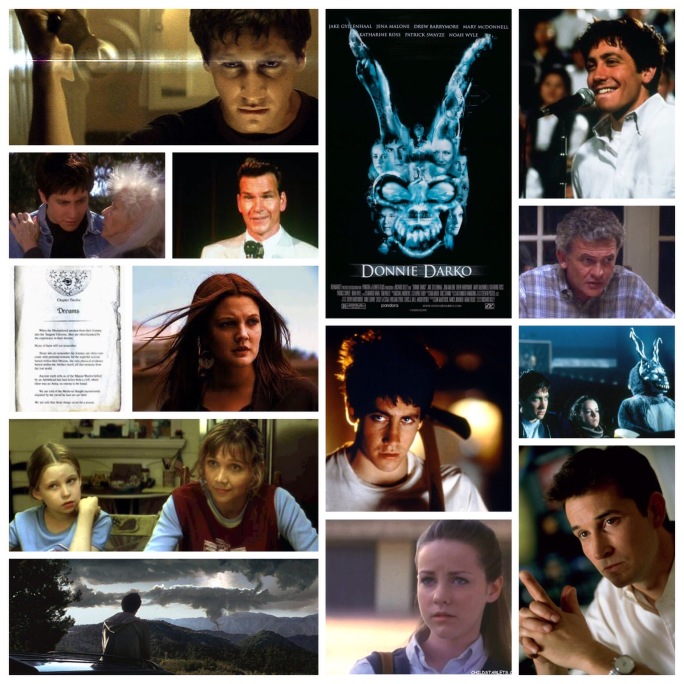
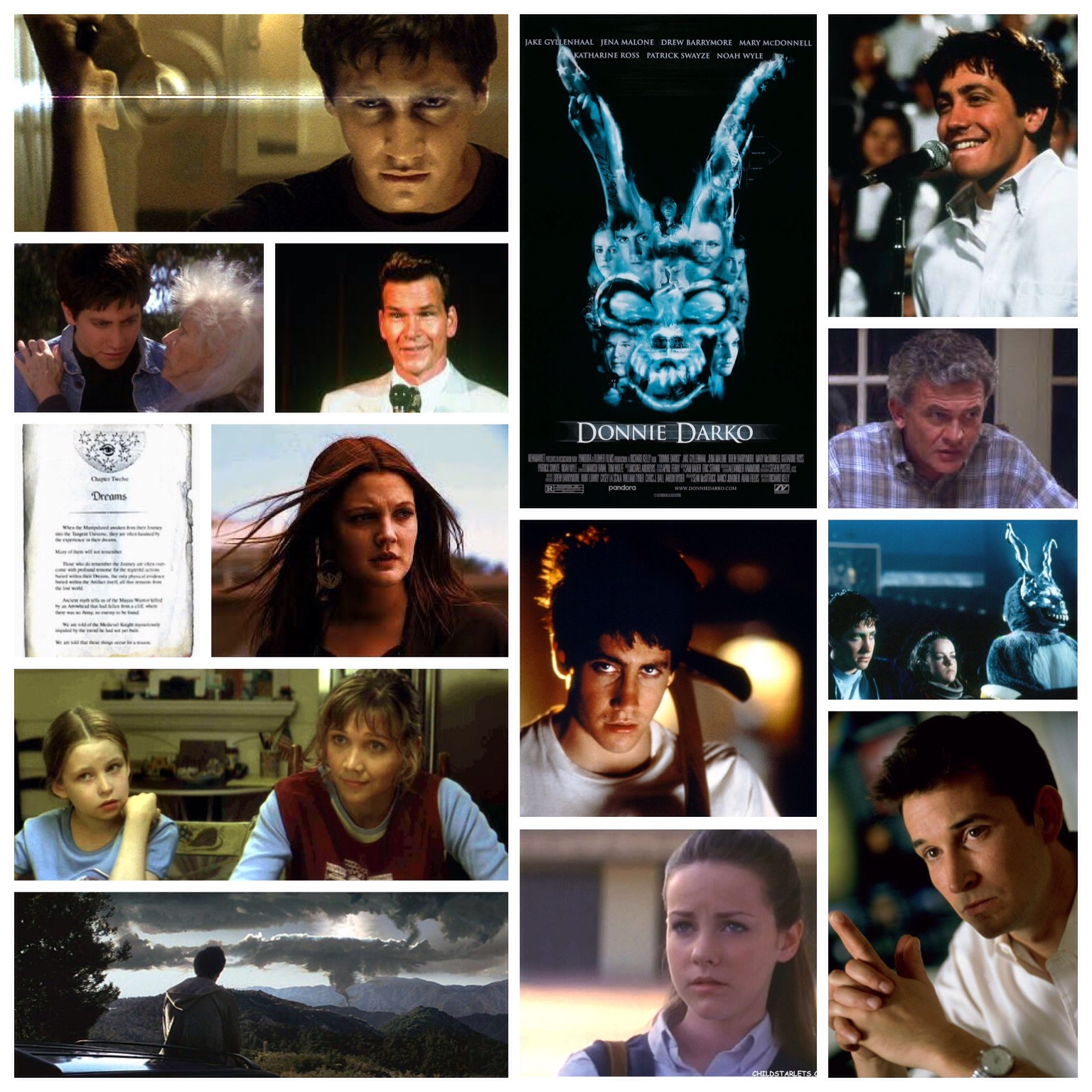
The director’s cut of Richard Kelly’s Donnie Darko is one of the most profound experiences I’ve ever had watching a film. It transports you to its many layered dimension with unforced ease and tells it’s story in chapters that feel both fluid and episodic in the same stroke. It has such unattainable truths to say with its story, events that feel simultaneously impossible to grasp yet seem to make sense intangibly, like the logic one finds within a dream. These qualities are probably what lead to such polarized, controversial reactions from the masses, and eventual yearning to dissect the hidden meaning which at the time of its release, didn’t yet have the blessing of the extended cut and it’s many changes. A whole lot of people hate this movie, and just as many are in love with it as I am. I think the hate is just frustration that has boiled over and caused those without the capacity for abstract thought to jump ship on the beautiful nightmare this one soaks you in. Movies that explore the mind, the unexplainable, and the unknowable are my bread and butter, with this one taking one of the premier spots in my heart. Kelly has spun dark magic here, which he has never been able to fully recreate elsewhere (The Box is haunting, if ultimately a dud, but his cacophonic mess Southland Tales really failed to resonate with me in the slightest). Jake Gyllenhaal shines in one of his earliest roles as Donnie, a severely disturbed young man suffering through adolescence in the 1980’s, which is bad enough on its own. He’s also got some dark metaphysical forces on his back. Or does he? Donnie has visions of an eerie humanoid rabbit named Frank (James Duval) who gives him self destructive commands and makes prophetic statements about the end of the world. His home life should be idyllic, if it weren’t for the black sheep he represents in their midst, displaying behaviour outside their comprehension. Holmes Osborne subtly walks away with every scene he’s in as his father, a blueprint of everyone’s dream dad right down to a sense of humour that shows he hasn’t himself lost his innocence. Mary McDonnell alternates between stern and sympathetic as his mother, and he has two sisters: smart ass Maggie Gyllenhaal (art imitating life!) and precocious young Daveigh Chase (also Lilo and Samara from The Ring, funnily enough). The film also shows us what a showstopper high school must have been in the 80’s, with a script so funny it stings, and attention paid to each character until we realize that none are under written, and each on feels like a fully rounded human being, despite showing signs of cliche. Drew Barrymore stirs things up as an unconventional English teacher, Beth Grant is the classic old school prude who is touting the teachings of a slick local motivational speaker (Patrick Swayze). The plot is a vague string of pearls held together by tone and atmosphere, as well as Donnie’s fractured psyche. Is he insane? Are there actually otherworldly forces at work? Probably both. It’s partly left up to the viewer to discern, but does have a concrete ending which suggests… well, a lot of things, most of which are too complex to go into here. Any understanding of the physics on display here starts with a willingness to surrender your emotions and subconscious to the auditory, visual blanket of disorientation that’s thrown over you. Just like for Donnie, sometimes our answers lies just outside what is taught and perceived, in a realm that has jumped the track and exists independently of reality and in a period of time wrapped in itself, like a snake eating it’s own tail. Sound like epic implications? They are, but for the fact that they’re rooted in several characters who live in a small and isolated community, contrasting macro with micro in ways that would give David Lynch goosebumps. None of this malarkey would feel complete without a little romanticism, especially when the protagonist is in high school. Jena Malone is his star crossed lover in an arc that finds them spending little time together, yet forming a bond that that feels transcendant. Soundtrack too must be noted, from an effective opener set to INXS’s Never Tear Us Apart to the single most affecting use of Gary Jules’s Mad World I’ve ever heard. It’s important that you see the director’s cut though, wherein you can find the most complete and well paced version of the story. There’s nothing quite like Donnie Darko, to the point where even I feel like my lengthy review is stuff and nonsense, and you just have to watch the thing and see to truly experience it.
NEIL LABUTE’S IN THE COMPANY OF MEN — A REVIEW BY NICK CLEMENT

This film is utterly poisonous. It’s totally cruel and it’s in love with the fact that it’s cruel. It’s happy to be mean, and it doesn’t care if you don’t like it. Neil LaBute’s first film, In the Company of Men, is still more than likely his best. This is a movie where two seemingly nice guys simultaneously romance a naive, deaf woman, with the express written plan to drop her like a sack of potatoes, thus destroying her as a person. Rarely do you get a glimpse of cinematic treachery on a level that this film provides. Some of this film is dangerously funny; portions of it will make you sick. It made a star out of Aaron Eckhart and it led to a fabulous chacter actor career for Matt Malloy. Stacy Edwards breaks your heart – it’s such a gutsy performance. LaBute’s extremely pessimistic worldview was on full display here, and without spoiling everything, you should know that this is a worldview where bad people often times come out on top. LaBute’s plain but subtle visual style gave off an icy, emotionally remote vibe that extends to the themes on display. I can remember being absolutely in awe of this movie as a high school senior; it’s the first film I reviewed for my school newspaper and it’s the movie that really spurred on my interest in discussing film in the written form.
ADVENTURELAND – A REVIEW BY J.D. LAFRANCE

Summer jobs are usually the bane of a young person’s existence. They are what you slog through so that you can afford to go to school. They are the drudgery you endure while daydreaming of going to the beach, hanging out with your friends or going to see your favorite band – in other words, pretty much anything else but work. Summer jobs are a necessary evil and no one understands that better than filmmaker Greg Mottola who has masterfully encapsulated these feelings in Adventureland (2009), his follow-up to the popular hit Superbad (2007).
The film opens to the strains of “Bastards of Young” by The Replacements and right away you know you’re in good hands. The year is 1987 and James Brennan (Jesse Eisenberg) has just graduated from college. He is planning to go to Europe for the summer with his buddies; however, his folks can no longer afford to help him pay for it or for grad school at Columbia University in the fall where he hopes to study journalism. James makes some calls, does some legwork and realizes that, with his academic background and a resume with a severe lack of work experience, he’s not qualified for manual labor.
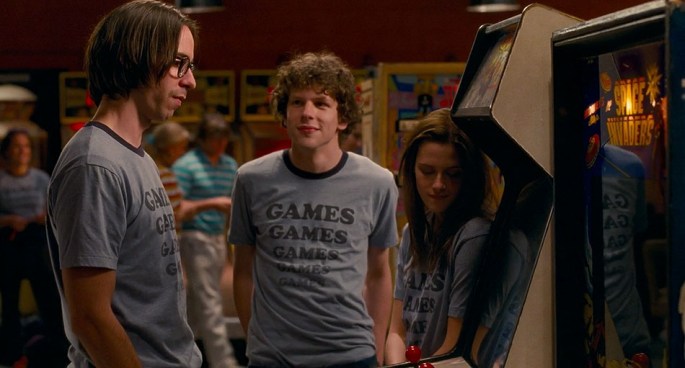
Faced with no other options, James decides to apply at Adventureland, a local amusement park. Much to his surprise, he’s hired right on the spot and put in charge of various games booths. He’s shown how everything works by Joel (Martin Starr), a terminally bored co-worker who’s clearly done this song and dance routine way too many times, telling James at one point, “So, your life must be utter shit or you wouldn’t be here.” While working at the theme park James meets Em (Kristen Stewart), an attractive co-worker with excellent taste in music, and whom he develops a crush on. He also befriends Connell (Ryan Reynolds), the park’s maintenance man, and who is in a local band in his spare time, claiming to have once jammed with Lou Reed. James spends the summer hanging out with Em and his fellow co-workers and learns that if he wants to be a good writer he needs to have some life experiences under his belt.
Adventureland accurately portrays the thankless slog of a minimum wage job (“We are doing the work of pathetic lazy morons,” Joel deadpans) with repetitive tasks, annoying customers, and crap pay. The only thing that makes it remotely bearable is the people James works with – after all, misery loves company. Mottola includes all sorts of nice touches, like the cheesy Foreigner cover band that plays at the local bar, or the mixed tape of music that James makes for Em, which gives the film a more personal feel. This is helped considerably by a great soundtrack that features the likes of Big Star, Crowded House, Husker Du, and The Jesus and Mary Chain – bands responsible for some of the best alternative music of the 1980s. Like the way music was used in Richard Linklater’s Dazed and Confused (1993), the music in Adventureland transports you back to another time and immerses you in it.
Jesse Eisenberg and Kristen Stewart have excellent chemistry together and do a good job of playing two young people that want different things out of a relationship. She has her own issues and they keep James always slightly at arm’s length. One hopes that despite the success of the Twilight films, Stewart will continue to make small, more personal films like Adventureland. Eisenberg nails the awkwardness of someone who’s had very few life experiences, especially in the romance and relationship department.
Mottola does a good job of portraying the brief flings that happen over the course of a summer. They are intense while they last even though they rarely do. He also accurately depicts how messy they can be, especially when you’re at that awkward age – your twenties – and are still trying to figure things out. Adventureland has an authenticity in how it feels to be in your twenties and to fall in love for the first time, stumbling through things, learning as you go. Whereas Mottola was basically a hired gun on Superbad, Adventureland comes from a very personal place and has much more heart while still being very funny and entertaining.
HAL ASHBY’S THE LAST DETAIL — A REVIEW BY NICK CLEMENT

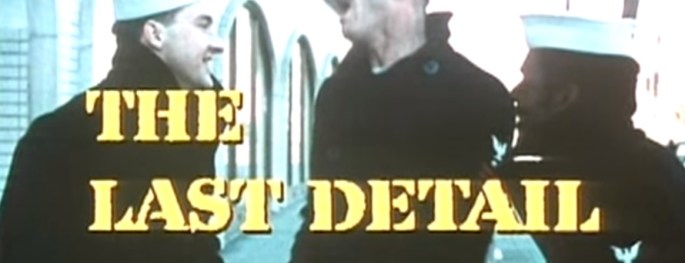
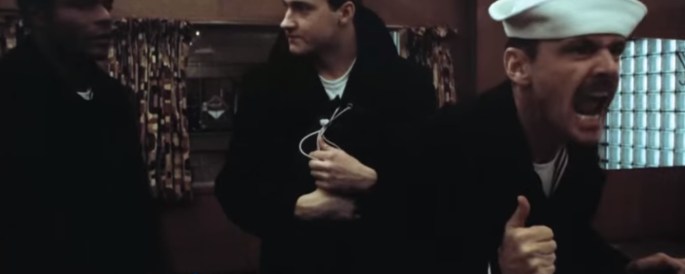
Released in 1973 and featuring an absolutely fantastic screenplay by Robert Towne, The Last Detail found Ashby doing some of his best mixing of comedy and drama, with results that are piercing and at times brutal. Starring Jack Nicholson and Otis Young as two sailors who are tasked with escorting one of their own (Randy Quaid, fantastic) to a military prison in New England, The Last Detail is one of those amazingly observed character studies that’s wholly interested in human behavior and how the bonds of friendship are tested in ways that the characters could never expect. The three men have all sorts of adventures along the way to their destination, and the final act involves some decisions that are as smart as they are sad, because you fully believe in the story and the people who populate it. Towne adapted the screenplay from the 1970 novel written by Darryl Ponicsan, which would became famous for a copious amount of “F-bombs,” and which would solidify Towne’s status as one of the premiere screenwriters of his generation. Shot in muted tones with a naturalistic sensibility by the great cinematographer Michael Chapman, the film has a terrific sense of time and place, with Ashby’s understanding of tone and pacing in full effect. Nominated for three Academy Awards (Nicholson, Quaid, and Towne), the film would become a critical and commercial success, and would also find Nicholson winning Best Actor at The Cannes Film Festival. Now available on Blu-ray from Twilight Time.

Paul W.S. Anderson’s Soldier: A Review by Nate Hill
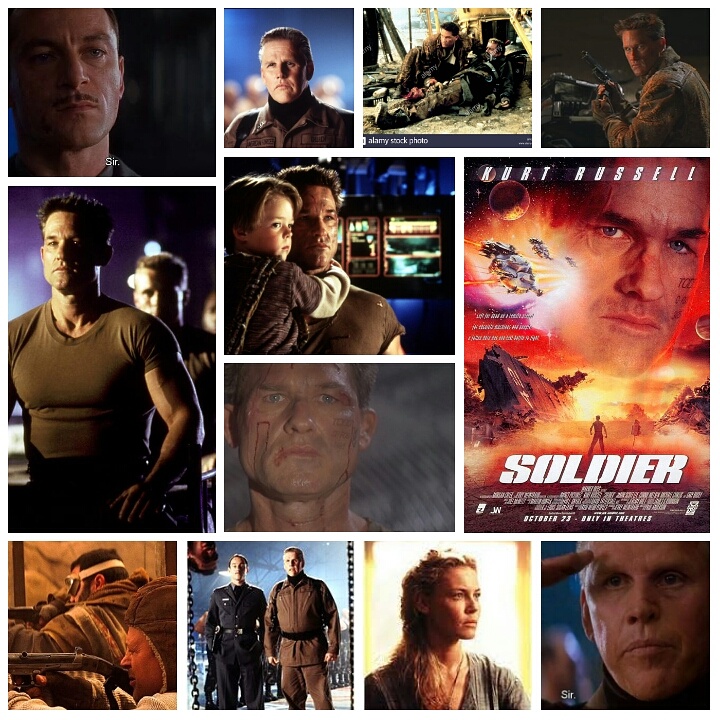
Before poor Paul W.S. Anderson made a fatal misstep with Alien Vs. Predator and was maligned, he made a few really excellent genre flicks back in the mid to late 90’s, one of them being the mostly forgotten and excessively fun Soldier, starring a mostly mute and wholly badass Kurt Russell as a genetically bred super soldier who has fallen on hard times. His name is Todd 3465, and he’s from the last line of soldiers who are in fact real humans, albeit altered. There’s a new program moving in, wherein actual replicants are produced, rendering Todd obsolete. The head of the new outfit is sadistic Colonel Mekum (Jason Isaacs in full evil prick mode), who wants to do away with anything that isn’t state of the art. Todd is thrashed in a one on one smackdown with Mekum’s lead soldier (Jason Scott Lee), and then left to die on a remote planet used only for trash disposal and inhabited by wayward crash survivors who scavenge what they can. Todd is immediately the outsider, an unfeeling asset bred only for combat and alien to human qualities. A few among the group, including their leader Mace (Anderson regular Sean Pertwee) and Jimmy Pig (Michael Chicklis) attempt to connect, but it’s gorgeous Connie Nielsen who finally breaks the ice. He may be conditioned to kill, but he’s still a human man after all, and there’s some base instincts you just can’t ignore. Trouble brews when Mekum shows up again, that bastard. Now he wants to vaporize their planet on the grounds that the refugees are essentially squatting. Undermining him is Todd’s former boss Church (an unusually restrained Gary Busey), an honorable military veteran who’d love to put Mekum six feet under and restore order. Todd must help his newfound friends, fight tooth and nail against replicants and win his superiority back. Russell is a tank in the role, letting both silence and action speak volumes, a one man old school ass kicking hero of the highest order. The world building and outer space effects are incredibly fun, the villains are broadly characterized with the force of a western, and the whole film knows what people want for a good time at the cinema. Oohh and fun fact: this takes place in the same cinematic universe as Blade Runner, and you can listen for the brief tie in reference that only die hards will pick up on. Great stuff.
The Wedding Singer: A Review by Nate Hill
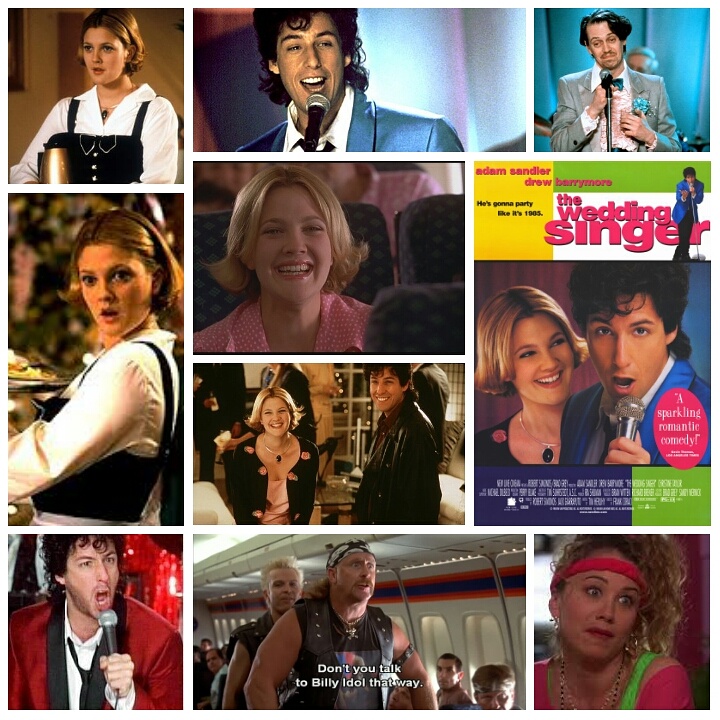
I’m not usually very stoked on Adam Sandler movies, I’ll say that right off the bat. I mean, there’s a lucky select few that are either geniunly funny or have nostalgic value (Happy Gilmore, Big Daddy and the absurdly fascinating Little Nicky come to mind), but he’s just such a ball of cancer onscreen it’s hard to actively see his stuff. The Wedding Singer, however, is a really sweet little movie, and works well thanks to an impressive 80’s soundtrack and the presence of Drew Barrymore, who frequently hangs around in Sandler’s stuff. He plays Robbie Hart here, a singer who belts out the hits of the 1980’s at weddings, parties, you name it. After being left at the alter by his fiance, he spots waitress Julia (Barrymore), who uncannily seems to be working every event she is. The two form a bond, but she is engaged to another dude (Matthew Glave), who quickly is revealed to be kind of a jerkoff, prompting Robbie to go to great lengths to prove, and win Julia’s heart. The film makes the absolute most of its setting, as any period piece should. The music is a delight, right down to the amusing dawn of the ‘CD’, and a great little cameo from a rock legend aboard an airline. Some of the usual troupe of Sandler disciples pop up here, including Christine Taylor, Allen Covert, Kevin Nealon, Peter Dante, Jon Lovitz and Steve Buscemi, who can be counted on to appear in pretty much any Adam flick you can think of. Sandler and Barrymore handle the comedic romance well and have decent chemistry (perhaps while theyre always paired). It’s light, sweet, carried on by the rockin soundtrack and detailed production design.
GARETH EVANS’ THE RAID 2 — A REVIEW BY NICK CLEMENT

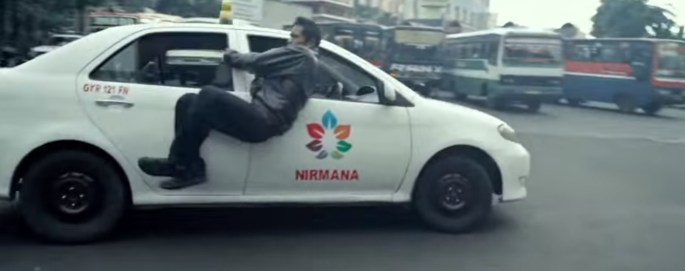
When I left the theater after seeing The Raid, I said to myself that it was the best action movie I had seen. Nothing could prepare me for how intense and focused that film would be, and it made me excited all over again to be a lover of action movie cinema. When I left the theater after seeing The Raid 2: Berandal, I was nearly in tears, not because I was sad, but because I was overly ecstatic, as I had seen something that actually bested what the first film had accomplished. Within the realm of the shoot-em-up action thriller, I have never seen anything as unrelentingly amazing as The Raid 2: Berandal, and my guess is that I won’t see anything better than it until director Gareth Evans delivers the third chapter in this extra-assaultive series of films. Out of all of the genres that one can pick from, the Action Film is easily my favorite. More than most types of cinema, it exists to exhilarate and to transport, and when in the hands of a master like Evans, the results are nothing short of extraordinary. This film completely and utterly eviscerates the competition; American movies pale in comparrison to this blood-drenched effort. There’s nothing else that even remotely comes close to matching the cumulative level of bad-assery that you’ll find in The Raid 2. It’s two and a half hours of punching, shooting, maiming, garroting, car-chasing, slicing, dicing, hammering, base-ball-batting, kicking, and shanking. And yes, if you can believe it, there’s more plot to choke a horse, with developments that make sense, and a fully sympathetic lead character you entirely root for.

Picking up mere moments after the obscenely bloody events of The Raid, this sequel ups the ante in every regard — characters, plot-lines, set-pieces, and the overall level of lunatic abandon when it comes to the mind-blowing action sequences. You’ll see one of the very best car chases ever captured by cameras in The Raid 2, and you’ll also see the single most vicious and bloody one-on-one fight that I could ever possibly imagine. Honestly – after the stuff done in this film – I’m not sure what else needs to be attempted with this sort of thing. But leave it to Evans to try, as he’s currently working on The Raid 3. This is legendary action cinema, taking cues from genre masters like John Woo, Takashi Miike, and Paul Greengrass, mixing an undercover-cop-in-prison narrative ala The Departed with classic tribal feuds straight out of a Japanese Yakuza picture. Iko Uwais is a living legend, and the same can be said for Yayan Ruhian; these guys ostensibly have zero limits and are willing to go above and beyond what’s physically expected from a human being. The Indonesian setting makes for an exotic backdrop for all of the insane bouts of mayhem, with the impossibly agile cinematography covering all of the action from the most eye-popping angles possible. This is a movie where you feel every punch, hear every bullet whizz past your ears, and every single scene seems to have been designed to top the last. This is outstanding action cinema that will be very, very tough to beat.

DRIVE ANGRY – A REVIEW BY J.D. LAFRANCE

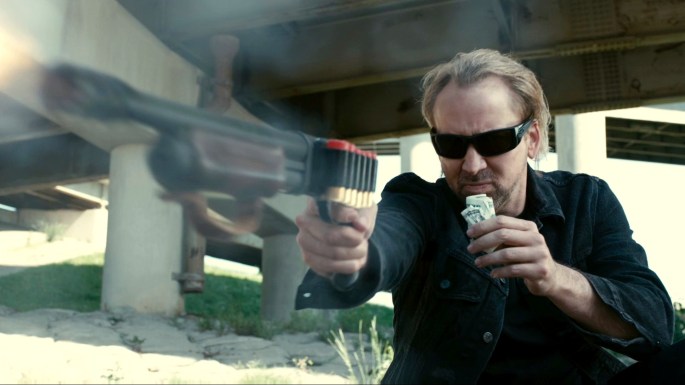
Continuing his string of paycheck movies, Drive Angry (2011) is actually closer to the gonzo Nicolas Cage of old than the diluted actor we’ve come to expect in films like Next (2007) and Knowing (2009). With Drive Angry, he’s made a full-on, balls-out cult film that flopped spectacularly at the box office and was trashed by the critics. It has all the necessary ingredients of cult status: loads of ultraviolence, nudity, lots of cussing, and all kinds of character actors chewing up the scenery. The film is the brainchild of Patrick Lussier and Todd Farmer, the former, a B-horror director responsible for efforts like Dracula III: Legacy (2005) and My Bloody Valentine 3D (2009). While the latter film was an unnecessary remake of the 1980’s Canadian slasher film of the same name, it did hint at the garish excesses Lussier was capable of and has finally delivered with Drive Angry.
The film begins with John Milton (Nicolas Cage) literally escaping from hell in a badass muscle car. He is trying to avenge his daughter’s murder and rescue her kidnapped baby from Jonah King (Billy Burke), the sadistic leader of a satanic cult. In the first five minutes, Milton totals a pick-up truck with three flunkies in a way that is so gloriously and stylishly over-the-top that it would make Robert Rodriguez green with envy. While his film Machete (2010) paid homage to exploitation films, Drive Angry is one, only with A-list talent. Milton crosses paths with Piper (Amber Heard), a tough ex-waitress who has recently broken up with her deadbeat boyfriend (Todd Farmer in a cameo). Hot on their trail is a man known only as the Accountant (William Fichtner), a dapper minion from Hell come to bring Milton back.
Inspired by another cartoonish action film, Shoot ‘Em Up (2007), Drive Angry also features a gun battle while the protagonist is having sex only captured in slow motion and cheekily scored to “You Want the Candy” by the Raveonettes. While excessively violent and gory, the action sequences are all so overtly stylish that they can’t be taken too seriously. This film is akin to a blood-drenched, R-rated cartoon. The violence isn’t cruel and mean-spirited like in a torture porn horror film, but rather gleefully petulant like the guys who orchestrated all of this mayhem grew up reading Fangoria in the ‘80s.
Surrounded by all of this garish style and crazed violence, Nicolas Cage wisely underplays his role, going for the calm, collected man of action. He’s matched up perfectly with the always watchable William Fichtner who seems to be channeling Christopher Walken with his wonderfully eccentric performance. He looks to be having an absolute blast with this role and steals every scene he’s in with his unfailingly polite yet very lethal character. Billy Burke is suitably sinister as a religious fanatic and the beautiful Amber Heard holds her own as a two-fisted, curse-like-a-sailor sidekick to Cage’s undead avenger. David Morse even shows up using his considerable skill as an actor to make a chunk of exposition dialogue palatable.
Drive Angry has everything you could want from a trashy action film: cool muscle cars, over-the-top shoot-outs, larger than life baddies, and a cool good guy with a mission. All of this is handled ably by Lussier in what is easily his most accomplished film to date. He gleefully sticks a middle finger in the face of political correctness with a film that is more entertaining than it had any right to be. Cage needs to do more films like this and Bad Lieutenant: Port of Call New Orleans (2009), which harken back to the eccentric characters he played early on in his career.
MIKE FLANAGAN’S HUSH — A REVIEW BY RYAN MARSHALL

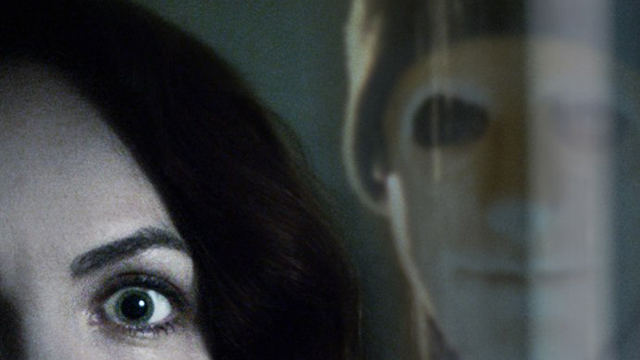
There’s a considerable appreciation to be had for a solid, mostly intelligent genre exercise such as Mike Flanagan’s HUSH. Sometimes, smart and inspired is enough, and ever since his well-above-average debut (ABSENTIA), Flanagan has been hard at work giving his audience just that and something a little more to boot. There are almost zero pretensions to be found in this short, simple, efficient, and surprisingly clever home invasion yarn; it’s merely a welcome addition to a familiar (often to a fault) genre that doesn’t really aspire to reinvent the wheel so much as it does to have its fair share of fun breathing new life into it by challenging conventions and expectations in near-equal measures.
A deaf writer alone in the woods with, save for a couple neighbors she’s quite friendly with, only her thoughts as company is terrorized one night by an intruder (John Gallagher Jr.) whose motivations are certainly more ambiguous than his identity – this is the simple but convenient logline of Flanagan’s film if there ever was one. Immediately, the viewer is thrust into the unique world of its protagonist, only to be taken out of it as soon as the assailant makes his presence known, and for the remainder of the run-time we are (mostly sonically) taken in and out of these two respective points of view. It actually sounds LESS ambitious on paper than it is in execution, though this ends up being one of the film’s most striking features.
Kate Siegel turns in commendable work as the heroine, who we learn from the back of one of her published novels has been living with her particular ailment since the age of 13, and sharing writing credits with Flanagan himself seems to have provided the proceedings with a refreshingly non-self-congratulatory female touch. HUSH empowers its protagonist without practically begging the audience to sympathize with her plight, which registers as something of a surprise in today’s cinematic landscape, and the narrative doesn’t rely on the usual slasher idiocy to remain constant (the film not really exploring the motivations of the intruder doesn’t strike me as idiocy so much as a desire to keep things interesting); instead, the mistakes made by Siegel’s Maddie Young are for the most part logical and notably human given the situation she finds herself in. A bit of naivety on the part of this particular character is believable, and the scribes have a grand old time building up both her external and internal worlds only to creatively break them down as they go on into the night.
The manipulation of space here is also most impressive. A single-location thriller is like a strange and dangerous dance, but it’s one that Flanagan seems comfortable to temper with, and for good reason. His visual language is thoroughly immersive, following the majority of Maddie’s more urgent actions on Steadicam, bringing to mind the Italian Giallo without the expected flashiness (the lighting set ups here are evocative and appropriate, but never invasive). The soundscape is also genuinely effective – and with such minimal dialogue it’s got to be – but even more impressive than the film’s technical achievements are its confrontations with cliché. Flanagan displays a certain obsession with Maddie’s material possessions and seamlessly integrates a certain number of them into her fight for survival. For example: an exceedingly loud fire alarm with bright flashing lights introduced in one of the earliest scenes is brought back in a creative way later on – and there’s even a fairly clever subversion of the old lost pet trope. Even a sequence in which the voices in Maddie’s head run through the various escape routes throughout the house is ultimately justified by the aforementioned information delivered via book jacket, though it at first serves to catch the viewer off guard when they least expect it to.
While overall, Flanagan isn’t aiming for anything more than a film that amounts to precisely the sum of its parts, there’s something to be said for it getting there in the end with such a thoroughly organic grasp on form. It’s clear from the get-go, and from his debut (I regrettably missed OCULUS but intend to fix that ASAP), that Flanagan has a lot of love for the horror genre and wishes only to contribute in positive ways to its future whilst injecting it with much-appreciated intimacy and emotional honesty. HUSH is the kind of taut home invasion thriller that the world could certainly use a little more of – that being one which understands that sometimes the only way to truly progress is to not make a big deal out of doing so, to raise awareness for genre issues of importance (in this case, strong female representation in horror is a big one) in a quiet, coherent manner. Ultimately, it makes for surprisingly thoughtful and consistently engaging Saturday night-type viewing; a film that is significantly more interesting in its technique than in its conception. Keep a look out – it may just sneak up and surprise you.
PAUL MAZURSKY’S ALEX IN WONDERLAND

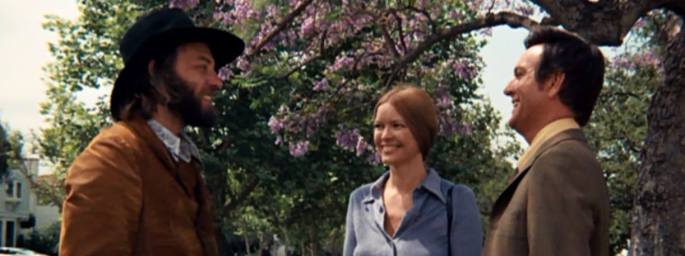
Somewhere in Movie Heaven, there exists a double bill with Richard Rush’s The Stunt Man and Paul Mazursky’s Alex in Wonderland. I’ve seen this film a few times now, and it’s never not entrancing or fully engrossing. Released in 1970, this was Mazursky’s eagerly awaited follow up to his hugely successful Bob & Carol & Ted & Alice, with the story centering on a movie director named Alex Morrison (Donald Sutherland, incredible), who is stressing out over what to do next after his first movie was a huge success. Sounds a bit like reality for Mazursky, no? Co-written with Larry Tucker, Mazursky used his second feature as a venting and homage session, crossing his real life insecurities as a filmmaker with the age old narrative conceit of an artist struggling with a crisis of artistic conscious. He even cast himself as a Hollywood producer (in one of the film’s best scenes), further upping the satirical spin to the picture. Federico Fellini and Jeanne Moreau also made cameos which boosted the wink-wink inspiration factor, with Mazursky and Tucker even explicitly referencing 8½. The heady narrative dabbles in the past, present, and possible future, with thematic nods to cinema history in general explored all throughout, while the script constantly tackled the almost impossible balance that artists face between family life and “the biz.” Ellen Burstyn played Alex’s put-upon wife while László Kovács handled the varied, dreamy, and always interesting cinematography. This is a seriously cool movie that gets better each time I revisit.