THE P.T. ANDERSON FILES: BOOGIE NIGHTS (1997)

It’s a strange thing to consider but for all of the power that sex wields to start wars, topple the powerful, and put people into financial or personal ruin, the porn industry is small time. That’s not to say that the porn business doesn’t make boatloads of cash. In fact, it’s quite the opposite. I mean, if one really wants to believe that the only things subsidizing the porn industry are the spending habits of amoral perverts, that person may want to try and show their math on that assertion if only to sooner realize that there just aren’t that many degenerates wandering the earth. In other words, a whole lot of people you encounter at work, in the streets, and (gasp) at church have at least dipped a toe or, more likely, engaged in a full baptism into one of the four corners in the pool of the sex industry. But yet, for all of the dough the films generate, there are precious few hardcore actors or directors that have been able to transcend the hermetic shell of the adult film world either in name or deed. For every John Holmes, Ron Jeremy, or Sasha Grey, there are a thousand others whose stopover into the world of porn occurs because it’s a place that, if they can’t build a legacy, they can definitely make a buck.

It is because of this that, despite actually working at a General Cinemas theater at the time, I’m unsure as to what went through the public’s mind when they saw the expertly cut and energetic trailers for Paul Thomas Anderson’s Boogie Nights prior to its release in the summer of 1997. Here was a film that was going to be playing in the multiplexes and malls across America that would, in seemingly frank terms, follow the story of an ersatz John Holmes as he navigated the literal ups and downs in the pornographic film industry in the 1970’s and 80’s. Would America be able to reckon with its very real attachment to pornography to feel comfortable enough to go and see it and give it the respect it deserved or would the film flop given the culture’s mind-bogglingly puritanical attitude towards THIS KIND OF SEX™️? If there is anything to challenge the accepted notion that sex sells, it’s to invite people to sit through two-and-a-half hours of it.

But Boogie Nights was a hit and, surprisingly, a quite sizable one. Anchored in the front by a dynamite and keenly sensitive central performance from a then-risky Mark Wahlberg and, in the back, by a jaw-dropping return to form by Burt Reynolds with incredible, fearless performances by Julianne Moore, Heather Graham, John C. Reilly, Don Cheadle, William H. Macy, and Philip Seymour Hoffman (among others) between them, Boogie Nights was received as a rollicking, exhilarating American epic that was an intoxicating mix of Scorsese-like rhythms and editing being navigated by Demme/Ashby-like heart across an Altman-like canvas; the most joyous piece of pop filmmaking since Quentin Tarantino’s Pulp Fiction three years earlier.

Boogie Nights appeared at just the right time in America to make the splash that it did. The years of peace and economic expansion under the Clinton administration turned the 90’s into a freewheeling party which saw the birth of the internet and, also, a certain lax in our social mores as latchkey kids from the 70’s who grew up sneaking peeks at their parents’ poorly hidden porn stashes rolled into their twenties with a more permissive, NBD attitude towards Boogie Nights’s subject matter. All of the moments within the film that focused on the hilariously crude approach to adult filmmaking (and its spot-on recreations of the final product) were met with the appropriately knowing chuckles of an audience that couldn’t do anything but acknowledge that they understood exactly what they were looking at and, in the words of Elliott Gould in The Long Goodbye, it was (at long last) ok with them. And it was the good fortune of everyone cast in the film that the worm of American culture had somewhat turned as Boogie Nights is a virtual “who’s who” of talent that was just beginning to crest a professional summit out of indie-world and the film’s success would propel almost every single one of them to mainstream fame.

One of the things that has continued to work in Boogie Nights’s favor almost a quarter century later is its anticipation of the succeeding generation’s devotion to 100% acceptance and the encouragement of full positivity among its peers. To this end, Anderson doesn’t excuse his characters’ flaws but is ultimately sympathetic to all of them (save and except Diggler’s mother, Joanna Gleason in a ferociously monstrous performance). The characters are small time but, almost presciently, exist in a world of total support and encouragement; one in which, from the point of view of those on the ground in the actual time and place, seemed like more of a legitimate enterprise than, say, selling blowjobs on Hollywood Boulevard for a hot meal and/or somewhere to sleep. So maybe it’s technically incorrect (and borderline irresponsible) for Julianne Moore’s mother-surrogate, Amber Waves, to fawn over Wahlberg’s decidedly not-very-talented (but massively endowed) Dirk Diggler as “so fucking talented,” but is it really worse than how his actual mother treats him in the neatly trimmed “normal” world of Torrance? Sure, Jessie St. Vincent’s (Melora Walters) paintings are uniquely awful but, really, are they any more subpar than some of the tacky prints that adorned the walls of suburbia at the same time? Are those adult award shows any more moronic and stupidly self-congratulatory than the Oscars? Certainly, the ephemeral static attached to the porn industry doesn’t make it look like the most positive environment to some people who live nine-to-five existences but, as the film makes crystal clear, the need-driven support structure within it is mighty alluring for the socially outcast, the marginalized, and the abused.

And Boogie Nights was never going to be a movie that reveled in its orgiastic pleasures for its own sake. Much like Goodfellas, there is a real “set ‘em up and knock ‘em down” formula to the film’s structure. The film’s first half looks like a total blast of wanton abandon; an effervescent celebration of the largesse of the sexual revolution replete with a pulsating soundtrack and the promise of a perpetual California sunset. As an audience member, you WANT to be there, even if you’re just hanging out in a lounge chair poolside while drinking a margarita while everything else swirls around you. But, sweet Christ, brutal is the comedown that occurs in the second half of the film when the organic pleasures of the 70’s are replaced with the synthetic coke high of the 80’s. A nonstop stack of nightmares including a murder-suicide, crippling addiction, accompanying sexual dysfunction, mounting legal challenges, the cold yet practical move from film to video, and violent moments of terrifying, rock-bottom sobriety show that Boogie Nights is just as eager to argue the downslope as convincingly as it does the ascension, though without any kind of sanctimony in regards to its characters’ plights.

But as much as Robert Altman utilized the titular city to examine America as a whole in 1975’s Nashville, Anderson is using the porn industry in the bracketed time frame to explore the fluid boundaries of family much like he did in Hard Eight the year before and he would in Magnolia two years later. And, to be sure, the world of Boogie Nights remains his best Petri dish in which to study this dynamic as the film’s libertine atmosphere mixes with its members’ outcast and discarded statuses which create disarmingly moving and powerful moments throughout the film, most especially those involving any combination of Wahlberg, Reynolds, and/or Moore.

And so it is that Boogie Nights endures not just because it’s a naughtily hilarious and dramatically satisfying film, well-remembered by Gen-Xers who pine for the sun-kissed days of the mid-90’s. It endures due to the fact that it was written and directed by a guy not yet twenty eight who could resist the easy temptation of sniggering at its subject matter in favor of focusing on the longer view that included poignancy, care, and familial love shared among its characters, ensuring that it would continue to pay dividends to its audience well into the future.

Hélène Cattet & Bruno Forzani’s Let The Corpses Tan

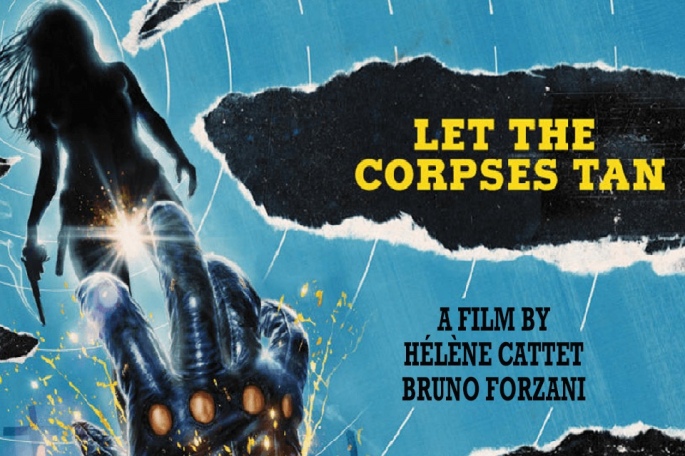
Whenever contemporary filmmakers attempt a homage to cinematic styles, tones and artistic mechanics of bygone eras in cinema it’s very easy to tell whether they know their shit and have captured their intended aesthetic or missed the mark. Every culture and era of the medium has their own unique and distinct flavour woven into every aspect of the artistic process, and any pastiche is just going to be a delicate undertaking. In the case of Hélène Cattet and Bruno Forzani’s Let The Corpses Tan they have done an impeccable job of emulating this kind of… 60’s/70’s Italian pulp/murder/spaghetti/cop/splatter/action vibe that’s so specific to that time and region I can’t even properly describe how… unmistakable the palette is. It’s like Italian genre cinema went to sleep one night and this film is a window into into its REM cycle. On a remote, sun drenched island in the Mediterranean (shot in beautiful Corsica), a gang of murderous thieves spearheaded by a vicious femme fatale (Romanian cult icon Elina Löwensohn) hide out in the crumbling ruins of a Hellenic ghost town, harbouring a stolen trove of gold bullion. As they languidly await some vague deadline, others approach including a gaggle of unfortunate civilians and two intrepid motorbike cops, whose arrival heralds the furious, bloody, beautiful extended gun battle that becomes the film’s centrepiece. That’s all for plot really, but trust me it’s all you need, this film is all style, aesthetics and nightmarish visual poetry and contains some of the most outright striking imagery, editing and production I’ve ever seen in cinema. The weapons are all gorgeously retro and have this… ‘Spaghetti SteamPunk’ mechanical anatomy, the violence has a Giallo singed, pop art bloodiness to it, and the editing is some of the most painstakingly detailed work I’ve ever seen. Closeups on craggy faces, hyper-quick zooms, pans, jump cuts and jarring chops that are so off the wall, intense and unconventional they nearly give the viewer a heart murmur in the best way possible. Amidst the gunplay that although supremely stylish is very down to earth there is also this wonderful flourish of shocking surrealism woven into the story, as we see a mysterious, Venus-esque maiden appearing occasionally surrounded by tantalizing, erotically charged symbolism, gunshots explode into otherworldly blasts of coloured paint and all manner of dreamlike cutaways, hyper-stylized mysticism and enough bright colours and sunshine to get a rave going. Absolutely astonishing film, highly recommended.

-Nate Hill

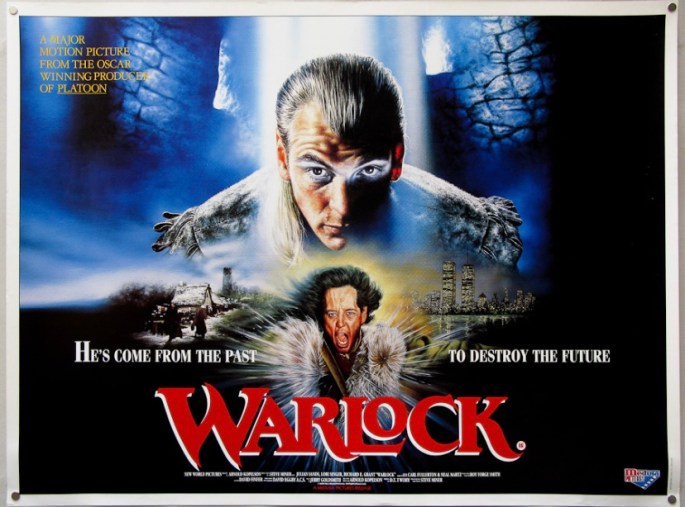
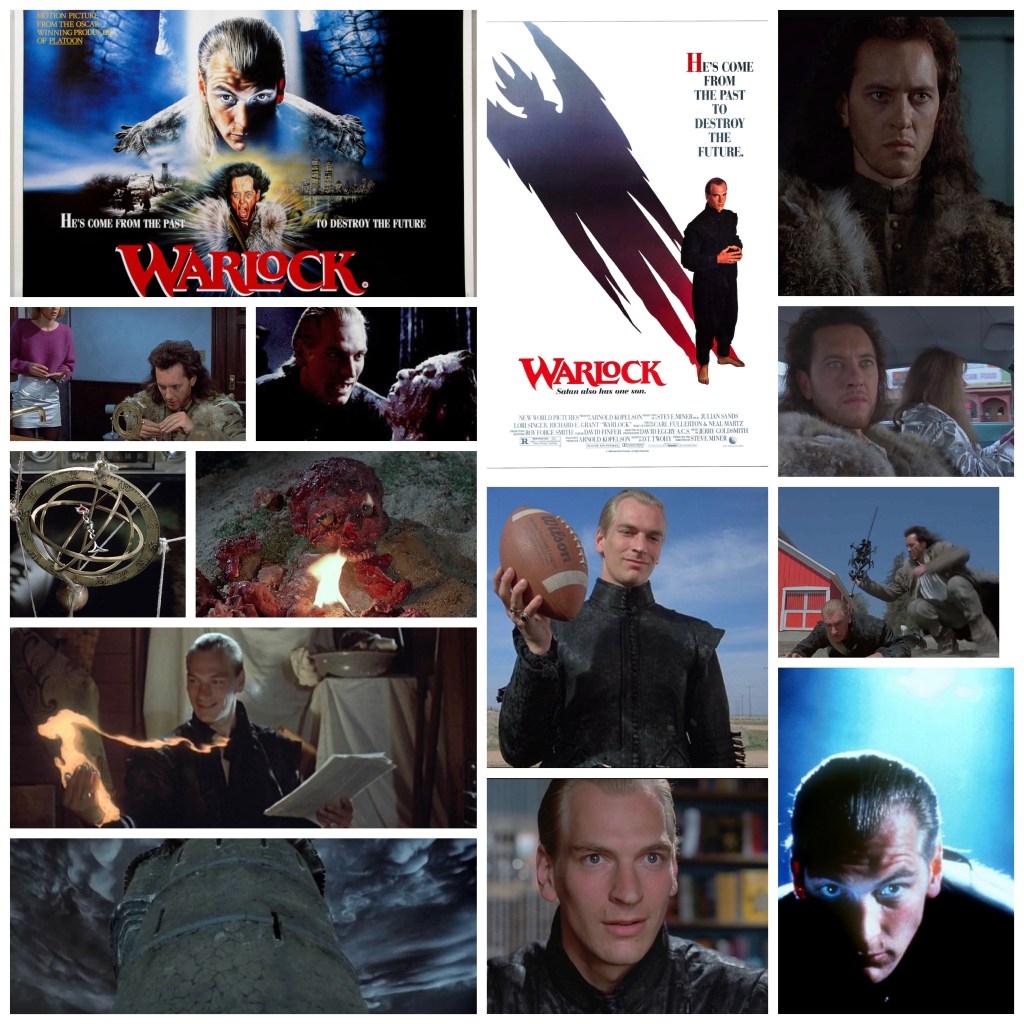
Steve Miner’s Warlock

Steve Miner’s Warlock is billed as a horror film but it looks, feels and works better as a sort of time travel adventure deal. There are elements of horror, and the sequel (which I’ll review next) definitely dabbles in horror more hardcore but this is a rollicking, spirited jaunt from 1600’s New England through space and time to 1990’s L.A. as a hyperactive witch hunter (Richard E. Grant) pursued a dangerous supernatural sorcerer (Julian Sands) before he can collect enough dark magic to unleash the apocalypse or… something. It doesn’t matter what your specifics are when your effects, journey and overall atmosphere are this much fun. Sands is mercurial, devilish and relentless as the Warlock and he carefully walks a tightrope between being an unstoppable, faceless force of evil like some horror boogeymen and having his own unique charisma and panache, like others. Grant is ridiculously fun as the initially boorish, then gradually likeable and by the third act downright adorable witch hunter, sporting a coat right out of The Revenant and a mullet that Chuck Norris would be jealous of. Also he’s called “Giles Redferne,” which might be the coolest name ever in cinema, and he sure lives up to it. He meets a bubbly 90’s valley girl who has no interest joining forces with him until the Warlock puts a nasty aging spell on her and then, well, you can imagine. The effects are naturally of the 90’s variety but they have their own kitschy charm, especially during a hilariously shocking sequence where Sands literally kills a child and uses its blood for a flying potion so he can become a cruise missile and engage Redferne in a raucous highway car/flying Warlock chase. This is a fun one with elements of horror, dark comedy and swashbuckling tinged adventure all at play.

-Nate Hill

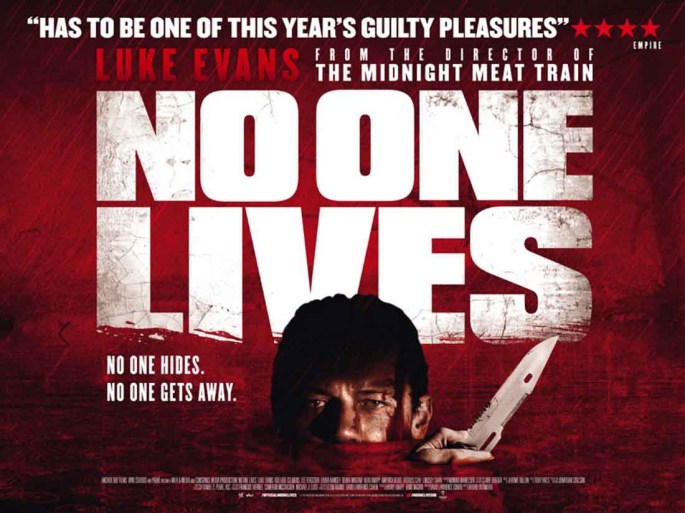
No One Lives

I don’t think I’ve ever seen quite as… efficient a serial killer as Luke Evans in No One Lives, an absolutely mental, ruthlessly gory, completely unhinged shocker with enough torque in its hood to short circuit your TV. It’s one of those stories where a group of very bad people accidentally enter the orbit of someone much, much worse and live to deeply regret being so careless. In this case the bad people are a roving gang of backwater criminals led by Lee Tergesen, but they’re not a biker gang or anything specific they’re just like… a gang, like the Warriors or something which I found hilarious for some reason. Anyway they unwittingly piss off Luke Evans’s seemingly benign ‘Driver’, who turns out to be an impossibly cunning, deviously psychotic and *very* experienced mass murderer and he has now decided that they are all gonna die. Every. Last. One. It’s not so much a game of survival as it is a total massacre of fish in barrel and we see him dispatch them all in some truly unsettling and bloody ways that involve everything from an industrial wood shredder (it’s not a wood ‘chipper’, the only applicable description of this fucking giant thing is ‘shredder’) to a lethal harpoon gun pulley system to a grisly variation on the ‘Leo hiding in a horse carcass’ moment from The Revenant. Amidst the mayhem and splatter the film even finds time for some genuinely twisted victim/aggressor psychology involving a former captive of his played by the lovely and always slightly unnerving Adelaide Clemens, who comes across like a shellshocked Michelle Williams. The two have a perverse, Stockholm Syndrome laced former dynamic that is eerie and very well acted by both. Evans usually shows up in polished, rollicking Hollywood high budget fantasy and whatnot but it’s very refreshing to see him roll up his sleeves and dive headlong into something knowingly lurid and deliriously pulpy, he has a ton of fun as basically the Jason Bourne of serial killers and I could totally see the character returning for a sequel or two. It’s decidedly lo-fi, B horror stuff and very in your face gruesome but Japanese director Ryûhei Kitamura keeps the momentum surging at a breathless pace, the gore and action nearly nonstop and the schlocky, Midnite tone evenly dispersed throughout for a wicked wild ride.

-Nate Hill

THE ROBERT ALTMAN FILES: NASHVILLE (1975)

The Paramount logo appears in black and white and in a state of mismanaged distress. This is quickly followed by a calm pre-title credit countdown; Three, the studio… two, the producers… one, the director. Then, the blast off occurs with a voice that booms “NOW AFTER YEARS IN THE MAKING…” revealing a commercial for the film’s soundtrack album that will also operate as the film’s opening credit sequence. Welcome to Nashville, Tennessee in 1975, a reflection of an America that could be marketed just like a K-Tel record. Years in the making but here for your enjoyment “in stereophonic sound and without commercial interruption.”

Robert Altman’s Nashville is ground zero for reflecting America’s unhealthy appetite for mixing celebrity and politics and it savagely and meticulously lays bare the ugly mechanisms that fuel both enterprises and also our collective and insatiable obsessions with them. It’s about a post-war, post-Eisenhower America being left behind as a perverted geek show of wrong-headed populism, shameless grifters, and shallow entertainment tightens its grip on a nation that has been so beaten down and disillusioned that a earnest yet moronic song like “200 Years,” an anthem that marvels at America’s ability to withstand trials and tribulations long enough to last two whole centuries, can be mistakenly presented as a chest-bursting piece of patriotism instead of the hilariously stupid self-own that it is.

Nashville is the story of a few days in the life of twenty-four people in the titular city in which there are two defining events afoot. One of them is the re-emergence of country artist Barbara Jean (Ronee Blakely), the undisputed but fragile queen of Nashville who’s been convalescing after a recent “flaming baton” incident. The other is the organization of a political rally for Hal Phillip Walker, presidential candidate for the populist, third-party “Replacement Party,” and winner of enough recent primaries to make the political establishment sweat. Through these two events, which will eventually thread together, we follow a whole host of country stars, political advance men, groupies, journalists, bored husbands, their even more bored wives, rock stars, hangers-on, has-beens, never-weres, kooks, and earnest fans. There’s a lot of information that floats at the viewer like an unstoppable current but Altman, with the help of a framework screenplay by Joan Tewkesbury, links all of these characters together with an uncanny skill and a uniquely American eye.

Up until 1975, there had not been a film quite like Nashville. Sure, star-studded films in the vein of Grand Hotel had been produced and were crowd-pleasing successes, but even those felt more like omnibus tales and less like a grand tapestry in which there truly is no lead character. Nashville was the first film to spread its giant cast comfortably across the widescreen canvas while also making them feel as they were part of something that was bubbling with vitality and was recognizably and organically alive. And in fact, Nashville exists in a space where real stars such as Elliott Gould and Julie Christie appear alongside characters portrayed by actors with whom they’ve worked before. Additional life is given to the film in the way it integrates likewise authentic locations like the Grand Old Opry (replete with a real GOO audience) being utilized for the actors to authentically perform songs that they wrote and brought to the project themselves. While the greatest example of this form of Altman commitment likely goes to the mock presidential campaign that crossed paths with very real ones in Altman’s Tanner ‘88 (which, not coincidentally, featured Michael Murphy as the central visible political figure), Nashville was the first to truly make an Altman production the kind of all-in communal effort he’d been tinkering with since McCabe & Mrs. Miller.

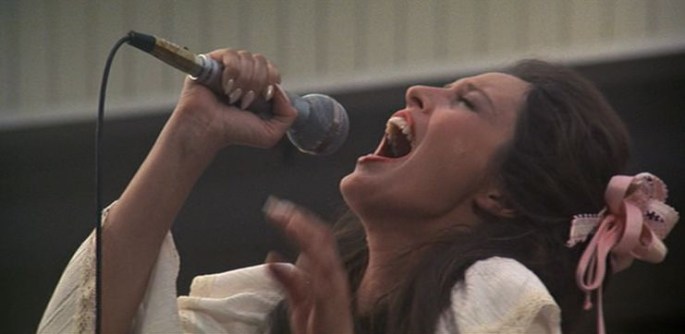
In the spirit of how our lives actually unfold, Nashville is a big movie built of little things. Broad gags such as the freeway pileup at the beginning and the climactic ending aren’t subtle nor are they hard to forget but the heart of the film is found in its small, fleeting passages such as the moment where Barbara Jean’s manipulative, boorish husband/manager, Barnett (Allen Garfield) blows her a kiss as she hits an emotionally terse high note while struggling to get through a musical set without a meltdown. It’s a film that recognizes the hurt on Mary’s (Cristina Rains) face when the vacuous Opal From the BBC (Geraldine Chaplin) announces that she, too, has slept with Tom (Keith Carradine), Mary’s musical partner to whom she’s truly in love despite being married to Bill (Allan Nicholls), the third in their musical trio. It’s a film that makes no judgements in understanding the delta between the feelings of frustration felt by Delbert Reece (Ned Beatty) and the joy felt by his wife, Linnea (Lilly Tomlin), while listening to their deaf son’s story about swimming class. It’s a film that picks up on the absolute contempt, punctuated by camera-ready smiles, that floods the face of Connie White (Karen Black) as she waits in the wings at the Grand Old Opry to fill in for Barbara Jean, a woman she positively hates. Finally, it’s a film that documents the sometimes ugly birth of stardom as it allows Barbara Harris’s unlikely and wonderfully ragged Albuquerque, a total hot mess of bleached hair, torn stockings, mismatched outfits, and wild dreams of becoming a “country western singer and or a star,” to triumphantly rise above tragedy, fully embodying American’s broken soul.

Nashville is also very good at both covering all of its bases and existing on a wavelength of recognizable ebbs and flows. It’s not satisfied with Gene Triplett’s (Michael Murphy) smug disdain for the people of Nashville as he tries to schmooze each and every star or half star into the Walker rally; it’s satisfied when it gets to show his utter shamelessness, following him into the hotel room of Tom and Mary where he attempts to rook them into the same show by dismissing the appeal of the country music artists he’s worked to put on the bill as being limited to dumb shitkickers. It’s not satisfied by showing us Barbara Jean virtually being draped in an American flag while performing “One, I Love You”; it’s satisfied when, earlier in the film, the tragically untalented Sueleen Gay (Gwen Welles) gets booed off the stage at a smoker for performing the same song. It’s not satisfied to show self-absorbed Tom treating every single woman that moves through his hotel room like absolute garbage and with reckless abandon; it’s satisfied when Linnea returns the favor by coldly and wordlessly reminding him that she’s past a point in her life where her feelings can be manipulated by a casual fling, even by him.

Nashville was the last time Altman keenly anticipated the culture and, in fact, the film’s ending became a reference point when Mark David Chapman assassinated John Lennon five years after the film’s release. But created in the haze between Richard Nixon’s resignation and the ascension of Jimmy Carter, Altman found the most fertile possible ground for the ascendancy of the campaign of a sleazy idiot like Hal Phillip Walker. For all the ink spilled on the prophetic nature of Sidney Lumet’s brilliant Network, released the following year, the bone-headed populism at the root of Hal Phillip Walker’s campaign has had longer legs with American culture. After all, not by coincidence, Altman would find the depths of the Reagan years to be the perfect time to recast Hal Phillip Walker as a (still unseen by the audience) right-wing television talking head in his unnecessarily maligned O.C. and Stiggs. The chord of Hal Phillip Walker and how it would likely eat America from the inside out was something that must have troubled and disgusted Altman to such a degree that, after Nashville, Altman ceased reporting on the culture and, in a manner of fashion, tried to do more to influence it (to diminishing returns) with specific elements found in A Perfect Couple, Quintet, and HealtH.

Nashville caused quite stir when it was released and it was uniformly detested by the Nashville community. Of course, this should be expected as, outside the coasts, most every place in America which feels like it’s keeping her memory pure has an almost insatiable desire to appear as unblemished as one of Tom Wolfe’s freshly-pressed suits. But what did Nashville reveal that was so objectionable? That, despite their cornpone humility, folks in the south can be just as petty, uninformed, and judgmental as those in New York or Los Angeles? That reductive, simple-minded country weepies like “For the Sake of the Children” could actually be hits? That there exists a ruthless power structure within the bowels of show business, regardless of what region of the country one finds themselves? That black country entertainers like Tommy Brown (Timothy Brown) have to often grit their teeth and accept the transactional relationship they have with their majority-white milieu? That boredom and infidelity occur in spades, even in places where seemingly everyone goes to church on Sunday morning, even if that house of worship is a hospital chapel? If Nashville, the city, was so bent out of shape at the content explored in Nashville, the film, then they simply revealed that the flame put to their hypocrisy was justified. Just as, in an effort to move forward, Shelley Duvall’s Keechie resigned herself to repeating the untruth that the father of her child died of consumption in Thieves Like Us, perhaps Nashville (and America as a whole) keeps its engine humming along on the fuel of an untenable false narrative about itself that is two parts hubris and one part tomfoolery, lacking any ability or desire to take account of itself.

In 2017, I was asked to list my top ten films of all time and I chose Nashville as number two (for the record, Peter Yates’s Breaking Away will never not be number one). At that time, I talked about how the election of Donald Trump evoked the memories of the end of the film and how America was basically conditioned to just sing and move on after catastrophic events without proper acknowledgment or collective reflection. Since that time, we’ve lived through a pandemic in which the former president couldn’t have cared less that half a million Americans died on his watch. We also saw a deadly insurrection in Washington D.C. at the behest of that same president. With the help of performative politicians who traffic in shallow patriotism with low-rent celebrities, the disreputable, right-wing media has created a cultural situation in which logic is untoward and facts are verboten, preparing us for a future that is as terrifying as it is unpredictable. But in our relative, localized comfort, we still continue to do the same thing as Haven Hamilton does at the end of Nashville; bloodied and bruised, we will call everything to order and give the microphone to someone… anyone… who will hopefully distract us from the pain and the damage. Up until now, this formula has always worked though, as sure as I’m sitting here writing this, one day it won’t. But, until that day, “It Don’t Worry Me” won’t be just a song in this film, it’ll stand as our glib, alternative-national anthem.

America the doomed, the damndest thing you ever saw.

Aneesh Chaganty’s Run

Sarah Paulsen can be pretty damn scary when she wants to be and casting directors have taken full advantage of her talents, placing her in some truly unsettling roles where she somehow always manages to find humanity in the monstrosity. Aneesh Chaganty’s Run is a diabolically calibrated shocker that sees the actress in one of her more disturbing turns yet as a new mother who, as we see in an atmospheric prologue, loses her newborn child two hours after it’s born and appears devastated. Fast forward a decade and a half and we see her living in relative tranquility with a disabled daughter (Kiera Allen) and a good teaching job. She loves her kid very much and takes care of her multiple serious medical conditions until the daughter sees some cracks in the seams and realizes that mommie dearest might not be who she says she is and may be downright dangerous. This leads to a series of excruciatingly suspenseful scenes of the kid trying to break free, figure out what’s going on and how she’s being lied to and Paulsen furiously trying to keep her close, and very much in the dark. Director Chaganty also did the sensational 2018 thriller Searching with John Cho and that film was almost entirely restricted to the realm of digital social media screens and phone/tablet interfaces and somehow managed to be as exciting and propulsive as can be. This film obviously has less limitations and takes place out and about in the real world but the same nerve wracking momentum and crackling energy are present the entire time, so it stands to reason that this guy is a filmmaker to keep a close eye on as far as thrillers go. The ending was a bit.. demented for me and although deliciously and darkly serendipitous, felt a tad strange but everything that comes before is top tier thriller material, with Paulsen firing on all certifiably deranged cylinders.

-Nate Hill

Sydney Lumet’s Before The Devil Knows You’re Dead

I’ve seen some ill advised plans in my day and even orchestrated a few of them myself but I’ve never seen quite an ethically fucked, totally stupid, domed to fail miserably scheme as the one dreamed up by two dysfunctional middle aged NYC blue collar brothers in Sydney Lumet’s Before The Devil Knows You’re Dead, a bleak, depressing, pitch dark, anxiety inducing morality play that although admittedly is an excellent film on all fronts, is *NOT* a pleasant viewing experience and I shan’t be revisiting any time soon. Ethan Hawke is the lower middle class, very aloof, perpetual screw-up brother whose marriage is a disaster, relationship with his daughter depressing and he needs cash for alimony quick. Philip Seymour Hoffman is the older, wiser (HA!) and more successful sibling with a sleek corporate career but has his own issues including backdoor corruption, a failing marriage of his own to Marisa Tomei (really? Those two?) and a crippling heroin habit. They’re both financially fucked, so big bro hatches a plan to rob a mall jewelry store on a low-key Saturday when the cash drop is in house. That’s already a bad enough idea, but get this: the store in question is owned by their own parents, who are elderly no less. Now, Hoffman has his own complicated reasons for justifying such a terrible act that stem back into their childhoods, as these kinds of inexplicably dour familial tragedies usually do, while Hawke sort of tags along in befuddled, brainless complicity. Naturally the heist itself goes just about as wrong as it can go and results in (this isn’t a spoiler it’s in the trailer) the gunshot wounding of their mother (Rosemary Harris) thanks to the incompetence of a hapless small time hoodlum (Brian F. O’Byrne) that Hawke hires to do his dirty work in an act of despicable cowardice. Their father (Albert Finney in a towering performance and the finest work of the film) is very clearly still in love with her and starts to unravel, and it becomes clear he always loved her over his own children, a gnawing thorn in the side of their overall dynamic that was just waiting for a traumatic event to rear its head in. The film skips around in time as we see the events leading up to the heist itself, each character’s desperate situation reaching a breaking point that leads to such an extreme decision, spearheaded by Hoffman’s impossibly bitter character, a fellow who is so uncomfortable in his own skin he even makes a seemingly lighthearted sex scene with Tomei come across as uncomfortable. The actors are all terrific with Finney being the standout as the furious, heartbroken and vengeful father who seems like he never wanted to be a father to begin with, just a husband. The supporting cast has some excellent cameos including Leonardo Cimino, Amy Ryan and Michael Shannon as a violent ex-con who muscles in on their lives. This is a great film with terrifically developed character dynamics, a crisp, well oiled storytelling vernacular and a refreshingly earthen portrait of lower middle class shenanigans that few films capture with authenticity, and naturally Lumet’s by now second nature knack for expressing the spirit of NYC, this time in deglamorized boroughs not usually focused on in cinema. It’s a great film, it’s just not a nice one and you’ll feel like shit after, there’s no other way to slice it.

-Nate Hill

Rob Zombie’s CSI Miami: L.A.

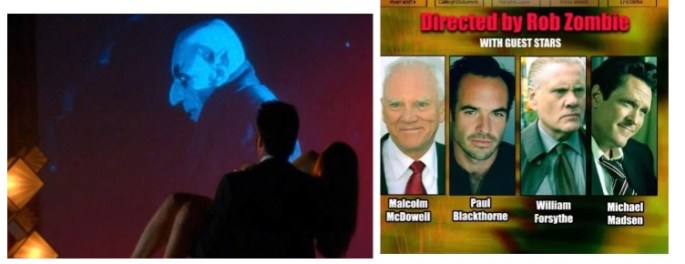
Usually television shows employ ‘gun for hire’ directors who are expected to not so much have their own vision, but carry on the style, spirit and elemental energy of the show overall for tonal consistency. Every once in a while they’ll deviate though and hire a renowned artist for an episode’s departure into their own specific style, or a melding of both for something that feels fresh, exciting and unmistakably ‘that director.’ This allows for my periodic enjoyment of a particular show’s window of escape into something creative beyond the weekly slog of predictable monotony and let me tell you, CSI:Miami was the worst show monotony. Thankfully Rob Zombie not only peppered his unique, pop-art retro baroque elements into the scheme but the the network also decided to shift the episode’s action from Miami over to LA, flying in David Caruso’s Caine and his term of regulars to interact with a host of fresh new characters, all casted from the Zombie pool of underused cult and character actor icons. Caine & Co have travelled to LA on the trail of a shady pornographer (Paul Blackthorne) who was tried and acquitted of killing his wife and an additional girl back in Miami, prompting them to join forces with a no nonsense LAPD Captain (the great William Forsythe) and interrogate various sideshow suspects who range from cooperative to obstinate. Michael Madsen is in slick tough guy mode as the amoral former football star turned bodyguard for the porn kingpin, Sheri Moon Zombie is relaxed and down to earth as ever playing a good natured photographer with key intel on the case, and other Zombie troupe regulars briefly show up including Kristina Klebe and Jeff Daniel Philips. Perhaps the least cooperative person involved is a nasty, scumbag defends attorney played to the absolute scene stealing hilt by the unmistakable Malcom McDowell at his devilish best. It’s terrific seeing these kind of underground, Midnite Movie type faces all together in the same episode of a glossy, otherwise blandly routine piece of cable TV fluff, and I wish they’d gone this route more often and hired distinct, auteur talents to augment the proceedings. This is a terrific episode laced with dark humour (thanks to McDowell), moral ambiguity (Madsen is a real snake in disguise) and genuine pathos for the victims (Forsythe’s cop shows striking empathy and compassion in his actions). This episode (which almost feels like a standalone mini-film) also reinforces what some people refuse to admit about Zombie: he’s a smart, versatile, adaptable artist who is more than capable of calibrating his toolset beyond the raucous, rowdy and raunchy aesthetic sandbox he’s used to playing in and doing something different with his boundless creative spirit, which admittedly he doesn’t often do, but this is a terrific example of.

-Nate Hill

Las Tinieblas: The Darkness

The Darkness was a weird one, even by my standards, but I somewhat enjoyed its particular brand of bizarre, despite feeling that the film overall seems a bit… incomplete. It’s a Spanish horror film, but one of those ones that seems to shirk the conventions of sub-genre and aspires to be something completely unique. Somewhere in a perpetually fog enshrouded, seemingly post apocalyptic wilderness, a paranoid fellow (Brontis Jodorowsky, son of legendary filmmaker Alejandro Jodorowsky) lives in a small cabin with his three grandchildren, in constant fear. He claims that if they go outside a mysterious ‘beast’ will come for them, and makes them wear gas masks if they set one foot outside for food or water, for fear of some vague toxicity in the air. Indoors doesn’t seem all that much better though because he’s kind of an unstable whack job who has an extremely unsettling collection of puppets he brings out, plus his rules and phobias just come across as… nuts. Soon the eldest grandchild, who bears the brunt of his antics, gets suspicious and it puts a tense saga of attempted escape and surreal, dreamlike imagery into motion. This is an arthouse film through and through, a style that I love but sometimes they get too loose, unstructured and neglect to tell a story that has any kind of discernible substance to it beyond just.. weird stuff happening. There are some absolutely striking visual terrors on display including aforementioned puppets, who are terrifyingly lifelike and a strange, split second glimpse at some kind of monster who may or may not be there for real, and the atmosphere is a smothering auditory tarpaulin of palpable unease that hangs over everything as does the eternal Silent Hill-esque fog. The film looks and sounds amazing and is very immersive from an atmospheric standpoint, it just needs more: a smidge more tangible exposition, a longer runtime to flesh things out and some more character to development to make it the full package. An almost great film.

-Nate Hill

White Noise

I’ll start with the Thomas Edison quite that this film opens with because I just love it:

“Nobody knows whether our personalities pass on to another existence or sphere, but if we can evolve an instrument so delicate to be manipulated by our personality as it survives in the next life such an instrument ought to record something.”

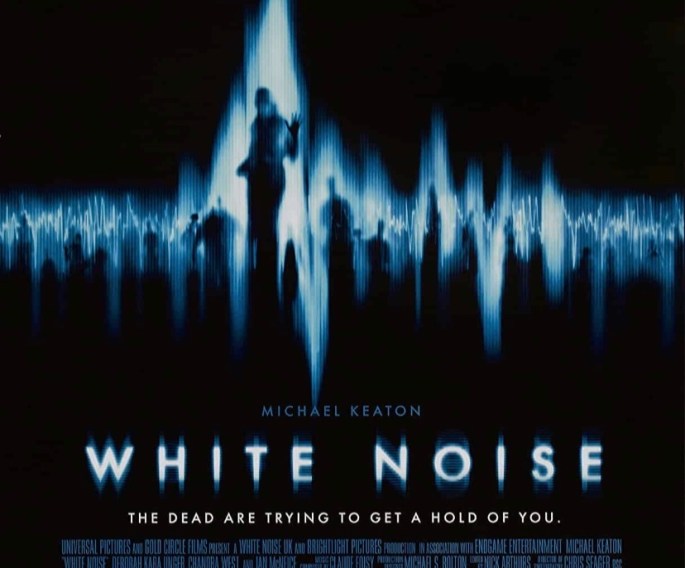
I’m not sure what film critics were watching back in 2005 that caused such a knee jerk reaction of overall negativity, but the White Noise I saw was a chillingly effective, moodily atmospheric and very well done horror with a solid lead performance from Michael Keaton and one hell of a central premise. I mean it’s a bit low key, favouring hovering room tone and slow paced suspense over frenzied thrills or jarring shocks but that tends to be what I gravitate towards in horror anyways, so here we are. Keaton plays a Canadian construction CEO in Vancouver whose recently pregnant wife (Chandra West) doesn’t come home one night. A few days pass and her body is found near her crashed car, vaulted over a seawall gorge. As he begins mourning her, a mysterious gentleman (Ian McNeice) approaches him and claims that she has been contacting him via a phenomenon known as EVP, or electronic voice phenomenon in which the spirits of the dead can speak out across the gulf between worlds using electronic equipment, in this case a VHS recording system and a screen full of the titular white noise. Keaton is skeptical at first but it soon becomes clear that this is very real and with the help of another grieving woman (the great Deborah Kara Unger) he sets out to communicate with his wife and discern whatever message she has for him. Problem is, the VHS system is an open receiver and she isn’t the only spirit out there who can hear or talk, which sets the conflict in motion. I won’t say more but it’s a tense, brooding thriller and the Vancouver setting provides that classic rainy day, chilly PNW feel while much of the action is shot through these muted blue grey filters and accompanied by unnerving, otherworldly cues from the score by Claude Foisy. The scenes of communication over the VHS equipment are the film’s strongest attribute and fill the visual auditory realm of the film with a stark, creepy sensory dreamscape of fuzzy movement, shadows around the corner and wailing souls crying out from the abyss. Like I said, I’m really not sure what the issues were with this film from a critical standpoint other than the fact that they play fast and loose with plot a bit, but even then there’s a clear answer and resolute final act, while overall they focus on atmosphere and tone, which is my jam anyways. Great film.

-Nate Hill