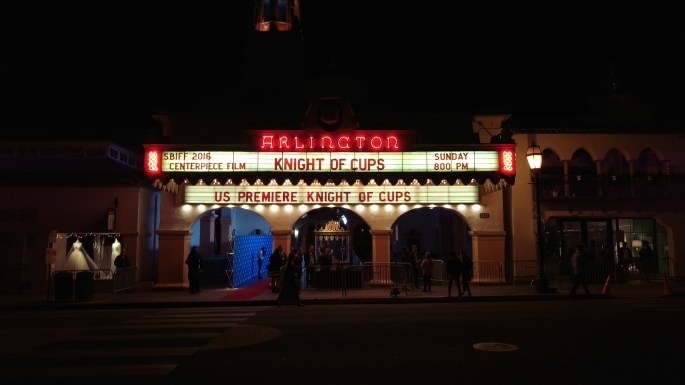
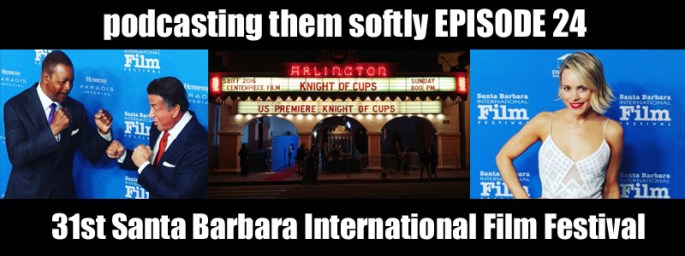
Our coverage of the 31st Santa Barbara International Film Festival is up! This has been our first red carpet coverage, and included are interviews with actors James Morrison, Michael Keaton, Rachel McAdams, Carl Weathers, film historian Leonard Maltin, filmmakers Benjamin Cox of STEREOTYPICALLY YOU and Tom McCarthy of SPOTLIGHT, producers Marcia Nasatir (THE BIG CHILL, COMING HOME, IRONWEED) and Sarah Green (THE NEW WORLD, THE TREE OF LIFE, TO THE WONDER, KNIGHT OF CUPS) and executive director of the Santa Barbara International Film Festival Roger Durling. We then dive in, head first, into Terrence Malick’s new film KNIGHT OF CUPS which had it’s US Premiere, and was the Centerpiece film at this years fest. We would like to thank Roger Durling and the staff of the SBIFF for accommodating Podcasting Them Softly at the festival this year. To find out more about the SBIFF please click here.
After making a tremendous splash with his masterful debut City of God, it was a decidedly tricky and unexpected task to take on an adaptation of a John Le Carre novel, what with its dense sense of narrative and expectations stemming from the source materuial, but that’s exactly what the aggressively talented filmmaker Fernando Meirelles did, with results that are positively spellbinding. This is a lush yet gritty film, one that has a sensuous visual texture at times, with Meirelles and his incredible cinematographer César Charlone using light and color and hand held cameras to convey tons of visual information as well as a constant sense of unnerving tension all throughout. Claire Simpson’s expert editing went a long way in keeping all of the information coherent, while providing a sense of tragic grace to the flow of the narrative. Adapted by screenwriter Jeffrey Caine, the film centers on Justin Qualye (the always excellent Ralph Fiennes), a British diplomat living in Kenya, and trying to put together the pieces to the mysterious death his wife Tessa (a sensational Rachel Weisz), who was working as an Amnesty International activist. The film utilized a nonlinear structure to tell its story, showing flashbacks to Justin and Tessa’s intense romance, intercut with the present day, political thriller narrative. The strong supporting cast included Bill Nighy, Pete Postlethwaite, Donald Sumpter, a nasty Danny Huston, and Hubert Kounde, with portions of the film being shot on location in the seemingly dangerous slums of Kenya. The plot line to the film was loosely based on a real-life incident in Nigeria, thus amping up the film’s sense of moral outrage, as elements of the story include the illegal testing of unproven drugs on the poorest members of African society. The Constant Gardener would receive extremely strong critical support and would perform solidly at the box office, before receiving four Academy Award nominations for Best Adapted Screenplay, Best Original Score, Best Film Editing, and Best Supporting Actress for Rachel Weisz, who would go on to win the little gold man.
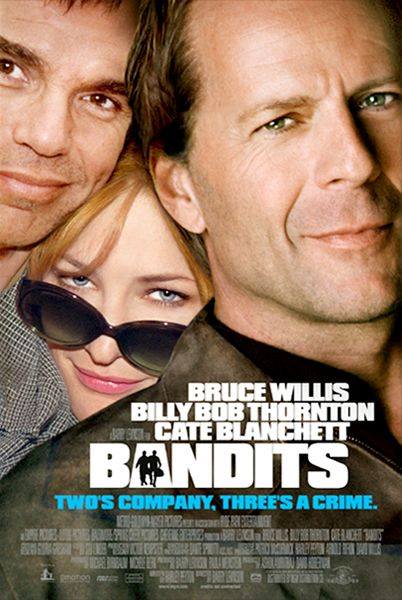
Barry Levinson’s Bandits is a film that I really enjoyed when I first saw it in theaters back in 2001 and it seems to be playing a lot of late on the HD movie channels. And every time I come across it, I can’t help but check it out, because it’s always insantly entertaining. It’s fun. It’s witty. It’s VERY clever. It’s got a great sense of casual style which was captured by the great cinematographer Dante Spinotti. Bruce Willis and Billy Bob Thornton were a terrific team with lots of chemistry, and Cate Blanchett has rarely been more sexy and fun and loose in a role. The ending is magnificent, to be honest – it’s a great twist that makes sense and that you never see coming, even if it’s been hinted at previously in the twisty narrative. Bank robber movies have been done to death, but there’s something unique about this mostly unsung effort that’s sort of hard to exactly pinpoint. I can remember laughing out loud in the theater over the ingenuity and the unexpected nature of the final moments. Harley Peyton’s perfectly calibrated screenplay knew when to be funny, knew when to be serious, knew when to be romantic, and knew how to pile on the incident and action, showing a total mastery of tone and really treasuring the element of surprise. Levinson’s career has been all over the place, with lots of great films, a few total duds, and dependably solid work in between; this is easily one of his most underrated efforts.
Frost/Nixon is one of those historical dramas with a predetermined ending that somehow never fails to be anything less than mightily entertaining. Reprising their stage roles, Michael Sheen is David Frost, the wild British talk show host who bought himself an interview with Richard Nixon, played by Frank Langella, after he had left office. Crisply directed by Ron Howard from a witty and detail-oriented script by Peter Morgan (who also wrote the stage version), Frost/Nixon is an intimate time-capsule, going back to a time when an ex-President could be gullible (and conceited) enough to agree to a series of interviews without really doing his due diligence. Nixon figured that Frost would be a push-over, as nothing that Frost had done professionally up to that point had suggested any real depth or societal importance. Nixon was blinded by cash. But boy did he get what he deserved. Essentially, and I’m not really spoiling anything that anyone with a nominal US history background wouldn’t know already, Frost got Nixon to admit guilt in his role as President during the taped interviews, which would then be broadcast on world-wide television (and have been released on DVD). The film has a terrific supporting cast of some of the best character actors in the business: Sam Rockwell, Kevin Bacon, Oliver Platt, Toby Jones, Matthey MacFadyen, Rebecca Hall, and Clint Howard all turn in vivid performances. Howard directs in an unfussy fashion with a simple elegance coming from his director of photography, Salvatore Totino, who has been working with Howard for over a decade. Shooting the film with a burnished, gold-brown glow gave off a feeling of yesteryear which was integral to the production. Again, you know where the story is going and how it’s going to end; it’s just a question of how good the film is in getting you there. This is easily one of Howard’s best films to date, and one that stands up on repeated viewings.
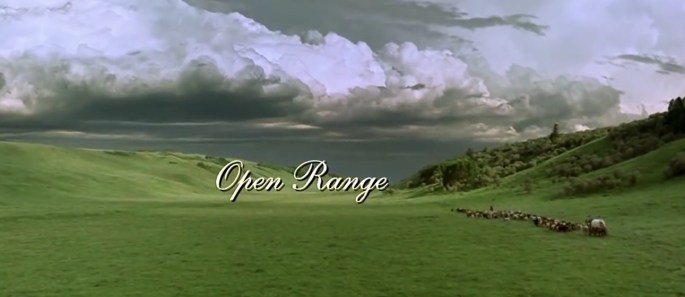
Open Range found Kevin Costner confidently in John Ford/John Wayne territory. This is a lovely throwback to old-school westerns, the sort of film that has a noble love story at its center, and is peppered with violent confrontation and surly character actors doing their gruff best. Robert Duvall, Annette Benning, and a vicious Michael Gambon all did fantastic supporting work, with Costner the firm and strong center to this tale of open range cattleman (Costner and Duvall) who go up against a greedy and deadly Irish land baron (Gambon) intent on total domination of the area. Benning is the woman who Costner falls in love with, and the deft screenplay by Craig Storper (from an original story by prolific novelist Lauran Paine) had the perfect balance of drama, romance, and bloody action, with the final 20 minutes containing an absolutely ear shattering and ferociously staged gun battle, with all sorts of bodies getting torn up in Peckinpah-esque fashion, with bullets whizzing by and overhead, splintering the wooden buildings with killer intent. Cinematographer J. Michael Muro, one of the all-time great steadicam operators, was able to touch upon classical and iconic imagery with his gorgeously composed widescreen photography, but never surrendered to any sort of slavish imitation of films from the past; there’s still more than a few modern aesthetic touches, especially during the gun battles, that make this film zip and pop around the edges. But at its heart, this is a classical Western filled with themes of honor and promises kept and friendship that knows no bounds. Critically embraced, the film broke the “Westerns are dead” curse back in 2003, becoming a late summer sleeper hit at the box office. The film features a terrifically rousing score by Michael Kamen.
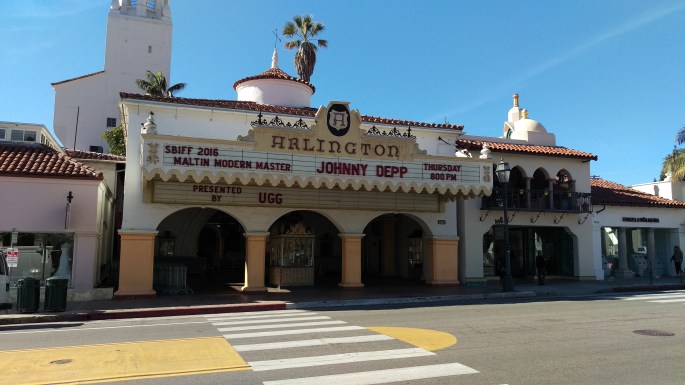
Everyone was waiting. Leonard Maltin was waiting, Roger Durling was waiting, Scott Cooper was waiting, the press was waiting, and the giant mob of screaming fans were waiting. Johnny Depp was running late, and nobody cared. Depp arrived thirty minutes late. He was set to receive the Leonard Maltin Modern Master Award from BLACK MASS director, Scott Cooper as well as participating in a much anticipated Q&A with Leonard Maltin.
He arrived in a black Cadillac SUV and once he exited he instantly disobeyed his handlers and went directly to the vast mob of his fans. He took his time signing autographs, taking photographs, and shaking each hand he could. Depp then moved to the red carpet, timidly keeping away from the press yet posing for a gracious amount of time for photos against the sleek SBIFF backdrop. He posed with Scott Cooper and then he quickly was moved to the end of the press line, but I caught his attention:
“Mr. Depp, one quick question: DONNIE BRASCO, ONCE UPON A TIME IN MEXICO, and SWEENEY TODD. Which is your favorite role?”
He put his hand up to his mouth, held his chin, stared right at me through his blue Michael Mann tinted glasses and said,
“I don’t know. That’s difficult, man.”
Depp was quickly moved into the Arlington Theatre and the floodgates opened and everyone rushed in. Once the gorgeous Arlington Theatre settled down, the dapper Roger Durling took the stage and he spoke graciously, thanking everyone for being there and thanked Johnny Depp for coming.
Maltin then took the stage and he introduced Depp and an excellently edited highlight reel played. Watching a brief highlight of Depp’s career doesn’t do it justice, yet you can’t help feeling overwhelmed by his truly epic career.
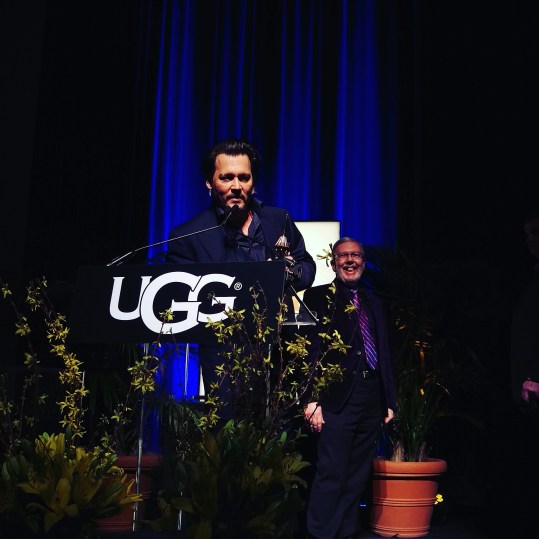
Depp walked out, and the theatre erupted with applause and screaming. Depp shyly smiled. To this day, Johnny Depp is the epitome of cool. He was wearing socks with hemp leaf patterns and for about the first hour and a half of the Q&A, he meticulously hand rolled a perfect cigarillo. He then lit it and took the rest of the Q&A slowly smoking it. In California, and pretty much anywhere else, it is illegal to smoke in a public venue, but who is going to tell Johnny Depp to stop smoking?
Depp is a very sweet guy, he’s incredibly humbled. Whenever Maltin would bring up a film, whether it was one of Depp’s blockbusters or a seminal undercard performance, the audience would clap and Depp would smile and thank the audience.
The Q&A with Leonard Maltin was almost three hours long and it was wonderful. I was able to ask Leonard Maltin two quick question on the red carpet, I asked him to pick between DONNIE BRASCO, ONCE UPON A TIME IN MEXICO and SWEENEY TODD. Maltin paused for a moment and said DONNIE BRASCO. I then asked him what his favorite underrated performance of Depp’s was and he said, without hesitation, DON JUAN DEMARCO.
It took about an hour for Depp to warm up and get comfortable. He was incredibly candid about his career. He spoke frankly about how he’s a musician, who happened to become an actor to pay the rent. He spoke in depth about what a horror he was, and sometimes still is, on film sets. Maltin asked him about his relationship with Leonardo DiCaprio on the set of WHAT’S EATING GILBERT GRAPE. Johnny Depp just started laughing.
“You know, I respect Leo a lot. He did so much work and research and preparation for that role,” and a sly smile arose on his face, “and I tortured him.”
The audience started laughing, and Depp stopped, and looked at the audience,
“No, really, I did. He liked video games. No Leo, I won’t give you a drag of my cigarette while you hide from your Mom.”
Depp briefly spoke about his work with John Waters, saying how Waters was the only filmmaker he knew who made a film based on a title. He said Waters came up with the idea of PECKER, solely for the fact that when it would be advertised it would be: John Waters’ PECKER Coming Soon.
When Depp was asked about his casting in EDWARD SCISSOR HANDS and his long and awesome collaboration with Tim Burton, Depp started laughing. He spoke about how he didn’t want to even meet with Burton, he knew he wouldn’t get the part, but his agent Tiffany talked him into it. Depp recalled walking into a diner to meet Burton. He had no idea what he looked like. He scanned the diner and saw a guy “whose hair looked like a hardware store exploded, and I knew I had to talk to him. Even if he wasn’t Tim, I still had to talk to him.” The man with the exploded hair was Tim Burton, and that was the beginning of one of the greatest collaborations in cinema history.
Leonard Maltin beamed as he showed a clip of DON JUAN DEMARCO and then asked him about that film, and working with Marlon Brando. Depp settled back in his chair and smiled, and spoke about his abundant love and admiration for Brando. He said he was a father, mentor, brother, essentially a gigantic blanket that meant the world to Depp. When Maltin asked Depp to describe what he learned from Brando, he paused looked down, and then back up at Maltin and said: justice.
Maltin asked Depp about the only film he directed, THE BRAVE that premiered at Cannes in 1997 and featured Marlon Brando in a prominent role. Maltin asked when we could see it. Depp asked the audience who wanted to buy it. He then went on to speak about the reason he shelved the film was because he didn’t want to play the distribution game, and he wanted to retain control over it.
In 2004, when Brando died, Depp was devastated and he was receiving offers about releasing THE BRAVE. He was told it was a prime time to release the film, it was an unseen Brando performance, and now was the time to release it. That’s the moment when Depp decided to put the film under lock and key. He was returning justice back to Marlon Brando. Maltin then said that releasing it now wouldn’t be an exploiting Brando’s death. Depp then said he would show THE BRAVE at the Santa Barbara International Film Festival next year, and shook Maltin’s hand on it.
So in theory, next year, Johnny Depp will be premiering his unicorn of a film, THE BRAVE, at the 32nd Santa Barbara International Film Festival. That remains to be seen, but seeing Depp speak, in depth, for three hours about his remarkable career was amazing. After the Q&A was over, Depp went back outside to all his screaming fans and took more photographs and signed as many autographs as he could. Johnny Depp is not only one of cinema’s best actors, but he’s truly a class act.
Genuinely creepy. Never truly “scary” but unnerving and happily cruel. This was Polanski twisting the emotional and psychological screws for a mainstream audience, and doing it with dark humor, visual panache, with his always incredible sense of pacing firmly on display. Mia Farrow in the role of a lifetime, and John Cassavetes perfectly cast as the shady husband who makes the wrong bargain. Based on Ira Levin’s novel, this is a truly messed up film, with all sorts of nasty implications, with Polanski’s obsession over sex and violence intrinsically linked, except this time, it’s the internal turmoil and toll that’s really stressed. Released in the summer of 1968, and shot for a reported $3 million, the film would become a massive critical and box office hit. Produced by genre master William Castle, with expert cinematography from William Fraker, who was easily one of the most prolific and steady cameraman of his era. Taylor Hackford’s exceedingly entertaining The Devil’s Advocate borrowed many thematic elements from Rosemary’s Baby, with Polanski’s iconic effort serving as inspiration for a variety of cheap imitations in the years that followed the success of Rosemary’s Baby. Ruth Gordon would win the Oscar for Best Supporting Actress, and what a performance she delivered. And let’s not forget a young Charles Grodin as Dr. Hill!
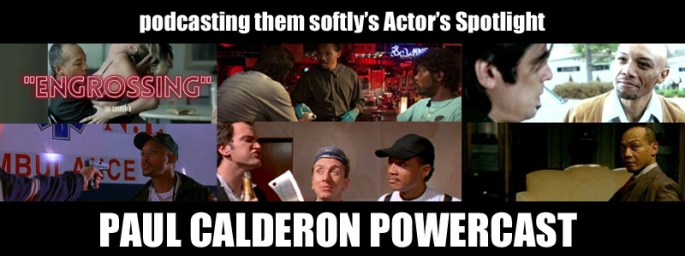
Podcasting Them Softly is honored to present a chat with veteran actor PaulCalderon, who has appeared in a wide range of some of our favorite films and TV shows for close to the last 40 years. Paul has worked with filmmakers such as Quentin Tarantino, Abel Ferrara, James Mangold, Alejandro Gonzalez Innaritu, Steven Soderbergh, Spike Lee, Sydney Pollack, Harold Becker, Sydney Lumet, and Arthur Penn, to name only a few, with credits including Pulp Fiction, King of NY, Bad Lieutenant (which he co-wrote with Ferrara), Welcome to New York, Q&A, Sea of Love, Copland, 21 Grams, Out of Sight, Clockers, and The Firm. His massive list of television credits include Boardwalk Empire, Hostages, Law and Order: Criminal Intent, How to Make It In America, Miami Vice, and an epic run on the daytime soap One Life to Live. He’s also no stranger to the theater, having appeared with Robert De Niro in Cuba and His Teddy Bear. He also runs his own acting school, which you can find out more about at his website www.paulcalderon.net.Paul is a founding member of the Touchstone Theater, The American Folk Theater, and The LAByrinth Theater Company, as well as being a member of the Actors Studio since 1984. A consummate NY character actor all throughout his career, Paul brings energy and edge to every performance in every project, and we’re extremely excited present this interview! We hope you enjoy!
Rating in Stars: *½ (out of ****) Cast: Ben Stiller, Owen Wilson, Penélope Cruz, Will Ferrell, Kristen Wiig Director: Ben Stiller MPAA Rating: PG-13 (for crude and sexual content, a scene of exaggerated violence, and brief strong language) Running Time: 1:42 Release Date: 02/12/16
The appeal of 2001’s Zoolander was that its titular protagonist was so adorably daft that one couldn’t help but to like the guy. Zoolander 2, then, seriously tests that theory. Everything about the first film is exacerbated here, including the ever-present potential of going so far over the top that, as the late Roger Ebert (whose infamous hatred of the first film only nurtures curiosity about what the film critic would have thought of this clearly inferior sequel) once put it, it circumnavigates the globe. The jokes come at a faster pace as the targets for the film’s attempted satire have been updated by 15 years. The cameos are more numerous by three times, to a point far short of amusement when one begins to realize that’s the only novel trick up its sleeve. The ratio of the film’s successes to its failures is about one inspired minute to 15 subsequent ones of uninspired lunacy.
Indeed, the best stretch is right at the beginning. After “a scene of exaggerated violence” (clever, MPAA) in which Justin Bieber is murdered rather excessively right outside Sting’s villa in Rome, we become reacquainted with Derek Zoolander’s (co-writer/director Ben Stiller) and old friend Hansel’s (Owen Wilson) fates following the finale of the first film (which, if one remembers, was positively, absurdly optimistic about the possibility of a model’s facial expression stopping a Chinese throwing dart in mid-flight). Derek’s wife Matilda (Christine Taylor) died after the educational institution she and Derek built (the one with the elaborate name) collapsed. Derek’s parenting skills were gravely affected by the tragedy, and Derek Jr. (Cyrus Arnold) was transferred through the system to an orphanage. Derek sought refuge in northern New Jersey (an arctic wasteland).
For his part, Hansel, whose face was, um, disfigured by the collapse, has fled to Malibu (an arid wasteland) and into the arms of an orgy, all of whom, he learns, have been impregnated. He isn’t ready to be the father of 11 children, though, so in spite of Kiefer Sutherland’s tearful protests and when Billy Zane comes calling upon his (and Derek’s) talent as a male model, he travels to Rome to try and find work with new fashion moguls Don Atari (Kyle Mooney) and Alexanya Atoz (an unrecognizable, mostly incoherent Kristen Wiig) in order to find Derek Jr. and be reunited. Soon, though, he is drawn into an investigation led by Valentina Valencia (Penélope Cruz), an agent with the fashion division of Interpol (what?), that has uncovered a startling conspiracy.
Apparently, there is a conspiracy dating back to the very beginning of the human race wherein Steve (the third wheel to Adam and Eve, here played in cameos by Alexander Skarsgård and Karlie Kloss), the first male model, will be the ancestor of the male model to end all others. Bieber’s death was the latest in a series of celebrity murders that all ended with an attempt at one of Derek’s most signature expressions, which when unlocked leads our incredibly stupid models right into the clutches of old foe Mugatu (Will Ferrell) and an ancient tribunal of all the great fashion minds.
This all sounds far cleverer than it is. The screenplay by Stiller, Justin Theroux (who also appears opposite Milla Jovovich in their old roles as Mugatu’s henchmen), Nicholas Stoller, and John Hamburg barely follows any detectable structure until the controlled chaos of the climax. The celebrity cameos, which number far greater than any I have mentioned, lose their luster by the time stars like Olivia Munn, Joe Jonas, Susan Sarandon, and far too many more simply exist in the background (the less said about Benedict Cumberbatch as an androgynous model and Fred Armisen as a ten-year-old child laborer via disturbing digital effects the better off we would be). Zoolander 2 is, frankly, bizarre in a tired way.






 Podcasting Them Softly is honored to present a chat with veteran actor
