BENNETT MILLER’S MONEYBALL – A REIVEW BY NICK CLEMENT

moneyball

The great American movie Moneyball centers on our great American sport, but is less about the sport itself and more about the people behind the scenes, those who constantly grapple with one recurring feeling: Disappointment. Baseball, after all, is a sport based on winning and losing, and Moneyball’s lead character, Billy Beane (the wonderful Brad Pitt in full movie-star mode), the general manager of the Oakland A’s, will stop and nothing in order to come out on top. But because baseball is a game, only one team can say that they’ve won the final game of the season. This is what Beane has been striving for his entire career, and the endless quest to win that final game will likely forever drive him as a competitor. In terms of bucking the standard conventions of your typical sports movie, the brilliance of Moneyball lies in how it doesn’t take a rote approach to telling a story focused on a sport that we’re all familiar with. Much like The Social Network (the two films share the invaluable Aaron Sorkin as writer and Scott Rudin as producer) this is an “inside-the-machine” movie, looking at the sport of baseball from an analytical and statistical point of view. But rather than bogging down the narrative with numbers and esoteric jargon to the point of confusion and/or boredom, Sorkin, and his estimable co-screenwriter Steven Zaillian (Schindler’s List, Searching for Bobby Fisher) have shaped Michael Lewis’s book into an emotional journey for Beane, as a coach, father, and friend.

Choosing to center your film on the notion of “sabremetrics” was a bold and unique decision. And considering the numerous starts and stops for Moneyball throughout its development, it’s remarkable that director Bennett Miller (Capote, Foxcatcher) was able to deliver such a clear cut vision (Steven Soderbergh was set to direct before the movie collapsed over “creative differences.”) Taking a niche subject and a somewhat unfilmable book and turning it into a quietly powerful film is no easy task, so much credit needs to be given to Sorkin and Zaillian. If you know their work, you’ll hear Sorkin’s witty, satiric voice in the rapid-fire dialogue, while the fluid structure, which deftly mixes flashbacks of Billy Beane’s subpar minor and major league career as a way of making correlations to what Beane as a manager was going through with his team, can be traced to Zaillian’s confidently guiding hand in the organization department. And instead of giving you a saintly approach to the head coach role, as written, Beane is a man of steadfast, stubborn convictions, willing to ruffle feathers, and more than happy to berate and fire people who aren’t valuing his new found philosophy. Many of the film’s best scenes take place within the team’s closed-door strategy meetings with the scouts, all of whom were either phenomenally well cast or the real deal. What Sorkin and Zaillian have done so well is that you don’t need to be a baseball expert to understand the sometimes arcane, economics-based approach to the sport that’s on display. Moneyball is an “inside-baseball” movie, something that really hasn’t been done before, and it sits right next to Field of Dreams, Eight Men Out, and Bull Durham as one of the best films to spotlight our national pastime.

But the key to Moneyball’s success is the rapport between Pitt and Jonah Hill, who both delivered engaging, funny, and totally inviting performances. Pitt hasn’t been this out-right-likable and charming in years, and it’s a treat watching him literally transforming into his generation’s Robert Redford right before our eyes. There’s an animal magnetism to Pitt as actor, and as he’s gotten older, the lines in his face and around his eyes have begun to express a vulnerability that was absent in his earlier work. Pitt plays Beane as a man trying to be a better father to a daughter that he doesn’t get to spend enough time with, and as such, no matter how much of a thorn-in-the-side he is to his teammates (he makes many selfish decisions in an effort to preserve his vision), you’re always on his side. Look at this performance and then contrast it to the tough-love-S.O.B. dad in The Tree of Life or the low-lives he so brilliantly essayed in Killing them Softly and The Counselor – Pitt loves to quietly stretch his range, and his not afraid of taking chances as an actor.

And Hill, playing the awkward comic relief to Pitt in the role of a stats-obsessed advisor who helps Beane develop and implement the sabermetrics system of player evaluation, was perfectly and smartly cast against Pitt, and the two of them immediately demonstrate a chemistry that’s hysterical to see unfold. Hill, who got his start as an Apatow class-clown and who has been killing it in every raunchy comedy made over the last 10 years or so, was a perfect partner for Pitt, and his career stretching work in this film would serve as a warm-up to his brilliant turn in The Wolf of Wall Street. He was also fantastic in the underseen black comedy Cyrus. Pitt and Hill couldn’t be any more different when it comes to performance style, personality, appearance, and expectation. Hill, playing a fictionalized version of real-life-stats-guru Paul De Podesta named Peter Brand, gets the lion’s share of the movie’s laughs, but also registers strongly as a dramatic presence. Without their bond, Moneyball wouldn’t be as powerful as it ultimately becomes, as the two men teach each other about themselves and about the sport that they love. It should also be mentioned that Philip Seymour Hoffman is effortlessly good as Art Howe, the put-upon manager who has to deal with Beane’s unconventional methods.

Moneyball doesn’t end with the last play of the game on the final pitch in the bottom of the ninth. It’s not that sort of movie and doesn’t want to be; it couldn’t be less interested in final-pitch heroics and dramatics if it tried. Wally Pfister’s intimate cinematography captures the sport in all of its glory when that sort of thing is called for, but instead takes a measured approach to the action, following Beane around relentlessly as he tries to figure out what his next move will be. Mychael Danna’s amazingly subtle yet highly effective musical score helps underline the big emotional beats without ever grandstanding or calling attention to itself. But what’s truly exceptional about the film is that it definitely does deliver a rousing, totally satisfying emotional release upon its conclusion, despite not bowing to the “final game” or “impassioned coach’s speech” cliché that we’ve seen a hundred times already. And when thought about at length, one realizes how the message of the film (echoed by Pitt’s daughter singing the lyric “You’re such a loser, Dad” during the end credits) is that losing is part of our culture, and at the end of the day, it’s more about how you conduct yourself as a person than it is about how many games you’ve won. In that sense, it’s very similar to Peter Berg’s fantastic high school football movie Friday Night Lights, and joins the ranks as one o the finest contemporary sports films ever made. It’s not about winning or losing, but about how the game has been played.

moneyball

Joe Wright’s Hanna: A review by Nate Hill

Joe Wright’s Hanna started as a Vancouver Film School script, funded through grants that would make it the catalyst for the positively unique, incendiary action fairy tale that it is today. It’s crowd pleasing without any superficiality, straight to the point without being over serious, and is made with a slick, vibrant aesthetic that will have your pulse dancing a jig in time with the thumping score by The Chemical Brothers. I held off on seeing this one for years after its initial release, jaded by the prospect of another ‘killer genetically altered female assassin’ flick. One night I finally caved and took a peek on Netflix. I then kicked myself hard for not taking notice sooner, purely on the notion that I wouldn’t dig it based on its formula. I suppose I learnt a little ‘book by its cover’ lesson there, as I was completely enamoured with the film and have seen it at least ten times since then. The tired ingredients of any old formula can be whipped up into a tantalizing new recipe, providing all those involved have the commitment and passion. The filmmakers of Hanna go for broke with one of the best thrillers in years. Saoirse Ronan is an explosive, feral waif as the titular hero, raised in isolation by her badass ex CIA father Erik Heller (underrated Aussie Eric Bana nails the German accent to a T). They reside in the frozen tundras of Lapland, where Erik trains her in the ways of a warrior, instilling survivalism in both physical and intellectual measures, preparing her for their inevitable separation. An enemy from Erik’s past surfaces in the form of evil CIA witch Marissa Wiegler (Cate Blanchett practically breathes fire with a naughty southern accent and a red hairdo that looks acidic to the touch), and both Hanna and him are forced to run, separated from each other. She escapes from a remote facility and begins her journey across Europe, befriended by a lovable squabbling family of travellers, igniting a yearning for companionship in her that Ronan expertly shows the camera. Wiegler enlists the slimy help of a euro trash club owner who moonlights as some sort of freelance über villain (Tom Hollander almost walks away with the movie as the psychopathic, bleached blonde pervo Deutsch-bag) who relentlessly pursues Hanna along with his neo nazi skinhead henchman. The thing about this film is that it’s all been done before, but they find a way to make it fresh, exciting and strike chords which simply haven’t been hit in this sub genre before, providing a film experience that really sticks. Ronan has never been more virile and effective, also proving a mastery of the German accent and embodying Hanna with intense physicality that’s achingly punctuated by a gradual awakening as a person as well. Impressive balance is shown in her character arc, through writing and stunt work alike. This is the first movie to be scored by The Chemical Brothers, and damn I hope we get more. They belt out a technicolor rhapsody of electric music that flows beautifully with the story, hitting every beat, ramping up suspense when needed, being surprisingly weird at times and kicking around your head long after the credits roll. The actors are all easy listening with the dialogue, never feeling forced or making us doubt for a minute that these aren’t real people engaged in genuine interaction. The film neither drags nor rushes, arriving at its often grisly, sometimes touching and always entertaining conclusions exactly when it needs to. It shows uncanny intuition with its pacing, an absence of the need to show off with unnecessary fights or effects which don’t serve the story, and above all a keen desire to entertain us. Terrific stuff. 

MATTHEW VAUGHN’S KINGSMAN — A REVIEW BY NICK CLEMENT

1

Kingsman is absurd, outlandish, totally over the top, and cheeky as all hell. It’s a movie that is in love with the fact that it’s a movie, and as such, the film can never be taken seriously, and poses no real threat or menace – you just sit there and laugh at the audaciousness and the verve and the craft. This is a hyper-violent and extremely knowing send up of Bond and spy movies in general, a gleefully sadistic and sometimes cruel R-rated cartoon that’s been directed with the same smack-you-in-the-face style that don’t-give-a-shit British director Matthew Vaughn brought to his similarly ribald and cheerfully vulgar superhero riff Kick-Ass. There’s an anger that runs throughout Kingsman which is interesting to note; I detected some of the subversive shades of Fight Club and Falling Down running through its veins, while the more obvious touchstones of Bond, Bourne, Bauer, and Kill Bill are up front and center.

Given that this is a big-budget offering from a major studio – 20th Century Fox – I was shocked and pleased to see the level of out-right craziness on display here. This is an action film first and a comedy second, and it’s yet another indication of the Gareth Evans factor; it’s as if all Hollywood action guys got a chance to see The Raid and The Raid 2 and they now feel they have to up the ante. I also noticed some stylistic nods to Running Scared during the numerous shoot-outs. Vaughn brings a mean streak to much of his work (Layer Cake, his debut, is still my favorite of his) and while it’s clear he loves the trappings of the Bond universe and spy movies, he’s really set out to make a wink-wink, tongue-firmly-in-cheek effort that pokes fun at the ludicrousness of everything.

Because of this, the intense violence, while entertainingly stylish in the moment and bracing to witness as a result of the somewhat recent PG-13’ing of Hollywood, holds no lasting impact – this is a film that is comprised of a series of money shots, all the way from the opening frames, up until the final bits, concerned with being “cool” at all times, and as a result, nothing carried any weight or honest heft. Which is fine. It’s an R-rated comic book, and Vaughn really seems to excel with this tone. Some of it looks absolutely great (the stylish cinematographer is George Richmond), some of it looks like overly-CGI’d junk, but all of it is made with a certain bloody zest and boldness and the sheer delirium of the action set-pieces can’t be denied. Henry Jackman and Matthew Margeson deliver a truly fantastic musical score that sounds like outtakes from a Bond flick in many areas, and which helps drive the film home in every manner.

Colin Firth appears to have had the time of his life playing the suave and lethal member of the Kingsman, a secret group of British spies who help to keep the world in balance, while newcomer Taron Egerton appealingly underplays his fish-out-of-water character, the young recruit who has to step up to the plate. Samuel L. Jackson camps it up with a lisp as the megalomaniacal villain with a hilariously convoluted scheme to rid the world of most of the population in an effort to reverse global warming. Or something like that. Just wait until you see the method to his madness – it’s hysterical and nasty and I was sort of shocked to see it played out to the degree that it was. All of Kingsman is purposefully asinine, and as previously mentioned, it’s never realistically menacing or truly suspenseful. This is an over-stuffed, frenetic, sometimes witty, mostly predictable piece of escapism that blows heads up with a smile. And listen – any movie that finds the time to slaughter at least 100 ultra-conservative, right-wing, hate-spewing, super-Christians from Kentucky and ends its narrative with the promise of kinky sex is A-OK with me. This a’int your father’s 007.

1

PETER HYAMS’ BUSTING — A REVIEW BY NICK CLEMENT

busting

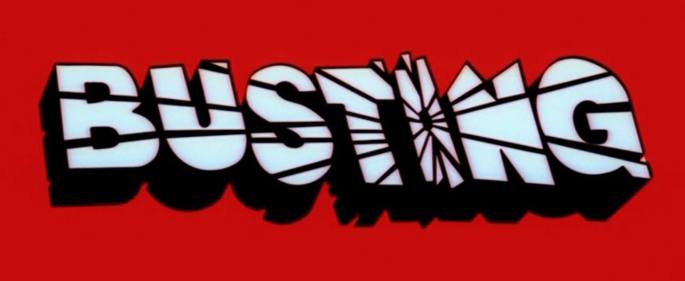
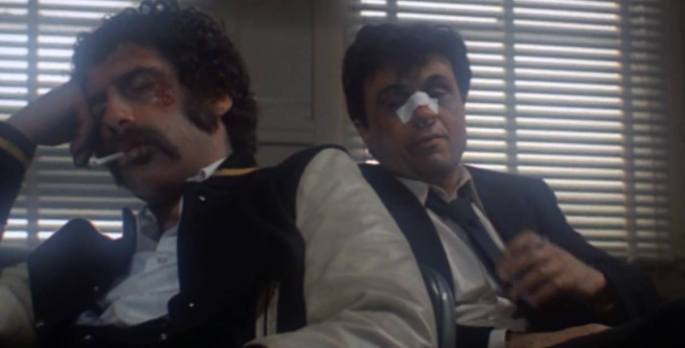
Busting is early buddy movie brilliance from the master of mid-budget studio actioners Peter Hyams (The Relic, 2010, Capricorn One, Timecop, The Star Chamber, End of Days, Sudden Death). This was the filmmaker’s debut feature film after two made-for-TV efforts, and while the project has a low-tech quality all around the edges, it still stands as one of the director’s best films. Starring an amazingly mustached Elliot Gould and future Robert Blake as a pair of pimp-slapping Vice squad detectives, Busting takes on an episodic structure, throwing the viewer into various cases and assignments, all of which lead to an overarching bad guy who is controlling the city’s vast pimping and whoring racket. At 95 minutes, there’s not a wasted scene, and despite the various converging plot lines, everything stays streamlined and easy to follow. I love how the two cop characters are idealistic and interested in cleaning up the streets, but that they slowly realize that their efforts may be all for not. Cynical, formally exciting in surprising ways, casually sexist and homophobic (those were the times!) and totally trading off of ugly, common stereotypes of the era, this was 1974’s “other” precursor to the popular 80’s buddy-cop film, with Freebie and the Bean beating Busting to theaters that year, and earning more box office and respect from critics and audiences. While the two films share some common traits, they are vastly different genre exercises, with Richard Rush’s Freebie placing an emphasis on madcap comedy and hilarious antics, and Busting being the more serious of the two films, mixing violence and sex into a gritty, decidedly more adult package, with Hyams clearly loving the chance to show off a down and dirty visual aesthetic. But there were two BIG things that stood out in Busting for me as a viewer. First — I can’t remember another film that ends on a freeze frame that then goes on to include a flash-forward voiceover narration which wraps up the narrative and the main character’s personal arc. I’d never seen this before, and I totally loved the nerve of it, as it fit perfectly with the film’s hopeless and dark denouement, which could only have been pulled off in a low budget 70’s item such as this one (with a few modern exceptions). The other technical aspect that I was constantly marveling over was the camerawork, and in particular, the numerous tracking shots that appeared to have been accomplished without the use of a dolly, and this being a film that predates the use of the stedicam (no?), I’m left only to guess how these fantastic scenes of action were accomplished. During the film’s various chase scenes and shoot-outs, the action is captured in long, unbroken takes, with actors running straight for the camera and then right past it as it continues to move and turn and swivel, all of which suggests the use of some sort of motion stabilizer device for the camera, as everything is ultra-smooth, especially considering the obvious budget limitations. It’s awesome, energizing stuff. Gould clearly had fun with his role, and the short-statured Blake made for a solid partner when contrasted with Gould’s lankiness. I found very little to quibble over with Busting. This is an example of a filmmaker crafting a tight, entertaining, hard-nosed actioner that now has the benefit of serving as a societal time capsule of a bygone era.

2

SAM RAIMI’S A SIMPLE PLAN — A REVIEW BY NICK CLEMENT

simple_plan.jpg

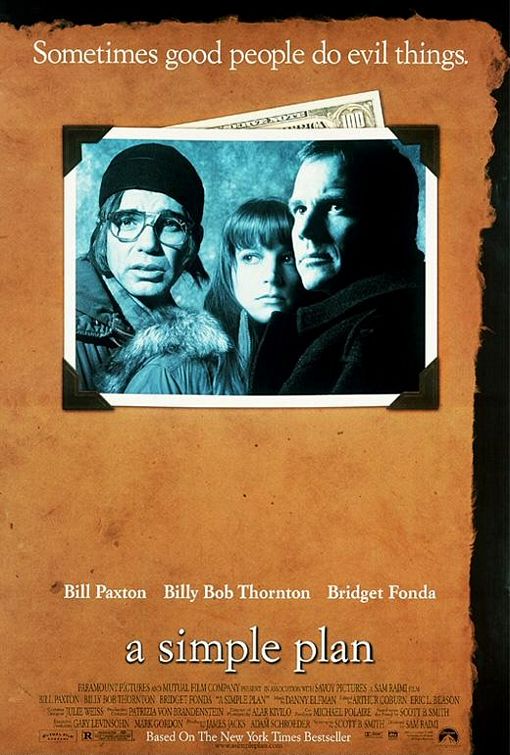
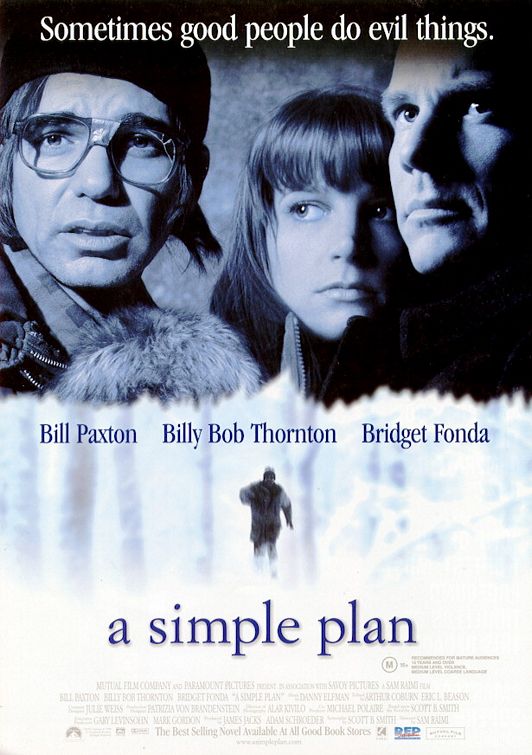
Make no mistake: A Simple Plan is the best film that Sam Raimi has ever made. It’s his most complete, his most human, his most emotionally affecting. This film has ice water running through its veins. I’ve seen it easily 10 times and it never fails to raise the hairs along the back of my neck, and because of how deadly serious the film is, nothing is played for laughs or with a sly smirk. What would you do if you found a ton of money in a crashed airplane in the middle of the snowy woods, with seemingly nobody around to see you make your discovery? That’s the dangerous and potentially lethal scenario posed by Scott B. Smith’s brilliant screenplay (which was based on his novel), which takes on Shakespearean levels of familial tragedy. Bill Paxton and Billy Bob Thornton were perfectly cast as Minnesota brothers, desperate for one big stroke of luck in their otherwise unremarkable lives, and Bridget Fonda was absolutely terrific as Paxton’s too-clever wife who might just be the smartest person in the room. The cinematography sends a chill down your spine, the snow vistas are shot with cutting simplicity, and the lack of nonsense in the final act truly elevates this film from standard genre piece to something more powerful and memorable.
simple_plan_ver4

I’d love to see Raimi return the neo-noir genre, as this film was aced from top to bottom, and displayed a maturity that he would seemingly abandon in future efforts. Danny Elfman’s creepy musical score was unsettling in all the right moments (love the piece of music that plays over the opening credits), and cinematographer Alar Kivilo made the most out the wintry, desolate locations, using bright daylight in a way that you normally don’t see in a thriller, with visual nods to In Cold Blood strewn all throughout. There’s also a ton of snow in this movie, and I love movies that take place in snowy environments. Gary Cole turns up as the villain in an extremely memorable performance. At one point, Mike Nichols was set to direct, before Ben Stiller became interested, which then lead to John Dahl becoming attached with Nicolas Cage in the Paxton role, only to have John Boorman temporarily replace him as a potential director (Boorman would be responsible for casting Paxton and Thornton). Despite grossing only $16 million at the American box office, the film was nominated for two Oscars (Best Supporting Actor, Billy Bob Thornton; Best Adapted Screenplay), and has most certainly taken on cult classic status. A Region A Blu-ray upgrade is long overdue, but for those with Region Free players, there’s a spiffy looking German Blu-ray available to own.

simple_plan_ver3

JOHN WELLS’ BURNT — A REVIEW BY NICK CLEMENT

burnt.jpg

Burnt is enjoyable fluff but should have been meatier, a decent first and second course, but it felt like old Harvey Scissorhands didn’t include the dessert. Now that I’ve got enough bad food puns out of the way, this movie was extremely sharp looking (MONTAGE POWER), Bradley Cooper was very commanding (he plays a terrific jerk, with the various outbursts in the kitchen registering as the film’s strongest scenes), the supporting cast is very deep (Sienna Miller, Daniel Bruhl, Omar Sy, Alicia Vikander, Emma Thompson), and it’s engagingly directed by John Wells. But, it’s the script by Steven Knight (Locke, Dirty Pretty Things) that felt surprisingly undernourished, or, more was shot and for some reason taken out of the final cut. And if that’s the case, I can’t begin to understand why. Not that what we’ve been given is bad; it’s just mostly predictable and it felt too quick and a tad slight. Cooper’s personal reflection/awakening happened awfully fast for someone with so many personal demons, and all of his potentially dangerous side issues got too neatly wrapped up. The real star of Burnt is the food and the high-energy scenes set inside of Cooper’s kitchen, as this is where the film feels truly alive. The filmmakers really nailed the chaos that overtakes a bustling cooking space, and Cooper’s performance was clearly inspired by real-life bad boy chefs who take their work very, very seriously. Interesting to note that Cooper played a sanitized version of this character on the short lived FOX TV series Kitchen Confidential. Also interesting to note, this project bears striking similarities to an unproduced screenplay that made the rounds about a decade ago called Seared, which was written by one-time flavor of the week Jesse Wigutow (who also penned the similarly unproduced yet fantastic Urban Townie), and was primed to be a David Fincher/Brad Pitt package. As is, Burnt is solidly decent, fast moving (a bit too fast), and always a slick visual treat. It’s what I’d like to call a Good Netflix.

burnt

GASPAR NOE’S LOVE — A REVIEW BY NICK CLEMENT

Untitled

The French cinematic outlaw Gaspar Noe loves to provoke his audience. It seems to be his job. And it’s clear that he’s immensely enjoying himself. Throughout his overwhelmingly intense career as a filmmaker, he’s fashioned a body of work that could best be described as ugly-beautiful; he’s a man who sees genuine wonder and sometimes transcendent beauty in some of the most vile and visceral moments of human behavior. If I Stand Alone and Irreversible were both endurance tests and warm-ups for his magnum opus, Enter the Void, his newest picture, the hardcore sex drama Love, represents a nicer Noe to adventurous cinema lovers. Not that he’s not interested in taking his audience on a sometimes surreal, all the time wild ride through the sexual relationships of a particular trio, because in this film, which was presented in some theaters in 3-D, Noe joins the ranks of other filmmakers (Michael Winterbottom, Catherine Breillait, etc) who show honest sexual behavior as a way of communicating truth and reality to the viewer. Because our society is still so openly Puritanical, especially in America, where nothing is thought of if heads explode on TV but freak-outs occur if nipples are unleashed, this movie will certainly shock those who are unprepared for what Noe has up his sleeve, or I guess, in this instance, down in his pants.

The film’s very first scene, a three minute static shot of a man and a woman mutually pleasuring each other, sets the tone immediately, and it’s because Noe forces you to watch in an unblinking fashion that the action becomes more than just a rush of primal sexual energy, but a glimpse into the private world of two people who seemingly have a lot of affection for each other. The story to Love centers on a guy named Murphy (Karl Glusman), an aspiring American filmmaker living in Europe who enters into a volatile relationship with damaged-goods stunner Electra (Aomi Muyock), a dark haired vixen who runs away with Murphy’s heart and libido. As the two of them have always fantasized about a threesome, they bring a sexy young blonde into the mix named Omi (Klara Kristin), and in the film’s sexual centerpiece, you see the three of them make love for what seems to be an eternity; this sequence is easily one of the most rigorously and sensually realized bits of on-screen sexuality that I’ve ever seen, and it’s sort of insane (and sort of cool) to learn that Noe didn’t necessarily choreograph what went down during this sequence and others during the film.

But things get very complicated when Murphy begins an outright affair with Omi, gets her pregnant, and then Electra snaps, which sends the film down some narrative paths that it’s not necessarily interested in answering, offering more of a mosaic atmosphere and stressing its nonlinear structure as a way of showing the emotional complications that stem from people not being able to accept the past and move on. And like the sexual content of Blue is the Warmest Color, you feel an undeniable passion during each carnal encounter, with the film achieving an incredible sense of primal energy that frequently bubbles to the surface. The rest of the film is your typical Noe shock fest, with trips to neon-lit sex clubs with strobe light effects, discussions of fate, life, death, drugs, movies, and infidelity. I liked the film, but I never fell head over heels for it like I did with Enter the Void, which I consider to be one of the most amazing cinematic experiences that I’ve ever encountered.

The acting in Love is rough around the edges, as it was probably hard to find extremely skilled thespians who would be willing to get as down and dirty as Noe wanted them to get. Glusman, in particular, strains to achieve the emotional heft required to make the audience truly care about his plight, and the fact that he’s not the most likable of characters isn’t helped by the lack of subtlety required to turn his role into something more than two dimensional. And while I liked the content of the voice over that Noe wrote, Glusman’s reading of the lines seemed strangely flat. Nothing particularly enlightening is offered from a narrative POV, and while certainly stylish and glisteningly photogenic (Noe’s regular cinematographer Benoit Debie was behind the sinuous camera yet again), there’s a reserved sense of normalcy in comparison to Noe’s other works. I’m glad I experienced Love, but unlike Enter the Void, I don’t have the immediate desire to revisit, and with Noe, I am always expecting and prepared to have that itch, even if it’s an itch that can never be scratched again (Irreversible is the only film I can’t watch a second time, despite many attempts and an interest in doing so). Love is currently available in its completely uncensored form via Netflix streaming and Amazon streaming, and will hit Blu-ray on March 15.

Untitled


31st Santa Barbara International Film Festival Centerpiece Film: Terrence Malick’s KNIGHT OF CUPS

image

“You don’t want love, you want a love experience.”

Despite the little we collectively know about Terrence Malick, it has become apparent since THE TREE OF LIFE that he has been telling us his own story through the guise of abstract filmmaking.  His new film, KNIGHT OF CUPS, was this year’s centerpiece film at the 31st Santa Barbara International Film Festival, and it is one of the best films I have ever experienced.

image

Set in modern day Los Angeles, the camera follows a screenwriter, Rick (played by Christian Bale as a placeholder for the filmmaker), who hasn’t so much lost himself, because he doesn’t know who he is.  He has been wandering through his adult life, questing through money, drugs, and women.

image

This cast is huge, it’s akin to THE THIN RED LINE.  Bale is the mainstay, but the abundance of recognizable actors in miniscule parts is awesome.  Malick’s producer, Sarah Green, was on the red carpet for the premiere and I asked her what it’s like casting a Malick film and what the actor’s responses are to Malick’s interest.  She told me that even though this film did not have an orthodox script, Malick has reached the point in his career where if there is interest shown in the actor, they immediately say yes.

image
KNIGHT OF CUPS producer Sarah Green on the red carpet for its US premiere at the SBIFF

This film marks Green’s four collaboration with Malick, with an addition two more films pending release.  I asked her if there was something about KNIGHT OF CUPS that sets it apart from her other films with Malick, and she said that this film was set modern day (like TO THE WONDER) but was set and shot in LA.  And that this film was shot on a whim, run and gun style. 

image

KNIGHT OF CUPS is a journey through Malick’s subconscious.  It is a remembering of faded memories.  Some are reconstructed, some a fantasy.  Rick is a placeholder for the camera, who rarely interacts with anyone or anything.  He watches, he broods, and most importantly he remembers.  When he does interact with others, maybe it is real, maybe it is what he thinks is real, or maybe it is what he thinks he should have done. The film chronicles life–his life, our life.  Success, fame, love, emotion, family, safety – that doesn’t even scratch the surface. 

image

A Malick film is like Hemingway’s iceberg theory but reversed.  We are shown everything, yet we know nothing.  We piece it together through an overwhelming abundance of emotion captured on screen, and what’s beneath the water is Malick’s intent.  His answer, his reasoning, his life.  KNIGHT OF CUPS is a painfully beautiful and personal journey of escaping the darkness and finding the light.

image

“You gave me peace.  You gave me what the world can’t give.  Mercy.  Love.  Joy.  All else is cloud.  Mist.  Be with me.  Always.”

CHARLIE KAUFMAN AND DUKE JOHNSON’S ANOMALISA — A REVIEW BY NICK CLEMENT

anamolisa.jpg

Anomalisa is more miserable brilliance from Charlie Kaufman. He’s got a distinctly pessimistic world view that’s not going to sit well with some people, and his latest effort, which feels birthed from the same source as his previous masterpiece Synecdoche, NY, is just as dryly hilarious and caustically introspective, if even more interested in the crushing banality of life. Co-directed by Kaufman with animation superstar Duke Johnson, all of Anomalisa is designed with stop motion animation, with digital effects used to smooth things over, and the results are positively unique and at times distractingly curious. I spent the first 15 minutes of this film just staring at the construction of the faces and bodies, not to mention becoming sort of obsessed with the cracks in the sides of the heads; there’s a beguiling sense of wonder that comes from watching this strange and unique piece of cinema, and it truly feels like nothing I’ve ever seen before. The story is classic Kaufman stuff: A man is VERY disappointed with his life, and through a series of unfortunate circumstances, has to learn that not much is going to change, and that he’s doomed to repeat his frustrations again and again. David Thewlis voices the lead character, all filled with self-doubt and existential paranoia, and totally unimpressed with the fact that he’s married and has a kid and is still obsessing over an ex-girlfriend. Then, he meets a woman, exquisitely voiced (not to mention sung) by Jennifer Jason Leigh, and he thinks that this is it – he’s found his EXACT match. But, this being a romance from the poisoned soul of Kaufman, I’m not spoiling anything by saying that by the conclusion, happiness will likely still be out of reach for everyone.

It really reminds, in lots of ways, of the Coen brothers film A Serious Man, which I think is one of the top five efforts from those acerbic artists. Like A Serious Man, Anomalisa is about temptation, regret, disappointment, and the general principle that if something bad can happen, it more than likely will, even if there are moments of levity along the way. Lots of people will be immediately turned off by this film, and that’s cool. I get it. Scenes of oral sex comprised by Claymation characters shot in stop motion probably aren’t what everyone has in mind for their Saturday afternoon. But for me, this film was a non-stop (if incredibly dark) visual and verbal treat, a further reminder that there is only ONE Charlie Kaufman, and that his collective work has formed some sort of overall treatise on the human condition. Tom Noonan’s phenomenal voice work went a long way in cementing this film’s confidence, and without spoiling it, the central conceit to the sonic nature of the film was beyond heady. Joe Passarelli’s impossible to fully understand cinematography is worthy of repeated viewings as to dissect all of the subtle and ingenious ways that ideas were visually conveyed to the viewer. To be honest, I never thought this movie was going to open in my area, and including myself and my wife, there were four people in the theater, with the other two individuals displaying ZERO outward response to the film. Very interesting. I consistently wonder if people know about the films they choose to see before buying a ticket. The film was based on a 2005 play that Kaufman wrote for a Carter Burwell produced theater series comprised of “sound plays”, and it’s the first R-rated animated film to be nominated for an Academy Award for Best Animated Feature.

anamolisa


Peter Jackson’s The Lovely Bones: A review by Nate Hill

Peter Jackson’s dreamlike adaptation of The Lovely Bones gets unfairly beat down way too much. While I will concede that, having never read the book myself, I’ve heard it differs considerably in story, I view the film on a standalone level. And what a film. It’s an absolute stunner, on every level, from effects and casting to acting and production design. It contains elements of the subconscious and astral planes which are a huge draw in any film for me, and are visualized here spectacularly. Saoirse Ronan plays Susie Salmon, an adolescent girl barely coming into her own when she is cut down like a flower that has jus begun to bloom. Her killer, a skin crawling creep named George Harvey (Stanley Tucci) is a neighbor and well disguises his inner nature, making the search for her murderer lead to cold dead ends. Her father (an oddly cast Mark Wahlberg makes it work) doesn’t give up for a minute, tormented by not knowing what happened to his little girl. Her mother (Rachel Weisz) and grandmother (Susan Sarandon) slowly come apart at the seams from the insidious trauma that such an incident inflicts on loved ones left behind. Only her plucky sister Rose (an excellent Rose McIver) is able to find any clues which lay the blame on Harvey. She quietly scopes him out for proof of the murder, providing a scene of hair raising suspense that will leave you needing a change of pants. Meanwhile, Susie finds herself in a place beyond space and time, a dazzling purgatory filled with the sights, sounds and memories of her short life all projected through the abstract prism of the unconscious mind, and is simply the most innovative and eye opening look into the unconscious dream world of the human mind since Tarsem Singh’s The Cell. Ronan is a beacon of hope in her performance, projecting resilience frayed with the vulnerability of a young soul achingly wounded at the tragedy of her outcome, yet determind to set things right and make peace with the life she was ripped out of so soon. Tucci is flat out genius as Harvey. Gone is his usual spitfire cameraderie, giving us an empty, psychopathic shell of a human with a reptilian gaze that causes shudders all round. He’s made Harvey a truly harrowing movie villain to rank as one of the very best, and when viewed alongside other performances of his, one can scarcely comprehend his versatility, let alone believe it’s the same guy in both roles. Peter Jackson has a yearning for every project he takes on to be the longest, flashiest, most opulent vision he can conjure up, and while that sometimes causes his own masterful technique to  buckle in on itself a bit, here its employed wonderfully to make the very best version of this story that anyone probably could have. He also doesn’t shy away from showing the blunt brutality of the situation, or the undeniably ugly event, which is hard to sit through yet neccesary for the arc of the story to have full impact. In the end, elements of the story both nasty and uplifting alike combine with a set of impressive visual effects and earnest acting all across the board to create a treasure of a film.