STEVEN SPIELBERG’S MUNICH — A REVIEW BY NICK CLEMENT

Munich

I thought so after the first viewing and 10 years later my feelings are still the same – Munich is a great film, one of Steven Spielberg’s top five movies of all time (Jaws, Close Encounters, Saving Private Ryan, and Schindler’s List would be the other four, with Minority Report nipping at heels), and a reminder that when a filmmaker is passionately involved in the thematic ambition of the story they are telling, the results can be incendiary and all-consuming. The Blu-ray retains the film’s overwhelming visual beauty and sonic glory. This is a raw and angry story about the impact of violence, grief, and revenge, and the way that Spielberg and his writers, Eric Roth and Tony Kushner, explored various themes and topics within the confines of the political thriller, elevate this film from merely a rush of ruthlessly staged and exhilarating action sequences, resulting in a deeply heartfelt study of a country’s need for vengeance and emotional catharsis. Munich covers the massively upsetting and extraordinarily intense story of the various Mossad agents who were dispatched to find and kill the 11 Palestinian terrorists who made up Black September, and who killed 11 Israeli athletes at the 1972 Olympics. This is a profoundly moving film experience, a piece of work that juxtaposes sex and violence in a way that’s rarely glimpsed, and the way that Spielberg designed the film stylistically with his immensely talented cinematographer Janusz Kaminski is a thing of geometric beauty. Using zooms, pans, hand-held camera, and always finding ways to cover the proceedings in a stealthy manner, the film has a rich visual style that’s endlessly engrossing and amazing to study in the fine details. The bombing sequences are handled in an ultra-tense fashion, and the raid in Beirut still stands as one of the most visceral, most unsettling displays of close-quarters AK-47 combat ever put to film. Bullets rip apart flesh in this film, with the unflinching camera never turning a blind eye to the bloody carnage all round it.

This is the harshest film of Spielberg’s career, a movie born out of the ashes of 9/11, one that simmers with burning rage and resentment. I love when Daniel Craig’s character so bluntly states “Don’t fuck with the Jews.” It’s a comment that’s meant to sort of be funny, but it’s also meant to reinforce the notion that when push comes to shove, a body of people can take their collective pain and return it to those who caused it in the first place; the cycle of violence that Munich perpetuates is both honest and frustratingly real. The ensemble is stellar across the board, with a perfectly cast Eric Bana leading the unit as the commanding agent, with terrific support coming from underrated Irish actor Ciarán Hinds as a “cleaner”, a pre-Bond Daniel Craig as the getaway driver, Geoffrey Rush in a slyly humorous performance as the group’s government contact, Mathieu Kassovitz as the group’s apprehensive resident bomb maker, Mathieu Amalric as a shadowy French informant who helps the group with tracking down their targets, and other familiar and not so familiar faces rounding out the edges. There are so many great scenes in this film it’s almost a joke to try and list them all. The film crackles with violent, propulsive energy during the numerous action scenes, there’s a truly wonderful sequence with Bana and his crew arriving in an already occupied safe-house with members of the opposition, and an Amsterdam-set interlude that finds the crew going after a drop-dead gorgeous female assassin who has taken out members of their group. And the final, haunting image of a changing-through-the-years NYC skyline pumps up the film’s ultimate message that things are never going to get any better despite how hard we try to change our societal landscape. It’s a troubling, cynical comment to make at the end of such an emotionally draining film, but just look at how things have progressed since the time of this film’s release, and tell me we’re any further along at correcting the mistakes of the past. If anything, we’re headed down an even more dangerous path.


Peter Weir’s Picnic At Hanging Rock: An appreciation by Nate Hill

  Yesterday I went into HMV, looking for a standard Blu Ray edition of a film I’ve recently seen that has stuck with me since in a way that I can’t quite describe, Peter Weir’s Picnic At Hanging Rock. The only version they had was a pricy Criterion Blu Ray/Dvd combo which also included the original novel which Weir based his film on. Now normally I’m reluctant with Criterion, as I almost always disagree with the films they pick for their releases. Also..it was expensive as shit. But then I remembered how much it affected me when I first watched it on my humble iPad, and realized that I wanted to have the snazziest output that money could buy, as this is one I’ll be revisiting probably until my years on this rock have run out.   At it’s heart it’s a mystery of the deepest primordial resonance, laced with the burgeoning sexuality of its female lead characters, and ultimately leaving an aftertaste of such yearning, mournful sadness that I had no idea movies were even capable of. Weir sets his story in 1900 Australia, with amusing attempts by the British to tame the near prehistoric nature of the land. Their prim, drawn up customs seem ludicrous and surreal in the face of a wild, abstractly formed landscape that meets their need for order and custom with unimpressed chaos. 

  A group of girls from a nearby boarding school embark on an annual picnic to Hanging Rock, an ominous geological gnarl set in a scorched, unearthly swath of land that evokes the feeling one might get from a partially recalled dream of some far off dimensional plane. For the conservative visitors and the audience alike, the surface of the moon might feel more at home. In a gust of unsettling foreshadowing, several members of their party note that their watches have mysteriously stopped at dead noon. A group of four girls venture forth to explore the upper plateau of the rock, promising their teacher Mademoiselle (radiant, elemental Helen Morse) they’ll be back before tea. Four enter the jagged, awaiting maze; two disappear and are never heard from again. It’s an enigma that shakes the foundations of the boarding school to its core. From stoic headmistress (Rachel Roberts) to a tragically abandoned orphan girl (Margaret Nelson, staggering for a girl who’d had no previous acting experience) no one is quite the same after the incident, almost as if whatever intangible forces responsible for the girl’s disappearance have reached out and deeply disturbed every form of life in its vicinity, the very madness of the continent itself driving these civilized newcomers to the brink of soul shaking distress. In spite of the film’s beauty, there are also moments of sheer horror that rival anything in your garden variety fright flick. The key scene where the girl’s are last scene is fogged over with such a feeling unshakable dread, crafted through sound and editing alone, no actual discernible violence or threat. It’s utter genius and you begin to question why you’ve got hordes of goosebumps from so ambiguous a scene, but you’re left snatching for the same answers to a feeling akin to the sensation of a quickly dissipating nightmare I mentioned above. That’s how powerful the filmmaking is… You are shaken without ever really knowing why or what’s the matter, which is really the concept of a mystery distilled to its purest form.

  What claws at your mind and lingers in the fringes of your awareness long after watching the film is its atmosphere of mounting dread, like knowing for certain the the worst possible type of end is coming for you, yet being utterly unable to articulate exactly what it is. The soundscape is thick with melancholic unease as well, evident in a knockout pan flute solo from Georghe Zamfir, providing a hazy chorus that will stand up the hairs on your arm in its beauty and terror. The scenes at Hanging Rock are lifted straight out of a subconscious place and laid down on the canvas of film with the same exquisite care of pressing flowers, which we see the girls doing early on. Film essentially does this: the painstaking preservation of beauty for countless generations to be pleased, terrified and puzzled by. There’s no better version of this film I’d rather have that with than this one. 


31st Santa Barbara International Film Festival Opening Night: THE LITTLE PRINCE

image

Opening the 31st Santa Barbara International Film Festival was the new film by Mark Osborne, THE LITTLE PRINCE.  The film completely honored Antoine de Saint-Exupéry’s legendary novella. SBIFF’s director, Roger Durling, introduced the film, spoke of how much the novella means to him, and then he joyfully introduced Santa Barbara’s favorite son, donning an incredibly glorious beard, Jeff Bridges.

image
Jeff Bridges attending the SBIFF premiere of THE LITTLE PRINCE

The voice cast is one of the most eclectic and brilliant voice casts ever.  Bridges headlines as the Aviator, Rachel McAdams as the Mother, Paul Rudd as Mr. Prince, Marion Cotillard as the Rose, James Franco as the Fox, Benico Del Torro as the Snake, Bud Cort as the King, Paul Giamatti as the Academy Teacher, Riley Osborne as the Little Prince, Mackenzie Foy as the Little Girl, Ricky Gervais as the Conceited Man, and Albert Brooks as the Business Man.

image

The film itself has a wonderfully unique animation style that was a merger of stop motion looking animation and clean and crisp animation that was masterfully fastened together by Osborne.

image

The film was as funny as it was sweet and struck the perfect balance of the importance of child’s development of daring to be yourself and adult oriented entertainment.

Episode 23: Chicago Films with Mike Krumlauf

Episode 23

We were joined by Chicago native and independent filmmaker, Mike Krumlauf.  The three of us discuss our favorite films set and/or shot in Chicago.  We had a great time chatting, and hope you guys enjoy the chat as much as we enjoyed recording it!


TERRENCE MALICK’S KNIGHT OF CUPS — A REVIEW BY NICK CLEMENT

1

Terrence Malick, at this point, isn’t going to make any new fans with the distinctly personal direction his work has taken him in over the last five or six years. You’ve either accepted the radical change in his intent as an artist, or you haven’t. I was absolutely soul shaken by The Tree of Life (one of the best movies ever made) and his continued reinvention of the cinematic language continued with the perhaps even more personal To the Wonder. Now, with Knight of Cups, Malick has crafted his most openly sexual film of his career, telling a familiar story of hedonistic Los Angeles excess through a filter of dreamy poetry and the blinding beauty of the incomparable Emmanuel Lubezki’s bewilderingly seductive images. Christian Bale is the Malick stand-in this time around, and he continues where Ben Affleck impressively left off in To the Wonder, acting as a wandering cipher for most of the runtime, yet allowing you, crucially, into his headspace at key moments for maximum emotional impact.


4

Bale plays a screenwriter named Rick, aimlessly living a potentially toxic and empty existence in Los Angeles, and in a Fellini-esque stroke, Malick fills the film with strange and surreal moments that seem designed to test and tempt his flawed hero. Still haunted by the death of one brother and the troubling lifestyle of another, it’s clear that Rick’s chosen brand of self-medication is women and the carnal pleasures they can provide him. He stunts his sadness with a series of romps with a slew of impossibly attractive women, each one more potent than the last, with the voiceover slyly informing us that “sometimes you want raspberry…and then…sometimes…you want strawberry.” But instead of cheaply reducing women to nothing more than fanciful play objects, Malick makes it clear that women hold the key to Rick’s full understanding of his life, and that without the sometimes painful and challenging experiences that he faces, he wouldn’t be the complete man that he has become without these moments of potential discomfort.

2

Knight of Cups feels like Malick’s response to the overwhelming attraction that men can have when seeing a beautiful woman, and I found, at times, that the film seemed terrified by the power of the female form and mindset. Malick, never one to show on-screen sexual behavior or nudity in any sort of graphic fashion, cuts loose in Knight of Cups, filling the screen with one sexy and sensual image after another, all in a quest to capture the female body in ways that you’re not normally used to seeing. Similar to the recent work of Paolo Sorrentino in The Great Beauty and Youth, there is an almost fetishistic love for the female body in Knight of Cups, with the camera lingering on legs, breasts, faces, and derrieres, with Bale encountering one beguiling beauty after another, and the narrative taking on an impressionistic quality; this film is a blur of sound, image, and color, with a fleeting sense of randomness that thematically and aesthetically ties it neatly into Phase 2 Malick.

3

If To the Wonder was born out of The Tree of Life, then Knight of Cups feels like the next logical extension from To the Wonder, with Malick continually pushing the boundaries of non-linear, free-form storytelling. It’s also sort of thrilling to see a totally modern film from Malick, who is prone to period pieces, and to my knowledge, has never shot in the city of Los Angeles before working on Knight of Cups. The city is given the glow of a halo, with a lyrical vibe projected under Malick’s starry-eyed gaze, and it’s rather astonishing that he’s made one of the most recognizable cities look totally different than what you’re used to seeing. There are some nighttime shots of downtown Los Angeles that will produce feelings of apoplexy for Michael Mann when he sees this shimmery piece of work. The overwhelmingly alluring supporting cast of females includes Nathalie Portman, Cate Blanchett, Teresa Palmer, Imogen Poots, Freida Pinto, and Isabel Lucas, while Antonio Banderas, Brian Dennehy, Wes Bentley, and Armin Mueller-Stahl all provide memorable bits and pieces that help to solidify the clearly personal and internalized story. I’m sure I’ll have more to say about this decadent piece of cinema throughout the year as more viewings occur, but for now, I’ll state that I was positively engrossed immediately from the start, and after two screenings, it feels as different and new as one could hope from a filmmaker who never seems content to play it traditional or safe.


HAIL, CAESAR!: A Review by Joel Copling

Rating in Stars: ** (out of ****)
Cast: Josh Brolin, George Clooney, Alden Ehrenreich, Ralph Fiennes, Scarlett Johansson
Directors: Ethan Coen, Joel Coen
MPAA Rating: PG-13 (for some suggestive content and smoking)
Running Time: 1:46
Release Date: 02/05/16

(Note: The following review may have spoilers. It’s impossible to tell. Seriously.  You might want to see the movie before reading this or any other piece written on it. Good luck.)

So here I am two-and-a-half hours after an advance screening of Hail, Caesar!, the new film from writing/directing duo (and siblings) Ethan and Joel Coen, attempting to write a review. Questions spring up in my mind, mainly one in the form of an acronym that includes the 23rd, twentieth, and sixth letters of the alphabet, in that order. This movie is not one for classification of any particular sort, yet here I sit, trying to classify it with a rating in stars. The advertisements, once again proving their inadequacy at conveying a film’s qualities, sell it as a comic mystery, yet the joke isn’t a very funny one and the central mystery is solved almost immediately. That alone raises a whole load of other questions, most of them personal in nature.

For instance, how in the world can I possibly lead into the narrative-summation part of this review when so much of it is a potential spoiler? Further, how can I detect what is and is not a spoiler when almost all of it, by the final shot, is reduced to being inconsequential? Is all of it really inconsequential, or is the veiled commentary on the capitalistic structure of the Hollywood machine (and one group of men’s response to it) part and parcel with the oddities surrounding that thread? Does one despise the movie for the abject nonsense of the plot’s trajectory, or does one admire it for going whole-hog and not caring what anyone else thinks?

I’m in a state between these two extremes. I could tell you that Baird Whitlock’s (George Clooney) kidnap at the hands of a sort of tribunal with specific political leanings is crucial, but it doesn’t even seem to be so by the man himself, an actor currently shooting a movie within the movie whose name it shares. I could tell you that the ransom money given to them by Eddie Mannix (Josh Brolin) is significant, but I’m not even sure to what end it was supplied. The film is an explosion of ideas that are promptly handled so ineffectually as not to exist and characters that are either dropped unceremoniously or handled as the inspiration of what amounts to a series of extended and pointless cameos.

There’s Hobie Doyle (Alden Ehrenreich), a dreadfully awful actor whose latest starring role in Lawrence Laurentz’s (Ralph Fiennes) Broadway production of Merrily We Dance is going predictably unwell. There’s DeeAnna Moran (Scarlett Johansson), who is caught in a pickle with her latest romantic relationship and must adopt her own child (or something like that). These seem to be the foremost subplots in the Coens’ screenplay, playing second fiddle (I think?) to the kidnap, which itself seems to be of no consequence even to the culprits of the crime.

The result is a mishmash of form that is occasionally inspired (anything involving Fiennes and Ehrenreich, both of whom are very funny as industry folk on two sides of the camera) and, at an equal pitch, grueling (Sequences that show the process of filming often go on for far too long in a movie that may or may not be padded, even at less than two hours). The actors are constantly playing to the room, the production is glossy but unrefined (Roger Deakins is the director of photography here, but he seems to be having an off-day), and it all comes to mean absolutely nothing before cutting to credits. So, back to a previous question: Despise or admire? With Hail, Caesar!, I’m settling for polite incredulity at an extended in-joke that I didn’t get.

PILOT REVIEW: THE PEOPLE VS. OJ SIMPSON — BY NICK CLEMENT

OJ

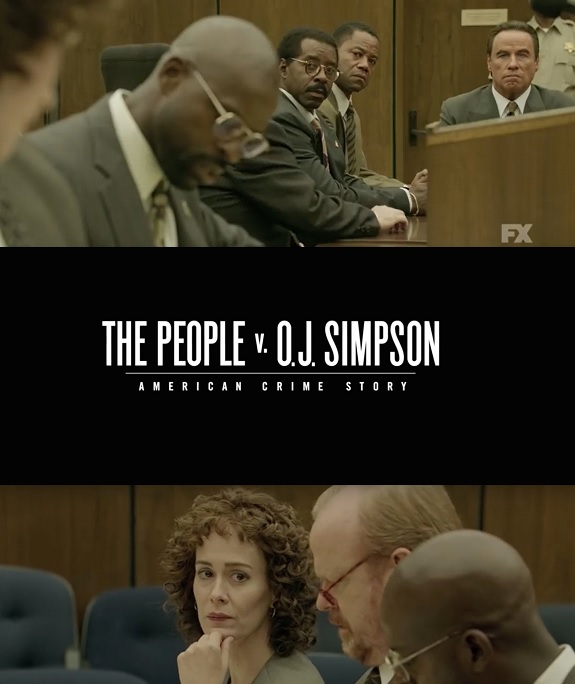
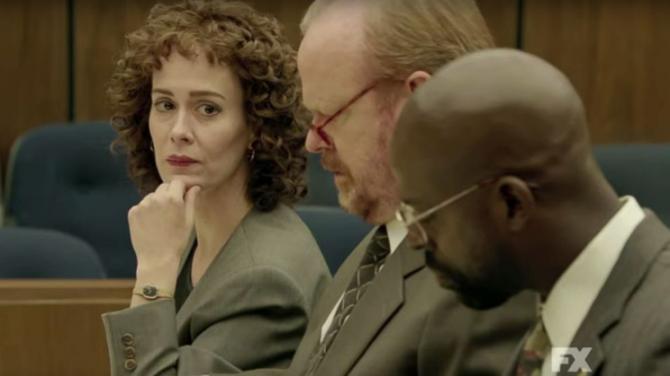
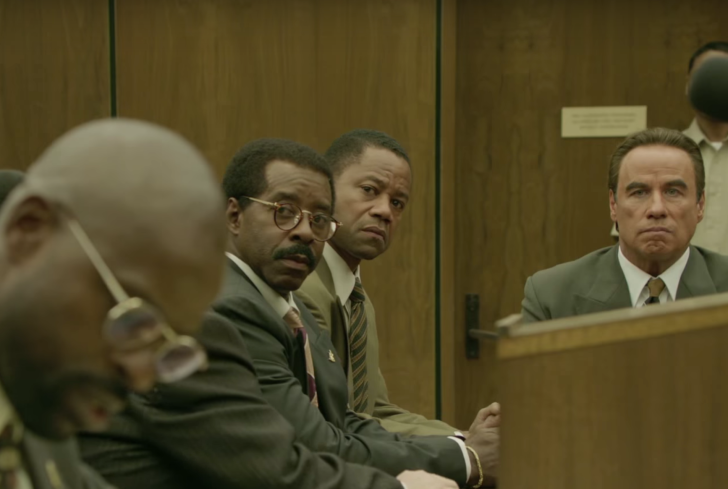
Believe the hype. The pilot for the new FX series The People vs. OJ Simpson was absolutely terrific, and if the quality level of the first installment is any indication as to where the entire show is headed, then it’s going to become essential TV viewing, because already, the hooks have been set firmly in place. I had a feeling that this was going to be a show of particular merit when I learned that Larry Karaszewski and Scott Alexander were going to be calling the shots as executive producers and writers, if not director(s) — the episode list at Wikipedia only has credits listed thru episode five. Their insanely awesome feature screenwriting credits include Ed Wood, Man on the Moon, The People vs. Larry Flynt, and Big Eyes, to name just four, all fantastic projects in similar and different ways, with their past work promising smart writing, plotting, and character building for this new crime anthology series. Of course, it can only help to have material as juicy and as iconic as the OJ Simpson fiasco/murder trial as your playing field, and during the first hour, Karazeweski and Alexander, along with director and executive producer Ryan Murphy, establish an almost dizzying array of people, places, and events, all of it coherently streamlined and executed with a minimum of stylistic intrusion or unnecessary fuss. There’s an urgency to the storytelling, which nails all of the key moments during those feverish first 24 hours of Nicole Brown Simpson and Ronald Goldman’s murders, and the way that the media circus is portrayed hits all of the perfect satirical marks about how frenzied our celebrity obsessed culture can be, especially during times of crisis. An almost absurdly stacked cast is top lined by sweaty and nervous Cuba Gooding Jr. as The Juice, a brittle and hostile Sarah Paulson as Marcia Clarke, John Travolta doing a lovely lock-jaw impersonation of Robert Shapiro (“I’m on the list” – ugh!), Courtney B. Vance as hot-tempered Johnnie Cochran, Rescue Me’s Steven Pasquale as the racist detective Mark Furhman, with Connie Britton, Jordana Brewster and Selma Blair popping up for a quick scene (more with them to most certainly come…). And yet the entire piece is practically stolen by, of all people, David Schwimmer, playing OJ’s long time friend Robert Kardashian, all sad-sacked and droopy-eyed, trying to discredit all that he’s learning about the increasingly desperate situation, never wanting to believe or accept the fact that his buddy is actually a murderer. Honestly, this is one of the most impressive ensemble casts I’ve ever seen on a TV series, and it’s tremendously clear that every performer brought their A-game to this production. I was 14 years old when I saw that white Bronco charging down the California freeway from my living room in CT, and during those final moments of the pilot when you see Simpson being driven by Al Cowlings (Malcolm Jamal Warner!) in that infamous SUV, you get that creeped-out sensation all over again, with the show serving as a volatile time capsule as well as a riveting drama. I watched this first installment twice, and I am very anxious to see more.

TOM MCCARTHY’S SPOTLIGHT — A REVIEW BY NICK CLEMENT

1

The dangerous and hideous organization otherwise known as the Catholic Church gets the greatest cinematic middle finger ever possible with the gripping journalism procedural Spotlight. Exhaustively researched and written with class and care by director Tom McCarthy and co-scripter Josh Singer, this is a bold and provocative film that dares to speak out against one of the most disgusting and powerful religious groups that gets to carry on with impunity in our increasingly absurd and hypocritical society. My stomach was in twisted knots all throughout this film, as the script details the various sexual abuses that rocked the Boston Archdiocese in the early 2000’s. A sterling ensemble cast comprising of Michael Keaton, Mark Ruffalo (absolutely superb), Rachel McAdams, John Slattery, Liev Schreiber, Brian d’Arcy James, Stanley Tucci, and the amazing voice of Richard Jenkins all do intense and laser focused work. There isn’t one bad performance out of the group, the direction is crisp and efficient, the writing razor sharp, the editing fluid, the cinematography subtle and controlled.

2

I have nothing negative to say about the film or the way it was crafted. Were there other movies from 2015 that I enjoyed watching more? You bet. But not many were this incendiary, this enraging, or this important to our society. How ANYONE could support the Catholic Church is well outside my realm of personal understanding in this day and age. This movie makes it ABUNDANTLY CLEAR that 249 priests molested or raped 1,000 children of various ages, from all over the Boston area, and in many instances, were simply moved by the Church from one city and parish to another, and sometimes listed in official documents as being on “sick leave.” Yeah. Sick leave, all right. The systemic failure of the Catholic Church to take care of an epidemic of this nature is disturbing and embarrassing, and clearly demonstrates the church’s smug and cavalier attitude towards this reprehensible behavior. I wanted to throw my TV out the window when the filmmakers included the text note that Cardinal Bernard Law was reassigned to a senior position of honor in Rome after being removed from his duties in Massachusetts. The text listing of all the states and countries affected by this tragedy is detailed at the finish, and it makes your skin crawl. This is a great movie about something insanely ugly and sad.

3

The People vs OJ Simpson – A Review by Frank Mengarelli

image

We’ve reached a tipping point with dramatic television.  The new golden age of TV has almost reached this Marvel-esque oversaturation point.  There is a constant onslaught, whether on the television itself, or ads online, of new programming.  Programming that promises to be different, to be sharper, to be like nothing you’ve seen before.  Then came THE PEOPLE VS OJ SIMPSON.

This new series, American Crime Story, started last night with its pilot episode, and it is PHENOMENAL.  We all know the story, we can recall the nostalgic era of the OJ trial.  Jay Leno and his dancing Itos, the NBA finals game getting minimized for the “high speed” chase, but how much do we actually know about it?

image

The cast is paramount, stringing together former star power with character actors and current talent; the cast may very well be on the top tier of television ensembles ever.  Sarah Paulson and Bruce Greenwood as wonderfully solid as ever.  John Travolta, David Schwimmer, Courtney B. Vance, and Cuba Gooding Jr have dusted themselves off, and marked their return in wonderful showboating performances.

image

Larry Karaszewski and Scott Alexander have created a show that not only drums up our nostalgic rememberings of the greatest media circus ever and humanizing it, but also made this at a time where the social climate of the OJ trial is more relevant than ever.  Just when you thought TV couldn’t get any better, then came THE PEOPLE VS OJ SIMPSON. 

JAMES KENT’S TESTAMENT OF YOUTH — A REVIEW BY NICK CLEMENT

3

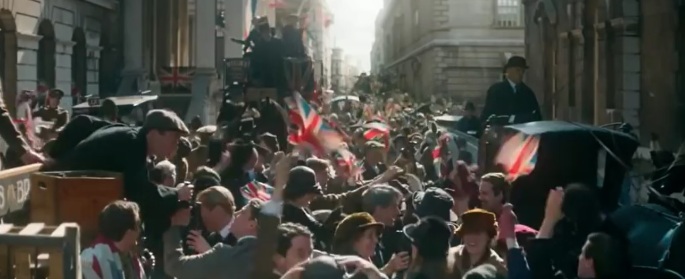
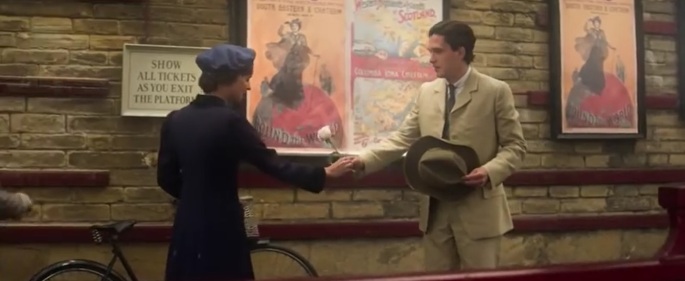
Make no mistake: Alicia Vikander is the real deal and she’s here to stay. 2015 was the year of Vikander POWER, with her brilliant work in Ex-Machina, her much lauded performance in The Danish Girl (which I’ve yet to see), her playfully sexy romp in The Man from U.N.C.L.E., and her quietly forceful turn in the staid and solid British WWI drama Testament of Youth. This is material that’s been done to death, and while there’s nothing revolutionary about the material or approach, there’s a comfortable squareness to the production, all of which is anchored by Vikander’s excellent portrayal of a woman caught at multiple crossroads at various points in her life. Capably directed by James Kent and efficiently written by Juliette Towhidi, the film was based on the memoir by Vera Brittain, and details her struggles both with herself and the social environment that she found herself a part of.

2

A strong willed and fiercely independent woman in the face of almost certain lifelong domestication, she wasn’t interested in getting married and becoming arm candy for a rich suitor; she had her own dreams and aspirations, despite her father’s insistence that she find a suitable husband before anything else. She gets accepted to Somerville College, an offshoot of Oxford, ends up reluctantly falling in love, and then WWI explodes on the scene, changing her life forever, with her joining the Voluntary Aid Detachment as a nurse serving near the front lines of battle, caring for both British and German soldiers wounded in London and France. Again, this material is tried and true, the production goes through the expected paces, and the entire piece finishes on a downbeat note that is appropriately sad and tragic. Taron Egerton (so terrific in last year’s Kingsman), Emily Watson, Haley Atwell, Dominic West, Miranda Richardson, Kit Harrington, and Colin Morgan all provide solid supporting turns. Rob Hardy’s studious and cleanly composed widescreen cinematography is a major highlight, while the musical score from Max Richter hits the expected notes of poignancy. This film never received any sort of wide or even semi-wide theatrical release in the United States. Saoirse Ronan was once attached to Vikander’s role, for which she received a Best Actress nomination from the British Independent Film Awards.

1