Once Upon A Time In Nostalgia Occupied France: Revisiting Quentin Tarantino’s Inglorious Basterds


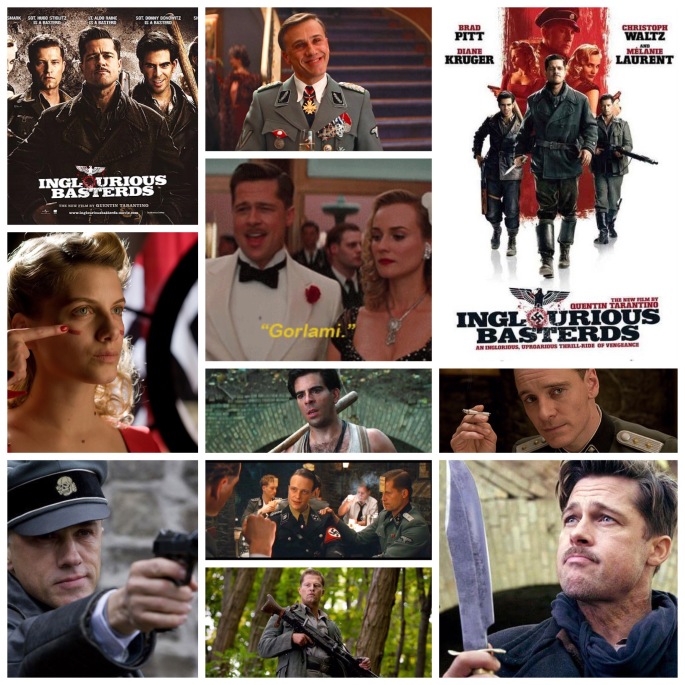
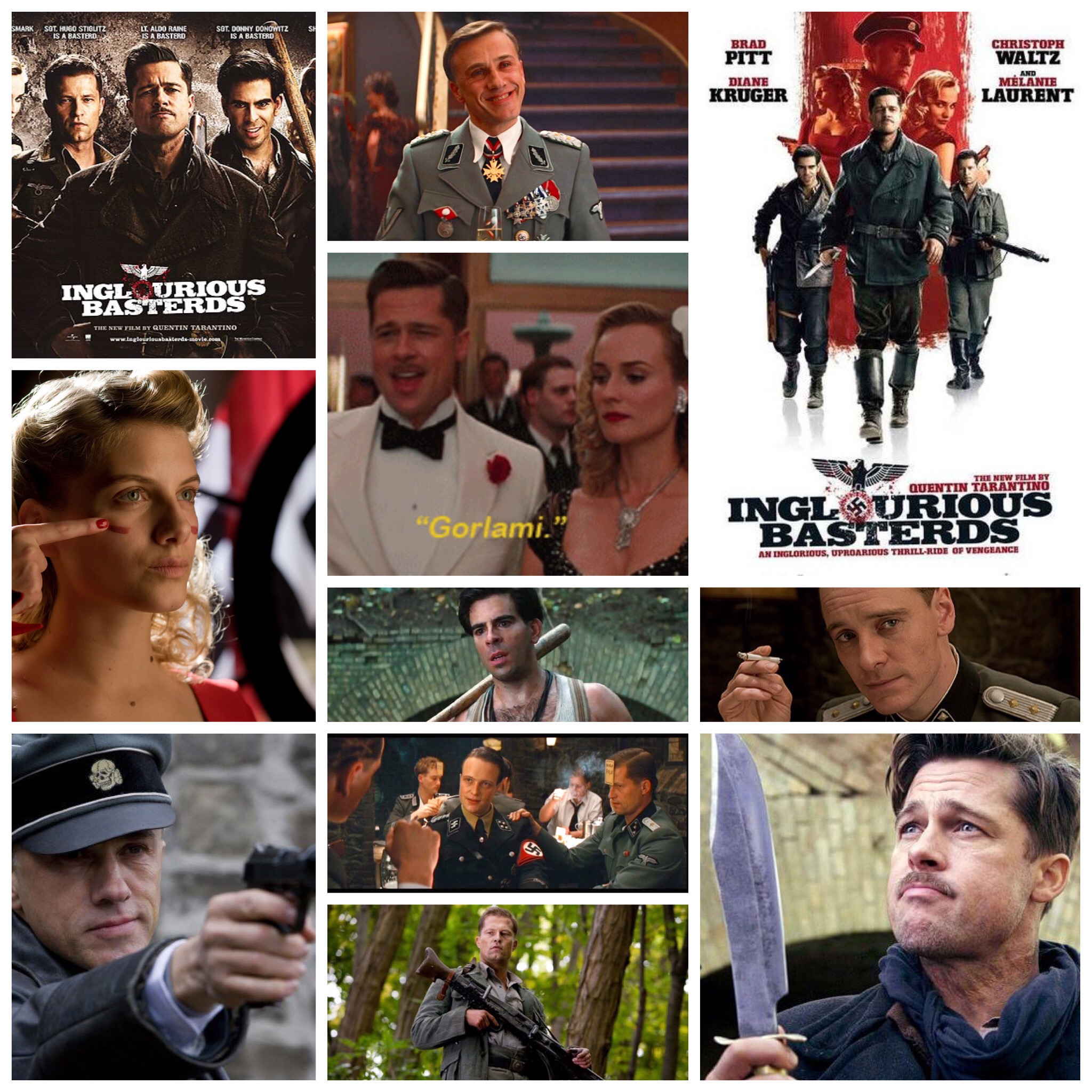
Having rewatched Quentin Tarantino’s Inglorious Basterds the other night for the first time in years, I’d since forgotten what a fuckin rip snorting good time at the movies it is. It used to rank fairly low on my Quentin-metre, but not only has it aged quite nicely since 09′, it’s even better than I remember it being in theatres. I think that one of the reasons I didn’t hold it in such high esteem right off the bat is that I wasn’t prepared for the blunt revisionist history approach, which at the time I think felt very silly and fake. I get now what he was going for and appreciate it tenfold more than I did then. From the opening chords of a Morricone piece that signals the portentous arrival of Christoph Waltz’s terrifyingly affable Jew hunting SS nutbar Hans Landa, this film is a near perfect ballet of extended dialogue, shocking musical cues and sporadic bursts of satisfying and graphic violence. It’s an episodic roundtable outing that spins around to focus intently on specific scenarios for quite a bit of time before jarringly shunting off to the next. Young Shosanna (Melanie Laurent) runs a quaint cinema in rural France that garners the attention of a pesky German war hero (Daniel Brühl). Evil Landa and his corps doggedly hunt enemies of the state whilst preparing to act as a security force for a bigwig film premiere attended by the Fuhrur himself, et al. Elsewhere in Germany, a plucky band of double agents led by Michael Fassbender and Diane Kruger await instructions on a small tavern, commissioned by Winston Churchill and Austin Powers to carry out their mission. This sequence is a textbook example on how to whip up vice grip suspense until one can barely breathe, then cut the cord loose all of a sudden, brilliantly structured, written and acted scene all round. Brad Pitt also leads his merry band of Nazi killers all over Europe creating havoc and delivering some of the best dialogue that the Q-Man has ever penned. The sequence where Aldo Raine (Pitt) and his crew must be ‘fake Italian’ to blend in at the film premiere is the single funniest thing in a Tarantino film to date. The cast is layered with all kinds of wonderful work, standouts from August Diehl, Richard Sammel, Eli Roth, a priceless Til Schweiger, as well as quick snippets from Samuel L. Jackson and Harvey Keitel. Waltz made a name for himself with the Landa character, and is a simultaneously freaky and funny villain who steals the film each time he shows up to smarm and charm the pants off of everyone else. Funny beyond words, brutally exploitive in the best possible ways, whip smart in writing and characterization and just a hell of a good time, Basterds has held up and even improved excellently since it’s release, and will likely stand as one of Tarantino’s key films in years to come. Gorlami. 

-Nate Hill
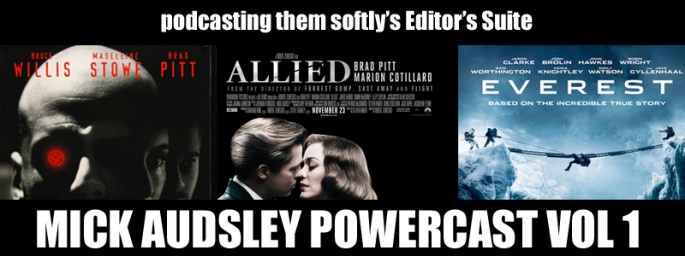
PTS Presents EDITOR’S SUITE with MICK AUDSLEY

audsley-powercast

audsleyPodcasting Them Softly is thrilled to present a chat with veteran film editor Mick Audsley! His latest feature, which he co-edited with Jeremiah O’Driscoll, is the Robert Zemeckis-directed WWII action-romance Allied, which hits theaters this weekend! He’s worked numerous times with filmmaker Stephen Frears, with credits that include The Hit, My Beautiful Laundrette, Prick Up Your Ears, Sammy and Rosie Get Laid, Dangerous Liasons, The Grifters, Hero, The Van, High Fidelity, Dirty Pretty Things, Tamara Drewe, Lay the Favorite, and Muhammad Ali’s Greatest Fight.  He’s also collaborated with director Mike Newell on Love in the Time of Cholera, Harry Potter and the Goblet of Fire, Mona Lisa Smile, and Prince of Persia. He’s teamed up with director Neil Jordan on We’re No Angels and Interview with the Vampire, and has crafted multiple films with director Terry Gilliam, including the sci-fi classic 12 Monkeys, The Zero Theorem, and the Imaginarium of Dr. Parnassus. He also cut last year’s superb mountain climbing disaster film Everest, which was shot by cinematographer and friend of Podcasting Them Softly Salvatore Totino. And we also learned about Sprocket Rocket Soho, an online networking organization for filmmakers, actors, and craftspeople, which he co-founded with his wife as a way of keeping open communication between various artists. Check out the site at Sprocket Rocket Soho   We hope you enjoy this fabulous hour of passion and cinema love!
Confessions Of A Dangerous Mind: A Review By Nate Hill


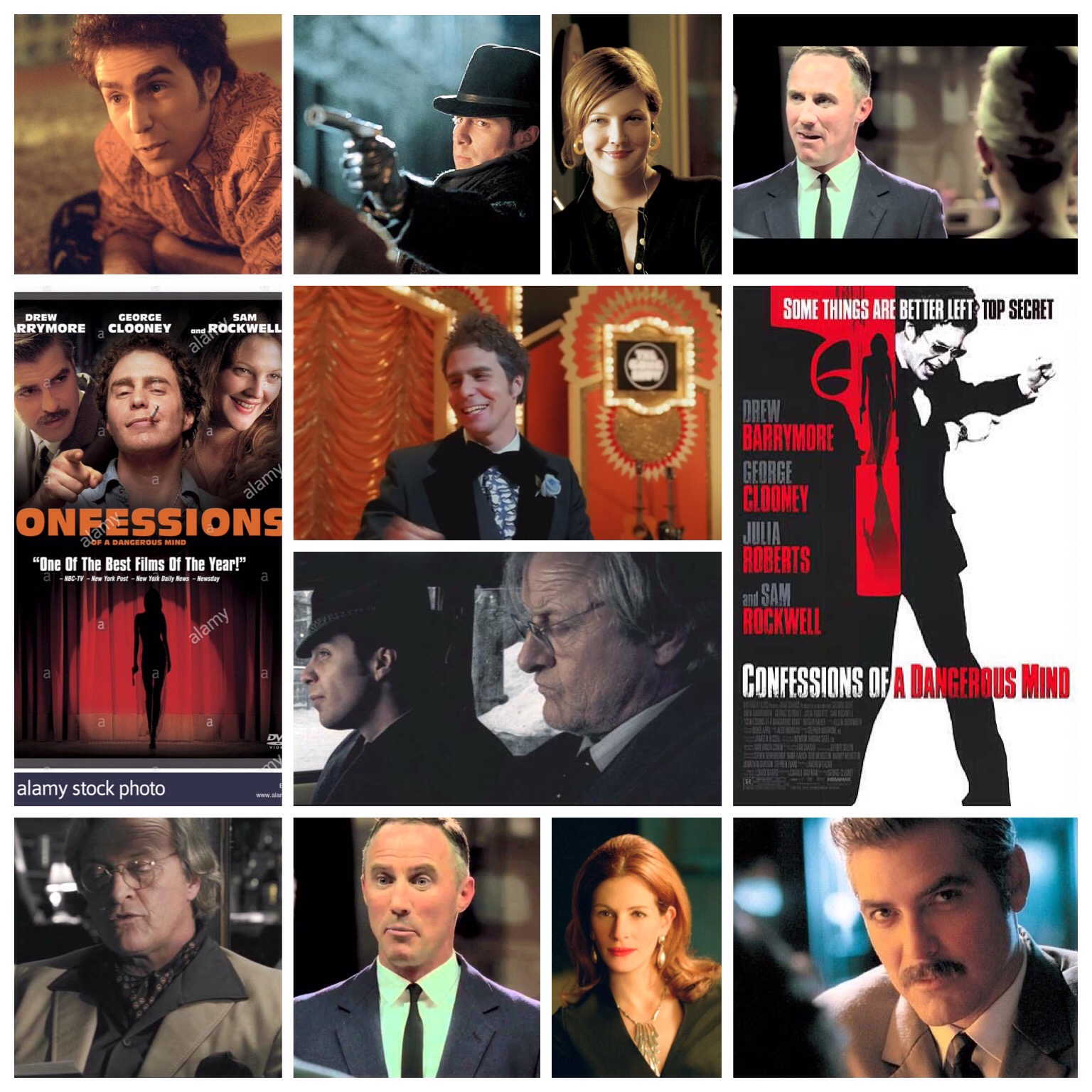
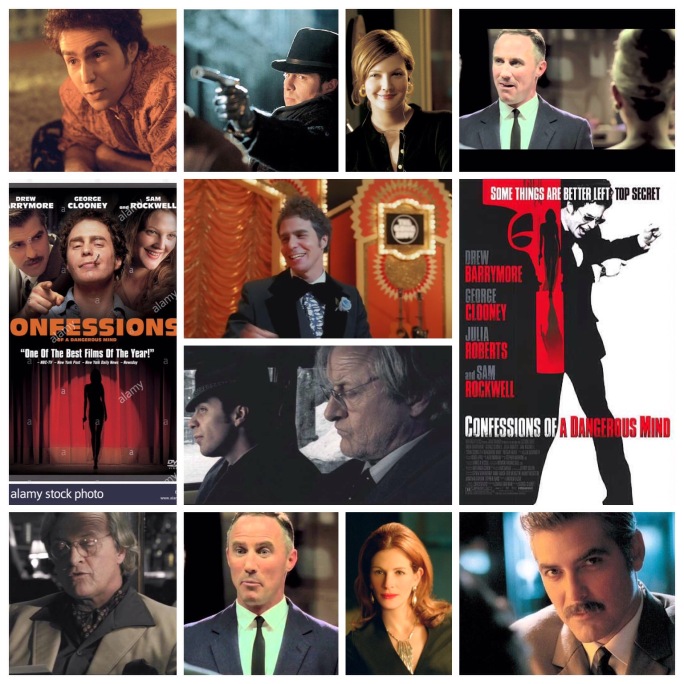
As soon as George Clooney built up enough clout and reputation in the industry to a point where he could make his own projects, he started to send some unique and refreshing stuff down an assembly line that needed some shaking up. Confessions Of A Dangerous Mind is such a curiosity, but it’s so specific and idiosyncratic that I can barely say what makes it so special. I can go over the plot, performances etc. and give the reader a general idea, but to get it you had to be there. I suppose that’s the case with all movies, this one just sort of has its own frequency that you have to be tuned into. For a square jawed leading man, Clooney sure busted the box open with this directorial effort, as well as a few others, all just as distinctive. A screenplay by Mr. Abstract himself, Charlie Kaufman, helps with making an impression as well. Sam Rockwell, who continues to prove himself as one of the best actors of his generation, plays Chuck Barris. Chuck was the brain child behind numerous gaudy television game shows in the 60’s, including the infamous ‘Dating Game’. Flippant creative output was his brand, but there was another side to him as well, a darker period in which he claimed to be recruited by the CIA to carry out cloak and dagger assassinations. Whether or not this was ever a factual part of his life is murky, but he certainly believes it to be true and has written extensively about it in the novel which Clooney based this on. The film deftly intersperses his life at the television network and the genesis of the programs with his training and eventual missions for the Company. It’s an odd contrast, but when you’re treated with Clooney’s dutiful storytelling and an extremely committed turn from Rockwell, it’s hard not to be drawn into it. Not to mention the supporting cast. Julia Roberts is cast against type as a lethal, sociopathic femme fatale who crosses paths with Barris more than a few times. Rutger Hauer mopes about as a loveable alcoholic operative who covers Barris’s back on a few assignments. Drew Barrymore spruces things up as a ditzy love interest, Michael Cera plays Chuck as a young’in, Clooney himself underplays his CIA handler, letting an epic moustache do the talking, and there’s cameos from Maggie Gyllenhaal, Brad Pitt and Matt Damon. At one point the film stops dead in its tracks for the funniest performance which hijacks a scene briefly, in the form of Robert John Burke as a maniacal censorship board hyena. Burke pulls the ripcord and delivers roughly 40 seconds of pure comedic genius that I could watch on loop, and is the only moment of its kind in the film. You’d think it’d offset tone, but in a film this organic and quirky, it simply serves as a garnish of hilarity. The whole thing has a Soderbergh feel to it (perhaps due to Clooney), a sharp, crystalline precision to the burnished cinematography from Newton Thomas Sigel, who previously wowed us with similar work on Blood & Wine, The Usual Suspects and Gregory Hoblit’s Fallen. His lens captures the melancholy accompanying Barris’s very strange path path in life with moodily lit frames, and pauses for the brilliant moments of absurd black comedy which seem to follow him around like the spooks he was always running from. A film with dual aspects that never tries to prove or disprove Chuck’s claims, but loyally tells the story the way he told it, guided by Clooney all the while. A little stroke of genius. 

Andrew Dominik’s Killing Them Softly: A Review by Nate Hill

image

What can I really say about Andrew Dominik’s Killing Them Softly. Well, my bosses named our site after it, and judging by our ongoing excellent taste in film (hehe), the namesake of our moniker should be a masterpiece. It is a masterpiece, a slow burning, truly clever crime yarn that slightly deconstructs the genre, sets it’s story at a pivitol time in American history, and has some of the most hard hitting, intimate scenes of violence I’ve seen on film. Dominik takes his sweet damn time getting to know these characters before any bloodshed occurs, and when it does, it’s a visceral affront to the senses, pulveruzing us with a very un-cinematic, realistic and entirely ugly vision of violence. Ray Liotta plays Markie, an illegal gambling official who once robbed one of his own games, subsequently boasting about it like a chump. When another of his outfits is knocked off by two scrappy losers (Ben Mendelsohn and Scoot Mcnairy) logic dictates that it must be him playing games again, and his superiors send a merry troupe of thugs to find him. The matter is overseen by Jackie Cogan (Brad Pitt) a slick, sophisticated killer who prefers to ‘kill them softly’, in other words, from a distance and with little pleading or fuss. He is employed by “” (an awesome Richard Jenkins), a businessman sort who isn’t above haggling for the price of a killer’s contract down to the very last dime. You see, the film is set during the 2008 financial crisis, and Dominik takes every opportunity he can to fill his frames with debris, dereliction and strife. Even in a world of criminals the blow to the economy is felt, and they too must adjust accordingly. Cogan brings in outsider Mickey (James Gandolfini), an aging wash up who spends more time swearing , boozing and whoring up a storm than he does getting any work done. Gandolfini ingeniously sends up his capable Tony Soprano character with this bizarro world rendition on the Italian hoodlum, a fat, lazy layabout with bitter shades of the threatening figure he must once of been. Before all this happens, though, we are treated to extended interludes spent with Mendelsohn and Mcnairy, and they both knock it out of the park with their shambling, sweaty, reprehensible presence. Mendelsohn is endlessly watchable, muttering his slovenly dialogue through a curtain of heroin and sleaze. Watch for a tiny, super random cameo from Sam Shepherd as a thug who hassles Liotta. There’s a beatdown sequence, and you’ll know when it comes, that pushes the limits to extremes. Every punch is felt like a meteor landing, leaving the victim and the viewer aghast. Dominik never throws gimmicks into his work here. Every scene is insistently unique, and the real hero is pacing. The film moves in fits, starts and eruptions with long flatlines in between, until our instinctual knowledge of a narrative truly is lost to the story, with no idea what will happen next. Genius.  

Angelina Jolie Pitt’s BY THE SEA – A Review by Frank Mengarelli

A cinematic love story is rarely grounded in reality.  We see a projection of it, someone else’s idea of what love is.  The escapism of boy meets girl, boy loses girl, and then the boy triumphantly wins girl back – is a mundane and trite formula.  Angelina Jolie Pitt’s BY THE SEA is a love story that wages war with itself and takes place within the reality of life.

image

The film spans a few weeks at a villa in France.  Roland (Pitt) and Vanessa (Jolie) are married, waging a toxic and a fearless psychological war with one another.  Roland drinks all day, desperately seeking inspiration for his next novel while Vanessa bunkers herself within their room and lies comatose in bed on a self medicated mixture of pills and wine.

image

At this point in their marriage, all is lost, yet they continuously fight for and against one another.  Their passion still burns bright, but their hope flickers as each minute of the film passes.

Jolie has become an inspiring vision behind the camera, fluidly crafting her film; using the vulnerability and innocence of 1970’s France as a canvas to showcase such a painfully beautiful film.

image

BY THE SEA is a clear cut example of a critical and box office failure that eludes the self indulgence of critics and the current cinematic populous with its pulverizing and honest view of love.

Ocean’s Thirteen: A Review by Nate Hill

image

As silly, gaudy and drawn out the Ocean’s franchise had gotten by its third outing, I still somewhat enjoyed Ocean’s Thirteen, an overblown attempt to keep the magic alive that most of the time trips over its own bells and whistles. That being said, the gang is all there, and that alone is good for some laughs. This time around, Eliott Gould’s cranky charmer Reuben has been ousted from his Vegas property by Willie Bank (Al Pacino) a ruthless and ludicrously rich casino tycoon with big plans for the future. Reuben is left in a dazed depression, and the gang all drifts back together to try and rob the hell out of Pacino, using methods and cons so over the top they almost seem like a parody of the former films. Pacino is a bit more clownish than Andy Garcia’s grim Terry Benedict was in the first film, which adds to the cavalier absence of any sense of real danger. In fact, Benedict is now chummy with the gang himself, which is a cute turn of events but kind of seems to silly. Ellen Barkin adds a lot of class as Pacino’s head honcho, fitting into the Ocean world nicely. The gang I’d all back and more eccentric than ever, with Matt Damon scoring comedic points in one of the funniest prosthetic jobs I’ve ever seen. Newcomers to the show include Julian Sands, Oprah Winfrey and a reliably hapless David Paymer. It’s not that this one takes the formula too far, it’s just that we’ve been there, done that, got the t-shirt and there was really not much need for it. I won’t say no though, because the blue print of what made the first so fun is still there, it’s just been jazzed up and adorned with a few too many gilded sequins and fancy jib jab. Still enjoyable.

Neil Jordan’s Interview With The Vampire: A Review by Nate Hill


Neil Jordan’s film version of Interview With The Vampire is simultaneously one of the most sumptuous and tedious visions of the affliction to ever hit cinema. On the one hand, it’s an absolutely gorgeous, atmospheric and old worlde glance at two damned souls who carry out their macabre destiny with flair and vicious grace. I say tedious as some kind of bitter compliment, because no other film has quite captured the internal torture of eternity or the nocturnal gloom that must prevail over such an existence quite as well as this film has. It barely runs over two hours and we feel like we’ve been planted in front of the screen for years. Such is the dedication of director Jordan, a sneakily versatile gent who augments his stylistic and tonal approach to whatever material he is working with. The film is exciting and raises a pulse, but only on its terms, and for long periods of time we sit through languishing despair that no doubt adds to the mood, but exists to serve the psyches of our two leads, and dares the viewer to suffer alongside them. I have somewhat of a bone to pick with certain producers behind the scenes who no doubt had a forceful hand in the casting of Brad Pitt and Tom Cruise. You see, author Ann Rice had her heart set on a filmic version starring Rutger Hauer as Lestat, and Lance Henriksen as Louie. Now, Cruise and Pitt are at the utter opposite end of casting types in Hollywood, and while Jordan is never a guy to compromise or chase stars right off that bat, I am still sour when I think of the film we’ll never see, starring two actors infinitely more fascinating and vampiric that Brad and Tom. Nevertheless, I have som much appreciation for the film that I can’t take it too hard, and remain a steadfast fan. Pitt plays Louie, a depressed Louisiana plantation owner with nothing left, especially to lose. He meets roaming vampire Lestat (Cruise), who promptly turns him, and the two embark on a century spanning odyssey of nighttime escapades, thoroughly fraught with homoeroticism. It’s isn’t so much an organized narrative as it is a lengthy look at these two, trapped by their condition and making the bitter best of it. They meet others along the way, including Armand (a slinky Antonio Banderas), Santiago (Jordan regular Stephen Rhea, lively evil incarnate) and Claudia, a child who Louie turns. She’s played by Kirsten Dunst in the best performance of the film. A young girl with the vampire curse thrust upon her at such an age, who mentally matures into a steely, furious woman trapped in the body of a ten year old. Not many actresses could succeed at that, but she is a spitfire little shryke who dominates every scene. All this is being retold by Louie to a 1990’s journalist (Christian Slater) who morphs from bemused disbelief to cold terror, and eventual morbid fascination. It’s a slog to get through, but an ornately beautiful one with some really bloody effects and the always terrific stewardship of Neil Jordan, whose films are never short of mesmerizing, whichever genre they fall into. A dark, dingy horror with lacy elegance at its core. 

Barry Levinson’s Sleepers: A Review by Nate Hill

image

Barry Levinson’s Sleepers is a deliberately paced, downbeat look at revenge, and is one of the most brilliant yet seemingly overlooked dramas of the 90’s. Part of it could have been marketing; The cover suggests blistering violence, confrontation and courtroom intrigue. While there are such moments within the narrative, they live to serve the story, which Levinson and his dream cast are doggedly intent on telling. It’s a sombre affair to be sure, slow and methodical as well, but never to be confused with boring. It’s just such a great story, one that unfolds exactly as it needs to. It starts in the 1950’s, where four young rapscallions run wild on the streets of Manhatten. It kicks the story off with a sort of urban Stand By Me vibe, and if you thought that film went to some heavy placed, stick around through Sleepers. When an innocent prank ends in tragedy, the four are sent to an austere children’s correctional facility, where they run afoul of some sadistic and abusive guards, led by Kevin Bacon, who is scummier than scum itself. They endure months of ritual abuse at the hands of these sickos, until their eventual release. Life goes on, as it must, the four boys grow up and follow very different paths from one another. Michael (Brad Pitt) becomes an esteemed lawyer. Shakes (Jason Patric) lives a quiet life, while Tommy (Billy Crudup, wonderfully cast against type) and John (Ron Eldard) take a darker road to drugs and crime. Eventually their past rears it’s head, and they are presented with an opportunity for much delayed revenge. It doesn’t all play out the way you may think though, and half the fun of this one is being surprised by geniunly lifelike plot turns and characters who behave as real humans would. Pitt is the highlight in a performance of quiet torment. Dustin Hoffman is fun as a washed up lawyer who gets involved, Minnie Driver shows up as a tough NYC gal who gets involved with Patric, Robert De Niro has a nice bit as a kindly priest who counsels the boys even until adulthood, and there’s further supporting work from Jonathan Tucker, Bruno Kirby, Frank Medrano, Brad Renfro, Terry Kinney and more. Levinson usually takes on bright, chipper comedies and razor sharp political satire. With Sleepers he deviates into tragic dramatic material, and shows his versitility excellently. This one gets grim, no doubt about it. However, it’s a story not only worth the telling, but worth the watching for us.

Tony Scott’s Spy Game: A Review by Nate Hill


Tony Scott’s Spy Game is a kinetic yet heartfelt espionage thriller that sees the director maintain considerable shards of his assaulting sensory overdrive of style, whilst pausing along the way for a story that is really rooted in the personal story of the bond and friendship between two men. A lot of his films are predominantly visual and auditory, a bullet train of sound and fury, with plot and characterization as passengers onboard. Here those elements are cogs in the machine, resulting in a very touching, extremely exciting outing and perhaps the director’s most overlooked piece. Robert Redford used to be the younger, more naive faction in a lot of cinematic pairings, especially with Paul Newman. Here he flips the coin, taking on the grizzled mantle of both father figure and mentor to Brad Pitt. Pitt is Tom Bishop, an operative taken under the wing of veteran agent Nathan D. Muir (Redford). Nathan no doubt sees some of himself in the lad, and takes a shine to him, grooming him with all the skills and cunning that a lifetime in the business has given him. Life throws curveballs though, and more often than not they involve love. Bishop has gone rogue in an attempt to rescue relief worker Elizabeth Hadley (the brilliant Catherine McCormack, who needs to be in more movies) from a Chinese prison. In his eagerness he is captured, leaving Muir to make some tough decisions, pull some hidden cards and use all of his talent and resources to extract them. Now in many films like this there would be several blistering action set pieces to show how it’s done. Scott instead chooses to give Redford the intellectual grit and subversive genius to pull hidden strings and come up with a wicked fun solution that is endlessly more satisfying than an explosion ridden shock and awe campaign. His struggle to get his friend back is laced with flashbacks of his training, with a 70’s flavour that feels authentic and writing that lovingly builds the blocks of their dynamic. Stephen Dillane provides wonderfully understated work as a quietly smarmy CIA prick, and watch for a quick appearance from the great Charlotte Rampling. To see Scott’s frenetic aesthetic hired for a script that takes its time and plays out less like a conventional thriller and more like the paced, elliptical spy thrillers of years past (vaguely reminiscent of aspects of Le Carré) is a somewhat rare treat. Terrific thriller with Redford at his best, highly, highly recommended. 

Kalifornia: A Review by Nate Hill

image

Dominic Sena’s Kalifornia is a brilliantly vicious dark fable, a moody cautionary tale regarding the dangers of trust, the true nature of the sociopath and the ironic way in which demons sneak up on us while we are to busy looking for them with our backs turned. It’s also damn fine thriller filmmaking and fits nicely into a subgenre which I happen to be an avid fan of: the American road movie. The highways, byways and back roads of desolate rural USA have a bitter menace that clouds the air like the desert dust kicked up by many a vehicle on their way through. There’s endless possibility out there, for great and terrible evil, in a place where help is always a county away and opportunity looms on the horizon like the bloated California sun. From The Hitcher, to U Turn, to Thelma & Louise, to Duel and everything in between, it’s a setting that hums with cinematic potential. David Duchovney and Michelle Forbes play a yuppie couple who unwittingly wander into the path of extreme danger. Duchovney is a writer who is working on a book about American serial killers. Their journey takes them to many bloodstained locales where incidents took place. Eventually they decide to carpool with rugged redneck Earley Grayce (Brad Pitt), and his bimbo girlfriend Adele Corners (Juliette Lewis) whose IQ appears to be lower than the cut of her blouse. The two couples couldn’t be more different, yet get on well enough. Slowly it becomes clear that there’s something very off about Earley though, noticed keenly by Forbes’s intuition. Duchovney is enamored by the tumbleweed hick, and thinks he’s made a friend. He’s half right, and not even in the way he thinks. The film takes its time letting Earley’s true nature emerge, Pitt slowly detaches and unravels until the tarp is fully torn off and we see the sociopathic monster within. All set in abandoned clusters of former Americana and given slick, almost action movie direction from Sena, it’s not one to miss for any fan of a crackling psychological thriller.