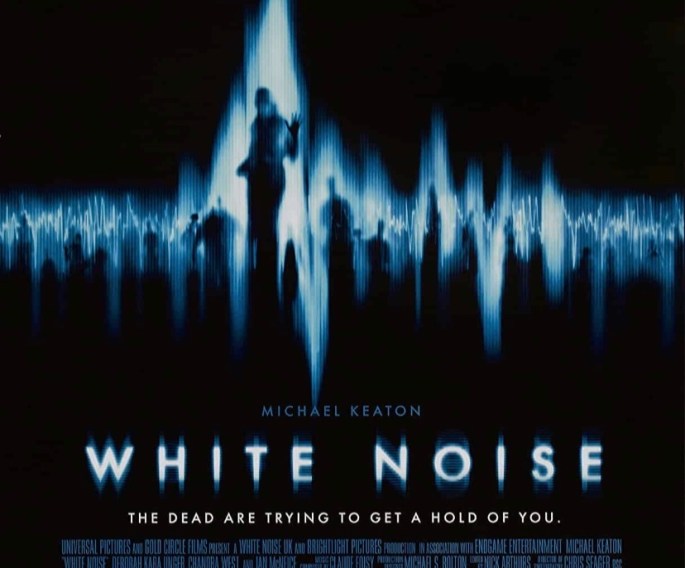
White Noise

I’ll start with the Thomas Edison quite that this film opens with because I just love it:

“Nobody knows whether our personalities pass on to another existence or sphere, but if we can evolve an instrument so delicate to be manipulated by our personality as it survives in the next life such an instrument ought to record something.”

I’m not sure what film critics were watching back in 2005 that caused such a knee jerk reaction of overall negativity, but the White Noise I saw was a chillingly effective, moodily atmospheric and very well done horror with a solid lead performance from Michael Keaton and one hell of a central premise. I mean it’s a bit low key, favouring hovering room tone and slow paced suspense over frenzied thrills or jarring shocks but that tends to be what I gravitate towards in horror anyways, so here we are. Keaton plays a Canadian construction CEO in Vancouver whose recently pregnant wife (Chandra West) doesn’t come home one night. A few days pass and her body is found near her crashed car, vaulted over a seawall gorge. As he begins mourning her, a mysterious gentleman (Ian McNeice) approaches him and claims that she has been contacting him via a phenomenon known as EVP, or electronic voice phenomenon in which the spirits of the dead can speak out across the gulf between worlds using electronic equipment, in this case a VHS recording system and a screen full of the titular white noise. Keaton is skeptical at first but it soon becomes clear that this is very real and with the help of another grieving woman (the great Deborah Kara Unger) he sets out to communicate with his wife and discern whatever message she has for him. Problem is, the VHS system is an open receiver and she isn’t the only spirit out there who can hear or talk, which sets the conflict in motion. I won’t say more but it’s a tense, brooding thriller and the Vancouver setting provides that classic rainy day, chilly PNW feel while much of the action is shot through these muted blue grey filters and accompanied by unnerving, otherworldly cues from the score by Claude Foisy. The scenes of communication over the VHS equipment are the film’s strongest attribute and fill the visual auditory realm of the film with a stark, creepy sensory dreamscape of fuzzy movement, shadows around the corner and wailing souls crying out from the abyss. Like I said, I’m really not sure what the issues were with this film from a critical standpoint other than the fact that they play fast and loose with plot a bit, but even then there’s a clear answer and resolute final act, while overall they focus on atmosphere and tone, which is my jam anyways. Great film.

-Nate Hill

DJ Caruso’s The Salton Sea

DJ Caruso’s The Salton Sea is a brilliant piece of filmmaking, a fascinating hybrid between go-for-broke, tweaked out drug cinema, bloody, violent crime revenge thriller and moody, jazz soaked neo-noir, with a central performance from a committed Val Kilmer that goes waist deep in all three. I would say that it was ahead of its time and for that reason didn’t quite fully find its audience, but upon years of reflection I think it’s just such a specific piece that one has to be tuned in just right, and invest enough attention to appreciate it, the first time anyways. Kilmer is washed out meth head snitch Danny Parker, playing both sides of the narcotics game in hazy LA. Or is he trumpet player Tom Van Allen, haunted by past tragedy? The first half of the film sees him awash in an endless cycle of drug fuelled debauchery, stuck in a tireless set of hijinks with his tweaked out ‘friends’ (Adam Goldberg, Peter Saarsgard and more), and habitually snitching out dealers to two very corrupt cops (Doug Hutchison and Anthony Lapaglia, both royally sleazy). The second half shows us why, what dark passage of events led him to the lifestyle and the cursed trajectory he finds himself on in the final act. Kilmer is a restless fallen angel in the role, a man with secrets that the film respects by taking its time unfolding and not revealing too much too soon (avoid any trailers). His Danny even begs the audience to stick around, promising us there’s more to his story than rampant substance abuse. The cast is thick with talent, including Danny Trejo, R. Lee Ermey, Chandra West, B.D. Wong, Shirley Knight, Luis Guzman, Meat Loaf, Deborah Kara Unger and a crazed, memorable Glenn Plummer. The scene stealer award has to go to thespian Vincent D’Onofrio though as one of the antagonists, a terrifying drug baron called Pooh Bear because he railed so much blow they had to cut off his nose and replace it with a disturbing prosthetic. His favourite pastimes include reenacting the Kennedy assassination with pigeons and an air rifle, smoking crack to yodel music CD’s and setting a rabid badger called ‘Captain Striving’ loose on the genitals of disloyal employees. The film finds a demented dark humour in him and many other characters, but the other side of that coin is the emotional turbulence and tragic resonance to Kilmer’s arc, two conflicting energies that seem to somehow coexist beautifully. The score by Thomas Newton is noirish and sad, with strains that sound almost like heavenly choirs too, giving the city of angels a half lit, otherworldly quality. The title is important; the Salton Sea represents three key elements to the film. The incident that spurs Kilmer down the rabbit hole takes place right near the picturesque titular place, but it also represents both the sea of excess and scum that Danny basks in, and the ocean of anguish, regret and sadness that engulfs Tom. A brilliant piece.

-Nate Hill