Virtuosity: A Review by Nate Hill 

Nothing says the 90’s like Virtuosity, a big hunk of circuit board sleaze and cheese that is so of it’s time that it’s hard to watch it these days without believing it to be some kind of spoof. Re-reading that sentence it sounds like I was making some kind of underhanded compliment, which I suppose is a better outcome for a film to arrive at than some. It could have gotten stale or dated in a bad way. Well it’s definitely not stale (it is dated though), in fact it’s one of the liveliest flicks from back then, thanks mostly to a ballistic characterization from Russell Crowe. Crowe is Sid.6, a virtual reality program molded from the personalities of several different serial killers and designed to basically wreak havoc. This is exactly what happens when he escapes, or rather is let out by one of the maniacs at the research centre (Stephen Spinella). Sid is now flesh, blood and roughly 200 pounds of extremely skilled, remorseless killing material, running wild in the unsuspecting streets. The head of the Institute (William Forsythe) has the brilliant idea to recruit ex-cop whack job Parker Barnes (Denzel Washington) to hunt Sid down and destroy him. Barnes has a bleak history with artificial intelligence, one that has left him with a cybernetic replacement arm and a huge chip on his shoulder. This is one mean, mean spirited film, as we are subjected to a manic Crowe as tortures, murders and maims innocent civilians with a grinning cavalier cadence the Joker would applaud. He’s off his nut here, something which clumsy bruiser Crowe rarely gets to do, so it’s a rare and extreme outing for him. Washington is perpetually angry, ill adjusted and violent here, and the lengths he goes to destroy Sid are almost as bad as his quarry’s homicidal antics. The cast is stacked with genre favourites, so watch for Costas Mandylor, Kevin J. O’Connor, Louise Fletcher, Kelly Lynch, Traci Lords and a weaselly William Fichtner. The special effects… well what can I say, this was the 90’s and they look like a computer game that’s been drenched in battery acid, then souped up with caffeine. There’s brief homages to video games in fact, and the opener where Crowe is still inside the program is fairly creative. I don’t know if the creators of the film were trying to say something about the dangers of virtual reality, but whatever it was, it’s sort of lost in a hurricane of unpleasent shenanigans that are admittedly entertaining. One thing that’s evident is that anyone who makes a computer program with the persona of one, let alone a handful of murderers is just begging for an incident. I suppose that’s the point here though, the catalyst for the whole deal. Crowe and Washington are great though, both down and dirtier than their characters in the next royal rumble they’d share, Ridley Scott’s American Gangster. Fun stuff, if you have a strong gag reflex and don’t take yourself too seriously.
Philip Noyce’s The Bone Collector: A Review by Nate Hill

image

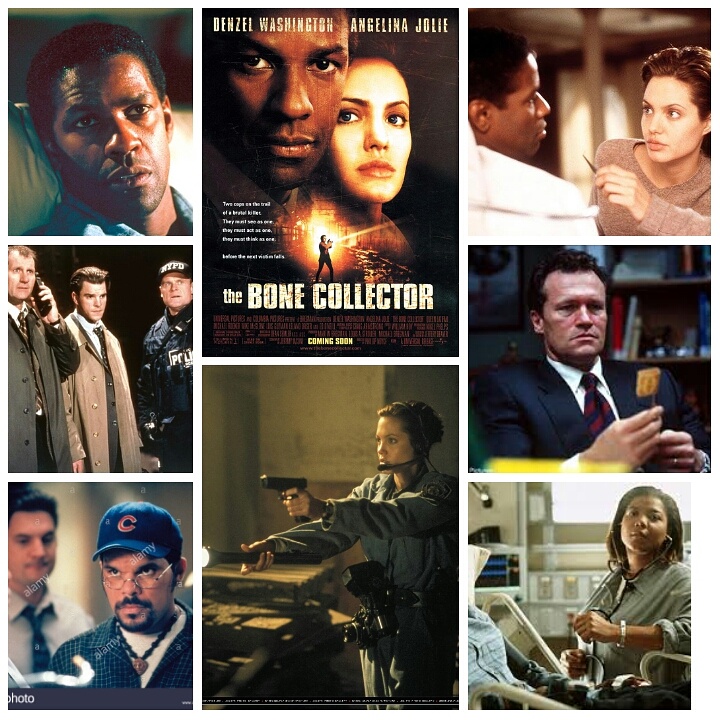
Philip Noyce’s The Bone Collector augments it’s atmosphere in the obvious hopes of evoking memories of David Fincher’s Sev7n (It’s even got an actor who also appeared in that film) which for the most part it nicely does. Story wise, however, it’s got entirely it’s own thing going on and follows the ever popular path of the serial killer whodunit. In this almost audience interactive sub-genre, we are routinely presented with a host of different characters, some following archetype and others not so much. The identity of the killer could literally be anyone we see onscreen at any time, even down to a tiny character who maybe shows up in one small scene. Then it’s up to the viewer to race the protagonist towards a correct conclusion, a game which I’ve never been all that good at lol. This time it’s Denzel Washington and Angelina Jolie who step up to the batters’s plate, hunting a very nasty individual who kidnaps people in locked taxi cabs and leaves them to die in various sadistic ways. Washington plays renowned criminal profiler and ex cop Lincoln Rhyme, left paralyzed from the neck down and bereft of any will to live following an accident. When his old cop buddy (Ed O Neil) shows up and pleads him to take a gander at the case files of the new killer, he reluctantly dusts off the old instincts and goes on the hunt. Problem is, he’s a turnip from the neck down and needs an avatar with whom he has a rapport with and can carry out the leg work, so to speak. He takes a shine to young patrol woman Amelia Donaghy (Jolie) who is showing early signs of the same forensic brilliance after she responds to the scene of one of the murders. She becomes an extension of him, and together they work to smoke out the killer and put a stop to his crimes, also bringing some kind of peace to Rhyme’s restless mind in the same stroke. They are hassled by the world’s most belligerent and obnoxious Police Captain (Michael Rooker in full on asshole mode) and helped by Rhyme’s kindly nurse assistant (a very good Queen Latifah). There’s also work from Bobby Cannavle, Leland Orser, Luis Guzman, Mike Mcglone and David Warshofsky too. Noyce is a solid and very slick director (he did wonderful work in the Jack Ryan franchise, as well as the very underrated The Saint), gamely shunting his aesthetic into the serial killer vs. Detective corner. It’s a decidedly grisly affair, despite the glossy sheen and big names, and almost veers into outright horror in places, but is always kept in line by the excellent chemistry and friendship between Jolie and Washington, who are both great on their own and as a team. Good stuff.

Ridley Scott’s American Gangster: A Review by Nate Hill


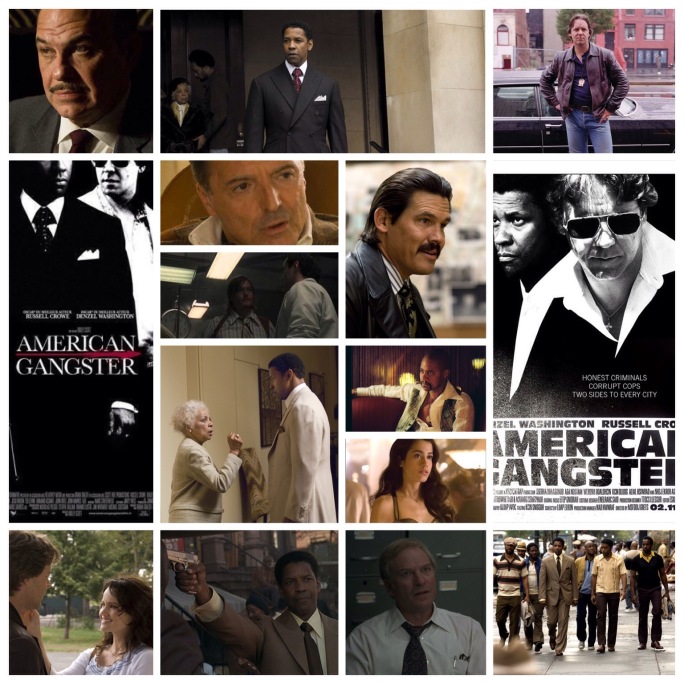
Ridley Scott’s vast, intricate crime epic American Gangster is one of the director’s finest achievement in film to this day. It’s sprawling in nature, expansive in scope but never chaotic or muddled. It always maintains a laser focus on its characters and story, thumping along at a rhythmic pace which swells and falls to the time of one of the most iconic stories in true crime. It’s Scott’s Heat, a titanic tale of cop vs. criminal in which neither are the villain or hero, but simply men adhering to rigid, ruthless principles moulded by the environments they have grown up in. Both men have an intense set of morals completely different from the other, yet equally as captivating. Russell Crowe is a troubled bruiser as Detective Richie Roberts, a cop so determined to convince himself of his own upstanding nature that he won’t take any illicit payoff in any amount or context. In contrast, every other aspect of his life is a shambling mess. Denzel Washington is quiet fury as Frank Lucas, an enterprising gangster and drug smuggler who rides the tidal wave of capitalism like there’s no tomorrow, flooding the streets of Harlem with pure heroin directly from the southeast Asian source, and rising swiftly to the peak of underworld infamy. The two are on an inevitable collision course, two juggernauts with different empires backing them who will stop at nothing. Lucas believes himself to be untouchable, shirking the flashy, preening nature of his peers and remaining out of the limelight, until cunning Roberts catches onto him. The rough and tumble world of New York in the 60’s and 70’s is lovingly brought to life by Scott, his cast and crew who go to impressive lengths in order to bring us that grit, realism and specific anthropological aura of another time, another setting. Speaking of cast, this has to be one of the most rip roaring collection of actors ever assembled, even to rival that of Heat itself. In Richie’s corner there is senior Detective Lou Toback (a sly Ted Levine, perpetuating the vague Michael Mann vibe even further), a scummy colleague (Yul Vasquez), and an off the books team of gangbusters including John Ortiz, John Hawkes and a mumbling RZA. He also clashes with his bitter ex wife (Carla Gugino) in an ugly custody battle for their young son. Over on Frank’s side of the hill are his huge extended family including Common, TI, Chiwetel Ejfor and Ruby Dee in one of the film’s finest performances as his strong willed, passionate mother, one of the only people who could talk sense into him and keep the animal inside at bay. Lymari Nadal is great as his bombshell Puerto Rican wife as well. His rivals include superfly-esque Nicky Barnes (Cuba Gooding Jr.) and a brief, hostile turn from Idris Elba. He also deals with the Italian mafia, personified by a hammy Armand Assante, an earnest Jon Polito and a slimy Ritchie Coster. One of the best performances of the film comes from Josh Brolin as positively evil corrupt narcotics detective Trupo, threatening everything that moves with his grease slick hair, porno moustache and silky, dangerous tone. As if that army of talent wasn’t enough, there’s also work from Kevin Corrigan, Joe Morton, Clarence Williams III in a powerful turn as an ageing Bumpy Johnson, and a blink and you’ll miss it cameo from Norman Reedus as well. What. A. Cast. The whole thing rests on Crowe and Washington, though, and both are like Olympian titans of crime and conflict, sweeping up everyone around them in a whirlwind of explosive violence, shifting alliances and the booming arrival of capitalism giving the American people in every walk of life a defibrillator jolt of economic change, laying the foundation for the world we live in today, one brick, one bullet, one business deal at a time. Scott achieves legendary heights with this one, a crime film for the ages that one can always revisit to see not how one hero cop took down a villainous drug lord, but how the forces which inexorably bind humans to various fates in accordance with their decisions swept up two extraordinary yet mortal men into historic infamy. In a word: Epic.

Tony Scott’s Deja Vu: A review by Nate Hill

The late Tony Scott and Denzel Washington collaborated on five films, the second last of which is underrated sci fi thriller Deja Vu. It contains Scott’s trademark visual style, all skitchy sketchy frames, deliriously rapid editing and deep, gorgeously saturated colours that pisses a lot of people off in its garish, flippant aesthetic. I for one love his style, and here he is coming down off the high that was his masterpiece, Domino, exercising restraint that was no doubt mandated by the studio bigwigs. Nevertheless, the same unmistakably heightened forces of filmmaking that flow through the veins of this crackling thriller can be found in most of his work, just in smaller doses here. The film tackles a lot in its unassuming narrative, from terrorist bombing, an elliptical story that’s put in an otherworldly trance by a plot point involving a high tech time travel capability, and a surprisingly heartfelt undercurrant that somewhat sneaks up on you. During a captivating opening credit sequence, we see a horrific explosion onboard a navy transport ferry in the New Orleans harbour, killing over five hundred people including women and children. ATF Agent Doug Carlin (Washington) is called in to investigate, and before long his cunning intuition catches the eye of FBI Agent Pryzwara (an unusually calm Val Kilmer) who is spearheading a very hush hush investigative technique that’s being used to track the terrorist in the days leading up to the incident. What Kilmer doesn’t tell him is the mind-bending metaphysical implications of it, but keener Denzel gets wise to their act, and throws himself headlong into a quest to stop the bomber, save the mysterious Claire (Paula Patton, just phenomenal) who was murdered and has ties to the event, and reverse time. Denzel is an implosive wrecking ball of determination, his ingenuity and reserve made me wonder why Carlins career aspirations stopped short of the ATF. I don’t know why Patton isn’t in more films (she recently starred alongside Denzel again in the super fun 2 Guns), she brings a battered resilience to her work, and is a radiant beauty to boot. Peppy gerbil Adam Goldberg is the obligatory one liner spewing techie who’s got more going on than his exterior may read, and Bruce Greenwood is all stern bluster as the FBI honcho in charge. This film doesn’t often come up in discussions of either Denzel’s or Scott’s greatest hits, but it’s ripe for rediscovery and praise. Propulsive action, far fetched sci fi intrigue that’s hard to digest and follow, yet simultaneously wicked fun, and like I said before an emotional core that takes you by surprise. There’s a sentence that I internally intone to myself whenever I see a film, or aspects within a film that fire up my adrenal glands, tear ducts or simply rouse my soul. Be it a banger of an action sequence, a romance that hits all the right notes, a good old fashioned fantastical invention or visual flights of fantasy that stir wonder within me. That sentence is “This is why I watch movies”. I get no greater pleasure in my cinematic escapades than being able to say that to myself as my heart pumps to the tune of whatever grand spectacle I’m witnessing before me onscreen. I can tell you, the sentence was uttered while watching this one, and now that I think of it, pretty much every film in Scott’s portfolio. Highly recommended.

TONY SCOTT’S MAN ON FIRE — A REVIEW BY NICK CLEMENT

3

Tony Scott’s slick, gritty and highly influential revenge thriller Man on Fire is over 10 years old (which seems insane to think about!) and it holds even more fiery resonance today than when it did upon first release. Brian Helgeland’s hard-nosed, straight-ahead screenplay set a simple foundation for Scott to run amok with his distinct brand of directorial tricks. The film is a stylistic tour de force and serves as a bridge from the post-Bruckheimer era to the more experimental/artiste period for the filmmaker. Mixing staccato editing patterns with mixed film-stock cinematography by the brilliant cameraman Paul Cameron (Deja Vu, Collateral) that occasionally borders on the avant-garde (Scott would push his maximalist style to the breaking point in his next film, the career-defining genre-bender Domino), Scott utilized wildly creative subtitles (notice the fonts and screen placement) and a hyper-layered soundtrack of both scored and sourced music and threatening ambient sounds, thus achieving a fractured-nightmare quality that sneaks up and envelopes the viewer, as it does lead character Creasey, played with stoic resilience by Denzel Washington. Bloody and violent but never unnecessarily so, the film has a mean-streak a mile wide, but also contains, like so many other Scott films, a seriously warm heart. The restless, nervy filmmaking aesthetic intelligently meshed with the damaged psychological complexities of Washington’s character; it’s a slow burn performance and one of Denzel’s absolute best and most compelling. And every bit his equal was Fanning, whose enormously affecting performance as the girl-in-trouble makes the viewer care each and every step of the way, no matter how dark and nasty things get within the framework of the story. Creasey’s about to paint his masterpiece, and we’re invited to the wild show. Man on Fire is one of the best examples of its genre.

2