Ron Howard’s Backdraft

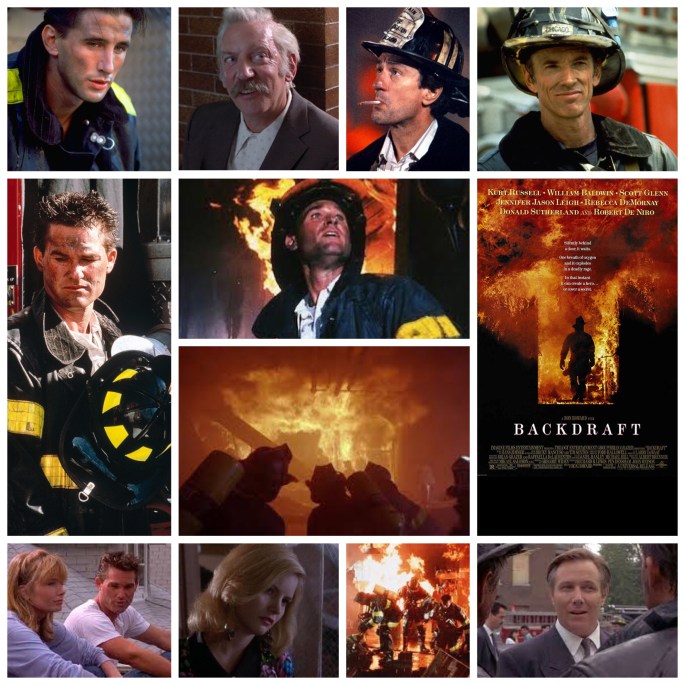
Ron Howard’s Backdraft is all you could want in a big budget Hollywood picture, and more in the sense that it combines a handful of genres for one big opus that’s bursting at it’s seams with family drama, romance, mystery, psychological thrills (of the deliciously heavy handed variety) and no shortage of shit blowing up. As far as firefighter films go, this is probably where the buck stops as far as I’m concerned. Stuff like Ladder 49 came and went without much lasting impression as I’m sure the Josh Brolin one from this year will too, but Backdraft man, it’s an action classic that’s endured and aged remarkably well over the years. It opens with a bang as a Chicago team thunders into action set to a score by Hans Zimmer that could wake the dead. This intro serves as a showcase moment for what’s to come, as we meet two brothers who are fiercely competitive, each scarred by there fireman father’s (Kurt Russell) untimely demise. The older (also Russell) is a headstrong bull with self destructive tendencies, while the younger (William Baldwin) does his best to live up to the family name by struggling through the academy. That’s the framework for a story that’s brimming with characters and subplots, as any Hollywood epic should be. Robert Deniro steals the show as a gruff, old school arson investigator who’s seen a few deadly fires in his time, and keeps a close watch on psychopath firebug Donald Sutherland, who himself gives a thoroughly chilling performance. Scott Glenn is rough ‘n tough as veteran fireman Axe, Jennifer Jason Leigh is Baldwin’s flame in a role that’s uncharacteristically safe for the daring actress, while Rebecca De Mornay is terrific as Russell’s ex-wife. Ohh and J.T. Walsh steals every scene as a dubious politician. What a cast. The film is big, bold and noisy, with a visual and auditory aesthetic that will give any home theatre system a pounding. Zimmer’s score is seriously awesome, a grandiose, emotional, booming concoction that stands as both one of his best and most underrated. This is one of the old fashioned, pure bangers of unbridled cinematic escapism that can’t be beat, replicated or watched too many times.

-Nate Hill

Gregory Hoblit’s Fallen


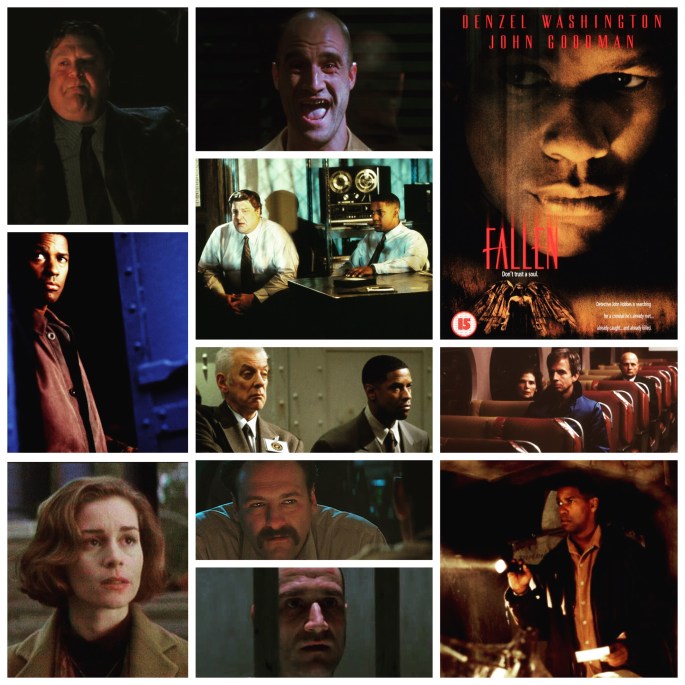
A demon angel. A Badass Denzel Washington. Tony Soprano singing the Rolling Stones. Creeping psychological dread. Browned, burnished production design. A deliciously mean spirited, ballsy twist ending. All this and more can be found in Gregory Hoblit’s Fallen, an atmospheric spook-house of a flick that gets tone, fright and suspense just right. Nestled in that sweet spot of the 90’s where detective stories often had a neat supernatural twist (The Prophecy is another dope one), it’s a film that demonstrates the power of storytelling and atmosphere done right, like a campfire tale that cops tell their youngsters. Denzel is Hobbs, a detective who oversees the graphic execution of serial killer Edgar Reese (Elias Koteas, terror incarnate), a monster he once caught. Case closed, right? Not so much. Soon after he kicks the bucket, one or more copycat killers show up, and once again the crimes happen under Hobb’s watch. Coincidence? Paranormal? It’s a neat, eerie game of cat and mouse with an antagonist who possesses a few unearthly methods of skulking around in the dark. Hobbs is helped by his two colleagues, salt of the earth John Goodman and hothead James Gandolfini, bumps heads with the obstinate police captain (Donald Sutherland), and runs into his foe at every turn, each time in a new vessel which gives the actors, right down to extras, an opportunity to have some devilish fun. Embeth Davidz is her usual withdrawn self as a woman with ties to the killer’s past, and watch for Robert Joy and Gabriel Casseus as well. Composer Dun Tan’s unearthly drone of a score compliments the drab shadows, oppressive nocturnes and threatening frames of the film eerily as well, creating a mood-scape that drips ambience. The end is an acidic kick in the nuts, and I admire a film that has the stones to chuck in such a shock tactic, embracing the dread that has been built up to that point with one last sardonic, hopeless cackle. Film noir to it’s roots, subtly mystical, a perfect one to settle down with as we move into the Halloween season. 

-Nate Hill

The Art Of War


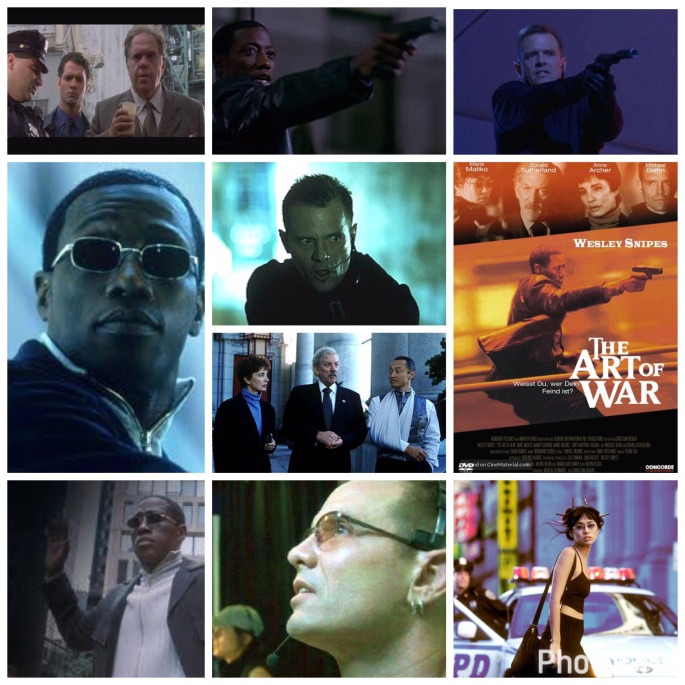
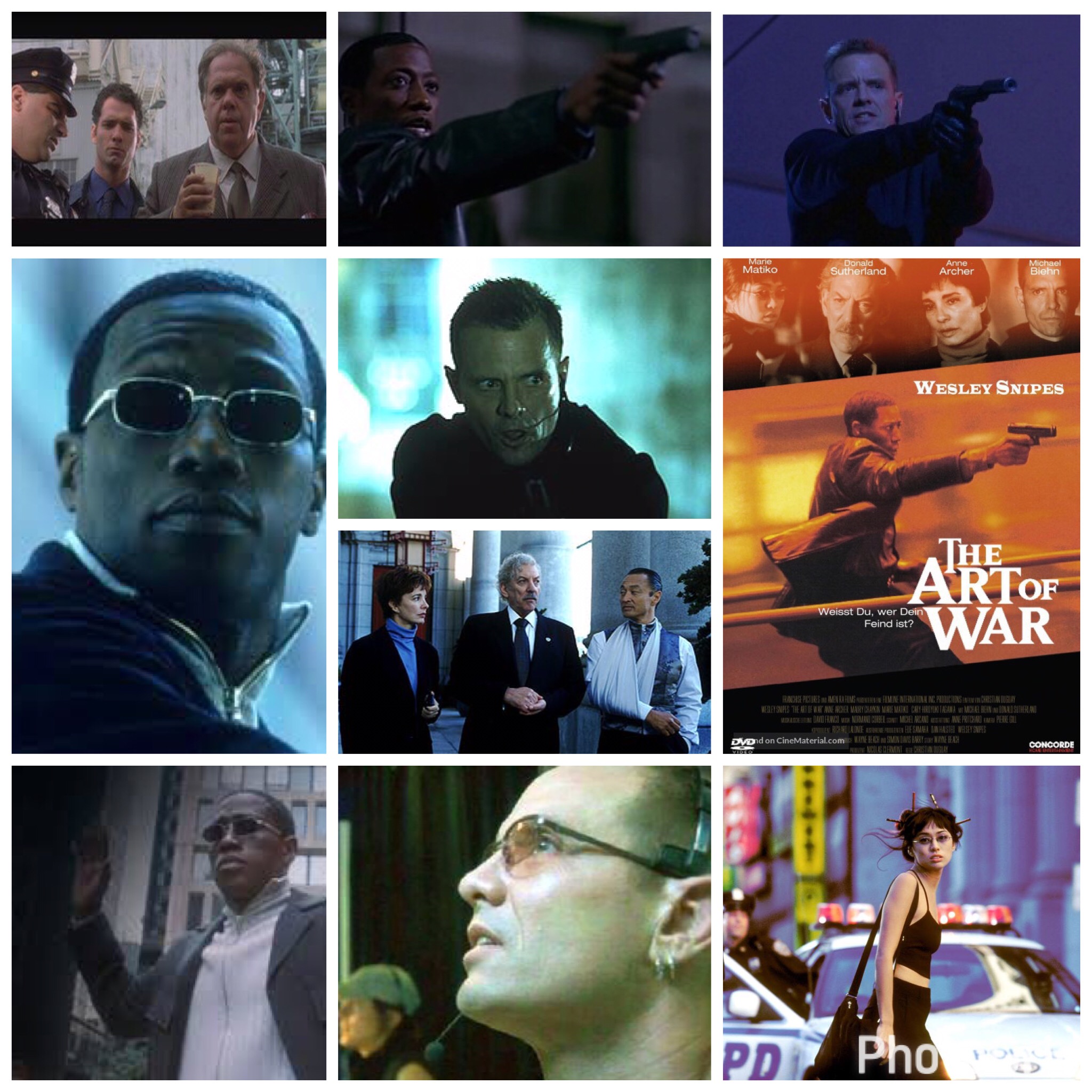
Everyone loves a Wesley Snipes flick. If it’s decent, that is, and these days he’s been churning out some sewer muck. Back in the day, however, he had some bangers, which includes The Art Of War. Wesley heads up an elite tactical team here, secretly employed by the United Nations, hired to do all kinds of cloak and dagger stuff, including securing trade deals, eliminating potential threats and maintaining cooperation from all sides. Run by a well spoken Donald Sutherland and Anne Archer, it’s a low key ‘fight fire with fire’ situation, until it all goes tits up and Snipes is framed for the murder of some bigwig Chinese dirtbag. Forced to contend with Triads, government factions and his own former partner gone rogue (Michael Biehn steals every scene, as usual), it’s a nice set up for a serviceable, above average action yarn. That Oriental influence always seems to make these thrillers seem cooler (ever seen Black Rain or Rising Sun?) which helps as well. Snipes and Biehn are livewires though and have a fantastic silenced pistol duel late in the third act, which is one slick showcase of a sequence. Not a whole lot to this one, but as an entertaining garden variety actioner, it holds up just fine. 

-Nate Hill

Episode 30: Alan J. Pakula’s KLUTE with Special Guest FRANCINE SANDERS

ep-30

We welcome back Frank’s former film professor Francine Sanders to discuss Alan J. Pakula’s masterpiece KLUTE.  We talk in depth about the film, and also cover some of Pakula’s other films.  We hope you enjoy!

The Hunger Games: A Review by Nate Hill

image

I have never read the Hunger Games books, and didn’t rush out to see this first installment when it was released. I have this thing where I sometimes resist a largely popular project simply because it’s buxzingwith so much hype. There’s a word for that that I resist even more, which starts with H, but good luck getting me to admit to that. Anywho, I did watch it one day on netflix, loved the hell out of it, and have seen every subsequent entry, up til last year’s final one. It’s damn great storytelling that soars on a brilliant extended performance by Jennifer Lawrence, who is the actress of her generation and a genius of the craft no matter what anyone says. People called this a slick version of Battle Royale, and while that may be true, it’s certainly not a bad thing, and not the sole extent of what the franchise achieves. There’s stinging social commentary which both condemns and makes satirical light of modern North American culture. It examines the power of propoganda for both good and bad ends. It looks at the abuse of power, and the potent rise of fascism and fear tactics, and how quickly they can become commonplace. And this is all in a young adult orientated film that stars a strong, unhindered female protagonist. Gives you hope for the world. Lawrence is powerful as Katniss Everdeen, a young woman chosen from her district to compete in the much celebrated and very violent Hunger Games, a death tournament which serves as a purge and reminder to the citizens what it cost them to rebel against their oppressors years before. This is all at the behest of mega villain President Snow (Donald Sutherland oozes quiet malice with every articulate and icy syllable), who lives in the wealthy and decadent capitol city of Panem, a dystopian version of North America. Along with Katniss there’s also Peeta  (but no hummus) a local baker’s boy played by Josh Hutcherson, who really struggles to match the skill level of almost everyone around him, especially Lawrence. They are thrust into the posh and stylized razzle dazzle of Capitol life as they train for the ruthless games, watched over by previous Victor and proud alcoholic Haymitch Abernathy (Woody Harrelson), as well as preening diva Effie Trinket (Elizabeth Banks channellig Marie Antoinette crossed with a poodle). The film takes some time to ramp up to the games, but as soon as it does the events unfold in breathless fashion set against a lush wilderness background, each and every member fighting tooth and nail to stay alive against both each other and the obstacles which gamesmasters have placed in their way. Anyone with an intense fear of wasps will want to be warned. A clever riff on the talk shows of our climate is shown, as the competitors are quizzed by Ceasar Flickerman (Stanley Tucci) a manically hopped up pop personality with a hairstyle that would make a samurai jealous and teeth so white they get accused of stealing oscar nominations. Tucci is truly a well of energy and the proceedings go electric whenever he’s around. Watch for Paula Malcolmson, Liam Hemsworth, Wes Bentley, Toby Jones and Lenny Kravitz as Cinna, a kindly fashion guru who takes a shine to Katniss and designs her a dress to end all dresses. Lawrence carries the entire thing on her mockingjay wings, making Katniss a spirit of unrest, a true symbol of hope and above all, a scared girl tossed into events she can’t possibly imagine navigating. Her performance is most of what makes these films so solid, and they couldn’t have made a better casting choice. Be sure to stay fpr the credits to hear ‘Abraham’s Daughter’, a fittingly grandiose original song by Arcade Fire.

JFK – A REVIEW BY J.D. LAFRANCE

JFK5

The assassination of American President John F. Kennedy is a watershed event in American history and one that has provoked people to question their own beliefs and those of their government. Yet, for such a highly publicized affair there are still many uncertainties that surround the actual incident. Countless works of fiction and non-fiction have been created concerning the subject, but have done little in aiding our understanding of the assassination and the events surrounding it. Oliver Stone’s film, JFK (1991) depicts the events leading up to and after the assassination like a densely constructed puzzle complete with jump cuts and multiple perspectives. Stone’s film presents the assassination as a powerful event constructed by its conspirators to create confusion with its contradictory evidence, to then bury this evidence in the Warren Commission Report, which in turn manifests multiple interpretations of key figures like Lee Harvey Oswald. JFK offers a more structured examination of the conspiracy from one person’s point of view where everything fits together to reveal a larger, more frightening picture implicating the most powerful people in the United States government.

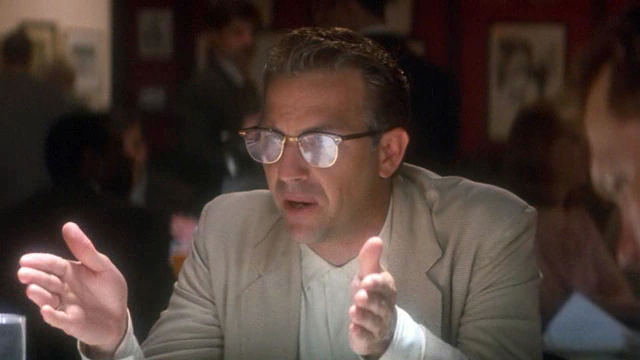
JFK presents the assassination of Kennedy as a powerful event constructed by its conspirators to create confusion with its contradictory evidence and then theorizes that the evidence was buried deep in the Warren Commission Report. Stone’s film filters a structured examination of two conspiracies, one to kill the President and one to cover it up, from one person’s point of view — Jim Garrison (Kevin Costner) — who then assembles all of the evidence at his disposal to reveal a larger, more frightening picture that implicates the most powerful people in the United States government. Stone saw his movie consisting of several separate films: Garrison in New Orleans against Clay Shaw (Tommy Lee Jones), Oswald’s (Gary Oldman) backstory, the recreation of Dealey Plaza, and the deep background in Washington, D.C.

While attending the Latin American Film Festival in Havana, Cuba, Stone met Sheridan Square Press publisher Ellen Ray on an elevator. She had published Jim Garrison’s book On the Trail of the Assassins. Ray had gone to New Orleans and worked with Garrison in 1967. She gave Stone a copy of Garrison’s book and told him to read it. He did and quickly bought the film rights with his own money. The Kennedy assassination had always had a profound effect on his life and eventually met Garrison, grilling him with a variety of questions for three hours. The man stood up to Stone’s questioning and then got up and left. His hubris impressed the director.

Stone was not interested in making a film about Garrison’s life but rather the story behind the conspiracy to kill Kennedy. To this end, he also bought the film rights to Crossfire: The Plot That Killed Kennedy by Jim Marrs. When Stone set out to write the screenplay, he asked Sklar to co-write it with him and distill the Garrison book, the Marrs book and all the research he and others conducted into a script that would resemble what he called “a great detective movie.” Stone told Sklar his vision of the movie: “I see the models as Z (1969) and Rashomon (1950), I see the event in Dealey Plaza taking place in the first reel, and again in the eighth reel, and again later, and each time we’re going to see it differently and with more illumination.”

Sklar worked on the Garrison side of the story while Stone added the Oswald story, the events at Dealey Plaza and the “Mr. X” character. To tell as much of the story as they could, Stone and Sklar used composite characters, a technique that would be criticized in the press, most notably the “Mr. X” character played by Donald Sutherland and who was a mix of several witnesses and retired Air Force colonel L. Fletcher Prouty, an adviser for the film.
600px-JFK_017

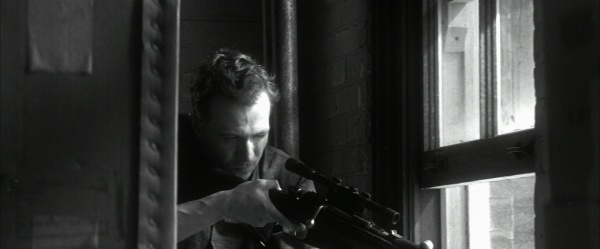
Stone ambitiously wanted to recreate the Kennedy assassination in Dealey Plaza and his producers had to pay the Dallas City Council a substantial amount of money to hire police to reroute traffic and close streets for three weeks. He only had ten days to shoot all of the footage. Getting permission to shoot in the Texas School Book Depository was more difficult. They had to pay $50,000 to put someone in the window that Lee Harvey Oswald was supposed to have shot Kennedy from. They were allowed to film in that location only between certain hours with only five people on the floor at one time: the camera crew, an actor, and Stone. Co-producer Clayton Townsend has said that the hardest part was getting the permission to restore the building to the way it looked back in 1963. It took five months of negotiation.

Filming was going smoothly until several attacks on the film and Stone began to surface in the mainstream media including the Chicago Tribune, published while the film was only in its first weeks of shooting. Five days later, the Washington Post ran a scathing article by national security correspondent George Lardner entitled, “On the Set: Dallas in Wonderland” that used the first draft of the JFK screenplay to blast it for “the absurdities and palpable untruths in Garrison’s book and Stone’s rendition of it.” The article pointed out that Garrison lost his case against Clay Shaw and claimed that he inflated his case by trying to use Shaw’s homosexual relationships to prove guilt by association. Other attacks in the media soon followed. However, the Lardner Post piece stung the most because he had stolen a copy of the script. Stone recalls, “He had the first draft, and I went through probably six or seven drafts.”

The film depicts the events leading up to and after the assassination as a densely constructed story complete with jump cuts, multiple perspectives, a variety of film stocks and the blending of actual archival footage with staged scenes dramatized by a stellar cast of actors. This blurring of reality and fiction by mixing real footage with staged footage makes it difficult to discern what really happened and what is merely speculation. Stone does this in order to create what he calls “a countermyth to the myth of the Warren Commission because a lot of the original facts were lost in a very shoddy investigation” and simulate the confusing quagmire of events as they are depicted in The Warren Commission Report. Stone creates different points of views or “layers” through the extensive use of flashbacks within flashbacks. Stone has said that he “wanted to the film on two or three levels — sound and picture would take us back, and we’d go from one flashback to another, and then that flashback would go inside another flashback . . . I wanted multiple layers because reading the Warren Commission Report is like drowning.” This technique conveys the notion of confusion and conflict within evidence.

Kevin Costner acts as the perfect mouthpiece for Stone’s theories. The auteur’s infamously forceful directorial approach to his actors pays off here as he reins in the actor’s usual tics and mannerisms. Stone was no dummy — he knew that by populating his film with many famous faces, he could make the potentially bitter pill that was his film, that much more palatable to the mainstream movie-going public. The rest of the cast is phenomenal. Gary Oldman’s delivers an eerily authentic portrayal of the enigmatic Lee Harvey Oswald. Tommy Lee Jones is note-perfect as the refined, self-confident businessman, Clay Shaw. Even minor roles are filled by such name actors as Vincent D’Onofrio, Kevin Bacon, Jack Lemmon, and Walter Matthau.

The film throws many characters at us and it is easier to keep track of them by identifying them with the famous person that portrays them. Stone was evidently inspired by the casting model of a documentary epic he had admired as a child: “Darryl Zanuck’s The Longest Day (1962) was one of my favorite films as a kid. It was realistic, but it had a lot of stars…the supporting cast provides a map of the American psyche: familiar, comfortable faces that walk you through a winding path in the dark woods.” Future biopics with sprawling casts, like The Insider (1999), and Good Night, and Good Luck (2005), and The Good Shepherd (2006) would use this same approach.

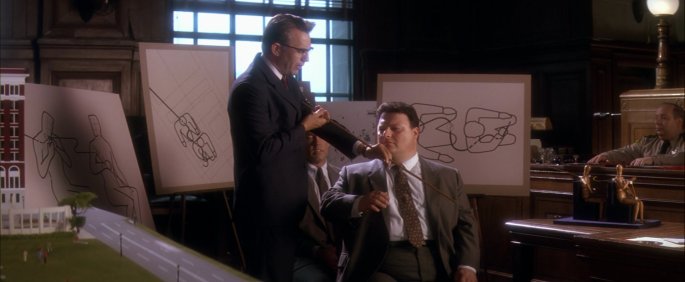
Seeing JFK now, one is reminded that first and foremost, it is a top notch thriller. There are so many fantastic scenes of sheer exposition that would normally come across as dry and boring but are transformed into riveting scenes in the hands of this talented cast. For example, the famous scene between Garrison and X (Sutherland) where the mysterious man lays out all the reasons why Kennedy was killed and how is not only a marvel of writing but also of acting as the veteran actor gets to deliver what is surely one of the best monologues ever committed to film.
capture91

JFK is an important film in the sense that it accurately portrays the assassination of Kennedy as a complex public event surrounded by chaos and confusion. It presents a main protagonist who exposes the conspiracy to be an intricately constructed coup d’état. Stone paints his canvas with broad brushstrokes and powerful images. JFK takes a larger, confrontational stance by boldly implicating the government in the conspiracy and the mainstream media in conspiring to cover it up. Stone is using the persuasive power of film to reach the largest number of people he can in order to wake them up and to reveal how they have been deceived by higher powers. There is no mistaking the importance of the assassination of Kennedy in American culture. Based on the excitement that surrounded Stone’s film, the American public is still greatly interested in the event with more and more people believing in a plot to kill Kennedy.
Forsaken: A Review by Nate Hill

image

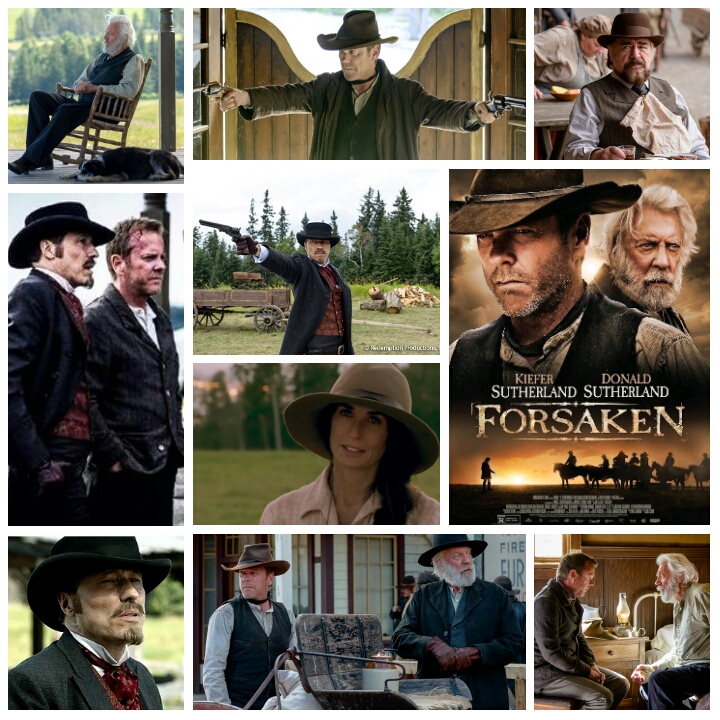
It’s refreshing that in an age populated by revisionist westerns and snazzy new takes on the ancient genre, some filmmakers just want to play it straight and deliver a good old oater without any newfangled bells and whistles. Jon Cassar’s Forsaken does just that, arriving a few years late (turbulent post production issues) but in modest, simple form, here to tell the age old tale of one man who stands up to some evil frontier bankers with stoic heroism. Kiefer Sutherland is John Henry Clayton, a man who has been away from his quiet hometown for nearly a decade. Following a traumatic stint in the war, circumstance led him into the life of the gunfighter. His unannounced return home stirs up old wounds in his preacher father (Donald Sutherland) who cringes in the very presence of his violent aura. John has thrown down the guns and sworn never to pick them up again, but we all know that just ain’t true, and when he meets a certain group of unsavory dudes in town, he becomes a time bomb of righteous anger that’s liable to go off any time. He spends some time mourning his mother and reconnecting with a lost love (Demi Moore), until the inevitable conflict brews. Corrupt banker James McCurdy (Brian Cox) is buying up farms and forcing families who don’t want to sell off their land, using despicable methods carried out by his two goons, vicious Frank Tillman (Aaron Poole) and mercurial ‘Gentleman’ Dave Turner (Michael Wincott). Tensions arise and everyone finds themselves headed for an unavoidable and blistering conclusion. Kiefer always has a jagged rage simmering just below the surface, which is what made him so perfect as Jack Bauer, another time bomb. He’s downright implosive here, delivering the best work I’ve ever seen him give. He’s got a touching scene with his father in which he goes to places I didn’t know he was capable of in his work. Donald is quiet, resentful and compassionate, wrestling internally to keep his serenity in the face of injustice. Cox always puts on a good show as the villain, and he’s exactly what he needs to be here: beaurocratic menace with just a dash of swagger. It’s Wincott who steals the show though, with the best work in the film. He inhabits Dave (and his incredibly dapper costume) with a relaxed, lupine calm, punctuated by sudden bursts of danger and always presided over by the midnight black, raspy croon of a voice that makes him so special. He jaunts along the line between villain and sympathetic antihero so well, the only character in the film to shirk the archetypes, and I was please try reminded of Jason Robard’s Cheyenne from Once Upon A Time In The West. His best work in a while as well, but then he’s always perfect. The film is refreshingly violent in its gunplay, with an earned brutality that never feels gratuituous, and always satisfying. The production took place in wildest alberta, a trip worth the taking for the breathtaking scenery we get to feast on, especially in an opening credit sequence that is very reminiscent of Eastwood films of yesteryear. It’s a landmark in the sense that although both Kiefer and Donald have been in the same film before (Joel Schumacher’s underrated A Time To Kill) they never have shared the same frame until now. Trust me, it was worth the wait. They are both excellent, along with their peers in a simple, honest to goodness Western film that should please fervent fans of the genre and moviegoers alike.