TOKYO DRIFTER – A REVIEW BY J.D. LAFRANCE

641022096879472221-tokyo-drifter-neon-banner.full

Seijun Suzuki made his name in Japan with hard-boiled B-crime films during the 1950s. By the 1960s, he took traditional Yakuza stories and juxtaposed them with an extreme Andy Warhol-esque pop art look that gleefully pushed genre conventions. He started to break away from convention with Youth of the Beast (1963) and then fused the sensibilities of Samuel Fuller with the aesthetics of Douglas Sirk with Story of a Prostitute (1965). Tokyo Drifter (1966) is a film that eschews narrative logic for playful abstraction and the results are quite unlike anything at the time or since.

Tetsuya Hondo (Tetsuya Watari) is a Japanese gangster trying to lead an honest life as the syndicate he belonged to dissolved itself and went legit. The only problem is that they borrowed money from their rival – Yoshii – and now they’ve come to collect. In the film’s striking washed out black and white prologue, Tetsu is beaten up by the Yoshii syndicate when he refuses to work for them, which, as it turns out, is a test to see if he’s actually gone legit. Out of loyalty to his former bosses, Tetsu decides to help him pay off the debt that is owed. However, complications arise when yet another rival syndicate kills Yoshii and takes over collecting the debt.

Tokyo Drifter has a striking ‘60s pop art look with a nightclub’s walls saturated in purple; a scene with a singer accompanied by a piano in a yellow room and is visited by a man in a red suit, while phones in various rooms in various places are primary colors. These vivid contrasts in color, coupled with the hep jazz soundtrack, make for a very unusual gangster film. Suzuki uses color and composition of the widescreen frame masterfully, like how he places his actors in a given frame.

Tetsuya Watari’s Tetsu is the epitome of ‘60s mod culture cool with his stylish suits, good looks and fashionable existential angst. It also doesn’t hurt that he’s pretty good with a gun. The pop art style that influenced Tokyo Drifter can also be seen in films like Modesty Blaise (1966) and In Like Flint (1967) but Suzuki’s film fearlessly pushes genre conventions further than either of these examples as he experimented with color and composition to a fascinating degree.

Stephen King’s Firestarter: A Review by Nate Hill 

Film versions of Stephen King novels can be a tricky thing. Often they’re half assed,  clunky miniseries (ever tried to sit down and watch The Langoliers??), and when they’re given the lofty cinema treatment, he has famously turned his nose in the face of Kubrick’s might. I feel like Firestarter escaped unscathed, and still holds to this day, if a bit achingly retro now. It’s a thriller perceived in a childlike manner by its young protagonist, Charlie Mcgee (Drew Barrymore). Charlie can start fires with her mind, and certain shadowy agencies just can’t wait to get their hands on her. Her father (David Keith) once participated in some scary drug testing related to telekinesis back in the day, and some of whatever altered his DNA has been passed on to her. He will do anything to protect her, as the two frantically race across the country to safety, pursued by forces working for Hollister (Martin Sheen), a spook with too much power and nasty ideas about what to do with it. Also on their trail is pseudo spiritual whacko John Rainbird, who wants to absorb Charlie’s abilities, man what a freak. Rainbird is a native American in King’s novel, so white haired yankee boy Scott is an odd choice, but he does a fine job all the same. Two things are what makes this one really stand out in a special way. Tangerine Dream provides yet another ultrasonic, elemental synth score that has since become legendary. It accents the story in an almost fairy tale like way, gilding the danger with a fable style sound, but never stamping out the real menace. Barrymore is the other leg of the table, giving one hell of a fierce and vulnerable performance for such a young girl, her childlike honesty a prism for the audience to see the evil around her through innocent eyes. It’s great stuff, and one of the most solid King adaptations out there. Now there is a sequel (not sure if the man wrote a second book?) called Firestarter 2: Rekindled, which pales in comparison and runs about 45 minutes too long (!), but it’s worth a look for the casting of Marguerite Moreau as a grown up Charlie, Malcolm McDowell taking over from Scott as Rainbird, and Dennis Hopper as well. 

Best Men: A Review by Nate Hill 


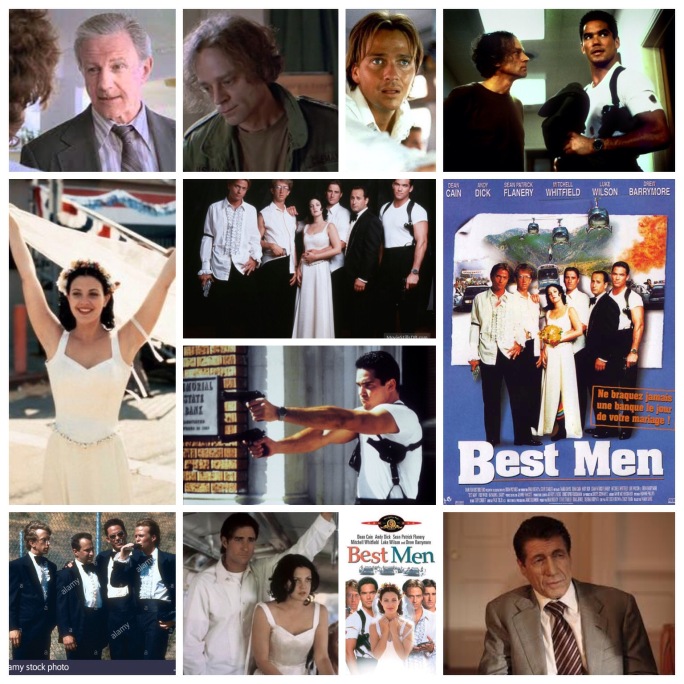
Best Men is the most charming, dainty and innocuous movie about bank robbing that you’ll ever see. It’s premise revolves around a wedding party that unwittingly gets roped into a heist, but they’re all solid folks, including the perpetrator, and all just want the best for the happy couple they are celebrating for. Therein lies both the comedic and the touching moments, of which there are many, supplied by a diverse and very capable cast. A troupe of best men accompany a groom (Luke Wilson) on the way to his matrimonial bliss. One among them is a hotheaded adrenaline junkie named Billy (Sean Patrick Flanery, never more adorable). Billy has knack for robbing banks whilst reciting Shakespeare. Demands, commands, profanities. All in the Bard’s tongue. He brazenly holds up a rural branch and drags his friends in, including two others, an ex military stud (Dean Cain) and a squirrelly, pussy whipped Andy Dick. They soon find themselves trapped in the bank with law enforcement prepping a siege outside their front door and Wilson’s determined Bridezilla (a feisty Drew Barrymore) marching straight into the crime scene to furiously give her fiancé what for. Billy also has severe daddy issues, which probably led to him lashing out in such a theatrical fashion in the first place. Coincidentally, the local sheriff (Fred Ward) happens to be his Poppa, and the two face off in scenes which undermine the lighter tone and dig for pathos that’s worth pausing for. They’re threatened by a gung ho FBI agent (Raymond J. Barry) who wants to blow them to kingdom come so he can go to lunch. They also find themselves sequestered in the bank with a sketchy Viet nam vet played by a wicked funny Brad Dourif in quite the commanding little supporting turn. Amid the screwball roughhousing, him and Cain find a few aching moments of truth relating to Cain’s sexual orientation, and his shame regarding it. I love a light, harebrained comedy, but I love em even more when they take deep breaths between fits of lunacy to gift their characters with some gravity that makes you feel something besides your sides splitting. This ones sadly forgotten, and you should all give it a go, it’s a gem. 

Finding Dory: A Review by Nate Hill 

While Finding Dory is not the same magic that Nemo was back in 2004 (it’s hard to catch that kind of lightning in a bottle twice), it’s safe to say it’s it’s own awesome little movie, and as far as a sequel goes, passes with flying colors. It’s more or less structured the same way as the first in terms of plot, adding it’s own twists, new characters and a core message that relates to previous themes while intrepidly covering new ground. My only complaint is I wish it were longer. It seemed to be over in a flash, even for a reliably slim Pixar running time. It would have been nice to have an extra 15 or 20 minutes to flesh out a few scenes, and elaborate a bit more on one particular character. Even so, what we get is completely charming and inspired. It starts off pretty much where we left off, with Nemo, Marlin and Dory living happily on the reef, intercut with scenes featuring an infant Dory who is most likely the cutest little thing to ever be seen in a Pixar movie. It’s revealed that a long time ago she was separated from her parents (Eugene Levy and Diane Keaton), and has grown up lost, adrift and afflicted by her relentless memory disorder. When an interaction triggers memories of them, she sets off with Marlin and Nemo in tow, on a merry quest across the ocean to connect with her roots. A great deal of this one is spent in a Sea World like habitat, which is another change and leaves room for many more new jokes and creatures. An octopus named Hank (Ed O Neil) begrudgingly helps her out, as well as a nearsighted whale shark (Kaitlyn Olsen), and as beluga (Ty Burrell) whose echo location is busted, providing one of the best jokes. There’s also a couple of exuberant seals played by Idris Elba and Dominic West, a few returning familiar faces and an epic cameo by a huge star, dead panning the voice of the aquarium tourist announcer in classic Pixar good humour. The film stresses the importance of acceptance and resilience, putting forth the idea that someone with a debilitating condition can in fact find their own unique method of coping, and achieving their goals despite the symptoms of their ailment. Trust Pixar time and time again to take mature, lofty themes and mold them into totally relatable fables that never preach, and are distilled to a point where the little ones can absorb them right alongside their parents. Like I said before, the film needs a bit more padding in its narrative to feel complete, which may materialize in an extended dvd version. What we have here is brilliant enough though, and didn’t disappoint. 

Dark Blue: A Review by Nate Hill 


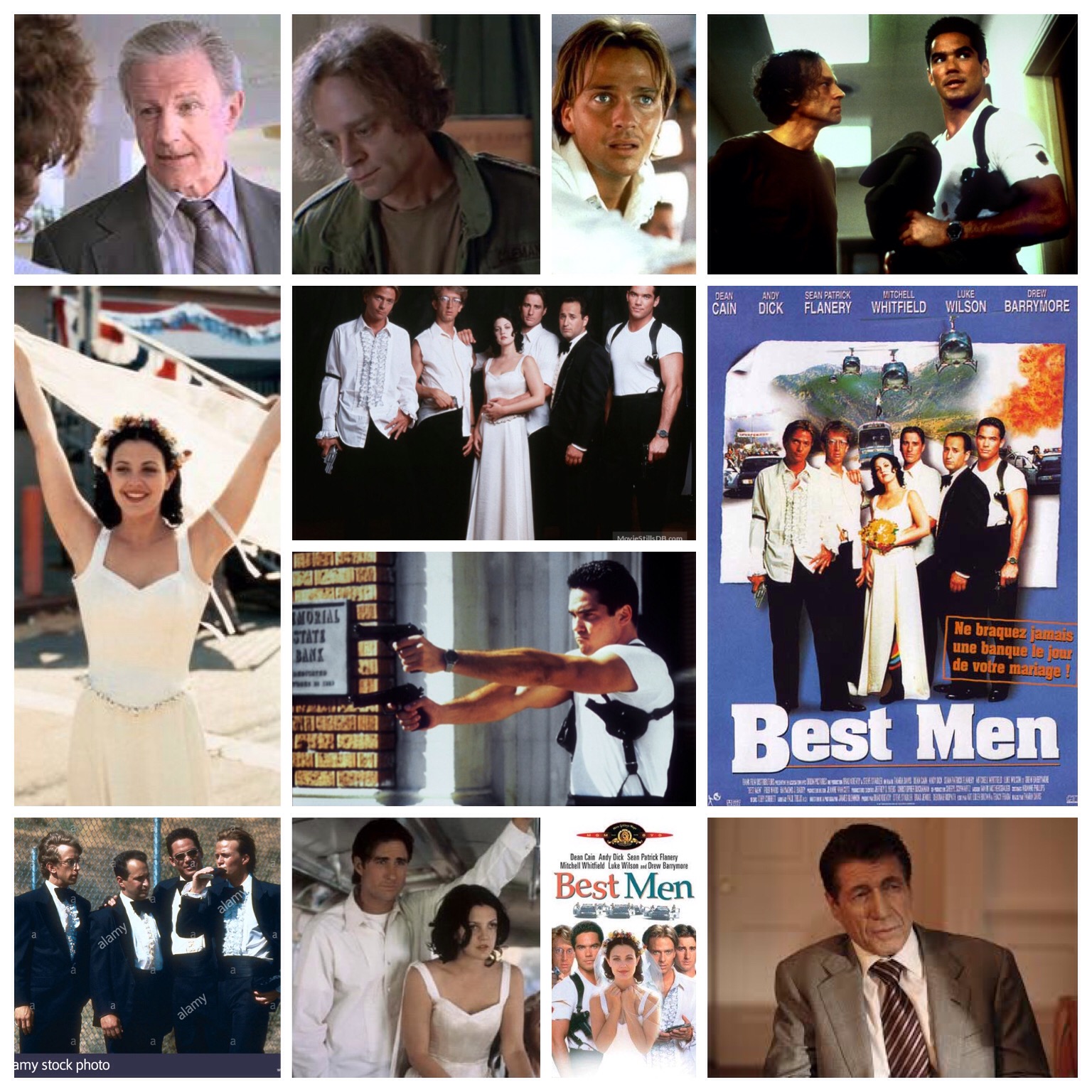
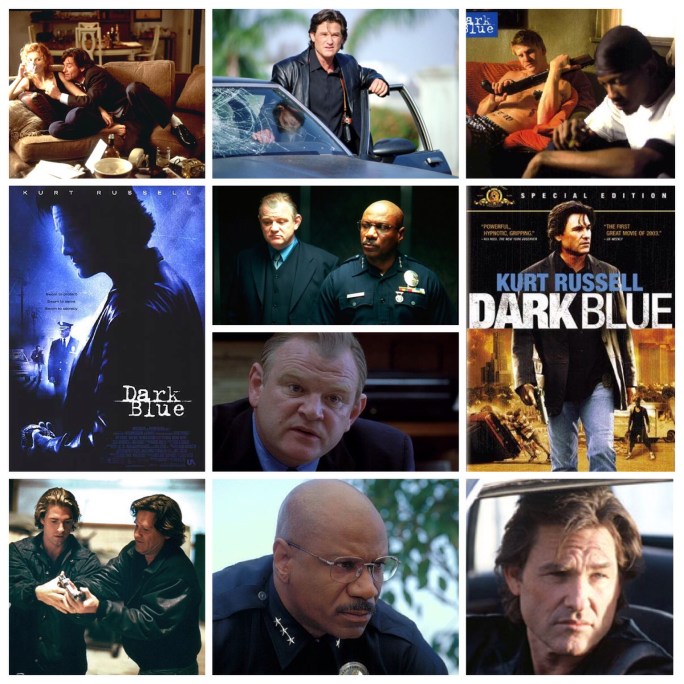
Dark Blue is the overlooked performance of Kurt Russsel’s career, and also the best. It’s also a film that brilliantly examines corruption, lies, brutality and abuse of power through a thoughtful narrative lens and via a powerfully moving story . So why then was it received with an unceremonious cold shoulder? Life is full of mysteries. I was too young to see it when it came out, or pay attention to the buzz surrounding it’s release, but I fell in love with it when I was older, and it remains one of my two favourite LA cop films, alongside Training Day. Kurt Russell throws himself headlong into one of the fiercest and most complex character arcs he has ever been in as Eldon Perry, an LAPD detective who comes from a long lineage of law enforcement. Eldon is a corrupt cop, but the important thing to realize about them is that they never consider themselves to be the bad guys which they are eventually labeled as. To him he’s on a righteous crusade, led by Captain Jack Van Meter (a purely evil Brendan Gleeson), a quest to clear the streets using any means necessary in his power. Eldon is blind to to the broken operative he has let himself become, questioned only by his wife (Lolita Davidvitch) and son, who are both thoroughly scared of him. The film takes place during the time of the Rodney King beating, with tensions on the rise following the acquittal of four LAPD officers. Ving Rhames is resilient as Holland, the one honcho in the department who isn’t rotten or on his way there, a knight for the force and a desperate loyalist trying to smoke out the corruption. Perry is assigned a rookie partner (Scott Speedman) and begins to show him the ropes, which include his patented brand of excessive force and intimidation. As crime ratchets up and a storm brews, Perry realizes that his blind trust in Van Meter and his agenda has been gravely misplaced, and could lead to his end. It’s a dream of an arc for any actor to take on, and Russell is seems is the perfect guy for the job. He fashions Perry into a reprehensible antihero whose actions have consequences, but not before a good long look in the mirror and the option to change the tides and find some redemption, before it’s far too late. It’s not so common anymore for crime films to cut through the fat of intrigue and action, reaching the gristle of human choices, morality and the grey areas that permeate every institution know to man, especially law enforcement. Working from a David Ayer screenplay based on a story by James Ellroy (hence the refreshing complexity), director Ron Shelton and everyone else onboard pull their weight heftily to bring this difficult, challenging, sure fire winner of a crime drama to life. Overlooked stuff.

A MIGHTY HEART – A REVIEW BY J.D. LAFRANCE

hero_EB20070621REVIEWS70621002AR

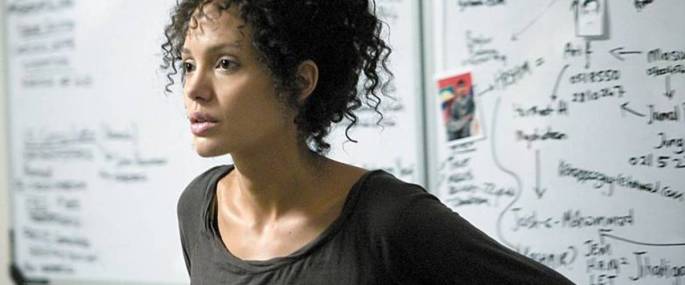
Ever since Angelina Jolie won an Academy Award for her memorable role in Girl, Interrupted (1999), she has gradually gotten further and further away from the kinds of roles that won her that coveted accolade in the first place. And so it was with some anticipation that she would be returning to more challenging, interesting work with A Might Heart (2007), an adaptation of the memoir by Mariane Pearl about the kidnapping and death of her husband, journalist Daniel Pearl. Of course, there were the usual fears that this would merely be a vanity project for Jolie – a desperate attempt to reclaim Oscar glory yet again. However, the wild card thrown into the mix was the presence of British filmmaker Michael Winterbottom. He has the reputation of being something of a maverick, adept at all kinds of genres, be they literary adaptations (The Claim), period pieces (Tristram Shandy: A Cock and Bull Story), biopics (24 Hour Party People) or politically-charged docu-dramas (The Road to Guantanamo). However, he also has the habit of turning them on their head in a way that polarizes critics and audiences. If anyone could get Jolie to shed her movie star persona it would be him.

The film is set in Pakistan as Daniel (Dan Futterman) is doing a story on the Taliban for the Wall Street Journal. One day, he goes off to interview a religious leader and never comes back. When he doesn’t return later that night, Mariane (Angelina Jolie) checks his email and tries to track down his contacts but with no success. The next day he is still missing and she starts calling anybody she can think of, eventually bringing in the local police. The film becomes an intense, Michael Mann-esque police procedural as local law enforcement, led by Captain (Irrfan Khan), turn the city upside down questioning anyone connected with Daniel or who helped set up the interview he was going to.

The Department of Justice and Diplomatic Security Service special agents are called in and a representative by the name of Randall Bennett (Will Patton) meets with Mariane in order to get her side of the story. She is also a journalist and does her own digging into the case. In a few days, she receives an email from the kidnappers who claim that Daniel is a CIA agent posing as a journalist while the local newspapers claim that he’s a Mossad agent just because he also happens to be Jewish. Mariane finds herself drowning in the political quagmire that is Pakistan as the authorities question Daniel’s methods and motivations.

Angelina Jolie does an excellent job as a woman barely keeping it together in the face of such uncertainty, not knowing if she will ever get to see her husband alive again while also dealing with being pregnant on top of everything else. She wisely underplays the role, resisting the urge to come on too strong by being showy and instead immersing herself in the part. Winterbottom helps her out, like in one scene where Mariane allows herself a moment to let it all out and break down. He refuses to go for the easy money shot close-up of Jolie’s teary, anguished face and instead opts for a long shot, letting her body language speak volumes about how she’s feeling.

Winterbottom’s hand-held camera careens through the crowded, claustrophobic streets of Karachi much like in the opening scenes of The Insider (1999) when Al Pacino’s character meets with the leader of the Hezbollah. Winterbottom creates an immediate, immersive experience as the sights and sounds of the city are everywhere. He also keeps everything grounded in reality with minimal use of music because of its ability to easily manipulate our emotions. A Mighty Heart feels like a personal project for Jolie but never seems like a vanity project because one never feels like she is grandstanding but rather is passionate about the subject matter and doing justice to it.

John Singleton’s Rosewood: A Review by Nate Hill 

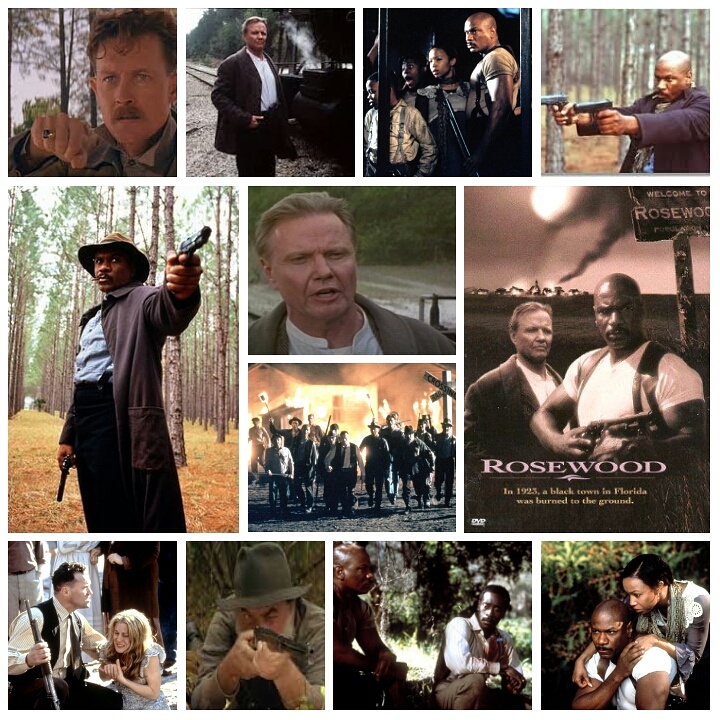
John Singleton’s Rosewood is a partly fictionalized, greatly dramatized retelling of one of the largest lynchings and subsequent conflicts in American history. The time is 1923, the place is Rosewood, a small southern town populated largely by African communities. When borderline insane local housewife Fanny (Catherine Kellner) is caught in the midst of a violent sexual fling, a young black man accidentally stumbles upon the scene. Being the crazy bitch she is, she melodramatically pins it on him, inciting the wrath of the town. The real culprit was of course a white dude, played briefly by Robert Patrick before fleeing the county for good. Because of this selfish misdirection, every white man and his mother now wants the boy hung, and it escalates with the speed of a prairie fire until a full scale race war rages through Rosewood. A lone mercenary called Mann (Ving Rhames) happens to be around and lends his quickdraw talents to the townsfolk who are being hunted. The sheriff (Michael Rooker) is somewhat of a pushover, and unable to quell the mob anyway, especially when it’s led by a rabid Bruce McGill, who is scary and then some. The only white boy who has anything but ropes or torches to offer these poor folks is a kindly store owner played by Jon Voight, who shelters a group of them on his property, much to the mob’s anger. Voight’s character is odd; when we meet him he is in heated coitus with one of his shopkeeps, a young African girl. It’s later revealed that she’s afraid of him. Despite this dark piece of his arc, Singleton treats him as a hero, begging the question, were there scenes cut that elaborated on his relationship with her? Such imbalances in tone can be found in the story as well: much of the film is treated with a combination of severe melodrama and true crime drama, speckled here and there with jarring little bits of pulp that feel like they’re from a Django type flick. Wouldn’t have been the narrative mix I would have used, but perhaps Singleton’s hand slipped and too much of an aspect fell in which he only ever meant as a subtle garnish. Nevertheless, it’s very solidly made, wherever it sits on the genre map, with all the actors, particularly the African townsfolk, shining nicely. It’s disturbing as well, with the black body count reaching sickening heights and the racist fever at a vicious spike in temperature. It’s a scary scenario when the hunters greatly outnumber the hunted, and mass deaths are imminent, especially when such anger is involved. Sympathy is earned in spades from the viewer, as well as the urge to look away at least a few different times. I haven’t done my research on the real story so I couldn’t tell you where it falls on the authenticity charts, but I suspect a great deal of it has been exaggerated for effect and impact. In that, it succeeds, if faltering in tone a few times to puzzle the viewer, before getting back on track. 

THE ROCKETEER – A REVIEW BY J.D. LAFRANCE

rocketeer1

With the massive commercial success of Tim Burton’s Batman (1989), other Hollywood studios scrambled to find their own comic book franchise in the hopes of replicating the boffo box office of the Caped Crusader. With the notable exception of Dick Tracy (1990), most of these films failed to appeal to a mainstream audience. These included pulp serial heroes The Shadow (1994) and The Phantom (1996), and the independent comic book The Rocketeer. Originally created by the late Dave Stevens, it paid homage to the classic pulp serials of the 1930s. For some reason, Disney decided that it would be their tent-pole summer blockbuster for 1991, cast two unproven leads – Billy Campbell and Jennifer Connelly – and hired Steven Spielberg protégé, Joe Johnston to direct. Despite promoting the hell out of it and spending a ton of money on merchandising, The Rocketeer (1991) underperformed at the box office.

It’s a shame because out of the lot of retro comic book films done in the 1990s, The Rocketeer was the best one and the most faithful to its source material. While both The Shadow and The Phantom looked great, they were flawed either in casting or with their screenplays while Dick Tracy was top-heavy with villains and director (and star) Warren Beatty’s ego, but The Rocketeer had the advantage of its creator actually being involved in bringing his vision to the big screen. The end result was a fun, engaging B-movie straight out Classic Hollywood Cinema albeit with A-list production values. The film has quietly cultivated a cult following and deserves to be rediscovered.

Cliff Secord (Billy Campbell) is a young, hotshot pilot who races planes for a living with the help of his trusted mechanic and good friend Peevy (Alan Arkin). One day, while out testing his new plane, Cliff stumbles across an experimental jetpack stolen from Howard Hughes (Terry O’Quinn). Soon, he finds himself mixed up with the FBI, who want to recover it, and unscrupulous gangsters who stole it in the first place. Also thrown into the mix is Neville Sinclair (Timothy Dalton), an Errol Flynn-type matinee idol who wants the jetpack for his own nefarious agenda. Cliff’s beautiful girlfriend Jenny Blake (Jennifer Connelly) is an aspiring actress who catches Sinclair’s eye, which further complicates Cliff’s life. With Peevy’s help, Cliff figures out how to use the jetpack and fashions himself an alter ego by the name of the Rocketeer.

Billy Campbell does a fine job as the scrappy Cliff Secord. He certainly looks the part and has great chemistry with co-star Jennifer Connelly (they fell in love while making the film). Connelly plays Jenny as the gorgeous girl-next-door and looks like she stepped out of a 1930s film. Jenny loves Cliff but dreams of being a movie star, not hanging around the airfield. Connelly, with her curvy figure, shows off her outfits well and does the best with what is ostensibly a damsel in distress role.

Timothy Dalton has a lot of fun playing the dashing cad as evident in the scene where he “accidentally” wounds a fellow actor during filming for stealing a scene from him. Sinclair is a vain movie star with big plans and there’s a glimmer in Dalton’s eye as he relishes playing the dastardly baddie. Alan Arkin is also good in the role of Peevy – part absent-minded professor-type and part father figure to Cliff.

The Rocketeer features a solid supporting cast with the likes of Ed Lauter playing a no-nonsense FBI agent, Terry O’Quinn as the brilliant Howard Hughes, Jon Polito as the money-grubbing airfield owner, and Paul Sorvino as a blustery gangster begrudgingly in league with Sinclair. His casting is a nice nod to the patriarchal mobster he played in GoodFellas (1990) only a lot less menacing (this is Disney after all). The always entertaining O’Quinn is particularly fun to watch as a dashing Hughes that could have easily stepped out of Francis Ford Coppola’s love letter to American ingenuity, Tucker: The Man and His Dream (1988).

The attention to period detail, in particular the vintage planes, is one The Rocketeer’s strengths. The film gets it right with the clothes that people wear and how they speak so that you feel transported back to this era. The recreation of old school opulence is fantastic as evident in the South Seas nightclub sequence where Sinclair works his charms on Jenny. Even Joe Johnston’s direction feels like a throwback to classic Hollywood filmmaking as he gives the flying sequences the proper visual flair that they deserve. He wisely keeps things simple, never trying to get too fancy or show-offy as he takes a page out of his mentor, Steven Spielberg’s book. There’s never any confusion as to what is happening or where everyone is – something that seems to be missing from a lot of action films thanks to the popularity of the Bourne films. Johnston is an interesting journeyman director whose best work is old school action/adventure films, like Hidalgo (2004), or slice-of-life Americana, like October Sky (1999), which is why he was the wrong choice to helm the ill-fated reboot of The Wolfman (2010) and the right director for Captain America: The First Avenger (2011).

rocketeer2Filmmaker Steve Miner (Friday the 13th, Parts II and III) was the first person to option the film rights to Dave Stevens’ independent comic book The Rocketeer but he ended up straying too far from the original concept and his version died an early death. Screenwriters Danny Bilson and Paul DeMeo (Trancers and Zone Troopers) were given the option in 1985. Stevens liked them because “their ideas for The Rocketeer were heartfelt and affectionate tributes to the 1930’s with all the right dialogue and atmosphere. Most people would approach my characters contemporarily, but Danny and Paul saw them as pre-war mugs.” Their subsequent screenplay kept the comic book’s basic plot intact but fleshed it out to include the Hollywood setting and the climactic battle against a Nazi zeppelin. They also tweaked Cliff’s girlfriend to avoid comparisons (and legal hassles) to Bettie Page (Stevens’ original inspiration), changing her from a nude pin-up model to a Hollywood extra while also changing her name from Betty to Jenny.

Bilson and DeMeo submitted their seven-page outline to Disney in 1986. They studio put the script through an endless series of revisions and, at one point, frustrated by the seemingly endless process, the two screenwriters talked to Stevens about doing The Rocketeer as a smaller film shot in black and white. The involvement of Disney put the project on a much bigger level as the writers remembered, “you can imagine the commitment Disney was making to develop a series of movies around a character. They even called it their Raiders of the Lost Ark.” With Stevens’ input, Bilson and DeMeo developed their script with director William Dear (Harry and the Hendersons) who changed the zeppelin at the film’s climax to a submarine. Over five years, the mercurial studio fired and rehired Bilson and DeMeo three times. DeMeo said, “Disney felt that they needed a different approach to the script, which meant bringing in someone else. But those scripts were thrown out, and we were always brought back on.”

They found this way of working very frustrating as the studio would like “excised dialogue three months later. Scenes that had been thrown out two years ago were put back in. what was the point?” Disney’s biggest problem with the script was all of the period slang peppered throughout. Executives were worried that audiences wouldn’t understand what the characters were saying. One of their more significant revisions over this time period was to make Cliff and Jenny’s “attraction more believable … how do we bring Jenny into the story and revolve it around her, and not just create someone who’s kidnapped and has to be saved?” DeMeo said. In 1990, their third major rewrite finally got the greenlight from Disney. However, when the studio acquired the rights to the Dick Tracy film from Universal Studios, DeMeo was worried that executives would dump The Rocketeer in favor of the much more high-profile project. However, when Dick Tracy failed to perform as well at the box office as Disney had hoped, DeMeo’s fears subsided.

All kinds of actors were considered for the role of Cliff Secord, including Bill Paxton, who almost got it, and Vincent D’Onofrio, who was offered the role but turned it down. Finally, Billy Campbell was cast as Cliff. Prior to this film, his biggest role to date was regular on the Michael Mann-produced television show, Crime Story. For the role of Jenny, Sherilyn Fenn, Kelly Preston, Diane Lane, and Elizabeth McGovern were all considered but lost out to Jennifer Connelly, fresh from making the comedy, Career Opportunities (1991). Dave Stevens wanted Lloyd Bridges to play Peevy but he turned the film down and Alan Arkin was cast instead. The Neville Sinclair role was offered to Jeremy Irons and Charles Dance before Timothy Dalton accepted the role.

Campbell wasn’t familiar with Stevens’ comic book when he got the part but quickly read it and books on aviation while also listening to period music. The actor also had a fear of flying but overcame it with the help of the film’s aerial coordinator Craig Hosking. To ensure Campbell’s safety, he was doubled for almost all of the Rocketeer’s flying sequences. Hosking said, “What makes The Rocketeer so unique was having several one-of-a-kind planes that hadn’t flown in years,” and this included a 1916 standard bi-wing, round-nosed, small-winged Gee Bee plane.

The numerous delays forced William Dear to leave the production and director Joe Johnston signed on to direct. He was a fan of the comic book and when he inquired about its film rights was told that Disney already had it in development. He approached the studio and was quickly hired to take over when Dear departed. Johnston said, “One of the great appeals of Stevens’ work was his attention to detail, which really placed the reader in the period. I’ve tried to do the same thing cinematically.” Pre-production on the film started in early 1990 with producer Larry Franco in charge of securing locations for the film. He found an abandoned World War II landing strip in Santa Maria, which the filmmakers used to build the mythical Chaplin Air Field. The Rocketeer’s attack on the Nazi zeppelin was filmed near the Magic Mountain amusement park in Indian Dunes. The film was shot over 96 days and ended up going over schedule due to weather and mechanical problems.

rocketeer3Like The Right Stuff (1983) before it, The Rocketeer is a love letter to the wonders of aviation and the brave souls that risked their lives pushing the envelope. In a nice touch, Cliff even chews Beeman’s gum, the same kind that Chuck Yeager uses in The Right Stuff. The comic book is masterfully translated to the big screen, right down to recreating the iconic Bull Dog Diner. The filmmakers also got all the details of Cliff and his alter ego right, including the casting of Billy Campbell. The same goes for Jenny, although, because Disney backed the film, they downplayed the blatant homage her character was to famous pin-up model Bettie Page. With Dave Stevens untimely passing in 2008, watching this film is now a bittersweet experience but there is some comfort in that at least he got to see his prized creation brought vividly to life even if failed to catch on with the mainstream movie-going public. The Rocketeer is flat-out wholesome fun with nothing more on its mind than to tell an entertaining story and take us on an exciting adventure.

Green Room: A Review by Nate Hill 

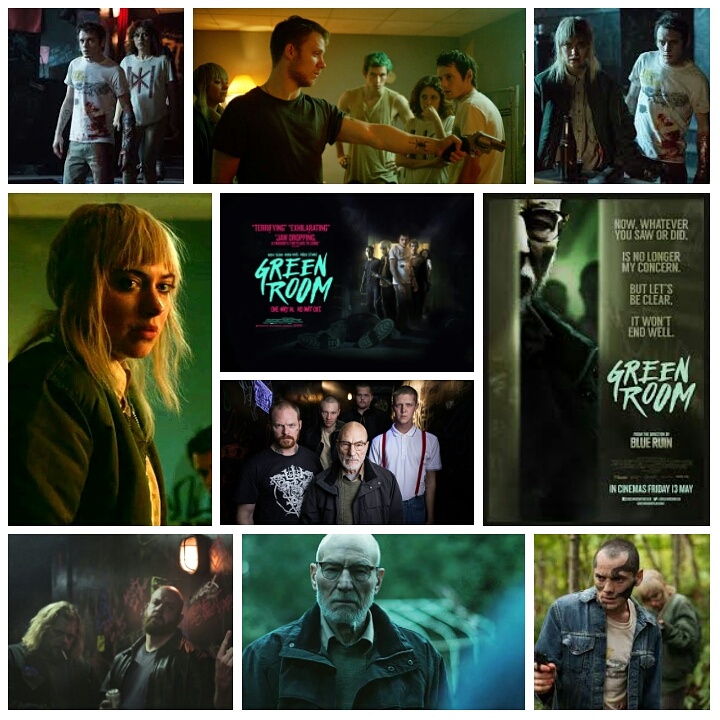
Green Room has the same vicious, simplistic edge to it that director Jeremy Saulnier’s 2011 thriller Blue Ruin had, but sharpened and honed to near perfection this time around. This is one grim thriller, a claustrophobic little odyssey of desperate violence that’s thick with a sick, overwhelming atmosphere that isn’t for the faint of anything. A big part of what makes it work so well is the fact that it makes sense, in terms of scene to scene actions and character motivations. These aren’t cardboard horror protagonists darting through a predetermined rat maze of a narrative, these are real humans in a deadly situation who act accordingly, with both purpouse and realism. Atmosphere was a huge part of Blue Ruin, and now again Saulnier weaves a tense auditory cloak that puts the characters in the hot seat of danger and the audience in conniptions of suspense. It’s a situation straight out of a seething nightmare: a down and out punk band led by Anton Yelchin are on a dead end tour, severely strapped for cash and getting desperate. When a vague buddy hooks them up with a rural gig, they jump at the chance, until they find out they’re playing for a clubhouse full of angry neo nazi skinheads in a backwoods bar. Everything is going marginally well (as well as coexisting with nazis for a set could go, I suppose) until a member of their group accidentally witnesses one of these freaks brutally slaughter a girl, suddenly branding them all as witnesses. With nowhere to go, the band barricades themselves into the green room and descends into a collective panic as the reality of their situation sets in. Outside, an armada of furious Aryan psychopaths prepares to siege the bar and kill them, led by the clubhouse owner, Darcy (a wicked, malevolent Patrick Stewart, loving every second of a rare villain role). The film clocks in at a scalpel sliced 90 minutes, with not a second wasted on anything that doesn’t propel the story forward with the momentum of a machete ripping through bone. These dudes are out to get them at any cost, and the band in turn are whipped into an adrenaline overdrive of base survival instinct, using anything they can to dispatch their tormentors and escape. Yelchin does an excellent job of making their plight feel uncannily real, the terror emanating from every pore until there’s none left, and empty, deadly resolve sets in. Imogen Poots is great as one of the clubhouse girls, a no nonsense spitfire with revenge on the brain and the will to make it happen. Stewart chomps at the bit with an eerie calm and articulate, insidious presence, a genius casting decision and a joy to see in menacing action. I’m curious to see how much farther Saulnier can push the envelope with his next film, which I’ve heard will be the last entry in this episodic trilogy. This one shows us what a real thriller is, one that pumps your pulse to a boiling point and makes you glad there are filmmakers out there with the balls and creative know-how to make something like this happen. Just bring a thick skin, there’s a ton of graphic and very realistic looking violence. Unbelievably terrific stuff.

CHE – A REVIEW BY J.D. LAFRANCE

hero_EB20090114REVIEWS901149990AR

Che (2008) began as a personal project for actor Benicio del Toro around the time he was making Traffic (2000) with Steven Soderbergh. Originally, he planned on making the film about iconic revolutionary Ernesto “Che” Guevara with Terrence Malick and its focus was to be on the disastrous Bolivian campaign in 1967. Malick eventually dropped out to go off and make The New World (2005). Soderbergh helped out Del Toro by agreeing to direct and in the process expanded the film’s scope by depicting Che’s role in the Cuban Revolution as a way of explaining his motivations for going to Bolivia.

Amazingly, Soderbergh raised the $58 million budget entirely outside of North America, which allowed him much more creative freedom. The result was a four-and-half-hour epic that refused to champion or demonize Che and instead opted to objectively depict his rise in Cuba and his fall in Bolivia. This approach ultimately doomed Che’s chances in North America where, despite breaking the film up into two, more digestible parts, it received limited distribution. Predictably, it divided critics and was criminally ignored by all of the major award ceremonies – rather fitting for a film about someone who refused to rest on his laurels, always hungry to get back to the jungle and get back to work.

I think that the key to understanding Del Toro and Soderbergh’s take on Che comes from an interview with director where he said, “Clearly this is a guy whose priority is going into the jungle and starting a revolution. That is the most important thing in his life … If you take away all the words and just look at what he did, the guy kept going back into the jungle.” Del Toro and Soderbergh were faced with the daunting task of making a film about an iconic historic figure, someone whose image has graced countless t-shirts and posters. Che is an extremely polarizing figure and so it makes sense that they would step back and take a more objective look at the man. Then, it would be up to the audience to decide how they felt about him.

Those looking for a crowd-pleasing underdog story a la Erin Brockovich (2000) will be disappointed by Che. The famous Argentinean is not as easy to like as the scrappy Brockovich. As depicted in Che, he’s a much more complex individual. He cares about the cause and those that fight with him but does not feel the need to show a lot of emotion. When he’s in the jungle it is all about the task at hand and living in the moment. Che never loses sight of what his objective is and his conviction never wavers, not even in the face of death. He’s like a Method actor that stays in character on and off-camera during a shoot.

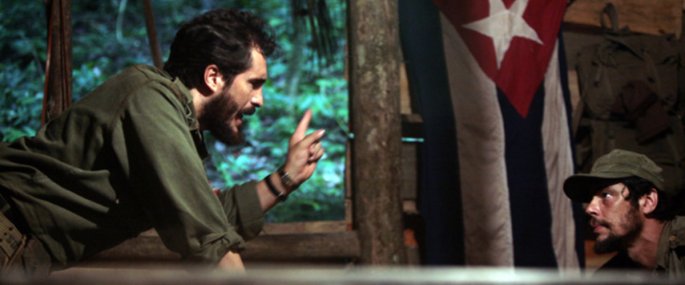
Part One juxtaposes Che’s efforts to remove Batista from power in Cuba in 1958 with him addressing the United Nations in 1964 and in doing so we see Che in his element, putting into practice guerrilla warfare tactics, and we see Che the superstar espousing his beliefs to the media in New York City and the international community at large. At first, the Bolivia campaign as depicted in Part Two starts off well enough with Che sneaking into the country and meeting with his fellow revolutionaries. We see them get supplies and train in preparation for the task at hand. However, the country’s Communist party refuses to support an armed struggle, especially one led by a foreigner. The support of the peasants, so crucial in Cuba, is lacking in Bolivia, making food hard to come by. A feeling of dread creeps in as government troops gradually close in on Che, cutting off any avenue of escape.

Soderbergh maintains an objective stance by refusing to show any close-ups of Che. We always see him from a certain distance and often grouped with others. During the battle at El Uvero on May 28, 1957, Soderbergh conveys the noisy, chaotic nature of combat as men are seemingly wounded at random but there is never any confusion visually about what is going on. Twice during the battle, he takes us out of it by having a voiceover by Che where he espouses his philosophy of guerrilla warfare. With a widescreen aspect ratio, Soderbergh opens things up in Part One and this is particularly evident during the battle scenes. In Part Two, this all changes, as the smooth camerawork is replaced with hand-held cameras and a more standard aspect ratio which creates a claustrophobic feel and look. The long takes and deliberately slow pace may frustrate some expecting a more traditional biopic but I found it a welcome change from the cookie cutter mentality of most Hollywood depictions of history.

During the Cuban campaign it is evident that Che is very much a man of the people, whether it is making contact with and befriending peasants that he comes across in the jungle or treating a wounded comrade. However, Che eschews character development in favor of showing the nuts and bolts of a revolution. As Che says at one point, “A real revolutionary goes where he’s needed. It may not be directly in combat. Sometimes it’s about doing other tasks … finding food, dressing wounds, carrying comrades for miles … and then, taking care of them until they can take care of themselves.” The film takes this philosophy to heart by showing the day-to-day activities of Che and his fellow revolutionaries. We see him dressing wounds, the wounded being carried through the jungle and strategizing with his men and Fidel Castro (Demian Bichir).

Benicio del Toro effortlessly becomes Che and tones down his tendency to sometimes resort to Brando-esque acting tics (see The Way of the Gun) and plays the iconic revolutionary as a man confident of his own convictions. He conveys Che’s sharp intellect with his eyes and also does an excellent job with the physical aspects like his recurring asthma that constantly plagued him. Del Toro provides us insight into the man’s character through attitude, behavior and the way he acts towards others.

24a125_34547ac222f04702b5e68cb83dd8629cChe is ultimately a study in contrasts. What worked in Cuba did not work in Bolivia. Soderbergh’s film illustrates the differences. In Cuba, the revolutionaries were able to get the trust and support of the peasants while in Bolivia they feared the rebels. It must also be said that Castro played a key role in the success of the Cuban revolution and his absence in Bolivia, the galvanizing effect he had, is sorely missed. With Che, Soderbergh has created an unusual biopic that does its best to not try and manipulate you into feeling one way or another about the revolutionary. Instead, it shows two very different examples of the man’s philosophies put into practice and how they played out – one a success and the other a failure. Che was a polarizing historical figure long before this film came along and will continue to be long afterwards.