Amazon Prime’s Goliath: Season 3

Amazon Prime has released season 3 of their excellent original series Goliath and I pretty much binged the thing in one night. While the first entry set the stage for a darkly funny, deeply emotional and consistently eccentric brand of storytelling, season 2 diverged from that into the decidedly perverse and unconventional in terms of a narrative bereft of catharsis, obvious beats or satisfactory resolution. That’s not to say it wasn’t good, it was just… different. This third season both continues to trailblazer those off colour paths and also gets back to the roots of what made the first season such an engaging genesis.

Billy Bob Thornton’s Billy McBride takes on the case of his old buddy (Griffin Dunne) whose wife (Sherilyn ‘Audrey Horne’ Fenn) has a deep connection to their past and has now died under mysterious circumstances. This eventually pits McBride and his trusty motley crew up against the deranged Blackwood clan and their acolytes, an elite society of billionaire ranchers who are corrupt to the bone, willfully malicious and have been stealing the county’s water for their own gross financial gain. Led by brother and sister Wade (Dennis Quaid) and Diana (Amy Brenneman), they and their peeps prove to be a titanic adversary for Billy & Co. and the story here feels fresh, funny, immediate and fully fleshed out right down to the smaller roles and one episode arc players. I love this show because it doesn’t just cast ‘of the moment’ stars, attractive young blood or flavour of the month hotshots like a lot of other stuff, it delves back into the collective cinematic and televised past and pulls out some truly talented people that we maybe haven’t seen onscreen in the past decade or so but certainly haven’t forgotten and recall with a smile as soon as they show up. As such we get excellent work from folks like Beau Bridges, Illeanna Douglas, Julia Jones, the great Graham Greene, Monica Potter, musician Paul Williams and season 1 villain William Hurt who comes back with a nasty vengeance here.

Thornton rocks the McBride role, cultivating the jet black humour, deadpan self deprecation and fiercely guarded but incredibly soulful empathy that make the character come alive and the performance stick in your mind. Nina Arianda returns as ruthless scene stealer Patty Solis-Papagian (pronounce it wrong and I wouldn’t wanna be you) and steals scenes harder than she ever has, this girl whips up Emmy worthy work and makes it seem effortless. The season focuses a lot on the villains and their struggles as well as their wicked acts, particularly Quaid and Brenneman who are both flat out phenomenal. There’s this kinky, just plain wrong aesthetic between the two of them but they never seem like moustache twirlers or one note monsters, always complicated and conflicted. You get a sense of region, of history and of real human strife on their side of things and I heartily applaud all artists involved for the work put in to invoke such a world and such reactions from me. The narrative is airtight to this season too and feels as conclusive as a hammer blow while still leaving plenty of room for more story and keeping one ever present, omniscient antagonist in the wings for more storytelling later. Also kept up is the strange, experimental and increasingly surreal style, and you haven’t seen anything until you’ve seen Dennis Quaid take peyote and dream that he’s singing Conway Twitty’s Some Say Love to an auditorium packed with other Dennis Quaid’s. He’s got some pipes too. All in all this is such a rich, unique and invigorating piece of storytelling and I hope they never cancel it.

-Nate Hill

Clive Barker’s Hellraiser

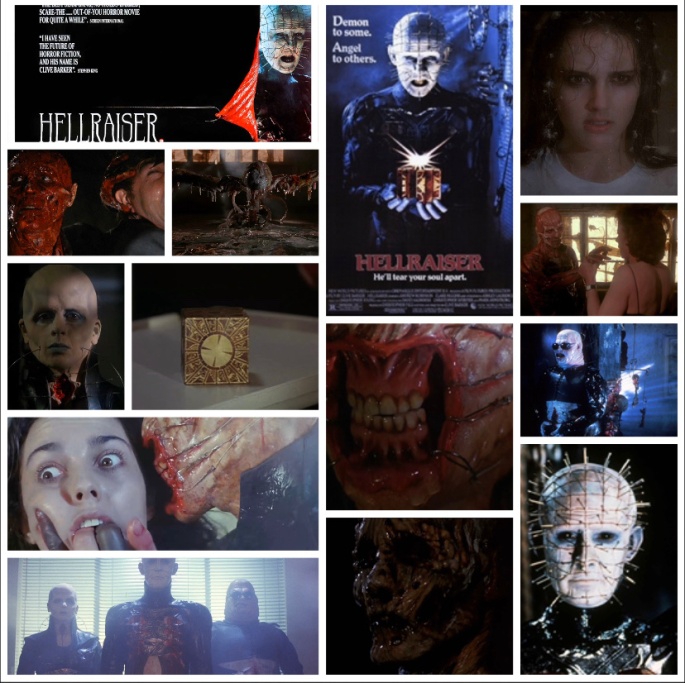
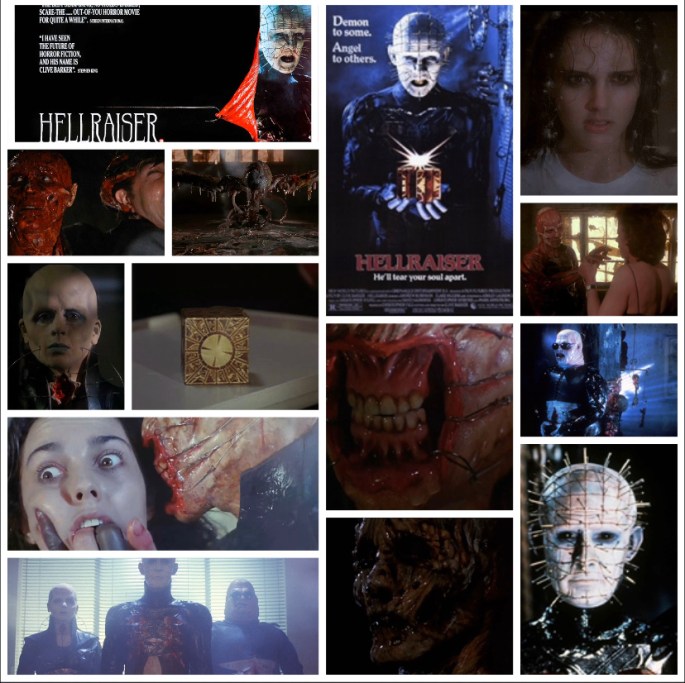
“Jesus wept!” exclaims a character in Clive Barker’s Hellraiser before being ripped to shreds. No kidding, and I bet David Cronenberg did too. Explaining the plot of rgis film to someone who hasn’t seen it can be vague and pretty bizarre. “Magic evil Rubik’s cube has the power to summon mutilated, sadomasochist beings from hell who inflict both pain and pleasure by maiming, mauling, dismembering and otherwise dispatching those who called for them in the most inventively graphic ways possible.” Well it is that, but you kind of have to watch it all unfold yourself to see how cool it actually is or it just sounds weird.

Many horror films start by showing a family moving into a house that has a dubious past and so does this but where it goes from there will floor you. Andrew Robinson (cast against type here as a meek dude) is a chatty yuppie who moves his new wife (Claire Higgins) into a family inherited home for some relaxation. Never mind that there’s maggots and decrepitude everywhere, the real danger is the lingering ghost of his reckless alpha male brother Frank (Sean Chapman in a role originally intended for Mickey Rourke which I would have paid big money to see) who got too curious with aforementioned Rubik’s cube and started all kind of trouble. Before too long his half dead corpse is resurrected, Robinson’s young daughter (Ashley Lawrence) becomes involved as do the inter-dimensional Cenobites and yes, all kinds of hell is raised.

It’s cool to see the impact that one film can have on so much in culture after it, the ultra gory practical effects, kinky costume design and overall distinct vibe here has obviously gone on to influence everything from Jacob’s Ladder, Event Horizon, Beetlejuice to countless video games and graphic novels. Pinhead is now an iconic character to the point where people know him before they do the film but back here he wasn’t even called Pinhead, credited simply as ‘Lead Cenobite.’ Every infamous legacy has its beginnings though and this is quite an arresting, gruesome, atmospheric and deliberately weird piece of cosmic horror. The performances are all sensual 80’s melodrama which just somehow works, the score is a bombastic orchestral overture courtesy of Christopher Young but it’s really the special effects that win the day here. Whether it’s a corpse crawling across the floor with no skin, razor sharp meat hooks ripping though flesh, living room walls opening up into other worlds or the startling, otherworldly design of the Cenobites themselves, this is one visually gorgeous piece of horror and looks even better on Blu Ray.

-Nate Hill

B Movie Glory: Ripper – Letter From Hell

The early 2000’s saw a lot of MTV crowd, ensemble piece slasher flicks try and imitate the success of the Scream franchise. Some are great (Urban Legend) and some, like Ripper: Letter From Hell, fall short of being anything but vaguely entertaining distractions.

AJ Brook plays the survivor of a previous slew of killings studying the psychology of mass murder under a creepy but well researched college professor (Bruce Payne). Suddenly a new killer emerges who uses the crimes of infamous Jack The Ripper as a baseline and commits horrific copycat murders. She finds herself in the crosshairs of this fiend while her friends all start falling victim one by one and a mysterious homicide cop (Jurgen Prochnow) from her past begins to open new investigations.

This is some bottom of the barrel stuff, not gonna lie. Payne and Prochnow genre pedigree amongst the newbie teenage cannon fodder but even they seem too melodramatic for this. I will say it has a cool atmosphere though, and anything to do with the Ripper legacy will always be fascinating.

-Nate Hill

Todd Phillips’ Joker

Gotham City, 1981. Sanitation services are on strike, leaving piles of garbage curb side. Mounting inequality and rampant poverty poison the collective climate and spur on bubbling unrest. Billionaire Thomas Wayne (Brett Cullen) makes the kind of callous comments on live tv that don’t help anyone’s situation much. “Is it just me or are things getting crazier out there?” laments Joaquin Phoenix’s Arthur Fleck. He’s more right than he knows, both in terms of ‘out there’ and closer to home. Todd Phillips’ Joker is a brilliant, flammable, uncomfortable, thought provoking, beautifully crafted piece not only on its own terms as a standalone character study but also as part of the Batman universe as well.

Arthur lives with his ailing mother (Frances Conroy) in a shit box apartment, works as a street clown for an agency that resents him, sees a dour social worker until funding is cut along with access to his medication. He idolizes a funny-man TV talk show host (Robert Deniro in scenery chewing mode) until the guy cruelly mocks him for laughs. Arthur is as close to snapping as the entire city around him and one can almost use his gradually disintegrating grasp on reality and coherence as a barometer for that of Gotham itself and the world outside the cinema that we know too. Phoenix is indescribably good in the role, shedding pounds and growing a shaggy mane to portray this beyond iconic antagonist and giving us a portrayal that is so well built up, so scarily developed that by the time he has incarnated into the full fledged clown prince of crime we feel like running for the door in terror. But he’s also madly human too, a man repeatedly stomped down by the forces around him until a combination of stress, untreated mental illness, hurt and humiliation push him over that edge in a startling act of violence. Joaquin is the star here but Phillips also populates his Gotham with a variety of faces both new and familiar including Douglas Hodge, Zazie Beets, Brian Tyree Henry, Josh Pais, Bill Camp, Shea Wigham, Glenn ‘The Yellow King’ Fleshler and more.

So, about that elephant in the room. I don’t usually like to address this kind of thing in my reviews but this film has inexplicably whipped up a hilariously misguided fever of opinions, so read loud and clear folks: The Joker is a comic book character. This is a film. The way he’s written here is as a mentally ill victim of an would be standup comedian who is pushed to the brink, left to stew in his own mind as well as a horrifying cycle of abuse and finally loses it. This film in no way glorifies, condones or puts lone wolf violence onto a pedestal and if you think otherwise than you either haven’t seen the film or gravely misunderstood it’s themes. This maniacal, dogmatic, woke-a-cola nonsense has no business here and those peddling it should be embarrassed of themselves, shut both their mouths and their laptops, go into the corner and count to ten. Got it? Good.

Philips has created quite the vision of Gotham and The Joker here, drawing inspiration from Martin Scorsese’s work, lovingly observing key touchstones of the Batman universe and adding his own stylistic flairs that help this thing do a dance all its own. This is not a crowd pleaser or a pleasant experience though. Gotham has none of the Hammer aura of Burton or Broadway kitsch of Schumacher, but is simply a weary, dirty, worn out avatar for late seventies New York with just a tad of 30’s/40’s atmosphere present in the soundtrack choices and a terrific cameo from Charlie Chaplin. Phoenix owns the film and can’t really be compared. I love every Joker portrayal so far in cinema (yes even Jared Leto) for a host of different reasons and Phoenix adds another incendiary notch to the belt here with his psychologically shredded howl of a performance. Add to that gorgeous, gritty urban cinematography by Lawrence Sher, stunningly grimy and beautifully lit production design by Mark Friedberg and a surprisingly ethereal, skin crawling score from Hildur Guanodóttir and you’ve got quite the package. One of the best films of the year so far.

-Nate Hill

Hidden Gems: Brad Anderson’s Stonehearst Asylum aka Eliza Graves

Ever heard the expression ‘inmates running the asylum?’ Brad Anderson’s Stonehearst Asylum has, and quite literally spins a terrifically gothic horror yarn for the ages around it, packed with stars, ideas, twists, beautiful scenery and a wistful aesthetic reminiscent of old Hammer horror stuff. Now if the premise sounds like a final act twist let me assure you I haven’t spoiled anything that the trailers don’t cheerfully announce early on. This film is so bonkers it starts at level ten madness and only ratchets the lever up from there. But don’t get the idea that this is a raving madhouse without story or subtlety either, for all its wanton spectacle there are well drawn human beings with something to say behind these walls.

Based on a short story by Edgar Allen Poe, Jim Sturgess stars as an apprentice Alienist shipped off to the austere Stonehearst Asylum in rural Britain (actually stunning Bulgarian countryside) to learn the trade. Once there he discovers that the facility’s real staff have been overthrown by the patients in a violent revolution and now a cunning madman (Ben Kingsley doing a sly riff on his Shutter Island character) is impersonating the actual superintendent (an icy Michael Caine) and calling the shots. This is apparent right off the bat since the place seems to have no security protocol in place and oddballs of all shape and size cavort freely about the manor. One patient who doesn’t seem to be a hopeless basket case though is the mysterious Eliza Graves (Kate Beckinsale), a girl with a shady past and secrets up her sleeve.

Director Anderson is an unsung horror thriller maestro with an incredibly solid track record including The Machinist, Session 9, The Call, Vanishing On 7th Street and now this which is a proper old school horror flick like you don’t really see anymore. This is a film that throws in subplots simply to have them there, amps up simple set pieces until they are unnecessarily but wonderfully cacophonous and is just overall in love with storytelling. The cast are all clearly having the time of their lives especially Kingsley who injects some genuine pathos into a role that could come across as high camp in someone else’s hands, exploring the notion of what would happen for real in this outlandish scenario. We also get familiar faces like Brendan Gleeson, Jason Flemyng, Christopher Fulford, Sinead Cusack and others. Standouts include newcomer Sophie Kennedy Clarke as a scene stealing patient with a penchant for childlike melodrama and David ‘Professor Lupin’ Thewlis as a particularly scary homicidal resident. You’ve kind of gotta employ considerable suspension of disbelief here, this is a film where spectacle, atmosphere and incident dance over the graves of logic and continuity, but there’s a rich tale to be absorbed with many fine performances, gorgeous cinematography and a creaky gothic vibe. Highly recommended, you can find this streaming on Amazon Prime.

-Nate Hill

Halloween 6: The Curse Of Michael Myers – that glorious Producer’s Cut

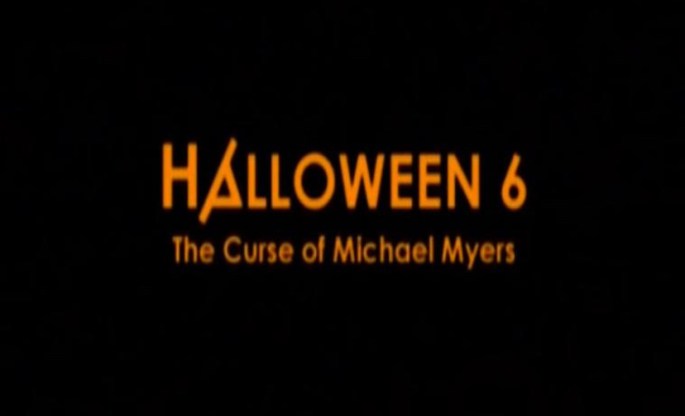
Halloween 6: The Curse Of Michael Myers was one curious and troubled production, living up to that title and then some. Bashed on release, fans heard hushed rumours of the fabled ‘Producer’s cut’, a much different take on the story with numerous alternate scenes, augmented kills and a brand new score by Alan Howarth. I finally got a chance to snag a Blu Ray of it from amazon (for six bucks no less, I’d get on that now if you’re interested) and after checking it out last night I’m elated to say it’s pretty much a whole new film as well as one of the best of the sequels, between the changes to story and the beautiful picture restoration.

Here’s the cool thing about Halloween 6 for me: while the rest in the franchise all sort of come as stylistic and narrative package deals/double feature type things with one another, this really stands on its own. The original and 2 happen on the same Halloween night and both have Carpenter’s stamp plus Laurie Strode. 4 & 5 feature Danielle Harris’s Jamie Lloyd and bear similar approaches. H20 and Resurrection both have an early 2000’s Scream/MTV vibe and an older Laurie Strode. Rob Zombie’s two versions were intrinsic to one another and even the 2018 reboot is getting some three’s company fellowship in the coming years. But 6 is really a singular, unique vision and stands like a lighthouse of originality albeit still bearing the framework and blueprint of the Myers legacy.

Michael is back and more violent than ever as he hunts down Jamie (J.C. Brandy stepping in for Danielle Harris) and in turn pursued by the now semi retired Dr. Loomis (beloved Donald Pleasance in his final franchise appearance), his colleague Dr. Wynn (Mitchel Ryan) and the now grown up Tommy Doyle, played by a young Paul Rudd in a turn that can only be described as a knowingly campy harbinger of his then untapped comic talent. Michael shows up in 90’s Haddonfield on that night of nights to cause quite a bit of trouble for the family living in his old house, but his ultimate endgame is to find Jamie’s baby, who somehow holds the key to… something.

So this is known as that Halloween film that betrayed the legacy by explaining away Michael’s evil with the inclusion of a spooky pagan cult that worships the power of ancient Celtic runes and thereby both gives him his power and uses him for their agenda. Not even Rob Zombie was that brazen with his extended Smith’s Grove childhood sequence. I have no real problems with the direction they went here though. Maybe it’s because I’m a sucker for spooky folk horror, maybe it’s the excellently atmospheric Howarth score that sells the weirdness, who knows. I suspect it’s the big, unwieldy and multi-canon best that this franchise has become over the years though. There’s been a few restarts, do overs, lapses in overall logic and liberties taken with continuity to allow new ideas and the paving over of them next time someone gets out the crayons. What’s wrong with a Myers timeline in which he’s controlled by a spooky Pagan cult whose leader looks like Jack The Ripper dresses by Johnny Cash’s tailor? It’s cool, it’s well done and in terms of camp, style and music it holds a candle and then some to other entries in this run. This Producer’s Cut is the way to go though mind you, I’ll probably toss my old DVD and only ever revisit this cut again.

-Nate Hill

B Movie Glory: Charles Winkler’s Disturbed

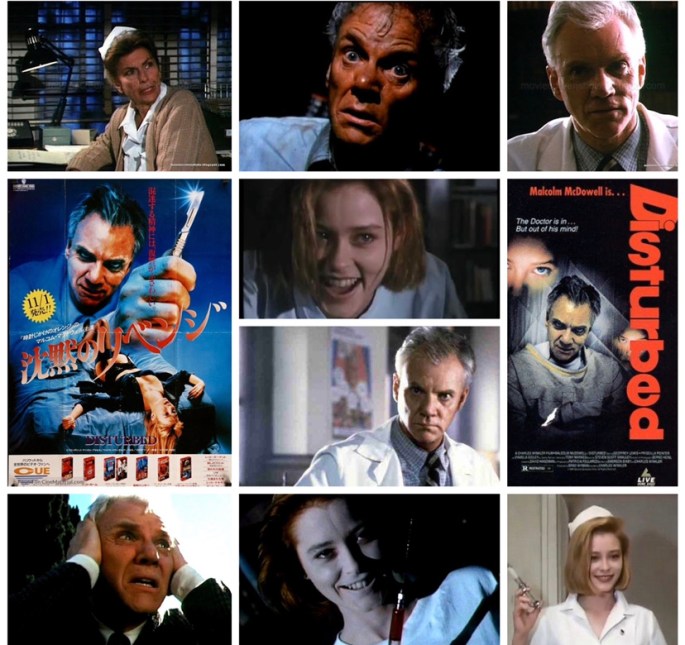
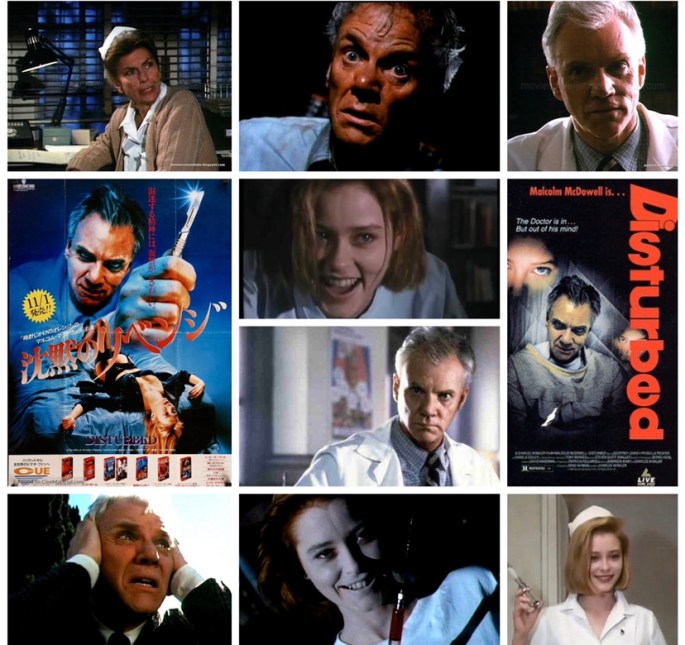
The horror genre has this hilarious unwritten rule that the head doctor of any asylum featured in a narrative simply must be far crazier than any of the patients and Charles Winkler’s Disturbed definitely checks out in that category. Malcolm McDowell stars here as the psychiatrist in question, an amoral basket case with a nasty habit of snatching female patients from their beds at night, drugging and raping them until one such atrocity ends in death, and he seeks to cover up his nocturnal escapades. When one would be victim (Pamela ‘Teresa Banks’ Gidley) takes a fatal plunge off the roof while running from he thinks he’s got away with it… until she literally comes back and starts haunting him. This allows McDowell to do his trademark loony bin routine and slowly lose it bit by bit, chewing more and more scenery with each new scene. Is he nuts? Is her ghost really there? How much were their paycheques to star in this trash? Not to be a hard ass but this really is sleazy, bottom of the barrel shock value trash and the only real reason to check it out is, naturally, McDowell. His Dr. Russell is truly an unhinged creation and it’s fun watching him between unorthodox group therapy sessions, whacked out hallucinations and his eventual grisly comeuppance. The film itself is unabashed bottom feeding swill but there’s other familiar faces like Irwin Keyes, Priscilla Pointer, Clint Howard and Geoffrey Lewis to spice things up. The highlight of the film is when a nurse tells McDowell he needs professional help to which he triumphantly replies “I AM professional help!!” and starts cackling like a witch. Sure, bud.

-Nate Hill

John Carpenter’s Cigarette Burns

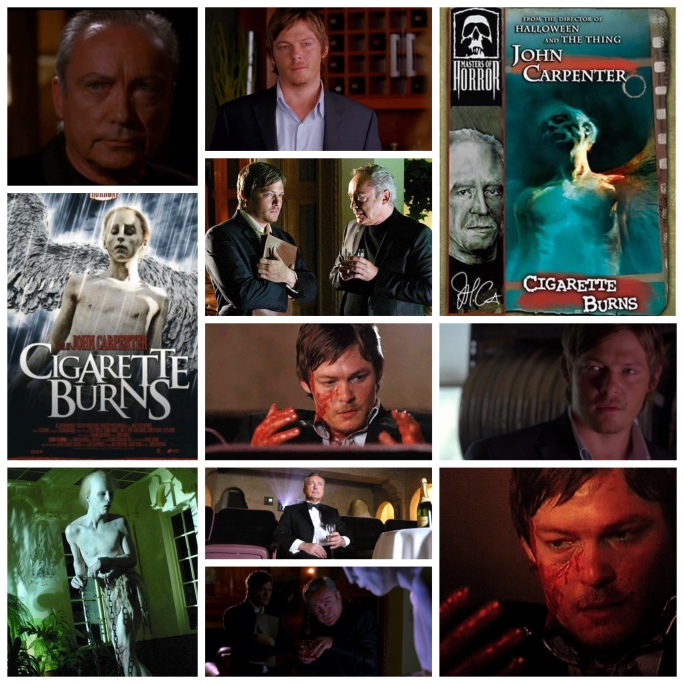
What if there was a film out there that was so destructively evil that it had the power to end the world? (And no it’s not The Master Of Disguise). John Carpenter’s Cigarette Burns explores this in grisly, eerie fashion for one of the many varied and interesting horror features produced by Showtime’s limited Masters Of Horror run.

Norman Reedus plays a moody private investigator with a dark past hired by Udo Kier’s sinister rare film collector to track down and bring him ‘La Fin Absolut du Monde’, a fabled piece of celluloid that is apparently so disturbing to watch it sends audiences into homicidal mania and subsequently causes the end of all things. Cool, huh? It’s wicked great with two creepy central performances from Norman and Udo who just ooze cult charisma and fit well into Carpenter’s spooky palette.

I particularly enjoyed the skin crawling appearance of a ‘willowy being’ (Christopher Redman) who is supposedly some sort of celestial creature that was tortured to bring about some of the film’s cursed imagery. Reedus’s character is given a ne’er do well aura and practically radiates bad luck as we see ongoing flashbacks to a tragic relationship and sense that he’s headed purely in the wrong karmic direction in looking for this film. Kier has demented fun as the weirdo film aficionado and if you think you’ve seen everything just wait for the sight of him feeding his own bloody intestines through a film projector with a satisfied smile on his face. Yeesh. You won’t find this brought up when discussing Carpenter’s usual stuff because it’s technically a TV episode but it is feature length and does have his trademark dark suspense and macabre inventiveness all over it, and is great fun. Oh and pay attention to what the titular cigarette burns refers to because it’ll come in handy for movie trivia at the pub.

-Nate Hill

John Carpenter’s In The Mouth Of Madness

Any enthusiastic reader will attest to the power of books, how they can transport you to other worlds and open doors to new realities. John Carpenter’s In The Mouth Of Madness takes that idea and whips it up into something terrifyingly literal, deliciously meta, relentlessly gruesome and thoroughly addictive for any horror fan whose tastes are rooted in pop culture.

It starts off with a crazed Sam Neill being shunted off to a remote asylum, raving like a loon about things that go bump in the night. This is cool because inherently Neill seems like a collected, pragmatic fellow onscreen so it’s especially disturbing watching him come apart at the seams and go ballistic. As he tells his story to a state appointed shrink (the great David Warner) so too do we learn of how he was once a hotshot insurance investigator hired by a publishing tycoon (Charlton Heston in an awesome extended cameo) to find their golden goose horror author Sutter Cane, who has gone missing. Cane is of course a spiritual avatar for Stephen King here but King also exists in this universe because they proudly and hilariously proclaim that Cane outsold him by a landslide, the first little meta touch of many. Neill heads off to Hobbs End, a town in one of Cane’s books that doesn’t seem to actually exist… until it does. He finds a whole lot there including Cane himself, now gone mad and played by ever intense scene stealer Jurgen Pröchnow in a devilish turn.

I’m not sure why this didn’t make as big a splash as some of Carpenter’s flagship works but for me it’s one of his very best. As Neill realizes the kind of chaos that his visit to Hobbs End will cause the audience gets to experience a medium shattering dose of immersive horror that breaks the boundaries of screens in front of us and feels both hilariously and eerily alive all it’s own (think Last Action Hero in the horror realm). That’s not to mention some truly spectacular special effects to almost rival Carpenter’s The Thing and sly, tongue in cheek performances from all involved including Julie Carmen, Peter Jason, Bernie Casey, Willhelm Von Homburg, Frances Bay and John Glover as the freaky deaky asylum administrator. You can’t ask for much more from a horror film as far as I’m concerned; reality bending narrative, gore to spare, atmosphere in bushels and humour as well. Grab the Shout Factory Blu Ray if you can because the single DVD release is a grainy, cropped affair and this film deserves to have all its gristle, guts and Lovecraftian glory shown in HD. Horror classic.

-Nate Hill

Mind At War: Nate’s Top Ten Films on Mental Illness

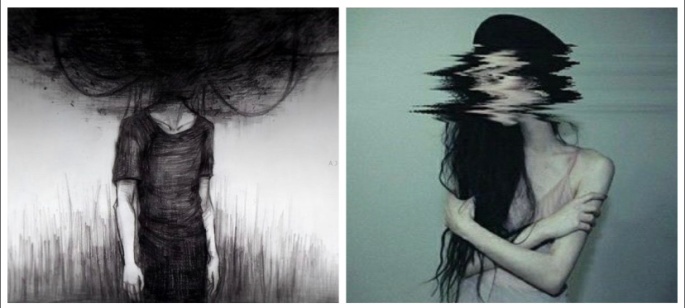
The subject of mental illness is one that’s close and important to me as I myself am one of the afflicted, and it’s impossible to ignore that the treatment of it by Hollywood, particularly in formative years, hasn’t been so apt. Don’t get me wrong, I love stuff like Me, Myself & Irene or Split as entertainment but in terms of accurately representing the conditions that beset human beings, they haven’t been so hot. There are those films and filmmakers out there that strive to educate and enlighten or even just to craft an effective thriller or comedy and still stay true to real life, doing important work for the collective awareness and making terrific art/entertainment in one shot. Here are my personal top ten favourites!

10. Geoffrey Sax’s Frankie & Alice

Multiple personality disorders are popular in Hollywood but there’s a tendency to mock, sensationalize or tell a ‘real life’ story that’s later proved as fraud. This one showcases Halle Berry in a galvanizing dual performance as a go-go dancer afflicted by two very different internal identities and finding her life in splinters as a result. When a kind, compassionate psychiatrist (Stellan Skarsgard) makes it his mission to help her get back on track it becomes apparent just how challenging and horrific it must be to endure such a thing.

9. Dito Montiel’s Man Down

I heard this one sold one single theatrical ticket in the UK and didn’t fare much better here, getting squeaked into a quiet streaming release. It’s too bad because it is one haunting drama about PTSD featuring an implosive, incredibly intense performance from Shia LaBeouf as an ex marine who can’t psychologically reconcile his experience and is lost amongst his own trauma. Terrific work from Kate Mara as his wife and Gary Oldman as an army counsellor too.

8. James Mangold’s Girl Interrupted

Likely the most accessible and mainstream story on this list, Mangold’s look at a mental care facility for girls in the 60’s gets a superficial rep in some circles but I find it to be every bit the rewarding drama, ensemble piece and explorative journey that those who champion it say. Winona Ryder plays a wayward girl whose self destructive behaviour lands her there but it’s Angelina Jolie as a fellow patient diagnosed with borderline personality disorder that both anchors the film and provides it with a wildly unpredictable streak.

7. Martin Scorsese’s Shutter Island

This is of course a big old elaborate mystery film with a gigantic cast, many red herrings, tons of subplots and all kinds of stylistic fanfare. But if you look past all that there’s a harrowing and very realistic portrait of minds irreparably damaged, between Leo Dicaprio’s PTSD afflicted ex soldier and Michelle Williams in a haunting turn as his deeply sick wife. The film overall is a tantalizing guessing game and broadly covers the thriller board but the final act brings it right down to earth for a grounded, grim finale showcasing the brutal honesty of these illnesses and the heart wrenching tragedy they beget.

6. Terry Gilliam’s The Fisher King
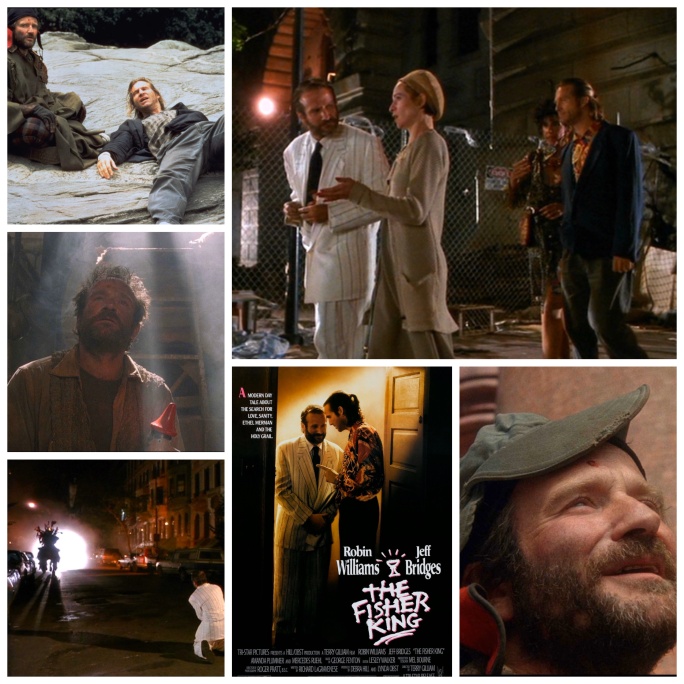
Robin Williams gives one of his best performances as Parry, a once successful professor of medieval history who lost his mind following the death of his wife and now wanders the streets of NYC, homeless. Jeff Bridges is the radio DJ who befriends and tries to understand him and their relationship carries the film. So to does Gilliam’s knack for surreal visual storytelling, letting these fantastical creations run wild and giving us a glimpse into Parry’s damaged but fascinating mind.

5. Brad Anderson’s The Machinist

Christian Bale’s Trevor Reznik hasn’t slept in a year. Guilt, extreme weight loss and delusions are just the start of his problems. This is billed as and feels like a thriller but I think that’s deliberate on director Anderson’s part to put us in the hot seat next to Trevor, to make us feel the same paranoia and delusions of persecution he does. The atmosphere here is almost suffocating, the score a muted tangle of busted nerves and Bale’s performance something just this side of unearthly. When it all comes together and we see why he is the way he is it’s deeply sad but makes a kind of terrible sense and gives the film a final stab of emotional weight.

4. Debra Granik’s Leave No Trace

PTSD is only vaguely hinted at in this beautiful father daughter drama but it’s there in every frame, in every mannerism of Ben Fosters masterful performance. Him and newcomer Thomasin Mackenzie achingly display a family dynamic that has been set off balance by his illness, and the wedge it has driven both between them and between him and ever living a normal life again. This is a restrained yet heartbreaking film that gently unpacks its themes with kindness and compassion, letting a devastating final scene bring the whole point home heavily but somehow lightly in the same note.

3. David Cronenberg’s Spider

Ralph Fiennes give a focused, intense turn as the titular individual, a man released from a mental care facility and relegated to a London halfway house where all the scrambled and tumultuous memories of his past come tumbling down through the scattered web of his broken mind and into the present. Recollections of his parents (Gabriel Byrne and Miranda Richardson) are somehow shrouded from himself, by himself and as he tirelessly works to regain his sanity, he slips further away from it. Cronenberg uses shadows, dimly lit alleys and creaky, barren rooms to show how this character has been cast away from his own perception and wanders about like a lost soul.

2. Bill Pohlad’s Love & Mercy
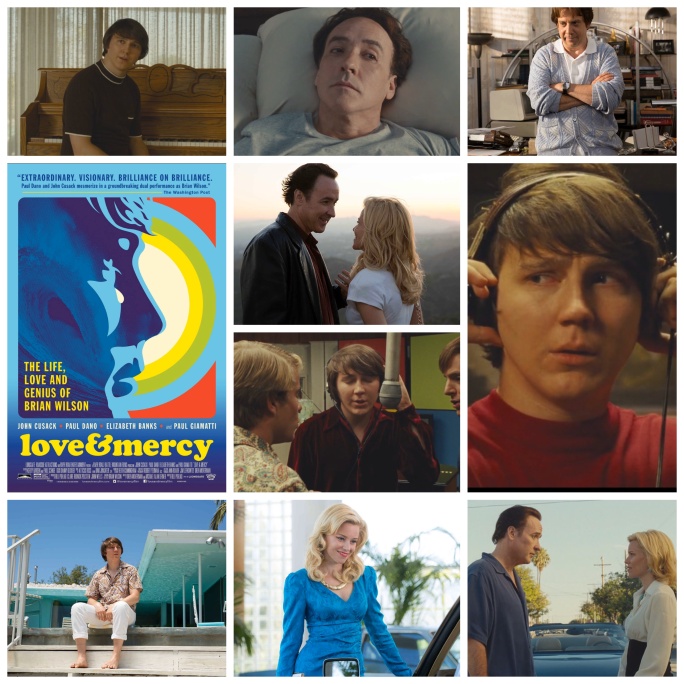
The life and times of Beach Boys pioneer Brian Wilson are explored here, namely at two important junctures in his life. Paul Dano plays him younger, at the height of fame and success but poised on the cusp of a psychotic breakdown after stress and an unhealthy relationship with his abusive father (Bill Camp) reach a fever pitch. Decades later John Cusack embodies a much older Wilson, stuck under the tyrannical yoke of an evil, manipulative psychiatrist (Paul Giamatti) until he meets the love of his life (Elizabeth Banks) and a chance at a fresh start along with her. The scene of Dano putting recording headphones over his ears and closing his eyes in horror as he hears voices is one of the most brutally honest and realistic depictions of auditory hallucinations you can find in film. Wilson had a rough life and the film makes that very clear but it’s never ever sensationalist or exploitive and overall has a message about love, light and working endlessly to overcome any demons or struggles thrown into your path.

1. Kasi Lemmons’ The Caveman’s Valentine
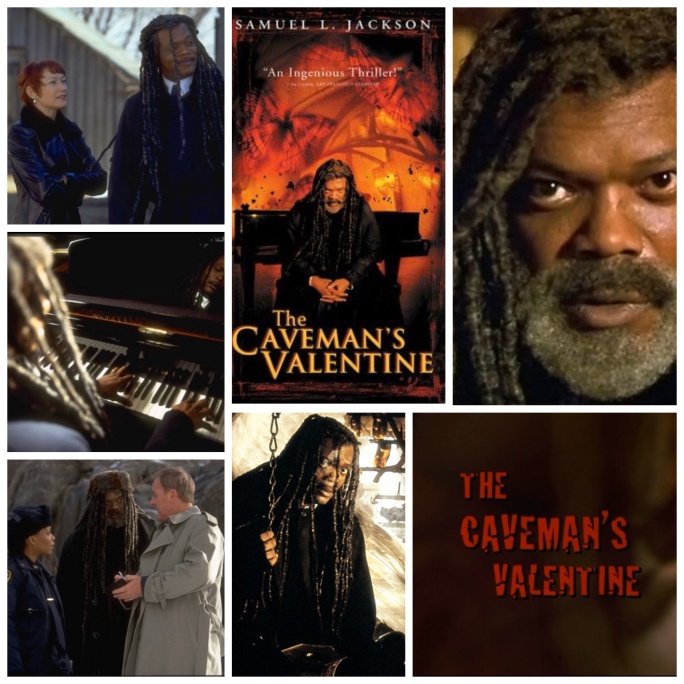
Samuel L. Jackson gives a career best as schizophrenic former musician Romulus, a man afflicted by terrible hallucinations and delusions to the point that when he discovers a genuine murder conspiracy no one, including his police officer daughter (Aunjanue Ellis) believes him. This film is driven by a fascinating mystery narrative that takes Romulus from his cave in Central Park into the pretentious New York art world and beyond to find a killer. At heart though director Lemmons let’s it m be a serious minded exploration of what it must be like to live like that, to be constantly sabotaged by your own mind. Jackson’s brilliant performance and Lemmons effective use of surreal, mesmerizing imagery give us a compassionate, dynamic window into this man’s mind and in turn a unique, thought provoking piece of cinema.

Thanks for reading and stay tuned for more content!

-Nate Hill