WRONG: DULL ISLAND

kong-skull-island1

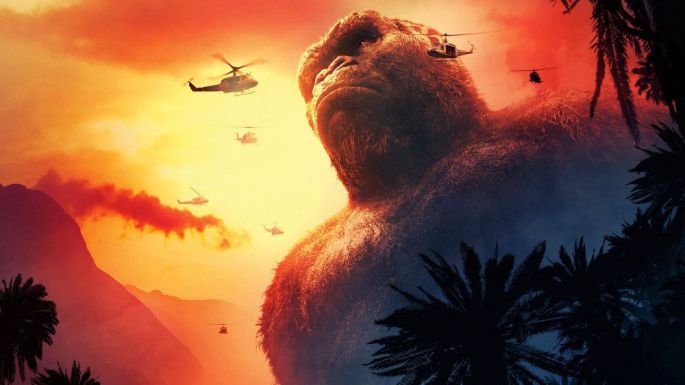
He’s bigger, he’s better and he’s back. He’s King Kong, and this time he is not going to be dragged off Skull Island and taken back to civilization to be paraded around till he takes exception to being someone’s meal ticket, breaks loose his chains and starts a city smashing rampage which ends with a barrage of bullets and a long fall to the asphalt below.

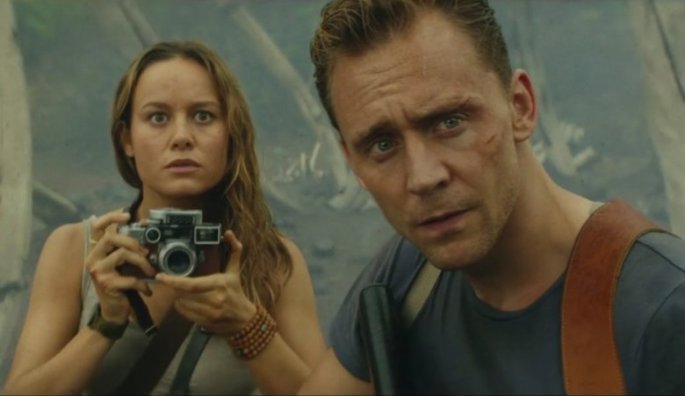
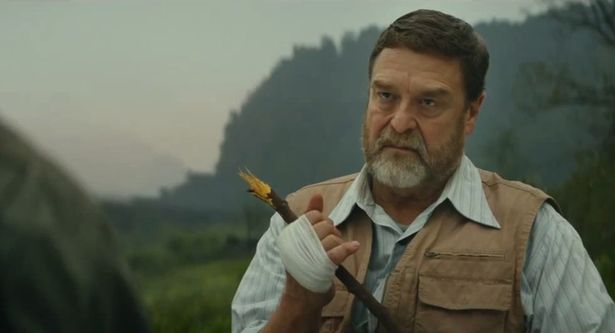
No folks, this time round Kong, now the size of a mountain, is hanging out and keeping the peace on his island. That is until and group of curious humans, led by an alleged Bear Grylls, Tom Hiddleston, Oscar winner Brie Larson who shifts between looking wide-eyed at things and taking photos, John Goodman who knows the truth is out there and Samuel L. Jackson. When you absolutely, positively have to kill every monkey in the room – accept no substitute. This group headlines a cast of who-gives-a-shit characters on a trip to Skull Island where everything is big. Even the ants apparently, but that’s a set piece too far.
Kong-Skull-Island-Trailer

The journey to the island is mandatory – montage and music stuff. Then we break through the perpetual storm clouds and have ourselves a bit of an Avatar moment as the crew marvel at the grandeur and beauty of this lost wilderness. Then Kong shows up and goes apeshit. He smashes up the Apocalypse Now homage and then walks off to enjoy a little calamari, ’cause they just don’t make bananas that big. So,  with the cast all over the place, Tom and snap-happy Brie and their group are headed from the rendezvous point, Sam and John and that guy who played Private Wilson in Tigerland, plus the other soldiers are off to get some more guns to aid in Sam’s desire to turn the King into fried funky monkey meat.

There’s a giant spider that should make Jon Peters happy. There’s the Watcher in the Water moment. The Soldier who writes to his son bites it, or gets bitten by something unusual, but we don’t get the exposition till we meet up with John C. Reilly looking like his character Gershon Gruen from The Extra Man, minus the collection of souvenirs and the no-testicle high voice. This guy though gives the film a pulse. Oh, and he was the pilot from the beginning, SPOILER! He’s been hanging out on the island with the tribe that speech forgot, waiting to come in and add some much needed comic relief. Turns out there are huge nasties that you can call whatever you want under the ground that Kong has kept from emerging to prominence and getting there own spin-off movie.
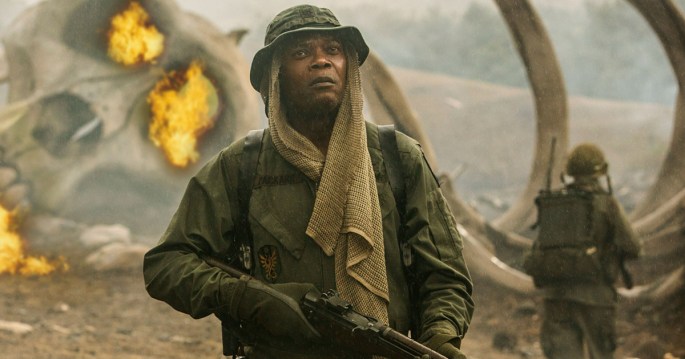
10-apocalypse-now-kong-skull-island_w1200_h630

This task used to be in the hands of more Kongs, but there is a ‘big one’ of these things that lay waste to them. Now Kong is the only one left who can keep cool, sit tight and keep the creatures in there holes. Of course this film falls into the cash-cow category. They brought back Godzilla, now they make a Kong that’s to scale, in order for the pair to have a decent scrap. But sadly it is a joyless ride. Predictable, laughable, with (and I’m quoting a prior review I’ve read) cardboard cut-out characters that are simply there to fill in the time between Kong and his monster-bashing bits. Heck my son started talking at least 45 minutes out from the end. This tells me that he is board out of his mind and I was with him. But I tried to hang on. I did not fall asleep like I did after the first fifteen minutes of the Conan remake. I have since completely avoided the try-again versions of Clash of the Titans, RoboCop, Ben Hur, Point Break, Total Recall as so on and so forth.

There is a line from James Ivory’s Surviving Picasso in which Anthony Hopkins, as the title character, refers to the methods of artists who have found fame and fortune. He says they make themselves little cake-molds and bake cakes, one after the other, all the same. He then  stresses to Natascha McElhone’s Francoise, not to become your own connoisseur. This is extremely relevant and typical of the modern Hollywood. There is little to no attempt at originality, and if there is, it takes place within a film that fits into the friendly confines of a pre-branded property.
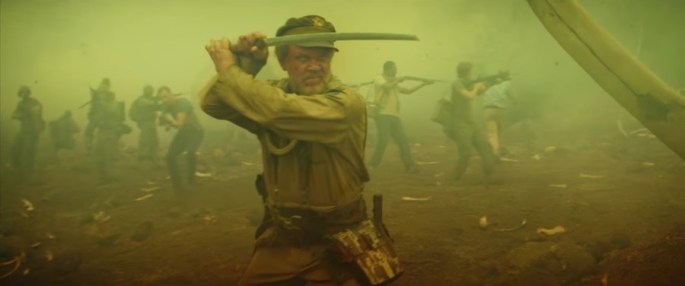
kong-skull-1

But the big ape lives and walks off into the center of his jungle home. He survives his encounter with dim-witted humanity, only to go off and fortify himself for the coming sequels and, quick note on cinematography, Larry Fong gets to send a love letter to his buddy Zack Snyder with a little samurai sword in green smoke action. We have reached that point in the history of the movies dear readers, in which the dead horse has been flogged so often that they have been whipping the bones. Soon all that will be left is the dust of said bones under foot. What are we to expect then? I’m reminded of one of Kevin Costner’s lines from his summation speech in JFK, “perhaps it will become a generational thing.” Ten years goes by  and it’ll be, “Well, time to drag a King Kong movie out again.”

Sam Jackson buys the farm much like he does in Deep Blue Sea, swiftly and unexpected, at least for him. I’m starting to believe Hollywood is looking at us the same way. Here we stand, full of confidence, about to witness triumph in whatever form it may appear. Then it becomes like the lead up to the first ever screening of the Phantom Menace. The audience was cheering, poised, ready for the planets to align in complete and utter harmony. The Fox logo. The Lucasfilm logo. A long time ago, in a galaxy far far away. Star Wars. If you watch the documentary The People Vs. George Lucas, one interviewees describes this as perhaps one the greatest moments in cinema history, then, then the film started.

I think it is a frequent occurrence today. There is so much pomp and pageantry surrounding these tent-pole movies that more often than not bad, because to achieve the same level as the hype generated is near impossible. Mind you, there are a few that defy this convention but they are few and far between.

So my favorite Kong is still the one I grew up with, the John Guillermin 1976 version.

People tell me they hate that one too. But to each his own. Kong will most likely be back in a decade after this lot. He’ll be half the size of the planet, ripped and ready to rumble against the Independence Day giant aliens when they decide to return to the best place in the universe, Planet Earth: home and the re-imagination of the adaptation of the sequel of the remake.

He’ll take a huge crap in his mighty hand and fling it at them. Oh if only…

The Dude in the Audience

flat,550x550,075,f.u1

Remembering Flight of the Navigator with Randal Kleiser by Kent Hill

Error
This video doesn’t exist

I was still a boy, and there was no such thing as a multiplex in sight the night I saw Flight of the Navigator.

I remember what was then the Russell Street theatre. A relatively new cinema built as its aged counterpart, The Strand, had slipped into disrepair. I remember the smell of the new carpet mixing with the popcorn, how the place always seemed packed, as two lines of movie-goers had to snake around both sides of the block to line up.

But it was a quiet Friday night when I went with my Mum to see Randal Kleiser’s new movie. From the poster, which was all you had to go on back in those days, it looked like one heck of a ride. Another boy meets an alien movie in the wake of the monumental achievement that was E.T. But let’s not descend into comparisons,  such is the way of the industry. Like Dante’s Explorers, Flight of the Navigator is an ingenious blending of many great elements. It begins as a movie about a family, about two brothers. Then we fall into a time travel story that sees our hero transported eight years into a future where he is presumed to be dead. This is further compounded by the fact that he has not aged a day. Thus the testing begins, a search for the heart of the mystery. The testing reveals the hero’s head is filled alien information and that he had been selected as a specimen to study on a far-flung planet in a distant galaxy. The boy is then taken by NASA scientists to be scrutinized further. This is where the boy meets alien story begins and our hero takes off inside a spacecraft in an adventure, not only to help the alien return home, but to once more, travel back in time and get home himself.

That’s a fairly vague overview I know. But I always take into account that there may yet be someone out there that has not seen the movie. That being the chase, I have no desire to spoil it for them.

After I saw the movie I wanted to write Randal Kleiser a letter, which I did, telling him what a marvelous movie I thought he’d made. I did not know where to send it, so my Dad looked up the address of Walt Disney Pictures and we mailed it together.

I know now Mr. Kleiser never got my letter, because thirty years later I got to call him on the phone and tell him just that – what a marvelous movie I thought and still think Flight of the Navigator is.

I hope you’ll enjoy our interview  you dumb dork! Buttface! Scuz-bucket! Ha-ha!

P.S. –

If you would like further information on the Nina Foch DVD or course please follow this link: http://www.ninafochproject.com/

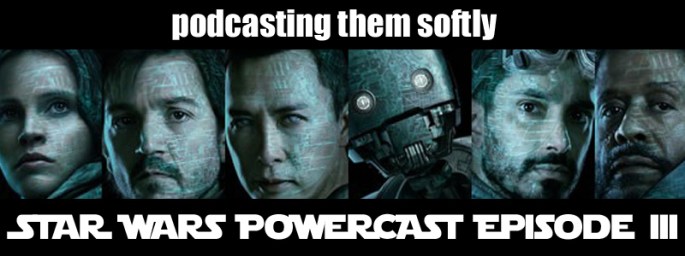
STAR WARS POWERCAST EPISODE III

star-wars-powercast-3

ATTENTION SPOILERS.  SPOILERS.  SPOILERS.  Frank and Tim FINALLY did another STAR WARS podcast.  This time we speak about the new standalone film, ROGUE ONE: A STAR WARS STORY.  We dive in deep about the emotional impact, the cinematic influences, and where Disney takes the STAR WARS brand from here!


Why ROGUE ONE is the Most Important STAR WARS Film to Date.

ROGUE ONE: A STAR WARS STORY is the most important film to enter the STAR WARS canon to date.  While the initial reaction and hype has this billed as one of the best films of the series; that’s a bit of a loaded statement.  Yes, the film is fantastic, it’s unlike anything we’ve seen from the cinematic universe before, but after the shock and awe wears down; it will still be a top tier film, but somewhere behind EMPIRE STRIKES BACK and A NEW HOPE.  ROGUE ONE is important for an array of reasons, but most importantly the films serves as a bridge between the film series as well as other mediums of the STAR WARS canon.

bail

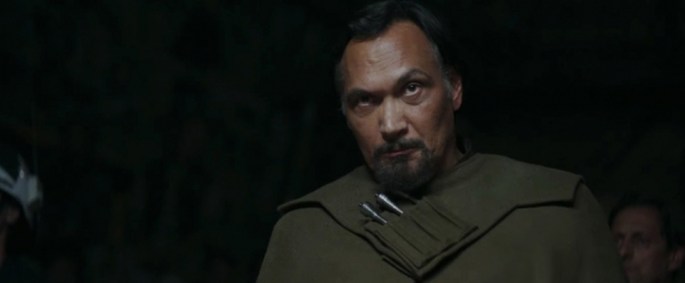
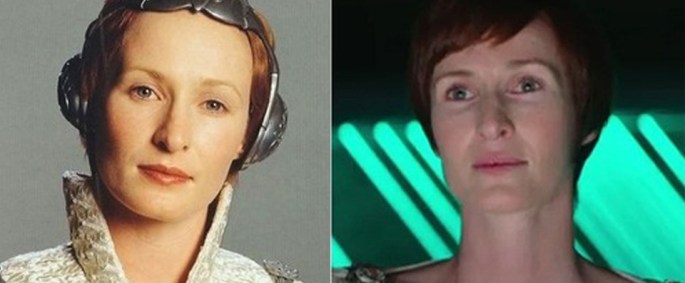
Jimmy Smits’ reprisal as Leia’s father and Rebel leader highlights a very important purpose.  Smits authenticates the prequel trilogy for those diehard fans that have disdain and immediately dismissal of them.  Smits as well as the reprisal of Genevieve O’Reilly as Republic Senator and successor to Bail, Mon Motha, legitimizes aspects of the prequels, as well as Disney further proving that they are not going to shy away from Lucas’ “controversial” trilogy.  O’Reilly would have been easy to recast, most of her scenes were cut from REVENGE OF THE SITH, and she isn’t particularly a well-known actress to the populous outside of STAR WARS diehards.  Both of these characters biggest roles can be found within the CLONE WARS series, were both parts are voiced by different actors.

Both these actors are great in their respective roles, and are given much more to do than any of us originally thought.  Smits has his most lengthy role to date, as does O’Reilly; and they are both important aspect of Disney’s bigger picture of what they plan on doing moving forward beyond the safe haven of the saga films.  Along with Vader and the CGI reconstructed Peter Cushing as Grand Moff Tarkin, the most important job these actors had was anchoring the film within the universe that so many of us hold so dear.

mothma

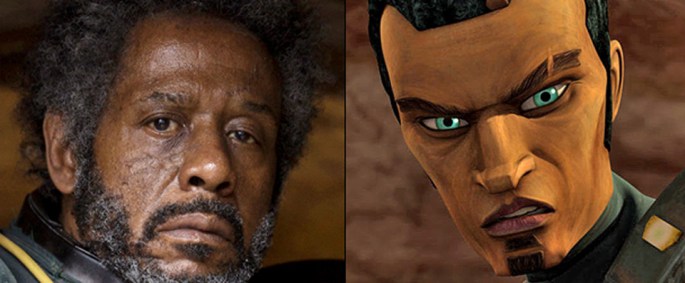
Forest Whitaker’s turn as Saw Gerrera, the Colonel Kurtz esque defrocked Rebel, might be the boldest move yet by Disney.  The origins of Gerrara lay within George Lucas’ concept for a live action STAR WARS show titled UNDERWORLD, an unproduced project that was originally announced in 2005.  Gerrera then made his first appearance in a four episode arc of the fifth season of animated series CLONE WARS.  Gerrera was a very grey shaded resistance fighter who used whatever methods possible to fight off the Separatists.

When it was first announced that Whitaker was playing a character we’ve already seen in the SW universe, rumors swirled of Captain Panaka from THE PHANTOM MENACE, Dash Rendar from the non-canonized novel SHADOWS OF THE EMPIRE.  Then it was quickly announced who he was playing, and many of us quickly booted up Netflix to rewatch the four episode arc.  So, why did Disney do this?

saw

Validity.

By doing this, Disney opens the door to make cinematic crossovers.  Bring characters to screen who we’ve seen before in novels, animated TV shows, or comics.  It was heavily rumored that bounty hunter Cad Bane was going to make an appearance in ROGUE ONE.  That ended up not being the case, but I imagine we’ll see him and other fan favorites (Ahsoka, Hondo, Thrawn) make cinematic appearances in the near future.

Lastly, the inclusion of Gerrera was a very nice and symbolic gesture to the creator, George Lucas.  In reality, Gerrera is an inconsequential character in the SW universe.  His part in the film could have just as easily had an original name with no prior connection, and it would not have lessened the impact of his character in the slightest.  For as ridiculously controversial the creator, George Lucas, has become amongst SW diehards, Disney showing him direct tribute with the addition of Saw Gerrera was an incredibly gracious gesture.  After all, without George Lucas, we wouldn’t have ROGUE ONE.

RADIOLAND MURDERS – A REVIEW BY J.D. LAFRANCE

radioland-murders_still1

Radioland Murders (1994) was one of George Lucas’ rare forays outside of the Star Wars universe and like others (Willow and Howard the Duck) it was a critical and commercial failure. Lucas seemed to be following in the footsteps of Woody Allen’s Radio Days (1987) by paying homage to the heyday of radio in the 1930s before television and when it was the source of news and entertainment for millions of Americans. It was a time when The Shadow captured people’s imaginations and Orson Welles’ War of the Worlds broadcast fooled thousands into believing we were actually being attacked by Martians. It is the twilight of this era that Lucas’ film depicts.

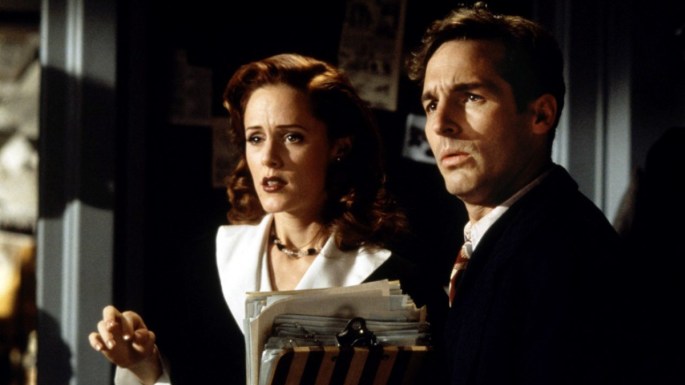
It’s 1939 on the night that WBN radio goes nationwide and the whole station is abuzz with activity. Roger Henderson (Brian Benben) is the head writer and his wife Penny (Mary Stuart Masterson) is an assistant to the director (Jeffrey Tambor). They are forced to deal with an unhappy sponsor who doesn’t like the scripts, unhappy writers who don’t like their working conditions, and unhappy actors with inflated egos. As if that wasn’t bad enough, during the opening musical number the orchestra’s trumpeter dies from a heart attack.

Soon, the station’s director turns up dead as well from an apparent suicide. However, it is revealed that both deaths are actually murders. Radioland Murders starts off as a farcical comedy and gradually mutates into a classical whodunit with no shortage of suspects and with the Hendersons out to solve the case while keeping the radio show going. Roger and Penny are married but their union is in big trouble because she caught him with another woman (the star of the station’s radio programs no less) and hasn’t forgiven him while he claims that nothing happened. To make matters worse, Roger ends up becoming one of the primary suspects and has to rush to clear his name.

Mary Stuart Masterson looks beautiful and is lit like a glamourous 1940s movie star but with screwball tendencies. However, she’s let down by the screenplay and saddled with a miscast co-star in the form of Brian Benben who’s not very funny. His character is a sap and it’s hard to see what Penny sees in him.

The problem with Radioland Murders is that it relies too much on broad, slapstick humor with many of the jokes falling flat. There is also too much going on. The movie gets too busy at times. A stronger director might have been able to handle it better but then again, maybe not because the problems are inherent in the screenplay. The movie is written by four different people and this may explain why it is such a mess. Screenwriting by committee is rarely a good idea.

The vintage big band music and the slick production values are the film’s only highlights. There are even cameos by Rosemary Clooney and George Burns (unfortunately his last film role) but they do little to help this mess of a movie. It’s not hard to see why Radioland Murders failed and why Lucas returned back to the safety of the Star Wars universe. One of his contemporaries, Francis Ford Coppola, also ran into difficulties trying to recreate a bygone era with The Cotton Club (1984). Obviously, people are not particularly keen on revisiting the 1920s and the 1930s, or, at least, the way Coppola and Lucas envisioned it.

STAR WARS EPISODE II: ATTACK OF THE CLONES – A Review by Frank Mengarelli

AoTC 2

The galaxy has begun to divide amongst the Republic and the newly formed Separatist Movement, led by former Jedi Master who was trained by Yoda and mentored Qui Gon Jinn, Count Dooku (perfectly played by Christopher Lee). ATTACK OF THE CLONES follows in line with THE EMPIRE STRIKES BACK as the transgressive center of the trilogy.

Like the rest of the prequels, the film has its recurring base of people who champion to dismiss the film at all costs. Yes, some of their points are valid, but some of them are ridiculous just to be ridiculous. We know people hate the prequels, but that will never stop the ones who love the films from continuing to do so.

The darkness of Episode II is very subtle, and upon first glance, it’s hard to pick up on due to the films cinematic glossiness. The first being the forbidden love between Padme and Anakin Skywalker. We know how this is going to end, and watching the beginnings of their courtship is the equivalent to looking for a gas leak with a match.

AoTC 1

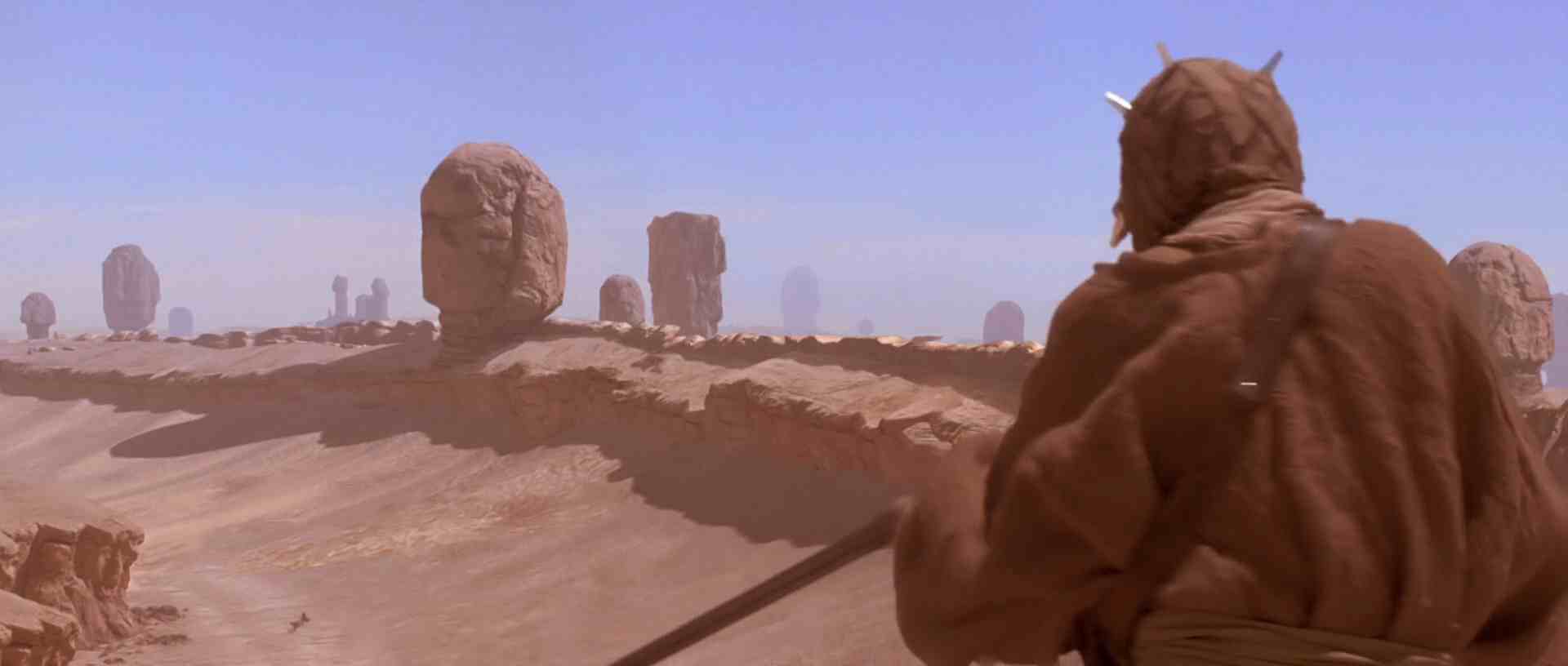
For me, the most fascinating aspect in which Lucas included in the film is Anakin’s motivation for accepting the dark tendencies he feels. Anakin’s mother gets kidnapped by Tusken Raiders, and he returns back to Tatooine to save her. He approaches the camp, and finds his Mother, who has been gone for months, beaten, bloodied, and chained up face first on a rack.

Anakin’s mother dies in his arms, and then he proceeds to kills every single Tusken Raider in the village. Including the women and children in a fury of anger. Yoda and Qui Gon call out to him, but that can’t stop him form seeking vengeance.

Anakin’s mother was being raped. Repeadly. There is not another sound explanation as to why she was still alive, or why she would be chained up face first against a rack. This was the spark that lit the dark fire inside of Anakin.

While, at times, the second act featuring the overly romantic love story between Padme and Anakin can drag it’s feet, it is all worth it for the final act that a lot of us have waited our entire lives to see: an all out Jedi battle.

AoTC 3

At least thirty Jedi, led by Yoda and Mace Windu, backed by the Republic’s new Clone Army descend upon the Separatist hub planet of Geonosis and wage war against the Geonosians and the Separatist’s droid army.

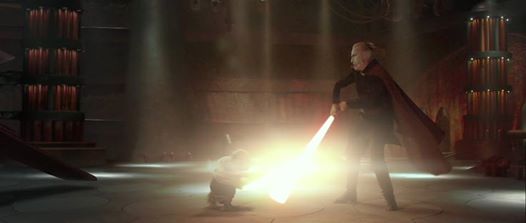
The film includes my favorite (yet widely unpopular) light saber duel featuring Yoda facing off against his former Padawan turned Sith Lord, Count Dooku. This is the moment when we are shown exactly why he is the head of the Jedi Council, General of the Republic’s Army, and how powerful he is with the Force.

ATTACK OF THE CLONES remains an imperfect film, aside from some clunky dialogue and misguided casting, I’ve come to wholeheartedly accept the film, and still marvel at George Lucas’ unbelievable command and vision behind the camera.

RAIDERS OF THE LOST ARK – A REVIEW BY J.D. LAFRANCE

raiders

There’s no disputing that Raiders of the Lost Ark (1981) is one of the greatest action/adventure films ever made, featuring some of the most memorable action sequences ever put on celluloid. Who can forget part-time archaeologist, part-time adventurer Indiana Jones (Harrison Ford) outrunning a giant boulder at the beginning of the film? Or the exciting gun battle in a Nepalese bar? Or Indy being dragged behind a truck full of Nazis? However, the older I get the more I appreciate the quieter moments in Raiders – the downtime between action set pieces. These scenes convey exposition and develop the characters. The credit for them working so well should be given to the film’s screenwriter Lawrence Kasdan, who also wrote the screenplays for such noteworthy films as The Empire Strikes Back (1980), Body Heat (1981), The Big Chill (1983), and many others. He’s written some of the best scripts ever committed to film and knows how to write witty dialogue and create engaging characters.

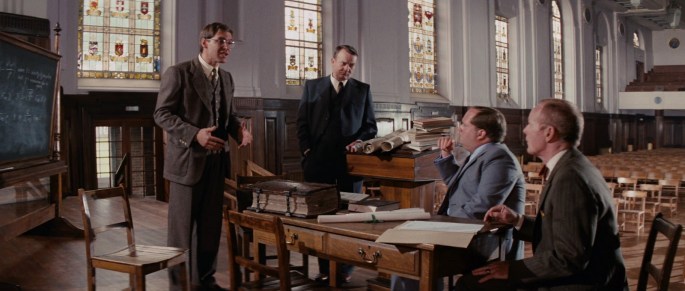
raiders1Kasdan’s ability to engage us in the obligatory exposition scene is evident early when Indy and his friend and colleague Marcus Brody (Denholm Elliott) meet with two military intelligence officers about the location of an old colleague of Indy’s – Abner Ravenwood – who might have an artifact – the headpiece of the Staff of Ra – that will reveal the location of the Ark of the Covenant, which the Nazis are eager to get their hands on. Indy and Marcus give the two men a quick history lesson on the Ark and its power. Marcus concludes with the ominous line about how the city of Tanis, that reportedly housed the Ark, “was consumed by the desert in a sandstorm which lasted a whole year. Wiped clean by the wrath of God.” The way Denholm Elliott delivers this last bit is a tad spooky and is important because it lets us know of the Ark’s power, his reverence for it, and why the Nazis are so interested in it. This dialogue also gives us an indication of the kind of danger that Indy is up against.
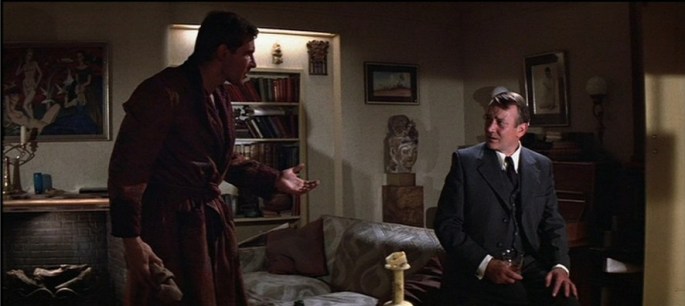
raiders2This segues to a nice little scene right afterwards at Indy’s home between the archaeologist and Marcus. He tells Indy that the United States government wants him to find the headpiece and get the Ark. As Indy gets ready they talk about the Ark. The camera pans away from Indy packing to a worried Marcus sitting on a sofa and he reveals his apprehension about what his friend is going after: “For nearly 3,000 years man has been searching for the lost Ark. It’s not something to be taken lightly. No one knows its secrets. It’s like nothing you’ve ever gone after before.” Indy shrugs off Marcus’ warning but his words, accompanied by John Williams’ quietly unsettling score, suggest the potential danger Indy faces messing with forces greater and older than himself.
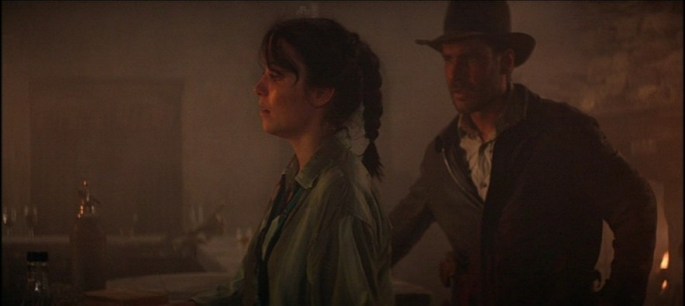
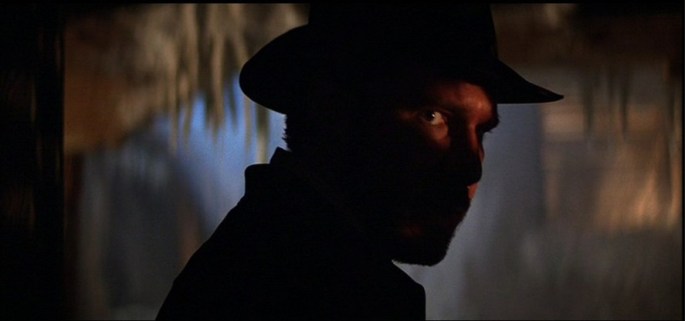
raiders3Kasdan also does a great job hinting at a rich backstory between Indy and his ex-love interest, Marion Ravenwood (Karen Allen). When they are reunited at a bar she runs in Nepal, she is clearly not too thrilled to see him, giving Indy a good crack on the jaw. Marion alludes to a relationship between them that went bad. She was young and in love with him and he broke her heart. To add insult to injury, her father is dead. All Indy can do is apologize as he says, “I can only say sorry so many times,” and she has that wonderful retort, “Well say it again anyway.” Harrison Ford and Karen Allen do a great job with this dialogue, suggesting a troubled past between them. In a nice touch, Spielberg ends the scene with Indy walking out the door. He takes one last look back and his face is mostly obscured in shadow in a rather ominous way as he clearly looks uncomfortable having had to dredge up a painful part of his past.
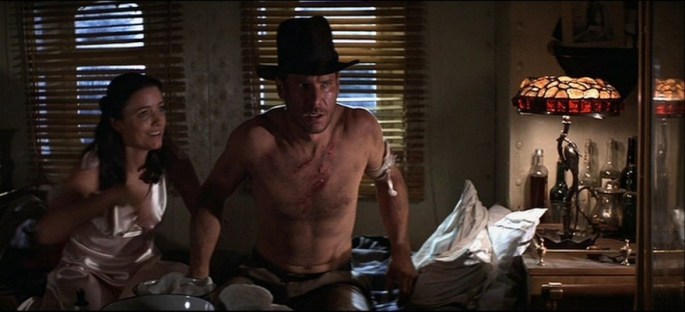
raiders4Indy and Marion have another nice scene together after they’ve retrieved the Ark from the Nazis and are aboard the Bantu Wind, a tramp steamer that will take them to safety. Marion tends to Indy’s numerous wounds and says, “You’re not the man I knew ten years ago,” and he replies with that classic line, “It’s not the years, honey, it’s the mileage.” It starts out as a playful scene as everything Marion does to help hurts Indy’s world-weary body. In frustration she asks him to show her where it doesn’t hurt and he points to various parts of his body and in a few seconds the scene goes from playful in tone to romantic as they end up kissing. Of course, Indy falls asleep – much to Marion’s chagrin. Kasdan’s dialogue gives Spielberg’s chaste, boyhood fantasy serial adventure a slight air of sophistication in this scene as two people with a checkered past finally reconnect emotionally.
raiders5.jpgFor me, Raiders is still the best film in the series. The pacing is fast but not as frenetic as today’s films. There are lulls where the audience can catch its breath and exposition is conveyed. In many respects, it is one of the best homages to the pulpy serials of the 1930s and a classic example of when all the right elements came together at just the right time. This film has aged considerably well over time and each time I see it, I still get that nostalgic twinge and still get sucked in to Indy’s adventures looking for the lost Ark.
STAR WARS EPISODE I: THE PHANTOM MENACE – A Review by Frank Mengarelli

It’s no secret that many high brow cinephiles have their knives out when it comes to STAR WARS, but in particular the prequels.  To be fair, my film snobbery overflows onto big blockbuster franchises, but STAR WARS, all aspects of it; the films, the novels, the video games, collectibles are so ingrained in my life since childhood that it’s fair to say I will never have as much passion for anything as I do for STAR WARS.

image

THE PHANTOM MENACE is a stark contrast from the original trilogy, and that’s exactly what it is supposed to be.  Yes, there are many missteps, including the casting of some actors, and the dialogue at times is lackluster and unintentionally laughable but there is so much more at stake when you look at the big picture.

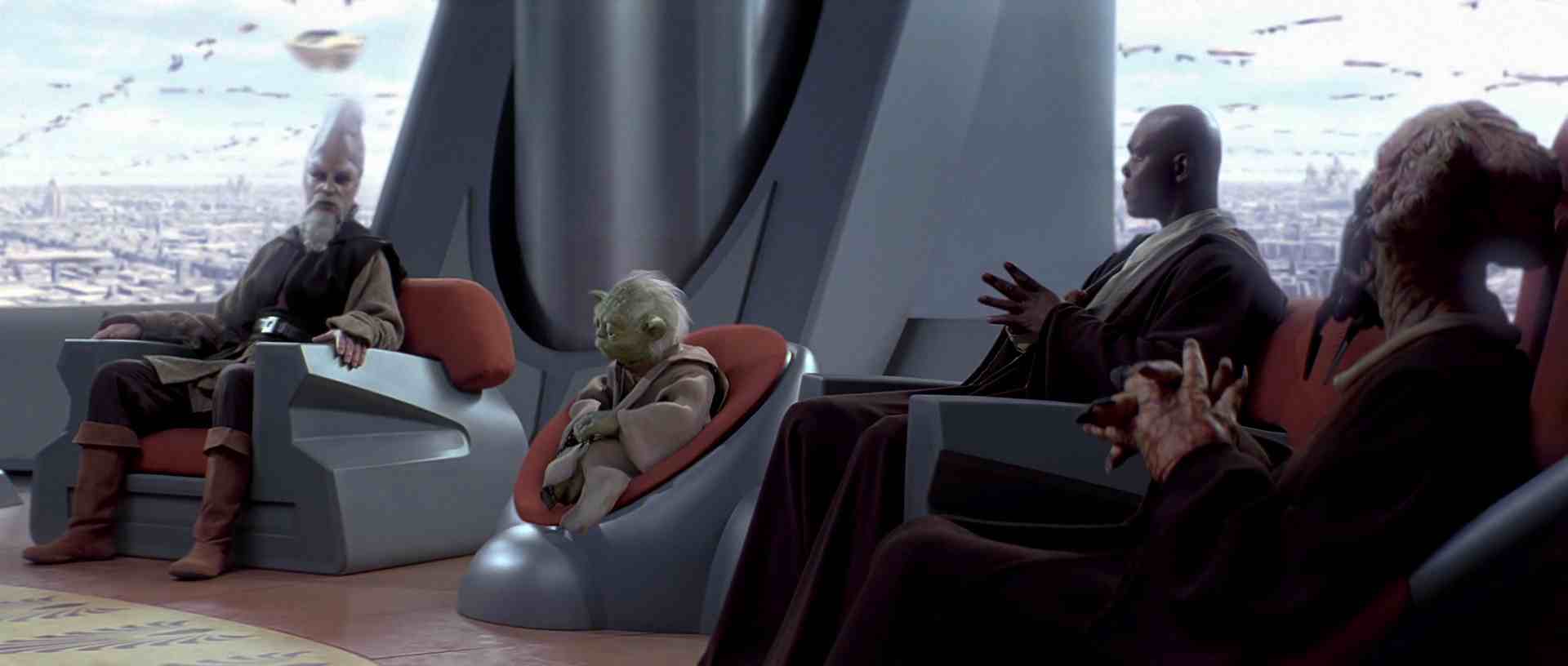
Set decades before A NEW HOPE, Episode I shows us the beginning.  We see a vibrant and fertile galaxy before the desolate dilapidation that the Empire brings to not only the aesthetics but also thematically in the original trilogy.  This is a time of prosperity, a time when the Jedi oversaw peace in the galaxy.

image

But.  This is also the beginning of the galaxy being divided in a full-out war.  Planets pitted against each other by fear and economics.  All the workings of seminal STAR WARS villain, Emperor Palpatine, who in Episode I is nothing more than the affable senator from the peaceful planet of Naboo.  His Sith alter ego, Darth Sidious, does all the dirty work.

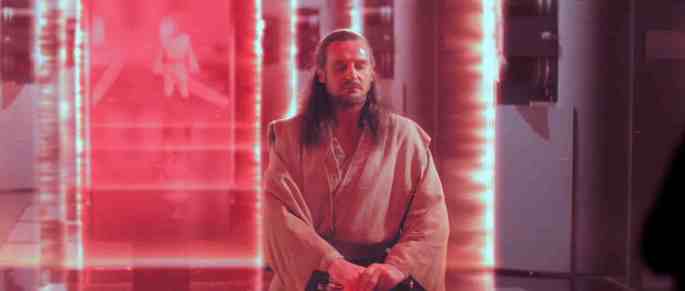
I know.  Jar Jar Binks is the go to hangup.  Yes, Jar Jar is annoying until you get over it and embrace him.  Liam Neeson as the Jedi Master who is the hierarchy of the Skywalker lineage more than makes up for Jar Jar.  As does John Williams’ AMAZING score, particularly DUEL OF THE FATES which loudly surrounds the greatest lightsaber battle in the STAR WARS saga: Qui Gon Ginn AND Obi Wan Kenobi versus fan favorite, Darth Maul.

Yes, THE PHANTOM MENACE is the weakest of the STAR WARS saga, but it is also a solid foundation of what’s to come after.  The chaos that engulfs the galaxy.  The tangible rise of Palpatine’s dark powers.  For all of Lucas’ faults, he does an excellent job guiding the camera through the birth of galactic turmoil.  His casting of Liam Neeson, Ewan McGregor, Samuel L. Jackson, and Terence Stamp are wonderfully perfect additions to the series, and his vibrant aesthetic is a pleasant contrast from the darkness of the original trilogy.

STAR WARS: EPISODE IV: A NEW HOPE – A REVIEW BY J.D. LAFRANCE

open-uri20150608-27674-lashgn_719bef9d

For many of my generation, the first Star Wars film (1977) was a defining moment of our childhood and so I always look back at it in a nostalgic way. I had the action figures, the coloring book, the calendar, the t-shirt, and so on – all part of the vast merchandising that helped build the George Lucas empire. But as a kid I wasn’t thinking about that – I loved the film and wanted to have everything associated with it, including the comic books and the novelization. The Star Wars I love is the original incarnation unmolested by Lucas’ awkward revisionist CGI makeover. The Star Wars I know and love has Han Solo (Harrison Ford) firing first. The film has been analyzed and written about extensively so I can only look at it from my perspective and offer various observations that always stick out in my mind whenever I watch it.

One of the reasons Star Wars works so well is because of a solid combination of engaging storytelling and groundbreaking (for its time) special effects. The coming-of-age story is as old as the hills and I’m sure that is part of the film’s appeal – its comforting familiarity. Young Luke Skywalker (Mark Hamill) leaves behind his life on a small, insignificant planet and becomes involved in an intergalactic civil war that involves rescuing a princess from the clutches of an evil empire. In the process, he grows up and becomes a man.

I still get goosebumps when I see that opening text, “A long time ago. In a galaxy far, far away…” And then, John Williams’ rousing score kicks in with a sudden blast from the horn section and we’re on our way. We get that iconic shot of the small Rebel Alliance spacecraft being pursued by an Empire Star Destroyer so massive it takes up at least three-quarters of the screen as it rumbles into view. We soon meet two of the film’s most endearing characters – C-3PO (Anthony Daniels) and R2-D2 (Kenny Baker), droids that have a sometimes slapstick-y love/hate relationship a la Laurel and Hardy. 3PO is the eternal pessimist as evident from his declaration early on, “We’re doomed.” Of course, this is as the Empire prepares to board the Rebel spacecraft. 3PO and R2 play well off each other – the former whines about danger and complains about the conditions of Tatooine (the planet they escape to), while the latter clearly has a purpose, a mission that he must complete with or without his long-time companion. They bicker like an old married couple and even on his own, 3PO still bitches about R2.

Has there ever been a cooler introduction for a villain than the one for Darth Vader (David Prowse)? Having boarded the Rebel ship by force, he emerges from the smoke to survey the damage done. We immediately hear his ominous breathing, that unsettling raspy respirator sound – awesome! We soon hear James Earl Jones’ booming, authoritative voice (later on the voice of CNN no less!) which, coupled with David Prowse’s intimidating physical presence and the brilliantly black armor, creates an instantly memorable bad guy, a real force of evil. Lucas constantly reminds us what a badass Vader is in scenes like the one where he deals with one of his officers who dares to scoff at the power of the Force compared to the power of Empire’s new battle station, The Death Star. Vader warns him, “Don’t be too proud of this technological terror you’ve constructed. The ability to destroy a planet is insignificant next to the power of the Force.”

Unconvinced, the guy foolishly insults Vader’s “sad devotion to that ancient religion,” and, in response, the Dark Lord merely raises a hand and chokes the man from afar. Vader coolly and ominously replies, “I find your lack of faith disturbing.” Now, how badass is that? It takes Peter Cushing’s bureaucrat Grand Moff Tarkin to step in and call Vader off. As evil as Vader is, Tarkin is on a whole other level. He destroys a planet populated by millions of innocent people just to make a point and teach Princess Leia (Carrie Fisher) a lesson. How nasty is that? Vader just chokes a few guys which pales in comparison to what Tarkin does.

I always found it fascinating how the Jawas are basically the used car salesmen of the galaxy and they even try to pawn off a faulty droid to Luke and his Uncle Owen (Phil Brown). Mark Hamill’s take on Luke is right on the money, playing the character as a teenager on the verge of becoming a young man – someone who would rather pick up power converters over at Toschi Station than haggle over the price of droids with Jawas. His uncle sees right through Luke and chastises him, “You can waste time with your friends when your chores are done.” This little moment is one of the reasons why Star Wars appealed to a younger generation – they could relate to Luke’s disinterest in chores and his frustration of being stuck on his uncle’s farm. Who would rather hang out with their friends than get stuck doing boring chores?

This is further reinforced in the scene where Luke talks to Aunt Beru (Shelagh Fraser) and Uncle Owen about transmitting his application to the Academy sooner rather than later but his uncle wants him to stick around for the harvest and another year. After Luke goes off in defeat, his aunt says, “Luke’s just not a farmer, Owen. He has too much of his father in him,” to which Owen replies, “That’s what I’m afraid of.” This conversation cleverly hints at earth-shattering revelations that come in the next film in the series, The Empire Strikes Back (1980). I just want to say how much I love the little moments of domesticity that Lucas shows here with Luke having a meal with his aunt and uncle or another scene where we see Aunt Beru (who I was always struck by what a kind face she has and what a gentle person she appears to be) preparing some sort of meal. It humanizes these people in a short amount of time so that we care about what happens to them later on.

What I also like about the story is that Lucas makes it personal for Luke. His only reason for staying was to help out his aunt and uncle but when they are killed by Imperial Stormtroopers, his life as a farmboy dies that day. He’s got nothing left to lose and his innocence has been taken away from him forever. Lucas makes sure that we understand just how horrible the Empire is with a lingering shot of the aunt and uncle’s still smoking, charred skeletons, which was pretty shocking to me when I first saw the film at a very young, impressionable age. This scene ups the stakes and reinforces just how ruthless the Empire is and how personal it has gotten for Luke.

The casting of Alec Guinness as Jedi master Obi-Wan Kenobi was genius on Lucas’ part. With his classic British accent, he gives his dialogue a classy spin, perfect for the expositional dialogue his character imparts throughout the film. For example, early on he explains the nature of the Force to Luke: “The Force is what gives a Jedi his powers. It’s an energy field created by all living things. It surrounds us, it penetrates us, it binds the galaxy together.” What a great way to describe the Force – it’s succinct and doesn’t give too much away, just enough to let our imagination fill in the rest.

One of the most memorable scenes in Star Wars takes place in the Cantina at Mos Eisley (a place that Obi-Wan warns Luke is a “wretched hive of scum and villainy.”), a bar where all sorts of strange and unusual creatures hang out. Of course, the purpose of this sequence is for Luke and Ben to meet and hire Han Solo and Chewbacca (Peter Mayhew) to rescue Leia, but it is also a fantastic showcase for a memorable collection of exotic-looking alien creatures. There’s one that looks a little like Cousin It from The Addams Family, one that looks like the Wolfman, one that kinda looks like a devil with two horns sprouting out of the top of his head, and so on. The diversity of these creatures is so fascinating that I just like rewatching this sequence to check out all of the various creatures. This sequence has gone on to inspire several other films, including Nightbreed (1990), Serenity (2005), and Hellboy II: The Golden Army (2008). The aliens in Star Wars don’t look cute and cuddly but strange and dangerous. Lucas reinforces this by having Luke bullied by two lowlifes until Obi-Wan steps in with his mad lightsaber skills.

How cool is Han Solo? We meet him haggling with Obi-Wan over the price of taking them to Alderaan and Han tries to impress his prospective clients with the speed and reputation of his spacecraft the Millennium Falcon. However, after their meeting, Han runs into Greedo, a bounty hunter collecting a sizable debt that the smuggler owes notorious gangster Jabba the Hutt. Han acts cool and casual, keeping Greedo talking while he quietly unholsters his gun and blasts the bounty hunter before he can shoot him. How badass is Han? Harrison Ford plays it so well – all cool and accommodating to Greedo so that he has time to get the drop on him. It’s this scene that establishes Ford’s character – is he a bad guy or a good guy? You’re never really sure until the end of the film and this is due in large part to Ford’s performance as a cocky smuggler who only looks out for himself.

I also like Han’s simple philosophy, like when he scoffs at the notion of the Force: “Hokey religions and ancient weapons are no match for a good blaster at your side … I’ve flown from one side of the galaxy to the other. I’ve seen a lot of strange stuff but never seen anything to make me believe there’s one all powerful force controlling everything. There’s no mystical energy field controls my destiny. It’s all a lot of simple tricks and nonsense.” He provides a lot of the film’s moments of humor, like when Luke tries to convince him to rescue Leia by appealing to his greed, or his constant bickering with her. As he tells Luke at one point, “Wonderful girl. Either I’m gonna kill her or I’m beginning to like her.” Han and Leia end up bantering like a couple in a vintage screwball comedy and this is carried over to an even more memorable degree in The Empire Strikes Back.

Another exciting scene is the one where our heroes escape the Death Star while Han and Luke man the Falcon’s laser cannons. Lucas uses editing and Williams’ stirring score to make this scene even more dynamic. It’s a nice warm-up for the climactic sequence where a squadron of Rebel Alliance X-Wing fighters launch an attack on the Death Star. Not only do the Rebels have to worry about the Imperial TIE Fighters, but also the battle station’s laser cannons. Also adding urgency to the assault is the ever-looming threat of the Death Star on the verge of eradicating the Rebel base located on the moon of Yavin. Luke finally gets to show off his piloting skills while many of his comrades are blown up. It doesn’t hurt that he’s aided by Obi-Wan’s disembodied voice and the Force. The use of models in this sequence gives it a more tangible quality, a realness that is missing from most CGI-heavy science fiction films nowadays. This sequence gets even more exciting when Luke and the surviving Rebel X-Wings descend into the trenches of the Death Star to bomb its weak spot. Lucas is able to convey a real sense of speed and urgency that is thrilling, especially when the Millennium Falcon comes from out of nowhere to give Luke the opportunity to destroy the Death Star.

Some feel that Star Wars looks dated and I would agree but for me that is a large part of its appeal, sideburns and all. Watching it instantly takes me back to when I first saw it and the rush of excitement and wonder that I felt as it unspooled before my eyes. It is one of those pivotal moviegoing experiences that I have never forgotten. While I think that The Empire Strikes Back is the better film in terms of story, pacing, characterization, action, etc., Star Wars is the film I enjoy watching the most for all of the reasons stated above. I think that a review in the now-defunct Sci-Universe magazine sums it up best: “even today, would-be sci-fi franchise-builders haven’t learned the lessons about what made Star Wars a cinematic landmark; compelling, but flawed, characters and attention to the smallest pieces of minutiae.”

PTS Presents STAR WARS POWERCAST EPISODE II

STAR WARS POWERCAST 2

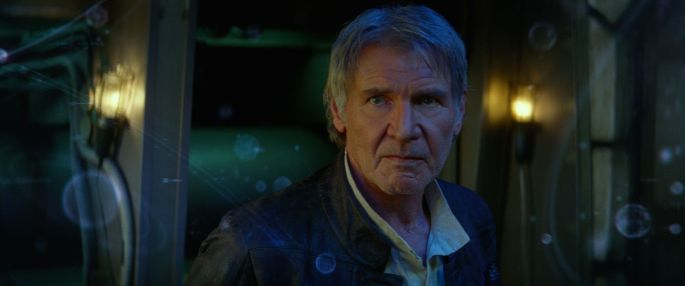
Frank and Tim discuss their reactions to STAR WARS THE FORCE AWAKENS.  They get into who Supreme Leader Snoke is, who Rey is, Harrison Ford’s brilliant return as Han Solo, the prequel tie-ins, the new Funko Pop FORCE AWAKENS series that just got released, and much more!