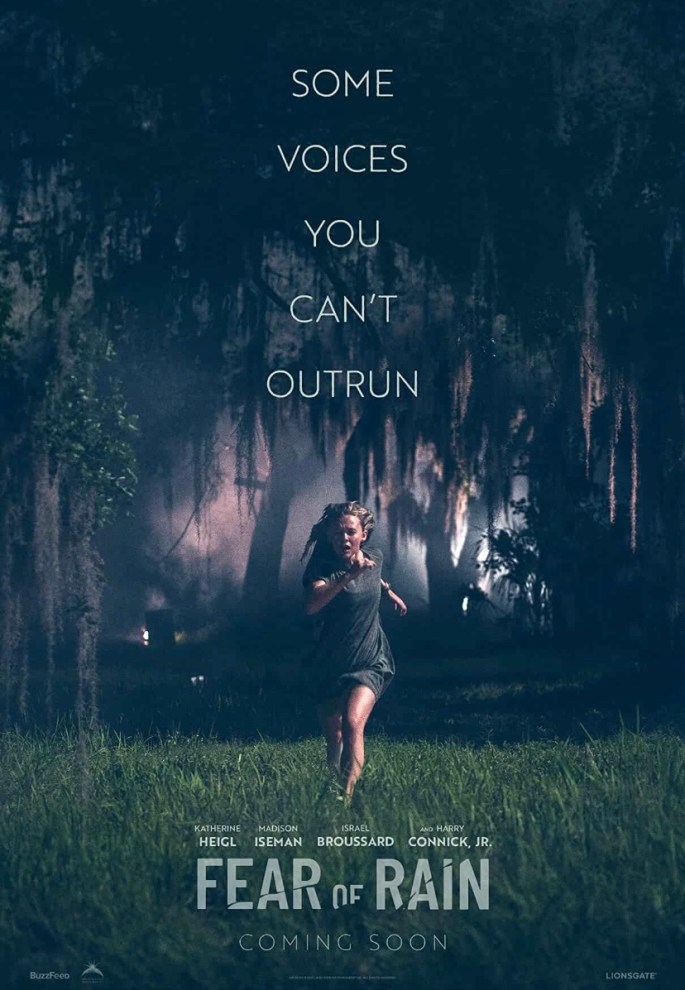

Castille Landon’s Fear Of Rain

Schizophrenia is a delicate subject to tackle in cinema; if you get too sensationalistic and thriller oriented you lose the honesty of the affliction, but if you get too bleak and oppressive with realism you’ll chase your audience away. I’m pleased to report that Castile Landon’s Fear Of Rain is a beautiful, haunting, truthful and compassionate portrait of the illness that incorporates a fragile character study, emotionally affecting family dynamics and an almost unbearably suspenseful thriller narrative for not only one of the most powerful films this year, but one of the most intelligent and thoughtful depictions of this unfortunate condition in cinema thus far. Madison Iseman is Rain, a teenage girl who has been struggling with schizophrenia her entire life. It affects her high school life, day to day routine and relationship with her loving parents (Katherine Heigl & Harry Connick Jr) who do everything they can to help her. She wants to get better but feels frustrated by the fact that the meds she takes dull her creative edge, as she’s an enormously talented painter. Things get impossibly complicated when she meets and makes friends with a boy (Israel Broussard) from out of town who she isn’t even sure is real and starts to suspect her neighbour/high school teacher (Eugenie Bondurant) of kidnapping and holding a little girl captive in her house. Are all these things realities of her life or densely spun facets of her own delusional mind spilling out into her outward mental state? The film could have easily gone for cheap thrills, cloying teen romance and a sanitized, glossed over depiction of schizophrenia but there’s a brutal honesty and careful balancing act between all these elements that feels genuine. Iseman is raw and potent, finding the desperate notes, the inevitable clarity and the instances where Rain skirts the dangerous line of hopelessness and losing her mind forever. Heigl and Connick Jr are excellent as the parents, finding all the right beats individually and as a unit. Director Landon seamlessly weaves the thriller aspects into the psychological themes for a story that has twists that feel earned, performances that feel human, a third act that will toss your nerves into a bundle and some visually striking, almost fairytale-like cinematography that gets downright dreamy to illustrate Rain’s kaleidoscopic mental state and draw you into her journey. Great film, and important because it goes a long way in educating and erasing stigmas around schizophrenia.

-Nate Hill

John McTiernan’s Basic

John McTiernan’s Basic is a film that commits the cardinal sin of cheating its audience with an obnoxious, horrendous twist ending that it neither earns nor properly makes sense of. It’s a real crying shame too, because the film up until then is a hell of a lot of fun and has a rambunctious John Travolta performance that could shake the cobwebs loose from a barn. When a near mythic drill instructor (a volcanic Samuel L. Jackson) with some terrifying over-the-line tactics disappears along with some of his cadets on a routine training exercise deep in the jungles of Panama, Travolta’s rowdy DEA Agent is called in to investigate. Why a DEA agent, you ask? Well, it being Panama one might assume that any controversy anywhere could be drug related, but the film states that it’s because no one is as skilled at interrogation than him. That proves to be true, as he slowly, cleverly speaks with the remaining trainees and starts to piece together a cluttered version of events from each one. They are played by the reliable likes of Dash Mihok, Taye Diggs, Giovanni Ribisi, Brian Van Holt and Harry Connick Jr., and as such many of the scenes are quite engaging. It doesn’t hurt that Connie Nielsen is good too as Travolta’s anal retentive, by the book partner. The film oscillates through various scenarios, teasing us with which mystery might be real, and when it comes time to whisk the curtains back and land the pirouette of a reasonable final act… it just… shits itself and completely ruins not only everything that came before, but the entire film, which is really too bad. At first I thought I was just too stoned to get what happened the first time years ago, but I’ve since rewatched it a few more times and… nope. It’s illogical, unwarranted horse shit that doesn’t work any way you spin it. I would have honestly preferred the central mystery to never even get solved over the half assed resolution they cooked up. Roger Ebert pointed out that this film deserves to be in a genre he calls the ‘Jerk Around Movie,’ and I agree. It shamefully wastes the viewer’s time with an ending that’s both insulting to the efforts of the actors who really worked hard here, betrays it’s own narrative to the grave. Bleh.

-Nate Hill

P.S I Love You


P.S. I Love You is pretty grounded, affecting stuff as far as romantic dramadies go, a sorrowful story that’s light on sap and earns your tears. It’s sad, to be sure, but that’s a necessary element to balance out any otherwise happy-go-lucky narrative, which is something many forget when making these types of films. Jarringly soon after we meet adorable and slightly dysfunctional couple Gerry and Holly (Gerard Butler & Hilary Swank), Gerry passes away, leaving her bereft and broken, but not necessarily alone. Knowing of his illness beforehand, he’s left a series of love notes that lead her on a scavenger hunt, each new note and following action geared towards easing her pain, saying goodbye and trying to help her start a new life. Although consoled by her two caring friends (Gina Gershon & Lisa Kudrow) as well as her mother (Kathy Bates) this is Holly’s solo journey at heart, a meditation sent from the afterlife by the world’s most thoughtful husband, unconventional in his methods yet intuitive to his last breath. Losing a loved one, especially your other half, is a kind of pain one could never fathom unless, heavens forbid, we find ourselves in that situation one day. Holly and Gerry didn’t always work well, as we see in a few of the haughty flashbacks, but their love for each other was real, and the subsequent pain on her part is palpable in Swank’s performance, which must be no easy task. A trip to Ireland, an encounter with a handsome stranger there (Jeffrey Dean Morgan), flirting with a kindly potential suitor (Harry Connick Jr.), she circles many endeavours in her time after his passing, all part of a grieving process and a desire on deceased Jerry’s part that she live her life, remember him yet not fall into an abyss of chronic grief and let it stall her, which happens to some. It’s a sweet and good-natured way to tell a very grave, emotionally corrosive story, but like I said before, it’s never manipulative or deliberately mushy, it lets the story push your buttons naturally, until the floodgates on your tear ducts are opened by observing the story and characters, not connived by soap opera histrionics or tacky melodrama. A beautiful little film that makes you deeply sad, but also puts in an effort to cheer you up along the way, just like Gerry does for his Holly. 

-Nate Hill