Silent House (2011)

Elizabeth Olsen has been making a huge impact on film these days and already was a decade ago I was pleased to learn with 2011’s Silent House, a superior, intelligent and unconventional horror film that showcases some of the best ‘scream Queen’ acting from her that I’ve seen in the genre overall. This is a simple story that sees her play a teenage girl who is helping her father (Adam Trese) and uncle (Eric Sheffer Stevens) pack up a house that they are about to move out of. Everything seems routine save for a little bickering until suddenly she finds herself trapped in a threatening netherworld version of the house, full of half seen ghosts, whispering voices and apparently no contact with the outside world. Is she dead? Hallucinating? The switch from the opening scenes into frightening territory is so swift and so abrupt that at first I had no idea what was going on and felt disoriented, but then realized that’s exactly how this poor girl must feel and noted how effectively and promptly the film drew me into its world and the point of view of its protagonist. She wanders about with little notion of what to do beyond hide, scream and run until she finds old Polaroids and other long forgotten totems of memory and we see the truth slowly come to light. It’s a sad, tragic revelation that so many girls who went through what she did as a kid must later unearth in their own repressed memories and Olsen’s performance is note perfect on every level. There are some deeply terrifying scenes here including a sequence where she uses the brief flash of the Polaroid camera to gain some visibility in the dark and quickly wishes she didn’t as we catch momentary glimpses of the horrors surrounding her. The camera work, staging and spatial dynamics are all excellently done by husband and wife directing team Chris Kentis and Laura Lau, who are remaking a Uruguayan horror film here of the same name that I have yet to see but based on the sterling quality level I experienced here, it must be something else indeed. This is dark, tragic, genuinely creepy horror on all levels, a story told in almost dreamlike fashion with a lead performance from Olsen so potent with raw fear and deep anxiety I’d almost be hesitant to discover what her actor’s process is. Really great stuff.

-Nate Hill

Justin Dix’s Blood Vessel

What’s something you can find on a nazi warship that’s worse than nazis themselves? Well a group of allied castaways find out exactly what when they drift into the path of a deserted one in Blood Vessel (amazing title) a super fun, super old school, kinda low budget but enthusiastic B horror flick that I really enjoyed. As a stranded life raft from a torpedoed sub approaches a giant derelict boat, the survivors are seemingly saved until they board the craft, find it curiously deserted and discover what is lurking deep below deck, waiting to hunt them. It seems the nazis were transporting several caskets from Romania containing immortal creatures known as Strigoi, which are basically vampires with a lot more snazzy magic powers backed up by a lot more specific backstory lore. The minute these things wake up it’s game on as they discover these new people in their vicinity and begin to viciously take them out. The allied group is a surprisingly varied bunch including a cowardly Brit, an enthusiast Aussie, an American battle surgeon and an Eastern European badass who has survived all kinds of gnarly stuff and has the scars to prove it. They are all very well acted, written and have distinct, unique anthropological personas and angles which isn’t something you find in every horror flick about a bunch of folks who are essentially cannon fodder for vampires. The creatures themselves are very cool, designed with practical prosthetic effects, all exaggerated ears, accentuated fangs and acted with snarling vivacity by those under all that awesome makeup. What’s more is they aren’t just an animalistic horde either, they’re an ancient, evil aristocratic family complete with a young daughter Strigoi who is just as deadly as mom and dad, it’s a cool family dynamic. There’s gory showdowns, subtle sociopolitical banter amongst the human characters, well drawn arcs and loads of spooky, smoky, eerie abandoned boat atmosphere full of beautifully saturated Argento-esque lighting and gorgeous frames filled with gothic eye candy. A solid horror, streaming now on Shudder.

-Nate Hill

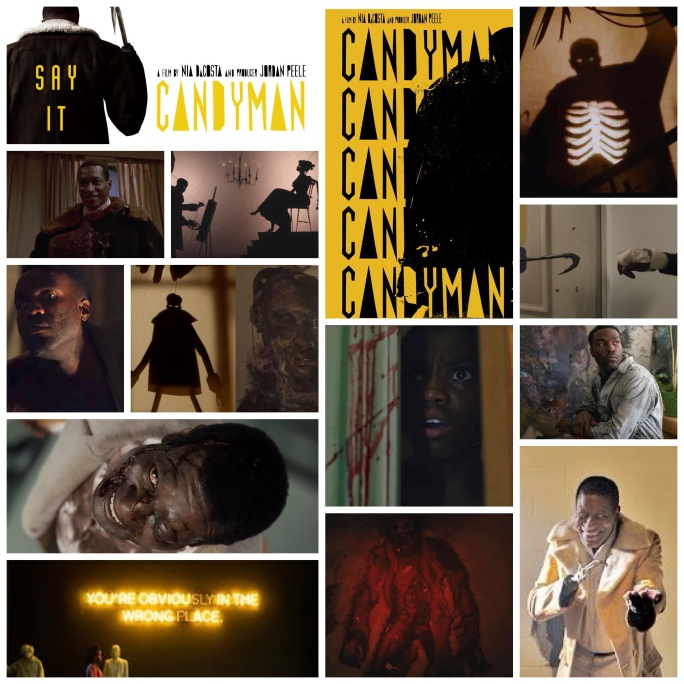
Nia DeCosta’s Candyman

Urban legends have a way of living on decades after the actual events that inspired them, like ghosts of the past doomed to linger as long as the collective human consciousness remembers what happened, and spreads it by word of mouth. The original 1992 Candyman film is a minted horror classic that has only gotten better with age and still holds up in every respect to this day, a terrifying supernatural parable that covers classism, racism, the power of myth and the passing on of stories in a ritualistic fashion. So how does Nia DeCosta’s Candyman, a ‘spiritual’ sequel and decades later follow up compare to its inspiration? Well naturally it’s not quite as good, but it was never going to be, and it was also never going to be the exact same thing because the world has changed and along with it so has the grim Chicago project housing neighbourhood of Cabrini Green, once a derelict death trap and now a hilariously partially gentrified (we see a rundown laundromat sitting snug right next to an artisanal ‘roastery’) overrun with art world types, the horrors that befell it over twenty years ago now almost forgotten. Not quite though, as we see struggling artist Anthony (Yahya Abdul-Mateen II) catch wind of the Candyman events, now little more than a campfire story, and decide to investigate further in order to gain inspiration during an artistic dry spell where his successful girlfriend (Teyonah Parris) is supporting him financially. Naturally the more he learns the more his life unravels and pretty soon people are saying those magic words five times into mirrors and being viciously murdered by Candyman, albeit a different incarnation than Tony Todd’s iconic and darkly tragic Daniel Robitaille. He’s called Sherman Fields this time (played excellently by Michael Hargrove) and I gotta hand it to the guy, he’s pretty damn scary, in less baroque, theatrical fashion than Todd and instead a more animalistic, unstable way. The idea here is that Robitaille pioneered the dark necromancy that keeps the Candyman legend alive but there are also others, each with an appropriately unfortunate backstory, who fill the position. It’s a neat expansion into the mythos even if Todd himself gets sadly little to do here. The callbacks to the first are integrated well enough into this version of today so that it feels psychically linked to it without having outright sequel syndrome, which I suppose is what they mean by ‘spiritual sequel.’ Nia Decosta is a filmmaker to watch out for, she meticulously blocks actors and stages the killing scenes in ingeniously innovative ways using space, movement and reflection for some truly trippy and original sequences invoking settings like mirrored elevators, high rise apartments, high school washrooms and cavernous holes in dilapidated drywall. There’s also some beautiful shadow puppetry that fills in for flashbacks instead of ripping actual footage right from the 1992 version, which adds an elemental flourish and a terrific musical score by Robert Aiki Aubrey Love that echoes Phillip Glass’s achingly gorgeous original composition without aping it. There’s even some startlingly gruesome body horror thrown in that breaks new prosthetic ground and is… quite something to look at, or look away from depending on your tolerance. It ain’t the 1992 version and let’s face it, nothing will be. But it’s hell of a good horror film and a damn fine shoutout to a classic that’s in its own time capsule now, it illustrates how myth, legend and superstition live on no matter who forgets, dark forces like that have a way of finding their way home to the hallowed grounds where they were birthed, and this incarnation of Candyman is every bit as chilling and atmospheric as the first, albeit in different, fresh ways.

-Nate Hill

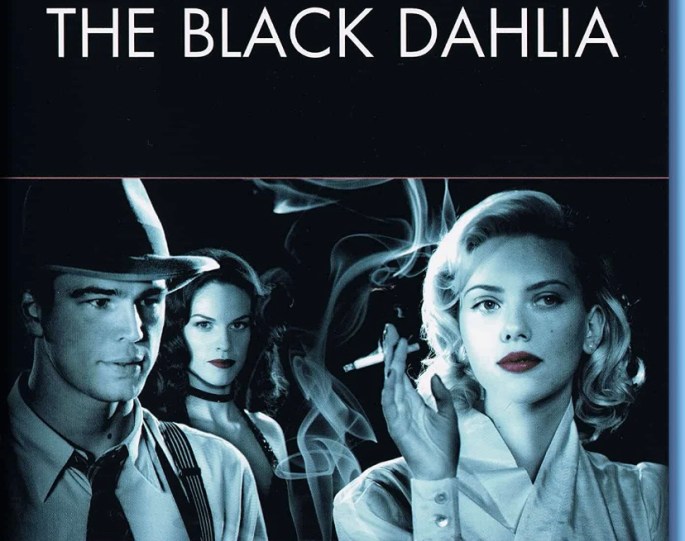
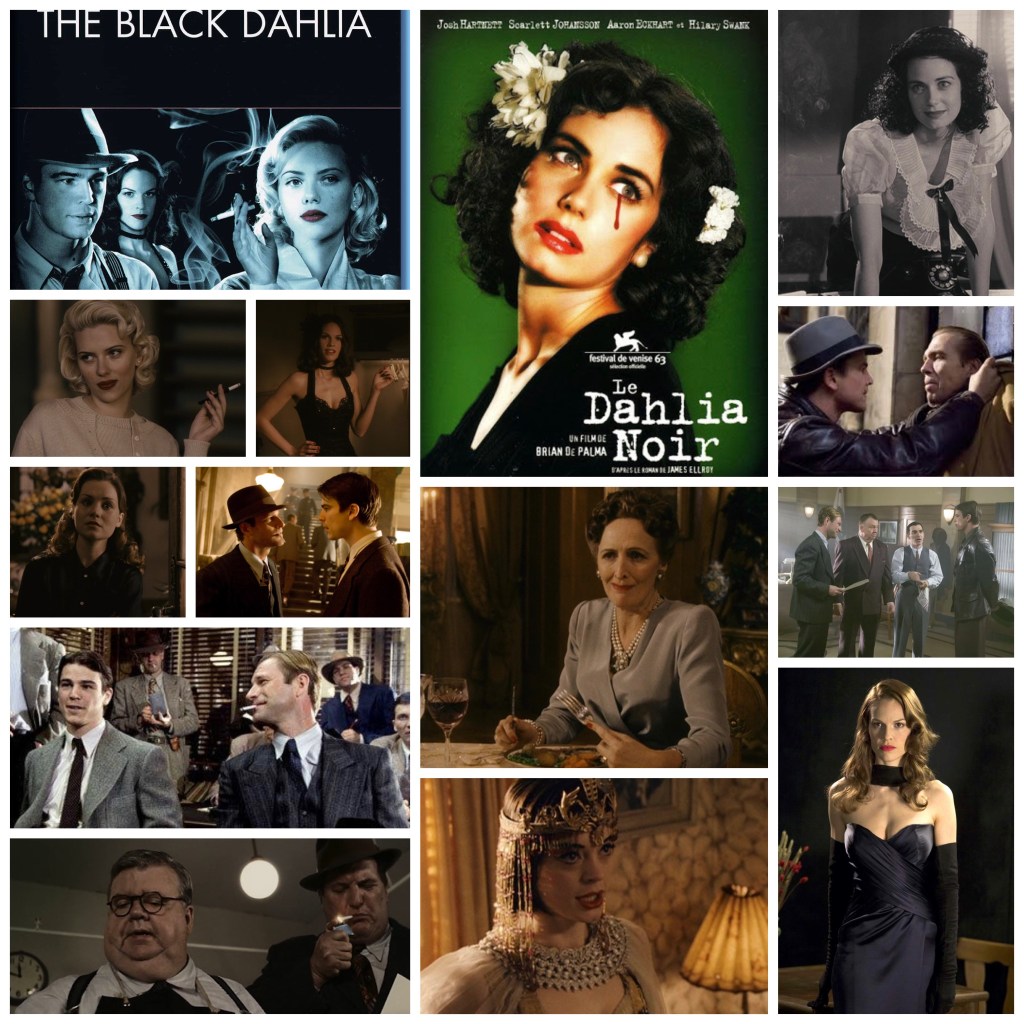
Brian DePalma’s The Black Dahlia

I’m not sure exactly happened with The Black Dahlia but it’s like the recipe was there, it was on time and legible and whoever was in charge of whipping up the ingredients into something coherent, be it editor or producer or Brian DePalma himself, was simply having an off day. In telling the story of two hard-boiled LAPD detectives (Aaron Eckhart and Josh Hartnett, both giving good performances that deserve a much better film) who are assigned to the infamous murder of Elizabeth Short (here played by Mia Kirshner in flashbacks), the filmmakers seem more intent on sidetracking into a useless love triangle between the two cops and a former prostitute (Scarlett Johannsson) as well as numerous political, high society and other cluttered subplot threads that don’t feel like they need to be there. Hartnett gets tangled up with a weird femme fatale (Hilary Swank trying on an accent that fails spectacularly) from a super rich and super shady aristocratic family and it’s here where the film, based on a fiction novel, tries its best to tell the made-up story of what really happened to this girl, kind of like that Johnny Depp Jack The Ripper film only nowhere near as gripping, atmospheric or well told of a story. There’s so much going on I just threw my hands up in frustration at one point and resigned myself to bailing on the story and simply spending most of the two hours playing I-Spy with all the familiar faces in the supporting cast, and it’s here I can say something truly positive about the film. I miss the days when big budget Hollywood flicks had epic, sprawling supporting casts full of awesome people on roll call, even if they’re only around for a swift cameo or couple cool quick scenes. Here we get appearances from many including Kevin Dunn, Mike Starr, Rose McGowan, Troy Evans, Richard Brake, Rachel Miner, Patrick Fischler, Gregg Henry, Ian McNeice, singer K.D. Lang, DePalma himself and more. The great British actress Fiona Shaw (Aunt Petunia in Harry Potter) almost saves the entire film with a deranged extended cameo as Swank’s deeply unstable mother, her performance is so intensely off the wall and bizarrely compelling she seems like she walked in from a David Lynch film, she’s basically the liveliest spark the film has to offer. There is one particular death scene that is also quite memorable and almost more gruesome than the Dahlia murder itself, you’ll know when you see it. I just couldn’t get wrapped up in this thing though, the story is all over the place, feels disingenuous at the core of its script and is just a giant mess, no other way to put it. Great cast though, at least there’s that.

-Nate Hill

Netflix’s Brand New Cherry Flavour

It’s always neat when a major streaming service takes a devilish gamble on something completely deranged and ‘out there’ for their original shows, and Netflix’s Brand New Cherry Flavour is about as WTF as you can accessibly produce without going into full fledged David Lynch surreal arthouse realms. It’s based on a book by a dude called Todd Grimson who I’m not familiar with but the creator/show-runner is Nick Antosca who is responsible for my favourite horror tv show of all time Channel Zero (which can be seen on Shudder) so it’s safe to say his creative output here is also a unique, otherworldly game changer. This tells the story of Lisa Nova (Rosa Salazar, the Battle Angel in Alita), a film student who has brought her horror short to LA in hopes of signing a feature deal, which starts by garnering the interest of fast talking, knowledgeable, well connected producing guru Lou Burke (Eric Lange). Unfortunately, as is often the case with Hollywood bigwigs, Lou is a sociopathic, sleazy piece of shit who not only comes onto her and gets petty when she rejects his advances but then steals her short film for his own purposes and even assaults her. What to do? Well, you could sell your soul to a weird cat worshipping witch deity in exchange for revenge most foul. I wouldn’t recommend it but in this case Lisa is a bit naive and doesn’t heed the obvious warning bells when she’s approached by mysterious Boro (Catherine Keener), who promises her retribution in return for a vaguely Faustian bargain. Well after neglecting to read the fine print Lisa finds her life and that of everyone around her turn into a full on hellish supernatural nightmare complete with flesh eating zombies, inter dimensional hallucinations, angry phantasms, peyote induced mania, pissed off Latino mob hitmen, hiccups, extreme violence at every turn and a strange affliction where every so often she’ll dry heave and vomit up a newborn kitten, and I mean that in the lost literal, explicit way possible, she straight up chundies little tiny demonic white cats covered in barf and it’s nasty af. But that’s what you get when you tangle with a mischievous witch I suppose. Catherine Keener hasn’t had a role this great in years and she’s a diabolical wonder as Boro, the least trustworthy being you’ve ever met, full of quips, quotes and scathing verbal roasts with the bizarre black magic to back her talk up, it’s truly a wondrous villain performance that she has a lot of fun with. This isn’t necessarily the most… succinct or airtight vision and it’s sometimes feels like paint just hurled at a canvas there are so many elements at play, especially in the back half of the season. But oh, what elements they are. This is dark, fucked up, no-chill storytelling with some of the blackest humour imaginable, laughs that catch in your throat on the way up like a barfed kitten and some of the most acidic, punchy, sizzling writing I’ve ever heard, full of impossibly colourful language and brimming with delicious, often very niche Hollywood references. It’s messy but it’s a beautiful goddamn mess and has so much jaw dropping, unbelievable content that I was transported along for the ride that resembles something like Mulholland Dr tossed together with Cronenberg, Raimi’s Evil Dead films with a dash of Entourage and something even intangible thrown in for good bloody measure. Be careful with this one if you’re content sensitive because it’s… punishingly perverse, overbearingly intense and unforgivingly willing got plumb the dark, demented depths of the collective storytelling psyche and puke up whatever it finds onto the screen. Like a kitten, or a self removed eyeball, cannibalistic zombies, metre long tapeworms pulled slowly out of human eye sockets, those are all but a taste. Buckle up.

-Nate Hill

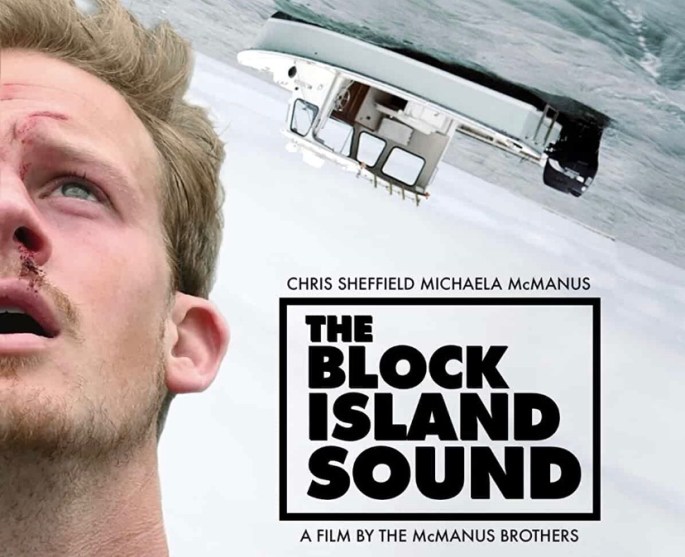
The MacManus Brothers’ The Block Island Sound

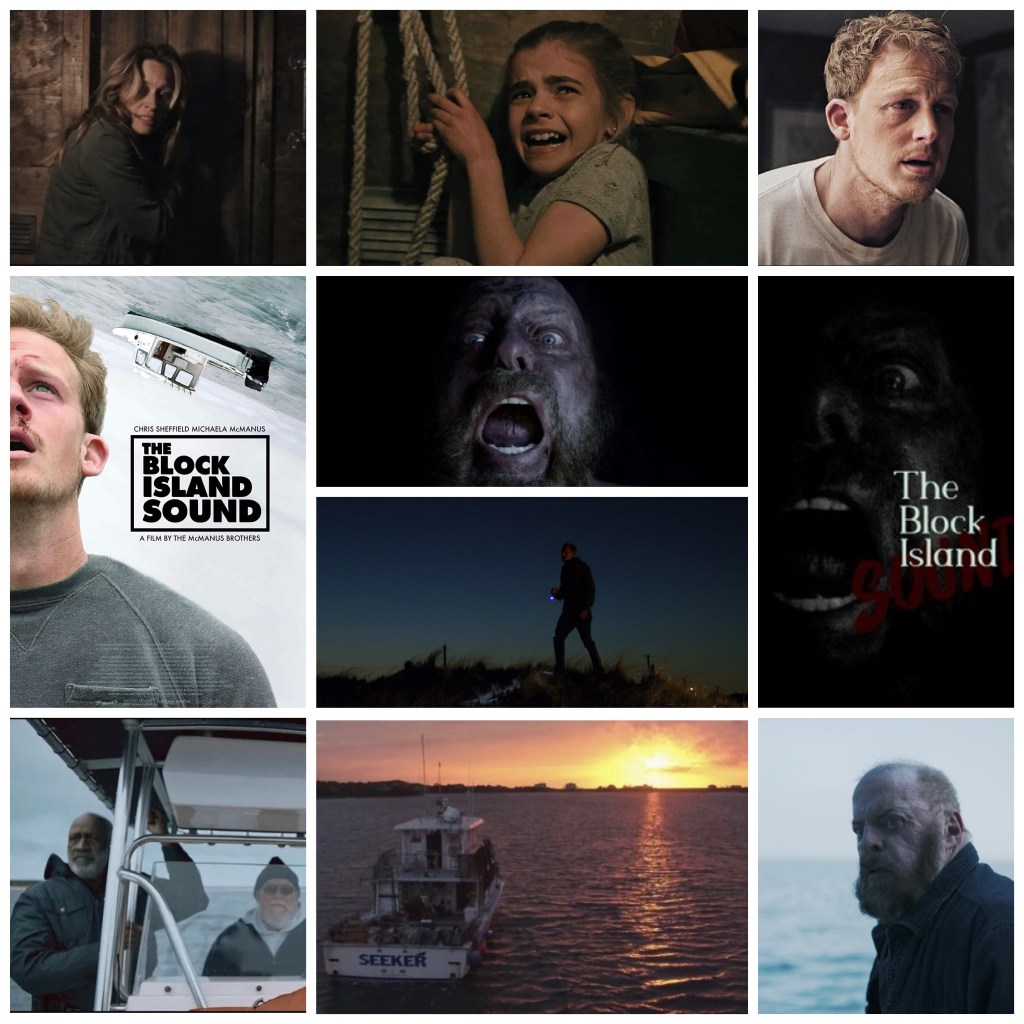
Aliens are up there and they’re messing with us… or are they down below, in the waters of the ocean? The MacManus Brothers’ The Block Island Sound is a fascinating, atmospheric and frequently terrifying glimpse of life in a small fishing town on the Rhode Island coast as inhabitants grapple with a mysterious, threatening, possibly extraterrestrial or cryptozoological force that slowly encroaches on them in increasingly horrifying ways. One fisherman (Chris Sheffield) has already seen his father (Neville Archambault) fall victim to these things and now finds himself coming down with strange symptoms: sleepwalking, blackouts, bizarre hallucinations, dark thoughts and the most severe case of tinnitus I’ve ever seen. He struggles to protect his family from whatever is out there and what it’s doing to him as he can no longer trust his own actions or impulses, especially around his young niece (Matilda Lawler, excellent) whose safety he fears for. This is a slow burn, ambiguous SciFi horror story that takes its time; you never see what’s out there beyond esoteric hints and chilling sounds behind the perpetually overcast coastal skies and the flint grey waters of the sea below. It’s always the threat of what’s out there that is scarier than the thing itself seen in full, and the filmmakers know this, taking full advantage of the ‘less is more’ mantra. Acting is all superior quality, there are a few sequences that drag and could have been tightened up a bit but overall this is a slick, nasty, spine chilling otherworldly horror that hits the spot. It even achieves a moment of pure greatness right at the very end when a character provides thought provoking narration that will make you completely rethink the nature of alien abductions themselves. Good stuff.

-Nate Hill

Willy’s Wonderland

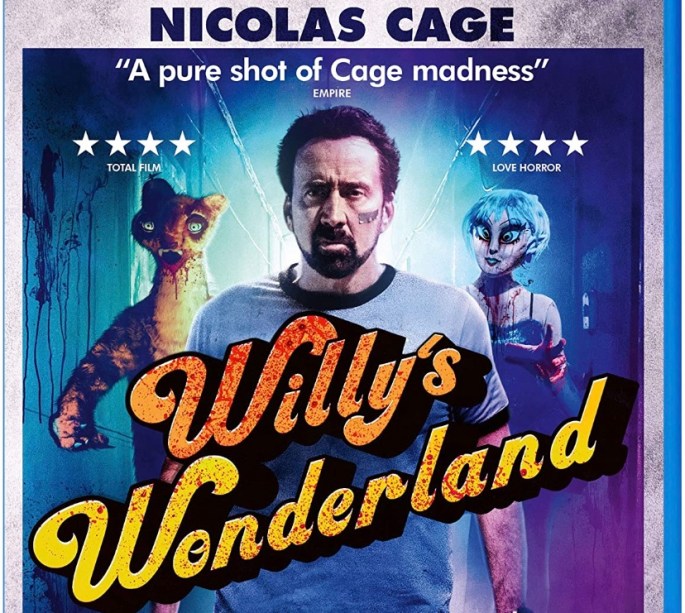
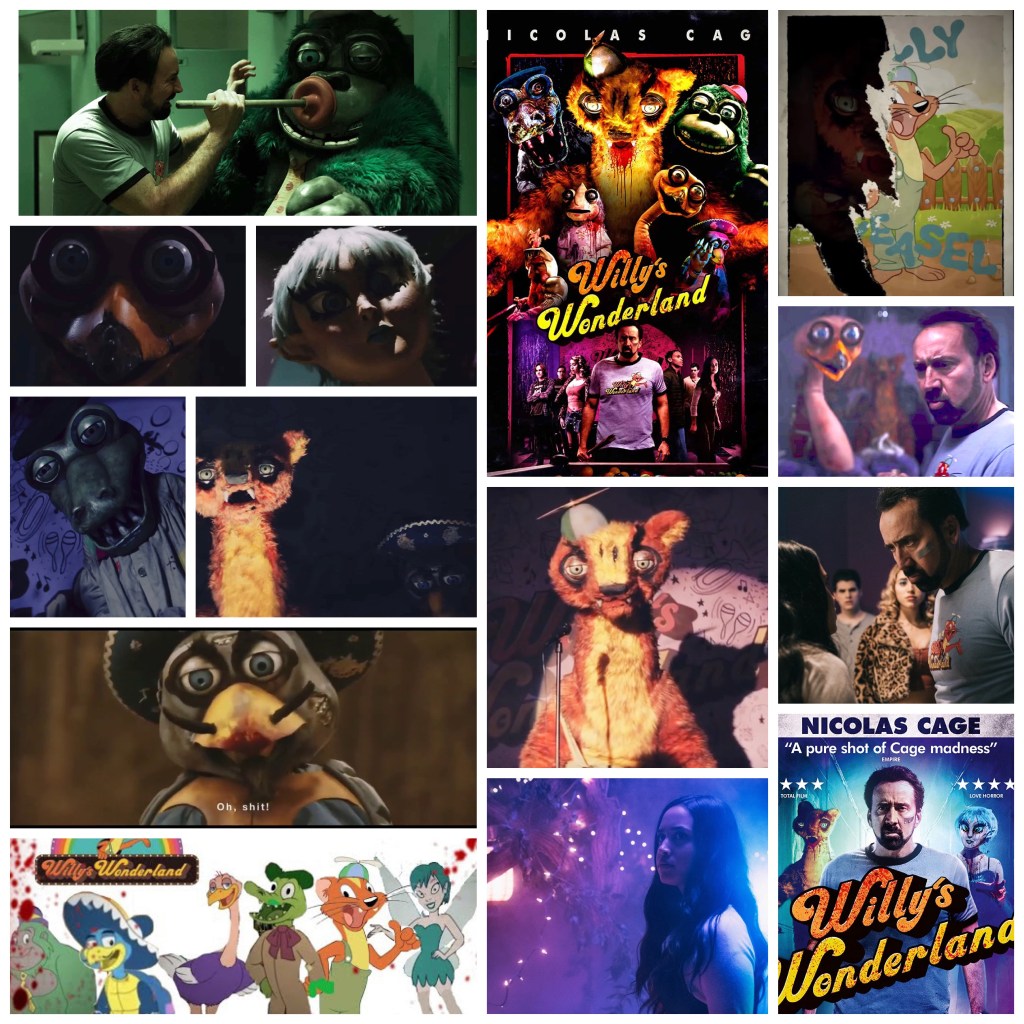
I never thought I’d live to see Nicolas Cage violently tune up a giant plush gorilla with a toilet plunger and curb stomp it’s head onto a urinal, but here we are. Willy’s Wonderland is an absolute bonkers blast, the kind of delirious, fucked up, funny as hell, gory as shit horror comedy I haven’t seen the likes of since the original Evil Dead. Now, I’m not sure what the rights or relationship situation is to the video game Five Nights At Freddy’s because this is clearly very much inspired by it, but that aside this finds it’s own demented groove, devilish mythology and wicked funny dark humour. Cage plays a mysterious, mute drifter who takes a night job cleaning a creepy, rundown Chuck E. Cheese restaurant to pay off a mechanic debt but it’s clear that the inbred yokels of this backwater enclave have a more sinister agenda, starting with the no nonsense sheriff (Beth Grant, Speed, Donnie Darko). Sure enough, the seemingly dormant animatronic toys are possessed by evil spirits and come to life at night with plans on killing Cage. What to do? He springs into silent but deadly action and beats the ever-loving fucking piss out of these loud mouthed Fisher Price rejects in what can only be described as an experience of pure unfiltered pandemonium. Meanwhile outside the restaurant a group of local kids prepares to pour gasoline and burn the place down in attempts to end the evil forever. This is Cage’s show and he’s a tornado of charisma even with no dialogue, guzzling down soda pop and dancing around pinball machines when he isn’t ruthlessly and violently decimating the animatronics, who all have interesting and creative designs from an ostrich to a medieval Knight to a Mexican mariachi turtle (lol) to Willy himself, a giant leering weasel with an elongated neck. The unnerving theme song and all of the musical numbers belted out by this demonic cabal of zoological burnouts are all written by experimental multi-musical artist Emoi and they all pop for a soundtrack that sets the cheeky tone perfectly. The story, although completely ludicrous, somehow feels engrossing and believable in a manic, bizarro world kind of way and every actor knows what kind of script they’ve been handed and does a terrific job with the humour. It is what it is man, if you came to see anything other than Nic Cage tangle with animatronics you’re gonna disappoint yourself but I’ll tell you this much: this could have been cheap lazy trash built around a gimmick they expected to sell itself. It isn’t. The gimmick is just the diving board, and the film itself is a genuinely well written, acted and executed piece that’s impressive and fun beyond being ‘just that crazy Nic Cage flick.’ It’s even legit scary in a few places, which is did NOT expect. So buckle up.

-Nate Hill

THE TOBE HOOPER FILES: THE TEXAS CHAIN SAW MASSACRE (1974)

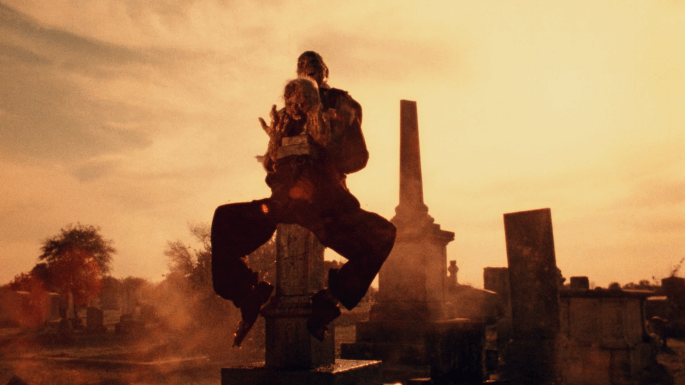
If Eggshells was Tobe Hooper’s way of showing Texas as a hospitable place where the entrenched past and the progressive future could find an uneasy truce in the name of peace, love, and harmony, then The Texas Chain Saw Massacre, his sophomore effort from 1974, aims to tear all of it down with shocking abandon. From the iconic opening flash shots of graves being desecrated to the tightly-wound, climactic ending, director Tobe Hooper and co-screenwriter Kim Henkel give the audience absolutely no breaks, immersing viewers in a cinematic world far beyond nature where exactly nothing is sacred.

In terms of plot, there may be no simpler film in the horror genre than The Texas Chain Saw Massacre. Five young people travel to a dilapidated family homestead out in the wilds of rural Texas and fall victim to a neighboring backwoods clan of cannibal ex-slaughterhouse workers.

Gosh, it feels really stupid to reduce the film to just its structural elements because recounting the broad outline of the film is kind of like calling a Jaguar “a car”; you’re not technically lying but you’re vastly underselling the product to a stupid and irresponsible degree. Yeah, The Texas Chain Saw Massacre is exactly as described and is more or less what you think you’ll be getting but it also achieves the absolute impossible by transcending the medium, establishing itself as a true nightmare printed on celluloid. It’s not that The Texas Chain Saw Massacre is a masterpiece of modern horror, it’s also that it’s the greatest horror film ever made and the clear victor in a race that’s not even particularly close. While Jaws did a number on people and shaped their attitudes about going to the beach, in reality there are only so many spots in the U.S. where a practical fear of sharks can really take hold. On the other hand, there are countless miles of country roads and rural highways dotted with the barest signs of civilization and The Texas Chain Saw Massacre roots itself in the mind in a way where each one of those dilapidated or barely functioning dwellings becomes suspect.

The Texas Chain Saw Massacre exists in a landscape where things are once close and a great distance; a place where time slips from day to night and back to morning in a sweaty compression. In Texas, the normal Jeffersonian survey grid that covers about 90% of the rest of the United States gives way to the weird, claptrap geometry of surveys and abstracts but this film exists in a land that feels even beyond that nonsense, landing somewhere totally uncharted. Geographically, it is a barren place where there is nowhere to turn when looking for solace or relief and where the characters are trapped between the two poles of a farmhouse and a gas station. There was a swimming hole that could once be found if you took the trail between two old sheds but it now leads to a dried out canyon of rocks and wild sunflowers. The only people who provide comfort and help are passers-through and absolutely are not native to the region. The only things on the radio are news reports about unspeakable horrors across the globe and twangy country music, all seemingly on a constant loop both day and night. Everything operates behind infinite curtains of unforgiving heat waves.

Conventions straight from gothic literature, specifically the examination of folks who untether themselves from society and live in a vacuum out in the middle of nowhere, are updated and amplified and contrasted with modernity in the guise of the post-Eggshells hippies in a van. We are forced to size up the primitive family with their more civilized counterparts and wonder why we get so much glee when Leatherface (Gunnar Hansen) digs his chainsaw into the gullet of the whiny, needy, and disgusting Franklin (Paul A. Partain), invalid brother to final girl Sally (Marilyn Burns) who, in a Freudian move pulled off no less than two times, quite literally points three of his peers (Terri McMinn, William Vail, and Allen Danzinger) in the general direction of their doom as if he were being subsidized by Leatherface’s clan to do such a thing.

The Texas Chain Saw Massacre is a film made up of memorable moments both great and small. Pam approaching the house as the camera tracks under the swing as it looms larger and larger like a giant that is about to swallow her whole; the corner of room packed with an animated, spindly nest of granddaddy long legs; the beautiful and darkly comic moment where the Old Man (Jim Siedow) confronts the Hitchhiker (Ed Neal) in the middle of the road, beautifully and macabrely backlit by the headlights of a pickup truck. One of the film’s greatest centerpieces, namely the introduction of Leatherface, is shocking and displays one of Hooper’s most favorite cinematic ideas (and one to which he would return time and time again) which is the unholy center of a world infested and rotten. As the set up is one big layered journey into hell and his initial appearance comes as a cold shock to the audience, Hooper parks it on the outer edge and plays the audience out to an unbearable level of discomfort, finally forcing the audience to simmer in the same paralyzed shock of Pam who sits dumbfounded among the detritus of bones both of animal and human origin after she literally stumbles onto same. Once orientated, Hooper springs the trap from the hell within the hell as Leatherface bursts out from behind the metal door, snatching Pam back into the house as she is trying to escape, her legs akimbo and lungs tearing themselves in half from her screams of terror that turn into screams of excruciating pain upon being unceremoniously hung on a meathook.

Employing a subjective camera that floats along the overgrown brush and looks out from the inside of roadside edifices as if something bigger and unseen is slowly deconstructing the known universe and all the logic and space that holds it together, Hooper and cinematographer Daniel Pearl set the audience on edge by hinting at something omnipresent that’s always observing even if the audience never actually sees it or knows what it is. Additionally, Hooper forces the audience to puzzle out just what exactly going on with the slaughterhouse family. Where every other Chainsaw film wears its cannibalism like a badge of honor bordered in bright neon, Hooper’s original keeps everything opaque with pieces of evidence floating about in a hazy, nightmarish rush that are never explicitly discussed but gel once one’s bearings are brought back center.

On a technical level, there is just nothing like The Texas Chain Saw Massacre. While every other Chainsaw film has tried to recreate the ghoulish interior of the family house, none have even come anywhere close to achieving the kind of natural sense of a completely functional yet terrifying place as Robert Burns created and dressed it in 1974. In every other Chainsaw film, the house feels like a trapdoor-festooned dark ride developed by professional funhouse workers, completely inorganic and phony. The cinematography is nightmarish which seems pretty upside down given than half of the film takes place in the daytime but the palpable heat and humidity almost mixes with the 16mm color-reversal blowup to create something chemically upsetting to look at yet entirely alluring all at once. Hooper and Wayne Bell’s musique concrète score is jangling and knows how to create a forever disquieting sonic atmosphere and the sound design finds the most upsetting of tones and puts its foot on the gas. While the special effects are all great, John Dugan is under some aging makeup courtesy of W.E. Barnes that’s some of the best stuff I’ve seen this side of Dick Smith and can’t help but impress given the film’s budget.

The Texas Chain Saw Massacre is a perfect film. It holds not one wasted shot, not one bum performance, and not one extraneous minute. Not one seam shows in its disorienting, maddening, uncomfortable, oppressive, and apocalyptic vision. There will never be another film like it nor will it ever find an equal. Tobe Hooper never came anywhere as close to hitting the heights as he does here but it really doesn’t matter as he could have directed nothing but industrial videos on 3/4” videotape for Honeywell for the rest of his life and gotten into director’s heaven and any and all halls of fame for just gestating The Texas Chain Saw Massacre. And that’s that.

(C) Copyright 2021, Patrick Crain

RL Stine’s Fear Street

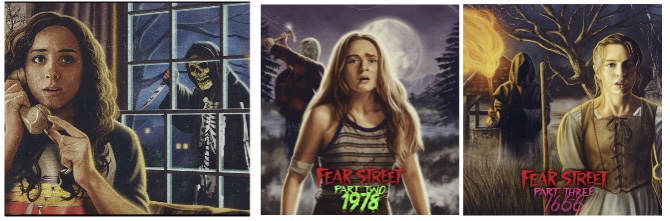
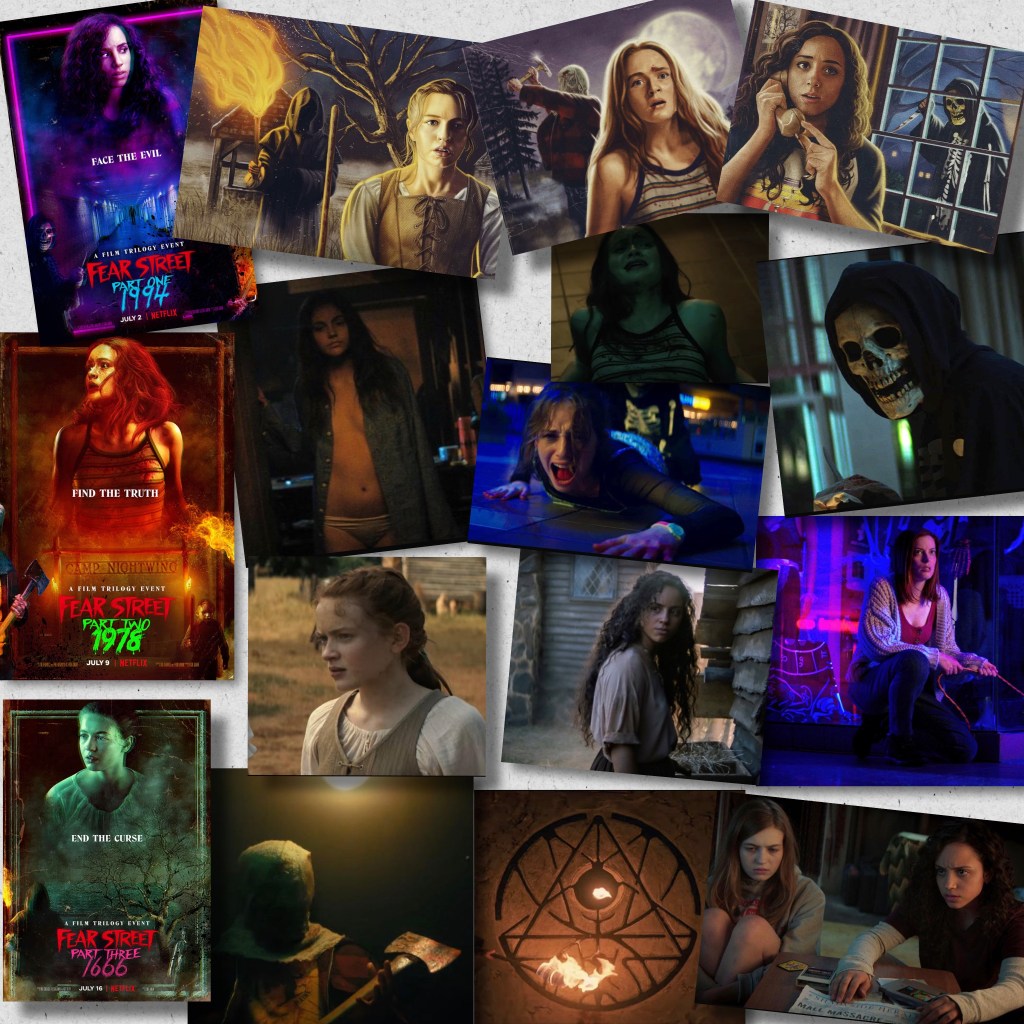
Netflix has tried a somewhat innovative and unique experiment with their film adaptations of R.L. Stine’s Fear Street books, filming an entire interconnected trilogy and then releasing them week by week like a running serial of feature length films. The effect is genius both in terms of marketing and the stories themselves and the only thing that would have made it better is if we got to see them week by week on the big screen, like a triple dip multiplex experience. The films are wonderful, three different slasher flicks set respectively in 1994, 1978 and 1666 with a neat double-back to the 90’s again as the last film wraps up the multigenerational, complicated tale of an evil curse placed on the hard-luck town of Shadyside, OH. As a group of teens in 94 scramble to figure out what’s causing some townspeople to go on murderous rampages, the second film takes us back to summer camp 78’ as the generation before them experiences the same killers who seem to be controlled by some kind of powerful force, and the third goes even farther back to the pilgrim settlers that first came to the region as we finally get to the root of what’s causing these century long killings spurred on by what seems like an evil witch, until we learn the real reason which is far more scary and sad. 94 presents to us a stunning opening sequence set inside an appropriately retro shopping centre complete with neon decorations and a masked killer inspired by Ghostface, while 78 offers a nice riff on stuff like Friday The 13th and Sleepaway Camp and 66 goes for a devilish spin on Salem-esque cultish witchiness. Despite all these stylistic influences and homages and an appropriately nostalgic soundtrack lineup full of crowd pleasing anthems of their day, this trilogy strives to be its own thing and not sink too deep into the waters of retro fan service without having an original voice of its own. The characters here are all terrifically developed and wonderfully acted by a massive cast full of familiar faces and relative newcomers alike and the whole thing is as fun as a gong show Halloween house party, as insanely gory (some of the kills are downright shocking) as we like our slashers to get, as down to earth as our favourite social commentary horrors and as deeply tragic and heartbreaking as horror should often be. Great stuff all round.

Nate Hill

David Cronenberg’s The Dead Zone

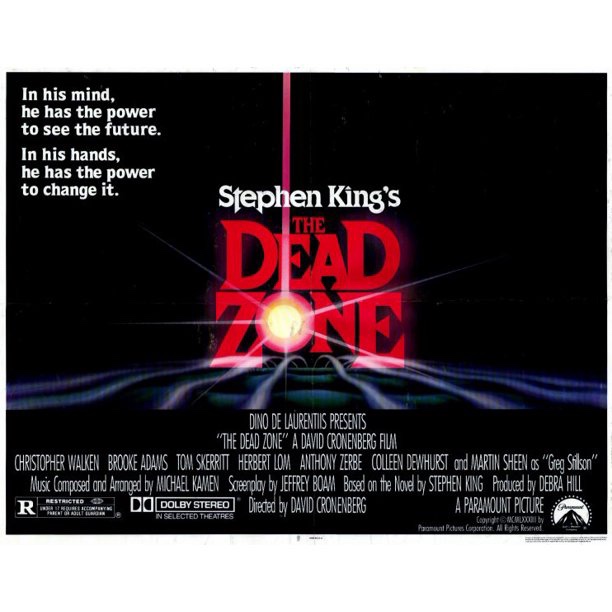
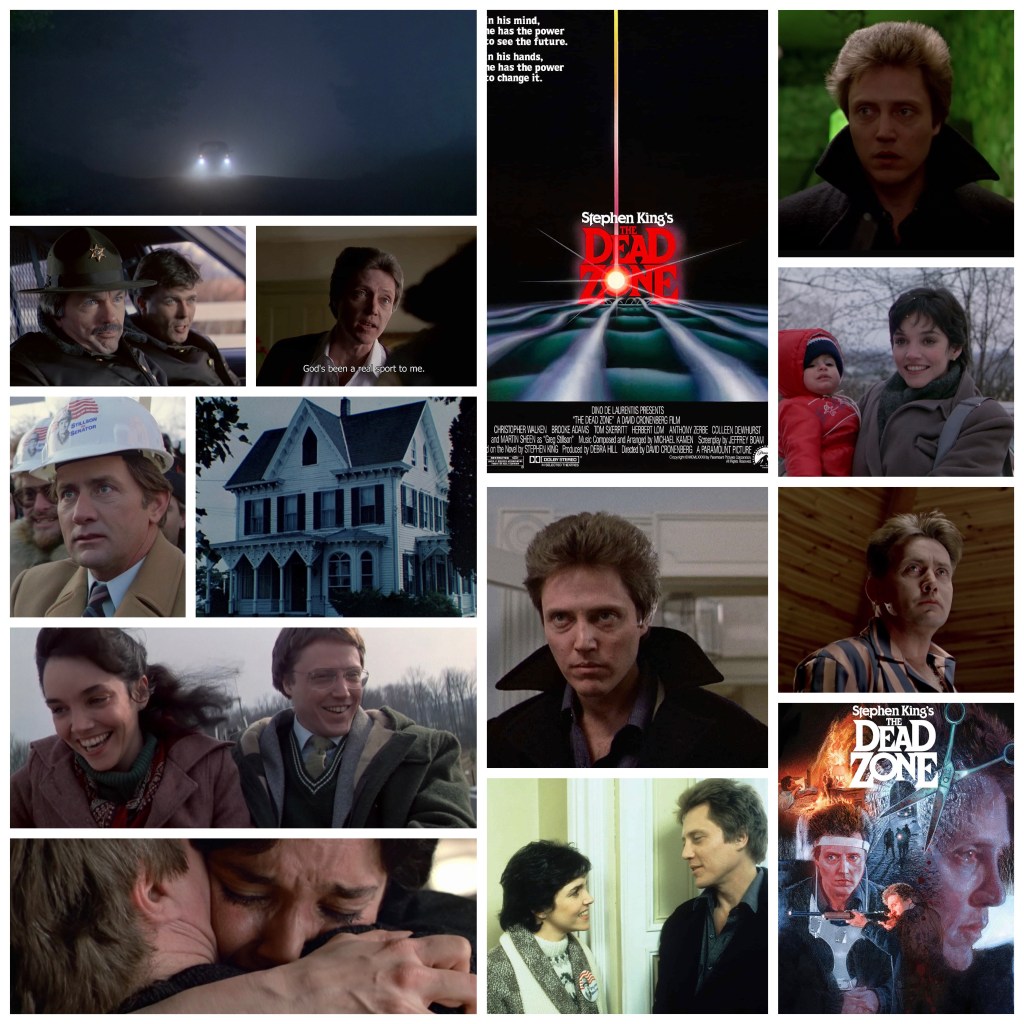
The Dead Zone is the combined efforts of three artists who can only be described overall as a trio of the most extreme storytellers of their day, Stephen King, Christopher Walken and David Cronenberg. It’s a bold, counterintuitive and brilliant move on all parts to then make this a restrained, humane and warm-hearted piece of compassionate thriller filmmaking, despite having the aura of a classic horror film. Christopher Walken gives one of his best, most soulful performances as Johnny Smith, a mild mannered schoolteacher who is blessed/cursed with the powers of spooky clairvoyance after a cataclysmic car wreck leaves him in a coma for five years. He can now sense the future, past and ill fated destiny of others around him based on touch, an ability that can save many lives but also has a draining effect on his own spirit forces. As he helps the local sheriff (Tom Skeritt) track a vicious serial killer, tutors the neurologically challenged young son of a rich businessman (Anthony Zerbe) and has growing suspicions about an overzealous, obviously sinister politician (a smarmy as hell Martin Sheen) running for senate, he tries his best to reconnect with the former girlfriend (Brooke Adams) who remarried during his coma and pick up the pieces of his life. Walken is excellent and reins in his usual eccentricities (apart from one brief, shockingly hilarious outburst) for a subtle, restrained and heartbreaking portrayal akin to his award winning turn in The Deer Hunter. Johnny isn’t a warrior, cop, leader or hero, he’s just a quiet schoolteacher who finds himself thrown into this extraordinary situation and has to deal, and Walken’s shy, awkward and otherworldly presence brings this to life wonderfully. The film is shot in rural Ontario during wintertime and as such there’s an icy, eerie blanket of small town atmosphere over everything, made thicker by a beautiful Michael Kamen score that lays on the orchestral swells and quirky, spine chilling experimental cues in perfect musical symbiosis. This is King at his kindest, with an ending that although is appropriately bleak, still has a sorrowful heart to it and not his often cynical, hollow hearted touch. It’s also Cronenberg at his most character based, ditching the body horror to explore the psychological strain a phenomenon like this would exert and taking a long breath in his otherwise hectic, gooey career to compassionately explore a character alongside Walken who is a dark angel revelation as Smith. Sensational film.

-Nate Hill