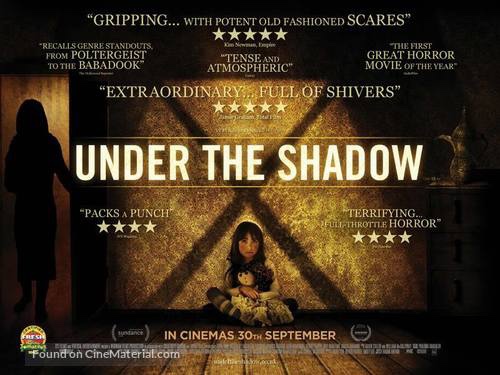
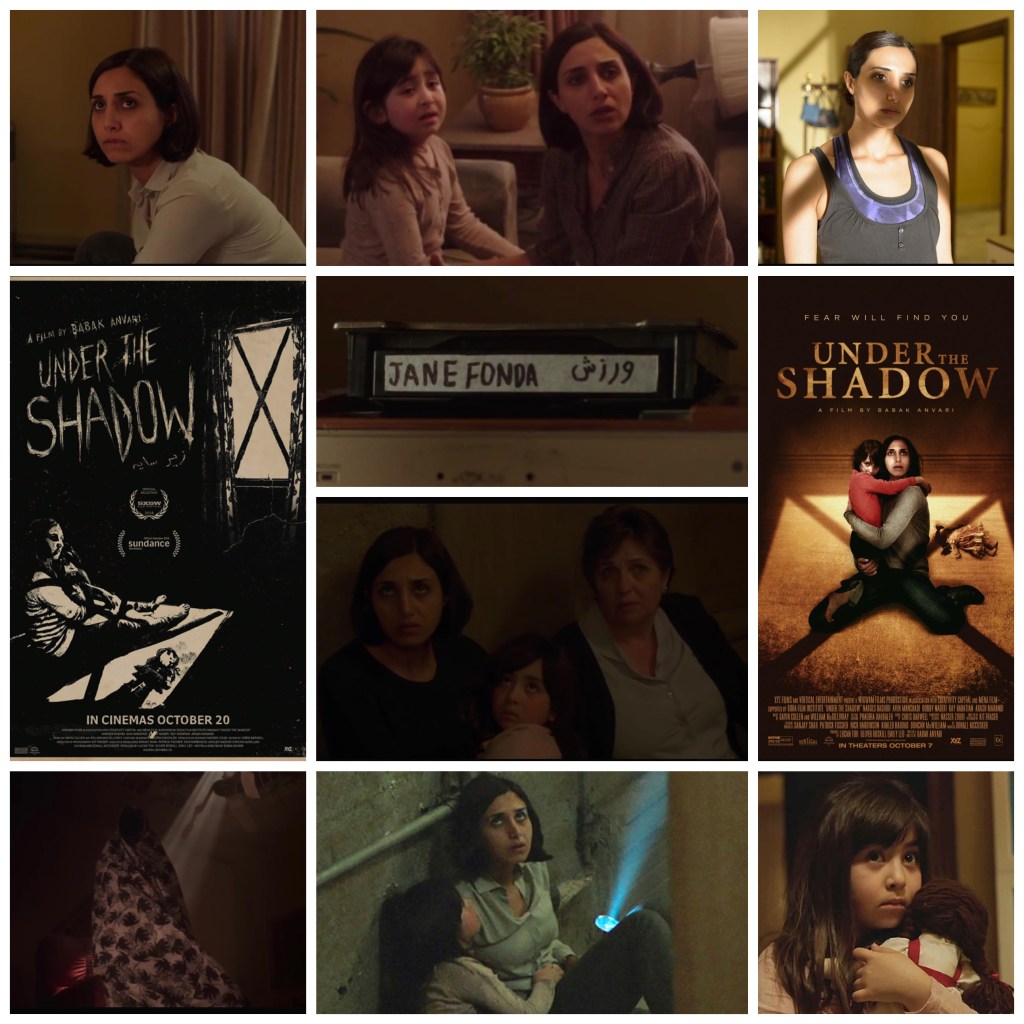
Babak Anvari’s Under The Shadow

I admire ghost stories that set their story around an already troubled region of period of conflict because it raises the stakes unbearably high. If a haunting occurs in tranquil North American suburbia it’s bad enough but can be dealt with on its own terms, but let’s say a ghost or demon shows up during an especially stressful time, in the case of Babak Anvari’s Under The Shadow the Iraq/Iran conflict of the 1980’s, there is an extra level of horror the protagonists must go through on top of their already considerable suffering and it can be incredibly effective in getting you to invest paramount interest and sympathy in the story. In war-torn Tehran, young mother Shideh (Narges Rashidi) struggles when her husband (Bobby Naderi) is drafted in the military and she’s left alone with her young daughter (Avin Mashadi) in a creaky tenement building as air raid sirens signal incoming bomb threats and the mounting tensions get closer to home. One day an actual literal bomb does drop in through the roof of the apartment complex and although doesn’t detonate, sits there like some ugly reminder of the potential violence just outside their walls. Her daughter is convinced that something else came along with it though, something evil and supernatural that rode the same winds that carried the bomb to them and is now tormenting her with night terrors, waking visions and feverish apparitions. There are some flat out terrifying scares in this film, the acting is all terrific and the mythology surrounding the ghost is utterly fascinating. What really makes it a winner though is the atmosphere that Anvari conjures up, a suffocating cloak of wartime dread and bleak apprehension that is completely immersive and will root you to your couch. I love films that start off with a brief written summary on black background like “The year is 1980. Conflict rages across so and so, as one family struggles etc etc.” It’s an incredibly powerful way to begin your story if you choose the right music and lead-in to follow and this film is darkly captivating from the moment those words show up on screen and the first scene fades in. This is streaming on Netflix (at least here in Canada, anyway) and I highly recommend it for fans of chilling atmospheric horror with a grounded human core.

-Nate Hill
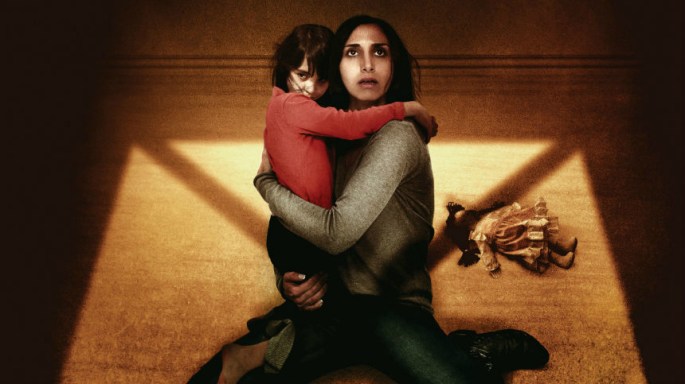
UNDER THE SHADOW (2016) – A REVIEW BY RYAN MARSHALL

UNDER THE SHADOW, the eerie slow-burn chiller that marks the directorial debut of Babak Anvari, indulges in a particularly dangerous dance. It’s a dance of many genres, many aspirations, and many roadblocks, and to be fair, Anvari almost gets us to a point where everything comes together to initiate a satisfying whole. In this sense, he’s already ahead of the game, even if the Iranian-born filmmaker doesn’t always seem content to be playing the field.

Set in post-revolution Tehran during the 1980’s, this macabre tale begins as former medical student Shideh (Narges Rashidi) is denied the opportunity to continue her studies as a result of being involved with Leftist activists in the past. At home, Shideh has plenty to worry about as it is – her husband Iraj (Bobby Naderi), a doctor, tends to openly undermine his wife’s achievements and their daughter, Dorsa (Avin Manshadi), often retreats to a fantasy world that she believes in a bit too much – while the war rages on outside.

undertheshadow1-1600x900-c-default1

Iraj’s medical assistance is needed in the heart of the combat zone and he must leave his family in the city for an extended period of time. Soon after his departure, a missile lands on the apartment directly above theirs, resulting in the death of one of its elderly tenants. Following the incident, Dorsa’s behavior becomes slightly erratic. She loses her favorite doll and constantly searches for it inside and outside of the apartment, believing that its disappearance is linked to a malicious spirit known as a “Djinn”, which may have possessed their home.

Shideh’s initial reaction is to chalk it up to an over-active imagination, but then terrifying visions begin to plague her fragile psyche during both night and day alike, and she finds herself, much like her child, no longer able to discern reality from fantasy. Anvari handles her struggle to reclaim individual strength and identity with grace, crafting an at times clever and never less than engaging feminist parable. In terms of social-political context, it uses its monster as an obvious metaphor for the ramifications of war, and it’s in this realm of lingering, impactful terror that UNDER THE SHADOW exceeds.

under-the-shadow1

It’s also here that it tends to stumble. The film is at its brooding best when embracing the power of implication, patience, and silence all at once, but its alternating concepts of fear seem, at times, contradictory. On one hand, it makes a conscious effort to be intelligent genre fare, seldom resorting to cheap shock tactics and utilizing the widescreen compositions to their maximum, anxiety-ridden potential; but there are also far too many instances in which initially effective sequences amount to little more than underwhelming jump scares. It’s as if whenever Anvari has something beautiful he feels the need to destroy it. This unfortunately also goes for the (thankfully few) glimpses the viewer is granted of the “Djinn” itself, which – mostly due to some pretty lame CG effects – are more ridiculous than blood-curdling, save for a genuinely ominous moment involving an old man and the colossal cracks in the apartment ceiling.

This isn’t a bad film, in fact it’s mostly a pretty good one, but it clearly wants to be so much more than that and there’s absolutely no reason why it shouldn’t be. It’s well made, performed, conceived, overall well-intentioned but one can’t shake the feeling that it’s the work of a director caught up in certain contemporary genre trappings, the kind that tend to obscure a poignant message. Anvari wants to have his cake and eat it too, which doesn’t always have to be a bad thing. It’s a sign of clear ambition and, especially in his case, talent. But next time he’d be best to count his blessings and roll with them rather than drive himself into such a dark, discouraged corner as this.