The Grudge (2020)

American movie studios are wild, man. They’ll remake Asian horror films, pump out a few sequels, and then once they get bored of that they (pauses, takes off glasses and rubs bridge of nose) remake their *own American remake* of the Asian horror like they forgot they even did the initial one in the first place. That’s not to say this bizarre behaviour can’t produce decent horror flicks as a rule but in the case of The Grudge (2020) I’d say they’ve done a pretty terrible job. The 2004 American Grudge film with Sarah Michelle Gellar scared the piss right down my leg at age 14 and despite being desensitized now that I’m older I’d still consider it a well made, effective chiller. But this new version is so all over the place and contains so little of what made the 2004 one so special it doesn’t even make sense to call it a Grudge film. So basically there’s two moody, hard boiled detectives played by the arbitrarily unlikely combo of Andrea Riseborough and Demien Bichir, who are investigating the classic case of a Grudge spirit hovering around a house and the unfortunate folks who are unlucky, stupid or morbidly curious enough to hang around it. There’s Lin Shaye in the Grace Zabriskie proxy role as the dementia ridden old woman who doesn’t know what planet she’s on, Frankie Faison as her desperate husband who enlists a lady (Jacki Weaver) who facilitates assisted suicides, John Cho and Betty Gilpin as a young couple trying for a baby that fall victim (in the film’s single, solitary effective scare, I might add), William Sadler as a disfigured, mentally disturbed former cop who ran afoul of the ghost and others. It has a huge big cast of talented, recognizable and engaging actors who run around in unnecessary subplots doing not much of anything. There’s barely any ‘classic Grudge moments’ and even when there are they feel somehow ‘off’ and not deserving of the franchise name. The single effective scare involving John Cho is a nicely shocking moment with a great choice of where to place the camera, but if your remake of your own remake only has one scary scene and not much else, I think it’s time to pitch the drawing board out the window and completely rethink your approach. It’s beyond me why they felt the need to do this, and make it so overloaded, needlessly elaborate and bereft of what made the initial Grudge film so good.

-Nate Hill
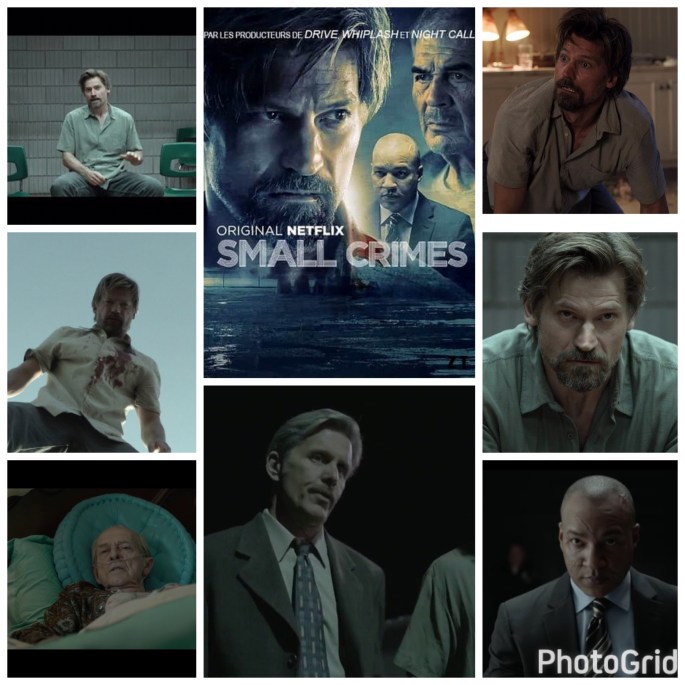
Netflix’s Small Crimes


Netflix’s Small Crimes is a bitter, barren, gnarled piece of work that leaves an uneasy vacuum in the air as it passes. If you haven’t heard of it yet, that’s because the platform does almost zero promotion when new content comes off the assembly line, quietly slipping it onto the site without so much as a tv spot. Some are forgettable, and some are gems that could have done with a bit of buildup. This one is like David Mamet, Cormac McCarthy and Elmore Leonard sipping whiskey sours one cold, empty night and brainstorming ideas. I love the time honoured themes presented here, but what I love and admire more is the filmmaker’s courage in completely subverting, perverting and putrefying the formula. There’s countless films about disgraced cops, criminals or what-have-you who return home to a small town with designs on putting the wrong things right and finding a modicum of redemption. Thing is, in 99.999% of these films, we end up with a happy ending where all the kinks are ironed out and bygones are left as such, a trend which really cripples the stakes and grinds our expectations down with a blunt, predictable Hollywood ending. Not this one. Nikolai Koster-Waldau, aka Jamie Lannister, is a wiry, cracked out ex con who used to be a cop, before he viciously, and I do mean viciously, sliced up the town DA at the behest of a crime kingpin. Moping back into the county following a six year stretch in the pen, it’s inevitable that his very presence will stir up a few noxious vibes. Sure enough, he runs into trouble from all angles, including the vengeful DA (“, looking like he shaves with a wheat thresher), a scummy corrupt detective (Gary Cole eats up the dialogue like candy), the mobsters he used to be employed by, and even his parents (Robert Forster & Jacki Weaver), who are clearly broken by the past. There’s a feeling of inescapable doom, an inevitable choking quicksand that Waldau wades deeper into,

his seemingly noble intent on reconnecting with his wife and daughters gradually ground away to reveal the true nature of his path, and it ain’t pretty. Gary Cole has a way with words and mannerisms, and he runs away with his bent cop role, stealing scenes like nobody’s business. Forster has salt of the earth gravitas in spades, and nails a near career best scene with clear eyed conviction, nailing our attention to his presence. It’s not a perfect film though, there’s pacing issues, sometimes it gets a little vague or scattered and a romantic subplot involving a nurse (Molly Parker) seems glaringly out of place. Waldau anchors it though, a twitchy, unpredictable ne’er do well who seems cosmically incapable of getting his act together. The ending floored my expectations and remind that there is hope for fresh narratives and abstract thinking amongst writers. You’ll come out of this one bruised, but you’ll be glad you sat through the beating. 

-Nate Hill

Peter Weir’s Picnic At Hanging Rock: An appreciation by Nate Hill

  Yesterday I went into HMV, looking for a standard Blu Ray edition of a film I’ve recently seen that has stuck with me since in a way that I can’t quite describe, Peter Weir’s Picnic At Hanging Rock. The only version they had was a pricy Criterion Blu Ray/Dvd combo which also included the original novel which Weir based his film on. Now normally I’m reluctant with Criterion, as I almost always disagree with the films they pick for their releases. Also..it was expensive as shit. But then I remembered how much it affected me when I first watched it on my humble iPad, and realized that I wanted to have the snazziest output that money could buy, as this is one I’ll be revisiting probably until my years on this rock have run out.   At it’s heart it’s a mystery of the deepest primordial resonance, laced with the burgeoning sexuality of its female lead characters, and ultimately leaving an aftertaste of such yearning, mournful sadness that I had no idea movies were even capable of. Weir sets his story in 1900 Australia, with amusing attempts by the British to tame the near prehistoric nature of the land. Their prim, drawn up customs seem ludicrous and surreal in the face of a wild, abstractly formed landscape that meets their need for order and custom with unimpressed chaos. 

  A group of girls from a nearby boarding school embark on an annual picnic to Hanging Rock, an ominous geological gnarl set in a scorched, unearthly swath of land that evokes the feeling one might get from a partially recalled dream of some far off dimensional plane. For the conservative visitors and the audience alike, the surface of the moon might feel more at home. In a gust of unsettling foreshadowing, several members of their party note that their watches have mysteriously stopped at dead noon. A group of four girls venture forth to explore the upper plateau of the rock, promising their teacher Mademoiselle (radiant, elemental Helen Morse) they’ll be back before tea. Four enter the jagged, awaiting maze; two disappear and are never heard from again. It’s an enigma that shakes the foundations of the boarding school to its core. From stoic headmistress (Rachel Roberts) to a tragically abandoned orphan girl (Margaret Nelson, staggering for a girl who’d had no previous acting experience) no one is quite the same after the incident, almost as if whatever intangible forces responsible for the girl’s disappearance have reached out and deeply disturbed every form of life in its vicinity, the very madness of the continent itself driving these civilized newcomers to the brink of soul shaking distress. In spite of the film’s beauty, there are also moments of sheer horror that rival anything in your garden variety fright flick. The key scene where the girl’s are last scene is fogged over with such a feeling unshakable dread, crafted through sound and editing alone, no actual discernible violence or threat. It’s utter genius and you begin to question why you’ve got hordes of goosebumps from so ambiguous a scene, but you’re left snatching for the same answers to a feeling akin to the sensation of a quickly dissipating nightmare I mentioned above. That’s how powerful the filmmaking is… You are shaken without ever really knowing why or what’s the matter, which is really the concept of a mystery distilled to its purest form.

  What claws at your mind and lingers in the fringes of your awareness long after watching the film is its atmosphere of mounting dread, like knowing for certain the the worst possible type of end is coming for you, yet being utterly unable to articulate exactly what it is. The soundscape is thick with melancholic unease as well, evident in a knockout pan flute solo from Georghe Zamfir, providing a hazy chorus that will stand up the hairs on your arm in its beauty and terror. The scenes at Hanging Rock are lifted straight out of a subconscious place and laid down on the canvas of film with the same exquisite care of pressing flowers, which we see the girls doing early on. Film essentially does this: the painstaking preservation of beauty for countless generations to be pleased, terrified and puzzled by. There’s no better version of this film I’d rather have that with than this one.