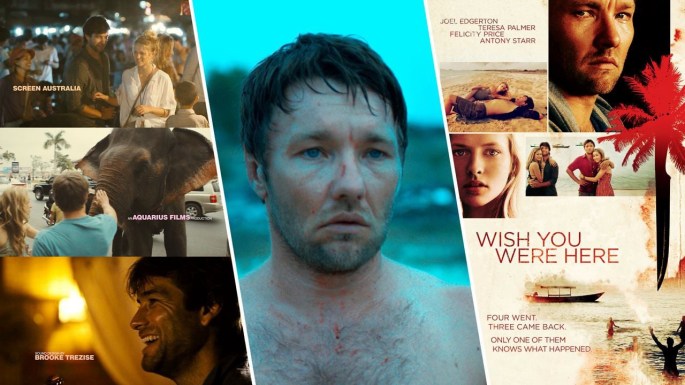
Kieran Darcy-Smith’s Wish You Were Here

How far would you go to keep a secret from your family, the authorities and your whole country if means keeping them safe, even if it also means causing a prolonged international incident? Wish You Were Here is a strikingly well acted and edited Australian dramatic thriller that illustrates how a backpacking vacation can be a once in a lifetime dream experience or spiral out of control into the darkest nightmare. As four people from Sydney venture on a trip to Cambodia together, we observe only three of them return, and the devastating psychological and emotional aftermath the disappearance causes once they get home to Australia with no answers as to what happened. Joel Egerton and Felicity Price are the middle aged couple who have kids back in Sydney, and joining them is her younger sister (Teresa Palmer) and her hotshot businessman boyfriend (Antony ‘Homelander’ Starr) who is the one that eventually goes missing. The opening of the film is a dazzling, uplifting kaleidoscopic montage of beautiful sightseeing, beaches, smiling locals, delicious street food and moonlit beach parties, and as the film progresses we see a threatening veil of unfamiliarity and dread descend over the story as we flash back, forward and in between the trip to beforehand and after in Sydney until we get a real sense of being ‘out of time’ alongside these characters and their prolonged confusion and pain. One of these four knows what happened, why it happened and where the missing boyfriend is, and the intelligent, rewarding narrative shows us four human beings dealing with betrayal, lack of closure, fragile relationships and the ensuing chaos that comes from a vacation in a foreign land gone terribly wrong. Egerton is strikingly raw and vulnerable here in maybe the best performance I’ve seen him in as a man stuck in an unthinkable situation. Price and Palmer are equally affecting and each of the three keystone performances from these leads are simply staggering. The narrative shows us glimpses of the central mystery before doubling back and preparing us all over again with additional flashback information we didn’t have before and now sheds more light on what we’ve seen and then are about to see moving forward into the haunting final act, it’s a shifting puzzle-box experience that drew me right in. I haven’t really heard this film talked about much and didn’t even know it existed until I came across it on Amazon Prime, but I would highly recommend it for fans of mature, emotionally intelligent interpersonal drama with thriller sensibilities and a story that keeps you guessing but also, more importantly, has you feeling deeply for its characters. Brilliant stuff.

-Nate Hill

Red Sparrow

I really didn’t want Red Sparrow to be the dud everyone says it is, but.. yeah it is. I mean, I’ve got love right off the bat for a hard R rated spy flick released by major studios, and this one earns it’s R rating so much so that it’s nasty business to sit through. I just wish it had the aptitude to be more than a cold, unremitting series of events that go far beyond unfortunate. More than anything I’m just proud of Jennifer Lawrence for taking on such a dangerous, vulnerable role, she’s a natural born star and any project she’s attached to is lucky to have her. She just had the shitty luck of her immense talent being drowned in a sea of sadism and ultimate boringness here, which is a shame. Playing a Russian ballet dancer who’s career is cut short by an injury, her shady pervert uncle (Matthias Schoenaerts) recruits her for Sparrow School, a twisted spy academy that focuses on sex as a weapon, where she undergoes rigid, perverse training under the stern watch of Matron (Charlotte Rampling, terrifying). This is all run by the government in secret, and soon she becomes involved in a confusing cloak and dagger operation involving American agent Nate (Joel Edgerton), which frequently sees her in degrading, sexually violent situations that seem a bit excessive after a while. I’ll always champion R rated films and there’s some wicked bloody action here involving her training, but the lurid psychosexual stuff is kind of sickening and seems tacked on like a pornographic sheen. The cast is alarmingly first rate, with work from Joely Richardson, Ciaran Hinds, a bored looking Jeremy Irons and a drunken cameo from Mary Louise Parker. No one seems to really fit into the story though and the film struggles to hold our attention beyond just being in shock and actually giving a shit about the story, which is grey and lifeless. It also can’t decide on it’s setting either; everything about the film screams 70’s/80’s Cold War era, until Rampling’s character refers to the West as fixated on shopping and “social media”, which sounds suspiciously like a line that was added in reshoots to try and update a preexisting setting, the worst kind of continuity error because it’s deliberate. There’s literally not a single cell phone visible at any time!! Cmon guys, get your shit straight. It’s sad because there’s a lot of sumptuous atmosphere here that goes to waste, as does a magisterial score by James Newton Howard. The biggest crime here though is how great Jennifer Lawrence is in the role, and how royally the film just lets her down. She’s resilient, tough and smart running down a gauntlet of predators, assassins and danger, but none of that is as good as it sounds, and she deserves better.

-Nate Hill

Antoine Fuqua’s King Arthur

I’ve been singing the praises for Antoine Fuqua’s King Arthur for years, but here’s the thing: you simply have to watch the extended director’s cut, it’s a different film entirely than the theatrical. Expanding both on complex moral quandary and lethal, bloody carnage, it allows ideas, expression and extreme violence to play out in a cut free of time and rating constraints, and as such is one of the best sword/battle flicks I’ve ever seen. The main buzz surrounding this one was how much of a departure it is from the usual Arthur lore we’re used to.. darker, grittier, more tied in with Ancient Rome and bereft of any lighthearted fantasy, it may as well be its own thing untethered of any Arthurian scope, because who can really say how it all went down back then anyways. Here Arthur is a restless, stormy Sarmatian knight played by a hot blooded Clive Owen, a fearless, jaded warrior who is steward to a rowdy troop of loyal swordsman forced by the empire to serve out fifteen years of service in exchange for freedom at the end of it all. Each of his troupe is played by a stellar actor, and each blessed with their own distinct, fully formed personality. Headstrong Bors (The always awesome Ray Winstone), dysfunctional Lancelot (Ioan Gryffud), lethal Tristan (Mads Mikkelsen, probably the coolest of the bunch), stalwart Galahad (Hugh Dancy), mischievous Gawain (Joel Edgerton) and strong, silent Dagonet (Ray Stevenson). They’re a wickedly diverse bunch of warriors, lovers, brothers and each has their own carefully carved out view on freedom, the Romans, life on the battlefield and ancestry, just a few of the themes explored deeply by the consistently surprising script. This film is notorious for its portrayal of Keira Knightley’s Guinevere, a bikini clad warrior whose appearance in the third act eclipses what is actually a really well written character, is unfairly panned based on a few brazen costume choices. Arthur and gang are up against a fearsome Saxon army led by Cerdic (stellar Stellan Skarsgard), a bloodthirsty maniac restlessly looking for his equal on the battlefield, which he finds in Arthur once they duke it out. Merlin is a tree dwelling mystic played by an unrecognizable Stephen Dillane, the round table in a dilapidated version of the glory found in books, and the knights resemble rough n’ tumble mercenaries more than the glowing reputation they’re given in classic lore. Sure, it’s a different take, but I for one really like the gritty, hellish aura surrounding the whole thing, it’s a brutal and risky departure from anything close to Disney and I applaud them for it. Better still is the way morality and philosophy are explored through the character’s actions, until we have a clear picture of Arthur as a realistic, hands on hero who isn’t afraid to get violent to prove points. The set pieces and swordplay are breathtaking, from a tense stand-off set on a deadly frozen lake to the final spectacular battle, each knight getting their chance to nail some superb fight choreography and draw gallons of blood. Hans Zimmer provides one of his most surging, palpitating thunderclap original scores, it’s up there with his best work and rides right next to the knights into battle with symphonic glory that just begs for a surround sound system to play on. I think this got so shit on because critics are usually only privy to the theatrical version right out of the gate, and first impressions cement reputation for years to come. Once again, the director’s cut is really the only way to go. It’s bolder, longer, more violent and sensual, and just tells the best version of the film’s story that it can.

-Nate Hill