B Movie Glory: Mojave Moon


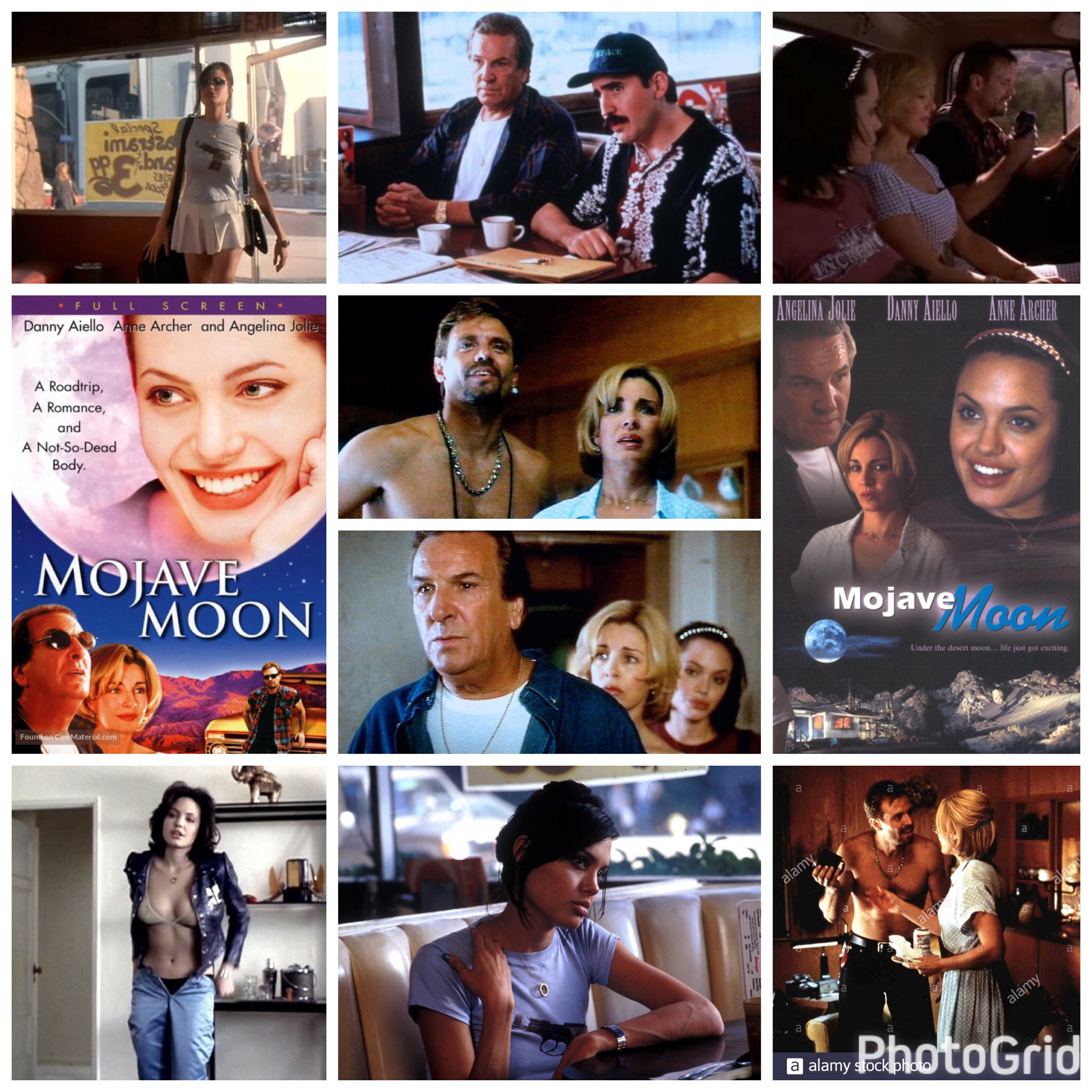
Before Angelina Jolie blew up front and centre, she got her start in some wild and wacky b movies and genre stuff, the weirdest of which has to be Mojave Moon. It’s one of those low rent flicks where not much of anything happens, the characters meander in and out of a non-story and almost everyone is completely nuts. ‘B movie dramedy’ I suppose would be the specific sub-genre. The ‘story’, as it were, follows drifter Al (Danny Aiello), who meets pretty young Ellie (Jolie) in a diner and hitches a ride out to the desert for seemingly no reason at all. As Ellie takes a shine to him, he begins to fall for her mother (Anne Archer). Only problem is, her mom has a boyfriend played by Michael Biehn who is quite possibly one of the weirdest characters I’ve ever seen in a film. Volatile, berserkly unstable and constantly in near hysteria mode, it’s an odd performance that off-sets the quirky tone straight into the twilight zone. That seems to be the idea here though, the dreamy desert climate having a strange effect on these folks, causing all kinds of outrageous behaviour and scenarios. The town offers a rogue’s gallery of characters including Michael Berryman, Alfred Molina, Jack Noseworthy, Peter Macnicol, John Getz, Michael Massee and others, all of whom don’t really do much other than show up, act weird for a bit and then wander off again. I like this type of film though, purposeless other than to languish about with characters who don’t want much, their arcs sputtering in a flatline of small town doldrums and behaviour that only makes sense to them. It’s not for everyone, which is why no one really gives credit to this stuff, but it’s enjoyable once in a while, when you’re in as strange a mood as the residents of this one horse sideshow of a town. 

-Nate Hill

James Cameron’s Aliens 


Each of the four Alien films has their own distinct and noticeable personalities. Ridley Scott’s original creeping horror show is a tense, streamlined, gracefully vicious film that slinks along at its own pace, not unlike the resident feline Jonesy who wondered about on the spaceship Nostromo back then. If Alien has the qualities of a cat, James Cameron’s Aliens has those of a rambunctious puppy dog, a rip snortin, go get em action backyard barbecue knockout that runs up and gives the audience a big wet slimy kiss. All animal metaphors aside (I’m running out of oh-so-clever ways to open my reviews, ok? Been at this shit for two years now), Cameron’s film is an undisputed classic, still jaw dropping to this day, even after what feels like hundreds of viewings, nostalgic yet fresh in different ways every time, and simply one of the best films ever made. It’s the gold standard for creature feature sci fi too, and while many argue whether or not it in fact outdid Scott’s original white knuckler, I can’t bring myself to be petty and pick favourites out of the quadrilogy, I love them all for a whole bunch of reasons. Aliens picks up quite a while after the catastrophic events of the first, with Ripley floating around in that cryo-pod for way too long, until she happens to cruise past earth, crossing the vision of the Weyland/Yutani corporation once again. Because they always make astute, well thought out choices, they decide to send a research team, accompanied by a very reluctant Ripley and a group of hoo-rah, bull in a China shop colonial marines to far off industrial exomoon LV-426, where they have lost communication with the settlers. After a brief, clammy build up, all hell breaks loose, and we get to see the full impressive extent of Cameron’s skill as a visual storyteller, as well as the oh-so-gooey, inspire practical effects work that brings those gorgeous Xenomorph beauties to snarling life. The cast is the epitome of badass, as we are constantly reminded of by Bill Paxton’s Hudson, the film’s resident squirrel who gets hilariously skittish when things get dicey (“game over, man!” Will never not out a big, Paxton sized grin on my face), but who heroically holds his own once he gets his sillies out. The other side of that coin is Corporal Dwayne Hicks (Michael Biehn, never slicker), cool as ice, shaken by nothing, including an atmosphere entry landing that would make Alfonso Cuaron pee himself, but doesn’t come close to disturbing Hick’s afternoon nap. Every Alien team must have an artificial human, some of which are trustworthy, and some not. Lance Henriksen’s Bishop is as solid as they come, never losing his head (despite being reduced to a puddle of spilt dairy product) and sticking by Ripley’s side until the bitter, hectic end. Ripley herself is a little older, a little wiser and a lot tougher, her intensity calcified into grit after losing her daughter, and given somewhat of a surrogate in the form of Newt (Carrie Henn) an orphaned child who has survived months living like a rodent in the air ducts. “They mostly come at night… mostly” she eerily warns Ripley. Oh boy, do they ever. LV-426 is positively teeming with them, and they show up to provide speaker shattering, pixel scattering action like only Cameron can do. The facehugger in the room sequence is still one of the most terrifying sequences in any film, and serves to make you hate Weyland weasel Burke (Paul Reiser) with that deep loathing reserved for the scummiest traitors in film. The final thirty minutes of the film are a showcase of action cinema, and it’s amazing to think they pulled off the Queen fight without any cgi back then, a slam-bang marvel of a climax that fires on a thousand cylinders, and to this day has never been topped. That goes for the film too. It’s *the* action sci-fi film, and as close to perfection as you can get.  
-Nate Hill

Malevolence: Bereavment- A Review by Nate Hill 

Back in 2003, director Steven Mena made an ultra low budget slasher effort called Malevolence, chronicling the brutal crimes of a kidnapped child named Martin Bristol, who grew up watching his abductor commit heinous murders in front of him, and as such became a monster himself. The torch of evil was passed, but we never got to see those early years and the inciting incident which led to such madness. Cue a prequel, entitled ‘Malevolence: Bereavment’, a detailed, suffocating and very, very disturbing account of Martin’s childhood initiation into the life of a serial killer, under the wing and at the hands of a madman named Graham Sutter (Brett Rickaby, a walking nightmare). He snatches 6 year old Martin (Spencer List) from a backyard swing, with designs on naming him as both protégé and acting as mentor, kidnapping locals in the area and subjecting them to unspeakable acts of violence and psychological experimentation, all in the name of some illusory philosophy that only makes sense in his diseased psyche. Meanwhile, a young girl (early work from Alexandra Daddario) moves into town to stay with her estranged uncle (Michael Biehn) and his family. While she tries to wade through a romantic coming of age story involving a local boy, events surrounding the killer’s actions get perilously close to everyone, and erupt into one of the most stressful, harrowing chain of events I’ve ever seen in a horror film. Biehn is Hollywood’s resident badass, but the genius in casting him here is that not even he is a match for Sutter’s tedious reign of terror, and it’s in such contrast that the film strikes despair right down to the bones. Sutter is barely human, with ninety percent of his dialogue spent on indecipherable rambling, making us feel all the more alienated by the fact that the only other human being around to soak up this toxic output is poor young Martin, on a clear path to mental destruction. These scenes are as lonesome and depressing as the acrid rural vista in which this all unfolds, and while we’re thankful for atmosphere and setting, we can’t wait to get out and breathe fresh air by barely the halfway mark, lest we choke on such overpowering despair. Keep an eye out for genre legend John Savage in a crotchety cameo, providing the film’s single iota of comic relief. As much of a vicious little sleeper as the first film is, nothing quite compares to the sheer bleakness and soul dampening evil they achieved this time around. Don’t go onto this one in a bad mood, it’ll mess you up. 

Cherry Falls: A Review by Nate Hill 

The slasher genre never got a tune up quite like it did with Cherry Falls, a tongue in cheek satire that while hilariously high concept and silly, can actually be pretty frightening, especially during it’s intense climax. Here’s the premise: Cherry Falls is a small town in Virginia that has fallen prey to a masked serial killer. The twist? Said killer is only targeting virgins, which causes quite the uproar. As the high school kids all scramble to get laid before they get laid six feet under, the prudish townsfolk become unhinged and disgusted by the whole affair, and a decades old secret involving some of the town’s best and brightest comes to light, a scandal to rival tr sleazy parade of flesh this murderer has set into motion. Young Jody Markum (Brittany Murphy) has yet to have her cherry popped, and fears for life in between bouts of teenage angst. Her father (Michael Biehn), who also happens to be the town sheriff, wrestles with demons in his past, as well as his own. A schoolteacher (Jay Mohr) scours the town archives for clues before it’s too late. And every horny adolescent tries to desperately get their freak on, providing some of the funniest moments you’ll see in a fright flick. Gymnasium orgies, rampant fornication and all kinds of naughty antics ensue. Nothing beats the faculty meeting where parents violently argue as to who has the sluttiest offspring. Full of in jokes, innuendo and sly sexy humour, this is one of the great overlooked horror comedies out there. 

Tombstone: A Review by Nate Hill 

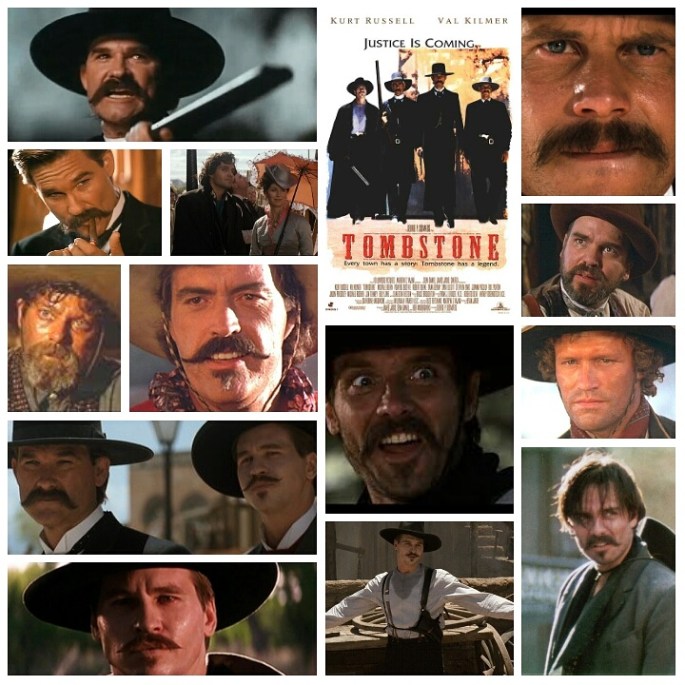
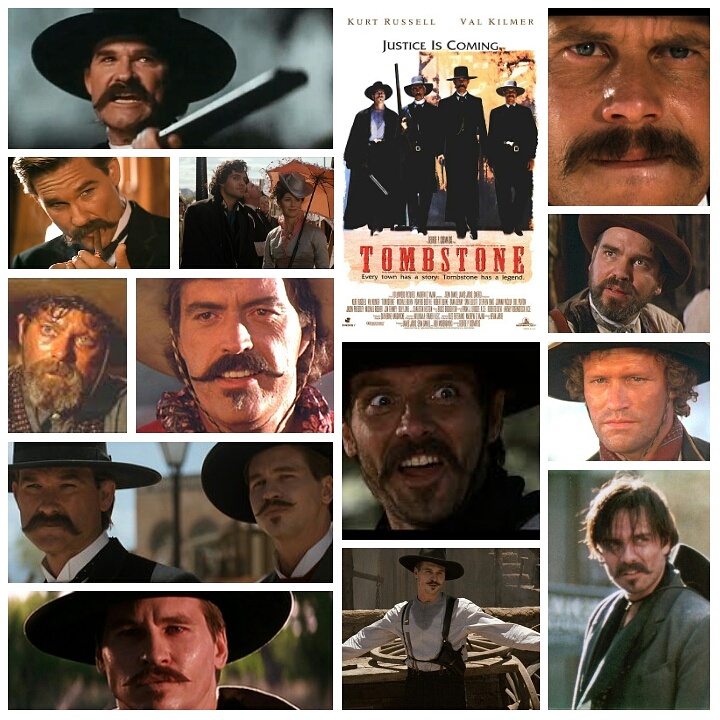
There are two main film versions based on the life of infamous outlaw Wyatt Earp: a serious, sombre one with Kevin Costner (and a whole lot of others), and a rolkicking circus sideshow starring Kurt Russell, bedazzled with a jaw dropping supporting cast that doesn’t quit. Both films are great, but if you held a six shooter to my head and demanded a preference, I’d have to give Tombstone the edge. It’s just too much fun, one wild screamer from start to finish, filled with swashbuckling deeds, evil outlaws and bawdy gunfights galore. It should have been called It’s A Mad Mad Mad Mad World In The Wild West. Kurt Russell is in mustache mode again here, but looks younger and leaner than last year’s western double feature his mutton chops starred in. Along with his brothers Virgil (Sam Elliott) and Norman (Bill Paxton) he arrives in Tombstone with a life of law enforcement in his dust and designs on retirement and relaxation. He gets pretty much the opposite though, when every lowlife bandit and villain in the area comes crawling out of the woodwork to give him trouble. Michael Biehn is the worst of them as crazy eyed Johnny Ringo, a deadly smart and ruthless killer, and Powers Boothe hams it up terrifically as drunken scoundrel Curly Bill Brocius. They are the two main causes of grief for the Earps, backed up by all sorts of goons including Michael Rooker, Billy Bob Thornton and a petulant Stephen Lang as Ike Clanton. Russell is joined by an off the wall Val Kilmer as Doc Holliday, the wheezy southern prince with a silver tongue that’s constantly fuelled by booze. He gives the best work of the film, and it’s fascinating to compare it to its counterpart, Dennis Quaid’s turn in the other version. Theres also great work from Billy Zane, Dana Delaney, Thomas Haden Church, Paula Malcomson, Tomas Arana, Johanna Pacula, Paul Ben Victor, Robert John Burke, John Corbett, Terry O Quinn, Robert Mitcham and even Charlton Heston good lawd what a cast. The standoffs, both verbal and physical, are a thing of beauty and the reason we go to the movies. Of all the westerns out there, this has just got to be the most fun. It’s constantly alive, there’s always something going on, a cheeky glint in its eye and a vitality in every corner of every frame, like a kid that won’t sit still. Russell is a champ as Earp, a no nonsense killer, plain and simple, but a man of both style and charisma, two weapons that are equally as important as his side arms. Kilmer gets all the best lines and goes to town with his portrayal, creating electric tension whenever he faces off with Biehn, who is equally mesmerizing in a more intense way. The three of them kill it, and along with the howling mess hall of a supporting cast, make this simply the liveliest western I’ve ever seen in the genre. 

B Movie Glory with Nate: Borderline

image

Borderline plays around with the grey areas of the human mind that control impulse, empathy and rational thinking, showing (albeit in slightly stunted and blunt B movie form) us a recently released psychiatric patient with Borderline Personality Disorder who becomes obsessed with bis former doctor. Gina Gershon is Lila Coletti, a prison psychiatrist who is very good at her job. Maybe too good. When she sanctions the release of Ed Baikman (Sean Patrick Flanery), she has no idea the heap of trouble she’s headed for. Ed is anything but rehabilitated, just a charmer who’s great at disguising his instability. Pretty soon people in Lila’s life start to get mysteriously injured, and even killed. She is protected by her boyfriend, Detective Macy Kobacek (a slick Michael Biehn), but it may not be enough to put a stop to Ed’s crafty, dangerous game. Gershon has always been a strong force, despite being saddled with a lot of… I don’t want to use the M word, but let’s say, promiscuous roles. She holds her own as a lead female protagonist in a real world context even better, and I wish she’d get more roles like this. Flanery is creepy without resorting to gimmicky grimacing or run of the mill psycho stuff. Biehn is Biehn, he’s just a legend in any role. Most of the acting besides those three is pretty patchy, but one can only hope for so much with this kind of low budget fare. Worth it for fans of these actors (they’re all favesies of mine), and a not too shabby little thriller.

A Chat with Michael Biehn: An interview by Nate Hill


  I am unbelievably ecstatic to bring you my first interview in quite some time, this time with legendary badass Michael Biehn. Michael has played the fearless Kyle Reese in The Terminator, the cavalier mercenary Dwayne Hicks in Aliens, and appeared in countless other fantastic films including The Abyss, The Art Of War, The Seventh Sign, Stiletto, Michael Bay’s The Rock, Grindhouse, Tombstone, Mojave Moon, and many more. He is as iconic as he is magnetic on screen, a powerhouse of a performer with a legacy that I was honoured to quiz him on. Please enjoy our brief chat!
Nate: At what point did you know you wanted to become an actor? 
Michael: Since I was very little I was acting in school plays and community theater from productions like Pinocchio, rags to riches, Alice in wonderland and I just never stopped.

Nate: You have forged an impressive lineup of tough guys and take no prisoner badasses with your roles. Did you see yourself becoming that kind of Charles Bronson/Lee Marvin style, old school guy, or did the direction your career took surprise you? 
Michael: I really never had a plan for the direction my career would take, you really can’t control the roles you get when you start out. I was fortunate enough to keep getting cast in these roles. They just ended up being a consistent thing for me.

Nate: I’m trying to keep these questions about things you don’t normally get asked about, but I gotta bring up Terminator- how was that experience for you. You created a believable, vulnerable, visceral action hero that holds up today and is a classic dude in the genre. What was your mindset going into that role?
Michael: I read a book for my preparation. It was on the soldiers that had to fight for survival in the sewers against the Germans. And it took a very long time for the Germans to find all the soldiers and destroy them. This book gave me a mental investment that this role was about survival. It was the best investment I made for myself to portray that character.

Nate: The Seventh Sign- Always been one of my favourites, especially the devastating final scene in the hospital.. How was creating that character for you, your process, acting with Demi and especially Jurgen Prochnow? (He’s a favourite of mine as well). 
Michael: Demi, and Jurgen are great actors. They really have a good professionalism around them. We were really able to act with each other, present and in such truth. You can’t just go into this kind of movie reading the script and winging it. You really have to lay a foundation. And research your part to develop what you need. That’s what we all did.

Nate: Stiletto- a highlight for me in your roles, and a nice reunion for a lot of early 90’s action guys (Berenger, Forsythe, Russo, Sizemore etc, a dream cast). How did you get approached for that, and did you enjoy playing that lively psycho Lee? 
Michael: We had a lot of fun on set. There were a lot of serious scenes to deal with so its hard to break character and interact in-between. But it was still enjoyable.

Nate: You and Jennifer have quite a legacy these days with BlancBiehn Productions. How are you enjoying the work with that and the incredibly original lineup of films that you’ve been doing?
Michael: It’s a Blessing. Not only to have the ability to produce films we like but to do it together. It has made us stronger and the films are coming out great!

Nate: If you had to pick a few roles that you’ve played that you enjoyed the most for whatever reason, what would they be? 
Michael: I really enjoy all the roles ive played, and I really like working with Cameron. Anything I film with him has been amazing.

Nate: Another very memorable role for me was on Law & Order CI, in a heartbreaking role that went to some sad places and for me is a standout in your career. How was that experience for you. 
Michael: It was a difficult scene particularly because I am not a method actor and the emotions that I was working from were pulled from current situations and events In my own life. It’s always hard to open yourself up to such vulnerability but if you don’t you will not create and develop an honest scene and then it just looks staged. As difficult as it was I enjoy those character roles very much.
Nate: Thank you so much for your time Michael, it’s phenomenal to be able to chat with you. Best of luck in the future with all endeavours, including your fantastic work with the production company!

THE ABYSS – A REVIEW BY J.D. LAFRANCE

abyss07

The more times I see The Abyss (1989), the more I am convinced that it is James Cameron’s best film to date. Wedged between megahits, Aliens (1988), and Terminator 2: Judgment Day (1991), The Abyss was unfortunately lost in the shuffle. This may also have been due to the flood of leaky underwater films like Leviathan (1989) and Deep Star Six (1989) that were released around the same time. Even though The Abyss came out after these financial and critical failures, it was dismissed by most critics as yet another underwater disaster. Most reviewers were clearly tired of this string of underwater themed films and assumed that Cameron’s motion picture was no better than the rest. However, this is simply not the case with The Abyss, which, like many of Cameron’s films, is filled with stunning visuals, a strong ensemble cast, and a solid story that is never sacrificed at the expense of the movie’s special effects.

As the film opens, a United States nuclear submarine is accidentally sunk by a mysterious, unidentified source under 2,000 feet of water off the coast of Cuba. Nearby, a corporate owned underwater oil-drilling rig commandeered by Virgil “Bud” Brigman (Ed Harris) is subsequently ordered to aid a group of Navy SEALs, led by the no-nonsense Lt. Coffey (Michael Biehn), to salvage the downed sub and search for survivors, if any. To make the situation even more interesting is the surprise arrival of Bud’s soon-to-be ex-wife, Liz (Mary Elizabeth Mastrantonio), who designed the rig and rejoins the crew to ensure that everything goes smoothly. As the mission progresses, a storm rages topside causing many problems for the rig and its crew. Add to this the growing tensions of nearby U.S. and Russian naval fleets and you have a potentially volatile situation. But this is only the beginning of a string of dilemmas that beset Bud and his cohorts who gradually realize that there is something else down there with them, and it may not be human.

The Abyss
was a project that James Cameron had dreamed of making ever since he was 17 years old. He wrote a “very, very crude and simple story dealing with the idea of being in the very deep ocean and doing fluid breathing and making a descent to the bottom from a staging submersible laboratory that was on the edge.” His original short story concerned the adventures of a group of scientists in a laboratory at the bottom of the ocean, “which is the sort of sci-fi idea that appeals to all kids, I suppose,” he said. Over the years, Cameron became involved in numerous other projects but he never forgot about this underwater adventure and wrote several drafts that changed radically over time but the original idea that started it all remained intact. When Terminator (1984) and Aliens became bonafide box office hits, Cameron was in a position to make his dream project a reality. He had no idea the problems that he would face trying to realize this dream.

The bulk of The Abyss was shot in and around Gaffney, South Carolina. At first, this seems like a rather unlikely place to shoot an underwater epic, but it turned out to be the best place after their decision to shoot on-location became unrealistic. Cameron had originally planned to try filming in the Bahamas where the story is set, but soon realized that he had to have a totally controlled environment because of the stunts and special FX involved. To this end, Cameron found the Cherokee Nuclear Power Station, an abandoned site that proved to be ideal for what they needed. The film crew ended up shooting all of the underwater sequences (this comprised 40% of all live action principal photography) in two specially constructed concrete containment tanks: one holding 7.5 million gallons of water, and the other holding 2.5 million gallons.

As if this wasn’t enough of a challenge, the actual shoot consisted of a grueling six month, six-day, 70-hour a week schedule that took its toll on cast and crew alike. “I knew this was going to be a hard shoot, but even I had no idea just how hard. I don’t ever want to go through this again,” Cameron remarked at the time. And yet, the sense that what they were making was groundbreaking and worth doing was the glue that kept everything together. The film’s producer, Gale Anne Hurd clearly viewed The Abyss in this fashion. “No one has attempted this before, and we had to solve everything from how to keep the water clear enough to shoot, to how to keep it dark enough to look realistic at 2,000 feet where it’s pitch black.” By all accounts, the cast and crew thrived on this challenge, and as the final results demonstrate, succeeded in producing a truly stunning work.

Cameron’s production company had to design and build experimental equipment and develop a state-of-the-art communications system that allowed the director to talk underwater to the actors and dialogue to be recorded directly onto tape for the first time. For all of the underwater scenes they used three cameras in watertight housings specially designed by underwater cinematographer expert Al Giddings, known for his incredible work on The Deep (1977). Another special housing was designed for scenes that went from above-water dialogue to below-water dialogue. Underwater visibility was a major concern for Cameron as he wanted to see the actors’ faces and hear their dialogue. Western Space and Marine built ten experimental diving units for the film. They engineered helmets which would remain optically clear underwater and installed innovative aircraft quality microphones in each helmet.

In addition, Cameron was also breaking new ground in the area of special visual effects, which were divided up among seven FX divisions with motion control work by Dream Quest Images and computer graphics and opticals by Industrial Light & Magic. ILM was brought on board to create the amazing water pseudopod and spent six months to create 75 seconds of computer graphics needed for the creature. However, this work caused the film’s release to be delayed from July 4, 1989 to August of the same year.

The production difficulties that plagued The Abyss have become the stuff of Hollywood legend. There were reports from South Carolina that Ed Harris was so upset by the physical demands of the film and Cameron’s dictatorial style that he said he would refuse to help promote the picture. The actor later denied it and did press for the film. He did admit that the daily mental and physical strain was very intense. He recalled, “One day we were all in our dressing rooms and people began throwing couches out the windows and smashing the walls. We just had to get our frustrations out.” The actors were not happy about the slow pace of filming. Mary Elizabeth Mastrantonio remembered, “We never started and finished any one scene in any one day.” Michael Biehn was frustrated by the waiting. He claims that he was in South Carolina for five months and only acted for the three to four weeks. Cameron responded to these complaints by saying, “For every hour they spent trying to figure out what magazine to read, we spent an hour at the bottom of the tank breathing compressed air.”

Like all of Cameron’s other films the action plays a secondary role to the central love story — whether it was between Kyle Reese and Sarah Connor in Terminator or Ripley and Newt in Aliens. In The Abyss we are presented with a disintegrating relationship between Bud and Liz. And yet, as the film progresses and we spend more time with these two people, we begin to realize that they still love each other and that this is what adds a real element of humanity to the special effects-laden film. But The Abyss is much more than that. It mixes elements of an exciting thriller, action film, and science fiction story together in one great package. The way the film is structured, we are presented with several small movies that, when linked together, comprise a larger whole. It is this wonderful structure that makes one realize that there is more going on than a search for a missing submarine.

As Cameron demonstrated with Terminator, he has a real eye for action sequences and The Abyss is no different. One scene, in particular, demonstrates Cameron’s ability to create moments of white knuckle intensity. Several compartments of the underwater rig begin flooding, while crew members try frantically to escape to a safer area. Cameron’s hand-held camera follows these men through the claustrophobic hold at such a breakneck pace, via a compelling first person point-of-view angle, that one can’t help but get caught up in the feeling of urgency brought on by this dangerous situation. At times, it feels like you are actually bouncing through the tight corridors of the rig alongside the characters and this enhances the thrill and excitement of such adrenaline-fueled sequences.

The Abyss
is also similar to Cameron’s previous film, Aliens in the sense that both have a top rate ensemble cast. The crew of the rig all have their own distinctive personalities, which are each given their own moment to shine and never detract from the larger story. The interaction between these people has a ring of honesty and authenticity, which suggests that every character is important and crucial to the film’s outcome. But these colorful characters never obscure the three main principles that are also fully-fleshed characters each with his or her own agenda. Ed Harris portrays Bud as a man dedicated to his rig and his people, but he cannot balance his work life with his personal life. Mary Elizabeth Mastrantonio’s Liz is, as she later admits, “a cast-iron bitch,” but underneath the hard, tough exterior there are occasional glimpses of a sensitive dreamer fighting to get out. Cameron regular, Michael Biehn (an underused actor also seen in Terminator and Aliens, respectively) personifies intensity as the leader of the Navy SEALs who slowly loses his grip on reality and his priorities, posing a threat to the safety of everyone on the rig. Each of these characters has their own inner conflicts as well as the larger conflict that threatens everyone. One of the pleasures of watching The Abyss is seeing how these personal conflicts play out and resolve themselves by the end of the film.

The Abyss
deviates from Cameron’s other features in the sense that it stresses the idea of settling disputes through non-violent means. Violence in the film is not the solution to the problem, but the source. This idea is illustrated through Lt. Coffey, the main instigator of violence in the film. His violent acts create the many problems that the protagonists face and this ultimately results in his demise. On the other hand, Liz personifies the peaceful alternative. Where the selfish Coffey sees anger and hatred, Liz is willing to sacrifice herself for others. She is the calming effect on everyone and her presence on the rig is pivotal in resolving many of the story’s conflicts. It’s a refreshing view that you don’t often see in films nowadays where everything is solved at the end of a gun. Unfortunately, this viewpoint seemed to have disappeared from Cameron’s subsequent work, which regressed to the usual violent antics. Whether it was because of the film’s failure to connect and succeed on a mass level or the departure of long time partner, Gale Anne Hurd, is unknown, but with a film like True Lies (1994), Cameron abandoned a strong, independently minded female character for one that is objectified by the camera and on the receiving end of a lot of misogynistic behavior. It’s too bad because The Abyss contains none of this and instead points the way for a new kind of action-oriented film that stresses problem solving over violence, while still providing the requisite amount of thrills. This is a much-needed antidote to the mindless violence and anger that is problematic in so many films today.

The Abyss
is a truly special film that never lags in pace or interest thanks to the many stunning visuals courtesy of breathtaking computer animation from Industrial Lights and Magic (effects that were the precursor to ones used in Terminator 2). There are also fascinating characters and exciting, often intense situations that keeps the viewer involved in the story. The Abyss is one of those rare films that you wish wouldn’t end because the world and the characters that inhabit it are so compelling and exciting. This film demonstrates, yet again, that James Cameron is one the few directors who can make good science fiction films, with a strong story, a solid cast, and exceptional images that help elevate it above the usual Hollywood dreck and straight-to-video sci-fi clunkers. And that is truly something special at a time of militaristic, flag-waving propaganda like Independence Day (1996), which purports to be entertainment, but is just another mindless special effects workout.