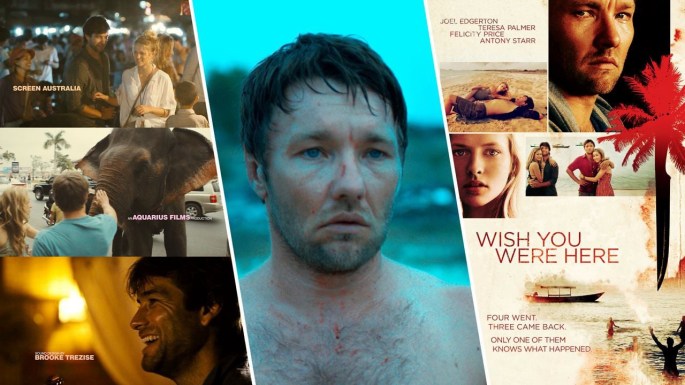
Kieran Darcy-Smith’s Wish You Were Here

How far would you go to keep a secret from your family, the authorities and your whole country if means keeping them safe, even if it also means causing a prolonged international incident? Wish You Were Here is a strikingly well acted and edited Australian dramatic thriller that illustrates how a backpacking vacation can be a once in a lifetime dream experience or spiral out of control into the darkest nightmare. As four people from Sydney venture on a trip to Cambodia together, we observe only three of them return, and the devastating psychological and emotional aftermath the disappearance causes once they get home to Australia with no answers as to what happened. Joel Egerton and Felicity Price are the middle aged couple who have kids back in Sydney, and joining them is her younger sister (Teresa Palmer) and her hotshot businessman boyfriend (Antony ‘Homelander’ Starr) who is the one that eventually goes missing. The opening of the film is a dazzling, uplifting kaleidoscopic montage of beautiful sightseeing, beaches, smiling locals, delicious street food and moonlit beach parties, and as the film progresses we see a threatening veil of unfamiliarity and dread descend over the story as we flash back, forward and in between the trip to beforehand and after in Sydney until we get a real sense of being ‘out of time’ alongside these characters and their prolonged confusion and pain. One of these four knows what happened, why it happened and where the missing boyfriend is, and the intelligent, rewarding narrative shows us four human beings dealing with betrayal, lack of closure, fragile relationships and the ensuing chaos that comes from a vacation in a foreign land gone terribly wrong. Egerton is strikingly raw and vulnerable here in maybe the best performance I’ve seen him in as a man stuck in an unthinkable situation. Price and Palmer are equally affecting and each of the three keystone performances from these leads are simply staggering. The narrative shows us glimpses of the central mystery before doubling back and preparing us all over again with additional flashback information we didn’t have before and now sheds more light on what we’ve seen and then are about to see moving forward into the haunting final act, it’s a shifting puzzle-box experience that drew me right in. I haven’t really heard this film talked about much and didn’t even know it existed until I came across it on Amazon Prime, but I would highly recommend it for fans of mature, emotionally intelligent interpersonal drama with thriller sensibilities and a story that keeps you guessing but also, more importantly, has you feeling deeply for its characters. Brilliant stuff.

-Nate Hill

THE RUSS MEYER FILES: MOTORPSYCHO! (1965)

Far from the swampy sin bucket of Lorna and the dusty Peyton Place of Mudhoney roars Motorpsycho!, Russ Meyer’s boldest sketch yet of what would become the Meyer template. Yet despite being one of the earliest entries in the biker film craze that would roll through drive-ins for the remainder of the decade and becoming a financial hit, Motorpsycho! is one of Meyer’s most under-appreciated works of his entire career. This is no doubt due to the fact that it lurks in the giant shadow of Faster, Pussycat! Kill! Kill!, the film which was made as a distaff inverse of Motorpsycho! and released almost immediately afterwards. But by tinkering with the mix of sex and violence, Meyer finds a way to expand the boundaries of the roughie while introducing his prototype of ass-kicking females, embodied here by the fantastic Haji.

Metaphorically, Motorpsycho! is about wild animals scavenging about in the California desert. Cory Maddox (Alex Rocco) is a veterinarian who operates a mobile clinic with his wife, Gail, (Lane Carroll, the ill-fated heroine from George Romero’s The Crazies) servicing those who care to live in the outer reaches of nowhere. During a routine visit to a client, they innocently run afoul of Brahmin (Steve Oliver) and his micro-gang of ne’er-do-wells consisting of Slick (Timothy Scott) and Dante (Jospeh Cellini) who, in turn, beat and rape Gail while Corey is away on a call. Soon after, the gang stumbles across Harry Bonner (Coleman Francis) and his wife Ruby (Haji), a pair of bickering, Louisiana-bred souls broken down on the side of the rode en route to California. The Bonners are shot and left for dead but Ruby survives and is found by an enraged and vengeful Cory. The two then have to fight their way through the terrain to get their blood-soaked revenge on the gang what done them wrong!

Perhaps for the first time in his career, Russ, taking on cinematographer duties along with a co-writing story credit (along with Hal Hopper!), intermingles violence and sex in a more immediate way in Motorpsycho!. While his other films more or less stuck to the conventions of the roughie, violence in sex are more interchangeable here. Aside from the expertly lit, late-night bedroom moment in which Gail is waiting for Cory to get done with the books (a favorite scenario for Meyer), there is no respite from the violence that permeates the film and, quite interestingly, Motorpsycho! has its share of décolletage and thread-bursting cleavage, but no actual nudity. Sex, too, is mostly toned down as Cory does not stray from his traumatized wife and, instead, treats Ruby as a partner in vengeance and not as an object of his desire. Match cuts are dynamically utilized to produce the full impact of any onscreen action and hysterically physical double entendres are employed to get the scandalous point across. I mean, when you see it, you’re likely to agree that Meyer stumbled upon one hell of a way to hilariously fake a blowjob scene while losing very little sexual value in the bargain.

And, curiously, Meyer also takes a more sympathetic tone with sexual assault as he doesn’t sexualize the violence itself as he had in his previous films, opting not to have the victim’s blouses conveniently ripped open during unprovoked attacks. Furthermore, Meyer gives voice to assault survivors by appearing as an arch-pig of a police officer who takes a purposefully nasty tone that is both not intended to endear his character to the audience and to illustrate that Russ Meyer liked cops about as much as Alfred Hitchcock did.

And, as is the case with most of Meyer’s narrative films, his unique and surreal sense of space is also a delight. Intersections in the middle of the desert feel as familiar to the characters as if they were cruising around in a neighborhood. And as the film reaches its conclusion, the roads begin to give way to wild rocks and jagged paths, making Brahmin’s descent into violent madness play out against a backdrop that resembles something out of William Friedkin’s Sorcerer while also laying claim to being one of the very first films to actually address the mental health of the young men returning from Vietnam.

And with no hyperbole intended, I would posit that Russ Meyer could shoot the desert as well as Sergio Leone or John Ford. From his majestic master shots to his artful utilization of horizon lines, Meyer got so much visual gold out of such a barren landscape that it’s no wonder that a pop urban piece like Beyond the Valley of the Dolls feels like a hyperactive child who can’t sit still. His eye for composition and visual propulsion may have even surpassed his love of tits, but only by a metric so minuscule that only Baby Jesus could discern it.

If I were to ascribe one word to this film, it would be “satisfying.” The violence is raw, the humor is abundant, the dialogue is delicious and delivered at a rapid pace, and the photography and tempo are both masterful. What it lacks in joyous sex, it more than makes up for with its action sequences and its elevation of Meyer’s shapely female protagonists into the tough, ass-kicking figures that would complete his prototype for 90% of his remaining work. Also, kudos to Meyer for conceiving and brilliantly pulling a war-inspired climax in which the lead motorcycle thug is blown to pieces by a bundle of dynamite. While Russ Meyer’s next effort would begin with an explicit voice-over welcoming the audience to violence, Motorpsycho! had already let most people into the party a little early and encouraged them to swing from the chandeliers and have a ball.

(C) Copyright 2021, Patrick Crain
David Cronenberg’s The Dead Zone

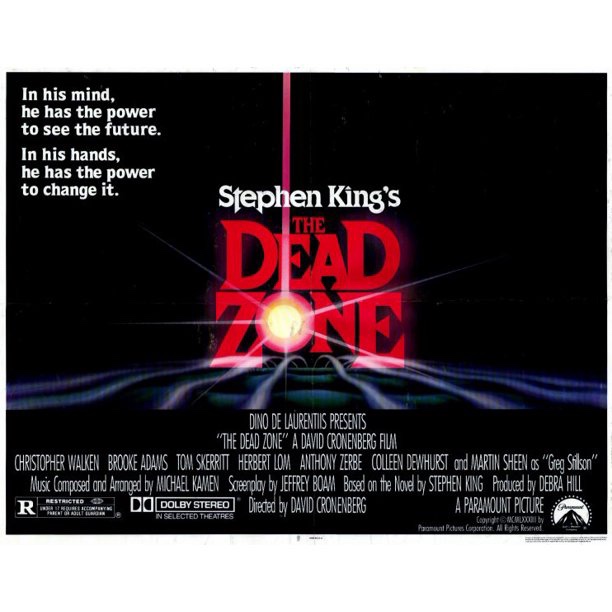
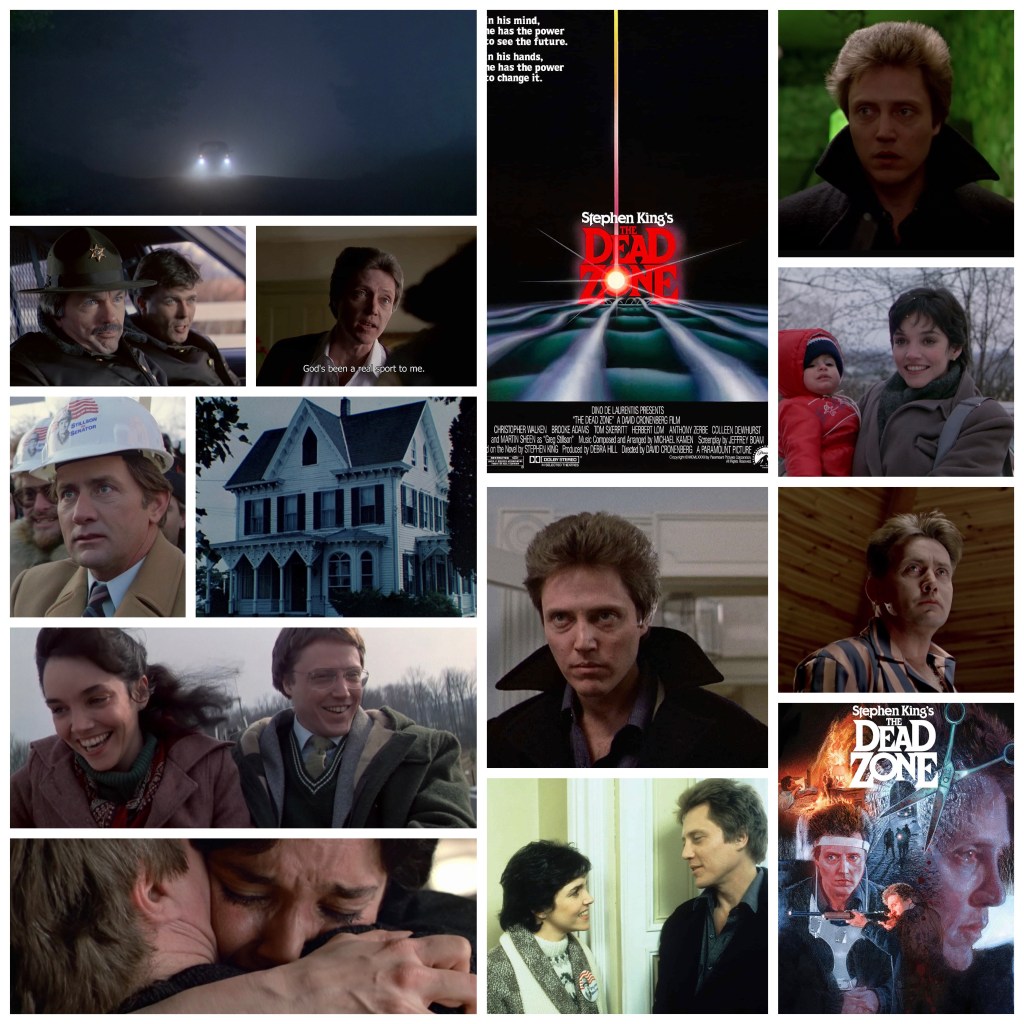
The Dead Zone is the combined efforts of three artists who can only be described overall as a trio of the most extreme storytellers of their day, Stephen King, Christopher Walken and David Cronenberg. It’s a bold, counterintuitive and brilliant move on all parts to then make this a restrained, humane and warm-hearted piece of compassionate thriller filmmaking, despite having the aura of a classic horror film. Christopher Walken gives one of his best, most soulful performances as Johnny Smith, a mild mannered schoolteacher who is blessed/cursed with the powers of spooky clairvoyance after a cataclysmic car wreck leaves him in a coma for five years. He can now sense the future, past and ill fated destiny of others around him based on touch, an ability that can save many lives but also has a draining effect on his own spirit forces. As he helps the local sheriff (Tom Skeritt) track a vicious serial killer, tutors the neurologically challenged young son of a rich businessman (Anthony Zerbe) and has growing suspicions about an overzealous, obviously sinister politician (a smarmy as hell Martin Sheen) running for senate, he tries his best to reconnect with the former girlfriend (Brooke Adams) who remarried during his coma and pick up the pieces of his life. Walken is excellent and reins in his usual eccentricities (apart from one brief, shockingly hilarious outburst) for a subtle, restrained and heartbreaking portrayal akin to his award winning turn in The Deer Hunter. Johnny isn’t a warrior, cop, leader or hero, he’s just a quiet schoolteacher who finds himself thrown into this extraordinary situation and has to deal, and Walken’s shy, awkward and otherworldly presence brings this to life wonderfully. The film is shot in rural Ontario during wintertime and as such there’s an icy, eerie blanket of small town atmosphere over everything, made thicker by a beautiful Michael Kamen score that lays on the orchestral swells and quirky, spine chilling experimental cues in perfect musical symbiosis. This is King at his kindest, with an ending that although is appropriately bleak, still has a sorrowful heart to it and not his often cynical, hollow hearted touch. It’s also Cronenberg at his most character based, ditching the body horror to explore the psychological strain a phenomenon like this would exert and taking a long breath in his otherwise hectic, gooey career to compassionately explore a character alongside Walken who is a dark angel revelation as Smith. Sensational film.

-Nate Hill

The Final Girls

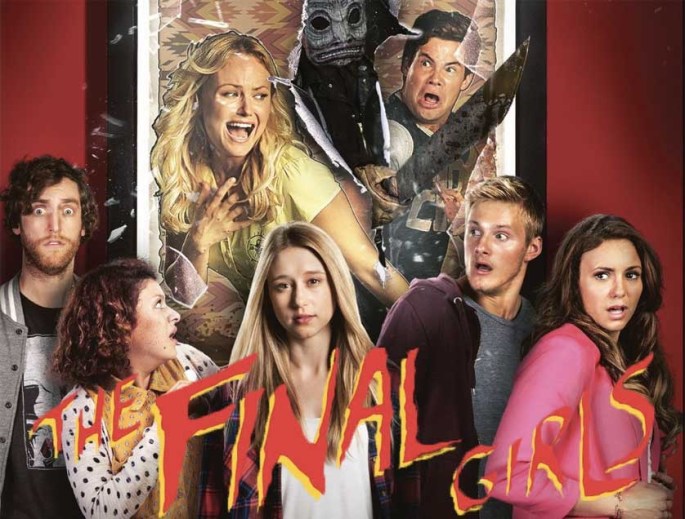
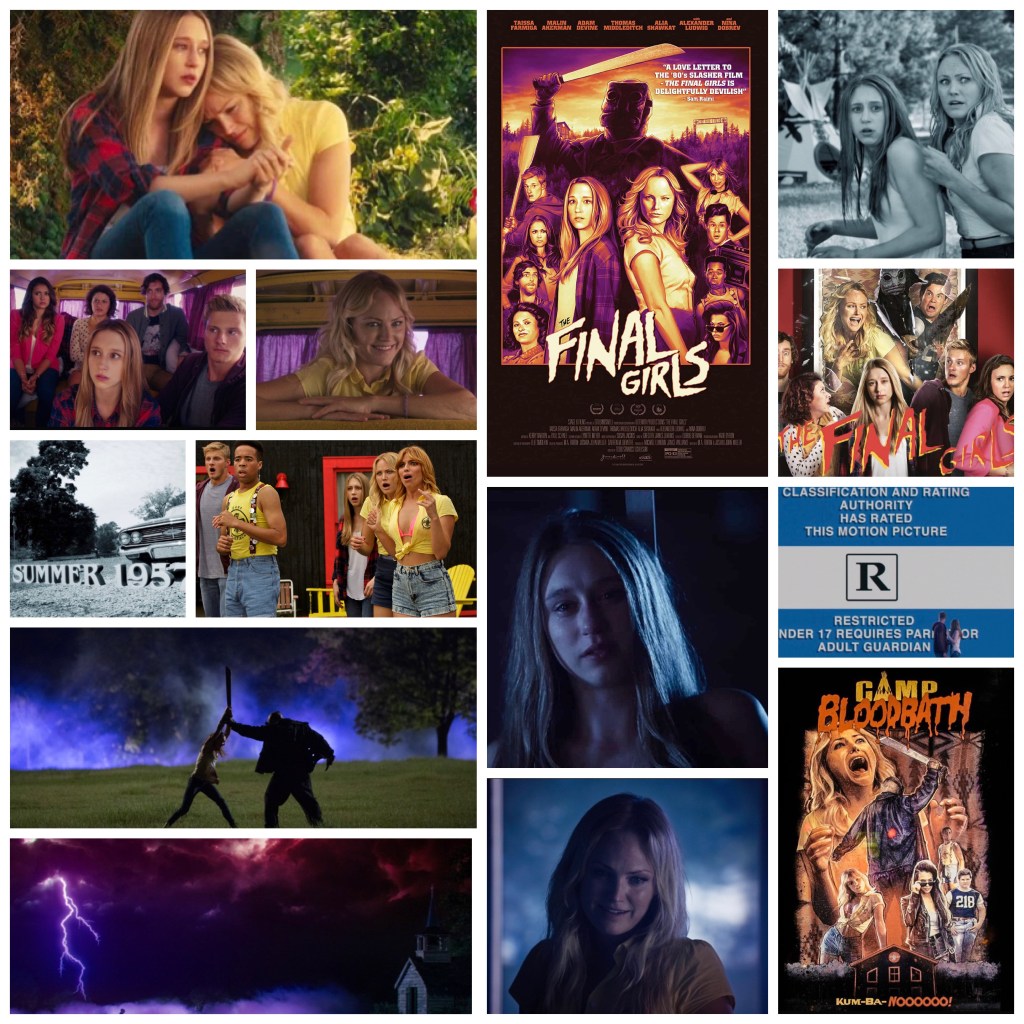
The slasher sub-genre of horror has consistently and gradually become self aware as it has evolved, reshaping it’s archetypes, going spectacularly meta and immersing the audience in self commentary whether it’s well known blockbusters like Scream or obscure indie treats like The Rise Of Leslie Vernon. The Final Girls is as detailed, referential, loving, meta and rewarding as they come with a disarmingly affecting emotional weight to it I did not expect. Playfully skewering summer camp slasher outings like Friday The 13th and Sleepaway Camp, it stars the lovely Taissa Farmiga as Max, a teen girl whose mother Nancy (Malin Ackerman) is killed in a brutal car wreck. Nancy was once a Hollywood scream queen and starred in the very popular Camp Bloodbath franchise, a claim to fame that she always resented and a legacy that Max now wants nothing to do with. At an anniversary screening of the first Bloodbath film Max and her friends find themselves somehow transported into the film itself through the screen by some sort of magical inter dimensional slasher voodoo, the same kind of cinema themed mysticism that brought that one kid into the Schwarzenegger movie world in another vastly under appreciated meta flick, Last Action Hero. In this pristine 1980’s world they find sunny campgrounds, a glassy lake and knowingly corny writing (the movie counsellors are priceless) and the killer himself, who is set on a preordained murder spree of these characters which include, as a panicked Max learns, her own mother. So begins a breathless, clever and often very funny deconstruction of the classic slasher narrative as these modern kids quite literally interrupt it midway and aggressively rearrange the formulaic turns we’re so used to experiencing beat by beat. There’s an epic, adderall fuelled striptease set to She’s My Cherry Pie, endless tongue in cheek jokes and references that get turned on their head, some wild, colourful and borderline psychedelic set design and cinematography in the ‘movie’ world too. What really makes this such a great film and a strong piece is the deeply heartfelt mother daughter relationship between Max and Nancy, acted stunningly by both. Farmiga is an unbelievable otherworldly talent and, dare I say, more mesmerizing onscreen than her sister Vera, one long stare from her could shatter down walls built by anyone, she makes Max a wounded yet resilient spirit. Ackerman gets shafted a bit as the ‘hot blonde’ archetype but she is far more talented than she gets credit for and does a delicate balancing act here between obligatory campiness with pockets of very candid realism peppered in for a gem of a performance. Now, myself being someone who has used both film and music to cope with the death of a parent, I can tell you that this film is almost too real and near transcendent at accomplishing that theme onscreen. It’s essentially a story about Max working through the unimaginable hurt, and very long lasting pain of losing her mother presented in a mature and heartbreaking way, reflected through the prism of a fun, self aware horror comedy and I think the overall idea and execution are genius, really. Add to the fact that the song that Max and Nancy share as ‘their song’ is Bette Davis Eyes by Kim Carnes which was one of my dad’s favourites so you can say that, for me, this cut really deep (slasher pub heavily intended). A masterpiece, streaming on Netflix now.

-Nate Hill

James Gunn’s The Suicide Squad

James Gunn has always been a delightfully rambunctious, perennially irreverent filmmaker whether he’s exploring the realm of sentient alien slugs, sad-sack superhero wannabes or comic book property, which he gets to do once again in The Suicide Squad, one of his very best films yet. He feels more at home in the world of DC than he does in Marvel and it’s not just the larger playground that a hard-R rating gifts him, although that is a *huge* factor given his stylistic tendencies as an artist and his roots in horror, which are on gooey display here as well. The DC stable, particularly villains, just has this dark, perverse edge to it that Marvel can’t match and in creating a maniacal palooza of second tier baddies in a subversive, heavily violent extravaganza he has found a groove and achieved an aesthetic that for the entire two plus hour runtime I wasn’t bored by once. Some of our familiar favourites from the other Suicide Squad naturally return including Harley (Margot Robbie, resplendent in the role of her career), Captain Boomerang (Jai Courtney), Rick Flagg (Joel Kinnaman) as well as welcome new additions like Bloodsport (Idris Elba), Peacemaker (John Cena), Ratcatcher (Daniela Melchior), Savant (Gunn totem Michael Rooker looking like he walked in from a Rob Zombie flick) the scene stealing Polka Dot Man (David Dastmalchian), impossibly adorable King Shark (Sylvester Stallone) and of course Viola Davis as their game warden Amanda Waller, the cunt to end all cunts. Their missions here include the overthrow of a South American country, constant bickering, shocking team casualties, betrayals, clever skewering of American patriotism, a giant alien starfish, bountiful loads of gratuitous and blessedly gory violence and a clever balancing act between lighthearted, frothy banter and a darker undercurrent of thematic heft that sneaks in the back door and lands with an effective, grounded touch. Obvious comparisons will be made to the 2016 Suicide Squad and I’d like to sideswipe that other than to say I love both films, they’re both very different and the 2016 is what it is, it has its reputation. I do believe this to be the stronger film but I think they both have their place on my shelf, they are M&M’s and Skittles, Pepsi and Coke, or Warheads and Airheads to reference a junk food as obscure as the characters on display here. Gunn has made a rollicking, badass, bizarre yet strangely accessible piece of pop art nutso comic book madness here with many standout moments including an emotional monologue by Ratcatcher (she’s the soul of the film), some stunning technicolor gore effects that call to mind Lovecraft and Carpenter, an Easter egg hunt of many hidden film and literary references, a ballsy, nihilism laced opening sequence wherein some of the characters brutally live up to the title of the film, one instance of Waller *finally* getting a modicum of what she deserves, some painfully on the nose political satire and, in my favourite sequence the film has to offer, a brilliantly placed and paced opportunity for Robbie’s ever awesome Harley to work through the trauma of her past and absolutely TAKE DOWN toxic relationships like the badass boss bitch we all know she is. A wonderful, weird, wild and fantastic film.

Jenn Wexler’s The Ranger

Park rangers are always kind of benign, often goofy and only vaguely threatening figures in cinema, they’re not quite cops, not quite tradesmen and the archetype for writers has always been a blurred line. Jenn Wexler’s The Ranger brazenly shakes that up and draws a firm delineation in the campfire dirt here for an utterly ruthless, absolutely fantastic grindhouse romp that packs a punch to the gut and a kick to the nuts. Teenage punk runaway Chelsea (Chloë Levine) has fuzzy memories of an encounter with a strange park Ranger (Jeremy Holm) when she was young at her deceased uncle’s cabin, briefly before being carted off to the foster care system. Years later and she has fallen in with the wrong crowd, a group of heavy metal brats who inadvertently kill a cop and drag her on the run, eventually ending up in the same national park her uncle’s cabin is in. Naturally, the Ranger is still there too and has made it his personal mission to hunt and kill anyone who wanders into his jurisdiction which now includes Chelsea and all her friends. This is a grisly, fucked up, jaggedly stylish exercise in knowingly lowbrow horror in the tradition of stuff like Cop Car, Wolf Creek and The Hitcher where one archetypal madman roams the enclaves of his realm and stalks anyone who ventures there. Holm is a twisted revelation as The Ranger, possessive of the kind of stalwart, clean cut, Kennedy-esque aura that is all the more unnerving when we see just how cuckoo bananas mentally deranged and wantonly homicidal he is. I appreciated a really fascinating psychological dynamic between he and Chelsea as well, a mysterious mental link that goes back to her childhood near the cabin and is revealed bit by bit in hazy hallucinatory flashbacks. Set to a brain melting nebula of heavy metal and synth music that clashes wonderfully with the wilderness palette, acted to the nines by Levine and Holm (the rest of the teens verge on camp but that’s half the fun) and wound tightly into a blood drenched, visceral mind-game mentality that’s just scrappy enough around the edges, this is a rip-snortin indie worth it for any fan of raw, torqued up exploitation horror, streaming now on Shudder.

-Nate Hill

Renny Harlin’s Deep Blue Sea

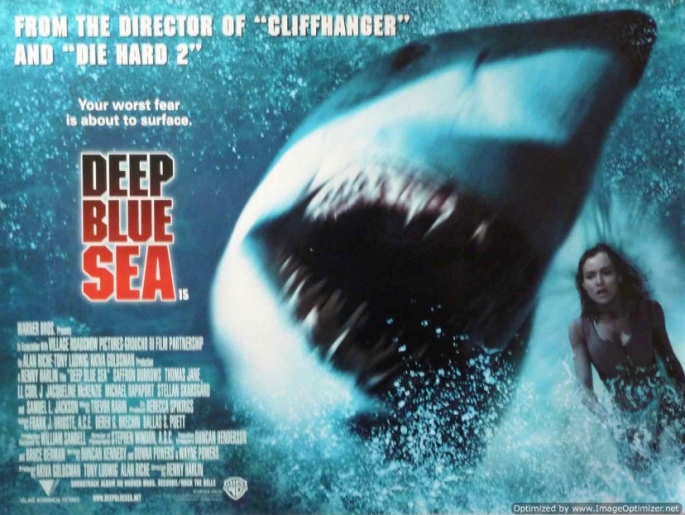
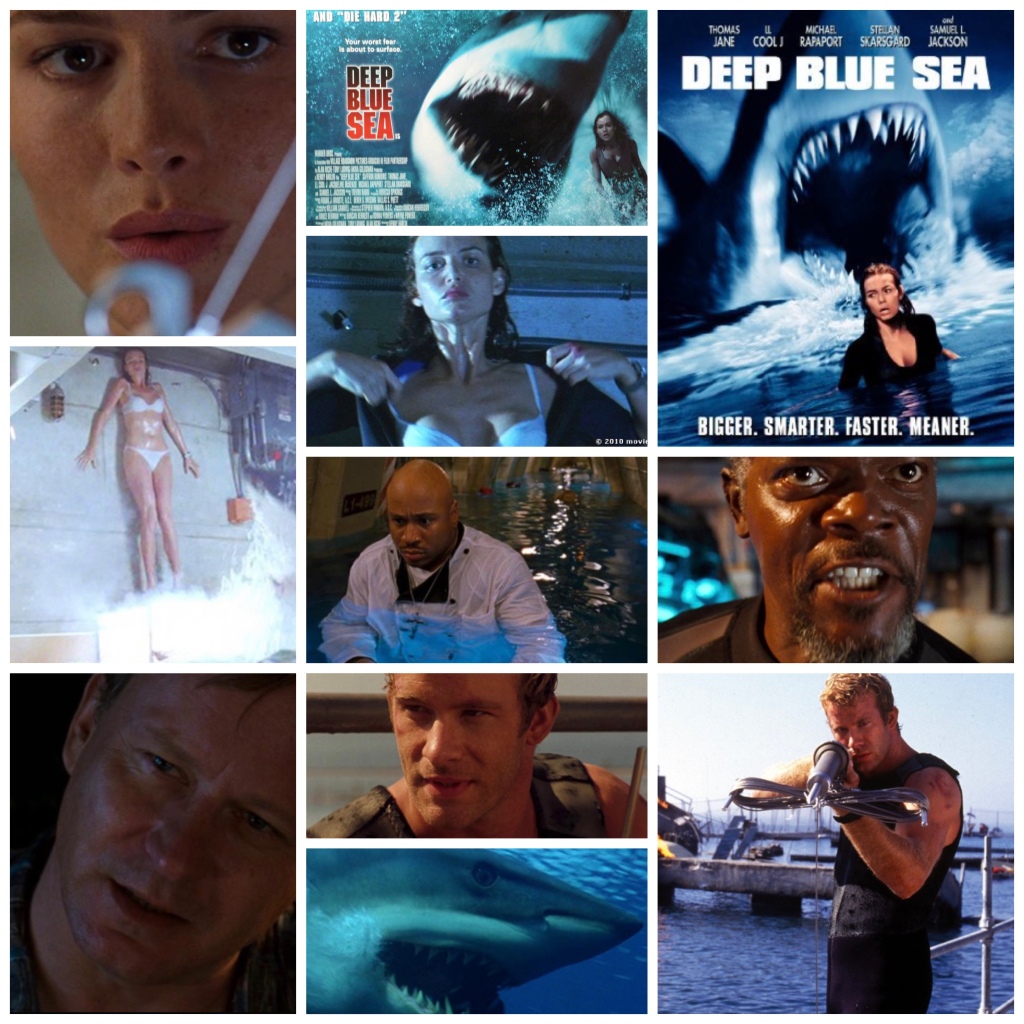
Renny Harlin’s Deep Blue Sea is about as loud, silly, gory and hilarious as you’d expect a ‘killer smart shark’ flick to be and is for the most part a lot of fun, even if it sometimes dissolves into eyeball melting pandemonium. The premise is actually a good one: a brilliant and obligatorily sexy scientist (the lovely Saffron Burrows) has developed a potential formula to treat Alzheimer’s using genetic material from shark brains, and she’s gotten a high level executive (Samuel L. Jackson) to convince his CEO boss (a brief, contemplative cameo from Ronny Cox) to sign off on funding, pending an inspection visit to her test facility out in the ocean. There we meet others including shark hunting guru Thomas Jane, gruff scientist Stellan Skarsgard, oddball cook LL Cool J and grunt Michael Rapaport, all who make great cannon fodder for the marauding sharks once they decide they’re too smart to be lab rats for these people anymore. There are some great gory kills here and the timing of them is sometimes genuinely shocking and inspired, including one death scene that is straight out of the book of nihilism and dark humour 101 and had me laughing hard. It’s basically a decent B movie souped up with Hollywood effects, tons of explosions and while it has the misfortune of being released when CGI wasn’t too great (it shows), it also has the advantage of being made at a time when shark horror films weren’t over saturated and done to death like they are these days and as such feels somewhat fresh, especially given its additional premise of sentient sharks. It’s fun, engaging and a bit cacophonous in some instances where it could have employed more stealth and suspense, but overall a good example of the shark sub genre.

-Nate Hill

Burnt Offerings

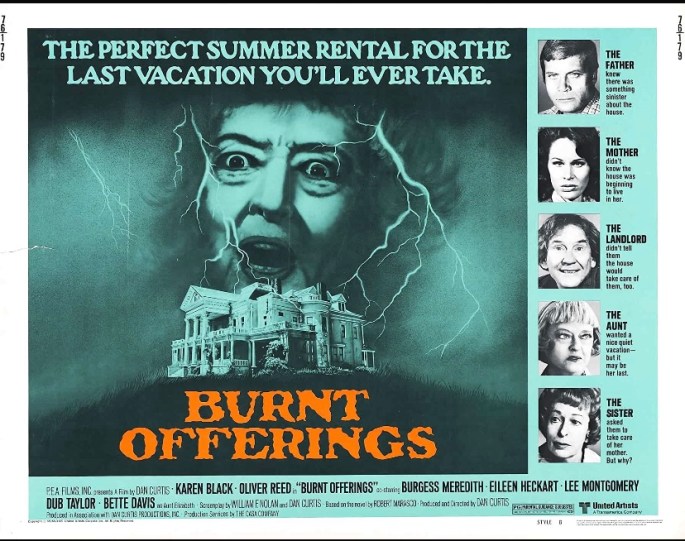
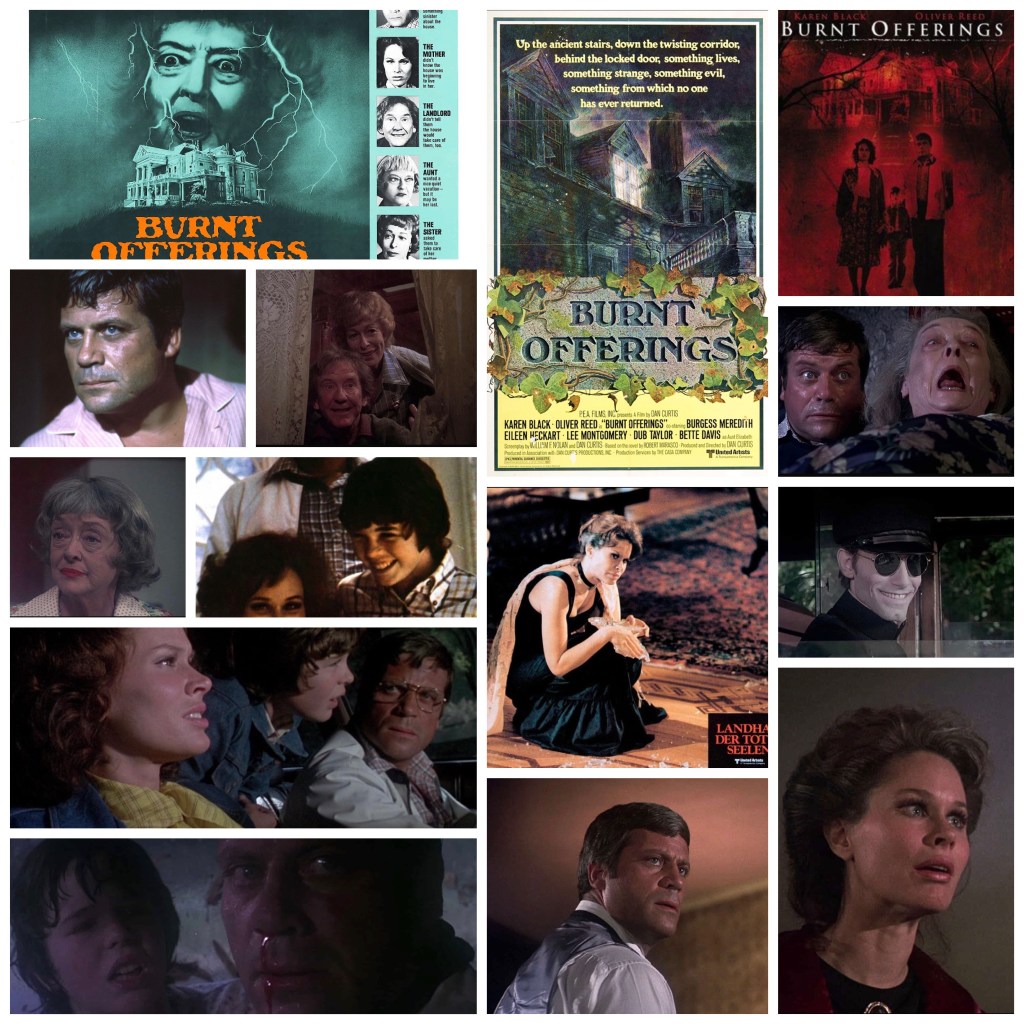
Burnt Offerings (that stellar title deserves a much better film) doesn’t do much as far as innovation goes in the haunted house genre but it’s serviceable enough as an atmospheric diversion and benefits from a very strong and frequently cuckoo bananas performance from the great Oliver Reed as a family man and writer who moves his wife (Karen Black) and son (Lee Montgomery) into a suspiciously creepy manor in the English countryside in a sort of caretakers capacity. Now we all know from collective cinema experience how ill advised it is for writers to move their families into empty large buildings with threatening auras, but hey that’s half the fun. They should have especially known better here though because they’re hired to house sit the place by the weirdest people imaginable, two creepy old goats played by a half mad Burgess Meredith and Eileen Heckart, and let me tell you if these two tried to hire me to look after their weird empty English house I’d run the other way, but then we wouldn’t have a story I suppose. The film hinges on a dynamic that consists of Reed trying to be steadfast and responsible but slowly succumbing to some Jack Torrence level madness while Black’s ineffectual wife blathers on in ditzy mania and the poor kid is stuck between them. There’s a highly effective sequence in the manor’s pool where playful, benign roughhousing between father and son turns unexpectedly violent and grim very fast and is a nice example of tension building and infused menace on Reed’s part. Bette Davis shows up in a rather forgettable role and there’s a spooky grinning valet driver who may or may not be a ghost that sows seeds of narrative and tonal unrest too. It’s nothing fancy, nothing new or noteworthy but as far as routine, atmospheric haunted house flicks with esteemed actors go, you could do worse. Streaming now on Shudder.

-Nate Hill

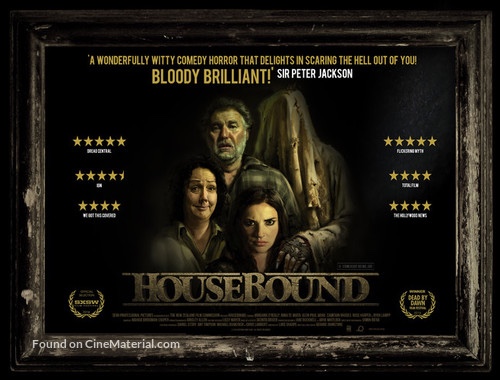
Gerard Johnstone’s Housebound

From early Peter Jackson to early Taika Waititi and many in between there has always been a steady low hum of horror output from New Zealand and Gerard Johnstone’s Housebound is a gorgeous little example of kiwi genre gold, an airtight, creaky would-be haunted house jaunt that knows how to be genuinely spooky while splashing just the right doses of dark humour in here and there and leading the audience down a breadcrumb trail of mystery that’s fun to discern alongside the main character. She’s called Kylie (Morgana O’Reilly) and as we meet her the NZ court system has finally reached its last straw as far as her methamphetamine and booze fuelled delinquent behaviour is concerned, placing her under ankle bracelet adorned house arrest with her weak willed mother (Rima Te Wiata) and meek stepfather (Ross Harper) in a rural enclave. The strained family dynamic is a sheepish joy to watch as this brat with a (deeply guarded) heart of gold makes life hell for her parental unit, but there’s something else in the house just waiting to make life hell for the three of them and soon weird sounds abound, creepy movements are observed and it becomes apparent that they aren’t alone. The cool thing is that the location scouts and set builders have created a house atmosphere that feels legitimately dusty, cluttered, oblong, weary and actually *lived in*, which isn’t always the case in haunted house outfits. Reilly is engaging and likeable as Kylie, even when she’s being a pain in the ass we never get the sense that this girl is truly a bad egg, just a lost and confused one who needs a rather intense outlet to channel her anger and pent-up negative energy into, and what better than a sly, possibly supernatural home invasion? I can’t go into too much detail about the central mystery and origins of the poltergeist shenanigans other than to say it’s a fun ball of yard to unravel alongside Kylie and goes to some narrative pitstops that are often fun, shocking and surprising. It’s goofy, it’s gory, it’s very well written and acted, it’s got tons of humour, a little heart, heaps of cobwebbed atmosphere and is just a great damn time at the horror movies. Streaming on Shudder now, highly recommended.

-Nate Hill

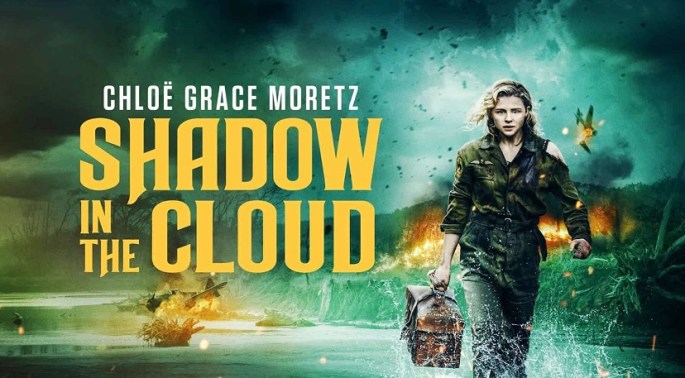
Roseanne Liang’s Shadow In The Cloud

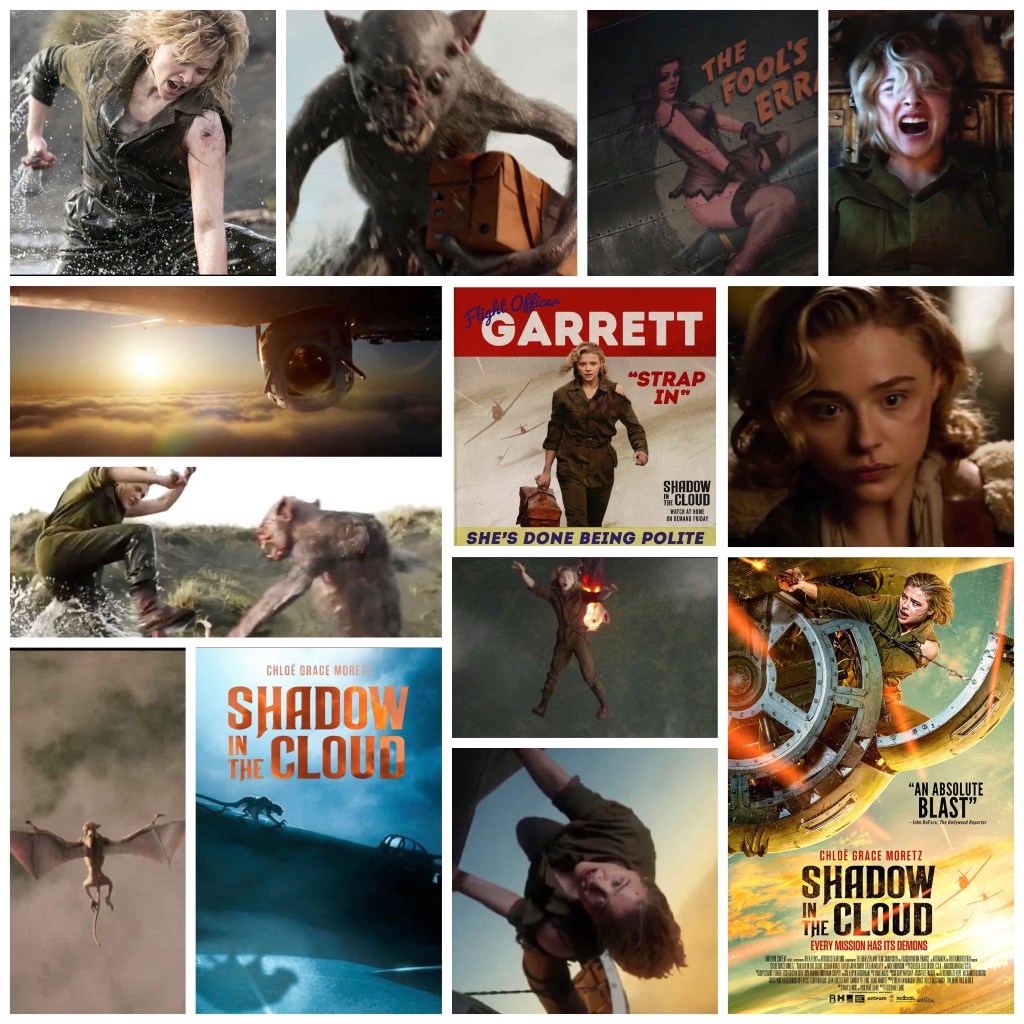
Some concepts just beg to not be taken seriously and in the case of Roseanne Liang’s Shadow In The Cloud we have Chloe Moretz as a WW2 fighter pilot fighting a nasty sky gremlin while also contending with Japanese planes trying to shoot her down and some incredibly sexist fellow officers who outnumber her ten to one. Surefire recipe for camp, right? Well… kind of, but what makes this film so much fun and so successful is that despite an outrageous premise it manages to feel like a real story and not some high flying Grindhouse lark. I haven’t seen Chloe act in some time so I kind of forgot how talented she is but she gifts this character with cunning, grace, badass physicality and genuine grit. As she boards a fighter plane last minute filled with all male officers and is sent straight to the hull turret, it starts with her being belittled and mocked by them, escalates into a breathless dogfight with enemy aircrafts and finally goes supernatural bonkers when this bizarre bat/rat/alien sky gremlin shows up and tries to kill everyone. The film clocks in tightly under 80 minutes and almost has that old timey radio play feel, especially in the first act when she’s alone in the turret, the camera focuses solely on her for a sequence and we only hear everyone else on the radio, thus some of the action left to our imagination just like entertainment mediums of that day. There are some flat-out spectacular action sequences here including Chloe firing up the turret gun and ruthlessly mowing down a Jap plane with brutal precision, a hair raising forced crash landing, a hilariously unbelievable yet absolutely thrilling instance where she falls out of a hatch and plummets a few hundred feet only to be BLOWN BACK INTO the plane by the force of another one exploding below and finally a bloody, ultra-violent hand to hand mortal kombat smackdown with the ugly little bastard gremlin that is laced with adrenaline torqued choreography. It’s just a damn fun film, Chloe has a blast in the best role I’ve seen her do in years, the score by Mahuia Bridgman-Cooper ditches usual war film orchestral notes for something sleek, electronic and rhythmically modern and just overall is badass, gnarly, r rated, rollicking action war horror hybrid good times. Streaming now on Netflix.

-Nate Hill