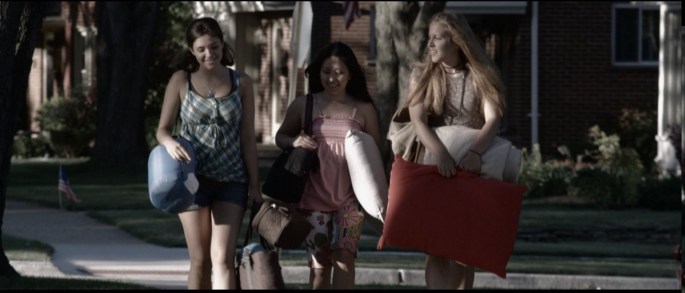
THE DAVID ROBERT MITCHELL FILES: THE MYTH OF THE AMERICAN SLEEPOVER (2010)

There’s a weird moment in some adolescent boys’ lives in which they don’t know whether they’d rather watch Cinemax or teepee a house. It’s a period that lasts about six months but it feels like a whole other lifetime to live through. For in life, there exists both a very specific twilight between being a child and being an adolescent, and then another between and adolescent and adult. David Robert Mitchell’s debut film, The Myth of the American Sleepover, realizes both simultaneously. Set in a suburban world where adults are heard but almost never seen, the film moves through a 24 hour period in the lives of several teens as they navigate a night of discovery, adventure, and wonder. Like American Graffiti, it has an elusive blonde who is the unobtainable end to a noble, nocturnal quest by a lovelorn romantic boy. Like Dazed and Confused, it celebrates the fluidity of cliques and the elasticity of youth. But instead of setting the tale in the expanse of a town where having a set of wheels is required to play along, The Myth of the American Sleepover shrinks it all down to the less-than-perfect suburban neighborhoods with aluminum filigree and poorly patched streets where everything in one’s world is within walking distance. It’s a film that looks divorced from actual time as it both completely modern but without any amenities to cement it in any one specific era. Of course, this is the point as The Myth of the American Sleepover aims to show just how very little changes no matter how many generations of young people one will see cycle through that same period.

Admittedly, perhaps my coming out of the other side of a spirit crushing, seventeen-year, white collar day job hasn’t caused me to regain the passionate grip on life that teenagers naturally have, but it has put things in a certain kind of perspective to understand that memory is precious, experience is beauty, and, in the words of Michael Mann, time is luck. Even when I can see the age of 50 on the horizon, absolutely nothing about this film feels foreign though it’s definitely pitched to an audience that is about a third of my age. And, in fact, there was a time in which I did not have faith in what the director was doing, thinking he brought little to the subgenre of coming-of-age films and overly inflating the importance of the rituals that kind of film celebrates. Now I see that he brought something very specific to the genre; a timeless and almost spiritual testament to the two most pivotal times in one’s life that, unfortunately, aren’t spaced too far apart from each other. No, it’s not saying anything new. But it’s also not wrapping its nostalgia in something larger than it needs to be. As life goes on, we’re saddled with many woes both self-inflicted or accidental. Indulging in entertainment to draw a heavy allegory is likely not most people’s idea of a good time at the movies. In part, I agree. So here’s one that captures the best part of your youth, now likely sundowning in the better part of your memory. And as the weeks on the downslope become quicker-paced in my own life, this film has incrementally revealed itself as a truly beautiful and life-affirming thing.

The Myth of the American Sleepover covers the spectrum of incoming freshman to the high school graduate floundering in his first year of college, but they’re used in a much more pointed way than in other coming-of-age films of its kind. This is a movie where the value is broken down into millions of pennies instead of banking on big money moments that are quote-ready and riotous. For this is a movie that remembers how fast you could put out a cigarette when you heard your parents roll up. It remembers how much an object as insignificant as a lighter could possess endless possibilities of meaning. It identifies the exact moment where you could sneak a quick kiss on the cheek and then giggle down the street about it with your friend. It recalls the pain of a breakup that would make you do a silly thing like take literally a “call me sometime” message in your senior yearbook after a couple of beers and go on a nocturnal quest for romantic companionship. It remembers how magical the smell of a crush’s shampoo could be. It remembers what it is to be of an age when a whole other epic sleepover was but two streets over. It remembers what it was to fuck with an Ouija board and think you were really getting away from something. It knows what a hazy, overcast “morning after” feels like and, better yet, dares to dream about the break in the clouds and the tomorrows to come. And, above everything else, it knows the crush of exhaustion that occurs after such a monumental and life-shifting evening. This is a rare film that wants to celebrate in all of the joy of youth even if it wants to gloss over those moments where memory might reveal a low time that you would certainly avoid or do over if given the chance to repeat it.

Maybe this feels like a G-rated Kids but that’s quite ok with me. Where sex is generally the ultimate goal of any post-pubescent creature, that doesn’t mean that every encounter and house party is like Fellini Satyricon with a Bugsy Malone cast. Near the beginning, there is a sweet and knowing juxtaposition between a freshman’s story of what happened with a girl and her story with what really happened between the two of them that puts the filmmaker squarely in the corner of both camps insofar as understanding how boys and girls function within their respective social cliques. But it flips convention a bit by not only showing the boy as having done much less than what he claims, it simultaneously shows that girls are likely quicker at sexually maturing than are boys. This is revealed again in a moment between the same freshman and his friend’s older sister who beckons him away from his buddies who are situated in the living room and into the bathroom. It’s a scene charged with some light sexual tension that she quickly gets defused by her as she senses just how out of his depth he is and, regardless of his pursuit, he wouldn’t know what to do with her if he caught her. “Can I kiss you?” he asks her after she’s pretty much thrown herself at him without explicitly articulating it and he’s missed every signal pitched in his direction. It’s a Mrs. Robinson moment he’s not ready for which again shows this as a universe not governed by adults but by kids who have to feel their way around life.

Sometimes, the dialogue given to the kids is a little pointed. Either my memory is faulty or there were high school juniors who would have rather waxed poetically about the good old days of playing a board game when they were carefree and younger instead of trying to make out with the girl who was obviously interested in them and sitting mere inches away. I mean, I just don’t recall that being how it went down in Del City, Oklahoma, but I do recognize it as a kind of creative license that, in pressing a point already made by the sheer mood of the film, it hits a rare false note. From a performance standpoint, the kids are something of a mixed bag but, on the other hand, I also think that is what lends to the film’s authenticity and the natural ease and sometimes awkwardness of the young cast never falls into distracting mediocrity.

More than just remembering, The Myth of the American Sleepover is a film that actually understands its characters, what happens to them, and how it affects them. It understands how you can end up in a car with strangers even though it’s a roll of the dice as to whether or not it’s a good idea to do so. It understands how the second banana can come along and, instead of being a third wheel or a stick in the mud, can find their own adventurous path. It understands how a letter revealing that the girl with whom you’re in love on only wants to be friends can create the mythical “Girlfriend in Canada” situation. It understands sneaking into the basement with an illicit crush even knowing it’s going to start static in the other room with his girlfriend. It understands the awkwardness of not knowing how you feel about your readiness to go to first base. It may even understand, in an opaque way, how confusing this might be for those not yet sure or comfortable with their sexuality. It understands a closed universe of benign fuck ups where forgiveness is much easier obtained than in one’s later years. It understands the fine line between creepy and sincere. It’s a film that understands, in the words of the tune from Streets of Fire, that tonight is what it means to be young and, doubling down on that, also poignantly and purposefully misunderstands that one will never run out of tonights. The Myth of the American Sleepover is, in a nutshell, Jim Steinman by way of Whit Stillman and an absolute treasure to behold.

(C) Copyright 2021, Patrick Crain

Anthony Scott Burns’s Come True

Sometimes a film just effortlessly and uncannily combines several elements that just resonates with me and lands as an all time favourite on the first time watch. In the case of Anthony Scott Burns’s Come True it’s the gorgeous mix of SciFi/horror, analog/VHS inspired aesthetic, dream and REM sleep centred storytelling, surreal artistic visuals and the synth dripping, supersonic original score by Electric Youth that just makes this film something so special I don’t even have the words. The story concerns a runaway teenager (Julia Sarah Stone) who sleeps on playground slides (theres a metaphor in there somewhere), lives a restless nomad life and suffers from paralyzing nightmares. She agrees to participate in a sleep study for cash by a shady group that has patented technology that maps and visualizes people’s dreams onto video screens, but this only seems to exacerbate her nightmares and literally give them the power to cross over into waking life. That’s just the diving board from which we plunge into a roiling subconscious abyss of daring, unapologetically strange narrative and atmospheric substance and it soon becomes clear that director Burns, although meticulously in control of his craft and vision, wishes to let this story run completely wild and go off the edge of the map, which is a great fit considering this is a film about dreams. Some folks will undoubtably dismiss this as confusing and inaccessible but for me it pierced a frequency in my psyche that few films are able to tune into and is just the perfect soul food for my warped perception and taste in film that always hungers for the different, the weird, the boundary pushing. Actress Stone has an ethereal, pixie-like aura to her that lends itself nicely to the overall vibe. We are treated to numerous extended dream sequences which are all shot through this sort of of perpetual POV forward propulsion movement, a technique that tricks us into thinking we are ourselves moving directly into both our TV screens and the dreams themselves, then we are presented in horrific inevitable fashion with the powerful antagonistic forces on display in dreamland and it feels just about as terrifyingly tactile and immersive as being in our own dream worlds, a genius filmmaking choice really, not to mention all of the dazzlingly surreal, stark monochrome imagery and artistic flourishes along the way. Electric Youth kind of got screwed in their first original score which was for a film called ‘Breathing’ that for whatever reason was never finished or released, but their wonderful work on it can still be heard on Spotify. Here they get another shot and go absolutely synthwave ballistic for an original composition that is so beautiful your ears will bleed neon and you’ll hear it in your own dreams. It brings the story to life in ways that transcend traditional narrative at times and lures you into its world until you are transfixed right up until the ballsy twist ending that will have some people rolling their eyes and some people’s minds blown, I thought it capped the story perfectly. I don’t often use the M word but to me, and my sensibilities of what I look for in film, this is a flat out masterpiece.

-Nate Hill

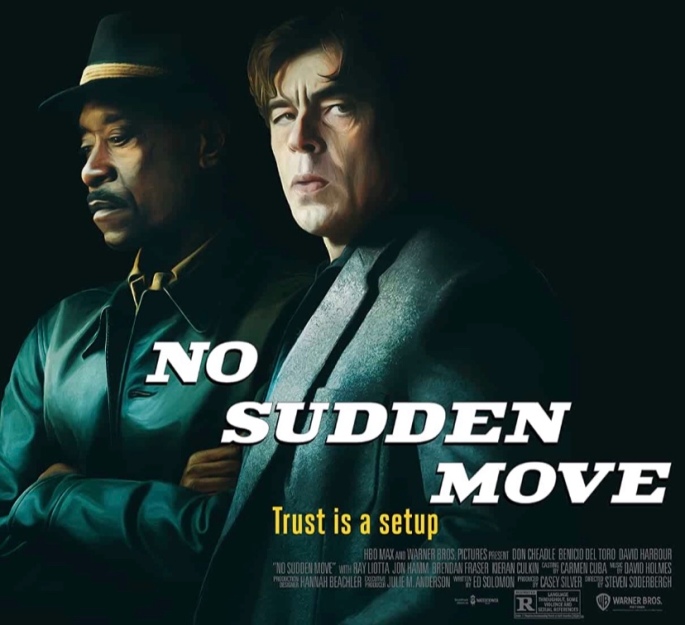
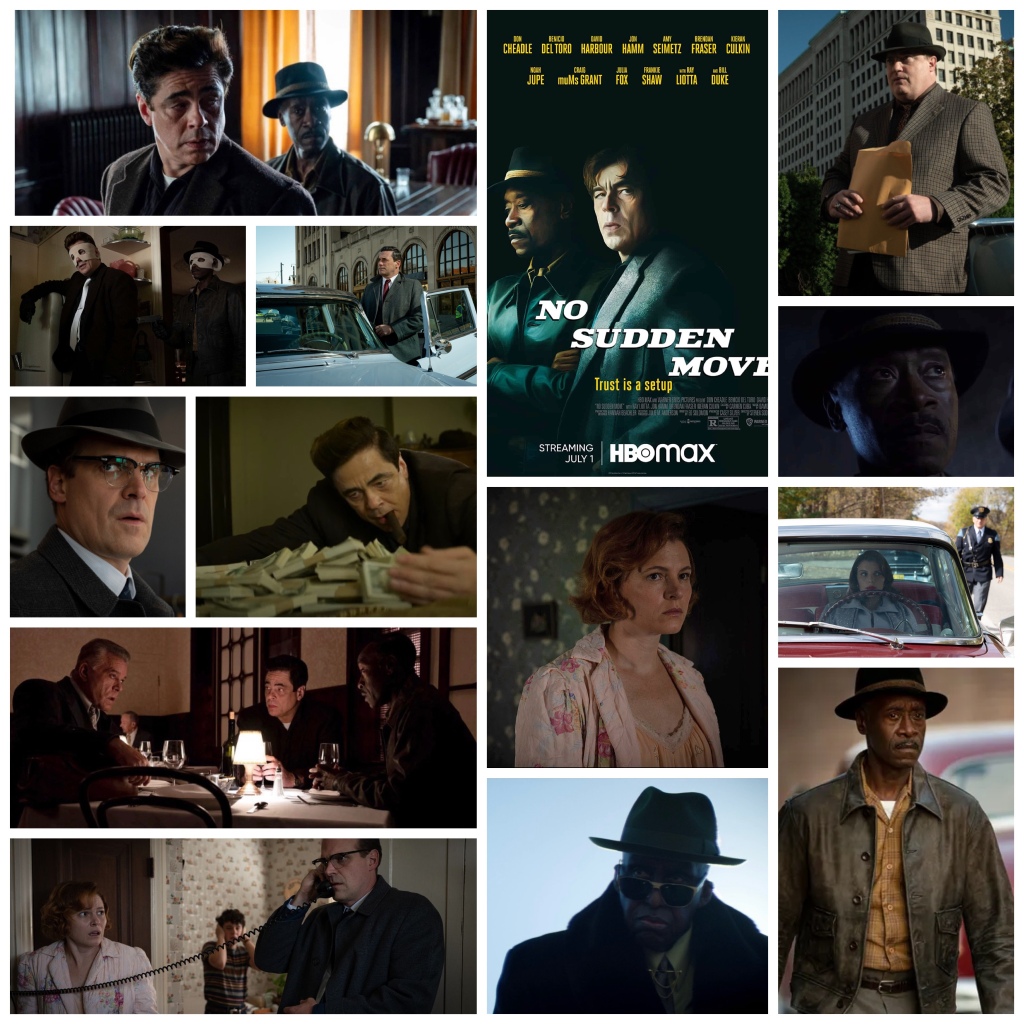
Steven Soderbergh’s No Sudden Move

Steven Soderbergh’s No Sudden Move contradicts its own title by showing up out of nowhere all of a sudden, with an ensemble cast for the ages, a snazzy 50’s production design vibe and one of those deliriously convoluted marble maze narratives where things make just as much sense as they don’t. The film is honestly a lot more low key, subdued and laconic than you might expect from all of these moving parts, let’s more Out Of Sight than Ocean’s 11, more burnished, modest caper games than ritzy, tongue in cheek sizzle. Don Cheadle plays an aimless Detroit ex-con who is hired by a shady mob figure (Brendan Fraser) to babysit the family of a twitchy executive (David Harbour) while he retrieves something of great McGuffin-esque importance from a safe at his work. Alongside him are two less level headed operatives played by a greasy Benicio Del Toro and Rory Culkin, who collectively escalate the proceedings into a dangerous powder keg of betrayals, backstabbing and hopeless incompetence. Others orbit their situation including Ray Liotta as an appropriately volatile mobster, Julia Fox as his philandering wife, Jon Hamm as a keen federal agent, Amy Seimetz as Harbour’s stressed out wife, Bill Duke as an all powerful underworld kingpin and a sly cameo from an A lister (that I won’t spoil) as a cheerfully corrupt automobile industry magnate. The cast are all exceptional with everyone really keeping it on a low, laconic burn save for perhaps Liotta who has to get fired up at least once in every movie per his contract and Harbour who is cast pricelessly against type as a spineless fuck up. The narrative is a shifting puzzle box that requires adderall level attentiveness to fully absorb which I wasn’t giving it and as such was a bit fuzzy on some of the particulars but it was nonetheless lots of fun to watch these quaint, colourful characters mosey around old Detroit and have some good old fashioned noir fun.

-Nate Hill

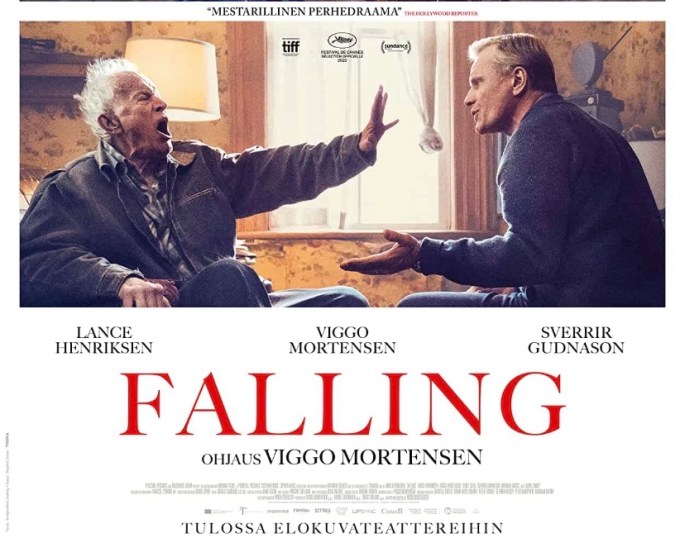
Viggo Mortensen’s Falling

I love to see it when a cherished and talented actor makes their debut as a director, especially if they absolutely nail it, and Viggo Mortensen’s Falling is an astonishingly terrific first time effort behind the camera, in front of it and collaborating with one of cinema’s most prolific and underrated character actors, the mighty Lance Henriksen. Mortensen paints a deeply personal and seemingly autobiographical portrait of a stormy father son relationship here, a dynamic put to the absolute test in its twilight years as dementia throws a curveball. Henriksen is Willis Petersen, a conservative, sexist, crass, bigoted, bitter, flint-edged old goat whose emotional problems and inability to properly communicate made life extra tough on his wife and two kids growing up on a farm in chilly upstate New York. He is now a snowy haired senior citizen who can barely remember what day it is, and journeys with his grown up son John (Mortensen; patient, restrained, meticulously pensive until the breaking point) to live with him, his husband (Terry Chen) and their young daughter (Gabby Velis) in sunniest California. Willis is utterly and completely out of his element in this setting, while John, his family and the rest of the city do their best to ignore, endear and diplomatically deflect his brittle onslaught of angry, bigoted, rude and altogether inappropriate behaviour. Willis is a tough cookie to love or care for, especially in this golden age of hyper-tolerance, but Henriksen, in an absolute career best tour de force, makes him not just another angry old man but a human being who is so scared of dying, losing his memories of life and slipping away from the life affirming groove of his routine that he’s lashing out at basically everyone around him. Except for his young granddaughter, his relationship with her is perhaps the only genuinely warm-hearted and easygoing interaction he allows himself to inhabit. Mortensen masterfully edits together their present day life in Cali with picturesque, auburn laced and earthen flashbacks to Upstate NY where we see a young Willis (Sverrir Gudnason) raise John and his sister, struggle to be there for them without letting his flaws run amok and navigate through two marriages, one to the children’s sensitive mother (Hannah Gross) and later to another (Bracken Burns). Laura Linney gives a reliably focused and mesmerizing turn as Willis’s grown up daughter, who does everything she can not to get emotionally compromised by her father’s issues, and there’s a sly cameo from Viggo’s longtime pal David Cronenberg as a stoic butt doctor whose scene with Willis highlights some of the films coarse black humour, often at the expense of his son’s homosexuality as John himself looks on in almost unfathomable patience. It’s easy to condemn and dismiss a difficult character like Willis, but Mortensen’s complex direction and Henriksen’s volcanic yet finely shaded nuance refuse the viewer in drawing such hasty, narrow conclusions. Mortensen’s surreal editing, fluidly washed transitions, the wonder of the natural world and the magic of music to remind us that human beings are never just one thing and that a seemingly lost, scared and downright mean old man is still capable of compassion, patience and a modicum of self reflection, even in the eleventh hour. This is an astonishing film and a staggering debut for any filmmaker of any background with a central performance by Lance that anoints his entire epic career with that one last minute entry to crown it all, he and the film overall are truly magnificent.

-Nate Hill

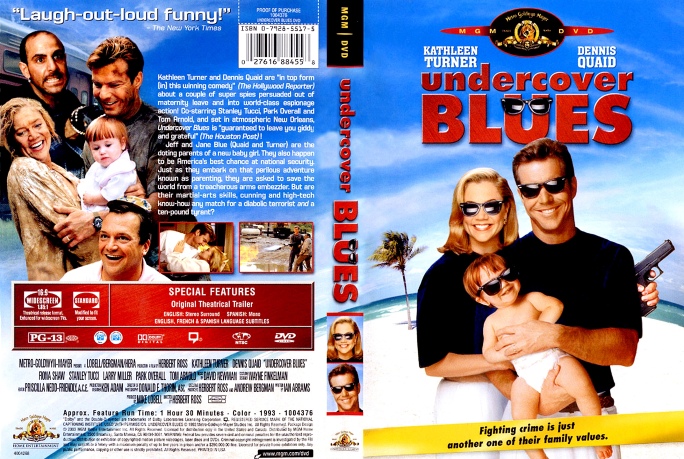
Undercover Blues

Undercover Blues is about as light, breezy and fluffed out as a film can get, to its own detriment in fact. I love a good lighthearted comedy but unfortunately this one tries to be so carefree and leisurely that it comes across as… well just that, something that feels like it’s trying too hard to achieve it’s vibe instead of just naturally arriving there. Dennis Quaid and Kathleen Turner play former spies who are on vacation in New Orleans, trying to escape the espionage life for awhile so they can raise their baby. When a chance encounter with a hopeless mugger named ‘Muerte’ (Stanley Tucci in a performance that has to be seen to be believed) puts them in the spotlight of their former boss (Richard Jenkins) they are tasked with finding and taking down an easily distracted Euro-trash villainess (Fiona Shaw) who is selling plutonium rods to terrorists.. that’s the loose version anyways, the film doesn’t really have much of a grasp on the reins of its own plot. Pretty soon two dogged detectives are after them, played by Obba Babatunde and the always scene stealing Larry Miller who is doing a voice/accent here that is so bizarre he sounds like he walked out of the looney toons. There really isn’t too much romantic chemistry between Quaid and Turner save for one brief scene and for all their cavalier swashbuckling and attempts at charisma they seem curiously lifeless. Tucci is anything but though as this ridiculous petty criminal, barking out childish threats with a priceless Spanish accent and spicing up the proceedings with his coked up manic energy. Watch for familiar faces including Tom Arnold, Jan Triska, Marshall Bell, Dennis Lipscomb, Saul Rubinek, Chris Ellis, Olek Krupa and a very young Dave Chapelle. I wish I liked this more but it just didn’t have substance or anything to grab ahold of. It’s fine to have easy breezy, fluffy action comedies but there’s still gotta be an interesting story, strong character dynamics and a genuine sense of danger or I’ll just lose interest. This was a great big meh. If you want to see how an effective lighthearted New Orleans caper with Quaid is done, check out The Big Easy with him and Ellen Barkin, an absolutely wonderful romance cop flick that feels genuinely laidback without having to try SO damn hard to convince us it is, like this pot of watered down gumbo.

-Nate Hill

Jeffrey Morris’s Oceanus: Act One

Sometimes you stumble across a gem of a short film randomly, one that has big name actors, a well told story, atmosphere and great production value that just happens to be only 20 minutes or so long instead of a feature. Oceanus: Act One is something I’ve seen hovering on IMDb for awhile and I’ve always been curious, and finally a quick google search led me to a Vimeo link.. I’m glad it did. This is the story of a futuristic deep sea exploration crew with a gigantic research base near the bottom of the ocean, their purpose to study potential communication and interaction with different species of whales. When a cataclysmic seismic event disrupts the day to day mission of one scientist (Megan Dodds) alone in a small vessel, she’s thrown vastly off course and must locate her colleague and husband (Sharif Atkins) in another craft, while their commander (Bruce Davison) back down at base tries to bring them in and they are all guided by the AI computer system running their equipment, voiced coolly and evenly by the great Malcolm McDowell. Not only do they find themselves off course of the mission, but when they attempt to breach the surface to get their bearings, they discover something so alarming and terrible it raises the stakes just about as high as they can go, and they find themselves faced with only one option: return back to their base on the depths of the ocean floor with busted navigation equipment and patchy radio communications. With courage, ingenuity and a little surprise miraculous help from some aquatic friends they must journey downwards to the only home they have left. This is all edited together with beautiful CGI, vividly colourful visuals and detailed design of the ships and underwater base, a wonderfully atmospheric electronic score by Jeff Rona that echoes the best work of Cliff Martinez and a sense of urgency, suspense, immediacy and most importantly, genuine wonder, as any film about the depths of the ocean should have. This is titled ‘act one’ and I see on IMDb that a follow up film has been in development for sometime, here’s hoping it finds the money and talent to become a reality because this first act is a blessing in the marine SciFi sub-genre. Available to stream on Vimeo.

-Nate Hill

The SuperDeep

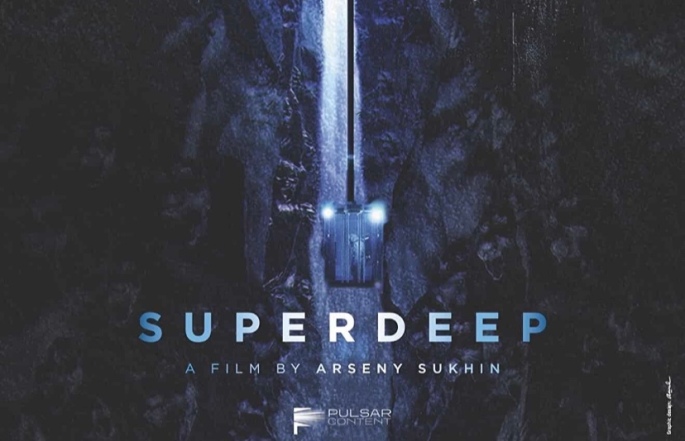
The SuperDeep is a Russian SciFi horror flick that lives up to its title in the most literal of ways, considering it’s about a research term that descends down a borehole wayyyyy below the earth to investigate something that’s so far down there it’s closer to the core than it is to the surface. We meet microbiologist Anya (Milena Radulovic), who has a guilt ridden past but agrees to lead the group, which consists mostly of Russian military, on the condition that whatever they find down there, she gets academic credit for the discovery. What could go wrong? A lot, it seems, and when you’re in one of the most remote, unfamiliar frontiers in our realm, it’s tough to get help, find your footing in an otherworldly environment and simply survive. There seems to be some horrific microorganism that lives in the permafrost and has now thawed and gotten loose, a life form that uses fungal spores to spread into the air kind of like seed dispersal and as soon as a human breathes them in… well, it ain’t a pretty sight and the special effects team take FULL advantage of the opportunity for ooze, slime, goo and body horror of every orifice invading fashion. I had one complaint; the version I watched on Shudder only had dubs available, no subs, and baby I’m just not a fan of dubs, I wanna hear the actors talking in their real voices, I don’t care how exotic and impenetrable the language is. That aside, this is a wonderfully atmospheric piece with some truly standout moments of filmmaking and a beautifully eerie score that sets up atmospheric tension and world building terrifically. There’s a hair raising sequence where they free fall down into the earth for hundreds of miles in a few minutes time for a kind of prolonged ‘Hellavator’ experience that would have been a showstopper on the big screen. An almost black and white colour timed scene sees Anya fall through a fissure in the earth into utterly unknown territory in this kind of languid, near zero gravity airspace accompanied by a particularly surreal score cue for an almost indescribably artistic visual and auditory effect. The climax is haunting and disquieting where it could have been loud, gory and cacophonous, choosing awe and wonder over grisly spectacle. It’s a slower burn, a more relaxed take on classic stuff and obviously comparisons to John Carpenter’s The Thing will be drawn but this is its own beast, a neat infusion of mood piece, body horror, artistic expression and classic B movie aesthetics for quite the experience. Streaming now on Shudder.

-Nate Hill

Guy Ritchie’s Wrath Of Man

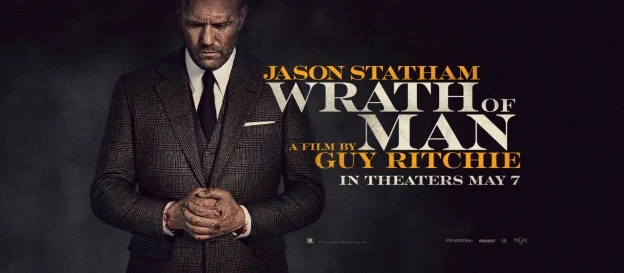
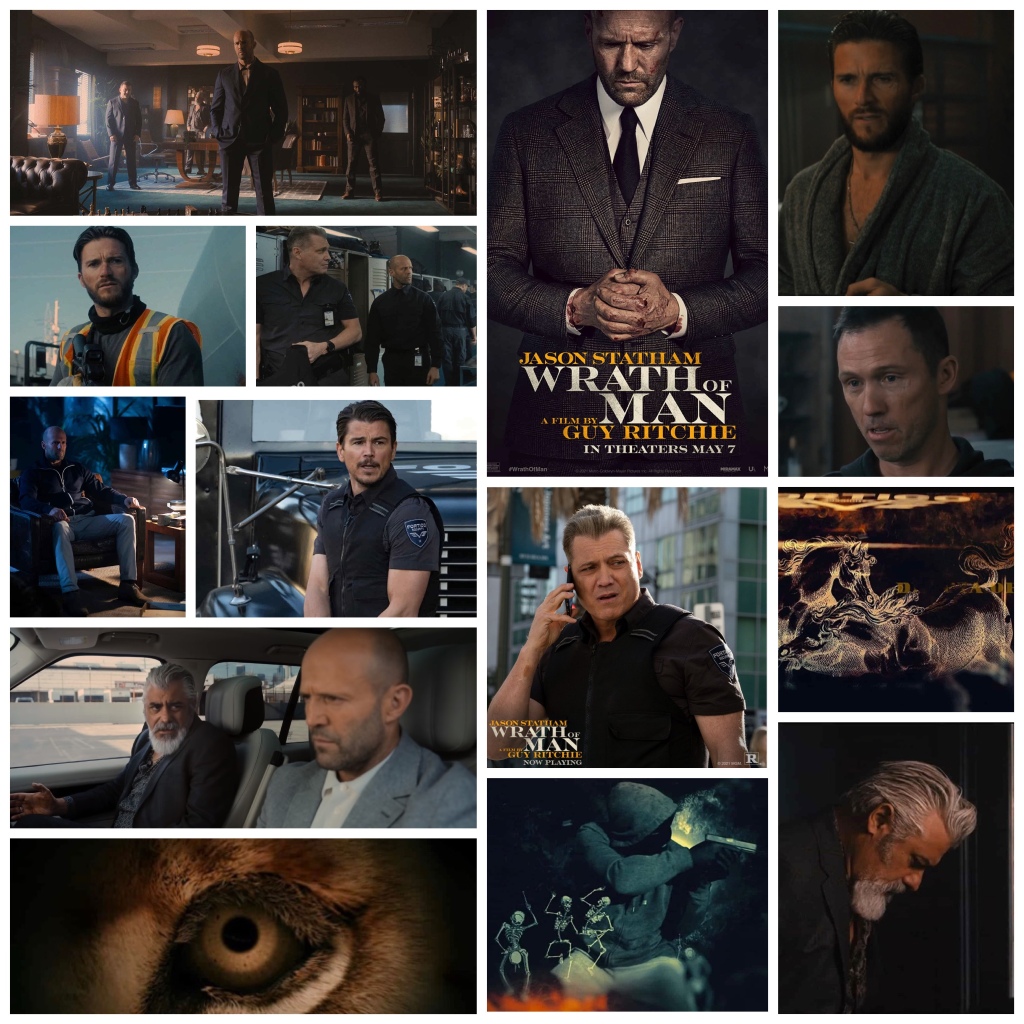
Wow man, Guy Ritchie isn’t fucking around with this one. What I mean by that is, his body of work in film thus far is marked by rambunctious characters, robustly flavourful dialogue, cartoonish mayhem, jubilant humour and just an overall house party vibe. His new heist/revenge/horror film Wrath Of Man is a jarring, impressive and welcome change of pace that plunges headlong into an aesthetic wrought with darkness, grim portent, ominous atmospherics, ruthless violence and nary a trace of whimsy to be found; Playtime is over. Jason Statham is Ritchie’s perennial muse and his gives what might be a career best performance here or at least their finest collaboration, playing a mysterious individual named H who infiltrates a no nonsense armoured truck syndicate as one of their employees, silently and lethally carrying out some dark agenda that is revealed beat by beat, flashback by flashback, scene by meticulously edited scene in a carefully calibrated nesting doll of a narrative. His coworkers are a varied bunch of assholes, tough guys and eccentrics including the top dog and natural born leader Bullet (Holt McCallany) and a dysfunctional pretty boy played by Josh Hartnett, who I was very happy to see in something again and does great cast just about as against type as possible for him. The supporting cast extends into very solid work from Andy Garcia, Jeffrey Donovan, Laz Alonso, Eddie Marsan, Post Malone, a scene stealing Darrell D’Silva and a vicious standout turn from Scott Eastwood who is looking so much like his dad these days it’s getting scary. I don’t want to spoil too much in terms of narrative because this is one serpentine, labyrinthine piece to work through and although the overall story isn’t the most complex or revolutionary endeavour, it’s in execution, tone, atmosphere and mood that Ritchie and his team do something thoroughly extraordinary. Statham makes H a truly elemental force here, like Keyser Soze, Hannibal Lecter, Michael Myers or The Devil himself he just exudes this inky menace and doom soaked ethos that fills the screen in every frame. One of the film’s strongest features is its dark, grinding, methodically rhythmical score by Christopher Benstead, full of guttural, agonized strings and stabbed by jagged notes in between the chords, standing out in the vividly stylized and blessedly old fashioned opening credit sequence and accented by several key soundtrack picks including a haunting, ghostly rendition of Folsom Prison Blues playing alongside one of the most visceral sequences. The film works as an action heist flick as it has many propulsive, bloody shootouts and chases but what really makes it something special, and for me the best of the year so far, is the time it takes in between beats, the measured, steady and grisly slowed down sequences that immerse you in its world using score, trademark colourful Ritchie dialogue albeit of a dark variety this time, hellishly overbearing, dreamscape-esque atmosphere of danger, anger and slowly burgeoning, ultimately cataclysmic vengeance. Absolutely sensational film.

-Nate Hill

Guy Ritchie’s Wrath Of Man

Wow man, Guy Ritchie isn’t fucking around with this one. What I mean by that is, his body of work in film thus far is marked by rambunctious characters, robustly flavourful dialogue, cartoonish mayhem, jubilant humour and just an overall house party vibe. His new heist/revenge/horror film Wrath Of Man is a jarring, impressive and welcome change of pace that plunges headlong into an aesthetic wrought with darkness, grim portent, ominous atmospherics, ruthless violence and nary a trace of whimsy to be found; Playtime is over. Jason Statham is Ritchie’s perennial muse and his gives what might be a career best performance here or at least their finest collaboration, playing a mysterious individual named H who infiltrates a no nonsense armoured truck syndicate as one of their employees, silently and lethally carrying out some dark agenda that is revealed beat by beat, flashback by flashback, scene by meticulously edited scene in a carefully calibrated nesting doll of a narrative. His coworkers are a varied bunch of assholes, tough guys and eccentrics including the top dog and natural born leader Bullet (Holt McCallany) and a dysfunctional pretty boy played by Josh Hartnett, who I was very happy to see in something again and does great cast just about as against type as possible for him. The supporting cast extends into very solid work from Andy Garcia, Jeffrey Donovan, Laz Alonso, Eddie Marsan, Post Malone, a scene stealing Darrell D’Silva and a vicious standout turn from Scott Eastwood who is looking so much like his dad these days it’s getting scary. I don’t want to spoil too much in terms of narrative because this is one serpentine, labyrinthine piece to work through and although the overall story isn’t the most complex or revolutionary endeavour, it’s in execution, tone, atmosphere and mood that Ritchie and his team do something thoroughly extraordinary. Statham makes H a truly elemental force here, like Keyser Soze, Hannibal Lecter, Michael Myers or The Devil himself he just exudes this inky menace and doom soaked ethos that fills the screen in every frame. One of the film’s strongest features is its dark, grinding, methodically rhythmical score by Christopher Benstead, full of guttural, agonized strings and stabbed by jagged notes in between the chords, standing out in the vividly stylized and blessedly old fashioned opening credit sequence and accented by several key soundtrack picks including a haunting, ghostly rendition of Folsom Prison Blues playing alongside one of the most visceral sequences. The film works as an action heist flick as it has many propulsive, bloody shootouts and chases but what really makes it something special, and for me the best of the year so far, is the time it takes in between beats, the measured, steady and grisly slowed down sequences that immerse you in its world using score, trademark colourful Ritchie dialogue albeit of a dark variety this time, hellishly overbearing, dreamscape-esque atmosphere of danger, anger and slowly burgeoning, ultimately cataclysmic vengeance. Absolutely sensational film.

-Nate Hill

B Movie Glory: Larva

I love a good, simple, blessedly cheesy SyFy creature feature flick, back when cable tv was around you could tune in any night of the week, settle in for the midnight hours and watch all kinds of monsters, ghouls, aliens and cryptid nightmares terrorize small towns. Whenever I get the chance these days I grab them on DVD where I can find them for sheer nostalgic value and Larva is a great example of that. Set in blessed small town Americana, we meet a farmer (the great William Forsythe) who is having trouble with his cows getting sick and dying of some mysterious and very deadly parasite. He contacts the environmental board who sends a representative (Vincent Ventresca) who discovers that the animals are falling prey to a brand new subspecies that is aggressive and altogether catastrophic to the region, especially when it starts infecting humans and we are treated to an impressive array of gut busting, chest bursting, skull exploding gore as these beasties grow from their larval state and bust loose from human hosts into these weird leathery winged, tooth ‘n fang adorned monsters that fly, crawl through tight spaces and kill with speed and ferocity. There’s a neat subplot about the dangers of outsourcing agricultural and livestock resources to big experimental corporations that don’t follow the rules until nature bites back which is a nice touch too. Forsythe is terrific as the stoic, capable farmer who keeps an arsenal of ‘just in case’ weaponry in his barn for occasions such as these and gets to blast many a monster to smithereens. The effects are terrific in the close quarters gore department and perfectly serviceable as far as visuals of the full grown creatures go and overall this is exactly the kind of good, splattery, brainless fun you’d expect from stuff like this. Good times.

-Nate Hill